

worst president
 |
Description
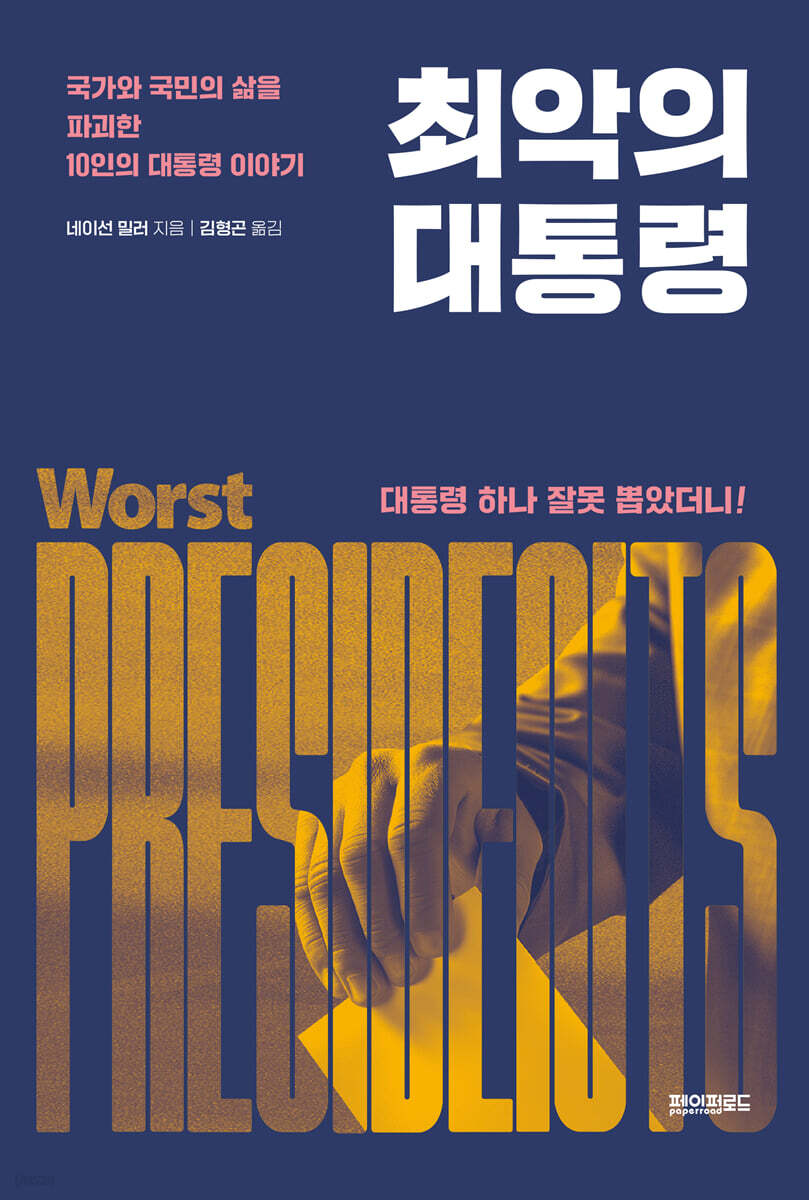
Book Introduction
A leader who broke common sense
A country where justice has collapsed
10 Presidents Who Destroyed Their Nation and the Lives of Its People
This is an age of loss, a time when the possibilities of politics are fading, and a time of crisis when the specter of extremes is resurrecting.
The world today is truly suffering from 'political aches'.
In France, once the cradle of the civil revolution, the far-right National Rally (Rassemblement National) led by Marine Le Pen is gaining ground, and in Italy, the Brothers of Italy (Fratelli d'Italia), which calls itself the successor to the former fascist party, has taken power.
Even in Germany, which has strived to erase Hitler's traces and reflect on its past, the far-right party Alternative for Germans (AfD) is growing rapidly.
The United States, which dominated the 20th century as the guardian of the free world, also faces a crisis of democracy due to Trump's re-election in November 2024.
And on December 3, 2024, Koreans, who experienced the unprecedented event of a coup d'état by the incumbent president, also stand at a crossroads regarding the survival of democracy.
Today, with the revival of the politics of violence, once thought to have vanished after the democratization of 1987, how can we restore democracy? Ahead of the countless political theories and policy practices, the majority of the public cannot help but once again focus on elections, the very beginning and end of democracy.
The importance of voting, the slogan “Let’s not elect a president like this!” still holds true.
Therefore, "The Worst Presidents," which introduces the 10 worst American presidents, can serve as a stern warning to those who remain indifferent to politics and optimistic, and offer a glimmer of hope to those who have fallen into despair as they witness the decline of politics.
This book is a historical work that selects 10 U.S. presidents who have caused enormous damage to the nation and its people in American political history. Author Nathan Miller established his own, reasonable standards to complete a list of the worst leaders, different from the public's evaluation.
The worst leaders, in the author's opinion, do not try to inform or teach their members, nor, conversely, do they try to learn anything from their members.
He does not trust the members who elected him as leader, and he refuses to cooperate with his colleagues who help him.
They are either extremely indecisive and forget their responsibilities, or they are overly dogmatic and do things their own way.
They are so lazy that they don't even seem to take the initiative to lead others.
There was even less innovation for a vision of the future.
Above all, they cause great harm to the daily lives of their members, yet they do not even properly reflect on what their mistakes are.
Jimmy Carter, William Taft, Benjamin Harrison, Calvin Coolidge, Ulysses Grant, Andrew Johnson, Franklin Pierce, James Buchanan, Warren Harding, and Richard Nixon.
Following the story in the book, you will learn in detail how ten presidents who ascended to the most honorable positions of power fell into ignominious straits.
I hope that this book will not only help Korean readers learn about the past, but also help them face current issues head-on.
A country where justice has collapsed
10 Presidents Who Destroyed Their Nation and the Lives of Its People
This is an age of loss, a time when the possibilities of politics are fading, and a time of crisis when the specter of extremes is resurrecting.
The world today is truly suffering from 'political aches'.
In France, once the cradle of the civil revolution, the far-right National Rally (Rassemblement National) led by Marine Le Pen is gaining ground, and in Italy, the Brothers of Italy (Fratelli d'Italia), which calls itself the successor to the former fascist party, has taken power.
Even in Germany, which has strived to erase Hitler's traces and reflect on its past, the far-right party Alternative for Germans (AfD) is growing rapidly.
The United States, which dominated the 20th century as the guardian of the free world, also faces a crisis of democracy due to Trump's re-election in November 2024.
And on December 3, 2024, Koreans, who experienced the unprecedented event of a coup d'état by the incumbent president, also stand at a crossroads regarding the survival of democracy.
Today, with the revival of the politics of violence, once thought to have vanished after the democratization of 1987, how can we restore democracy? Ahead of the countless political theories and policy practices, the majority of the public cannot help but once again focus on elections, the very beginning and end of democracy.
The importance of voting, the slogan “Let’s not elect a president like this!” still holds true.
Therefore, "The Worst Presidents," which introduces the 10 worst American presidents, can serve as a stern warning to those who remain indifferent to politics and optimistic, and offer a glimmer of hope to those who have fallen into despair as they witness the decline of politics.
This book is a historical work that selects 10 U.S. presidents who have caused enormous damage to the nation and its people in American political history. Author Nathan Miller established his own, reasonable standards to complete a list of the worst leaders, different from the public's evaluation.
The worst leaders, in the author's opinion, do not try to inform or teach their members, nor, conversely, do they try to learn anything from their members.
He does not trust the members who elected him as leader, and he refuses to cooperate with his colleagues who help him.
They are either extremely indecisive and forget their responsibilities, or they are overly dogmatic and do things their own way.
They are so lazy that they don't even seem to take the initiative to lead others.
There was even less innovation for a vision of the future.
Above all, they cause great harm to the daily lives of their members, yet they do not even properly reflect on what their mistakes are.
Jimmy Carter, William Taft, Benjamin Harrison, Calvin Coolidge, Ulysses Grant, Andrew Johnson, Franklin Pierce, James Buchanan, Warren Harding, and Richard Nixon.
Following the story in the book, you will learn in detail how ten presidents who ascended to the most honorable positions of power fell into ignominious straits.
I hope that this book will not only help Korean readers learn about the past, but also help them face current issues head-on.
- You can preview some of the book's contents.
Preview
index
Translator's Note … page 11
Preface … page 20
Appendix 1: Ranking of U.S. Presidents (1997) … 20 pages
Appendix 2: Ranking of US Presidents (2024) … Page 22
Appendix 3: Map of US States… Page 23
Chapter 1 Jimmy Carter … Page 25
Chapter 2 William Taft … page 75
Chapter 3: Benjamin Harrison … p. 123
Chapter 4: Calvin Coolidge … p. 165
Chapter 5: Ulysses S. Grant … p. 209
Chapter 6 Andrew Johnson … page 253
Chapter 7 Franklin Pierce … p. 297
Chapter 8: James Buchanan … p. 341
Chapter 9 Warren Harding … p. 377
Chapter 10: Richard Nixon … page 417
Epilogue… Page 471
Americas… Page 488
References … p. 499
Browse … Page 505
Preface … page 20
Appendix 1: Ranking of U.S. Presidents (1997) … 20 pages
Appendix 2: Ranking of US Presidents (2024) … Page 22
Appendix 3: Map of US States… Page 23
Chapter 1 Jimmy Carter … Page 25
Chapter 2 William Taft … page 75
Chapter 3: Benjamin Harrison … p. 123
Chapter 4: Calvin Coolidge … p. 165
Chapter 5: Ulysses S. Grant … p. 209
Chapter 6 Andrew Johnson … page 253
Chapter 7 Franklin Pierce … p. 297
Chapter 8: James Buchanan … p. 341
Chapter 9 Warren Harding … p. 377
Chapter 10: Richard Nixon … page 417
Epilogue… Page 471
Americas… Page 488
References … p. 499
Browse … Page 505
Detailed image

Into the book
Although the nationality is different, I translated this book with the hope that it could provide valuable lessons to the Republic of Korea, which operates a presidential system.
While reading the book, I found myself drawn in by the small lessons and the interesting content more than once.
It became more and more interesting each time I understood the question the author poses to the reader: “Why should these people be on the list of worst presidents?”
I believe that this is the kind of content that should be read by countless politicians aspiring to be president, leaders of organizations, and above all, everyone who desperately longs for and desires to become a great and successful president.
---From the Translator's Note
Aren't the characteristics of the worst presidents, or bad presidents, the opposites of the virtues of great or good presidents? They include lack of confidence, poor character, poor political skills and incompetence, a lack of vision, dishonesty and insincerity, and a breakdown in communication.
In this book, the author added one more criterion.
The question is, 'How much damage have they caused to the country and its people while serving as president?'
---From the "Preface"
It was unfortunate for Carter himself that he was elected the 39th president at a time when ominous clouds hung over the United States, including the aftermath of Watergate, the Great Recession, and the defeat in the Vietnam War.
Throughout this time, Americans have placed their trust in their president and their country.
However, he became disillusioned with the triviality and lies of the American government revealed by President Nixon's Watergate scandal.
It also suffered from the steep decline of the economic prosperity it had enjoyed after World War II.
In addition, they were at a loss in the face of soaring inflation, a mushrooming drug problem, ethnic conflicts, the fight against terrorism, and threats from Arab leaders to ruthlessly curb oil production and drive up prices.
Moreover, signs of the American system's defeat around the world and the resulting dismay further confused Americans.
---From "Chapter 1 Jimmy Carter"
William Taft was an anachronism.
He was fat, inactive, and slow-moving.
As a politician, he was clumsy, stuttered, and always hesitated.
He was an inappropriate person in an inappropriate position of power at an inappropriate time.
The trend of the times was innovation.
But he was a conservative.
At that time, America wanted a dynamic president.
But he was a man who wanted to keep things as they were.
As leader of the party that controlled the White House and Congress, and despite having won the presidency with overwhelming popular support, he wasted his rule and his popularity on useless things.
In the end, he barely managed to win in only two states in the presidential election four years later.
Anyone like this would probably make the list of worst presidents.
However, the historical context of the time served as a veil to hide Taft's incompetence and inadequacy.
Some experts argue that his reputation should be restored because he was a personable and emotionally compassionate person, but this is just an excuse.
---From "Chapter 2 William Taft"
The Harrison administration was in the midst of a period in which the American economy and its core industries were changing from agriculture to industry.
Although he took great pride in this growth, President Harrison, like many in the leadership of his time, had little idea of the impact these changes were having on ordinary workers.
Resting solely on the growth of capitalism, he knew little about the growing conflict between capitalists and workers, the dehumanization of society, the fierce competition for a living, and the tedious and arduous work of unskilled workers.
He failed to plan or implement any policies to reduce or resolve the class tensions and conflicts, economic chaos, and suffering that accompanied industrialization.
---From "Chapter 3 Benjamin Harrison"
A fate that could only be called destiny dragged Coolidge into a situation beyond his abilities and vision.
Most of the presidents on my list of worst American presidents are in the Hall of Fame for their specific actions.
But Benjamin Harrison and Calvin Coolidge made the list because they did nothing.
Coolidge transformed the still state of doing nothing into a form of art.
---From "Chapter 4 Calvin Coolidge"
Grant was so ignorant of the office of President.
His eight years were a period of bewildering confusion.
For eight years, he was in a position he shouldn't have been in, and he couldn't offer any vision.
I lived surrounded by ordinary people, selfish people, and hopeless thugs.
They granted the requests of those who came to them and favored those who asked them for favors.
Ultimately, the corrupt people around Grant turned the Grant administration into a costly money trap.
---From "Chapter 5 Ulysses S. Grant"
Most of the Republican members of the federal congress were centrists.
Republican centrists hoped that, although the president's plan was flawed, they could work with him to fix it.
Therefore, Johnson had to compromise with the centrists, who comprised the majority, to carry out his Reconstruction policy.
But Johnson chose fight and conflict rather than compromise and cooperation.
Johnson took the worst possible path: ignoring Congress and public opinion.
---From "Chapter 6 Andrew Johnson"
Pierce lacked the unwavering conviction and strong will to achieve anything for the public good as president.
There was nothing to see except the refreshing appearance.
During his four years in office, he was a plaything of factional politics designed to secure his reelection.
That is precisely why he failed to be re-elected.
With the exception of William Taft, no president has so thoroughly squandered the numerous favors bestowed upon him by the people at the start of his term as Pierce.
In fact, Pierce was the first elected incumbent president to have his reelection bid blocked by the ruling party.
---From "Chapter 7 Franklin Pierce"
Buchanan's interference and appeasement on behalf of the South was the worst mistake of his life.
Even though it was clearly unfair to try to influence Supreme Court decisions, he had no qualms about foolishly judging that this would work in the North as well.
It destroyed faith in the impartiality of the Supreme Court and led to biased rulings that favored the South, sparking a massive backlash against the presidency and the South.
In other words, Buchanan's inappropriate behavior provoked a backlash from the entire Northern people, and the spread of slavery in the territories made the situation worse.
---From "Chapter 8 James Buchanan"
Harding's problem was that he lived a life of solemnity in a rustic small-town 19th-century America.
He was woefully inadequate to understand the dynamics of post-World War I America: the chaotic social changes and moral crises, the fluctuating economic opportunities and the massive economic turmoil.
Harding's solution was a return to the past.
Rather than using the broad and enduring powers of the federal government to solve the problems facing Americans, the idea was to return to a mysterious and austere era when such powers had never been used.
After the Harding administration came to power, the president sat back and turned his back on the mounting problems, content with his own life.
While the president was indifferent to state affairs, the country lost its leadership and drifted.
---From "Chapter 9 Warren Harding"
Nixon chose to resign as a means of avoiding impeachment.
He was voted the worst president because he blatantly obstructed the judiciary and violated the Constitution.
Had Nixon not been pardoned by his successor, President Gerald Ford, he would have been indicted and punished for felonies for the Watergate scandal, which was a total mess.
But Nixon is different from the other presidents covered in this book.
Although he was far superior in ability and intelligence, he was a man who had a very cynical contempt for the very institution of American democracy.
---From "Chapter 10 Richard Nixon"
Thomas Jefferson and John F.
The Kennedys are special figures in American presidential history.
Both presidents are evaluated much better than their accomplishments during their term.
Whenever there is an evaluation of American presidents, Jefferson is always evaluated as a great president, and Kennedy is always evaluated as a great president.
But their reputations aren't based on their records or accomplishments in the White House.
It was influenced by events, emotions, and feelings that had little to do with the presidential term.
So Jefferson and Kennedy are generally overrated.
While reading the book, I found myself drawn in by the small lessons and the interesting content more than once.
It became more and more interesting each time I understood the question the author poses to the reader: “Why should these people be on the list of worst presidents?”
I believe that this is the kind of content that should be read by countless politicians aspiring to be president, leaders of organizations, and above all, everyone who desperately longs for and desires to become a great and successful president.
---From the Translator's Note
Aren't the characteristics of the worst presidents, or bad presidents, the opposites of the virtues of great or good presidents? They include lack of confidence, poor character, poor political skills and incompetence, a lack of vision, dishonesty and insincerity, and a breakdown in communication.
In this book, the author added one more criterion.
The question is, 'How much damage have they caused to the country and its people while serving as president?'
---From the "Preface"
It was unfortunate for Carter himself that he was elected the 39th president at a time when ominous clouds hung over the United States, including the aftermath of Watergate, the Great Recession, and the defeat in the Vietnam War.
Throughout this time, Americans have placed their trust in their president and their country.
However, he became disillusioned with the triviality and lies of the American government revealed by President Nixon's Watergate scandal.
It also suffered from the steep decline of the economic prosperity it had enjoyed after World War II.
In addition, they were at a loss in the face of soaring inflation, a mushrooming drug problem, ethnic conflicts, the fight against terrorism, and threats from Arab leaders to ruthlessly curb oil production and drive up prices.
Moreover, signs of the American system's defeat around the world and the resulting dismay further confused Americans.
---From "Chapter 1 Jimmy Carter"
William Taft was an anachronism.
He was fat, inactive, and slow-moving.
As a politician, he was clumsy, stuttered, and always hesitated.
He was an inappropriate person in an inappropriate position of power at an inappropriate time.
The trend of the times was innovation.
But he was a conservative.
At that time, America wanted a dynamic president.
But he was a man who wanted to keep things as they were.
As leader of the party that controlled the White House and Congress, and despite having won the presidency with overwhelming popular support, he wasted his rule and his popularity on useless things.
In the end, he barely managed to win in only two states in the presidential election four years later.
Anyone like this would probably make the list of worst presidents.
However, the historical context of the time served as a veil to hide Taft's incompetence and inadequacy.
Some experts argue that his reputation should be restored because he was a personable and emotionally compassionate person, but this is just an excuse.
---From "Chapter 2 William Taft"
The Harrison administration was in the midst of a period in which the American economy and its core industries were changing from agriculture to industry.
Although he took great pride in this growth, President Harrison, like many in the leadership of his time, had little idea of the impact these changes were having on ordinary workers.
Resting solely on the growth of capitalism, he knew little about the growing conflict between capitalists and workers, the dehumanization of society, the fierce competition for a living, and the tedious and arduous work of unskilled workers.
He failed to plan or implement any policies to reduce or resolve the class tensions and conflicts, economic chaos, and suffering that accompanied industrialization.
---From "Chapter 3 Benjamin Harrison"
A fate that could only be called destiny dragged Coolidge into a situation beyond his abilities and vision.
Most of the presidents on my list of worst American presidents are in the Hall of Fame for their specific actions.
But Benjamin Harrison and Calvin Coolidge made the list because they did nothing.
Coolidge transformed the still state of doing nothing into a form of art.
---From "Chapter 4 Calvin Coolidge"
Grant was so ignorant of the office of President.
His eight years were a period of bewildering confusion.
For eight years, he was in a position he shouldn't have been in, and he couldn't offer any vision.
I lived surrounded by ordinary people, selfish people, and hopeless thugs.
They granted the requests of those who came to them and favored those who asked them for favors.
Ultimately, the corrupt people around Grant turned the Grant administration into a costly money trap.
---From "Chapter 5 Ulysses S. Grant"
Most of the Republican members of the federal congress were centrists.
Republican centrists hoped that, although the president's plan was flawed, they could work with him to fix it.
Therefore, Johnson had to compromise with the centrists, who comprised the majority, to carry out his Reconstruction policy.
But Johnson chose fight and conflict rather than compromise and cooperation.
Johnson took the worst possible path: ignoring Congress and public opinion.
---From "Chapter 6 Andrew Johnson"
Pierce lacked the unwavering conviction and strong will to achieve anything for the public good as president.
There was nothing to see except the refreshing appearance.
During his four years in office, he was a plaything of factional politics designed to secure his reelection.
That is precisely why he failed to be re-elected.
With the exception of William Taft, no president has so thoroughly squandered the numerous favors bestowed upon him by the people at the start of his term as Pierce.
In fact, Pierce was the first elected incumbent president to have his reelection bid blocked by the ruling party.
---From "Chapter 7 Franklin Pierce"
Buchanan's interference and appeasement on behalf of the South was the worst mistake of his life.
Even though it was clearly unfair to try to influence Supreme Court decisions, he had no qualms about foolishly judging that this would work in the North as well.
It destroyed faith in the impartiality of the Supreme Court and led to biased rulings that favored the South, sparking a massive backlash against the presidency and the South.
In other words, Buchanan's inappropriate behavior provoked a backlash from the entire Northern people, and the spread of slavery in the territories made the situation worse.
---From "Chapter 8 James Buchanan"
Harding's problem was that he lived a life of solemnity in a rustic small-town 19th-century America.
He was woefully inadequate to understand the dynamics of post-World War I America: the chaotic social changes and moral crises, the fluctuating economic opportunities and the massive economic turmoil.
Harding's solution was a return to the past.
Rather than using the broad and enduring powers of the federal government to solve the problems facing Americans, the idea was to return to a mysterious and austere era when such powers had never been used.
After the Harding administration came to power, the president sat back and turned his back on the mounting problems, content with his own life.
While the president was indifferent to state affairs, the country lost its leadership and drifted.
---From "Chapter 9 Warren Harding"
Nixon chose to resign as a means of avoiding impeachment.
He was voted the worst president because he blatantly obstructed the judiciary and violated the Constitution.
Had Nixon not been pardoned by his successor, President Gerald Ford, he would have been indicted and punished for felonies for the Watergate scandal, which was a total mess.
But Nixon is different from the other presidents covered in this book.
Although he was far superior in ability and intelligence, he was a man who had a very cynical contempt for the very institution of American democracy.
---From "Chapter 10 Richard Nixon"
Thomas Jefferson and John F.
The Kennedys are special figures in American presidential history.
Both presidents are evaluated much better than their accomplishments during their term.
Whenever there is an evaluation of American presidents, Jefferson is always evaluated as a great president, and Kennedy is always evaluated as a great president.
But their reputations aren't based on their records or accomplishments in the White House.
It was influenced by events, emotions, and feelings that had little to do with the presidential term.
So Jefferson and Kennedy are generally overrated.
---From the "Epilogue"
Publisher's Review
Qualities of a Good Politician as Introduced by a Seasoned Journalist
Author Nathan Miller is a journalist who worked for 15 years in newspapers and also served as an aide on the U.S. Senate Budget Committee, giving him hands-on experience in American politics.
The author, a seasoned journalist who was nominated for the Pulitzer Prize five times, has written a total of 18 books.
He was particularly well-versed in biographies of American presidents and the history of the U.S. Navy, and he comprehensively researched not only existing history books but also letters, diaries, speeches, Congressional records, testimonies of officials, and interviews to publish "Star-Spangled Men," the original work of "The Worst Presidents."
This book uncovers previously unknown records and history, revealing hidden layers of American political history.
The lives of each person selected as the worst president are comprehensively analyzed, especially their private lives as private citizens and their actions as public figures are evaluated comprehensively without distinction.
For example, Andrew Johnson in Chapter 6 and Richard Nixon in Chapter 10 are representative examples.
Unlike other presidents, Andrew Johnson was a man of humble origins who became president without formal education. He developed a self-righteous personality in the process of overcoming the limitations of poverty.
Andrew Johnson, who believed that only he was right and that he was the representative of the "common people" who entered the White House to protect poor white people, failed to take into account the various political situations and social conditions of the country even when carrying out his official duties as president.
Ultimately, he ignored the opinion of the majority of Northern states that supported the human rights of freed slaves (freed black people) and did not cooperate with the Republican Party in the process of rebuilding the United States after the Civil War.
Ultimately, Andrew Johnson left behind a legacy of racial oppression of African Americans that would last for a century.
Meanwhile, as Richard Nixon grew into a political heavyweight, he repeatedly embodied strategies of deceiving voters and smearing his opponents, becoming a leader who despised democracy.
After World War II, Nixon presented himself as a champion of anti-communism and engaged in harsh personal attacks and slander against his Democratic rivals.
At a young age, he served as Vice President, firmly supporting the aging President Eisenhower, but later became President John F.
After losing the presidential election to Kennedy, he also lost the California gubernatorial election.
Having suffered two bitter defeats, Nixon obsessively sought to control every situation, condition, and person in his subsequent work.
The author examines Nixon's Watergate scandal and points out that Nixon's life was the background to the birth of a president of a democratic country that disregarded democracy.
The author's message is not to convey that we should pay attention to the private lives of politicians when evaluating them.
Rather, I request a comprehensive analysis of his life in order to properly evaluate a politician who is active as a public figure.
As stated in the introduction, a person's character and actions are clearly connected, and the responsibility and damage caused by a president's character flaws are largely passed on to the constituents who elected him.
Therefore, this book introduces the characteristics of a bad president and provides readers with the wisdom of a negative example.
Lack of confidence, bad character, poor political skills and incompetence that are far from compromise, lack of vision, dishonesty and insincere attitude, and refusal to communicate – these are the common characteristics of those who are called the worst presidents.
And readers will naturally seek out and elect candidates with opposite virtues.
The Foolish Choices of Villains in the Face of a Crisis of Democracy
In 1948, Arthur M. Schlesinger of Harvard University
Since Professor Schlesinger first conducted a popularity poll on past U.S. presidents, the United States has consistently conducted post-election evaluations of U.S. presidents.
If George Washington, Abraham Lincoln, and Franklin Roosevelt are always chosen as great presidents, then Theodore Roosevelt, Harry Truman, and Woodrow Wilson are chosen as excellent presidents.
But choosing the worst president isn't that simple.
It needs to be reviewed much more carefully and meticulously.
As the author states in the preface, the likelihood of anyone being chosen as the worst president is virtually endless.
Some presidents rank low in popularity polls simply because they are not well-known, while others receive overly harsh reviews that are disproportionate to their actual accomplishments.
In this respect, the "worst presidents" introduced in this book are different from the list of worst presidents actually chosen by people.
The author's criteria for selecting the worst president in the text are twofold.
One is, 'How much damage has he caused to the country and its people while serving as president?'
In other words, events unrelated to activities in the White House and the emotional likes and dislikes of voters were excluded from the criteria for judgment.
In fact, President Jimmy Carter won the Nobel Peace Prize for his volunteer work after leaving office, but the author focused solely on his actions as president and selected him as the first worst president.
Another criterion is, 'Did he lead the American people to achieve his goals?'
It is precisely for this reason that Ronald Reagan and George H.W., who were disliked by most Americans,
W. Bush was excluded, but the relatively unknown Benjamin Harrison and Calvin Coolidge were chosen as the worst presidents.
The two presidents were the height of inaction and incompetence, doing nothing and being unable to do anything.
The two men, who were lazy and indolent and unfit for the office of president, were ultimately recorded as irresponsible leaders who opened the door to the Great Depression of 1929.
Accordingly, the problems of the 10 worst presidents can be summarized as follows.
Jimmy Carter, mired in moral self-righteousness, failed to offer a vision or goals for the future.
William Taft was an anachronistic conservative in a progressive era, lacking courage and determination.
Benjamin Harrison was so socially awkward that he lacked human warmth.
Calvin Coolidge responded to every issue with incompetence and silence, failing to even perform the minimum duties of a president.
Ulysses S. Grant turned a blind eye to the wrongdoings of his incompetent and corrupt relatives.
Andrew Johnson completely ignored the politics of coexistence through the principles of agreement and compromise and pursued politics of arrogance.
Franklin Pierce was too timid to demonstrate any leadership qualities as president and was merely a laughing stock for the ruling party leadership.
James Buchanan's narrow-minded thinking and selfish actions ignited the flames of the American Civil War.
Warren Harding failed to prevent the infamous scandals of his friends and relatives.
Richard Nixon destroyed the Constitution and lied out of a cynical attitude toward democracy, instilling in Americans a distrust of the presidency and the country.
The fresh story and delicate writing style are the greatest foundations that sustain the book's appeal even today, more than 20 years after its publication.
As readers read the book, they will be drawn into the interesting content as well as the small lessons learned.
The intrigue I feel each time I understand the author's question, "Why should these people be included on the list of the worst presidents?", remains a valid insight for today's readers facing a political crisis.
This is a must-read for all politicians aspiring to be president, all leaders of organizations, and above all, all who yearn and hope for a great and successful president.
Author Nathan Miller is a journalist who worked for 15 years in newspapers and also served as an aide on the U.S. Senate Budget Committee, giving him hands-on experience in American politics.
The author, a seasoned journalist who was nominated for the Pulitzer Prize five times, has written a total of 18 books.
He was particularly well-versed in biographies of American presidents and the history of the U.S. Navy, and he comprehensively researched not only existing history books but also letters, diaries, speeches, Congressional records, testimonies of officials, and interviews to publish "Star-Spangled Men," the original work of "The Worst Presidents."
This book uncovers previously unknown records and history, revealing hidden layers of American political history.
The lives of each person selected as the worst president are comprehensively analyzed, especially their private lives as private citizens and their actions as public figures are evaluated comprehensively without distinction.
For example, Andrew Johnson in Chapter 6 and Richard Nixon in Chapter 10 are representative examples.
Unlike other presidents, Andrew Johnson was a man of humble origins who became president without formal education. He developed a self-righteous personality in the process of overcoming the limitations of poverty.
Andrew Johnson, who believed that only he was right and that he was the representative of the "common people" who entered the White House to protect poor white people, failed to take into account the various political situations and social conditions of the country even when carrying out his official duties as president.
Ultimately, he ignored the opinion of the majority of Northern states that supported the human rights of freed slaves (freed black people) and did not cooperate with the Republican Party in the process of rebuilding the United States after the Civil War.
Ultimately, Andrew Johnson left behind a legacy of racial oppression of African Americans that would last for a century.
Meanwhile, as Richard Nixon grew into a political heavyweight, he repeatedly embodied strategies of deceiving voters and smearing his opponents, becoming a leader who despised democracy.
After World War II, Nixon presented himself as a champion of anti-communism and engaged in harsh personal attacks and slander against his Democratic rivals.
At a young age, he served as Vice President, firmly supporting the aging President Eisenhower, but later became President John F.
After losing the presidential election to Kennedy, he also lost the California gubernatorial election.
Having suffered two bitter defeats, Nixon obsessively sought to control every situation, condition, and person in his subsequent work.
The author examines Nixon's Watergate scandal and points out that Nixon's life was the background to the birth of a president of a democratic country that disregarded democracy.
The author's message is not to convey that we should pay attention to the private lives of politicians when evaluating them.
Rather, I request a comprehensive analysis of his life in order to properly evaluate a politician who is active as a public figure.
As stated in the introduction, a person's character and actions are clearly connected, and the responsibility and damage caused by a president's character flaws are largely passed on to the constituents who elected him.
Therefore, this book introduces the characteristics of a bad president and provides readers with the wisdom of a negative example.
Lack of confidence, bad character, poor political skills and incompetence that are far from compromise, lack of vision, dishonesty and insincere attitude, and refusal to communicate – these are the common characteristics of those who are called the worst presidents.
And readers will naturally seek out and elect candidates with opposite virtues.
The Foolish Choices of Villains in the Face of a Crisis of Democracy
In 1948, Arthur M. Schlesinger of Harvard University
Since Professor Schlesinger first conducted a popularity poll on past U.S. presidents, the United States has consistently conducted post-election evaluations of U.S. presidents.
If George Washington, Abraham Lincoln, and Franklin Roosevelt are always chosen as great presidents, then Theodore Roosevelt, Harry Truman, and Woodrow Wilson are chosen as excellent presidents.
But choosing the worst president isn't that simple.
It needs to be reviewed much more carefully and meticulously.
As the author states in the preface, the likelihood of anyone being chosen as the worst president is virtually endless.
Some presidents rank low in popularity polls simply because they are not well-known, while others receive overly harsh reviews that are disproportionate to their actual accomplishments.
In this respect, the "worst presidents" introduced in this book are different from the list of worst presidents actually chosen by people.
The author's criteria for selecting the worst president in the text are twofold.
One is, 'How much damage has he caused to the country and its people while serving as president?'
In other words, events unrelated to activities in the White House and the emotional likes and dislikes of voters were excluded from the criteria for judgment.
In fact, President Jimmy Carter won the Nobel Peace Prize for his volunteer work after leaving office, but the author focused solely on his actions as president and selected him as the first worst president.
Another criterion is, 'Did he lead the American people to achieve his goals?'
It is precisely for this reason that Ronald Reagan and George H.W., who were disliked by most Americans,
W. Bush was excluded, but the relatively unknown Benjamin Harrison and Calvin Coolidge were chosen as the worst presidents.
The two presidents were the height of inaction and incompetence, doing nothing and being unable to do anything.
The two men, who were lazy and indolent and unfit for the office of president, were ultimately recorded as irresponsible leaders who opened the door to the Great Depression of 1929.
Accordingly, the problems of the 10 worst presidents can be summarized as follows.
Jimmy Carter, mired in moral self-righteousness, failed to offer a vision or goals for the future.
William Taft was an anachronistic conservative in a progressive era, lacking courage and determination.
Benjamin Harrison was so socially awkward that he lacked human warmth.
Calvin Coolidge responded to every issue with incompetence and silence, failing to even perform the minimum duties of a president.
Ulysses S. Grant turned a blind eye to the wrongdoings of his incompetent and corrupt relatives.
Andrew Johnson completely ignored the politics of coexistence through the principles of agreement and compromise and pursued politics of arrogance.
Franklin Pierce was too timid to demonstrate any leadership qualities as president and was merely a laughing stock for the ruling party leadership.
James Buchanan's narrow-minded thinking and selfish actions ignited the flames of the American Civil War.
Warren Harding failed to prevent the infamous scandals of his friends and relatives.
Richard Nixon destroyed the Constitution and lied out of a cynical attitude toward democracy, instilling in Americans a distrust of the presidency and the country.
The fresh story and delicate writing style are the greatest foundations that sustain the book's appeal even today, more than 20 years after its publication.
As readers read the book, they will be drawn into the interesting content as well as the small lessons learned.
The intrigue I feel each time I understand the author's question, "Why should these people be included on the list of the worst presidents?", remains a valid insight for today's readers facing a political crisis.
This is a must-read for all politicians aspiring to be president, all leaders of organizations, and above all, all who yearn and hope for a great and successful president.
GOODS SPECIFICS
- Date of issue: March 31, 2025
- Page count, weight, size: 512 pages | 766g | 152*225*25mm
- ISBN13: 9791192376509
- ISBN10: 1192376501
You may also like
카테고리
korean


korean

![GQ KOREA Mark (Monthly): December [2025]](http://librairie.coreenne.fr/cdn/shop/files/8ef265dbbfbf186523ed75ba7319009d.jpg?v=1765340328&width=3840)


