

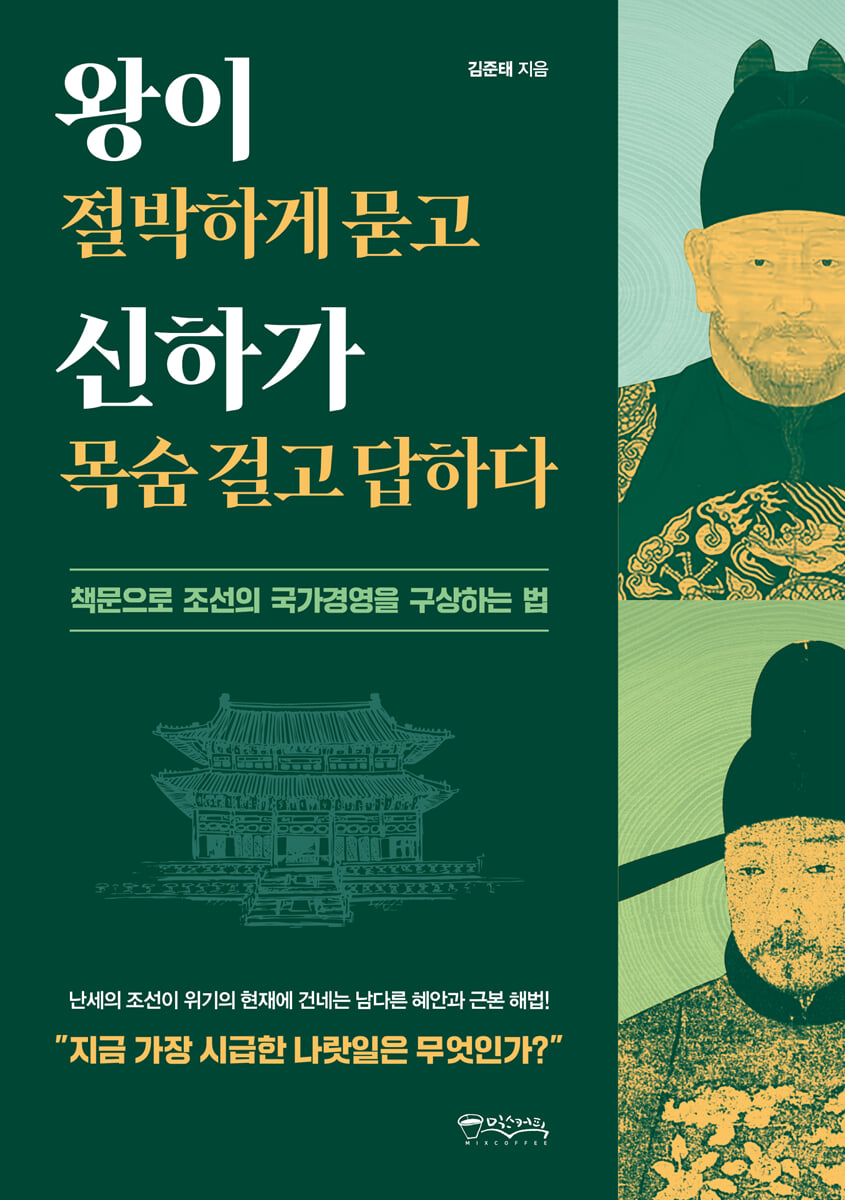
The king asks desperately, and the subject answers, risking his life.
 |
Description
Book Introduction
“What is the most urgent national issue right now?”
Joseon in times of chaos is handing over to the present in crisis.
Exceptional insight and fundamental solutions!
I wonder if there has ever been a time when South Korea was not in crisis.
While the majority of the people struggle to take care of themselves in the face of the uncertainty brought about by revolutionary change in many areas, no one is willing to engage in responsible politics that embraces everyone.
It appears that the main force behind the effort to revive the tumbling economy and the chaotic society has also disappeared.
They know what the most urgent national issue is right now, but they consistently pretend not to know.
The situation of Joseon, which was founded on this land several hundred years ago, was not much different.
Nevertheless, attempts to present fundamental solutions with extraordinary insight have continued.
This book, "The King Asks Desperately and the Subject Answers Risking His Life," deals with the king's "chaekmun" and the subject's "daecheop" (countermeasures) that were administered in the form of the civil service examination during the Joseon Dynasty.
We sought to comprehensively plan and prepare response measures for the most pressing issues and tasks of the time, including national management and national vision.
The leader of the nation, the 'king', asked with a desperate heart, and the talented 'subordinate' who assisted the leader risked his life to come up with a proper answer.
If we consider how ancient documents, which remain merely as relics and have historical value, can have contemporary value, it is because the king's desperate question and the subject's answer, prepared with the determination to die for their lives, hundreds of years ago are directly connected to our lives today and concern issues that recur even today.
In particular, the minister's policy is not only a concentrated reflection of his personal philosophy, historical awareness, and analysis of reality, but he also speaks only of the right words and correct statements in various fields such as economy, politics, administration, and welfare.
When you follow that advice, it is very useful and practical.
Joseon in times of chaos is handing over to the present in crisis.
Exceptional insight and fundamental solutions!
I wonder if there has ever been a time when South Korea was not in crisis.
While the majority of the people struggle to take care of themselves in the face of the uncertainty brought about by revolutionary change in many areas, no one is willing to engage in responsible politics that embraces everyone.
It appears that the main force behind the effort to revive the tumbling economy and the chaotic society has also disappeared.
They know what the most urgent national issue is right now, but they consistently pretend not to know.
The situation of Joseon, which was founded on this land several hundred years ago, was not much different.
Nevertheless, attempts to present fundamental solutions with extraordinary insight have continued.
This book, "The King Asks Desperately and the Subject Answers Risking His Life," deals with the king's "chaekmun" and the subject's "daecheop" (countermeasures) that were administered in the form of the civil service examination during the Joseon Dynasty.
We sought to comprehensively plan and prepare response measures for the most pressing issues and tasks of the time, including national management and national vision.
The leader of the nation, the 'king', asked with a desperate heart, and the talented 'subordinate' who assisted the leader risked his life to come up with a proper answer.
If we consider how ancient documents, which remain merely as relics and have historical value, can have contemporary value, it is because the king's desperate question and the subject's answer, prepared with the determination to die for their lives, hundreds of years ago are directly connected to our lives today and concern issues that recur even today.
In particular, the minister's policy is not only a concentrated reflection of his personal philosophy, historical awareness, and analysis of reality, but he also speaks only of the right words and correct statements in various fields such as economy, politics, administration, and welfare.
When you follow that advice, it is very useful and practical.
- You can preview some of the book's contents.
Preview
index
Entering_
What is the most urgent national issue right now?
Chapter 1: Pursue the Middle Way and Find Righteousness
_Taejong asks and Byeon Gye-ryang answers
Byun Gye-ryang emphasized "moderateness" and "straightforwardness" | The principles of human relations: "moderateness" and "timeliness" | Who is Byun Gye-ryang?
Chapter 2: Talent to implement laws and systems is crucial.
Sejong asks and Shin Suk-ju answers.
Shin Suk-ju's Response to Law and Personnel | What They Wanted to Change and Why | Who is Shin Suk-ju?
Chapter 3: The Right Attitude for Leaders to Deal with Talent
Sejong asks and Kang Hee-maeng answers.
Identifying, Hiring, and Using Talent | Take Advantage of Strengths and Compensate for Weaknesses | Who is Kang Hee-maeng?
Chapter 4: Talent Development Comes Before Talent Selection
_The king asks and Lee Mok answers
Hyanggeuiseon and Hyeonryangbangjeong | There is no perfect method for selecting talent | Who is Lee Mok?
Chapter 5: If You Want to Become a Good Prime Minister, Change Yourself First
_The king asks and the interest answers
The Most Important Task of a Monarch | How to Choose a Great Advisor | Who is Interest?
Chapter 6: To maintain your beginner's mind, reflect and listen.
_Jungjong asks and Kwonbeol answers
On King Jungjong's Questions | The Subject's Remonstrance and the King's Heeding | Who is the Power to Punish?
Chapter 7: Solving the harmful effects of alcohol requires both individuals and society.
_Jungjong asks and Kim Gu answers
Beware the Harmful Effects of Alcohol | Individual, Collective, and Social Structural Aspects | Who is Kim Gu?
Chapter 8: Knowing When to Advance and When to Retreat
_Jungjong asks and Song Gyeom answers
A Solitary Manner and a Grand Integrity | When to 'Come Out' and When to 'Chu' | Who is Song Gyeom?
Chapter 9: Establish Fair and Transparent Standards
_Jungjong asks and Kim Uijeong answers
Conflict and Opposition, Agreement and Harmony | The Harmony of Loyalty and Honesty | Who is Kim Ui-jeong?
Chapter 10: How to Create an Abundance of Talent
_Myeongjong asks and Yang Sa-eon answers
Ensuring an overflow of healthy talent | Talent is important, but leadership is crucial | Who is Yang Sa-eon?
Chapter 11: Four Items Needed for Study
_Seonjo asks and Jo Hee-il answers
Our ancestors needed sincerity | We need reflection and respect | Who is Jo Hee-il?
Chapter 12: The King Is Responsible for the Troubles of the Nation and the Illnesses of the Court
_Gwanghaegun asks and Im Suk-young answers
Im Sook-young's Urgent Needs | On the King's Grave Responsibilities | Who is Im Sook-young?
Chapter 13: The Realization that Generalship is the Foundation and Weapons are the End
_Injo asks and Jeong Du-gyeong answers
We must find and promote excellent generals | To enable frontline commanders to demonstrate their capabilities | Who is Jeong Du-gyeong?
Chapter 14: The King Must Fulfill His Duties
Injo asks and Odalje answers.
A king must set aside subjective feelings | He must fulfill his duties as a king first | Who is Odalje?
Chapter 15: Harmony in Seeking Convenience While Keeping the Principles
King Sukjong asks and Kwon Ijin answers.
Actions taken, but no results | A balance between principle and convenience | Who is Kwon Yi-jin?
Chapter 16: Why You Must Give Yourself the utmost Devotion at Every Moment
_Jeongjo asks and Jeong Yak-yong answers
Voices from the Field and the Concrete Voices of Reality | Discipline Yourself and Be Careful | Who is Jeong Yak-yong?
Chapter 17: How to Effectively Operate the Personnel System
_Jeongjo asks and Jeong Yak-yong answers
Active and efficient human resources | No talent is left behind or left behind.
Chapter 18: Show genuine commitment, not just words.
Cheoljong asks and Kim Yun-sik answers.
The clue to the solution lies in the battlefield | The final destination is the king's will | Who is Kim Yun-sik?
supplement
What is the most urgent national issue right now?
Chapter 1: Pursue the Middle Way and Find Righteousness
_Taejong asks and Byeon Gye-ryang answers
Byun Gye-ryang emphasized "moderateness" and "straightforwardness" | The principles of human relations: "moderateness" and "timeliness" | Who is Byun Gye-ryang?
Chapter 2: Talent to implement laws and systems is crucial.
Sejong asks and Shin Suk-ju answers.
Shin Suk-ju's Response to Law and Personnel | What They Wanted to Change and Why | Who is Shin Suk-ju?
Chapter 3: The Right Attitude for Leaders to Deal with Talent
Sejong asks and Kang Hee-maeng answers.
Identifying, Hiring, and Using Talent | Take Advantage of Strengths and Compensate for Weaknesses | Who is Kang Hee-maeng?
Chapter 4: Talent Development Comes Before Talent Selection
_The king asks and Lee Mok answers
Hyanggeuiseon and Hyeonryangbangjeong | There is no perfect method for selecting talent | Who is Lee Mok?
Chapter 5: If You Want to Become a Good Prime Minister, Change Yourself First
_The king asks and the interest answers
The Most Important Task of a Monarch | How to Choose a Great Advisor | Who is Interest?
Chapter 6: To maintain your beginner's mind, reflect and listen.
_Jungjong asks and Kwonbeol answers
On King Jungjong's Questions | The Subject's Remonstrance and the King's Heeding | Who is the Power to Punish?
Chapter 7: Solving the harmful effects of alcohol requires both individuals and society.
_Jungjong asks and Kim Gu answers
Beware the Harmful Effects of Alcohol | Individual, Collective, and Social Structural Aspects | Who is Kim Gu?
Chapter 8: Knowing When to Advance and When to Retreat
_Jungjong asks and Song Gyeom answers
A Solitary Manner and a Grand Integrity | When to 'Come Out' and When to 'Chu' | Who is Song Gyeom?
Chapter 9: Establish Fair and Transparent Standards
_Jungjong asks and Kim Uijeong answers
Conflict and Opposition, Agreement and Harmony | The Harmony of Loyalty and Honesty | Who is Kim Ui-jeong?
Chapter 10: How to Create an Abundance of Talent
_Myeongjong asks and Yang Sa-eon answers
Ensuring an overflow of healthy talent | Talent is important, but leadership is crucial | Who is Yang Sa-eon?
Chapter 11: Four Items Needed for Study
_Seonjo asks and Jo Hee-il answers
Our ancestors needed sincerity | We need reflection and respect | Who is Jo Hee-il?
Chapter 12: The King Is Responsible for the Troubles of the Nation and the Illnesses of the Court
_Gwanghaegun asks and Im Suk-young answers
Im Sook-young's Urgent Needs | On the King's Grave Responsibilities | Who is Im Sook-young?
Chapter 13: The Realization that Generalship is the Foundation and Weapons are the End
_Injo asks and Jeong Du-gyeong answers
We must find and promote excellent generals | To enable frontline commanders to demonstrate their capabilities | Who is Jeong Du-gyeong?
Chapter 14: The King Must Fulfill His Duties
Injo asks and Odalje answers.
A king must set aside subjective feelings | He must fulfill his duties as a king first | Who is Odalje?
Chapter 15: Harmony in Seeking Convenience While Keeping the Principles
King Sukjong asks and Kwon Ijin answers.
Actions taken, but no results | A balance between principle and convenience | Who is Kwon Yi-jin?
Chapter 16: Why You Must Give Yourself the utmost Devotion at Every Moment
_Jeongjo asks and Jeong Yak-yong answers
Voices from the Field and the Concrete Voices of Reality | Discipline Yourself and Be Careful | Who is Jeong Yak-yong?
Chapter 17: How to Effectively Operate the Personnel System
_Jeongjo asks and Jeong Yak-yong answers
Active and efficient human resources | No talent is left behind or left behind.
Chapter 18: Show genuine commitment, not just words.
Cheoljong asks and Kim Yun-sik answers.
The clue to the solution lies in the battlefield | The final destination is the king's will | Who is Kim Yun-sik?
supplement
Detailed image

Into the book
Taejong asked, “What were the factors that enabled Dangwoo and the three generations to achieve such an excellent reign?”
(...) Taejong's question was how the wise kings of the past were able to carry out such virtuous politics, and how we can emulate such politics and put it into practice today.
This is the variable's answer to this.
The way to govern a country should be rooted in the heart, and the laws to govern a country should be appropriate to the times.
If the principles are not rooted in the heart, they cannot form the foundation for politics, and if laws are not enacted in a timely manner, they cannot serve as tools for achieving good politics.
The key to preserving the mind, creating the way to heal, and establishing the method of healing according to the times lies in maintaining the middle way. There is no other way to maintain the middle way than to be rectified.
--- p.20~21
Yeonsangun said, “I have heard that talented people are the country’s greatest asset.
“Since ancient times, when an emperor has achieved great politics, there has never been a time when he did not consider acquiring talented people as a top priority,” he said, and asked why Joseon felt it lacked talented people despite introducing various selection methods, and how to “promote virtuous people so that they can flourish like trees and be used for the good of the world and help govern the country.”
The eye says:
May the gods desire that Your Majesty, by observing the practicalities of your own actions and attainments, enlighten the minds of the people and cultivate talents.
If talented people are constantly produced and every household is filled with them, Your Majesty's selection of talented people will be like taking items from a wealthy household, and nothing will go as planned.
How could a lack of talent be a cause for concern? Your Majesty asked about acquiring talent, and I answered with a concise, yet eloquent, "cultivating talent."
--- p.54~61
Jungjong asked why we are not consistent, and how the great kings of the three generations were able to remain consistent.
This is the right answer to this question.
Since ancient times, kings have wanted to do things well from the beginning to the end.
But as the Book of Songs says, even if you do well at the beginning, you won't be good until the end.
Confucius once said, “The human mind is something that can be preserved if held, but is lost if let go. It comes and goes without warning, and you cannot tell where it goes.”
Everyone's heart is different in what it catches and what it lets go of, and this is where the distinction between good and evil is determined.
If you start well, it's because you've made up your mind, but if you end poorly, it's because you've lost your mind.
It is truly a fearful thing, for good and evil depend on whether you keep your heart or lose it.
I humbly beg that Your Majesty keep this in mind from beginning to end and do not neglect it in the slightest.
--- p.84
The second question from the ancestors is, “There are four elements to studying: respect, reflection, discipline, and repentance.”
We will focus on Jo Hee-il's answer to the question, "Can you tell me more about that?"
Scholars of old always progressed by building up their skills sequentially from their current situation, rather than suddenly jumping through hoops and studying difficult subjects.
Broadly speaking, there are four aspects to learning, and each of these four has its own stages and order.
When studying, you must first understand the principles of things and use them as a stepping stone to learning and as a target to move toward the Way.
Next, we must be very careful and restrained when we are alone, thus making our inner selves very solemn, and we must be very careful about our outward expressions of words and actions, making our demeanor very respectful.
We must delve deeper into what we already know, and we must not give up on our academic pursuits, thinking that what we know now is enough.
Also, if you see a good deed, you must put it into practice. You should not stop doing good deeds because you think that what you have done is enough.
From the foundation of learning to the small details of daily life, we must cultivate both our inner and outer selves and practice them diligently to shine brightly.
(...) The way to pursue learning is to first know what to do and then put it into practice in order.
--- p.145~146
What did Kwon Yi-jin see as the problem with King Sukjong's politics? He pointed out the following.
Even though they promised to protect the people, they did not provide them with a place to live, so in every household, husbands and wives are leaving their hometowns with their children and wandering in search of a way to survive.
The purpose of surveying land is to correct boundaries, but the land acquisition of the wealthy has increased.
He tried to show mercy by forgiving unpaid taxes, but it did not reach the homes of the common people.
They want to reduce taxes by revealing the Daedong Law, but the government offices are crying out that their warehouses are empty.
(...) Just as when fire burns, smoke comes out, and when water flows, the soil gets wet, there is no such thing as work that is without merit, or service that is without effect.
But Your Majesty, your work has been ineffective and has come to this point. How can this be?
--- p.201
Jeongjo lamented, “During the Han and Tang dynasties, there were many people who spent their entire lives holding only one position, so the spirit of establishing government offices and dividing up duties has not completely disappeared, but the customs in our country these days are the opposite of this.” He asked for a solution.
This is Jeong Yak-yong's answer.
He said, “Because he changes agricultural officials frequently, he doesn’t know how much revenue there is and how little expenses there are. And because he changes military officials frequently, he doesn’t remember which military affairs should be prioritized or which military officers are useful.
“The reason that the judgments made by the previous official are overturned by the successor is because the Ministry of Justice changes frequently, so there is a lot of resentment in Oksong, and the reason that the officials are ignorant of the rules is because the Ministry of Rites changes frequently, so it is impossible to verify the rites,” he answered.
(...) Taejong's question was how the wise kings of the past were able to carry out such virtuous politics, and how we can emulate such politics and put it into practice today.
This is the variable's answer to this.
The way to govern a country should be rooted in the heart, and the laws to govern a country should be appropriate to the times.
If the principles are not rooted in the heart, they cannot form the foundation for politics, and if laws are not enacted in a timely manner, they cannot serve as tools for achieving good politics.
The key to preserving the mind, creating the way to heal, and establishing the method of healing according to the times lies in maintaining the middle way. There is no other way to maintain the middle way than to be rectified.
--- p.20~21
Yeonsangun said, “I have heard that talented people are the country’s greatest asset.
“Since ancient times, when an emperor has achieved great politics, there has never been a time when he did not consider acquiring talented people as a top priority,” he said, and asked why Joseon felt it lacked talented people despite introducing various selection methods, and how to “promote virtuous people so that they can flourish like trees and be used for the good of the world and help govern the country.”
The eye says:
May the gods desire that Your Majesty, by observing the practicalities of your own actions and attainments, enlighten the minds of the people and cultivate talents.
If talented people are constantly produced and every household is filled with them, Your Majesty's selection of talented people will be like taking items from a wealthy household, and nothing will go as planned.
How could a lack of talent be a cause for concern? Your Majesty asked about acquiring talent, and I answered with a concise, yet eloquent, "cultivating talent."
--- p.54~61
Jungjong asked why we are not consistent, and how the great kings of the three generations were able to remain consistent.
This is the right answer to this question.
Since ancient times, kings have wanted to do things well from the beginning to the end.
But as the Book of Songs says, even if you do well at the beginning, you won't be good until the end.
Confucius once said, “The human mind is something that can be preserved if held, but is lost if let go. It comes and goes without warning, and you cannot tell where it goes.”
Everyone's heart is different in what it catches and what it lets go of, and this is where the distinction between good and evil is determined.
If you start well, it's because you've made up your mind, but if you end poorly, it's because you've lost your mind.
It is truly a fearful thing, for good and evil depend on whether you keep your heart or lose it.
I humbly beg that Your Majesty keep this in mind from beginning to end and do not neglect it in the slightest.
--- p.84
The second question from the ancestors is, “There are four elements to studying: respect, reflection, discipline, and repentance.”
We will focus on Jo Hee-il's answer to the question, "Can you tell me more about that?"
Scholars of old always progressed by building up their skills sequentially from their current situation, rather than suddenly jumping through hoops and studying difficult subjects.
Broadly speaking, there are four aspects to learning, and each of these four has its own stages and order.
When studying, you must first understand the principles of things and use them as a stepping stone to learning and as a target to move toward the Way.
Next, we must be very careful and restrained when we are alone, thus making our inner selves very solemn, and we must be very careful about our outward expressions of words and actions, making our demeanor very respectful.
We must delve deeper into what we already know, and we must not give up on our academic pursuits, thinking that what we know now is enough.
Also, if you see a good deed, you must put it into practice. You should not stop doing good deeds because you think that what you have done is enough.
From the foundation of learning to the small details of daily life, we must cultivate both our inner and outer selves and practice them diligently to shine brightly.
(...) The way to pursue learning is to first know what to do and then put it into practice in order.
--- p.145~146
What did Kwon Yi-jin see as the problem with King Sukjong's politics? He pointed out the following.
Even though they promised to protect the people, they did not provide them with a place to live, so in every household, husbands and wives are leaving their hometowns with their children and wandering in search of a way to survive.
The purpose of surveying land is to correct boundaries, but the land acquisition of the wealthy has increased.
He tried to show mercy by forgiving unpaid taxes, but it did not reach the homes of the common people.
They want to reduce taxes by revealing the Daedong Law, but the government offices are crying out that their warehouses are empty.
(...) Just as when fire burns, smoke comes out, and when water flows, the soil gets wet, there is no such thing as work that is without merit, or service that is without effect.
But Your Majesty, your work has been ineffective and has come to this point. How can this be?
--- p.201
Jeongjo lamented, “During the Han and Tang dynasties, there were many people who spent their entire lives holding only one position, so the spirit of establishing government offices and dividing up duties has not completely disappeared, but the customs in our country these days are the opposite of this.” He asked for a solution.
This is Jeong Yak-yong's answer.
He said, “Because he changes agricultural officials frequently, he doesn’t know how much revenue there is and how little expenses there are. And because he changes military officials frequently, he doesn’t remember which military affairs should be prioritized or which military officers are useful.
“The reason that the judgments made by the previous official are overturned by the successor is because the Ministry of Justice changes frequently, so there is a lot of resentment in Oksong, and the reason that the officials are ignorant of the rules is because the Ministry of Rites changes frequently, so it is impossible to verify the rites,” he answered.
--- p.220~221
Publisher's Review
“What was Joseon’s leader worried about?”
“What are the pressing issues and how should we respond?”
What would the Joseon king have been thinking about, and how would his subjects have responded?
The dialogue between Taejong and Byeon Gye-ryang is theoretical.
Taejong asked how the wise rulers of old were able to carry out such virtuous politics and what should be done to emulate and practice their politics.
Byun Gye-ryang emphasized the middle way and rectitude, saying, “The way to govern a country should be rooted in the heart, and the method to govern a country should be appropriate for the times.”
The dialogue between King Jungjong and Kim Gu has some surprising aspects, but it is very closely related to real life.
King Jungjong asked, “Some people get drunk and do not do their work, and they are so deluded by alcohol that they lose their virtue.
“What should we do to save this?” he said.
Kim Gu replied, “People of the world say this.
They say that alcohol is harmful to people and should be eliminated immediately.
However, if we try to solve it with only complicated laws, even if we issue orders, they will be slyly avoided, and even if we punish them, they will be treated falsely.”
Rather than trying to solve the problem through legislation, I thought it would be better to improve people's awareness and change the social atmosphere.
The dialogue between Jeongjo and Jeong Yak-yong is practical.
King Jeongjo asked what should be done about the fact that Joseon at the time was not properly utilizing the expertise of its subjects.
Accordingly, Jeong Yak-yong proposed that lower-level officials be given experience in various duties, while upper-level officials should have longer terms of office to ensure professionalism and consistency in administration.
The goal is to ensure that no talent is left out or neglected.
About the country's management and vision
A passionate conversation between the king and young talents
This book consists of 18 chapters.
The 500 years of the Joseon Dynasty are covered in chronological order, including the writings and policies of Taejong and Byeon Gye-ryang, Sejong and Shin Suk-ju and Kang Hui-maeng, Yeonsangun and Yi Mok and Yi Ja, Jungjong and Gwon Beol, Kim Gu, Song Gyeom, Kim Ui-jeong, Myeongjong and Yang Sa-eon, Seonjo and Jo Hui-il, Gwanghaegun and Im Suk-yeong, Injo and Jeong Du-gyeong and Oh Dal-je, Sukjong and Kwon I-jin, Jeongjo and Jeong Yak-yong, and Cheoljong and Kim Yun-sik.
Furthermore, the appendix briefly covers the king's letter and the subjects' measures that were not shown in the main text.
Their conversations about the country's management and vision are passionate and sometimes even fiery.
This probably means that they are dealing with an urgent issue, such as a subject not hesitating to criticize the king harshly.
It is an attitude that thinks only of the safety of the country, without considering one's own safety.
If you see and feel only one thing from this book, it should be this.
“What are the pressing issues and how should we respond?”
What would the Joseon king have been thinking about, and how would his subjects have responded?
The dialogue between Taejong and Byeon Gye-ryang is theoretical.
Taejong asked how the wise rulers of old were able to carry out such virtuous politics and what should be done to emulate and practice their politics.
Byun Gye-ryang emphasized the middle way and rectitude, saying, “The way to govern a country should be rooted in the heart, and the method to govern a country should be appropriate for the times.”
The dialogue between King Jungjong and Kim Gu has some surprising aspects, but it is very closely related to real life.
King Jungjong asked, “Some people get drunk and do not do their work, and they are so deluded by alcohol that they lose their virtue.
“What should we do to save this?” he said.
Kim Gu replied, “People of the world say this.
They say that alcohol is harmful to people and should be eliminated immediately.
However, if we try to solve it with only complicated laws, even if we issue orders, they will be slyly avoided, and even if we punish them, they will be treated falsely.”
Rather than trying to solve the problem through legislation, I thought it would be better to improve people's awareness and change the social atmosphere.
The dialogue between Jeongjo and Jeong Yak-yong is practical.
King Jeongjo asked what should be done about the fact that Joseon at the time was not properly utilizing the expertise of its subjects.
Accordingly, Jeong Yak-yong proposed that lower-level officials be given experience in various duties, while upper-level officials should have longer terms of office to ensure professionalism and consistency in administration.
The goal is to ensure that no talent is left out or neglected.
About the country's management and vision
A passionate conversation between the king and young talents
This book consists of 18 chapters.
The 500 years of the Joseon Dynasty are covered in chronological order, including the writings and policies of Taejong and Byeon Gye-ryang, Sejong and Shin Suk-ju and Kang Hui-maeng, Yeonsangun and Yi Mok and Yi Ja, Jungjong and Gwon Beol, Kim Gu, Song Gyeom, Kim Ui-jeong, Myeongjong and Yang Sa-eon, Seonjo and Jo Hui-il, Gwanghaegun and Im Suk-yeong, Injo and Jeong Du-gyeong and Oh Dal-je, Sukjong and Kwon I-jin, Jeongjo and Jeong Yak-yong, and Cheoljong and Kim Yun-sik.
Furthermore, the appendix briefly covers the king's letter and the subjects' measures that were not shown in the main text.
Their conversations about the country's management and vision are passionate and sometimes even fiery.
This probably means that they are dealing with an urgent issue, such as a subject not hesitating to criticize the king harshly.
It is an attitude that thinks only of the safety of the country, without considering one's own safety.
If you see and feel only one thing from this book, it should be this.
GOODS SPECIFICS
- Date of issue: March 21, 2025
- Page count, weight, size: 260 pages | 364g | 148*210*16mm
- ISBN13: 9791170436263
- ISBN10: 1170436269
You may also like
카테고리
korean


korean

![GQ KOREA Mark (Monthly): December [2025]](http://librairie.coreenne.fr/cdn/shop/files/8ef265dbbfbf186523ed75ba7319009d.jpg?v=1765340328&width=3840)


