

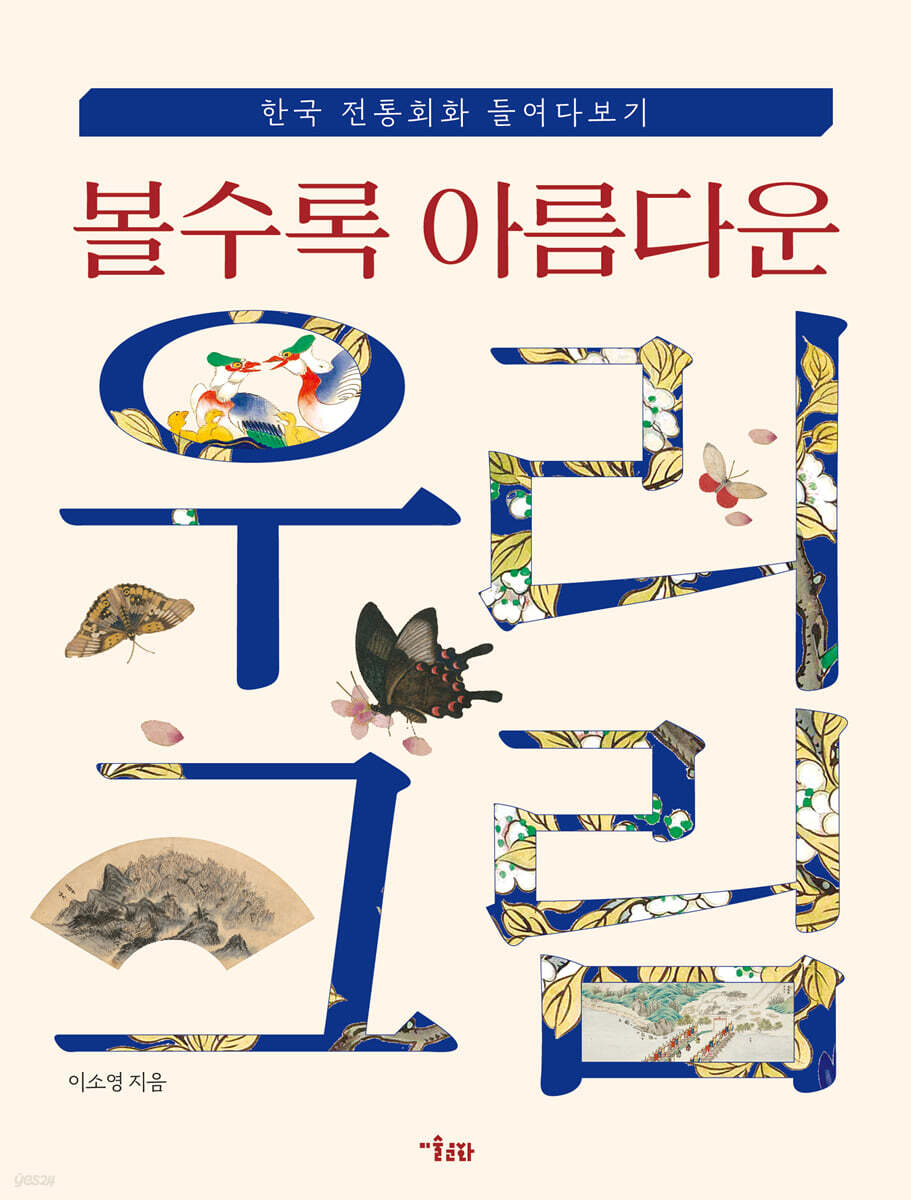
Our painting becomes more beautiful the more you look at it
 |
Description
Book Introduction
Our picture story, lightly unfolded and then absorbed
Interpreting the hopes in paintings that resonate across time
About 60 traditional paintings with the subtle elegance of the old people.
The animals and plants that coexisted with them,
Beautiful landscapes, everyday items, and even clothing…
Interpreting Korea's unique beauty with a modern sensibility
Interpreting the hopes in paintings that resonate across time
About 60 traditional paintings with the subtle elegance of the old people.
The animals and plants that coexisted with them,
Beautiful landscapes, everyday items, and even clothing…
Interpreting Korea's unique beauty with a modern sensibility
- You can preview some of the book's contents.
Preview
index
Entering
Part 1: The warmth of living animals
1.
The vivid flapping of a moving bee's wings / Shin Saimdang, "Cucumber and Frog"
2.
Hedgehog carrying a cucumber / Jeong Seon, 〈Piercing a cucumber〉
3.
A long-tailed swallowtail butterfly intoxicated by the scent of flowers / Nam Gye-woo, "Flower Butterfly Painting"
4.
Butterfly-like petals / Shin Myeong-yeon, "Landscape and Flower Painting"
5.
A Lizard Looking Back / Shin Saimdang, Poppy and Lizard
6.
The Law of the Jungle / Sim Sa-jeong, "The Hawk That Caught the Rabbit"
7.
The Unjust Tiger / Author unknown, "The Magpie and the Tiger"
8.
The Chick's Smile / Byun Sang-byeok, "Mother Hen and Chick"
9.
Sleeping Bird/Josok, Bird on an Old Tree on a Moonlit Night
10.
A swift duck cutting through the water / Hong Se-seop, Yeongmo Island
11.
The boundary between the moon and the owl / Park Rae-hyun, "Moonlit Night"
12.
Angry Cat Staring / Jang Seung-eop, "Flowers and Birds, More and More"
13.
A barking dog that barks without warning / Kim Du-ryang, "A barking dog"
14.
The imaginary animal that cannot be killed, the starfish / Unknown author, "The Unemployed"
15.
Whale swimming over a rock / Unknown artist, Bangudae Petroglyph
16.
The Octopus Embracing Wisdom / Author Unknown, "Eohaedo"
Part 2: The quietly permeating fragrance of plants
17.
The water magpie and lotus that bring good fortune / Unknown artist, "Birds and Flowers Folding Screen"
18.
Willow and lotus flowers in a pixelated screen / Unknown artist, "Flowers and Birds"
19.
Lotus in the Sky / Unknown author, "Lotus in the Rain"
20.
Ghost-Blocking Mandrake / Author unknown, "Flower and Plant Auspicious Patterned Screen"
21.
Grapes Hanging from the Branches / Lee Gye-ho, Grapes
22.
Peony and Rock Painting, a Strange Harmony / Unknown artist
23.
Overcoming trials and tribulations, the bamboo tree / Lee Jeong, "Bamboo"
24.
The plant of freshness, plantain / Park Byeong-su, "Falling Flowers and Birds"
25.
Sad Orchid with its Head Bowed / Min Yeong-ik, "Ink Orchid"
26.
Crevices and plants in rocks resembling people / Jeong Hak-yo, "Gwiseokdo"
All aspects of landscape painting in Part 3
27.
Dancing Pine Tree / Jeongseon, Jeongyangsa Temple
28.
A traveler wearing a black hat / Byeon Gwan-sik, "Autumn Scenery at Samseonam in the Outer Geumgang River"
29.
A pavilion built with fingers / Lee In-mun, "Jidusansuhwa"
30.
The Boat that Fishing Time / Choi Buk, "Hangang Fishing Boat"
31.
Water flowing to a low place / Unknown author, "Ilwol Obongdo Closet Door"
32.
The Weight of Transparent Rock / Lee In-sang, "Guryongyeon"
33.
A pavilion where winter dwells / Kim Su-cheol, "A scholar appreciating plum blossoms in a snow-covered pavilion"
34.
A map like a flower in full bloom / Author unknown, "Hansungdo"
35.
Lion of Justice Haechi-sang / An Jung-sik, "White Chunhyo"
36.
Chongseokjeong Pavilion, where immortals played / Kim Gyu-jin, "Chongseokjeong Pavilion Scenery"
37.
A carrying case that feels the weight of life / Lee Sang-beom, "Jo (朝)"
Part 4: Baby's Daily Necessities
38.
The palanquin carrying history / Unknown author, 〈Yeongjo Wangsejechaekrye Banchado Kwon〉
39.
An ingenious prefabricated bridge / Unknown author, Bishop's Bridge
40.
The Pulley that Lifts Life / Lee In-moon, "Endless Rivers and Mountains"
41.
Playing the geomungo / Unknown author, "Chaekgado"
42.
A Book of Dreams / Author unknown, "Book Street"
43.
Chopsticks that hold everyday life / Kim Hong-do, "Lunch"
44.
A vase of flowers wishing for peace / Unknown artist, 〈Peony painting with Hyeokpilhwa〉
45.
Flowerpot with Letters / Unknown artist, “Flower and Bird Characters”
46.
A painting of a folding screen / Oh Se-chang et al., “Joint Painting”
47.
Auspicious phoenix-patterned wrapping cloth / Unknown author, 〈Phoenix Literary and Inscriptions〉
48.
Abstract painting of a tiger skin / Unknown artist, "Hopido"
Part 5: The Style of Old People
49.
Sea Gods in Korean Mythology / Author Unknown, "Sea God and Moon God"
50.
Very high crown/head, 〈Revenge Island〉
51.
A hem filled with the wind / Jeong Sul-won, "Baeknapdo"
52.
Cute child's head / Unknown artist, "Nine Clouds Dream"
53.
A sophisticated multi-colored pleated skirt / Unknown author, "Acrobatics Appreciation"
54.
Wide-brimmed women's hat/ Shin Yun-bok, "Woman Wearing a Full Face Mask"
55.
The End of the Eosahwa / Kim Jun-geun, “Shindeungyongmun”
56.
Stepping Foot / Unknown artist, “Water Moon Avalokiteshvara”
57.
Unknown expression/ Kim Myeong-guk, “Dalmado”
58.
Straight Eyes Seeing the World / Chae Yong-shin, "Hwang Hyeon-sang"
59.
Seonyurak, the Flower of Festivals / Kim Deuk-sin et al., "Bongsudang Jinchando"
60.
Letters made of crowds / Lee Ungno, "Anti-war Peace"
Coming out
Americas
List of illustrations
Part 1: The warmth of living animals
1.
The vivid flapping of a moving bee's wings / Shin Saimdang, "Cucumber and Frog"
2.
Hedgehog carrying a cucumber / Jeong Seon, 〈Piercing a cucumber〉
3.
A long-tailed swallowtail butterfly intoxicated by the scent of flowers / Nam Gye-woo, "Flower Butterfly Painting"
4.
Butterfly-like petals / Shin Myeong-yeon, "Landscape and Flower Painting"
5.
A Lizard Looking Back / Shin Saimdang, Poppy and Lizard
6.
The Law of the Jungle / Sim Sa-jeong, "The Hawk That Caught the Rabbit"
7.
The Unjust Tiger / Author unknown, "The Magpie and the Tiger"
8.
The Chick's Smile / Byun Sang-byeok, "Mother Hen and Chick"
9.
Sleeping Bird/Josok, Bird on an Old Tree on a Moonlit Night
10.
A swift duck cutting through the water / Hong Se-seop, Yeongmo Island
11.
The boundary between the moon and the owl / Park Rae-hyun, "Moonlit Night"
12.
Angry Cat Staring / Jang Seung-eop, "Flowers and Birds, More and More"
13.
A barking dog that barks without warning / Kim Du-ryang, "A barking dog"
14.
The imaginary animal that cannot be killed, the starfish / Unknown author, "The Unemployed"
15.
Whale swimming over a rock / Unknown artist, Bangudae Petroglyph
16.
The Octopus Embracing Wisdom / Author Unknown, "Eohaedo"
Part 2: The quietly permeating fragrance of plants
17.
The water magpie and lotus that bring good fortune / Unknown artist, "Birds and Flowers Folding Screen"
18.
Willow and lotus flowers in a pixelated screen / Unknown artist, "Flowers and Birds"
19.
Lotus in the Sky / Unknown author, "Lotus in the Rain"
20.
Ghost-Blocking Mandrake / Author unknown, "Flower and Plant Auspicious Patterned Screen"
21.
Grapes Hanging from the Branches / Lee Gye-ho, Grapes
22.
Peony and Rock Painting, a Strange Harmony / Unknown artist
23.
Overcoming trials and tribulations, the bamboo tree / Lee Jeong, "Bamboo"
24.
The plant of freshness, plantain / Park Byeong-su, "Falling Flowers and Birds"
25.
Sad Orchid with its Head Bowed / Min Yeong-ik, "Ink Orchid"
26.
Crevices and plants in rocks resembling people / Jeong Hak-yo, "Gwiseokdo"
All aspects of landscape painting in Part 3
27.
Dancing Pine Tree / Jeongseon, Jeongyangsa Temple
28.
A traveler wearing a black hat / Byeon Gwan-sik, "Autumn Scenery at Samseonam in the Outer Geumgang River"
29.
A pavilion built with fingers / Lee In-mun, "Jidusansuhwa"
30.
The Boat that Fishing Time / Choi Buk, "Hangang Fishing Boat"
31.
Water flowing to a low place / Unknown author, "Ilwol Obongdo Closet Door"
32.
The Weight of Transparent Rock / Lee In-sang, "Guryongyeon"
33.
A pavilion where winter dwells / Kim Su-cheol, "A scholar appreciating plum blossoms in a snow-covered pavilion"
34.
A map like a flower in full bloom / Author unknown, "Hansungdo"
35.
Lion of Justice Haechi-sang / An Jung-sik, "White Chunhyo"
36.
Chongseokjeong Pavilion, where immortals played / Kim Gyu-jin, "Chongseokjeong Pavilion Scenery"
37.
A carrying case that feels the weight of life / Lee Sang-beom, "Jo (朝)"
Part 4: Baby's Daily Necessities
38.
The palanquin carrying history / Unknown author, 〈Yeongjo Wangsejechaekrye Banchado Kwon〉
39.
An ingenious prefabricated bridge / Unknown author, Bishop's Bridge
40.
The Pulley that Lifts Life / Lee In-moon, "Endless Rivers and Mountains"
41.
Playing the geomungo / Unknown author, "Chaekgado"
42.
A Book of Dreams / Author unknown, "Book Street"
43.
Chopsticks that hold everyday life / Kim Hong-do, "Lunch"
44.
A vase of flowers wishing for peace / Unknown artist, 〈Peony painting with Hyeokpilhwa〉
45.
Flowerpot with Letters / Unknown artist, “Flower and Bird Characters”
46.
A painting of a folding screen / Oh Se-chang et al., “Joint Painting”
47.
Auspicious phoenix-patterned wrapping cloth / Unknown author, 〈Phoenix Literary and Inscriptions〉
48.
Abstract painting of a tiger skin / Unknown artist, "Hopido"
Part 5: The Style of Old People
49.
Sea Gods in Korean Mythology / Author Unknown, "Sea God and Moon God"
50.
Very high crown/head, 〈Revenge Island〉
51.
A hem filled with the wind / Jeong Sul-won, "Baeknapdo"
52.
Cute child's head / Unknown artist, "Nine Clouds Dream"
53.
A sophisticated multi-colored pleated skirt / Unknown author, "Acrobatics Appreciation"
54.
Wide-brimmed women's hat/ Shin Yun-bok, "Woman Wearing a Full Face Mask"
55.
The End of the Eosahwa / Kim Jun-geun, “Shindeungyongmun”
56.
Stepping Foot / Unknown artist, “Water Moon Avalokiteshvara”
57.
Unknown expression/ Kim Myeong-guk, “Dalmado”
58.
Straight Eyes Seeing the World / Chae Yong-shin, "Hwang Hyeon-sang"
59.
Seonyurak, the Flower of Festivals / Kim Deuk-sin et al., "Bongsudang Jinchando"
60.
Letters made of crowds / Lee Ungno, "Anti-war Peace"
Coming out
Americas
List of illustrations
Detailed image

Into the book
The painting “Jawibugwa,” which depicts a hedgehog carrying a cucumber on its back, has the meaning of not only prosperity for descendants but also living within one’s means.
The proverb 'like a hedgehog carrying a cucumber' is a metaphor for the difficult situation caused by being in debt.
Knowing this, looking at the hedgehog's expression again, he looks pitiful, like a modern person carrying a heavy burden.
--- p.17
You can occasionally see old paintings depicting people sleeping, such as Osudo, which depicts a person taking a nap, or Chuimyeondo, which depicts a person sleeping drunk. This signifies that the artist has reached a level that transcends the boundary between consciousness and unconsciousness.
It is an experience of unity, that is, enlightenment, in which the creator reaches a state of no-mind through communication with the subject.
It is paradoxical that the image of a person sleeping represents a moment of enlightenment, but when you understand the meaning, the painting feels newer.
--- p.43
This work is unique in that it looks like a pixel structure that has been enlarged to resemble a photographic image.
The background of willow trees and lotus leaves is made of a fabric structure, and the birds are delicately painted.
This type of craft painting, which depicts a picture on paper and expresses the structure of fabric, is called 'Jijikhwa' and was mainly painted in the mid- to late-Joseon period.
Bamboo paper, called jukji, was cut into pieces about 1.2 millimeters wide, then woven with various colored papers and some drawings were added to increase density.
The meticulously colored birds and flowers on the checkered background are effective in revealing the subject matter.
--- p.81
Lee Jeong-eun, a royal literati painter and 5th generation descendant of King Sejong, was renowned for his ink bamboo paintings from his 30s, but suffered a serious injury to his right arm during the Imjin War.
For a painter, his arms and hands are tools he has spent his entire life honing, so it is a desperate situation.
However, Lee Jeong overcame this situation with strong will while staying in Gongju, a place of seclusion, and the poetry collection “Samcheongcheop” he published at the age of 41 received even higher praise than before.
--- p.103
A man wearing a hood and a straw hat is fishing from a boat.
Dorongi is a raincoat from the Joseon Dynasty that was made by weaving rice straw or grass into a skirt shape and was easy to wear. It was also used for keeping out the cold.
Old paintings often depict people living in seclusion in nature fishing.
It is a metaphorical expression of fishing for time, not for catching fish.
In other words, he can be said to be a scholar who spends a long time waiting alone and in seclusion, or a Zen monk who seeks enlightenment.
--- p.137
Simjeon An Jung-sik did not reproduce the palace as it was, which had been damaged and turned into a leisure facility during the Japanese colonial period, but rather restored the palace to its former state.
The title, “Baekakchunhyo,” which means “Spring dawn in Baekak,” conveys the artist’s hope for independence.
--- p.157
This work, which looks like both a painting and a letter, is the character for ‘filial piety.’
It can be inferred from the carp and bamboo shoots, and these two objects originated from anecdotes about Chinese filial sons.
According to the story, when King Shang of Jin tried to break the ice to catch fish for his stepmother in the middle of winter, a carp jumped out and offered it to him, and when Mengzong of Wu shed tears in a snow-covered bamboo grove for his sick mother, bamboo shoots sprouted in the middle of winter.
In the Joseon Dynasty, everyone knew this, so the moment they saw carp and bamboo shoots, they felt a sense of filial piety toward their parents.
--- p.203
There is an interesting anecdote about Kim Myeong-guk. When a Japanese person asked him to paint a mural, Kim Myeong-guk drank a lot of alcohol, spit out gold powder juice on the wall after holding it in his mouth.
And as he laughed loudly and drew with a brush as if sweeping the gold powder sprinkled on the wall, it became a landscape and a person.
People who saw the painting said that the jokes in the hand movements were natural and the brush strokes were powerful, making the painting seem alive.
The proverb 'like a hedgehog carrying a cucumber' is a metaphor for the difficult situation caused by being in debt.
Knowing this, looking at the hedgehog's expression again, he looks pitiful, like a modern person carrying a heavy burden.
--- p.17
You can occasionally see old paintings depicting people sleeping, such as Osudo, which depicts a person taking a nap, or Chuimyeondo, which depicts a person sleeping drunk. This signifies that the artist has reached a level that transcends the boundary between consciousness and unconsciousness.
It is an experience of unity, that is, enlightenment, in which the creator reaches a state of no-mind through communication with the subject.
It is paradoxical that the image of a person sleeping represents a moment of enlightenment, but when you understand the meaning, the painting feels newer.
--- p.43
This work is unique in that it looks like a pixel structure that has been enlarged to resemble a photographic image.
The background of willow trees and lotus leaves is made of a fabric structure, and the birds are delicately painted.
This type of craft painting, which depicts a picture on paper and expresses the structure of fabric, is called 'Jijikhwa' and was mainly painted in the mid- to late-Joseon period.
Bamboo paper, called jukji, was cut into pieces about 1.2 millimeters wide, then woven with various colored papers and some drawings were added to increase density.
The meticulously colored birds and flowers on the checkered background are effective in revealing the subject matter.
--- p.81
Lee Jeong-eun, a royal literati painter and 5th generation descendant of King Sejong, was renowned for his ink bamboo paintings from his 30s, but suffered a serious injury to his right arm during the Imjin War.
For a painter, his arms and hands are tools he has spent his entire life honing, so it is a desperate situation.
However, Lee Jeong overcame this situation with strong will while staying in Gongju, a place of seclusion, and the poetry collection “Samcheongcheop” he published at the age of 41 received even higher praise than before.
--- p.103
A man wearing a hood and a straw hat is fishing from a boat.
Dorongi is a raincoat from the Joseon Dynasty that was made by weaving rice straw or grass into a skirt shape and was easy to wear. It was also used for keeping out the cold.
Old paintings often depict people living in seclusion in nature fishing.
It is a metaphorical expression of fishing for time, not for catching fish.
In other words, he can be said to be a scholar who spends a long time waiting alone and in seclusion, or a Zen monk who seeks enlightenment.
--- p.137
Simjeon An Jung-sik did not reproduce the palace as it was, which had been damaged and turned into a leisure facility during the Japanese colonial period, but rather restored the palace to its former state.
The title, “Baekakchunhyo,” which means “Spring dawn in Baekak,” conveys the artist’s hope for independence.
--- p.157
This work, which looks like both a painting and a letter, is the character for ‘filial piety.’
It can be inferred from the carp and bamboo shoots, and these two objects originated from anecdotes about Chinese filial sons.
According to the story, when King Shang of Jin tried to break the ice to catch fish for his stepmother in the middle of winter, a carp jumped out and offered it to him, and when Mengzong of Wu shed tears in a snow-covered bamboo grove for his sick mother, bamboo shoots sprouted in the middle of winter.
In the Joseon Dynasty, everyone knew this, so the moment they saw carp and bamboo shoots, they felt a sense of filial piety toward their parents.
--- p.203
There is an interesting anecdote about Kim Myeong-guk. When a Japanese person asked him to paint a mural, Kim Myeong-guk drank a lot of alcohol, spit out gold powder juice on the wall after holding it in his mouth.
And as he laughed loudly and drew with a brush as if sweeping the gold powder sprinkled on the wall, it became a landscape and a person.
People who saw the painting said that the jokes in the hand movements were natural and the brush strokes were powerful, making the painting seem alive.
--- p.259
Publisher's Review
Discover with charming details
The true face of Korean traditional painting
For modern people who can appreciate splendid and colorful works of art from around the world anywhere, traditional paintings that are mainly composed of achromatic colors can feel boring.
However, these days, when Korean works are loved in various fields of art, such as dramas and movies, we need to look back at the roots of our art.
"Our Paintings, More Beautiful the More You See Them," is a book that rediscovers the beauty of traditional Korean painting, which we had forgotten, through over 60 works that capture the beauty, nature, and daily life of our ancestors using various materials and techniques.
It goes beyond the boundaries of traditional painting, which only brings to mind ink wash painting, and comprehensively covers works of various techniques, such as Jiduhwa, created from the artist's fingertips, and Jijikhwa, reminiscent of modern pixel art.
In addition, it includes everyday art pieces such as bojagi (traditional wrapping cloths), providing a glimpse into the style and creativity of our ancestors.
Author Lee So-young, who majored in Oriental painting, rediscovered our paintings from a new perspective.
He did not view tradition as old and outdated, but interpreted Korea's unique beauty with a modern sensibility and captured it from his own perspective.
This perspective will bring out the inherent charm and excitement in readers who vaguely think that traditional painting is difficult and boring.
Family health, employment and promotion, wealth and honor…
Our ancestors' wishes meet the wishes of modern people
The wishes of the ancients are in line with the desires of modern people.
From paintings of magpies and tigers drawn with the hope of good news in the new year, to peony screens wishing for wealth and honor, to paintings of crabs and fish wishing for success and fame, our people have long been familiar with the symbols these materials represent, and have harbored a deep belief that if we look closely, our wishes will come true.
He also included heterogeneous subjects such as cats, butterflies, mandrakes, and roosters in one screen, because in China, the Chinese characters for cat and 70-year-old man, and butterfly and 80-year-old man, are pronounced the same.
Modern people are not much different from those of the past, such as hanging a picture of a sunflower in the entrance hall, which is said to bring good fortune, or wearing an accessory shaped like a four-leaf clover.
Knowing the meaning of the symbols contained in these ancient paintings allows us to naturally empathize with the wishes of our ancestors, along with a sparkling sense of enlightenment.
From the perspective of an old person
Reading the world in the picture
This book, comprised of five parts, covers animals and plants, elements of landscape painting, everyday objects, and the beauty of ancient people, providing an opportunity to delve deeper into our paintings.
Part 1 explores the special relationship between ancient people and animals that are embedded in the paintings.
Our ancestors accepted animals not as mere living beings, but as companions of life and symbolic beings.
We looked at a variety of animals that appear in our drawings, from familiar animals like dogs and cats to somewhat unfamiliar ones like lizards and hedgehogs.
Part 2 introduced artworks featuring plants that were part of nature and people in the past.
From gorgeous flowers like lotus and peony to simple yet profoundly meaningful plants like bamboo and grapes, we looked into the minds of ancient people through various works.
Part 3 deals with the elements of landscape painting that embody the life and spirit of our people.
We introduced detailed elements that add to the beauty of landscape paintings, such as the appearance of an old person who looks like a hermit in seclusion and Chongseokjeong, one of the Eight Scenic Views of Gwandong.
You can also appreciate landscape paintings that reveal the individuality of masters such as Gyeomjae Jeong Seon, Neunghogwan Lee Insang, and Sojeong Byeon Gwansik.
Part 4 highlights the beauty of artwork incorporated into everyday objects.
Household goods are more than just practical tools; they are artistic media that embody the wishes and aesthetic sensibilities of our ancestors.
In addition to everyday items such as palanquins and wrapping cloths, it also features outstanding inventions that provide a glimpse into the science and technology of the time, such as modular bridges and pulleys.
In the final part 5, we looked into the elegance inherent in the appearance of the old people.
From our ancestors' philosophy of portraiture that reality must be faithfully reproduced to the unique depiction of imaginary beings such as the characters in Guunmong and the old man of Susung, you can explore the perspectives of ancient people on people.
The true face of Korean traditional painting
For modern people who can appreciate splendid and colorful works of art from around the world anywhere, traditional paintings that are mainly composed of achromatic colors can feel boring.
However, these days, when Korean works are loved in various fields of art, such as dramas and movies, we need to look back at the roots of our art.
"Our Paintings, More Beautiful the More You See Them," is a book that rediscovers the beauty of traditional Korean painting, which we had forgotten, through over 60 works that capture the beauty, nature, and daily life of our ancestors using various materials and techniques.
It goes beyond the boundaries of traditional painting, which only brings to mind ink wash painting, and comprehensively covers works of various techniques, such as Jiduhwa, created from the artist's fingertips, and Jijikhwa, reminiscent of modern pixel art.
In addition, it includes everyday art pieces such as bojagi (traditional wrapping cloths), providing a glimpse into the style and creativity of our ancestors.
Author Lee So-young, who majored in Oriental painting, rediscovered our paintings from a new perspective.
He did not view tradition as old and outdated, but interpreted Korea's unique beauty with a modern sensibility and captured it from his own perspective.
This perspective will bring out the inherent charm and excitement in readers who vaguely think that traditional painting is difficult and boring.
Family health, employment and promotion, wealth and honor…
Our ancestors' wishes meet the wishes of modern people
The wishes of the ancients are in line with the desires of modern people.
From paintings of magpies and tigers drawn with the hope of good news in the new year, to peony screens wishing for wealth and honor, to paintings of crabs and fish wishing for success and fame, our people have long been familiar with the symbols these materials represent, and have harbored a deep belief that if we look closely, our wishes will come true.
He also included heterogeneous subjects such as cats, butterflies, mandrakes, and roosters in one screen, because in China, the Chinese characters for cat and 70-year-old man, and butterfly and 80-year-old man, are pronounced the same.
Modern people are not much different from those of the past, such as hanging a picture of a sunflower in the entrance hall, which is said to bring good fortune, or wearing an accessory shaped like a four-leaf clover.
Knowing the meaning of the symbols contained in these ancient paintings allows us to naturally empathize with the wishes of our ancestors, along with a sparkling sense of enlightenment.
From the perspective of an old person
Reading the world in the picture
This book, comprised of five parts, covers animals and plants, elements of landscape painting, everyday objects, and the beauty of ancient people, providing an opportunity to delve deeper into our paintings.
Part 1 explores the special relationship between ancient people and animals that are embedded in the paintings.
Our ancestors accepted animals not as mere living beings, but as companions of life and symbolic beings.
We looked at a variety of animals that appear in our drawings, from familiar animals like dogs and cats to somewhat unfamiliar ones like lizards and hedgehogs.
Part 2 introduced artworks featuring plants that were part of nature and people in the past.
From gorgeous flowers like lotus and peony to simple yet profoundly meaningful plants like bamboo and grapes, we looked into the minds of ancient people through various works.
Part 3 deals with the elements of landscape painting that embody the life and spirit of our people.
We introduced detailed elements that add to the beauty of landscape paintings, such as the appearance of an old person who looks like a hermit in seclusion and Chongseokjeong, one of the Eight Scenic Views of Gwandong.
You can also appreciate landscape paintings that reveal the individuality of masters such as Gyeomjae Jeong Seon, Neunghogwan Lee Insang, and Sojeong Byeon Gwansik.
Part 4 highlights the beauty of artwork incorporated into everyday objects.
Household goods are more than just practical tools; they are artistic media that embody the wishes and aesthetic sensibilities of our ancestors.
In addition to everyday items such as palanquins and wrapping cloths, it also features outstanding inventions that provide a glimpse into the science and technology of the time, such as modular bridges and pulleys.
In the final part 5, we looked into the elegance inherent in the appearance of the old people.
From our ancestors' philosophy of portraiture that reality must be faithfully reproduced to the unique depiction of imaginary beings such as the characters in Guunmong and the old man of Susung, you can explore the perspectives of ancient people on people.
GOODS SPECIFICS
- Date of issue: February 26, 2025
- Page count, weight, size: 280 pages | 464g | 152*201*15mm
- ISBN13: 9791192768328
- ISBN10: 1192768329
You may also like
카테고리
korean


korean

![GQ KOREA Mark (Monthly): December [2025]](http://librairie.coreenne.fr/cdn/shop/files/8ef265dbbfbf186523ed75ba7319009d.jpg?v=1765340328&width=3840)


