

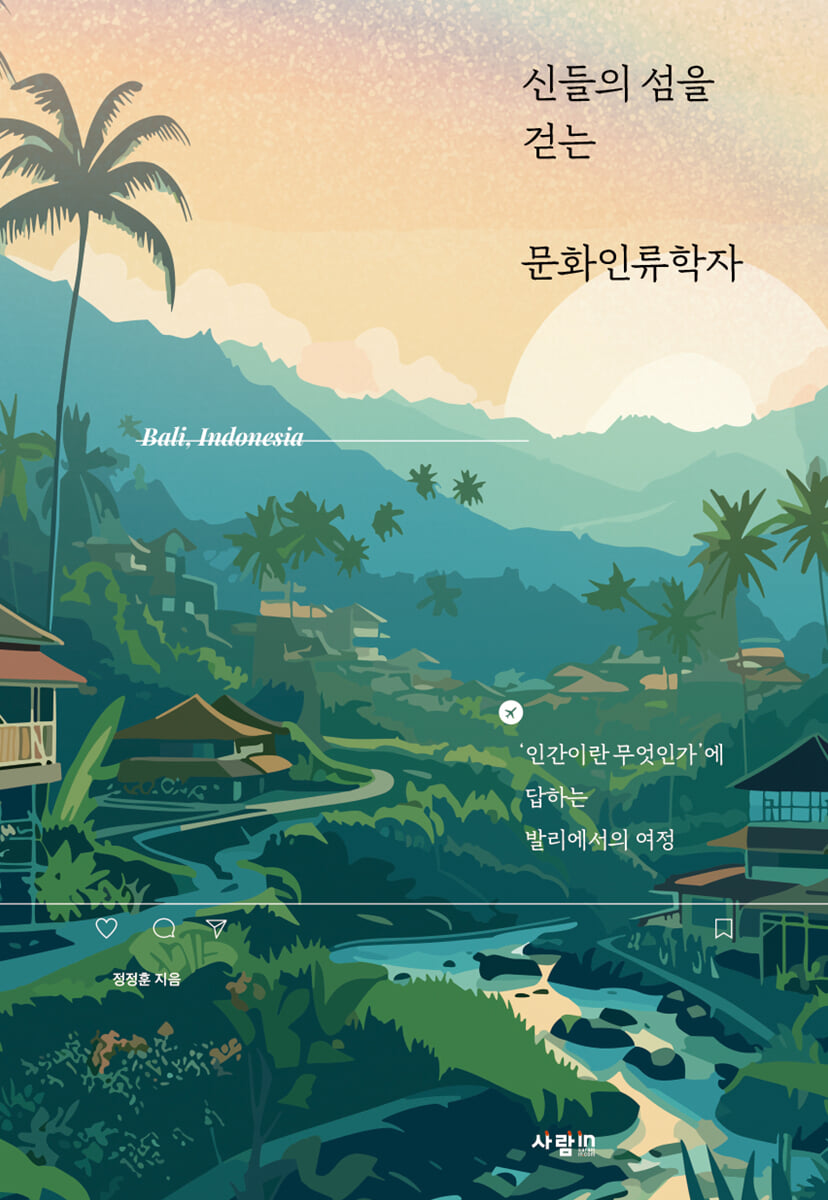
A cultural anthropologist walking the island of the gods
 |
Description
Book Introduction
★The Journey of a Cultural Anthropologist Lost in the Magical Word of "Culture"
Cultural anthropology is the study of cultures created by humans across all societies.
To this end, anthropologists use field research to understand specific regions, acquire knowledge, and ultimately find an answer to the question, "What is a human being?"
To find the answer, the author went to Bali, Indonesia, with the word 'culture' in his mind.
Who are the Balinese? What are the characteristics of their culture? How do they live? A small island in the South Pacific, a world-class tourist destination, Balinese Hindus, mystical rainforests nurtured by the equatorial sun, endless terraced rice fields, artist villages, and a cuisine brimming with flavor.
Let's delve into the magical word 'culture' that splendidly weaves all of this together.
Cultural anthropology is the study of cultures created by humans across all societies.
To this end, anthropologists use field research to understand specific regions, acquire knowledge, and ultimately find an answer to the question, "What is a human being?"
To find the answer, the author went to Bali, Indonesia, with the word 'culture' in his mind.
Who are the Balinese? What are the characteristics of their culture? How do they live? A small island in the South Pacific, a world-class tourist destination, Balinese Hindus, mystical rainforests nurtured by the equatorial sun, endless terraced rice fields, artist villages, and a cuisine brimming with flavor.
Let's delve into the magical word 'culture' that splendidly weaves all of this together.
- You can preview some of the book's contents.
Preview
index
Prologue - Embarking on a Long Journey with the Magical Word "Culture"
1. In search of the perfect village
2 A city where people live on the island of the gods
3 Finally to Ubud, and a new encounter
Return to Bali with your family
5 Fry, stir-fry, and sprinkle
The Birth of a 'Real Bali' Where Artists Gather
7. In search of the history of the Yellow Coconut Village
Even if dozens of Wayans live in one village,
9 Reasons Why Foreigners Stay in Rural Bali
10 Life Lessons from Dengue Fever
11 If a person living in Bali goes on a trip to Bali
12 Unexpected Changes in Ubud
13 Organic Food and Refrigerator
14 What Resurfaces Among the Disappearing Things
15 Mysterious rice fields in the forest as a tourist course
16 Napi Day, the day of darkness
17 Odalan, a ceremony held in the playground of the gods
18 When many people's hearts come together, great change occurs.
Funerals and coming-of-age ceremonies lasting 19 weeks
Epilogue - A Record of Growth Encountered in Bali
Americas
1. In search of the perfect village
2 A city where people live on the island of the gods
3 Finally to Ubud, and a new encounter
Return to Bali with your family
5 Fry, stir-fry, and sprinkle
The Birth of a 'Real Bali' Where Artists Gather
7. In search of the history of the Yellow Coconut Village
Even if dozens of Wayans live in one village,
9 Reasons Why Foreigners Stay in Rural Bali
10 Life Lessons from Dengue Fever
11 If a person living in Bali goes on a trip to Bali
12 Unexpected Changes in Ubud
13 Organic Food and Refrigerator
14 What Resurfaces Among the Disappearing Things
15 Mysterious rice fields in the forest as a tourist course
16 Napi Day, the day of darkness
17 Odalan, a ceremony held in the playground of the gods
18 When many people's hearts come together, great change occurs.
Funerals and coming-of-age ceremonies lasting 19 weeks
Epilogue - A Record of Growth Encountered in Bali
Americas
Detailed image

Into the book
Puputan means a desperate attack without fear of death against a numerically superior enemy.
It is also a march in which people chose an honorable death through suicide instead of a humiliating surrender.
In the early 20th century, Dutch forces anchored off the coast of Sanur in Bali to colonize the island and then headed to Denpasar, the center of the Badung Kingdom.
The king, who had already experienced a series of defeats in small battles, chose a mass suicide march without resistance rather than be captured by the Dutch.
On September 20, 1906, the king alighted from his palanquin at the head of the procession, and a Hindu priest, at the king's request, thrust a keris, a dagger, into his chest.
The nobles and citizens who followed the king also made a similar choice.
The woman carrying the child taunted the Dutch troops by throwing jewels and gold coins at them.
The panicked Dutch soldiers fired their rifles and shells, killing hundreds of civilians on the spot.
From 1906 to 1908, when the small kingdom of Bali waged its last resistance, about 1,000 Balinese chose honorable death and resisted the oppressive actions of the colonial powers.
--- p.34~35
In Indonesia, which is made up of hundreds of ethnic groups, one of the characteristics that distinguishes the Balinese from other ethnic groups is their religious differences.
Balinese Hindus have many social and cultural differences from Islam, Indonesia's dominant religion.
Especially in food culture, pork consumption is the biggest difference that distinguishes the Balinese from other ethnic groups.
Balinese people eat a wide variety of pork dishes.
Unlike Javanese who use chicken and goat meat in their nasi goreng and mee goreng, Balinese prefer to use pork.
Perhaps the most popular Balinese pork dish is babi guling.
The name of the food was created by combining the word 'bobby', meaning pig, and 'guling', meaning to roll something.
In the past, babi guling was a suckling pig dish eaten during ceremonies and festivals.
Over time, it has gradually become a dish eaten on a daily basis, and related restaurants cook and serve pigs weighing close to 100 kilograms to their customers.
--- p.83
“How did the market first start?” I asked Airi.
“There are a lot of Japanese women living in Ubud, but there were no gatherings for them to participate in.
“So I thought we could meet if we opened the market,” Airi replied.
“I don’t think the market will be very profitable,” he said. “When the market first opened, every Sunday morning, Kimura would go to Bedugul, an area more than an hour north of Ubud in the mountains, to buy organic vegetables and fruit.
There is a profit, but it is not great compared to the hard work.
“But since it is a market, I think there should be vegetables and fruits.” It was Airi’s answer that conveyed her bright energy.
“Are the communities outside the market doing well?” I asked.
“Every Wednesday and Friday, we run a playroom for children aged 1 to 3.
A teacher with experience working at a Japanese daycare center teaches songs and dances in Japanese.
“Anyone can participate if they pay a small fee, but most of them are children of Japanese women who married Balinese people,” Airi answered.
--- p.176~177
Odalan is a ceremony commemorating the founding anniversary of a temple every 210 days of the Paukon calendar year.
There are tens of thousands of temples throughout Bali, so the Odalan ritual is performed dozens of times a day throughout Bali.
The climax of the Odalan ritual is the procession of village women carrying on their heads the gebongan, a tall tower of food offerings piled high in layers.
They stand at the front and back of the line of hawks, making paths and controlling the surroundings.
A gamelan band composed of village men begins to play lively music, followed by a march of village women.
--- p.255~256
For Balinese, secular life is not the center of life.
Ritual itself governs life.
Daily life is merely a means to practice ritual.
Moreover, rituals are closely interconnected between individuals, individuals and families, and families and village communities.
There is the Odalan ceremony at the family temple to which an individual belongs, and there is also Nepi Day, which marks the beginning of a new year based on the Balinese calendar, the Saka calendar.
Also, depending on the circumstances of the village, the timing may vary slightly, but the village funeral and coming-of-age ceremony are held between the village temple Odalan ceremony.
Therefore, for the Banjarese, ritual practice is not simply a matter of purification and ups and downs; it is a way of life that governs their daily lives.
It is also a march in which people chose an honorable death through suicide instead of a humiliating surrender.
In the early 20th century, Dutch forces anchored off the coast of Sanur in Bali to colonize the island and then headed to Denpasar, the center of the Badung Kingdom.
The king, who had already experienced a series of defeats in small battles, chose a mass suicide march without resistance rather than be captured by the Dutch.
On September 20, 1906, the king alighted from his palanquin at the head of the procession, and a Hindu priest, at the king's request, thrust a keris, a dagger, into his chest.
The nobles and citizens who followed the king also made a similar choice.
The woman carrying the child taunted the Dutch troops by throwing jewels and gold coins at them.
The panicked Dutch soldiers fired their rifles and shells, killing hundreds of civilians on the spot.
From 1906 to 1908, when the small kingdom of Bali waged its last resistance, about 1,000 Balinese chose honorable death and resisted the oppressive actions of the colonial powers.
--- p.34~35
In Indonesia, which is made up of hundreds of ethnic groups, one of the characteristics that distinguishes the Balinese from other ethnic groups is their religious differences.
Balinese Hindus have many social and cultural differences from Islam, Indonesia's dominant religion.
Especially in food culture, pork consumption is the biggest difference that distinguishes the Balinese from other ethnic groups.
Balinese people eat a wide variety of pork dishes.
Unlike Javanese who use chicken and goat meat in their nasi goreng and mee goreng, Balinese prefer to use pork.
Perhaps the most popular Balinese pork dish is babi guling.
The name of the food was created by combining the word 'bobby', meaning pig, and 'guling', meaning to roll something.
In the past, babi guling was a suckling pig dish eaten during ceremonies and festivals.
Over time, it has gradually become a dish eaten on a daily basis, and related restaurants cook and serve pigs weighing close to 100 kilograms to their customers.
--- p.83
“How did the market first start?” I asked Airi.
“There are a lot of Japanese women living in Ubud, but there were no gatherings for them to participate in.
“So I thought we could meet if we opened the market,” Airi replied.
“I don’t think the market will be very profitable,” he said. “When the market first opened, every Sunday morning, Kimura would go to Bedugul, an area more than an hour north of Ubud in the mountains, to buy organic vegetables and fruit.
There is a profit, but it is not great compared to the hard work.
“But since it is a market, I think there should be vegetables and fruits.” It was Airi’s answer that conveyed her bright energy.
“Are the communities outside the market doing well?” I asked.
“Every Wednesday and Friday, we run a playroom for children aged 1 to 3.
A teacher with experience working at a Japanese daycare center teaches songs and dances in Japanese.
“Anyone can participate if they pay a small fee, but most of them are children of Japanese women who married Balinese people,” Airi answered.
--- p.176~177
Odalan is a ceremony commemorating the founding anniversary of a temple every 210 days of the Paukon calendar year.
There are tens of thousands of temples throughout Bali, so the Odalan ritual is performed dozens of times a day throughout Bali.
The climax of the Odalan ritual is the procession of village women carrying on their heads the gebongan, a tall tower of food offerings piled high in layers.
They stand at the front and back of the line of hawks, making paths and controlling the surroundings.
A gamelan band composed of village men begins to play lively music, followed by a march of village women.
--- p.255~256
For Balinese, secular life is not the center of life.
Ritual itself governs life.
Daily life is merely a means to practice ritual.
Moreover, rituals are closely interconnected between individuals, individuals and families, and families and village communities.
There is the Odalan ceremony at the family temple to which an individual belongs, and there is also Nepi Day, which marks the beginning of a new year based on the Balinese calendar, the Saka calendar.
Also, depending on the circumstances of the village, the timing may vary slightly, but the village funeral and coming-of-age ceremony are held between the village temple Odalan ceremony.
Therefore, for the Banjarese, ritual practice is not simply a matter of purification and ups and downs; it is a way of life that governs their daily lives.
--- p.281~282
Publisher's Review
Island of the Gods, Mysterious Forest, Life in Harmony
Even in Indonesia, where the majority of the population is Muslim, up to 4 million Balinese practice Balinese Hinduism.
Thus, they put their heart and soul into various rituals such as the odalan ritual, coming-of-age ceremony, wedding, and funeral, and let the rituals dominate their daily lives.
This is because it is believed that the gods who reside in the heavenly world descend to the earth only through rituals.
Balinese also follow the traditional philosophy of Tri Hita Karana, which is interpreted as the three reasons for prosperity, as a guide to life.
It values harmony with God, harmony among people, harmony with nature and the environment, and strives to maintain balance in various aspects of life.
The Balinese, who strive for such a harmonious life, live centered around village communities called banjar.
Among the numerous Banjars, the author studied and vividly recorded their lives while living in the New Kuning Banjar beyond the mysterious forest.
I am a cultural anthropologist who has lived with the Balinese.
The Balinese people became the author's interviewees and neighbors with whom he built his life.
Ari and his family took their first steps in Bali with us, where our instructor, Ediwan, taught us Indonesian and always encouraged us, and Dewi from the village of Svatu provided us with a wonderful vacation.
Many people, including Wayan, the owner of the Tugad Batu House where the author stayed, and Putu, who became the author's son's nanny and key informant, helped the author continue his research and guided him through the depths of Balinese culture.
Through this book, readers will not only broaden their cultural and anthropological understanding of Bali, but also find themselves opening their hearts to the many Balinese and Nyukuning villagers.
Even in Indonesia, where the majority of the population is Muslim, up to 4 million Balinese practice Balinese Hinduism.
Thus, they put their heart and soul into various rituals such as the odalan ritual, coming-of-age ceremony, wedding, and funeral, and let the rituals dominate their daily lives.
This is because it is believed that the gods who reside in the heavenly world descend to the earth only through rituals.
Balinese also follow the traditional philosophy of Tri Hita Karana, which is interpreted as the three reasons for prosperity, as a guide to life.
It values harmony with God, harmony among people, harmony with nature and the environment, and strives to maintain balance in various aspects of life.
The Balinese, who strive for such a harmonious life, live centered around village communities called banjar.
Among the numerous Banjars, the author studied and vividly recorded their lives while living in the New Kuning Banjar beyond the mysterious forest.
I am a cultural anthropologist who has lived with the Balinese.
The Balinese people became the author's interviewees and neighbors with whom he built his life.
Ari and his family took their first steps in Bali with us, where our instructor, Ediwan, taught us Indonesian and always encouraged us, and Dewi from the village of Svatu provided us with a wonderful vacation.
Many people, including Wayan, the owner of the Tugad Batu House where the author stayed, and Putu, who became the author's son's nanny and key informant, helped the author continue his research and guided him through the depths of Balinese culture.
Through this book, readers will not only broaden their cultural and anthropological understanding of Bali, but also find themselves opening their hearts to the many Balinese and Nyukuning villagers.
GOODS SPECIFICS
- Date of issue: February 25, 2025
- Page count, weight, size: 304 pages | 145*210*30mm
- ISBN13: 9791171011414
- ISBN10: 1171011415
You may also like
카테고리
korean


korean

![GQ KOREA Mark (Monthly): December [2025]](http://librairie.coreenne.fr/cdn/shop/files/8ef265dbbfbf186523ed75ba7319009d.jpg?v=1765340328&width=3840)


