

Emperors of the Qing Dynasty
 |
Description
Book Introduction
From barbarian to emperor,
From Nurhachi to the last emperor Puyi
The story of the Manchu emperor's challenges, successes, and downfall
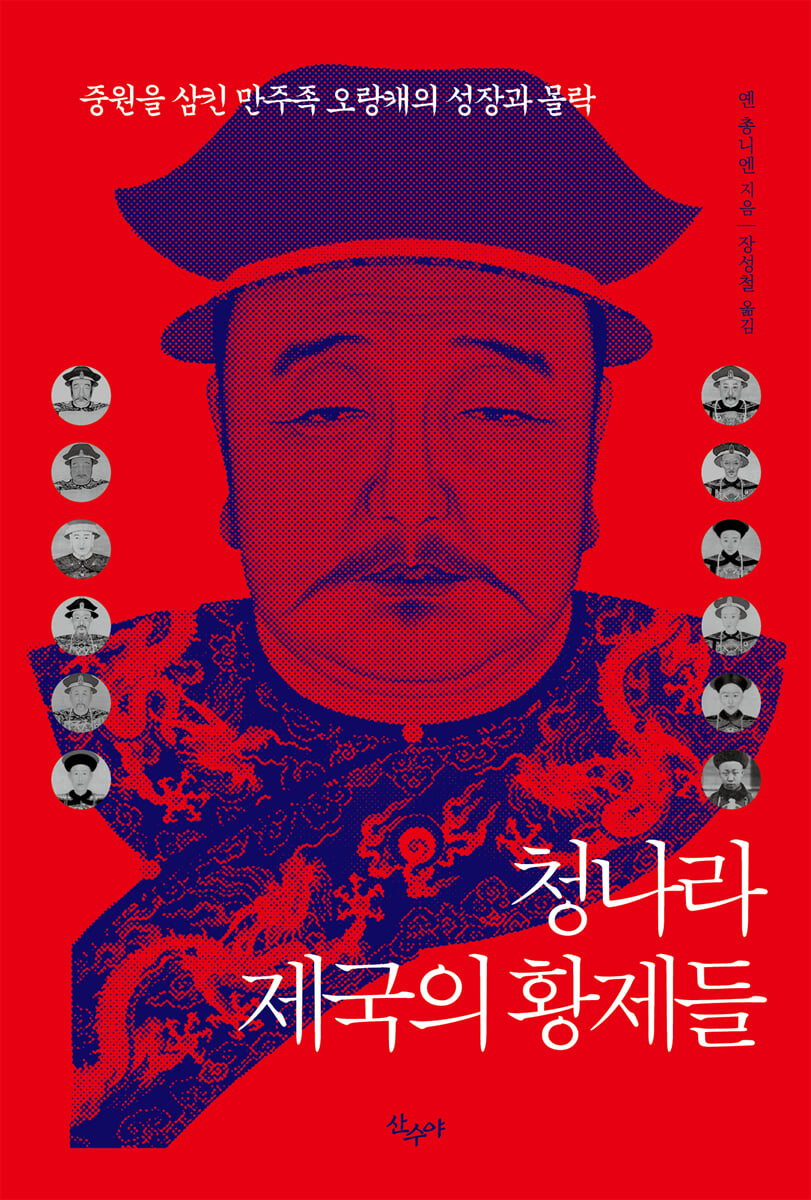
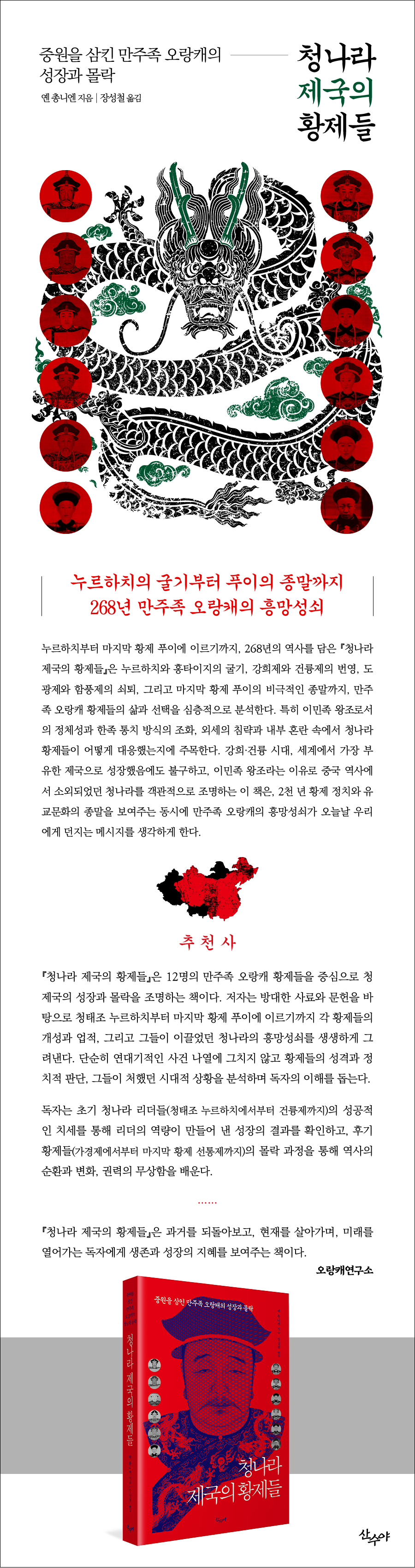
"The Emperors of the Qing Dynasty" vividly illuminates the 268-year rise and fall of the Qing Dynasty, China's last feudal dynasty founded by the barbarian Manchu people.
From the rise of the Nurhaci and Hong Taiji eras, to the prosperity of the Kangxi and Qianlong eras, to the decline of the Daoguang and Xianfeng eras, and to the tragic end of the last emperor, Puyi, this book delves into the lives and choices of the Manchu barbarian emperors.
In particular, it focuses on the harmony between the identity of the Qing dynasty as a foreign dynasty and the Han Chinese ruling style, and how the Qing emperors responded to foreign invasion and internal turmoil.
From Nurhachi to the last emperor Puyi
The story of the Manchu emperor's challenges, successes, and downfall
"The Emperors of the Qing Dynasty" vividly illuminates the 268-year rise and fall of the Qing Dynasty, China's last feudal dynasty founded by the barbarian Manchu people.
From the rise of the Nurhaci and Hong Taiji eras, to the prosperity of the Kangxi and Qianlong eras, to the decline of the Daoguang and Xianfeng eras, and to the tragic end of the last emperor, Puyi, this book delves into the lives and choices of the Manchu barbarian emperors.
In particular, it focuses on the harmony between the identity of the Qing dynasty as a foreign dynasty and the Han Chinese ruling style, and how the Qing emperors responded to foreign invasion and internal turmoil.
- You can preview some of the book's contents.
Preview
index
Recommendation _4
Preface _6
C hapter 1
Nurhachi, the founder of the Qing Dynasty
Nurhaci's Ten Great Achievements and Secrets to Success _19
Unification of the Jurchens | Unification of the Northeast | Creation of the Manchus | Creation of the Eight Banners System | Formation of the Manchus | Establishment of the Later Jin | Reorganization of the Military System | Enactment of a Policy of Appeasement | Promotion of Social Reform | Relocation of the Capital to Shenyang | Realization of Heavenly Harmony | Realization of Earthly Harmony | Realization of Human Harmony | Realization of Spiritual Harmony
The Causes of the Battle of Eternity's Defeat and Tragedy _40
Military stronghold | The first defeat and frustration
C hapter 2
Emperor Chongde Hong Taiji
Civil governance: Abolish corruption and promote new governance _49
Liquidation of old politics, satisfaction, and the Han Chinese regime|Ethnicity: Manchu, State: Great Qing|System established|Creation of Hongyi Cannon and artillery units
Martial Arts: Expanding Territories Around You _55
Conquest of Joseon twice | Conquest of Sakyun | Conquest of the Mongols three times | Conquest of the Central Plains five times
Scheme: Developing a scheme to seize power _60
The Great Khan ascends to power | The Mongol appeasement policy | The Battle of Songji, a demonstration of outstanding military tactics | The elimination of Yuan Chonghuan through a counter-plot
C hapter 3
Emperor Shunzhi Fulin
The Heaven-Blessed Crown of the Qing Empire _76
Manchurian Noble Conference | Dorgon | Compromise
The Heaven-Sent Move to Beijing _81
The Peasant Army Captures Beijing | The Seven-Year-Old Fulin Who Realized the Move of the Capital to Beijing
Unsatisfactory mother-child relationship _85
A 30-Year-Old Single Mother | Mother-Daughter Conflict
The Emperor Who Was Reduced to a Puppet of the Regent _90
Double Shield | Monopoly on Power | Execution of Tiger
Leaving the world following the Dongakbi _93
Dong-Ak-Bi, who was favored by everyone | Dong-Ak-Bi's death
Missionaries and Emperors Who Transcended the Relationship Between Lord and Subject _99
Adam Schall and Empress Dowager Xiaozhang | First-rank Gwangrok Daeboo (光祿大夫)
The Emperor Reborn as the Buddha_102
The Shaving Ceremony of Emperor Shunzhi | A Man of Sorrow
C hapter 4
Emperor Kangxi's Hyeonyeop
The Eight Great Historical Achievements of Emperor Kangxi _112
The pacification of the Three Fronts | Conquest of Taiwan | Signing of the peace treaty | Conquest of the Sakmak (朔漠) | Emphasis on agriculture, strengthening flood control, and improving irrigation facilities | Creation of large-scale gardens | Cultural education and dictionary compilation | Encouragement of science and technology to accept Western learning
Be strict with yourself, but love learning _118
Medicine | Vaccination and Science and Technology | Scientific Instruments | Contributions to World Geography
Carry out state affairs with diligence _126
Dimensions | Mongolian appeasement policy
Pursuing the Idea of Benevolence _134
Woo Seong-ryong | Ge Ergude | Peng Peng | Zhang Boxing
Accepting Western Learning _142
Adam Schall | Verbiest
Implement a strict educational system for your children _146
Important Virtues of Prince Education | Establishing an Education System for Descendants | Training Successors
C hapter 5
Emperor Yongzheng Yun Jin
The Struggle for Status and the Prelude to the Ascension _157
Crown Prince Group | 8th Prince Group | 4th Prince Group | Thorough Loyalty | Brotherly Love | Diligence and Careful Attitude | Class Tolerance
The Ascension to the Throne through Factional Strife _167
Succession to the throne according to the line of succession | Usurpation of the throne | Is the throne legitimate?
The Battle for the Throne and Questions _173
Did he poison Emperor Kangxi? | Did he persecute and murder his biological mother? | Did he murder his older brother and kill his younger brother?
Reform that Connects Above and Opens Below _182
Reorganization of the civil service system | Implementation of the secret system | Establishment of the Military Affairs Office | Implementation of the Gaetogwiryu system | Implementation of the Tanjeongji system | Abolition of natural enemies
Secrets Related to Emperor Yongzheng's Death _190
Theory of Lady Yeo's assassination | Theory of the palace maids' death by skewering | Theory of Jo Seol-geun and Chu Hyang-ok's poisoning | Theory of herbal medicine poisoning | Theory of stroke
C hapter 6
Emperor Qianlong Hongli
Secret of Birthplace _199
Onghwagungseol | Seungdeok Piseosanjangseol
The Emperor Who Didn't Know His Birth Mother _205
Jin Se-gwan's wife theory | Niu Guru theory | Han Chinese court lady Li Ga theory | Han Chinese theory | Southerner theory
Who is Mr. Newuguru? _212
Mr. Jeon and Mr. Newuguru
Cause of Death of the Two Empresses _214
Suicide theory | Dethronement theory
The Mystery of Hyangbi _219
Xiang Fei's Comedy Theory|Xiang Fei's Tragedy Theory|Xiang Fei is a Hui tribe dragon
The Eight Achievements of Emperor Qianlong _225
Compilation of books | Conservation and reconstruction of the imperial gardens | Contributions to poetry and prose | Tax exemption | Unification of Xinjiang | Rule over Tibet | Construction of a dam | Unification of multiple ethnic groups
Chapter 7
Emperor Jiajing Ongyeom
Marked as an Ordinary Emperor _244
Ordinary
Punish the Second Emperor, the Avatar _246
A brilliant Manchurian man|Scholarship and scheming|Information monopolization and impeachment|Imperial relatives|Emperor Gojong's scheme to curry favor|Inducements|Sudden attacks|Manipulation of public opinion|Punishment of the incarnation|Strategy
Crisis lurks everywhere _266
Outstanding Confucian Abilities|Institutional Abuses and Hidden Crisis
C hapter 8
Emperor Daoguang Minning
Confusion Surrounding the Succession to the Imperial Throne _275
Law and Family Law|The Royal Family's Suggestions|The Empress Dowager's Will|The Attitudes of the Ministers|The Records of the Annals
Opium Wars _285
Was the Qing Dynasty's defeat inevitable? | Who is responsible for its defeat?
C hapter 9
Emperor Xianfeng's Hyeokjeo
Ascending to the throne itself is a mistake _297
The Grace of the Empress Sosaeng|From Hyeokheun to Hyeokjeo
It was a mistake to leave the zodiac _303
Did not issue a decree of war to the death | Lack of political strategy | Abandoning the imperial capital and fleeing | Women | Peking opera makeup and direction | Famous wine | Benefiting life as much as mind ointment
It was a mistake to appoint a high-ranking minister _313
The power of the court ministers | The power of the emperors | The power of the feudal lords
C hapter 1 0
Emperor Tongzhi of the Qing Dynasty
Secrets Related to Empress Dowager Cixi _323
Gansu Lanzhou Theory | Zhejiang Shapo Theory | Anhui Wuhu Theory | Inner Mongolia Hohhot Theory | Shanxi Zhangjiang Theory
The Shin Yu Coup, which removed the eight ministers of Chanyang Jeongmu _330
Chengde Group and Beijing Group | The Coup Process
The Tongzhi New Government Begins _340
Establishment of the General Bureau of the General Affairs Office | Inspection of Western civilization | Cultivation of Western talents | Dispatch of students abroad | Westernization movement and strengthening the nation and military | Jiangnan Manufacturing Bureau | Jinling Manufacturing Bureau | Fuzhou Seonjeong Bureau
Controversy over the reconstruction of the Yuanmingyuan _353
The Will to Rebuild the Yuanmingyuan | Groundbreaking Ceremony for the Yuanmingyuan Reconstruction | Empress Dowager Yanggong's Court
The Death and Causes of Emperor Tongzhi's Death _356
Smallpox | Syphilis | Complications of smallpox and syphilis
C hapter 1 1
Emperor Guangxu's re-evaluation
Becoming Emperor by Empress Dowager Cixi's Will _369
Empress Dowager Cixi, who changed the imperial succession system | Empress Dowager Cixi, who changed the imperial succession procedure | Empress Dowager Cixi, who changed the precedent of supporting the young emperor
Empress Dowager Cixi and the Boy Emperor Who Reigned Above the Emperor _376
Prince Chun's Wise Conduct | Emperor Guangxu's Ascension to the Throne | Three Factors in the Formation of Emperor Guangxu's Character | Empress Dowager Ci'an's Death
The Sino-Japanese War and the Reform and Self-Strengthening Movement Ended in Failure _384
The Resistance Argument|The Reform and Self-Strengthening Movement Ended in Failure
Emperor Guangxu and Li Lianying _390
Rumors of a male and female leader | Empress Dowager Cixi's only friend | Excessive favor
A Tragic Personal Story That Ended in Pension _397
The Three Women Who Had the Greatest Influence | Empress Yongyou and Empress Jin
The Secret Surrounding the Death of Emperor Guangxu _403
Theories of Natural Death and Poisoning | Emperor Guangxu Died a Day Before Empress Dowager Cixi
C hapter 1 2
Emperor Puyi of Xuanzong
Empress Dowager Cixi reverses her decision to depose the crown prince _413
Establishing a successor | Deposing the crown prince | Re-establishing a successor to the throne
A turbulent life: ascension, abdication, and restoration _421
Puyi's Ascension to the Throne | Puyi's Abdication | Puyi's Restoration
Change of Status from Citizen to War Criminal to Citizen _435
Citizen of the Republic of Korea | War Criminal | Citizen
Preface _6
C hapter 1
Nurhachi, the founder of the Qing Dynasty
Nurhaci's Ten Great Achievements and Secrets to Success _19
Unification of the Jurchens | Unification of the Northeast | Creation of the Manchus | Creation of the Eight Banners System | Formation of the Manchus | Establishment of the Later Jin | Reorganization of the Military System | Enactment of a Policy of Appeasement | Promotion of Social Reform | Relocation of the Capital to Shenyang | Realization of Heavenly Harmony | Realization of Earthly Harmony | Realization of Human Harmony | Realization of Spiritual Harmony
The Causes of the Battle of Eternity's Defeat and Tragedy _40
Military stronghold | The first defeat and frustration
C hapter 2
Emperor Chongde Hong Taiji
Civil governance: Abolish corruption and promote new governance _49
Liquidation of old politics, satisfaction, and the Han Chinese regime|Ethnicity: Manchu, State: Great Qing|System established|Creation of Hongyi Cannon and artillery units
Martial Arts: Expanding Territories Around You _55
Conquest of Joseon twice | Conquest of Sakyun | Conquest of the Mongols three times | Conquest of the Central Plains five times
Scheme: Developing a scheme to seize power _60
The Great Khan ascends to power | The Mongol appeasement policy | The Battle of Songji, a demonstration of outstanding military tactics | The elimination of Yuan Chonghuan through a counter-plot
C hapter 3
Emperor Shunzhi Fulin
The Heaven-Blessed Crown of the Qing Empire _76
Manchurian Noble Conference | Dorgon | Compromise
The Heaven-Sent Move to Beijing _81
The Peasant Army Captures Beijing | The Seven-Year-Old Fulin Who Realized the Move of the Capital to Beijing
Unsatisfactory mother-child relationship _85
A 30-Year-Old Single Mother | Mother-Daughter Conflict
The Emperor Who Was Reduced to a Puppet of the Regent _90
Double Shield | Monopoly on Power | Execution of Tiger
Leaving the world following the Dongakbi _93
Dong-Ak-Bi, who was favored by everyone | Dong-Ak-Bi's death
Missionaries and Emperors Who Transcended the Relationship Between Lord and Subject _99
Adam Schall and Empress Dowager Xiaozhang | First-rank Gwangrok Daeboo (光祿大夫)
The Emperor Reborn as the Buddha_102
The Shaving Ceremony of Emperor Shunzhi | A Man of Sorrow
C hapter 4
Emperor Kangxi's Hyeonyeop
The Eight Great Historical Achievements of Emperor Kangxi _112
The pacification of the Three Fronts | Conquest of Taiwan | Signing of the peace treaty | Conquest of the Sakmak (朔漠) | Emphasis on agriculture, strengthening flood control, and improving irrigation facilities | Creation of large-scale gardens | Cultural education and dictionary compilation | Encouragement of science and technology to accept Western learning
Be strict with yourself, but love learning _118
Medicine | Vaccination and Science and Technology | Scientific Instruments | Contributions to World Geography
Carry out state affairs with diligence _126
Dimensions | Mongolian appeasement policy
Pursuing the Idea of Benevolence _134
Woo Seong-ryong | Ge Ergude | Peng Peng | Zhang Boxing
Accepting Western Learning _142
Adam Schall | Verbiest
Implement a strict educational system for your children _146
Important Virtues of Prince Education | Establishing an Education System for Descendants | Training Successors
C hapter 5
Emperor Yongzheng Yun Jin
The Struggle for Status and the Prelude to the Ascension _157
Crown Prince Group | 8th Prince Group | 4th Prince Group | Thorough Loyalty | Brotherly Love | Diligence and Careful Attitude | Class Tolerance
The Ascension to the Throne through Factional Strife _167
Succession to the throne according to the line of succession | Usurpation of the throne | Is the throne legitimate?
The Battle for the Throne and Questions _173
Did he poison Emperor Kangxi? | Did he persecute and murder his biological mother? | Did he murder his older brother and kill his younger brother?
Reform that Connects Above and Opens Below _182
Reorganization of the civil service system | Implementation of the secret system | Establishment of the Military Affairs Office | Implementation of the Gaetogwiryu system | Implementation of the Tanjeongji system | Abolition of natural enemies
Secrets Related to Emperor Yongzheng's Death _190
Theory of Lady Yeo's assassination | Theory of the palace maids' death by skewering | Theory of Jo Seol-geun and Chu Hyang-ok's poisoning | Theory of herbal medicine poisoning | Theory of stroke
C hapter 6
Emperor Qianlong Hongli
Secret of Birthplace _199
Onghwagungseol | Seungdeok Piseosanjangseol
The Emperor Who Didn't Know His Birth Mother _205
Jin Se-gwan's wife theory | Niu Guru theory | Han Chinese court lady Li Ga theory | Han Chinese theory | Southerner theory
Who is Mr. Newuguru? _212
Mr. Jeon and Mr. Newuguru
Cause of Death of the Two Empresses _214
Suicide theory | Dethronement theory
The Mystery of Hyangbi _219
Xiang Fei's Comedy Theory|Xiang Fei's Tragedy Theory|Xiang Fei is a Hui tribe dragon
The Eight Achievements of Emperor Qianlong _225
Compilation of books | Conservation and reconstruction of the imperial gardens | Contributions to poetry and prose | Tax exemption | Unification of Xinjiang | Rule over Tibet | Construction of a dam | Unification of multiple ethnic groups
Chapter 7
Emperor Jiajing Ongyeom
Marked as an Ordinary Emperor _244
Ordinary
Punish the Second Emperor, the Avatar _246
A brilliant Manchurian man|Scholarship and scheming|Information monopolization and impeachment|Imperial relatives|Emperor Gojong's scheme to curry favor|Inducements|Sudden attacks|Manipulation of public opinion|Punishment of the incarnation|Strategy
Crisis lurks everywhere _266
Outstanding Confucian Abilities|Institutional Abuses and Hidden Crisis
C hapter 8
Emperor Daoguang Minning
Confusion Surrounding the Succession to the Imperial Throne _275
Law and Family Law|The Royal Family's Suggestions|The Empress Dowager's Will|The Attitudes of the Ministers|The Records of the Annals
Opium Wars _285
Was the Qing Dynasty's defeat inevitable? | Who is responsible for its defeat?
C hapter 9
Emperor Xianfeng's Hyeokjeo
Ascending to the throne itself is a mistake _297
The Grace of the Empress Sosaeng|From Hyeokheun to Hyeokjeo
It was a mistake to leave the zodiac _303
Did not issue a decree of war to the death | Lack of political strategy | Abandoning the imperial capital and fleeing | Women | Peking opera makeup and direction | Famous wine | Benefiting life as much as mind ointment
It was a mistake to appoint a high-ranking minister _313
The power of the court ministers | The power of the emperors | The power of the feudal lords
C hapter 1 0
Emperor Tongzhi of the Qing Dynasty
Secrets Related to Empress Dowager Cixi _323
Gansu Lanzhou Theory | Zhejiang Shapo Theory | Anhui Wuhu Theory | Inner Mongolia Hohhot Theory | Shanxi Zhangjiang Theory
The Shin Yu Coup, which removed the eight ministers of Chanyang Jeongmu _330
Chengde Group and Beijing Group | The Coup Process
The Tongzhi New Government Begins _340
Establishment of the General Bureau of the General Affairs Office | Inspection of Western civilization | Cultivation of Western talents | Dispatch of students abroad | Westernization movement and strengthening the nation and military | Jiangnan Manufacturing Bureau | Jinling Manufacturing Bureau | Fuzhou Seonjeong Bureau
Controversy over the reconstruction of the Yuanmingyuan _353
The Will to Rebuild the Yuanmingyuan | Groundbreaking Ceremony for the Yuanmingyuan Reconstruction | Empress Dowager Yanggong's Court
The Death and Causes of Emperor Tongzhi's Death _356
Smallpox | Syphilis | Complications of smallpox and syphilis
C hapter 1 1
Emperor Guangxu's re-evaluation
Becoming Emperor by Empress Dowager Cixi's Will _369
Empress Dowager Cixi, who changed the imperial succession system | Empress Dowager Cixi, who changed the imperial succession procedure | Empress Dowager Cixi, who changed the precedent of supporting the young emperor
Empress Dowager Cixi and the Boy Emperor Who Reigned Above the Emperor _376
Prince Chun's Wise Conduct | Emperor Guangxu's Ascension to the Throne | Three Factors in the Formation of Emperor Guangxu's Character | Empress Dowager Ci'an's Death
The Sino-Japanese War and the Reform and Self-Strengthening Movement Ended in Failure _384
The Resistance Argument|The Reform and Self-Strengthening Movement Ended in Failure
Emperor Guangxu and Li Lianying _390
Rumors of a male and female leader | Empress Dowager Cixi's only friend | Excessive favor
A Tragic Personal Story That Ended in Pension _397
The Three Women Who Had the Greatest Influence | Empress Yongyou and Empress Jin
The Secret Surrounding the Death of Emperor Guangxu _403
Theories of Natural Death and Poisoning | Emperor Guangxu Died a Day Before Empress Dowager Cixi
C hapter 1 2
Emperor Puyi of Xuanzong
Empress Dowager Cixi reverses her decision to depose the crown prince _413
Establishing a successor | Deposing the crown prince | Re-establishing a successor to the throne
A turbulent life: ascension, abdication, and restoration _421
Puyi's Ascension to the Throne | Puyi's Abdication | Puyi's Restoration
Change of Status from Citizen to War Criminal to Citizen _435
Citizen of the Republic of Korea | War Criminal | Citizen
Detailed image
Into the book
Nurhachi realized the value of life to the fullest extent by practicing 'harmony of heaven, harmony of earth, harmony of humanity, and spirit' throughout his life.
However, as Nurhachi continued to advance towards the pinnacle of his great cause, he met Yuan Chonghuan of the Ming Dynasty and, although he had always lived a comical life, he met a tragic fate.
--- p.40
Hong Taiji's death marked the end of another dynasty in the Qing Dynasty, but also the completion of the great undertaking of founding the Great Qing Empire.
During the 60 years of the reigns of Qing Taizu and Qing Taizong, the Qing Dynasty established its capital in Beijing and laid the foundation for unifying the Central Plains.
--- p.74
Kangxi was the fourth emperor of the Qing Dynasty, the second emperor established after the capital was moved to Beijing, and the emperor who succeeded the first among the six emperors of the early Qing Dynasty.
Although the Qing Dynasty was founded, even the Shunzhi Emperor failed to achieve a wealthy and powerful country.
Therefore, preserving the achievements of our ancestors was still as important as starting a business.
--- p.108
The first year of Yongzheng (1723) marked the 80th anniversary of the Qing Dynasty entering the territory.
Social contradictions were tangled and deeply rooted.
Emperor Yongzheng achieved great success with his strong energy, extensive knowledge, rich experience, and outstanding decision-making skills.
If Emperor Kangxi admired generosity and kindness, Emperor Yongzheng admired solemnity and fierceness.
--- p.182
Among the twelve emperors of the Qing Dynasty, only Nurhaci and Qianlong have unknown birthplaces.
When Nurhachi was born, there was no Manchurian script and he was not a very important figure at the time.
Therefore, the place of birth may be unclear.
However, Emperor Qianlong was the fourth prince of Emperor Yongzheng and was born on August 13, 1711, the 50th year of Emperor Kangxi's reign, but his birthplace is unclear, which can be seen as suspicious.
--- p.199
Emperor Xianfeng's 11 years as emperor were truly a series of 'mistakes'.
Ascending to the throne itself was the first mistake, escaping from Beijing when the British and French allied forces invaded the imperial capital was the second mistake, and appointing the eight most important ministers before his death was the third mistake.
--- p.297
In “The First Half of My Life,” it is also said, “Rumors circulated that Empress Dowager Cixi knew that her illness was critical and was not willing to die before Emperor Guangxu, so she poisoned him first.”
In this way, people generally believed that it was no coincidence that the 38-year-old Guangxu Emperor died before the 74-year-old Empress Dowager Cixi, and that she had tried every means possible to kill the Guangxu Emperor.
However, as Nurhachi continued to advance towards the pinnacle of his great cause, he met Yuan Chonghuan of the Ming Dynasty and, although he had always lived a comical life, he met a tragic fate.
--- p.40
Hong Taiji's death marked the end of another dynasty in the Qing Dynasty, but also the completion of the great undertaking of founding the Great Qing Empire.
During the 60 years of the reigns of Qing Taizu and Qing Taizong, the Qing Dynasty established its capital in Beijing and laid the foundation for unifying the Central Plains.
--- p.74
Kangxi was the fourth emperor of the Qing Dynasty, the second emperor established after the capital was moved to Beijing, and the emperor who succeeded the first among the six emperors of the early Qing Dynasty.
Although the Qing Dynasty was founded, even the Shunzhi Emperor failed to achieve a wealthy and powerful country.
Therefore, preserving the achievements of our ancestors was still as important as starting a business.
--- p.108
The first year of Yongzheng (1723) marked the 80th anniversary of the Qing Dynasty entering the territory.
Social contradictions were tangled and deeply rooted.
Emperor Yongzheng achieved great success with his strong energy, extensive knowledge, rich experience, and outstanding decision-making skills.
If Emperor Kangxi admired generosity and kindness, Emperor Yongzheng admired solemnity and fierceness.
--- p.182
Among the twelve emperors of the Qing Dynasty, only Nurhaci and Qianlong have unknown birthplaces.
When Nurhachi was born, there was no Manchurian script and he was not a very important figure at the time.
Therefore, the place of birth may be unclear.
However, Emperor Qianlong was the fourth prince of Emperor Yongzheng and was born on August 13, 1711, the 50th year of Emperor Kangxi's reign, but his birthplace is unclear, which can be seen as suspicious.
--- p.199
Emperor Xianfeng's 11 years as emperor were truly a series of 'mistakes'.
Ascending to the throne itself was the first mistake, escaping from Beijing when the British and French allied forces invaded the imperial capital was the second mistake, and appointing the eight most important ministers before his death was the third mistake.
--- p.297
In “The First Half of My Life,” it is also said, “Rumors circulated that Empress Dowager Cixi knew that her illness was critical and was not willing to die before Emperor Guangxu, so she poisoned him first.”
In this way, people generally believed that it was no coincidence that the 38-year-old Guangxu Emperor died before the 74-year-old Empress Dowager Cixi, and that she had tried every means possible to kill the Guangxu Emperor.
--- p.406
Publisher's Review
"The Emperors of the Qing Empire" is a book that illuminates the rise and fall of the Qing Empire, focusing on twelve Manchu barbarian emperors.
Drawing on extensive historical materials and literature, the author vividly portrays the individuality and achievements of each emperor, from the founder of the Qing Dynasty, Nurhachi, to the last emperor, Puyi, and the rise and fall of the Qing Dynasty they led.
Rather than simply listing chronological events, it helps readers understand by analyzing the emperors' personalities, political judgments, and the circumstances of the times they faced.
Readers will learn about the cycles and changes of history and the transience of power through the successful reigns of early Qing leaders (from Emperor Taizu Nurhachi to the Qianlong Emperor), and through the downfalls of later emperors (from Emperor Jiaqing to the last emperor, Emperor Xuanzong).
The importance of leaders in organizations such as companies and countries cannot be overemphasized.
The Jurchen people, who were desperate to survive in the gap between Joseon and the Ming Dynasty, were reborn as the Manchu people and conquered Joseon and even the Ming Dynasty in the Central Plains. In the process of growth, there were leaders who were deeply united in the spirit of barbarians.
The leadership of Nurhaci, Hong Taiji, Shunzhi, Kangxi, Qianlong, and the early Qing emperors was outstanding.
Although they had wealth and power, they did not give up the 'free and strong wildness characteristic of barbarians' and possessed 'the discipline to keep to the rules they had set for themselves'.
And based on this wildness and discipline, it possesses 'openness to actively accept differences for survival', 'practicality to persistently pursue profit for growth', and 'strategy to skillfully handle change for sustainability'.
As a result, they were able to overcome the limitations of the border barbarians and fully project their power into the Central Plains.
However, the downfall of the later Qing emperors, who lost the strengths of their predecessors, also provides valuable lessons for readers.
The lesson is that no matter how great or strong the power, it cannot exceed the ability of the leader to handle it.
The power base of the later Qing emperors, including Jia Jing, was incomparably more stable than that of their predecessors.
Yet, they ultimately failed to rule the empire.
Because they lost the five barbarian spirits of the previous emperors, namely, 'wildness, discipline, openness, practicality, and strategy', they were unable to overcome domestic and foreign challenges.
"The Emperors of the Qing Dynasty" is a book that shows readers the wisdom of survival and growth as they look back on the past, live in the present, and open up the future.
A sharp dissection of the history of power shaped by human desire and choice.
The 268 years of suffocating power of the Qing Dynasty are sharply dissected through the 12 emperors.
Rather than simply listing the chronology, it vividly depicts the desires and ambitions of the people who held the fate of the empire in their hands, and the rise and fall brought about by their choices.
Nurhachi's founding of the nation, which felt like walking on a knife's edge, the ruthless strategist Hong Taiji's breathtaking seizure of power, the bloody battles with the Ming Dynasty, and the shadow of the label of a foreigner cast over them, forced Nurhachi and Hong Taiji to build the framework of a new empire.
Each of their choices was like a bomb that would soon determine the fate of the empire.
The Kangxi, Yongzheng, and Qianlong eras, shining with splendid golden light, the so-called 'Kang-Qian prosperous era'.
They commanded vast territories, accumulated enormous wealth, and developed a brilliant culture.
But behind that glamour, there was a bloody power struggle and a stark contrast between the haves and have-nots.
How on earth did they manage to walk this precarious tightrope?
It vividly conveys the harsh truth of history's ups and downs.
There is no eternal power.
After the Daoguang Emperor, the once-glorious Qing Empire began to show signs of gradual collapse.
The invasion of the fierce Western powers weighed on the heart of the empire, and rebellions erupting everywhere suffocated the empire.
Emperors Xianfeng, Tongzhi, and Guangxu desperately tried to hold on to their collapsing empire, but they were helpless against the great waves of history.
And the tragic fate of the last emperor, Puyi, thrown into a turbulent era, further highlighted the miserable downfall of an empire that once commanded the world.
"The Emperors of the Qing Dynasty" offers a story more thrilling than a thriller and more heartbreaking than a tragedy.
The harsh truth of history, its rise and fall, is vividly conveyed through the lives of each emperor and their choices, as if it were unfolding before your eyes.
Readers of this book will witness how the great wheel of history rolls over the destinies of men and empires.
Drawing on extensive historical materials and literature, the author vividly portrays the individuality and achievements of each emperor, from the founder of the Qing Dynasty, Nurhachi, to the last emperor, Puyi, and the rise and fall of the Qing Dynasty they led.
Rather than simply listing chronological events, it helps readers understand by analyzing the emperors' personalities, political judgments, and the circumstances of the times they faced.
Readers will learn about the cycles and changes of history and the transience of power through the successful reigns of early Qing leaders (from Emperor Taizu Nurhachi to the Qianlong Emperor), and through the downfalls of later emperors (from Emperor Jiaqing to the last emperor, Emperor Xuanzong).
The importance of leaders in organizations such as companies and countries cannot be overemphasized.
The Jurchen people, who were desperate to survive in the gap between Joseon and the Ming Dynasty, were reborn as the Manchu people and conquered Joseon and even the Ming Dynasty in the Central Plains. In the process of growth, there were leaders who were deeply united in the spirit of barbarians.
The leadership of Nurhaci, Hong Taiji, Shunzhi, Kangxi, Qianlong, and the early Qing emperors was outstanding.
Although they had wealth and power, they did not give up the 'free and strong wildness characteristic of barbarians' and possessed 'the discipline to keep to the rules they had set for themselves'.
And based on this wildness and discipline, it possesses 'openness to actively accept differences for survival', 'practicality to persistently pursue profit for growth', and 'strategy to skillfully handle change for sustainability'.
As a result, they were able to overcome the limitations of the border barbarians and fully project their power into the Central Plains.
However, the downfall of the later Qing emperors, who lost the strengths of their predecessors, also provides valuable lessons for readers.
The lesson is that no matter how great or strong the power, it cannot exceed the ability of the leader to handle it.
The power base of the later Qing emperors, including Jia Jing, was incomparably more stable than that of their predecessors.
Yet, they ultimately failed to rule the empire.
Because they lost the five barbarian spirits of the previous emperors, namely, 'wildness, discipline, openness, practicality, and strategy', they were unable to overcome domestic and foreign challenges.
"The Emperors of the Qing Dynasty" is a book that shows readers the wisdom of survival and growth as they look back on the past, live in the present, and open up the future.
A sharp dissection of the history of power shaped by human desire and choice.
The 268 years of suffocating power of the Qing Dynasty are sharply dissected through the 12 emperors.
Rather than simply listing the chronology, it vividly depicts the desires and ambitions of the people who held the fate of the empire in their hands, and the rise and fall brought about by their choices.
Nurhachi's founding of the nation, which felt like walking on a knife's edge, the ruthless strategist Hong Taiji's breathtaking seizure of power, the bloody battles with the Ming Dynasty, and the shadow of the label of a foreigner cast over them, forced Nurhachi and Hong Taiji to build the framework of a new empire.
Each of their choices was like a bomb that would soon determine the fate of the empire.
The Kangxi, Yongzheng, and Qianlong eras, shining with splendid golden light, the so-called 'Kang-Qian prosperous era'.
They commanded vast territories, accumulated enormous wealth, and developed a brilliant culture.
But behind that glamour, there was a bloody power struggle and a stark contrast between the haves and have-nots.
How on earth did they manage to walk this precarious tightrope?
It vividly conveys the harsh truth of history's ups and downs.
There is no eternal power.
After the Daoguang Emperor, the once-glorious Qing Empire began to show signs of gradual collapse.
The invasion of the fierce Western powers weighed on the heart of the empire, and rebellions erupting everywhere suffocated the empire.
Emperors Xianfeng, Tongzhi, and Guangxu desperately tried to hold on to their collapsing empire, but they were helpless against the great waves of history.
And the tragic fate of the last emperor, Puyi, thrown into a turbulent era, further highlighted the miserable downfall of an empire that once commanded the world.
"The Emperors of the Qing Dynasty" offers a story more thrilling than a thriller and more heartbreaking than a tragedy.
The harsh truth of history, its rise and fall, is vividly conveyed through the lives of each emperor and their choices, as if it were unfolding before your eyes.
Readers of this book will witness how the great wheel of history rolls over the destinies of men and empires.
GOODS SPECIFICS
- Date of issue: March 5, 2025
- Page count, weight, size: 440 pages | 153*224*220mm
- ISBN13: 9788980976294
You may also like
카테고리
korean


korean

![GQ KOREA Mark (Monthly): December [2025]](http://librairie.coreenne.fr/cdn/shop/files/8ef265dbbfbf186523ed75ba7319009d.jpg?v=1765340328&width=3840)


