

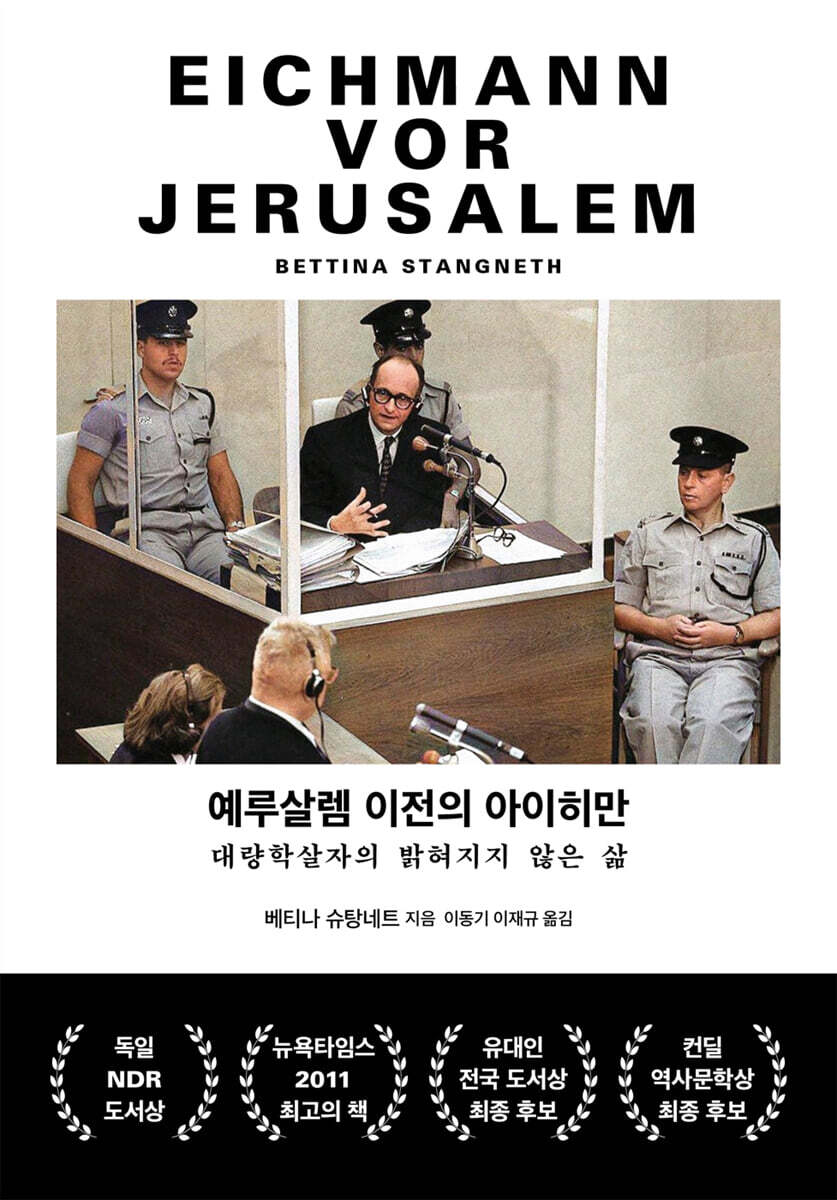
Eichmann before Jerusalem
 |
Description
Book Introduction
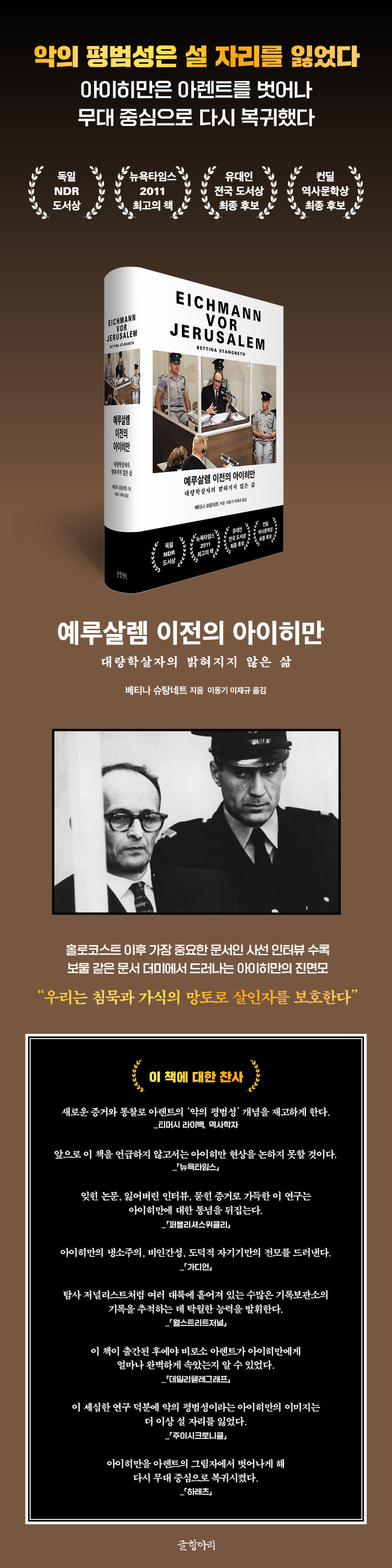
A study filled with forgotten papers, lost interviews, and buried evidence.
Analysis of 1,300 pages of transcripts
“Arendt was too hasty and dangerous.”
*German NDR Book Award*
*New York Times Best Books of 2011*
*Finalist for the Jewish National Book Award*
*Finalist for the Condill Historical Literature Award*
Why Eichmann 'before' Jerusalem Matters
Hannah Arendt was born on October 14, 1906.
Seven months earlier, on March 19, Adolf Eichmann came into the world.
Two people of the same age are victims and perpetrators of the Holocaust.
Arendt wrote Eichmann in Jerusalem with Eichmann as the main character.
Eichmann also wrote "Others Have Spoken, Now It's My Turn!" with himself as the main character.
Arendt wrote this book after attending the Jerusalem trial in 1961, but later scholars have spent far more time hunched over in the archives, tracing, reading, and interpreting the material Eichmann left behind.
Stannett, author of “Eichmann Before Jerusalem,” is one of them.
Eichmann's manuscripts, written in poor handwriting, would total 240 kilometers, and she read them as soon as she got her hands on them.
He then evaluates Arendt as “too hasty and, above all, dangerous.”
This is the first rebuttal in 50 years since the publication of Arendt's book.
This assessment was possible because research has accumulated over the decades since Arendt's writing, data has been continuously collected, and statistical data has been produced.
And now, to rephrase, Eichmann was not a symbol of the “banality of evil,” but rather a man who murdered Jews in a very skillful and systematic manner.
Eichmann Before Jerusalem traces Eichmann's life before he appeared before the Jerusalem court.
Arendt's book still has contemporary value.
However, Arendt was unaware of Eichmann's detailed records as a fanatical Kantian, nor of his debates with the radical theologian William Hull over the philosophy of religion.
Nor did he know that in court Eichmann had filled most of his final statement with Kant's words before being interrupted by his lawyer.
Arendt realized that Eichmann was trying to appear like a philosopher, but she mistakenly concluded that this stemmed from foolish vanity and a lack of philosophical knowledge.
The existence of audiotapes and transcripts of conversations held by Eichmann in exile in Argentina has long been known, but their poor quality has prevented systematic investigation.
Stannett, a philosopher and historian, intends to decipher these tapes and organize them with previously unknown materials to provide a complete analysis of Eichmann.
The first half of this book, which runs over 850 pages, sheds light on Eichmann's life during World War II and his life on the run after the war.
He meticulously planned his escape, using forged identification, multiple aliases, and lying about his escape route.
But after settling in Argentina, he did not hide himself.
It was because he had a strong desire to reveal his name and existence, and it was lamentable that he could only kill 6 million Jews, not 10.3 million.
Moreover, he cared for his family and even gave birth to a fourth child with his wife during his time on the run.
Eichmann was not, as Arendt noted, a man of “genuinely adequate mental talents,” “lacking judgment,” and “incapable of self-expression.”
Abner Res, who interrogated Eichmann for 300 hours in Israel, described him as “well-informed, very intelligent and experienced.”
Eichmann had an intellectual system that distorted every text to suit his own needs, but he was also a man who, in addition to Kant, quoted Nietzsche, Plato, and Schopenhauer, and even drew on the texts of the Jewish Spinoza to defend himself.
Analysis of 1,300 pages of transcripts
“Arendt was too hasty and dangerous.”
*German NDR Book Award*
*New York Times Best Books of 2011*
*Finalist for the Jewish National Book Award*
*Finalist for the Condill Historical Literature Award*
Why Eichmann 'before' Jerusalem Matters
Hannah Arendt was born on October 14, 1906.
Seven months earlier, on March 19, Adolf Eichmann came into the world.
Two people of the same age are victims and perpetrators of the Holocaust.
Arendt wrote Eichmann in Jerusalem with Eichmann as the main character.
Eichmann also wrote "Others Have Spoken, Now It's My Turn!" with himself as the main character.
Arendt wrote this book after attending the Jerusalem trial in 1961, but later scholars have spent far more time hunched over in the archives, tracing, reading, and interpreting the material Eichmann left behind.
Stannett, author of “Eichmann Before Jerusalem,” is one of them.
Eichmann's manuscripts, written in poor handwriting, would total 240 kilometers, and she read them as soon as she got her hands on them.
He then evaluates Arendt as “too hasty and, above all, dangerous.”
This is the first rebuttal in 50 years since the publication of Arendt's book.
This assessment was possible because research has accumulated over the decades since Arendt's writing, data has been continuously collected, and statistical data has been produced.
And now, to rephrase, Eichmann was not a symbol of the “banality of evil,” but rather a man who murdered Jews in a very skillful and systematic manner.
Eichmann Before Jerusalem traces Eichmann's life before he appeared before the Jerusalem court.
Arendt's book still has contemporary value.
However, Arendt was unaware of Eichmann's detailed records as a fanatical Kantian, nor of his debates with the radical theologian William Hull over the philosophy of religion.
Nor did he know that in court Eichmann had filled most of his final statement with Kant's words before being interrupted by his lawyer.
Arendt realized that Eichmann was trying to appear like a philosopher, but she mistakenly concluded that this stemmed from foolish vanity and a lack of philosophical knowledge.
The existence of audiotapes and transcripts of conversations held by Eichmann in exile in Argentina has long been known, but their poor quality has prevented systematic investigation.
Stannett, a philosopher and historian, intends to decipher these tapes and organize them with previously unknown materials to provide a complete analysis of Eichmann.
The first half of this book, which runs over 850 pages, sheds light on Eichmann's life during World War II and his life on the run after the war.
He meticulously planned his escape, using forged identification, multiple aliases, and lying about his escape route.
But after settling in Argentina, he did not hide himself.
It was because he had a strong desire to reveal his name and existence, and it was lamentable that he could only kill 6 million Jews, not 10.3 million.
Moreover, he cared for his family and even gave birth to a fourth child with his wife during his time on the run.
Eichmann was not, as Arendt noted, a man of “genuinely adequate mental talents,” “lacking judgment,” and “incapable of self-expression.”
Abner Res, who interrogated Eichmann for 300 hours in Israel, described him as “well-informed, very intelligent and experienced.”
Eichmann had an intellectual system that distorted every text to suit his own needs, but he was also a man who, in addition to Kant, quoted Nietzsche, Plato, and Schopenhauer, and even drew on the texts of the Jewish Spinoza to defend himself.
- You can preview some of the book's contents.
Preview
index
Preface to the Korean edition
Main characters
introduction
Chapter 1: "My Name Has Become a Symbol"
1.
The Path to Public Life
2.
Post-war history
3.
Aversion to anonymity
Chapter 2 Interlude
Fake traces of the Near East
Chapter 3 Eichmann in Argentina
1.
Life in the "Promised Land"
2.
Home front
3.
Work of Friendship
Chapter 4: The So-Called Diagonal Interview
1.
Author Eichmann
2.
Eichmann talking
Chapter 5: The Illusion of Safety
Chapter 6 Role Change
Eichmann in Jerusalem
Chapter 7 Behind the Scenes
Acknowledgements
Translator's Note
Main characters
introduction
Chapter 1: "My Name Has Become a Symbol"
1.
The Path to Public Life
2.
Post-war history
3.
Aversion to anonymity
Chapter 2 Interlude
Fake traces of the Near East
Chapter 3 Eichmann in Argentina
1.
Life in the "Promised Land"
2.
Home front
3.
Work of Friendship
Chapter 4: The So-Called Diagonal Interview
1.
Author Eichmann
2.
Eichmann talking
Chapter 5: The Illusion of Safety
Chapter 6 Role Change
Eichmann in Jerusalem
Chapter 7 Behind the Scenes
Acknowledgements
Translator's Note
Detailed image
Into the book
Opinions remain sharply divided, past and present, about exactly where criminals like Adolf Eichmann should be placed.
Some scholars have argued that he was an ordinary man who became a murderer without the ability to reason under a totalitarian regime.
Some other scholars saw him as a radical anti-Semite intent on extermination.
Other scholars have considered him a psychopath who simply used the Nazi regime to provide an excuse for his sadism.
As a result, many contradictory images about Eichmann were created.
It was more extreme in the debate surrounding Hannah Arendt's Report on the Banality of Evil.
But there is a perspective that has been left out of the discussion so far.
That's public opinion.
In other words, the 'Eichmann phenomenon' before Jerusalem and the image of Eichmann at various times in his life were missing.
--- p.26
It is easy to be deceived by this way of life and mistake Eichmann for a literary enthusiast who was somewhat politically shallow but interested in academics.
This would be especially true if the historical records did not reveal that he was meticulously working to denounce Jews, conducting anti-Semitic propaganda, and arresting and interrogating people with the Gestapo, even while chatting in cafes, writing and presenting texts, or reading and discussing professional literature with colleagues.
--- p.48
If he were a lowly commanding officer, he would probably look weak.
But did SS Lieutenant Colonel Eichmann waver? "That couldn't be possible." Eichmann was a symbol.
--- p.88
Anyone who has experienced pain, humiliation, and loss does not want to become a victim of such an opponent.
Because it is more bearable to think that a powerful person has power over us than to think that an insignificant person has power over us.
But that kind of cognitive approach makes it difficult to properly identify the perpetrator.
It not only facilitates the dynamics of symbol creation, but also increases the scope for exercising power by reducing and limiting judgment.
--- p.90~91
Eichmann's power was very high.
Because I went on a business trip “by special order from the President.”
But in a system where human relationships are important, real influence comes from personal contact with those in power.
While the support of the Führer's Office in consultations with the Reich Ministry of the Interior would make a strong impression, the mention of being able to inform Himmler personally would have a greater impact.
From a distance, Eichmann's frequent threats from 1943 onwards that he would fly to Himmler if there was no progress in negotiations seem as ridiculous as saying, "I'll tell Mom everything."
But in a system that is both a presidential system and a system of private dependence, the threat posed by such words cannot be ignored.
--- p.101
Eichmann focused all his senses on surviving.
The forest was quiet and there was plenty to eat.
He felt relieved to have his daily routine back and had time to reflect on his life.
In Argentina, Eichmann said, “In 1946, I wrote down what I remembered and the statistics that were still vivid in my mind.”
Given his circumstances at the time and his later explosion of writing urges, there is no reason to call such actions particularly meditative.
It was not that Eichmann's thoughts changed, but that he had no office desk at the time.
Moreover, looking back on one's life in this way was not an effort to understand one's own actions.
It was done in a situation where what he had previously considered an achievement was condemned as a crime.
Eichmann was not interested in finding the truth, but rather in defending himself well in case he were to stand trial.
--- p.147~148
There has been no systematic research yet on those who choose such escape.
The advantage of that road at the time was that there was no proper judging there.
Anyway, Otto Henninger didn't just suddenly disappear or run away like a thief.
He paid his overdue rent and said goodbye to his neighbors in Altensaltzkort.
For that reason, no one questioned it and no one reported it to the police.
In the residents' memories, he was just a nice guest and neighbor who lived there for four years.
Those who missed his quiet personality or his violin playing found solace in looking at his wedding photos.
--- p.173
Eichmann also utilized a network of organizations assisted by professional mediators working under the direction of various agencies, particularly Argentine President Juan Perón.
Argentina was keen to attract German experts to help it transition from an agricultural to an industrial nation.
Because of this, helping the Germans escape was seen as a worthwhile investment.
Post-war Europe was a good base for knowledge transfer.
In the ruined land of Europe, everyone had no choice but to look for new opportunities, and they were drawn to suitable jobs when they arose.
Argentina was not the only country willing to accept well-trained immigrants.
But Argentina was one of the few countries that even gave criminals like Eichmann a chance.
--- p.177
Eichmann, who had spent his entire life pursuing a career in crime, knew how to use his public image to his advantage.
--- p.285
Eichmann played violin melodies to thousands of chickens and white rabbits.
Still, the income was very good.
Eichmann said he earned 4,500 pesos, or about 1,000 marks.
At that time, an unexpected situation occurred and the family was in urgent need of money.
Vera Eichmann was pregnant again.
Five years later, Eichmann expressed his feelings at that time in special words.
“We were extremely happy to have our fourth son.”
--- p.297
Eichmann enjoyed the game of argument, the power of words, and his ability to manipulate.
Eichmann's writings are always marked by a desire to influence, a desire to lead the reader to his will and force him to accept his thought patterns.
Some scholars have argued that he was an ordinary man who became a murderer without the ability to reason under a totalitarian regime.
Some other scholars saw him as a radical anti-Semite intent on extermination.
Other scholars have considered him a psychopath who simply used the Nazi regime to provide an excuse for his sadism.
As a result, many contradictory images about Eichmann were created.
It was more extreme in the debate surrounding Hannah Arendt's Report on the Banality of Evil.
But there is a perspective that has been left out of the discussion so far.
That's public opinion.
In other words, the 'Eichmann phenomenon' before Jerusalem and the image of Eichmann at various times in his life were missing.
--- p.26
It is easy to be deceived by this way of life and mistake Eichmann for a literary enthusiast who was somewhat politically shallow but interested in academics.
This would be especially true if the historical records did not reveal that he was meticulously working to denounce Jews, conducting anti-Semitic propaganda, and arresting and interrogating people with the Gestapo, even while chatting in cafes, writing and presenting texts, or reading and discussing professional literature with colleagues.
--- p.48
If he were a lowly commanding officer, he would probably look weak.
But did SS Lieutenant Colonel Eichmann waver? "That couldn't be possible." Eichmann was a symbol.
--- p.88
Anyone who has experienced pain, humiliation, and loss does not want to become a victim of such an opponent.
Because it is more bearable to think that a powerful person has power over us than to think that an insignificant person has power over us.
But that kind of cognitive approach makes it difficult to properly identify the perpetrator.
It not only facilitates the dynamics of symbol creation, but also increases the scope for exercising power by reducing and limiting judgment.
--- p.90~91
Eichmann's power was very high.
Because I went on a business trip “by special order from the President.”
But in a system where human relationships are important, real influence comes from personal contact with those in power.
While the support of the Führer's Office in consultations with the Reich Ministry of the Interior would make a strong impression, the mention of being able to inform Himmler personally would have a greater impact.
From a distance, Eichmann's frequent threats from 1943 onwards that he would fly to Himmler if there was no progress in negotiations seem as ridiculous as saying, "I'll tell Mom everything."
But in a system that is both a presidential system and a system of private dependence, the threat posed by such words cannot be ignored.
--- p.101
Eichmann focused all his senses on surviving.
The forest was quiet and there was plenty to eat.
He felt relieved to have his daily routine back and had time to reflect on his life.
In Argentina, Eichmann said, “In 1946, I wrote down what I remembered and the statistics that were still vivid in my mind.”
Given his circumstances at the time and his later explosion of writing urges, there is no reason to call such actions particularly meditative.
It was not that Eichmann's thoughts changed, but that he had no office desk at the time.
Moreover, looking back on one's life in this way was not an effort to understand one's own actions.
It was done in a situation where what he had previously considered an achievement was condemned as a crime.
Eichmann was not interested in finding the truth, but rather in defending himself well in case he were to stand trial.
--- p.147~148
There has been no systematic research yet on those who choose such escape.
The advantage of that road at the time was that there was no proper judging there.
Anyway, Otto Henninger didn't just suddenly disappear or run away like a thief.
He paid his overdue rent and said goodbye to his neighbors in Altensaltzkort.
For that reason, no one questioned it and no one reported it to the police.
In the residents' memories, he was just a nice guest and neighbor who lived there for four years.
Those who missed his quiet personality or his violin playing found solace in looking at his wedding photos.
--- p.173
Eichmann also utilized a network of organizations assisted by professional mediators working under the direction of various agencies, particularly Argentine President Juan Perón.
Argentina was keen to attract German experts to help it transition from an agricultural to an industrial nation.
Because of this, helping the Germans escape was seen as a worthwhile investment.
Post-war Europe was a good base for knowledge transfer.
In the ruined land of Europe, everyone had no choice but to look for new opportunities, and they were drawn to suitable jobs when they arose.
Argentina was not the only country willing to accept well-trained immigrants.
But Argentina was one of the few countries that even gave criminals like Eichmann a chance.
--- p.177
Eichmann, who had spent his entire life pursuing a career in crime, knew how to use his public image to his advantage.
--- p.285
Eichmann played violin melodies to thousands of chickens and white rabbits.
Still, the income was very good.
Eichmann said he earned 4,500 pesos, or about 1,000 marks.
At that time, an unexpected situation occurred and the family was in urgent need of money.
Vera Eichmann was pregnant again.
Five years later, Eichmann expressed his feelings at that time in special words.
“We were extremely happy to have our fourth son.”
--- p.297
Eichmann enjoyed the game of argument, the power of words, and his ability to manipulate.
Eichmann's writings are always marked by a desire to influence, a desire to lead the reader to his will and force him to accept his thought patterns.
--- p.401
Publisher's Review
Eichmann as a forest ranger, poultry farmer, rabbit breeder, and Benz worker
As the head of the Security Service, Eichmann planned and implemented Germany's policy of extermination of Jews after the Wannsee Conference in 1942, and was particularly responsible for the deaths of three-quarters of Hungary's Jews.
But after the war, he enjoyed 15 years of freedom.
How could this be possible?
Unlike what we know today, information about the Holocaust was still inadequate after the war.
This ignorance allowed Nazi figures to escape severe punishment, and was compounded by the incompetence, indifference, and even complicity of the intelligence agencies and police.
The contest took place at several levels.
They planned political subversion, networked with like-minded individuals, and forged documents to promote the Nazis' splendid worldview.
And right in the middle of it all was Eichmann.
With the help of former Nazis, Eichmann moved to Austria, where he took on the new name Otto Henninger and a job as a rabbit breeder.
Eichmann, who played the violin as a hobby, also used his instrument to seduce local women during this period.
He also claimed that it was merely a coincidence that he had a career under Hitler, and that it was other people under the Nazi regime who were evil.
In 1950, Otto Henninger suddenly disappeared from Europe.
Instead, a man named Ricardo Clement emerged in Argentina.
Brokers created new names and identities for us.
Clement entered the hydroelectric power plant project and led the surveying team.
He also lived a life of leisure, roaming the Pampas region on horseback and even climbing Mount Aconcagua.
The wife who reported Eichmann's death came over here with her children and was reunited with her husband.
It had been seven years since we broke up.
The couple had a happy marriage and soon had a fourth son.
If he had lived his whole life under the name Clement, Eichmann might not have been caught.
However, having made his presence felt as an official in charge of Jewish affairs under the Nazis, he was not satisfied with rural life and gradually expanded the scope of his activities.
And in foreign countries, he met with Nazi figures and far-right journalists and revealed his identity.
The conversation with Saseon, which forms the main source of this book, begins in 1957, although it is not clear exactly when the two first met.
Because Argentina is trying to hide its deep ties to the German immigrant community with Nazi past.
Anyway, Eichmann was attracted to the journalist Saseon because Saseon was a writer.
The charismatic Saseon had a modern style and a secret to captivating readers.
He was expanding his influence not only in Argentina but also in post-war Germany through the far-right magazine Road.
The desire to become an author, to attract readers, and the obsession with far-right ideology were commonalities between Eichmann and Saseon.
In particular, the line sought to obtain from Eichmann the materials and testimony needed to write a book that would disprove Jewish claims about the Holocaust.
But in the late 1950s, as the outlines of the Holocaust crimes began to emerge, the former Nazis' hiding places began to tighten.
In February 1959, an arrest warrant was first issued for Josef Mengele.
He immediately went into hiding in Paraguay.
As the public became more aware of the mass murder, Eichmann's name began to appear in the newspapers.
However, on March 20, Eichmann obtained a job as a warehouse worker at Benz with the help of a former Nazi colleague.
Eichmann was sociable and quickly made friends in Benz.
He commuted four hours round trip every day, and on weekends, he and his sons began building a house on a small piece of land they owned.
During this period, Eichmann read a lot and often played the violin.
Eichmann as perpetrator, recorder, and writer
After the war, Eichmann's main stage was Argentina.
This is one of the countries where Nazis lived in communities after the war.
To help them indulge in their nostalgia, the place was stocked with the latest newspapers and books, and people with similar political views and positions met together.
Eichmann also found a home in Buenos Aires because there were Nazi sympathizers who helped key Nazi figures escape, arranged jobs, and even acted as real estate agents.
For them, the former executor of Nazi policies was a very valuable witness to the historical events.
In Argentina, the person who was on par with Eichmann was Willem Sassen.
A Dutch SS war correspondent, he was a writer with a unique style.
He led the so-called "Diagonal Circle," inviting Eichmann every week to talk and debate, all of which he recorded.
The latter part of the book focuses on recordings made from around April 1957, seven years after Eichmann's stay in Argentina, until mid-October.
There, Eichmann boasts about his exploits, claiming that the genocide of the Jews was a historically necessary policy for Germany's interests.
The line recorded the conversation with Eichmann and had his assistants type it up.
Today, the primary sources of information about Eichmann are the original audio recordings, typewritten transcripts, transcripts, Eichmann's writings, and Eichmann's extensive notes.
The transcripts run to 1,300 pages and the tapes to 29 hours, making them reliable primary sources that give us a peek into the living room of Saseon's house.
The members present included SS members, district party leaders of the Nazi Party, a member of the "Jewish Section" of the Nazi Foreign Ministry, a writer, a German Air Force pilot, Goebbels' press officer, and the son of the German Foreign Minister.
Eichmann was not alone in his ability to project a view of mass shootings, forced labor leading to death, murder by starvation and gas chambers, but he had created a reputation for himself that attracted their attention and earned him a ticket to membership.
The atmosphere of the meeting was like a seminar.
There was no small talk, only the rustling of papers and a respectful, considerate attitude.
Attendees spent hours each day discussing historical theory, reading and discussing documents and specialized books until they were exhausted.
The instructor also gave out reading assignments to read until the next meeting and asked them to prepare well.
Four years later, when Eichmann appeared before a Jerusalem court, he devoted himself to concealing the truth he had revealed in the death circle.
He defended himself by saying that he was no longer a National Socialist, that he had been living a quiet, apolitical life for the past 15 years, and that he had long since abandoned all animosity, including anti-Semitism.
When he is kidnapped by Israeli intelligence agents and imprisoned in a Jerusalem prison, he prepares his defense and uses all the debate and conversation skills he had practiced in the sparring circle.
In other words, the conversation ultimately served as a trial rehearsal for Eichmann.
Even in prison, Eichmann never gave up his desire to become an author, constantly reading and writing.
“The binding and cover of the book should be of one color, pearl or dove, and the typeface should be clear, straightforward, and attractive.” While waiting for the verdict after the trial, he added his thoughts on the cover color, font, and even potential editors or donors.
Eichmann's interrogation totaled 3,564 pages.
It was obvious that this material would be made public, so from then on Eichmann devoted himself to revising the final text.
Because tailored excuses were added, subtle contradictions emerge when comparing this statement with the Argentina Document written in 1957.
In the end, Eichmann's record in Jerusalem totals 8,000 pages, including manuscripts, depositions, letters, personal documents, ideological writings, personal notes, and thousands of notes in the margins.
***
Eichmann was adept at self-direction.
Therefore, Stannett believes that Eichmann's true madness began in 1945.
After the defeat of the Nazis, he lived a life of deception for 15 years before appearing before the Jerusalem court.
The author of the "Eichmann Documents" written in 1957 can be said to be Eichmann.
However, Stannett cautions those who wish to read these documents.
One should not expect to gain a new understanding of historical events directly here, for a man so self-interested as Eichmann has never been a reliable witness.
The only thing we can glean from this document is 'Eichmann's mindset'.
Because lies are created on the abyss of what they themselves consider to be truth.
And Eichmann Before Jerusalem looks right into that abyss.
As the head of the Security Service, Eichmann planned and implemented Germany's policy of extermination of Jews after the Wannsee Conference in 1942, and was particularly responsible for the deaths of three-quarters of Hungary's Jews.
But after the war, he enjoyed 15 years of freedom.
How could this be possible?
Unlike what we know today, information about the Holocaust was still inadequate after the war.
This ignorance allowed Nazi figures to escape severe punishment, and was compounded by the incompetence, indifference, and even complicity of the intelligence agencies and police.
The contest took place at several levels.
They planned political subversion, networked with like-minded individuals, and forged documents to promote the Nazis' splendid worldview.
And right in the middle of it all was Eichmann.
With the help of former Nazis, Eichmann moved to Austria, where he took on the new name Otto Henninger and a job as a rabbit breeder.
Eichmann, who played the violin as a hobby, also used his instrument to seduce local women during this period.
He also claimed that it was merely a coincidence that he had a career under Hitler, and that it was other people under the Nazi regime who were evil.
In 1950, Otto Henninger suddenly disappeared from Europe.
Instead, a man named Ricardo Clement emerged in Argentina.
Brokers created new names and identities for us.
Clement entered the hydroelectric power plant project and led the surveying team.
He also lived a life of leisure, roaming the Pampas region on horseback and even climbing Mount Aconcagua.
The wife who reported Eichmann's death came over here with her children and was reunited with her husband.
It had been seven years since we broke up.
The couple had a happy marriage and soon had a fourth son.
If he had lived his whole life under the name Clement, Eichmann might not have been caught.
However, having made his presence felt as an official in charge of Jewish affairs under the Nazis, he was not satisfied with rural life and gradually expanded the scope of his activities.
And in foreign countries, he met with Nazi figures and far-right journalists and revealed his identity.
The conversation with Saseon, which forms the main source of this book, begins in 1957, although it is not clear exactly when the two first met.
Because Argentina is trying to hide its deep ties to the German immigrant community with Nazi past.
Anyway, Eichmann was attracted to the journalist Saseon because Saseon was a writer.
The charismatic Saseon had a modern style and a secret to captivating readers.
He was expanding his influence not only in Argentina but also in post-war Germany through the far-right magazine Road.
The desire to become an author, to attract readers, and the obsession with far-right ideology were commonalities between Eichmann and Saseon.
In particular, the line sought to obtain from Eichmann the materials and testimony needed to write a book that would disprove Jewish claims about the Holocaust.
But in the late 1950s, as the outlines of the Holocaust crimes began to emerge, the former Nazis' hiding places began to tighten.
In February 1959, an arrest warrant was first issued for Josef Mengele.
He immediately went into hiding in Paraguay.
As the public became more aware of the mass murder, Eichmann's name began to appear in the newspapers.
However, on March 20, Eichmann obtained a job as a warehouse worker at Benz with the help of a former Nazi colleague.
Eichmann was sociable and quickly made friends in Benz.
He commuted four hours round trip every day, and on weekends, he and his sons began building a house on a small piece of land they owned.
During this period, Eichmann read a lot and often played the violin.
Eichmann as perpetrator, recorder, and writer
After the war, Eichmann's main stage was Argentina.
This is one of the countries where Nazis lived in communities after the war.
To help them indulge in their nostalgia, the place was stocked with the latest newspapers and books, and people with similar political views and positions met together.
Eichmann also found a home in Buenos Aires because there were Nazi sympathizers who helped key Nazi figures escape, arranged jobs, and even acted as real estate agents.
For them, the former executor of Nazi policies was a very valuable witness to the historical events.
In Argentina, the person who was on par with Eichmann was Willem Sassen.
A Dutch SS war correspondent, he was a writer with a unique style.
He led the so-called "Diagonal Circle," inviting Eichmann every week to talk and debate, all of which he recorded.
The latter part of the book focuses on recordings made from around April 1957, seven years after Eichmann's stay in Argentina, until mid-October.
There, Eichmann boasts about his exploits, claiming that the genocide of the Jews was a historically necessary policy for Germany's interests.
The line recorded the conversation with Eichmann and had his assistants type it up.
Today, the primary sources of information about Eichmann are the original audio recordings, typewritten transcripts, transcripts, Eichmann's writings, and Eichmann's extensive notes.
The transcripts run to 1,300 pages and the tapes to 29 hours, making them reliable primary sources that give us a peek into the living room of Saseon's house.
The members present included SS members, district party leaders of the Nazi Party, a member of the "Jewish Section" of the Nazi Foreign Ministry, a writer, a German Air Force pilot, Goebbels' press officer, and the son of the German Foreign Minister.
Eichmann was not alone in his ability to project a view of mass shootings, forced labor leading to death, murder by starvation and gas chambers, but he had created a reputation for himself that attracted their attention and earned him a ticket to membership.
The atmosphere of the meeting was like a seminar.
There was no small talk, only the rustling of papers and a respectful, considerate attitude.
Attendees spent hours each day discussing historical theory, reading and discussing documents and specialized books until they were exhausted.
The instructor also gave out reading assignments to read until the next meeting and asked them to prepare well.
Four years later, when Eichmann appeared before a Jerusalem court, he devoted himself to concealing the truth he had revealed in the death circle.
He defended himself by saying that he was no longer a National Socialist, that he had been living a quiet, apolitical life for the past 15 years, and that he had long since abandoned all animosity, including anti-Semitism.
When he is kidnapped by Israeli intelligence agents and imprisoned in a Jerusalem prison, he prepares his defense and uses all the debate and conversation skills he had practiced in the sparring circle.
In other words, the conversation ultimately served as a trial rehearsal for Eichmann.
Even in prison, Eichmann never gave up his desire to become an author, constantly reading and writing.
“The binding and cover of the book should be of one color, pearl or dove, and the typeface should be clear, straightforward, and attractive.” While waiting for the verdict after the trial, he added his thoughts on the cover color, font, and even potential editors or donors.
Eichmann's interrogation totaled 3,564 pages.
It was obvious that this material would be made public, so from then on Eichmann devoted himself to revising the final text.
Because tailored excuses were added, subtle contradictions emerge when comparing this statement with the Argentina Document written in 1957.
In the end, Eichmann's record in Jerusalem totals 8,000 pages, including manuscripts, depositions, letters, personal documents, ideological writings, personal notes, and thousands of notes in the margins.
***
Eichmann was adept at self-direction.
Therefore, Stannett believes that Eichmann's true madness began in 1945.
After the defeat of the Nazis, he lived a life of deception for 15 years before appearing before the Jerusalem court.
The author of the "Eichmann Documents" written in 1957 can be said to be Eichmann.
However, Stannett cautions those who wish to read these documents.
One should not expect to gain a new understanding of historical events directly here, for a man so self-interested as Eichmann has never been a reliable witness.
The only thing we can glean from this document is 'Eichmann's mindset'.
Because lies are created on the abyss of what they themselves consider to be truth.
And Eichmann Before Jerusalem looks right into that abyss.
GOODS SPECIFICS
- Date of issue: February 28, 2025
- Page count, weight, size: 864 pages | 1,178g | 147*214*57mm
- ISBN13: 9791169093590
You may also like
카테고리
korean


korean

![GQ KOREA Mark (Monthly): December [2025]](http://librairie.coreenne.fr/cdn/shop/files/8ef265dbbfbf186523ed75ba7319009d.jpg?v=1765340328&width=3840)


