

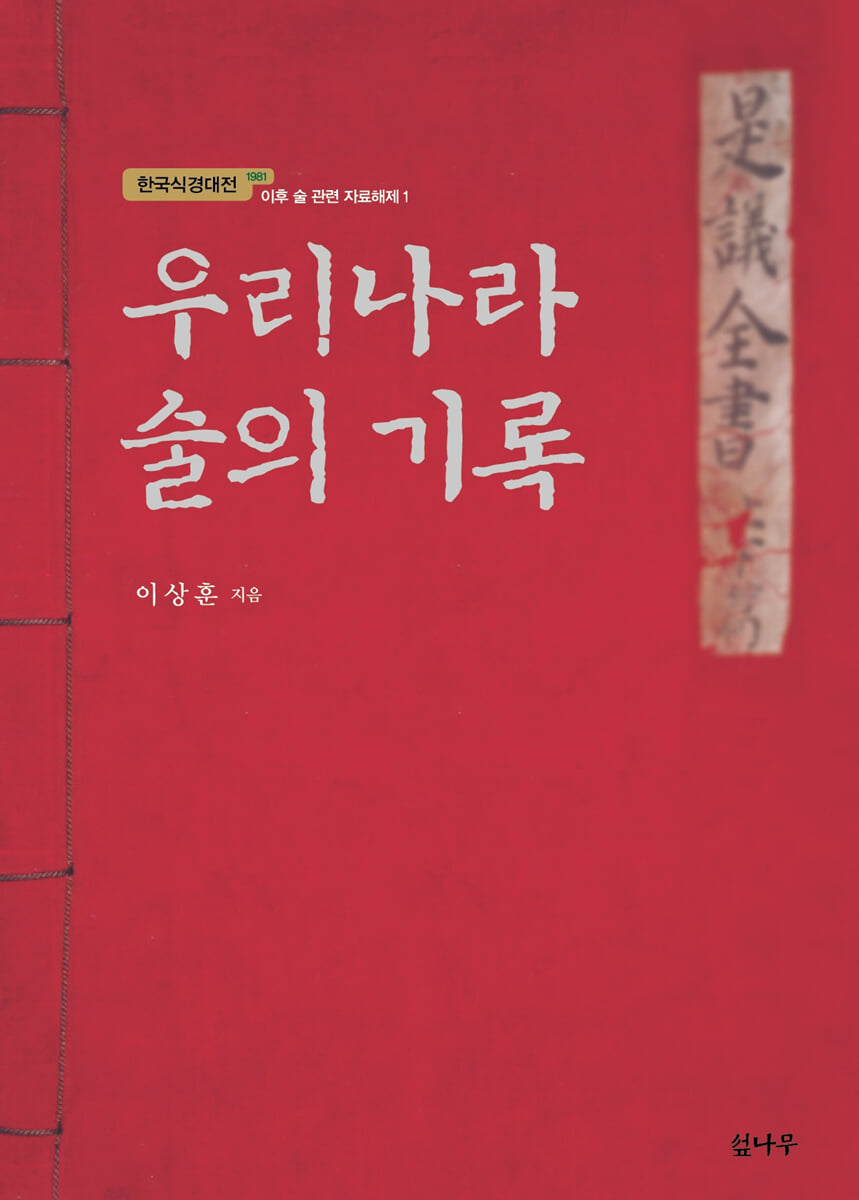
Records of Korean alcohol
 |
Description
Book Introduction
The story of publishing a book began when I recommended the 『Encyclopedia of Korean Cuisine』 to some acquaintances who wanted to study ancient cooking.
The 『Korean Food Dictionary』, a famous book representing our country, was published a long time ago and is no longer available anywhere. Furthermore, even used copies that occasionally appear on the market are sold for hundreds of thousands of won, so I had no choice but to make a few copies.
This book is a collection of materials created by the late Professor Lee Seong-woo in 1981, organizing the materials from Gojori Book one by one into files over a period of three years and six months.
Although this book is a timeless masterpiece, there are so many ancient cookbooks that have been discovered since its publication in 1981 that studying ancient cookbooks based solely on this book would inevitably leave a gaping void.
So, as part of after-sales service, we had no choice but to organize the ancient cookbooks discovered after 1981.
As I was organizing, I added not only ancient recipes, but also brewing books from the Japanese colonial period and after liberation.
Before the 1960s, most of the takju sold in the market was already made by fermenting rice wine, but legally, the main method was to brew rice wine with nuruk, so books from that time described methods of using nuruk not only for making yeast but also for managing the mash.
It was also a time when rice was in short supply, so a method was attempted to make rice wine by fermenting grains (barley, wheat, corn, millet, sorghum, etc.) to make a yeast liquor similar to a medicinal rice wine.
It is for this very reason that the experiences of this period and the book containing them are one of the important legacies of traditional liquor made with yeast.
Yet, not many people pay attention to this period.
As this is the first time in Korean history that the experience of industrialized alcohol brewing using nuruk and alcohol brewing using mixed grains was recorded in a book, the information is bound to be valuable.
In this extension, it was included in the data collection.
The 『Korean Food Dictionary』, a famous book representing our country, was published a long time ago and is no longer available anywhere. Furthermore, even used copies that occasionally appear on the market are sold for hundreds of thousands of won, so I had no choice but to make a few copies.
This book is a collection of materials created by the late Professor Lee Seong-woo in 1981, organizing the materials from Gojori Book one by one into files over a period of three years and six months.
Although this book is a timeless masterpiece, there are so many ancient cookbooks that have been discovered since its publication in 1981 that studying ancient cookbooks based solely on this book would inevitably leave a gaping void.
So, as part of after-sales service, we had no choice but to organize the ancient cookbooks discovered after 1981.
As I was organizing, I added not only ancient recipes, but also brewing books from the Japanese colonial period and after liberation.
Before the 1960s, most of the takju sold in the market was already made by fermenting rice wine, but legally, the main method was to brew rice wine with nuruk, so books from that time described methods of using nuruk not only for making yeast but also for managing the mash.
It was also a time when rice was in short supply, so a method was attempted to make rice wine by fermenting grains (barley, wheat, corn, millet, sorghum, etc.) to make a yeast liquor similar to a medicinal rice wine.
It is for this very reason that the experiences of this period and the book containing them are one of the important legacies of traditional liquor made with yeast.
Yet, not many people pay attention to this period.
As this is the first time in Korean history that the experience of industrialized alcohol brewing using nuruk and alcohol brewing using mixed grains was recorded in a book, the information is bound to be valuable.
In this extension, it was included in the data collection.
index
Genealogy of Old Cookbooks
Chapter 1: Alcohol in Cooking Books
Chapter 2: Alcohol in Medical and Nursing Books
Chapter 3 [Family Information] Alcohol in the Ryu
Chapter 4: Alcohol in the Pages of Old Documents
Chapter 5: Brewing Books from the Japanese Colonial Period
Chapter 6: Brewing Books after Liberation
Book 1: Alcohol in Oriental Medicine
Alcohol in the Book of Relief 2
Book 3: Sweet Potato Cultivation: Alcohol in the Book
Release 4 Alcohol in [Home Information] since the 1910s
About books related to Joseonju during the Japanese colonial period and immediately before the end of the 5th Japanese colonial period
Appendix 6: Unconfirmed contents of brewing books from the Japanese colonial period
Appendix 7 Report of the Central Testing Laboratory of the Government-General of Korea
Appendix 8 List of alcohol-related materials introduced in [Encyclopedia of Korean Cuisine]
Chapter 1: Alcohol in Cooking Books
Chapter 2: Alcohol in Medical and Nursing Books
Chapter 3 [Family Information] Alcohol in the Ryu
Chapter 4: Alcohol in the Pages of Old Documents
Chapter 5: Brewing Books from the Japanese Colonial Period
Chapter 6: Brewing Books after Liberation
Book 1: Alcohol in Oriental Medicine
Alcohol in the Book of Relief 2
Book 3: Sweet Potato Cultivation: Alcohol in the Book
Release 4 Alcohol in [Home Information] since the 1910s
About books related to Joseonju during the Japanese colonial period and immediately before the end of the 5th Japanese colonial period
Appendix 6: Unconfirmed contents of brewing books from the Japanese colonial period
Appendix 7 Report of the Central Testing Laboratory of the Government-General of Korea
Appendix 8 List of alcohol-related materials introduced in [Encyclopedia of Korean Cuisine]
Into the book
Another alcoholic beverage in Oriental medicine books is fermented liquor.
Alcohol is the best of all medicines.
[Hanseo] It is one of the propositions that has become the basis of oriental medicine since it first appeared in ‘Sikhwaji’.
[The source was first mentioned in the imperial edict promulgated by Wang Mang's Xin Dynasty, which read, "Salt is the best of all side dishes, wine is the best of all medicines, and iron is the foundation of farming."]
[Donguibogam] also says that alcohol “helps the body’s energy to spread well, eliminates all kinds of evil spirits and toxic energy, opens the blood vessels, strengthens the intestines and stomach, moisturizes the skin, relieves anxiety, makes one speak well, and improves one’s mood.”
It is the best of all medicines.
It is only natural that this excellent medicine, alcohol, is covered in books on Oriental medicine.
The oldest way to approach alcohol, the medically superior medicine, is connected to fundamental medical concerns.
This is called food treatment, and alcohol and food are representative examples.
As seen in [Eumseonjeongyo] written by Holsa Hye, a physician during the Yuan Dynasty in China, not only maintaining a healthy life in ordinary life, but also dealing with and preventing famine and famine (Guhwangbang), preventing and dealing with infectious diseases (Byeokonbang), and even the desire to live the life of an immortal (Sinseonbang) are all within the realm of Shikchi.
Among them, the most important area of food is the one that promotes a healthy life and longevity, and alcohol is at the center of it.
In Park Rok-dam's collection of [Yangjujip], there is a book called 'Another Barley Soju (又皮牟燒酒)', and in the first part of the brewing method, it says, "出酒, 則萬病通治", which means that making and drinking alcohol can cure all diseases, giving us a glimpse into his perception of alcohol.
From this perspective, medical books that describe a lot of fermented liquors include [Donguibogam], [Euirimchalyo], [Euibanghappyeon], and [Juchonshinbang].
However, since we have not examined all the numerous medical books, there is an endless amount of material to be discovered.
A significant amount of this data is already included in Kim Jae-hyung's 'Korean Literature Database'.
However, I hope to fill in the gaps and expand into life history research in the future.
If this work is carried out by blocking and unblocking each entry in the catalog of ancient Korean medicine books, the day will come when the full picture of alcohol in Korean medicine books will be revealed.
Alcohol is the best of all medicines.
[Hanseo] It is one of the propositions that has become the basis of oriental medicine since it first appeared in ‘Sikhwaji’.
[The source was first mentioned in the imperial edict promulgated by Wang Mang's Xin Dynasty, which read, "Salt is the best of all side dishes, wine is the best of all medicines, and iron is the foundation of farming."]
[Donguibogam] also says that alcohol “helps the body’s energy to spread well, eliminates all kinds of evil spirits and toxic energy, opens the blood vessels, strengthens the intestines and stomach, moisturizes the skin, relieves anxiety, makes one speak well, and improves one’s mood.”
It is the best of all medicines.
It is only natural that this excellent medicine, alcohol, is covered in books on Oriental medicine.
The oldest way to approach alcohol, the medically superior medicine, is connected to fundamental medical concerns.
This is called food treatment, and alcohol and food are representative examples.
As seen in [Eumseonjeongyo] written by Holsa Hye, a physician during the Yuan Dynasty in China, not only maintaining a healthy life in ordinary life, but also dealing with and preventing famine and famine (Guhwangbang), preventing and dealing with infectious diseases (Byeokonbang), and even the desire to live the life of an immortal (Sinseonbang) are all within the realm of Shikchi.
Among them, the most important area of food is the one that promotes a healthy life and longevity, and alcohol is at the center of it.
In Park Rok-dam's collection of [Yangjujip], there is a book called 'Another Barley Soju (又皮牟燒酒)', and in the first part of the brewing method, it says, "出酒, 則萬病通治", which means that making and drinking alcohol can cure all diseases, giving us a glimpse into his perception of alcohol.
From this perspective, medical books that describe a lot of fermented liquors include [Donguibogam], [Euirimchalyo], [Euibanghappyeon], and [Juchonshinbang].
However, since we have not examined all the numerous medical books, there is an endless amount of material to be discovered.
A significant amount of this data is already included in Kim Jae-hyung's 'Korean Literature Database'.
However, I hope to fill in the gaps and expand into life history research in the future.
If this work is carried out by blocking and unblocking each entry in the catalog of ancient Korean medicine books, the day will come when the full picture of alcohol in Korean medicine books will be revealed.
--- From the text
Publisher's Review
The new book, “Records of Korean Alcohol,” is a book that introduces and explains records related to Korean alcohol that were not included in the masterpiece “Encyclopedia of Korean Food” (Lee Seong-woo), published in 1981.
The books and materials introduced in this book are categorized into alcohol in cookbooks (76 types), alcohol in medical books and emergency books (16 types), alcohol in [Family Information] (5 types), alcohol in individual pages of old documents (12 types), brewing books from the Japanese colonial period (42 types), and brewing books after liberation (11 types). As an appendix, 8 types of brewing books from the Japanese colonial period whose contents could not be confirmed and 12 types of reports from the Central Laboratory of the Government-General of Korea are included.
There are a total of 182 types of data.
There are countless medical books in our country whose authors are unknown, making it nearly impossible to verify them and organize brewing-related data.
Not only medical books, but also [family information] books, brewing books during the Japanese colonial period, and brewing books after liberation, etc. were also investigated within the scope of my ability and convenience.
『The Encyclopedia of Korean Cuisine』 is a book in which Professor Lee Seong-woo compiled a vast amount of bibliographic data, so there is little to add.
However, I included it again to supplement some of the materials that lacked mention of alcohol (indicating whether it was included in [Korean Food Encyclopedia]).
Although I have not confirmed it, I have mentioned the data that clearly exists for those who will study it later.
In addition to ancient books and documents defined by the Korean Antique Book Association and other organizations, the collection also includes printed materials and books published until the early 1960s.
These include the hundreds of [Home Information Books] published over the past hundred years since 1912, agricultural and cookbooks from the Japanese colonial period, and brewing books from the Japanese colonial period and the liberated period.
These materials were divided into subjects such as cookbooks, medical books, emergency books, [family information books], old documents (individual sheets), brewing books from the Japanese colonial period, and brewing books after liberation.
Most of the books on brewing from the Japanese colonial era are books that I have been looking at little by little for a long time, focusing on topics that I was interested in.
However, books whose covers I had never even seen were included as appendices under the heading ‘Brewery books from the Japanese colonial period whose contents I had not verified,’ and ‘Reports from the Central Testing Laboratory of the Government-General of Korea’ were also included as separate appendices.
The books and materials introduced in this book are categorized into alcohol in cookbooks (76 types), alcohol in medical books and emergency books (16 types), alcohol in [Family Information] (5 types), alcohol in individual pages of old documents (12 types), brewing books from the Japanese colonial period (42 types), and brewing books after liberation (11 types). As an appendix, 8 types of brewing books from the Japanese colonial period whose contents could not be confirmed and 12 types of reports from the Central Laboratory of the Government-General of Korea are included.
There are a total of 182 types of data.
There are countless medical books in our country whose authors are unknown, making it nearly impossible to verify them and organize brewing-related data.
Not only medical books, but also [family information] books, brewing books during the Japanese colonial period, and brewing books after liberation, etc. were also investigated within the scope of my ability and convenience.
『The Encyclopedia of Korean Cuisine』 is a book in which Professor Lee Seong-woo compiled a vast amount of bibliographic data, so there is little to add.
However, I included it again to supplement some of the materials that lacked mention of alcohol (indicating whether it was included in [Korean Food Encyclopedia]).
Although I have not confirmed it, I have mentioned the data that clearly exists for those who will study it later.
In addition to ancient books and documents defined by the Korean Antique Book Association and other organizations, the collection also includes printed materials and books published until the early 1960s.
These include the hundreds of [Home Information Books] published over the past hundred years since 1912, agricultural and cookbooks from the Japanese colonial period, and brewing books from the Japanese colonial period and the liberated period.
These materials were divided into subjects such as cookbooks, medical books, emergency books, [family information books], old documents (individual sheets), brewing books from the Japanese colonial period, and brewing books after liberation.
Most of the books on brewing from the Japanese colonial era are books that I have been looking at little by little for a long time, focusing on topics that I was interested in.
However, books whose covers I had never even seen were included as appendices under the heading ‘Brewery books from the Japanese colonial period whose contents I had not verified,’ and ‘Reports from the Central Testing Laboratory of the Government-General of Korea’ were also included as separate appendices.
GOODS SPECIFICS
- Date of issue: February 10, 2025
- Page count, weight, size: 334 pages | 896g | 210*297*30mm
- ISBN13: 9791198479020
- ISBN10: 1198479027
You may also like
카테고리
korean


korean

![GQ KOREA Mark (Monthly): December [2025]](http://librairie.coreenne.fr/cdn/shop/files/8ef265dbbfbf186523ed75ba7319009d.jpg?v=1765340328&width=3840)


