

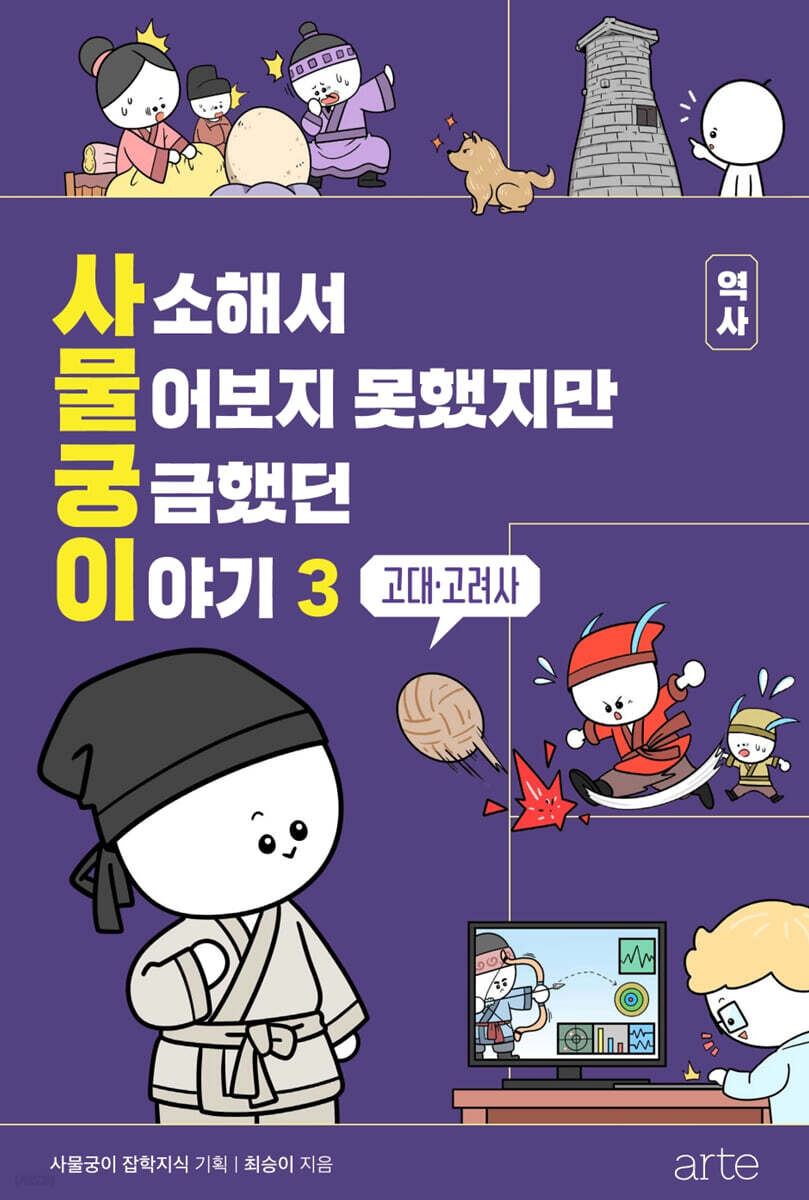
A story I was curious about but never asked because it was trivial: History 3 (Ancient History and Goryeo)
 |
Description
Book Introduction
“There is no unimportant question in the world!”
The history section of Korea's largest science channel, "Samulgungi Miscellaneous Knowledge," has been released!
"Samulgungi Miscellaneous Knowledge," a popular knowledge channel that humorously unravels the knowledge contained in trivial everyday curiosities, has returned with a history textbook! The ingenious questions that "make you wonder about things you didn't know before," the delightful and clear explanations that never leave a dull moment, and the lively illustrations naturally lead "subscribers" to become "readers."
The third volume of the 'Samulgungi' history series unfolds interesting stories related to ancient Korean history and Goryeo history.
Is Yeon Gaesomun's name a rumor, or a mere rumor? Did ancient people really wear the heavy, large gold earrings on display in museums? How many days did the Goryeo Dynasty rest on New Year's Day? It's easy to overlook, but every place in the world has a history and a story!
Let's dive into the world of "history" closely related to daily life, guided by YouTube's curiosity solver, "Gung-i," through the Samulgung History series, which returns with richer materials and colorful explanations, featuring three young historians.
The history section of Korea's largest science channel, "Samulgungi Miscellaneous Knowledge," has been released!
"Samulgungi Miscellaneous Knowledge," a popular knowledge channel that humorously unravels the knowledge contained in trivial everyday curiosities, has returned with a history textbook! The ingenious questions that "make you wonder about things you didn't know before," the delightful and clear explanations that never leave a dull moment, and the lively illustrations naturally lead "subscribers" to become "readers."
The third volume of the 'Samulgungi' history series unfolds interesting stories related to ancient Korean history and Goryeo history.
Is Yeon Gaesomun's name a rumor, or a mere rumor? Did ancient people really wear the heavy, large gold earrings on display in museums? How many days did the Goryeo Dynasty rest on New Year's Day? It's easy to overlook, but every place in the world has a history and a story!
Let's dive into the world of "history" closely related to daily life, guided by YouTube's curiosity solver, "Gung-i," through the Samulgung History series, which returns with richer materials and colorful explanations, featuring three young historians.
- You can preview some of the book's contents.
Preview
index
Prologue 4
Part 1: A Story of Ancient History That Was Too Trivial to Ask About
1. Dolmen is a tomb, but where are the bodies? 11
2 Were the Goguryeo people really good at archery? 17
3 Did the people of Goguryeo, Baekje, and Silla understand each other? 23
4 When did soccer start being played in our country? 29
5 How did they get into Cheomseongdae? 35
6 Did Wonhyo really drink the water from the skull? 41
7 Did people in ancient times raise dogs? 47
8 Did the large gold earrings on display in the museum actually belong to someone? 53
The more you watch Part 2, the more interesting the story of ancient society becomes.
9 Why are ancient kings described as being born from eggs? 59
10 Was there voting during the Three Kingdoms period? 67
11 Why did the Three Hans create a place where criminals could not be arrested? 73
12. Is Yeon Gaesomun's name Gaesomun or Somun? 79
13 Why doesn't Baekje have an extraordinary founding myth? 87
How was the Silla queen treated in ancient times, a male-dominated society?
15 Did the people of Unified Silla consider each other as fellow countrymen? 99
16 Why did Hwarang select its members based on their appearance? 107
The story of Goryeo history becomes more immersive as you read Part 3.
17. Goryeo was a vassal state of China, so why did the Goryeo kings call themselves emperors? 115
How did Kang Gam-chan, who had 18 tattoos, become a general? 123
19 Why did the Goryeo royal family practice incest? 129
20. What job would you start with if you passed the exam in the past? 137
21. Are there really traces of Jeong Mong-ju's blood on Seonjuk Bridge? 143
Why didn't the 22 military leaders, who controlled the central political apparatus, become kings? 151
Why did Prince Uicheon of Goryeo try to run away from home? 159
24 Why did the Yuan Dynasty marry its princess to the king of Goryeo, a vassal state? 167
Part 4: A More Interesting Story of Goryeo Society
25 Could it have been possible to sue during the Goryeo Dynasty? 175
26 Were the dating styles of Goryeo people much different from those of today? 181
27 Could Koreans Divorce and Remarry? 187
28 Why did Goryeo manage the entire long east coast as a single district? 193
29 How did people learn foreign languages during the Goryeo Dynasty? 199
30 When did falconry begin in our country? 205
31 Why is the statue of King Taejo Wang Geon naked? 211
32. What was the inheritance ratio for children during the Goryeo Dynasty? 217
Part 5: A Story of Goryeo Culture You've Always Been Curious About
33 When did people begin to believe in and follow feng shui? 225
34 How many days did people in the Goryeo Dynasty rest on New Year's Day? 231
35 Why did King Gongmin's love put the nation in danger? 237
36 Why were Goryeo palaces built on high ground? 243
Who erected the 37 monks' tombstones? 247
38 What kind of curses did the Goryeo people use? 253
39 Why was Samguk Yusa created when there is Samguk Sagi? 259
How did the Tripitaka Koreana, produced during the Goryeo Dynasty, remain intact? 265
References 270
Part 1: A Story of Ancient History That Was Too Trivial to Ask About
1. Dolmen is a tomb, but where are the bodies? 11
2 Were the Goguryeo people really good at archery? 17
3 Did the people of Goguryeo, Baekje, and Silla understand each other? 23
4 When did soccer start being played in our country? 29
5 How did they get into Cheomseongdae? 35
6 Did Wonhyo really drink the water from the skull? 41
7 Did people in ancient times raise dogs? 47
8 Did the large gold earrings on display in the museum actually belong to someone? 53
The more you watch Part 2, the more interesting the story of ancient society becomes.
9 Why are ancient kings described as being born from eggs? 59
10 Was there voting during the Three Kingdoms period? 67
11 Why did the Three Hans create a place where criminals could not be arrested? 73
12. Is Yeon Gaesomun's name Gaesomun or Somun? 79
13 Why doesn't Baekje have an extraordinary founding myth? 87
How was the Silla queen treated in ancient times, a male-dominated society?
15 Did the people of Unified Silla consider each other as fellow countrymen? 99
16 Why did Hwarang select its members based on their appearance? 107
The story of Goryeo history becomes more immersive as you read Part 3.
17. Goryeo was a vassal state of China, so why did the Goryeo kings call themselves emperors? 115
How did Kang Gam-chan, who had 18 tattoos, become a general? 123
19 Why did the Goryeo royal family practice incest? 129
20. What job would you start with if you passed the exam in the past? 137
21. Are there really traces of Jeong Mong-ju's blood on Seonjuk Bridge? 143
Why didn't the 22 military leaders, who controlled the central political apparatus, become kings? 151
Why did Prince Uicheon of Goryeo try to run away from home? 159
24 Why did the Yuan Dynasty marry its princess to the king of Goryeo, a vassal state? 167
Part 4: A More Interesting Story of Goryeo Society
25 Could it have been possible to sue during the Goryeo Dynasty? 175
26 Were the dating styles of Goryeo people much different from those of today? 181
27 Could Koreans Divorce and Remarry? 187
28 Why did Goryeo manage the entire long east coast as a single district? 193
29 How did people learn foreign languages during the Goryeo Dynasty? 199
30 When did falconry begin in our country? 205
31 Why is the statue of King Taejo Wang Geon naked? 211
32. What was the inheritance ratio for children during the Goryeo Dynasty? 217
Part 5: A Story of Goryeo Culture You've Always Been Curious About
33 When did people begin to believe in and follow feng shui? 225
34 How many days did people in the Goryeo Dynasty rest on New Year's Day? 231
35 Why did King Gongmin's love put the nation in danger? 237
36 Why were Goryeo palaces built on high ground? 243
Who erected the 37 monks' tombstones? 247
38 What kind of curses did the Goryeo people use? 253
39 Why was Samguk Yusa created when there is Samguk Sagi? 259
How did the Tripitaka Koreana, produced during the Goryeo Dynasty, remain intact? 265
References 270
Detailed image

Publisher's Review
“There is no unimportant question in the world!”
1.56 million subscribers, 320 million cumulative views
The history section of Korea's largest science channel, "Samulgungi Miscellaneous Knowledge," has been released!
“Were the Goguryeo people really good at archery?” “Why doesn’t Baekje have an extraordinary founding myth?” “What kind of curses did the Goryeo people use?” The popular knowledge channel “Samulgungi Miscellaneous Knowledge,” which unravels great knowledge contained in trivial curiosities through animation, has published volumes 1, 2, and 3 of its history series at the same time.
Based on the planning and supervision of YouTuber 'Samulgungi', three young historians who teach students in the Department of Korean History at Seoul National University participate as writers to solve historical curiosities in everyday life.
The third volume of the 'History' series addresses fascinating questions surrounding 'ancient history' and 'modern and contemporary history' in Korean history.
'Samulgungi', an abbreviation for 'a story that was so trivial that I couldn't ask, but was curious', is a knowledge channel that uses animation to easily and funnily explain the trivial curiosities that cross our minds in everyday life and the not-so-trivial knowledge contained within them.
As of February 2025, 'Samulgungi', which has a whopping 1.56 million subscribers, has a unique difference in that it asks novel and unique questions and supports them with solid historical research.
If you click on the video, captivated by the unexpected questions that make you curious about things you weren't curious about, you'll find historical facts and contexts explained in a fun and engaging way, organized through meticulous research and expert advice.
In recognition of this sincerity and high quality, 'Samulgungi' has established itself as a 'trusted and watched' knowledge channel recommended by teachers, students, various media, and education offices, and has proven its excellence by winning the Korea Foundation for the Advancement of Science and Creativity's Outstanding Science and Culture Content and the Youth Recommended YouTube Channel Award.
Recently, thanks to its popularity, it has established itself as an unrivaled knowledge channel by providing videos to public transportation such as Seoul and Gyeonggi buses, Seoul Subway Line 2, and Kakao T taxis.
The new "History" series of "Samulgungi" published by Arte Publishing faithfully embodies the channel's concept by inheriting the strengths of the existing "Science" series.
The video goes through a meticulous editing process to provide readers with a captivating reading experience, allowing them to grasp historical facts and context that are easily missed at a glance.
Let's embark on a journey into the world of "history" that is closely related to everyday life with YouTube's curiosity solver, "Gung-i."
- Topics that are 200% curious and not covered in the video
- A reliable and educational history textbook written by young historians
- Historical facts and context that are easily missed in textbooks at a glance
The history section of 'Stories I Was Curious About But Never Asked About' was planned and supervised by YouTuber 'Samulgungi', and three young historians participated as writers to provide fresher and richer content and friendly and colorful explanations.
The third volume of 'Samulgungi' history was compiled by Choi Seung-i, a young historian who teaches at the Department of Korean History at Seoul National University, by selecting 40 historical questions that readers are most curious about and confused about, with the theme of ancient history and Goryeo history.
The surprising charm of 'Samulgungi' is that no matter how trivial the question, the reason and history contained in it are by no means trivial.
For example, to understand “Did the people of Unified Silla consider each other as fellow countrymen after the unification of the Three Kingdoms?”, we need to understand the ruling strategies of the Silla ruling class after unification and the unstable public sentiment. To answer “Who erected the steles of monks?”, we need to look back at the role of Buddhism in the Goryeo Dynasty and the historical value of the steles.
Immerse yourself in a world of history that is closely related to your daily life, with novel questions that “make you wonder about things you weren’t curious about,” delightful and clear explanations that never leave you bored, lively illustrations, and the quirky and cute character Gung-i.
“There is no unimportant question in the world!”
The Power of the Question “Why?”
As we go through life, we often easily ignore the question, “Why?”
As we grow older, our knowledge accumulates, but our curiosity fades and our thinking becomes rigid.
The more we know, the more difficult it becomes to ask new questions.
But curiosity is what leads to unexpected discoveries, and those discoveries become the force that changes the world.
The flow of history also began with such small questions, and even the things we now take for granted began with someone's simple question, "Why?"
History, in particular, teaches us the valuable lesson that small questions can lead to deep insights, as we can only see the big picture after layering on layer upon layer of questions.
I hope that through this book, readers will awaken their dormant curiosity and rediscover the value of the power of questioning.
1.56 million subscribers, 320 million cumulative views
The history section of Korea's largest science channel, "Samulgungi Miscellaneous Knowledge," has been released!
“Were the Goguryeo people really good at archery?” “Why doesn’t Baekje have an extraordinary founding myth?” “What kind of curses did the Goryeo people use?” The popular knowledge channel “Samulgungi Miscellaneous Knowledge,” which unravels great knowledge contained in trivial curiosities through animation, has published volumes 1, 2, and 3 of its history series at the same time.
Based on the planning and supervision of YouTuber 'Samulgungi', three young historians who teach students in the Department of Korean History at Seoul National University participate as writers to solve historical curiosities in everyday life.
The third volume of the 'History' series addresses fascinating questions surrounding 'ancient history' and 'modern and contemporary history' in Korean history.
'Samulgungi', an abbreviation for 'a story that was so trivial that I couldn't ask, but was curious', is a knowledge channel that uses animation to easily and funnily explain the trivial curiosities that cross our minds in everyday life and the not-so-trivial knowledge contained within them.
As of February 2025, 'Samulgungi', which has a whopping 1.56 million subscribers, has a unique difference in that it asks novel and unique questions and supports them with solid historical research.
If you click on the video, captivated by the unexpected questions that make you curious about things you weren't curious about, you'll find historical facts and contexts explained in a fun and engaging way, organized through meticulous research and expert advice.
In recognition of this sincerity and high quality, 'Samulgungi' has established itself as a 'trusted and watched' knowledge channel recommended by teachers, students, various media, and education offices, and has proven its excellence by winning the Korea Foundation for the Advancement of Science and Creativity's Outstanding Science and Culture Content and the Youth Recommended YouTube Channel Award.
Recently, thanks to its popularity, it has established itself as an unrivaled knowledge channel by providing videos to public transportation such as Seoul and Gyeonggi buses, Seoul Subway Line 2, and Kakao T taxis.
The new "History" series of "Samulgungi" published by Arte Publishing faithfully embodies the channel's concept by inheriting the strengths of the existing "Science" series.
The video goes through a meticulous editing process to provide readers with a captivating reading experience, allowing them to grasp historical facts and context that are easily missed at a glance.
Let's embark on a journey into the world of "history" that is closely related to everyday life with YouTube's curiosity solver, "Gung-i."
- Topics that are 200% curious and not covered in the video
- A reliable and educational history textbook written by young historians
- Historical facts and context that are easily missed in textbooks at a glance
The history section of 'Stories I Was Curious About But Never Asked About' was planned and supervised by YouTuber 'Samulgungi', and three young historians participated as writers to provide fresher and richer content and friendly and colorful explanations.
The third volume of 'Samulgungi' history was compiled by Choi Seung-i, a young historian who teaches at the Department of Korean History at Seoul National University, by selecting 40 historical questions that readers are most curious about and confused about, with the theme of ancient history and Goryeo history.
The surprising charm of 'Samulgungi' is that no matter how trivial the question, the reason and history contained in it are by no means trivial.
For example, to understand “Did the people of Unified Silla consider each other as fellow countrymen after the unification of the Three Kingdoms?”, we need to understand the ruling strategies of the Silla ruling class after unification and the unstable public sentiment. To answer “Who erected the steles of monks?”, we need to look back at the role of Buddhism in the Goryeo Dynasty and the historical value of the steles.
Immerse yourself in a world of history that is closely related to your daily life, with novel questions that “make you wonder about things you weren’t curious about,” delightful and clear explanations that never leave you bored, lively illustrations, and the quirky and cute character Gung-i.
“There is no unimportant question in the world!”
The Power of the Question “Why?”
As we go through life, we often easily ignore the question, “Why?”
As we grow older, our knowledge accumulates, but our curiosity fades and our thinking becomes rigid.
The more we know, the more difficult it becomes to ask new questions.
But curiosity is what leads to unexpected discoveries, and those discoveries become the force that changes the world.
The flow of history also began with such small questions, and even the things we now take for granted began with someone's simple question, "Why?"
History, in particular, teaches us the valuable lesson that small questions can lead to deep insights, as we can only see the big picture after layering on layer upon layer of questions.
I hope that through this book, readers will awaken their dormant curiosity and rediscover the value of the power of questioning.
GOODS SPECIFICS
- Date of issue: February 5, 2025
- Page count, weight, size: 284 pages | 145*215*20mm
- ISBN13: 9791173570841
- ISBN10: 1173570845
You may also like
카테고리
korean


korean

![GQ KOREA Mark (Monthly): December [2025]](http://librairie.coreenne.fr/cdn/shop/files/8ef265dbbfbf186523ed75ba7319009d.jpg?v=1765340328&width=3840)


