

Interaction of colors
 |
Description
Book Introduction
A monumental work that changed the paradigm of 20th-century color education by prioritizing practice over theory.
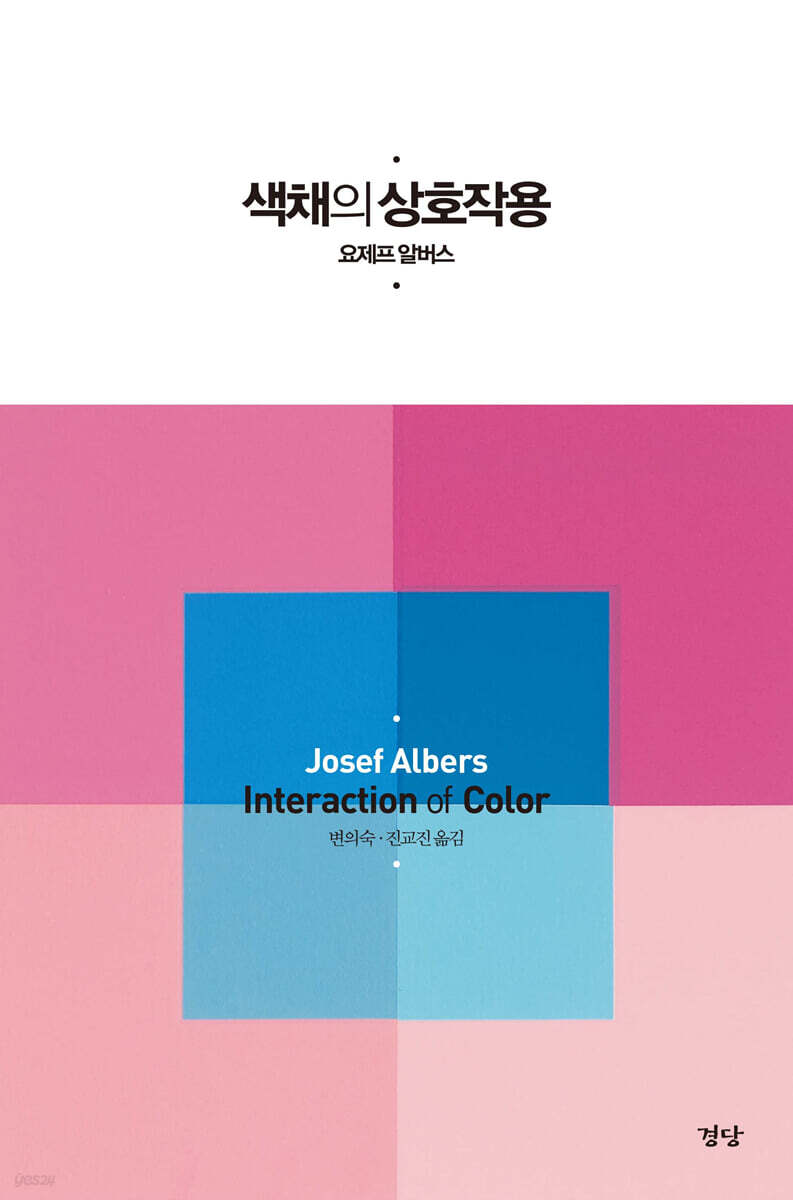
This is a monumental work by Josef Albers, a painter and art theorist who persistently delved into the problem of color and left a significant mark on 20th-century art.
Based on the original idea of the nature of color being perceived relatively differently depending on the surrounding conditions or background color, this book presents a color learning method that prioritizes practice over theory, along with abundant color illustrations. Since its first publication in 1963, it has not lost its immortal value as a guide for artists, educators, and students, and has had a profound influence on the aesthetic perception of numerous readers.
This is a monumental work by Josef Albers, a painter and art theorist who persistently delved into the problem of color and left a significant mark on 20th-century art.
Based on the original idea of the nature of color being perceived relatively differently depending on the surrounding conditions or background color, this book presents a color learning method that prioritizes practice over theory, along with abundant color illustrations. Since its first publication in 1963, it has not lost its immortal value as a guide for artists, educators, and students, and has had a profound influence on the aesthetic perception of numerous readers.
- You can preview some of the book's contents.
Preview
index
Recommendation
Foreword _Nicholas Fox Weber
introduction
I Color Associations - Visual Memory
II Reading Color and Structure
III Why colored paper instead of pigment or paint?
IV. A Color Has Many Faces - The Relativity of Color
V Brighter or darker - intensity of light, luminosity
VI 1 color appears as 2 - looks like inverted background colors
VII Two Different Colors Look the Same - Color Subtraction
VIII Why Colors Deceive Us - Afterimages, Simultaneous Contrast
IX Color Mixing with Paper - The Transparent Illusion
X Realistic Color Mixing - Additive and Subtractive
XI Transparency and Spatial Illusion / Color Boundaries and Three-Dimensional Effects
XII Visual Mixing - Modified Afterimages
XIII Bechault Effect
XIV Color Intervals and Transformations
XV Another Intermediate Color Practice - Intersecting Colors
XVI Juxtaposition of Colors - Harmony - Yang
XVII Planar and Spatial Colors - Two Natural Effects
XVIII Free Learning - A Challenge to Imagination
XIX Masters - Color Composition
XX Weber-Fechner law - measurement of color mixing
XXI From color temperature to humidity
XXII Vibrating Boundaries - Emphasized Outlines
XXIII Equal Intensity of Light - The Vanishing Boundary
XXIV Color Theory - Color Systems
XXV On Color Education - Some Color Terms
XXVI In lieu of references - My best collaborators
Illustrations and commentary
Translator's Note
Foreword _Nicholas Fox Weber
introduction
I Color Associations - Visual Memory
II Reading Color and Structure
III Why colored paper instead of pigment or paint?
IV. A Color Has Many Faces - The Relativity of Color
V Brighter or darker - intensity of light, luminosity
VI 1 color appears as 2 - looks like inverted background colors
VII Two Different Colors Look the Same - Color Subtraction
VIII Why Colors Deceive Us - Afterimages, Simultaneous Contrast
IX Color Mixing with Paper - The Transparent Illusion
X Realistic Color Mixing - Additive and Subtractive
XI Transparency and Spatial Illusion / Color Boundaries and Three-Dimensional Effects
XII Visual Mixing - Modified Afterimages
XIII Bechault Effect
XIV Color Intervals and Transformations
XV Another Intermediate Color Practice - Intersecting Colors
XVI Juxtaposition of Colors - Harmony - Yang
XVII Planar and Spatial Colors - Two Natural Effects
XVIII Free Learning - A Challenge to Imagination
XIX Masters - Color Composition
XX Weber-Fechner law - measurement of color mixing
XXI From color temperature to humidity
XXII Vibrating Boundaries - Emphasized Outlines
XXIII Equal Intensity of Light - The Vanishing Boundary
XXIV Color Theory - Color Systems
XXV On Color Education - Some Color Terms
XXVI In lieu of references - My best collaborators
Illustrations and commentary
Translator's Note
Detailed image

Into the book
Look for three red papers of equal size but different shades: a bright red, a dark red, and, almost always, a rare mixture of the two.
If you can't find it in red, prepare another color with different shades or tones, such as light, medium, or dark.
Place these next to each other, overlapping the edges of the medium red over the bright red on the left.
Next, place the dark red over the medium red, leaving only a narrow strip (about 0.5 centimeters wide) of the medium red visible.
Now, very slowly pull the dark red paper to the right, so that the narrow band of medium red gradually widens.
If you look at the middle red, you can see that as it gets wider, the right edge gets brighter and brighter, while the left edge gets darker and darker, making it look like there are two reds instead of one.
If you repeat this several times, it becomes clear that the intermediate color plays the role of both parents simultaneously, expressing them in reversed positions.
If you repeat this experiment with other colors, you will find that in an exact intermediate mixture, both parent colors appear in equal amounts.
However, in most cases, the one with the larger amount of two colors will show its dominance.
These exercises are not only interesting, but they can also reveal new facts, especially when expanded to include different or complementary colors.
This exercise reminds us that simultaneous contrast, a fundamental afterimage phenomenon, is the cause of all color trickery. --- pp.52-53
It may sometimes seem impossible to find instances of the same intensity (brightness) of light in paint, painting, colored paper, or around us, but we have come to realize that nature sometimes gives us the opportunity to see this through puffy clouds floating in a blue sky.
These clouds often form in horizontal clusters, their upper parts receiving full sunlight appearing a brilliant white that stands out sharply from the deep blue of the distance, while their lower parts appear a shaded white-gray tone.
This shade is a little bit earlier, but here it blends or blends closely with the very close blue.
Why are they so close? Because this gray has the same light intensity as the adjacent blue below.
So the line between gray and blue disappears, and we can no longer tell where the clouds end and the sky begins.
These clouds are best observed with the sun at your back.
To achieve such provocative and highly subtle color effects, all distracting effects from paper (e.g., different textures) and montage (e.g., visible borders or grass marks) had to be carefully removed beforehand.
Therefore, two types of paper with the same light intensity must be attached using the inlay technique.
In this process, the papers are not covered but placed inside each other.
Therefore, the thickness of the paper is not visible, and even the shadows that are very distracting—if the papers are of the same thickness—are eliminated.
To ensure an exact fit without visible seams, the inlay papers are cut and shaped at the same time.
The sharper the knife (a very thin razor blade is best), the thinner the paper, and the harder the cutting surface (glass is best), the better the fit and the less visible the seam.
It is also important to prevent the seams from becoming visible as the glue seeps in.
Just as patience is required in selecting paper, so too is skill and neatness required in expressing it. --- pp.81-82
Relativity is caused by a change in standards, a lack or avoidance of standard rules, or a change in perspective.
As a result, a single phenomenon comes to have various views, interpretations, and meanings.
This instability of values is what characterizes color.
Because of the afterimage, a light gray may sometimes appear dark and at other times almost white, or a green may appear reddish, and so on, and so forth, appearing like a shade or tint of a color.
The purpose of most of our color studies is to demonstrate that color is the most relative means of expression in art, and that we can hardly physically perceive what color is.
We call the interaction of colors with each other 'interaction'.
From the opposite point of view, it is 'interdependence'.
Just a few years ago, we were taught that there was no connection between visual and auditory perception, but now we know that colors appear to change visually as we hear changes in sound.
Just as the perception of the tongue and the eye are interdependent, as the color of food and its container increases or decreases appetite, this of course further clarifies the relativity of color.
If you can't find it in red, prepare another color with different shades or tones, such as light, medium, or dark.
Place these next to each other, overlapping the edges of the medium red over the bright red on the left.
Next, place the dark red over the medium red, leaving only a narrow strip (about 0.5 centimeters wide) of the medium red visible.
Now, very slowly pull the dark red paper to the right, so that the narrow band of medium red gradually widens.
If you look at the middle red, you can see that as it gets wider, the right edge gets brighter and brighter, while the left edge gets darker and darker, making it look like there are two reds instead of one.
If you repeat this several times, it becomes clear that the intermediate color plays the role of both parents simultaneously, expressing them in reversed positions.
If you repeat this experiment with other colors, you will find that in an exact intermediate mixture, both parent colors appear in equal amounts.
However, in most cases, the one with the larger amount of two colors will show its dominance.
These exercises are not only interesting, but they can also reveal new facts, especially when expanded to include different or complementary colors.
This exercise reminds us that simultaneous contrast, a fundamental afterimage phenomenon, is the cause of all color trickery. --- pp.52-53
It may sometimes seem impossible to find instances of the same intensity (brightness) of light in paint, painting, colored paper, or around us, but we have come to realize that nature sometimes gives us the opportunity to see this through puffy clouds floating in a blue sky.
These clouds often form in horizontal clusters, their upper parts receiving full sunlight appearing a brilliant white that stands out sharply from the deep blue of the distance, while their lower parts appear a shaded white-gray tone.
This shade is a little bit earlier, but here it blends or blends closely with the very close blue.
Why are they so close? Because this gray has the same light intensity as the adjacent blue below.
So the line between gray and blue disappears, and we can no longer tell where the clouds end and the sky begins.
These clouds are best observed with the sun at your back.
To achieve such provocative and highly subtle color effects, all distracting effects from paper (e.g., different textures) and montage (e.g., visible borders or grass marks) had to be carefully removed beforehand.
Therefore, two types of paper with the same light intensity must be attached using the inlay technique.
In this process, the papers are not covered but placed inside each other.
Therefore, the thickness of the paper is not visible, and even the shadows that are very distracting—if the papers are of the same thickness—are eliminated.
To ensure an exact fit without visible seams, the inlay papers are cut and shaped at the same time.
The sharper the knife (a very thin razor blade is best), the thinner the paper, and the harder the cutting surface (glass is best), the better the fit and the less visible the seam.
It is also important to prevent the seams from becoming visible as the glue seeps in.
Just as patience is required in selecting paper, so too is skill and neatness required in expressing it. --- pp.81-82
Relativity is caused by a change in standards, a lack or avoidance of standard rules, or a change in perspective.
As a result, a single phenomenon comes to have various views, interpretations, and meanings.
This instability of values is what characterizes color.
Because of the afterimage, a light gray may sometimes appear dark and at other times almost white, or a green may appear reddish, and so on, and so forth, appearing like a shade or tint of a color.
The purpose of most of our color studies is to demonstrate that color is the most relative means of expression in art, and that we can hardly physically perceive what color is.
We call the interaction of colors with each other 'interaction'.
From the opposite point of view, it is 'interdependence'.
Just a few years ago, we were taught that there was no connection between visual and auditory perception, but now we know that colors appear to change visually as we hear changes in sound.
Just as the perception of the tongue and the eye are interdependent, as the color of food and its container increases or decreases appetite, this of course further clarifies the relativity of color.
--- pp.89-90
Publisher's Review
A monumental work that changed the paradigm of 20th-century color education by prioritizing practice over theory.
Every day we live exposed to countless different colors.
Every object and thing around us, from the blue sky, green forests, yellow fields, red brick buildings, colorful, shiny cars, old furniture and odds and ends inside the house, and even people's colorful clothes, expresses its own color.
And then we perceive these colors, whether consciously or unconsciously.
So how accurately can people perceive these colors? If someone says the word "red" and fifty people listen, each person will have their own unique image of red in their head.
The red of maple leaves, the red of traffic lights, the red of Dancheong, etc.
Even when we show the same Coca-Cola logo directly to everyone and have them look at the red color, the red that they perceive varies from person to person.
As a painter and educator, Josef Albers, a master of color theory who had a profound influence on 20th-century art, had as his primary concern the question, “How do we perceive color?”
Throughout his life, he sought the best color education method for artists and art students specializing in color, and in 1963, he published a book summarizing his findings in 『The Interaction of Colors』.
Based on original ideas about the nature of color, which is perceived relatively differently depending on the surrounding conditions or background color, this book presents a color learning method that prioritizes practice over theory, along with abundant color illustrations. Even today, it has not lost its immortal value as a guide for artists, educators, and students, and has had a profound influence on the aesthetic perception of countless readers.
How are colors perceived by our eyes?
Born in Germany in 1888, Josef Albers was a member of the Bauhaus in the 1920s before moving to the United States to teach at Black Mountain College, renowned for its experimental and unconventional art education. In 1950, he took up a position at Yale University, where he headed the design department.
Around the time he moved to Yale, he began producing a series of works titled “Homage to the Square.”
These paintings, each consisting of only 3 or 4 squares, have a composition of squares within squares.
Albers experimented with various color arrangements using such an extremely simple form to show how colors are perceived by our eyes, and left behind hundreds of works until his death in 1976.
『The Interplay of Colors』 is a masterpiece that verbally expresses the images and spirit contained in the series “Homage to the Square.”
“To use color effectively, we must first realize that color is constantly deceiving us.”
What Josef Albers considers important is not the existing color system or the theory of harmonious color combinations, but the students' own experiences.
To develop an eye for color, it is better to first learn through various experiences and trial and error rather than learning theories first.
He breaks the educational practice of 'theory first, practice later' and expresses the belief that theory is ultimately the result of practice.
Albers points out that there is a difference between the 'physical facts', such as the wavelength of each color, and the 'psychological effects' that we actually feel.
According to him, color is rarely seen as it is, that is, as a physical property, and this fact means that color is the most relative means of expression in art.
For example, a light gray can sometimes appear dark, sometimes almost white, and even appear as a shade of another color due to the afterimage effect.
In the real world, it is rare to see only one color existing alone.
It is always interacting and coexisting continuously with other colors around it.
The most important goal of Albers's color education is to develop the ability to realize this relativity of color and to understand the interaction between colors.
He encourages students to create their own optical illusions using colored paper, saying, “To use color effectively, we must first realize that color is constantly deceiving us.”
Using colored paper instead of paints is meant to train the artist to mix paints imaginatively in their head instead of physically using a palette. This helps prevent unnecessary confusion caused by incorrect paint mixing or poor coloring skills, and develops the ability and sensitivity to discern subtle differences between colors.
Through hands-on experiments, students learn that the same color can appear as two different colors depending on the surrounding background color, and conversely, that two different colors can appear as the same color.
This book is structured in this way so that you can directly create and experience the various psychological effects that colors have on us.
Each topic is closely and naturally connected to the next, leading to increasingly challenging experiments.
Through this series of processes, students constantly compare colors and think about them in various situations, and furthermore, they constantly ask new questions.
Albus awakens our sensibilities to use color more delicately in fields such as pure art, design, architecture, and fashion.
This book, which contains all of his long-term color research and educational experience, is still considered an essential book for training color sense by numerous artists and educators even though half a century has passed since its first publication.
Every day we live exposed to countless different colors.
Every object and thing around us, from the blue sky, green forests, yellow fields, red brick buildings, colorful, shiny cars, old furniture and odds and ends inside the house, and even people's colorful clothes, expresses its own color.
And then we perceive these colors, whether consciously or unconsciously.
So how accurately can people perceive these colors? If someone says the word "red" and fifty people listen, each person will have their own unique image of red in their head.
The red of maple leaves, the red of traffic lights, the red of Dancheong, etc.
Even when we show the same Coca-Cola logo directly to everyone and have them look at the red color, the red that they perceive varies from person to person.
As a painter and educator, Josef Albers, a master of color theory who had a profound influence on 20th-century art, had as his primary concern the question, “How do we perceive color?”
Throughout his life, he sought the best color education method for artists and art students specializing in color, and in 1963, he published a book summarizing his findings in 『The Interaction of Colors』.
Based on original ideas about the nature of color, which is perceived relatively differently depending on the surrounding conditions or background color, this book presents a color learning method that prioritizes practice over theory, along with abundant color illustrations. Even today, it has not lost its immortal value as a guide for artists, educators, and students, and has had a profound influence on the aesthetic perception of countless readers.
How are colors perceived by our eyes?
Born in Germany in 1888, Josef Albers was a member of the Bauhaus in the 1920s before moving to the United States to teach at Black Mountain College, renowned for its experimental and unconventional art education. In 1950, he took up a position at Yale University, where he headed the design department.
Around the time he moved to Yale, he began producing a series of works titled “Homage to the Square.”
These paintings, each consisting of only 3 or 4 squares, have a composition of squares within squares.
Albers experimented with various color arrangements using such an extremely simple form to show how colors are perceived by our eyes, and left behind hundreds of works until his death in 1976.
『The Interplay of Colors』 is a masterpiece that verbally expresses the images and spirit contained in the series “Homage to the Square.”
“To use color effectively, we must first realize that color is constantly deceiving us.”
What Josef Albers considers important is not the existing color system or the theory of harmonious color combinations, but the students' own experiences.
To develop an eye for color, it is better to first learn through various experiences and trial and error rather than learning theories first.
He breaks the educational practice of 'theory first, practice later' and expresses the belief that theory is ultimately the result of practice.
Albers points out that there is a difference between the 'physical facts', such as the wavelength of each color, and the 'psychological effects' that we actually feel.
According to him, color is rarely seen as it is, that is, as a physical property, and this fact means that color is the most relative means of expression in art.
For example, a light gray can sometimes appear dark, sometimes almost white, and even appear as a shade of another color due to the afterimage effect.
In the real world, it is rare to see only one color existing alone.
It is always interacting and coexisting continuously with other colors around it.
The most important goal of Albers's color education is to develop the ability to realize this relativity of color and to understand the interaction between colors.
He encourages students to create their own optical illusions using colored paper, saying, “To use color effectively, we must first realize that color is constantly deceiving us.”
Using colored paper instead of paints is meant to train the artist to mix paints imaginatively in their head instead of physically using a palette. This helps prevent unnecessary confusion caused by incorrect paint mixing or poor coloring skills, and develops the ability and sensitivity to discern subtle differences between colors.
Through hands-on experiments, students learn that the same color can appear as two different colors depending on the surrounding background color, and conversely, that two different colors can appear as the same color.
This book is structured in this way so that you can directly create and experience the various psychological effects that colors have on us.
Each topic is closely and naturally connected to the next, leading to increasingly challenging experiments.
Through this series of processes, students constantly compare colors and think about them in various situations, and furthermore, they constantly ask new questions.
Albus awakens our sensibilities to use color more delicately in fields such as pure art, design, architecture, and fashion.
This book, which contains all of his long-term color research and educational experience, is still considered an essential book for training color sense by numerous artists and educators even though half a century has passed since its first publication.
GOODS SPECIFICS
- Date of issue: July 13, 2013
- Format: Hardcover book binding method guide
- Page count, weight, size: 168 pages | 464g | 148*225*20mm
- ISBN13: 9788986377477
- ISBN10: 8986377470
You may also like
카테고리
korean


korean

![GQ KOREA Mark (Monthly): December [2025]](http://librairie.coreenne.fr/cdn/shop/files/8ef265dbbfbf186523ed75ba7319009d.jpg?v=1765340328&width=3840)


