

survivors
 |
Description
Book Introduction
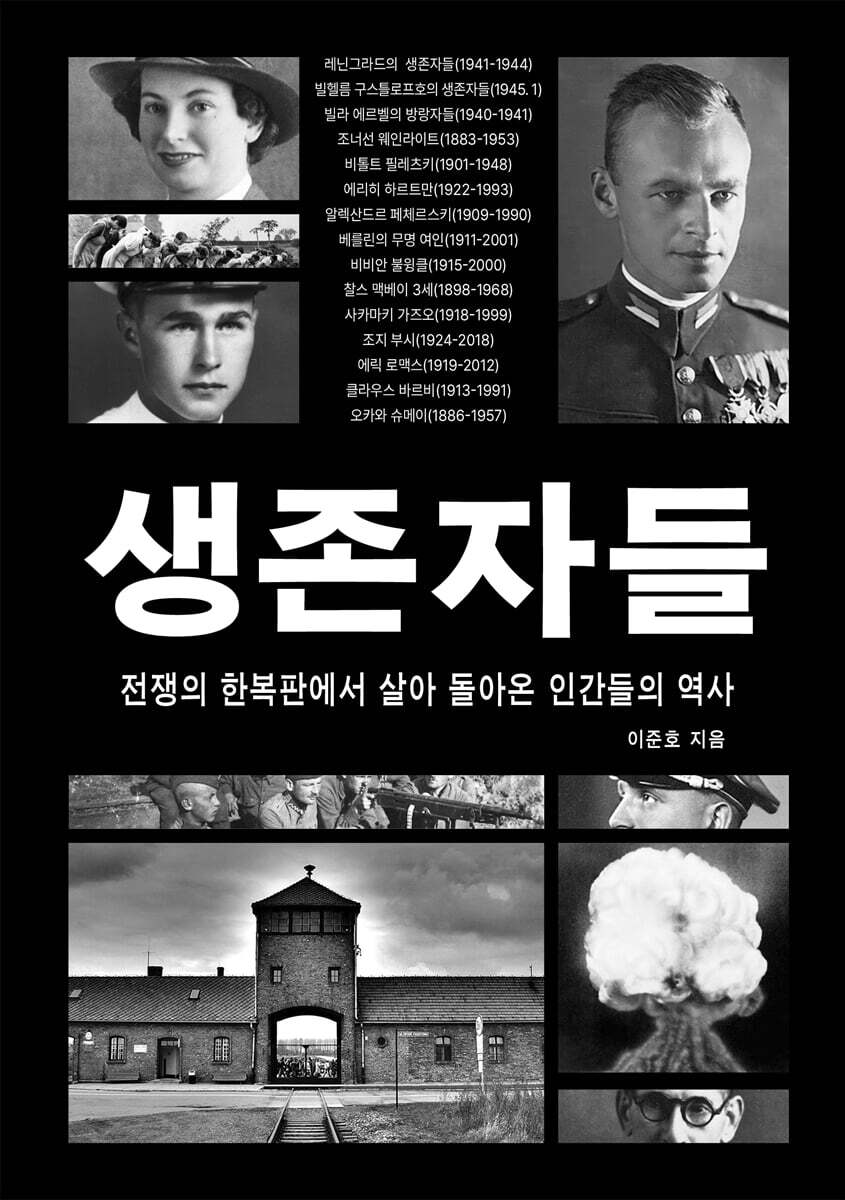
Author Lee Jun-ho, who shared his extensive knowledge of war history and fascinating backstories in his previous work, Traitors and Betrayers, has published his new book, Survivors.
In this book, the author delves into the details of World War II, which plunged the 20th century into a swamp of screams, and focuses especially on the 'survivors' who survived with indomitable will and mental strength.
The Polish soldier who walked into Auschwitz to tell people about hell, the 'Human Butcher of Lyon' who served as an American intelligence agent and presidential aide, artists who shone with intellect and creativity even in the ruins of war...
The survivors are very diverse.
The book highlights a diverse range of cases, including survivors of a single incident, victims of wartime sexual violence, soldiers who became victors through heroic actions, people who forgave their perpetrators and overcame trauma, and villains who saved their lives through their resourcefulness.
By gathering the fragmented stories of these individuals into a single book, the author emphasizes the irony of war: how solidarity, will, and vitality burn fiercely in the midst of war.
In this book, the author delves into the details of World War II, which plunged the 20th century into a swamp of screams, and focuses especially on the 'survivors' who survived with indomitable will and mental strength.
The Polish soldier who walked into Auschwitz to tell people about hell, the 'Human Butcher of Lyon' who served as an American intelligence agent and presidential aide, artists who shone with intellect and creativity even in the ruins of war...
The survivors are very diverse.
The book highlights a diverse range of cases, including survivors of a single incident, victims of wartime sexual violence, soldiers who became victors through heroic actions, people who forgave their perpetrators and overcame trauma, and villains who saved their lives through their resourcefulness.
By gathering the fragmented stories of these individuals into a single book, the author emphasizes the irony of war: how solidarity, will, and vitality burn fiercely in the midst of war.
- You can preview some of the book's contents.
Preview
index
Entering
Part 1 Mass Survivor
Chapter 1.
The 900-Day Nightmare Between Life and Death: The Citizens of Leningrad
Chapter 2.
Survivors of the Wilhelm Gustloff, the Titanic of the Third Reich and the German cruise ship
Chapter 3.
Freedom through Marseille, the Wanderers of Villa Herbel
Part 2: People Who Forged Their Own Destiny
Chapter 4.
Jonathan Wainwright, the ultimate victor in a forced defeat
Chapter 5.
Entering Hell to Tell It About Hell, by Witold Pilecki
Chapter 6.
Erich Hartmann, the man who wrote the legend of the black tulip
Chapter 7.
The greatest revenge one could have on the perpetrator, Aleksandr Pechersky
Part 3: Victims of Sexual Violence
Chapter 8.
The anonymous woman of Berlin, whose name could not be revealed until her death
Chapter 9.
Vivienne Bullwinkle, the indomitable woman destined to survive
Part 4: Swept up in an Unexpected Fate
Chapter 10.
Charles McVeigh, the unfortunate scapegoat who collapsed with guilt
Chapter 11.
Kazuo Sakamaki, the first prisoner of war in the Pacific War
Part 5: Forgiving the Offender
Chapter 12.
The man who crossed the line to the White House, George W. Bush
Chapter 13.
Transforming Extreme Pain into Forgiveness, Eric Lomax
Part 6: How the Villain Survives
Chapter 14.
Klaus Barbie, Lyon's human butcher
Chapter 15.
Shumei Okawa, the Goebbels of the Japanese Empire
Going out
References
Part 1 Mass Survivor
Chapter 1.
The 900-Day Nightmare Between Life and Death: The Citizens of Leningrad
Chapter 2.
Survivors of the Wilhelm Gustloff, the Titanic of the Third Reich and the German cruise ship
Chapter 3.
Freedom through Marseille, the Wanderers of Villa Herbel
Part 2: People Who Forged Their Own Destiny
Chapter 4.
Jonathan Wainwright, the ultimate victor in a forced defeat
Chapter 5.
Entering Hell to Tell It About Hell, by Witold Pilecki
Chapter 6.
Erich Hartmann, the man who wrote the legend of the black tulip
Chapter 7.
The greatest revenge one could have on the perpetrator, Aleksandr Pechersky
Part 3: Victims of Sexual Violence
Chapter 8.
The anonymous woman of Berlin, whose name could not be revealed until her death
Chapter 9.
Vivienne Bullwinkle, the indomitable woman destined to survive
Part 4: Swept up in an Unexpected Fate
Chapter 10.
Charles McVeigh, the unfortunate scapegoat who collapsed with guilt
Chapter 11.
Kazuo Sakamaki, the first prisoner of war in the Pacific War
Part 5: Forgiving the Offender
Chapter 12.
The man who crossed the line to the White House, George W. Bush
Chapter 13.
Transforming Extreme Pain into Forgiveness, Eric Lomax
Part 6: How the Villain Survives
Chapter 14.
Klaus Barbie, Lyon's human butcher
Chapter 15.
Shumei Okawa, the Goebbels of the Japanese Empire
Going out
References
Detailed image

Into the book
While many people died helplessly, there were also those who miraculously survived in extreme situations with incredible mental strength and will.
This book contains the amazing and thrilling survival stories of these 'miraculous survivors'.
Although each of their survival backgrounds and circumstances are different, their survivals each deal with the background of a huge historical event.
They had one important thing in common.
He had a strong will to live, loved and respected himself, and never gave up in any situation, but faced it with dignity.
Unfortunately, this also applies to those who, despite being criminals or villains, used all means possible to survive to the end.
(…) Through their extreme survival stories, we will learn how cruel and vicious humans can be to each other.
At the same time, you will be able to see how strong and great a human being is in the face of challenges and persecutions.
--- pp.4-5
Whole families were often killed, the most famous of which was that of Tatyana Savicheva, then just 11 years old.
Born in Leningrad and having lost her father when she was only six, Tatiana wrote about the siege of Leningrad in her notebook, much like Anne Frank wrote her diary from her hiding place in Amsterdam.
The young girl chronicled the deaths of six family members, down to the minute, on one side of her notebook.
First her sister died, then her grandmother, brother, uncles, and finally, on May 13, 1942, Tatyana's mother died.
Fortunately, she was later evacuated from Leningrad, but died in July 1944 from tuberculosis caused by prolonged malnutrition.
Tatiana's diary was accepted as evidence at the Nuremberg war crimes trials.
At the end of her diary was a short sentence: “Tanya (Tatyana’s nickname) was left alone.”
--- p.20
Ironically, the ship that was built to provide the Germans with the utmost comfort and enjoyment sank into the sea along with most of its passengers.
Despite the enormous tragedy, 1,252 people, including one newborn, miraculously survived.
Many of the survivors were refugees from the East (equivalent to refugees from North Korea in Korea), who later became a driving force in German society's economic revival in the 1950s, along with returned prisoners of war, surviving women (originally women who cleared the ruins), and foreign workers.
--- p.41
In addition to the sea route, the refugees also used the land route over the Pyrenees to escape to Spain.
In fact, the person who pioneered this route with his own know-how was Albert Hirschmann, a German Jew who escaped with Gold's support.
Hirschmann, who was born in Germany and studied economics in France and Italy, moved to Bayul-sur-Mer near the Spanish border and then walked through the rugged Pyrenees mountain paths with his sister, traveling all night.
Unsure of when the French police or border guards would arrive, they continued their journey disguised as local vineyard workers or shepherds, eventually crossing the border into Spain.
After that, Hirschmann sent his sister to America first and returned to Marseille to join Gold's party.
He continued to travel back and forth along this 'Pyrenees Route' he knew, helping others escape safely.
It was an extremely difficult journey, but thanks to Hirschmann, many were able to cross the border and survive the Nazis (he later served as a German interpreter at the Nuremberg trials, helping to convict the Nazis).
--- p.49
Refugees began to gather here one by one.
These were some of the most intelligent people in Europe, if not the world, writers and artists, many of whom were Jewish.
In the restaurant, the German-Jewish political scientist Hannah Arendt was translating her writings from German to English, and in the outdoor pool, the German painter Max Ernst enjoyed swimming naked.
André Breton, the French poet and founder of surrealism, enjoyed contemplation and reading in his second-floor study.
We also saw Marcel Duchamp, a painter and sculptor who led Surrealism and Dadaism, and Oscar Dominguez, a Spanish painter, and Wifredo Lam, a Chinese-Cuban painter who also enjoyed walking in gardens with people.
Additionally, French anthropologist Claude Lévi-Strauss, who would later gain world-renowned fame with his book Tristes Tropics, and best-selling authors Heinrich Mann and Franz Werfel also conversed.
Marc Chagall, a Russian-born Jewish painter known for his vibrant colors, lived in a nearby house and often visited the area with his wife.
All the greatest intellectuals and artists of the time gathered in one place.
Although they were refugees, they did not lose their dignity and did not despair of their fate.
--- p.52
In April 1943, Wainwright and 117 other high-ranking prisoners were transferred to a camp near Kagoshima in southern Japan.
The good news is that there were no beatings for a while after arriving here.
However, there was no significant change in food rations and the prisoners still starved.
One thing worth noting is that writing letters to the home country was permitted.
Wainwright wrote the following to his wife, Adele, to indirectly inform her about his weight loss:
“Honey! I’m doing well.
“My weight is fine, the same as when we were married.” But there was no reply.
The Japanese military intentionally hid this out of fear that news would be revealed to the outside world.
--- p.71
Auschwitz was literally a man-made 'hell on earth'.
But there was one person who voluntarily entered this hellish place and escaped.
This brave, if reckless, man was a Polish soldier whose incredible experiences brought the horrors of the Auschwitz concentration camp, previously shrouded in mystery, to light and paved the way for the post-war prosecution of Nazi criminals.
His life was as turbulent as his remarkable story, almost like a compressed version of the twisted modern history of Poland.
From now on, let's walk together through the life of this 'man with a twisted fate'.
--- p.78
Hartmann made a total of 16 emergency landings during the war.
Returning to duty, Hartmann finally shot down his 100th enemy aircraft on September 20, becoming the 54th German pilot to achieve the feat.
On October 29th he was awarded the Knight's Cross of the Iron Cross for his achievements, and by the end of 1943 his kill marks had reached 159.
From this time on, a black tulip pattern mark was drawn on his horse.
The legend of the 'black tulip' had just begun.
At the same time, the Soviet army feared him, calling him the 'Black Devil' and even offered a bounty of ten thousand rubles for his capture.
But his prime was yet to come.
--- p.103
Pechersky was not at all intimidated, but rather overwhelmed the Nazi overseer.
Franzel, who had left, returned a little later and brought me bread and butter.
At this point, Pechersky made a statement that he would not dare to make unless he had two lives to live: he proudly refused the offer, saying, “I am not hungry.”
After a while, Franzel disappeared without a word.
This novel-like heroic tale quickly spread throughout the camp, and many people were surprised but refused to believe it.
But because there were so many witnesses, Pechersky quickly became a 'hero of the prisoners'.
That night, Polish Jews who were desperately looking for a capable leader with a military background began to approach him.
The Messiah they had been waiting for had finally appeared.
--- p.122
Eventually, the two agreed on a method of escape, or rather, uprising, and began checking the date.
The rough plan was this:
First, lure the guard supervisors before the roll call and kill them en masse.
Afterwards, at 5 p.m. roll call, a false order was given that there would be outdoor work, and all personnel except those working in the gas chamber (they were physically distant) were ordered to walk out of the camp together.
Pechersky had anticipated that without the SS inspectors, the guards would be left without a commander.
It seemed like a crazy plan at first glance, but it was better than sitting still and dying, and in fact, there was no better alternative.
The date of the uprising was set for approximately mid-October, and was later set for October 14th.
--- p.124
In July 1940, Berlin was filled with excitement as the country's victorious army paraded in France and Western Europe.
The city's main street, Unter den Linden, was filled with jubilant crowds, and Hitler, at the height of his power, inspected his proud troops.
But just five years later, in April 1945, Berlin was a completely different place.
The laughter and energy of the people were no longer visible, and the city was a gray ruin filled with smoke.
The city was slowly dying, trapped in a Red Army encirclement on all sides.
--- p.135
A post-war survey conducted in Berlin found that 100,000 citizens had suffered injuries from sexual assault or had to be treated for venereal diseases.
According to British historian Antoni Beevor, two million people across Germany were victims of gang rape before and after the war.
Between 1946 and 1947, approximately 3 to 4 percent of German newborns were illegitimate children born from sexual abuse by Soviet soldiers.
--- p.142
Female prisoners were forced to endure various forms of humiliation, including bowing their heads at a 90-degree angle whenever they encountered Japanese soldiers in the camp.
They were also mobilized to clean toilets with their bare hands, and during the daily "Tenko" (Japanese for "roll call"), they had to bow toward the Tokyo side where the Emperor was, and repeatedly shout childish slogans such as "Japan is first, and Britain and the United States are last."
The prisoners joked self-deprecatingly, “The Japanese soldiers hate prisoners and women the most.”
They were the worst beings who had both conditions.
--- p.161
Unable to bear the pain, the soldiers began drinking salty sea water, but this only made the situation worse, and they soon began foaming at the mouth and complaining of extreme pain with swollen lips.
As several people boarded a small lifeboat, about 2 to 3 meters in size, water began to enter the boat and some sank.
As time passed, the soldiers, exhausted from hunger and dehydration, became half-delirious and began to fight each other.
In the sea, murderers were coming in droves, smelling the blood of the wounded.
It was a shark.
--- p.179
By the standards of the Japanese military, Sakamaki was a man who should not have been alive.
As a 'soldier of the Empire', he had to sacrifice his life to carry out his duty, and if that was impossible, he had to remain loyal until the end, even if it meant committing suicide.
Being a prisoner of war was considered a betrayal and a grave shame not only to oneself but also to one's family and country.
Although the US military personnel or guards who were watching him did not specifically beat or abuse him, every day was painful for Sakamaki, and eventually, unable to bear it any longer, he formally requested the US military to allow him to commit suicide.
The US military officer just laughed, thinking Sakamaki was out of his mind, and of course his request was not accepted.
--- p.193
There are not only good people in the world.
More evil people than good people participated in the war, and despite all their evil deeds, they survived in the end.
They read the changes and trends of the times well and appealed to the winners with their devilish strengths to the fullest extent.
Some tried to avoid judgment by pretending to have physical or mental problems.
Ultimately, the combination of all these factors creates the optimal survival equation for the situation at hand.
This book contains the amazing and thrilling survival stories of these 'miraculous survivors'.
Although each of their survival backgrounds and circumstances are different, their survivals each deal with the background of a huge historical event.
They had one important thing in common.
He had a strong will to live, loved and respected himself, and never gave up in any situation, but faced it with dignity.
Unfortunately, this also applies to those who, despite being criminals or villains, used all means possible to survive to the end.
(…) Through their extreme survival stories, we will learn how cruel and vicious humans can be to each other.
At the same time, you will be able to see how strong and great a human being is in the face of challenges and persecutions.
--- pp.4-5
Whole families were often killed, the most famous of which was that of Tatyana Savicheva, then just 11 years old.
Born in Leningrad and having lost her father when she was only six, Tatiana wrote about the siege of Leningrad in her notebook, much like Anne Frank wrote her diary from her hiding place in Amsterdam.
The young girl chronicled the deaths of six family members, down to the minute, on one side of her notebook.
First her sister died, then her grandmother, brother, uncles, and finally, on May 13, 1942, Tatyana's mother died.
Fortunately, she was later evacuated from Leningrad, but died in July 1944 from tuberculosis caused by prolonged malnutrition.
Tatiana's diary was accepted as evidence at the Nuremberg war crimes trials.
At the end of her diary was a short sentence: “Tanya (Tatyana’s nickname) was left alone.”
--- p.20
Ironically, the ship that was built to provide the Germans with the utmost comfort and enjoyment sank into the sea along with most of its passengers.
Despite the enormous tragedy, 1,252 people, including one newborn, miraculously survived.
Many of the survivors were refugees from the East (equivalent to refugees from North Korea in Korea), who later became a driving force in German society's economic revival in the 1950s, along with returned prisoners of war, surviving women (originally women who cleared the ruins), and foreign workers.
--- p.41
In addition to the sea route, the refugees also used the land route over the Pyrenees to escape to Spain.
In fact, the person who pioneered this route with his own know-how was Albert Hirschmann, a German Jew who escaped with Gold's support.
Hirschmann, who was born in Germany and studied economics in France and Italy, moved to Bayul-sur-Mer near the Spanish border and then walked through the rugged Pyrenees mountain paths with his sister, traveling all night.
Unsure of when the French police or border guards would arrive, they continued their journey disguised as local vineyard workers or shepherds, eventually crossing the border into Spain.
After that, Hirschmann sent his sister to America first and returned to Marseille to join Gold's party.
He continued to travel back and forth along this 'Pyrenees Route' he knew, helping others escape safely.
It was an extremely difficult journey, but thanks to Hirschmann, many were able to cross the border and survive the Nazis (he later served as a German interpreter at the Nuremberg trials, helping to convict the Nazis).
--- p.49
Refugees began to gather here one by one.
These were some of the most intelligent people in Europe, if not the world, writers and artists, many of whom were Jewish.
In the restaurant, the German-Jewish political scientist Hannah Arendt was translating her writings from German to English, and in the outdoor pool, the German painter Max Ernst enjoyed swimming naked.
André Breton, the French poet and founder of surrealism, enjoyed contemplation and reading in his second-floor study.
We also saw Marcel Duchamp, a painter and sculptor who led Surrealism and Dadaism, and Oscar Dominguez, a Spanish painter, and Wifredo Lam, a Chinese-Cuban painter who also enjoyed walking in gardens with people.
Additionally, French anthropologist Claude Lévi-Strauss, who would later gain world-renowned fame with his book Tristes Tropics, and best-selling authors Heinrich Mann and Franz Werfel also conversed.
Marc Chagall, a Russian-born Jewish painter known for his vibrant colors, lived in a nearby house and often visited the area with his wife.
All the greatest intellectuals and artists of the time gathered in one place.
Although they were refugees, they did not lose their dignity and did not despair of their fate.
--- p.52
In April 1943, Wainwright and 117 other high-ranking prisoners were transferred to a camp near Kagoshima in southern Japan.
The good news is that there were no beatings for a while after arriving here.
However, there was no significant change in food rations and the prisoners still starved.
One thing worth noting is that writing letters to the home country was permitted.
Wainwright wrote the following to his wife, Adele, to indirectly inform her about his weight loss:
“Honey! I’m doing well.
“My weight is fine, the same as when we were married.” But there was no reply.
The Japanese military intentionally hid this out of fear that news would be revealed to the outside world.
--- p.71
Auschwitz was literally a man-made 'hell on earth'.
But there was one person who voluntarily entered this hellish place and escaped.
This brave, if reckless, man was a Polish soldier whose incredible experiences brought the horrors of the Auschwitz concentration camp, previously shrouded in mystery, to light and paved the way for the post-war prosecution of Nazi criminals.
His life was as turbulent as his remarkable story, almost like a compressed version of the twisted modern history of Poland.
From now on, let's walk together through the life of this 'man with a twisted fate'.
--- p.78
Hartmann made a total of 16 emergency landings during the war.
Returning to duty, Hartmann finally shot down his 100th enemy aircraft on September 20, becoming the 54th German pilot to achieve the feat.
On October 29th he was awarded the Knight's Cross of the Iron Cross for his achievements, and by the end of 1943 his kill marks had reached 159.
From this time on, a black tulip pattern mark was drawn on his horse.
The legend of the 'black tulip' had just begun.
At the same time, the Soviet army feared him, calling him the 'Black Devil' and even offered a bounty of ten thousand rubles for his capture.
But his prime was yet to come.
--- p.103
Pechersky was not at all intimidated, but rather overwhelmed the Nazi overseer.
Franzel, who had left, returned a little later and brought me bread and butter.
At this point, Pechersky made a statement that he would not dare to make unless he had two lives to live: he proudly refused the offer, saying, “I am not hungry.”
After a while, Franzel disappeared without a word.
This novel-like heroic tale quickly spread throughout the camp, and many people were surprised but refused to believe it.
But because there were so many witnesses, Pechersky quickly became a 'hero of the prisoners'.
That night, Polish Jews who were desperately looking for a capable leader with a military background began to approach him.
The Messiah they had been waiting for had finally appeared.
--- p.122
Eventually, the two agreed on a method of escape, or rather, uprising, and began checking the date.
The rough plan was this:
First, lure the guard supervisors before the roll call and kill them en masse.
Afterwards, at 5 p.m. roll call, a false order was given that there would be outdoor work, and all personnel except those working in the gas chamber (they were physically distant) were ordered to walk out of the camp together.
Pechersky had anticipated that without the SS inspectors, the guards would be left without a commander.
It seemed like a crazy plan at first glance, but it was better than sitting still and dying, and in fact, there was no better alternative.
The date of the uprising was set for approximately mid-October, and was later set for October 14th.
--- p.124
In July 1940, Berlin was filled with excitement as the country's victorious army paraded in France and Western Europe.
The city's main street, Unter den Linden, was filled with jubilant crowds, and Hitler, at the height of his power, inspected his proud troops.
But just five years later, in April 1945, Berlin was a completely different place.
The laughter and energy of the people were no longer visible, and the city was a gray ruin filled with smoke.
The city was slowly dying, trapped in a Red Army encirclement on all sides.
--- p.135
A post-war survey conducted in Berlin found that 100,000 citizens had suffered injuries from sexual assault or had to be treated for venereal diseases.
According to British historian Antoni Beevor, two million people across Germany were victims of gang rape before and after the war.
Between 1946 and 1947, approximately 3 to 4 percent of German newborns were illegitimate children born from sexual abuse by Soviet soldiers.
--- p.142
Female prisoners were forced to endure various forms of humiliation, including bowing their heads at a 90-degree angle whenever they encountered Japanese soldiers in the camp.
They were also mobilized to clean toilets with their bare hands, and during the daily "Tenko" (Japanese for "roll call"), they had to bow toward the Tokyo side where the Emperor was, and repeatedly shout childish slogans such as "Japan is first, and Britain and the United States are last."
The prisoners joked self-deprecatingly, “The Japanese soldiers hate prisoners and women the most.”
They were the worst beings who had both conditions.
--- p.161
Unable to bear the pain, the soldiers began drinking salty sea water, but this only made the situation worse, and they soon began foaming at the mouth and complaining of extreme pain with swollen lips.
As several people boarded a small lifeboat, about 2 to 3 meters in size, water began to enter the boat and some sank.
As time passed, the soldiers, exhausted from hunger and dehydration, became half-delirious and began to fight each other.
In the sea, murderers were coming in droves, smelling the blood of the wounded.
It was a shark.
--- p.179
By the standards of the Japanese military, Sakamaki was a man who should not have been alive.
As a 'soldier of the Empire', he had to sacrifice his life to carry out his duty, and if that was impossible, he had to remain loyal until the end, even if it meant committing suicide.
Being a prisoner of war was considered a betrayal and a grave shame not only to oneself but also to one's family and country.
Although the US military personnel or guards who were watching him did not specifically beat or abuse him, every day was painful for Sakamaki, and eventually, unable to bear it any longer, he formally requested the US military to allow him to commit suicide.
The US military officer just laughed, thinking Sakamaki was out of his mind, and of course his request was not accepted.
--- p.193
There are not only good people in the world.
More evil people than good people participated in the war, and despite all their evil deeds, they survived in the end.
They read the changes and trends of the times well and appealed to the winners with their devilish strengths to the fullest extent.
Some tried to avoid judgment by pretending to have physical or mental problems.
Ultimately, the combination of all these factors creates the optimal survival equation for the situation at hand.
--- p.237
Publisher's Review
★ Selected for the Ministry of Culture, Sports and Tourism's Growth and Leap Production Support Project
A Polish soldier who walked into Auschwitz to tell people about hell.
The 'Human Butcher of Lyon', who transformed from a Nazi torture technician to an aide to a South American president.
Artists who shone with intellect and creativity even amidst the fear of arrest and death… …
Humans who survived the fire pit of World War II,
Their survival records are intertwined with historical context and the nature of human existence.
Author Lee Jun-ho, who shared his extensive knowledge of war history and fascinating backstories in his previous work, Traitors and Betrayers, has published his new book, Survivors.
In this book, the author delves into the details of World War II, which plunged the 20th century into a swamp of screams, and focuses especially on the 'survivors' who survived with indomitable will and mental strength.
Those who miraculously survived this extreme situation, where millions of people were arrested or killed simply for being 'enemies of a certain group or nation.'
Although the circumstances and locations in which they survive are all different, each story deals with the background of a huge historical event.
Therefore, reading their desperate survival stories will serve as a fresh opportunity to awaken our perspective by uncovering the positions and achievements of individuals who have been left out of the grand timeline of world history.
The survivors are very diverse.
"Survivors" highlights a diverse range of cases, including the collective survivors of an incident, victims of wartime sexual violence, soldiers who became victors through heroic actions, people who forgave their perpetrators and overcame trauma, and villains who saved their lives through their resourcefulness.
By gathering the fragmented stories of these individuals into a single book, the author emphasizes the irony of war: how solidarity, will, and vitality burn fiercely in the midst of war.
“Through their extreme survival stories, we will learn just how cruel and vicious humans can be to each other.
At the same time, you will be able to see how strong and great a human being is in the face of challenges and persecutions.
“Humanity is greater than anything else.” (Text)
How cruel can humans be?
Why can't humans see far?
How feeble are humans before history
… … How strong can humans become?
Their history of survival is the history of humanity's survival.
The survivors endured their own hell and eventually became witnesses to history.
In 1940, American Varian Fry, who planned and supported the escape of anti-Nazi artists, set up a sanctuary for the European intellectuals and artists he assisted in a secret mansion on the outskirts of Marseille.
Those who gathered at this mansion, 'Villa Herbel', included Hannah Arendt, Max Ernst, André Breton, Marcel Duchamp, Hufredo Lahm, Claude Révestrous, Heinrich Mann, and Marc Chagall.
Although they were refugees, they did not lose their dignity and did not despair of their fate.
Usually every Sunday there would be a meeting led by André Breton and his wife Jacqueline.
It wasn't just a simple tea time.
It was an 'intellectual playground' and 'debate ground' for the world's greatest intellectuals.
In this gathering, poems and lines were born on the spot and songs flowed out spontaneously.
They would sometimes throw parties to boost each other's mood and morale, and would participate in impromptu costumes full of their own individuality.
In particular, painters appeared in surrealist costumes and were joined by others in creating the costumes.
The long night of the 'Surrealist Party' passed by in an instant as the smoke of alcohol and cigarettes mingled with their intellectual conversation and laughter.
So, while they waited for their visas to leave Europe, they found true humor and love in a time of despair.
Meanwhile, after Berlin fell to the Soviets, some were exposed to horrific crimes.
At that time, Berlin women were victims of indiscriminate sexual violence by Soviet soldiers blinded by revenge.
No one knows the exact number of German women who committed suicide at that time.
A post-war survey conducted in Berlin found that 100,000 citizens had suffered injuries from sexual assault or had to be treated for venereal diseases.
According to British historian Antoni Beevor, two million people across Germany were victims of gang rape before and after the war.
Between 1946 and 1947, approximately 3 to 4 percent of German newborns were illegitimate children born from sexual abuse by Soviet soldiers.
The 'Nameless Woman' discussed in Chapter 8 is one of them. She recorded her experiences in detail and published them after the war, denouncing the numerous acts of violence committed against German women by the Soviet Army, the victors at the time.
As soon as the book came out, German society was shocked and critics poured in.
The main accusation was that the book tarnished the 'honor of German women'.
Some criticized the author for trying to capitalize on anti-communist sentiment by highlighting the atrocities of the Soviet army.
Perhaps because of this reaction, the book sold little in Germany and eventually went out of print shortly thereafter.
The 'Nameless Woman' vowed never to publish this book again in her life, and she kept her promise.
This book was republished in 2003, after the author's death.
Among the survivors, there are not only victims.
Part 6, 'How to Survive for the Villain', also covers the survival stories of two notorious individuals during World War II.
Among them, Klaus Barbie was a Nazi SS officer active in France who brutally tortured Jews and resistance activists, earning him the nickname “Butcher of Lyon.”
He even raided an orphanage and sent the children to Auschwitz.
With the defeat of Germany, his fate seemed doomed, but the United States, highly valuing his counterintelligence and intelligence gathering skills, protected him by using him as an intelligence agent.
After that, Barbie traveled to several countries, made a lot of money through business, and reached out to high-ranking officials, and came out into the open and started working confidently.
Although his identity was eventually discovered by Nazi hunters who pursued Barbie to the end, he paid little price for his crimes thanks to the help of the state powers that protected him.
In this way, the survivors fought different wars even within the same historical event of World War II.
Beyond good and evil, right and wrong, these people forged their will to survive and influenced the post-war world in some way.
In the shadow of war and violence that is engulfing the world again today,
Why We Must Remember the Past
Violence and fires are still raging around the world, including in Ukraine and the Gaza Strip in Palestine.
War technology is becoming increasingly sophisticated, and more brutal weapons of mass destruction and more sophisticated control of information and media than ever before are sharply dividing war zones from non-war zones.
The meaning of 'survival' will be very different for the survivors who barely managed to survive today and for those who live in a society where breathing is taken for granted.
But World War II clearly showed that extreme suffering can strike anyone at any time.
And it also showed us that the reason why the survivors of the past were able to survive was because they did not lose their ‘human dignity.’
Survivors who did not give up on surviving even in the face of great history and power.
Their stories now serve as a reminder and a way to mourn the sacrifices of the past that made today possible, and as a source of strength for us to not give up on surviving the violence of the present and the future.
A Polish soldier who walked into Auschwitz to tell people about hell.
The 'Human Butcher of Lyon', who transformed from a Nazi torture technician to an aide to a South American president.
Artists who shone with intellect and creativity even amidst the fear of arrest and death… …
Humans who survived the fire pit of World War II,
Their survival records are intertwined with historical context and the nature of human existence.
Author Lee Jun-ho, who shared his extensive knowledge of war history and fascinating backstories in his previous work, Traitors and Betrayers, has published his new book, Survivors.
In this book, the author delves into the details of World War II, which plunged the 20th century into a swamp of screams, and focuses especially on the 'survivors' who survived with indomitable will and mental strength.
Those who miraculously survived this extreme situation, where millions of people were arrested or killed simply for being 'enemies of a certain group or nation.'
Although the circumstances and locations in which they survive are all different, each story deals with the background of a huge historical event.
Therefore, reading their desperate survival stories will serve as a fresh opportunity to awaken our perspective by uncovering the positions and achievements of individuals who have been left out of the grand timeline of world history.
The survivors are very diverse.
"Survivors" highlights a diverse range of cases, including the collective survivors of an incident, victims of wartime sexual violence, soldiers who became victors through heroic actions, people who forgave their perpetrators and overcame trauma, and villains who saved their lives through their resourcefulness.
By gathering the fragmented stories of these individuals into a single book, the author emphasizes the irony of war: how solidarity, will, and vitality burn fiercely in the midst of war.
“Through their extreme survival stories, we will learn just how cruel and vicious humans can be to each other.
At the same time, you will be able to see how strong and great a human being is in the face of challenges and persecutions.
“Humanity is greater than anything else.” (Text)
How cruel can humans be?
Why can't humans see far?
How feeble are humans before history
… … How strong can humans become?
Their history of survival is the history of humanity's survival.
The survivors endured their own hell and eventually became witnesses to history.
In 1940, American Varian Fry, who planned and supported the escape of anti-Nazi artists, set up a sanctuary for the European intellectuals and artists he assisted in a secret mansion on the outskirts of Marseille.
Those who gathered at this mansion, 'Villa Herbel', included Hannah Arendt, Max Ernst, André Breton, Marcel Duchamp, Hufredo Lahm, Claude Révestrous, Heinrich Mann, and Marc Chagall.
Although they were refugees, they did not lose their dignity and did not despair of their fate.
Usually every Sunday there would be a meeting led by André Breton and his wife Jacqueline.
It wasn't just a simple tea time.
It was an 'intellectual playground' and 'debate ground' for the world's greatest intellectuals.
In this gathering, poems and lines were born on the spot and songs flowed out spontaneously.
They would sometimes throw parties to boost each other's mood and morale, and would participate in impromptu costumes full of their own individuality.
In particular, painters appeared in surrealist costumes and were joined by others in creating the costumes.
The long night of the 'Surrealist Party' passed by in an instant as the smoke of alcohol and cigarettes mingled with their intellectual conversation and laughter.
So, while they waited for their visas to leave Europe, they found true humor and love in a time of despair.
Meanwhile, after Berlin fell to the Soviets, some were exposed to horrific crimes.
At that time, Berlin women were victims of indiscriminate sexual violence by Soviet soldiers blinded by revenge.
No one knows the exact number of German women who committed suicide at that time.
A post-war survey conducted in Berlin found that 100,000 citizens had suffered injuries from sexual assault or had to be treated for venereal diseases.
According to British historian Antoni Beevor, two million people across Germany were victims of gang rape before and after the war.
Between 1946 and 1947, approximately 3 to 4 percent of German newborns were illegitimate children born from sexual abuse by Soviet soldiers.
The 'Nameless Woman' discussed in Chapter 8 is one of them. She recorded her experiences in detail and published them after the war, denouncing the numerous acts of violence committed against German women by the Soviet Army, the victors at the time.
As soon as the book came out, German society was shocked and critics poured in.
The main accusation was that the book tarnished the 'honor of German women'.
Some criticized the author for trying to capitalize on anti-communist sentiment by highlighting the atrocities of the Soviet army.
Perhaps because of this reaction, the book sold little in Germany and eventually went out of print shortly thereafter.
The 'Nameless Woman' vowed never to publish this book again in her life, and she kept her promise.
This book was republished in 2003, after the author's death.
Among the survivors, there are not only victims.
Part 6, 'How to Survive for the Villain', also covers the survival stories of two notorious individuals during World War II.
Among them, Klaus Barbie was a Nazi SS officer active in France who brutally tortured Jews and resistance activists, earning him the nickname “Butcher of Lyon.”
He even raided an orphanage and sent the children to Auschwitz.
With the defeat of Germany, his fate seemed doomed, but the United States, highly valuing his counterintelligence and intelligence gathering skills, protected him by using him as an intelligence agent.
After that, Barbie traveled to several countries, made a lot of money through business, and reached out to high-ranking officials, and came out into the open and started working confidently.
Although his identity was eventually discovered by Nazi hunters who pursued Barbie to the end, he paid little price for his crimes thanks to the help of the state powers that protected him.
In this way, the survivors fought different wars even within the same historical event of World War II.
Beyond good and evil, right and wrong, these people forged their will to survive and influenced the post-war world in some way.
In the shadow of war and violence that is engulfing the world again today,
Why We Must Remember the Past
Violence and fires are still raging around the world, including in Ukraine and the Gaza Strip in Palestine.
War technology is becoming increasingly sophisticated, and more brutal weapons of mass destruction and more sophisticated control of information and media than ever before are sharply dividing war zones from non-war zones.
The meaning of 'survival' will be very different for the survivors who barely managed to survive today and for those who live in a society where breathing is taken for granted.
But World War II clearly showed that extreme suffering can strike anyone at any time.
And it also showed us that the reason why the survivors of the past were able to survive was because they did not lose their ‘human dignity.’
Survivors who did not give up on surviving even in the face of great history and power.
Their stories now serve as a reminder and a way to mourn the sacrifices of the past that made today possible, and as a source of strength for us to not give up on surviving the violence of the present and the future.
GOODS SPECIFICS
- Date of issue: January 30, 2025
- Page count, weight, size: 292 pages | 492g | 148*210*19mm
- ISBN13: 9791198794321
You may also like
카테고리
korean


korean

![GQ KOREA Mark (Monthly): December [2025]](http://librairie.coreenne.fr/cdn/shop/files/8ef265dbbfbf186523ed75ba7319009d.jpg?v=1765340328&width=3840)


