

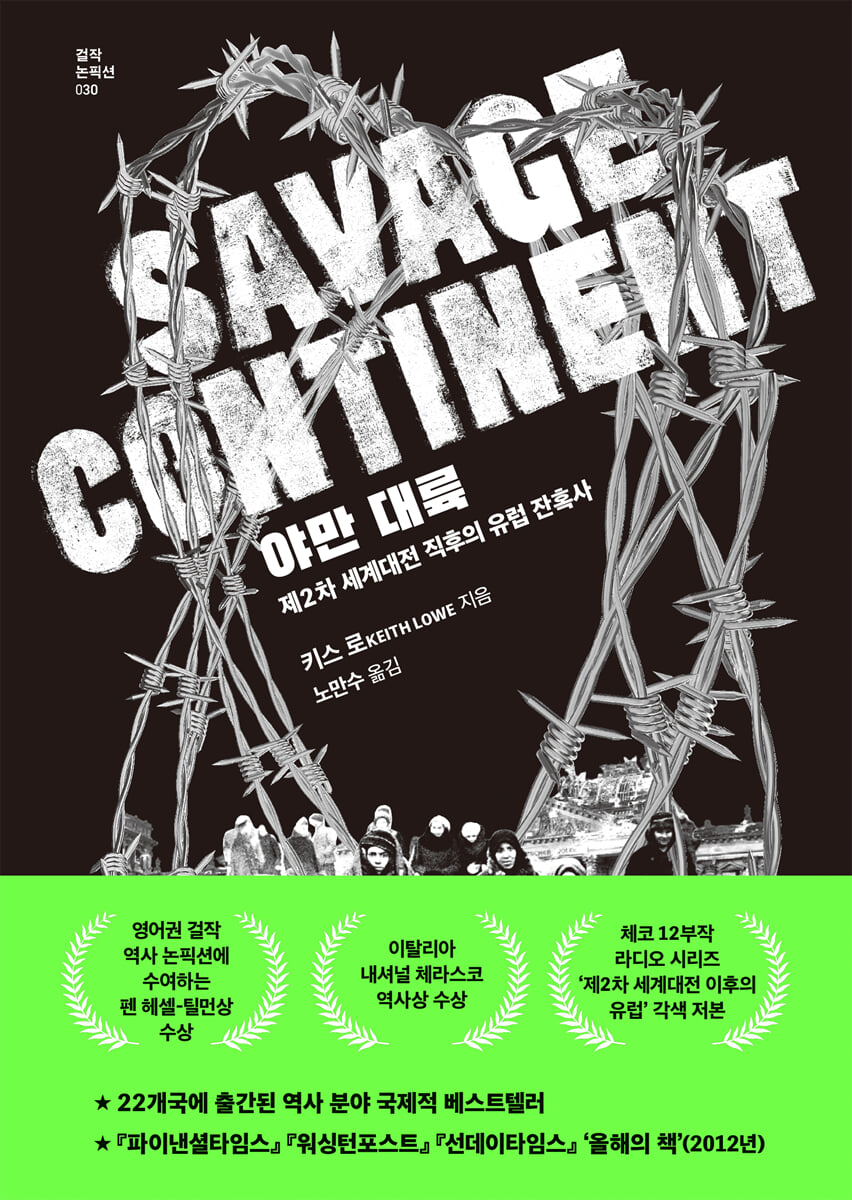
Savage Continent
 |
Description
Book Introduction
The European continent was gripped immediately after World War II.
of murderous revenge, violent retaliation, and brutal ethnic cleansing.
A vivid, realistic and chilling story
*International bestseller in history, published in 22 countries*
*Financial Times, Washington Post, Sunday Times 'Book of the Year' (2012)*
*Winner of the Penn-Hessel-Tillman Award for the best English-language historical nonfiction*
*Italy's 'National Cherasco History' Award*
*Adapted from the Czech 12-part radio series 'Europe after World War II'*
The nature of the ruins that built modern Europe
On May 7, 1945, Nazi Germany surrendered unconditionally.
World War II, which had lasted for six years, ended.
But Keith Law's book, "The Savage Continent," says otherwise.
The author denounces humanity's continued role as "beasts" not only during the war but also after the war, particularly through the countless atrocities committed in Europe.
The postwar period rather emphasizes that “the end of the world war became the starting point for another atrocity.”
People have had to endure some kind of loss or injustice.
Even countries like Bulgaria, which had seen little direct fighting, were exposed to political turmoil, violent altercations with neighbors, coercion from the Nazis, and eventually invasion by new powers.
In the midst of all this, it became quite natural to hate those we perceived as enemies.
A lieutenant colonel in the Bulgarian Air Force volunteers after the war asked a civilian who had been arrested for protesting against a communist official who had cut in line to buy bread:
“Who is your enemy?” He thought for a moment and then said, “I really don’t know.
“I don’t think there has been any,” he replied.
The lieutenant colonel jumped up from his chair.
"You have no enemies? What kind of person are you? If you don't know, I'll teach you.
“I’ll train you very quickly!”
The early postwar period was one of the most important periods in modern European history.
If World War II destroyed the old continent of Europe, the chaotic and volatile post-war period created a new Europe.
This period, filled with violence and revenge, gave rise to many hopes, aspirations, prejudices, and resentments among Europeans.
If we truly want to understand today's Europe, we must first understand what happened during this crucial period of the formation of a new Europe.
The view that one avoids difficult or sensitive topics can be criticized as cowardly.
Because these are the very foundations on which modern Europe was built.
of murderous revenge, violent retaliation, and brutal ethnic cleansing.
A vivid, realistic and chilling story
*International bestseller in history, published in 22 countries*
*Financial Times, Washington Post, Sunday Times 'Book of the Year' (2012)*
*Winner of the Penn-Hessel-Tillman Award for the best English-language historical nonfiction*
*Italy's 'National Cherasco History' Award*
*Adapted from the Czech 12-part radio series 'Europe after World War II'*
The nature of the ruins that built modern Europe
On May 7, 1945, Nazi Germany surrendered unconditionally.
World War II, which had lasted for six years, ended.
But Keith Law's book, "The Savage Continent," says otherwise.
The author denounces humanity's continued role as "beasts" not only during the war but also after the war, particularly through the countless atrocities committed in Europe.
The postwar period rather emphasizes that “the end of the world war became the starting point for another atrocity.”
People have had to endure some kind of loss or injustice.
Even countries like Bulgaria, which had seen little direct fighting, were exposed to political turmoil, violent altercations with neighbors, coercion from the Nazis, and eventually invasion by new powers.
In the midst of all this, it became quite natural to hate those we perceived as enemies.
A lieutenant colonel in the Bulgarian Air Force volunteers after the war asked a civilian who had been arrested for protesting against a communist official who had cut in line to buy bread:
“Who is your enemy?” He thought for a moment and then said, “I really don’t know.
“I don’t think there has been any,” he replied.
The lieutenant colonel jumped up from his chair.
"You have no enemies? What kind of person are you? If you don't know, I'll teach you.
“I’ll train you very quickly!”
The early postwar period was one of the most important periods in modern European history.
If World War II destroyed the old continent of Europe, the chaotic and volatile post-war period created a new Europe.
This period, filled with violence and revenge, gave rise to many hopes, aspirations, prejudices, and resentments among Europeans.
If we truly want to understand today's Europe, we must first understand what happened during this crucial period of the formation of a new Europe.
The view that one avoids difficult or sensitive topics can be criticized as cowardly.
Because these are the very foundations on which modern Europe was built.
- You can preview some of the book's contents.
Preview
index
Preface to the Korean edition
Introduction
Part 1: The Legacy of War
Chapter 1 Physical Destruction
Chapter 2 Absence
Death toll | Jews disappeared | Another Holocaust | Widows and orphans
Chapter 3: Forced Deportation
Chapter 4: Kia
Chapter 5 Moral Decay
Looting and theft | Black market | Violence | Rape | Morality and children
Chapter 6 Hope
Hero Worship | Brotherhood and Unity | Brave New World
Chapter 7: Landscape of Chaos
Part 2 Revenge
Chapter 8: Bloodthirst
Chapter 9: The Liberated Camp
Discovery | Revenge of the Jewish Captives
Chapter 10: Suppressed Revenge: Forced Laborers
Revenge of the Slave Laborers | Military Management of Refugees | Liberation Complex | Allied Rescue and Revival | The Problem of Personal Power
Chapter 11 German Prisoners of War
Prisoners of War under US Military Jurisdiction | Prisoners of War under Soviet Military Jurisdiction | The Price of Evil
Chapter 12 Unbridled Revenge: Eastern Europe
Germans in Czechoslovakia | New German Extermination Camps | The Politics of Numbers
Chapter 13: The Enemy Within
The Great Purge in Italy | The Failed Purge of Collaborators | Constructing a Convenient Myth
Chapter 14: Revenge on Women and Children
Shaved Heads of 'Horizontal Collaborators' | Child Exclusion
Chapter 15: Intention of Revenge
Part 3: Ethnic Cleansing
Chapter 16: Selection of Exhibitions
Chapter 17: Jewish Refugees
The Choice to Return Home | Return: The Netherlands | The Scuffle for Jewish Property | Capitalist Jews, Communist Jews | The Kielce Massacre in Poland | The Great Jewish Exodus
Chapter 18: Ethnic Cleansing in Ukraine and Poland
The Origins of Ethnic Violence Between Poland and Ukraine | Soviet-Style Ethnic Conflict Resolution | Forced "Repatriation" of Minorities | Forced Assimilation
Chapter 19: Forced Expulsion of Germans
The Reality of the Inhumane Deportation of Germans | The 'Return' to the Third Reich | Total Deportation, Elimination of Germanization | The Ethnically Purified Landscape of Eastern Europe
Chapter 20 Europe in Microscope: Yugoslavia
Historical Background | The Bleiburg Tragedy | Yugoslavia: A Symbol of Pan-European Violence
Chapter 21: Tolerance in Western Europe, Intolerance in Eastern Europe
Part 4: Civil War
Chapter 22: Pre-war: The War Within the War
Chapter 23: Political Violence in France and Italy
Targets of Political Violence | Reaction | The Communist Myth of a 'Lost Victory'
Chapter 24: The Greek Civil War
Characteristics of Communist Resistance Organizations | The Defeat of Communism in Greece | The Descent of the "Iron Curtain"
Chapter 25: The Romanian Communist Party, the Invader of Eastern European Democracy
The August Coup | The Communist Party's Power Struggle | The Collapse of Romanian Democracy | Stalinism Unleashed
Chapter 26: Subjugated Eastern Europe
Chapter 27: Resistance Activities of the "Forest Brothers" in the Baltic States
The Battle of Kalnyškes | Soviet-Style Terror | Partisans or Bandits? | The Baltic States: The End of the Anti-Soviet Partisan Resistance | A Land of Anti-Communist Martyrs
Chapter 28: The Mirror Image of the Cold War
Conclusion: The Importance of National Myths
Acknowledgements
Translator's Note
Introduction
Part 1: The Legacy of War
Chapter 1 Physical Destruction
Chapter 2 Absence
Death toll | Jews disappeared | Another Holocaust | Widows and orphans
Chapter 3: Forced Deportation
Chapter 4: Kia
Chapter 5 Moral Decay
Looting and theft | Black market | Violence | Rape | Morality and children
Chapter 6 Hope
Hero Worship | Brotherhood and Unity | Brave New World
Chapter 7: Landscape of Chaos
Part 2 Revenge
Chapter 8: Bloodthirst
Chapter 9: The Liberated Camp
Discovery | Revenge of the Jewish Captives
Chapter 10: Suppressed Revenge: Forced Laborers
Revenge of the Slave Laborers | Military Management of Refugees | Liberation Complex | Allied Rescue and Revival | The Problem of Personal Power
Chapter 11 German Prisoners of War
Prisoners of War under US Military Jurisdiction | Prisoners of War under Soviet Military Jurisdiction | The Price of Evil
Chapter 12 Unbridled Revenge: Eastern Europe
Germans in Czechoslovakia | New German Extermination Camps | The Politics of Numbers
Chapter 13: The Enemy Within
The Great Purge in Italy | The Failed Purge of Collaborators | Constructing a Convenient Myth
Chapter 14: Revenge on Women and Children
Shaved Heads of 'Horizontal Collaborators' | Child Exclusion
Chapter 15: Intention of Revenge
Part 3: Ethnic Cleansing
Chapter 16: Selection of Exhibitions
Chapter 17: Jewish Refugees
The Choice to Return Home | Return: The Netherlands | The Scuffle for Jewish Property | Capitalist Jews, Communist Jews | The Kielce Massacre in Poland | The Great Jewish Exodus
Chapter 18: Ethnic Cleansing in Ukraine and Poland
The Origins of Ethnic Violence Between Poland and Ukraine | Soviet-Style Ethnic Conflict Resolution | Forced "Repatriation" of Minorities | Forced Assimilation
Chapter 19: Forced Expulsion of Germans
The Reality of the Inhumane Deportation of Germans | The 'Return' to the Third Reich | Total Deportation, Elimination of Germanization | The Ethnically Purified Landscape of Eastern Europe
Chapter 20 Europe in Microscope: Yugoslavia
Historical Background | The Bleiburg Tragedy | Yugoslavia: A Symbol of Pan-European Violence
Chapter 21: Tolerance in Western Europe, Intolerance in Eastern Europe
Part 4: Civil War
Chapter 22: Pre-war: The War Within the War
Chapter 23: Political Violence in France and Italy
Targets of Political Violence | Reaction | The Communist Myth of a 'Lost Victory'
Chapter 24: The Greek Civil War
Characteristics of Communist Resistance Organizations | The Defeat of Communism in Greece | The Descent of the "Iron Curtain"
Chapter 25: The Romanian Communist Party, the Invader of Eastern European Democracy
The August Coup | The Communist Party's Power Struggle | The Collapse of Romanian Democracy | Stalinism Unleashed
Chapter 26: Subjugated Eastern Europe
Chapter 27: Resistance Activities of the "Forest Brothers" in the Baltic States
The Battle of Kalnyškes | Soviet-Style Terror | Partisans or Bandits? | The Baltic States: The End of the Anti-Soviet Partisan Resistance | A Land of Anti-Communist Martyrs
Chapter 28: The Mirror Image of the Cold War
Conclusion: The Importance of National Myths
Acknowledgements
Translator's Note
Publisher's Review
World War II must be redefined.
World War II, the most destructive war in human history, destroyed not only physical infrastructure but also all the institutions that united and sustained the nation as a complete national community.
However, contrary to popular belief, World War II did not end with Hitler's defeat.
In parts of Eastern Europe, violence continued after Victory in Europe Day (May 8, 1945).
In Yugoslavia, Tito's forces did not lay down their guns against the Germans until at least May 15, 1945.
In Greece, Yugoslavia, and Poland, civil wars raged for years, sparked by Nazi intervention.
In Ukraine and the Baltic states, nationalist partisans fought against Soviet forces until the 1950s.
Some Poles even see the end of the war in the 1980s, when they finally drove out the Soviet Union.
In the aftermath of the war, after the war, people were unable to love their neighbors for various reasons.
If you were German, you were condemned by almost everyone, and those who served Germany were treated just as harshly.
In the immediate aftermath of the war, most revenge was concentrated among two groups.
A person who worships a false god (the god worshipped by Catholicism, Orthodoxy, Islam, and Judaism) or does not believe in God.
A person belonging to the wrong race or nationality.
Accordingly, during the war, Croats massacred Serbs, Ukrainians killed Poles, and Hungarians oppressed Slovaks.
And almost all of them persecuted the Jews.
It is not enough to portray World War II as simply a territorial dispute between the Axis and Allied powers.
Some of the most brutal events of this war had nothing to do with territory, but rather with race or nationality.
Some of the most vicious battles were fought between local populations in different countries, who used the world wars as an excuse to vent long-standing grievances.
The Ustasha, a far-right nationalist group in Croatia, fought for racial purity.
Slovaks, Ukrainians and Lithuanians fought for national liberation.
Many Greeks and Yugoslavs fought for the abolition (or restoration) of the monarchy.
Many Italians fought to break free from the shackles of medieval feudalism.
Ethnic cleansing, 1945–1947, the expulsion of tens of millions
The Germans referred to the months following the end of the war as 'Stunde Null' (zero time).
The immediate post-war period, when all the scars of history have been completely washed away and reduced to zero, is the time when history is permitted to move forward again.
But this concept is questionable.
There has never been a history where the wounds of the past were washed clean and a new start was made from scratch.
Because the aftermath of the war, with its vengeance and punishment, swept through all areas of European life.
Several countries were stripped of their territories and assets, governments and social institutions were liquidated, and ethnic communities were threatened for alleged wartime actions.
Some of the worst acts of retaliation have been perpetrated against individuals.
Across Europe, German civilians were beaten, arrested, forced into slave labor, or simply murdered.
Soldiers and police officers who collaborated with the Nazis were arrested and subjected to severe torture.
Women who had sex with German soldiers were shaved, stripped naked, and tortured in the streets.
Millions of German, Hungarian and Austrian women were raped.
Far from completely eradicating the scars of history, the aftermath of the war left deep resentment between communities and nations, many of which remain unresolved to this day.
In fact, ethnic conflicts have worsened in some parts of Europe.
Jewish sacrifices continued as during the war.
Minorities have once again become targets of political struggles everywhere, and in some places atrocities as repulsive as those committed by the Nazis have occurred.
The immediate post-war period also showed the logical conclusion to all the Nazi efforts to classify, isolate, and discriminate against various races.
From 1945 to 1947, tens of millions of men, women, and children were driven from their countries in a campaign of ethnic cleansing on a scale unprecedented in human history.
Those who praise the postwar period as a 'European miracle' have rarely discussed this aspect, and it is not even well known.
Even those who knew about the expulsion of Germans from all over Eastern Europe knew little about the various minorities who were similarly driven out.
The narrative that Europe unfolded in the immediate aftermath of the war was not one of reconstruction and revival, but of a descent into anarchy.
Although dozens of excellent books have dealt with events in individual countries (especially Germany), they have neglected to portray the continent as a whole, 'missing the forest for the trees'.
In short, the same theme was repeated throughout Europe.
After all, the history of Europe immediately after World War II has never been properly written.
There are several historical books that take a broad view of the entire European continent, including Tony Judt's Postwar Europe, but these books cover such a broad time frame that the events of the "immediate post-war period" are summarized in just a few chapters.
No other work has ever been written in any language that analyzes this momentous and turbulent period of turmoil on a continent-wide scale.
This book is a partial attempt, however weak, to correct and supplement the current state of post-war research.
Local conflicts due to differences in race, ethnicity, class, ideology, territory, and religion
The book focuses on a period when even the slightest provocation could spark a resurgence of violence.
Part 1 did a great job of pinpointing exactly what World War II had wreaked on us, both materially and spiritually.
Only by fully identifying and recognizing what was lost can we understand the subsequent events.
Part 2 depicts the wave of revenge that swept across the continent and reveals how this phenomenon was manipulated for political gain.
Revenge is undoubtedly a consistent theme in this book.
To properly understand the atmosphere of post-war Europe, it is essential to understand the logic and purpose of revenge.
Parts 3 and 4 deal with what happens when this revenge and other forms of violence get out of hand.
Part 3, "Ethnic Cleansing," focuses on the ethnic cleansing that took place in Eastern Europe and the former Soviet Union, including Yugoslavia, Hungary, Poland, and Czechoslovakia.
It also examines the pan-European violence that followed, including forced population movements, the genocide of ethnic minorities, forced assimilation policies, and anti-Semitism, all aimed at creating a racially homogeneous nation.
For example, the victorious nations drew new borders in Europe and carried out mass migrations of people.
This was a 'good-willed' measure to prevent future hostilities, but it resulted in the brutal destruction of 12 ethnic groups, including Ukrainians, Hungarians, Poles and Slavs.
Part IV, "Civil Wars," discusses various types of civil wars in France, Italy, Yugoslavia, Greece, Poland, Romania, and the Baltic states.
It also reminds us of the fact that World War II was not only a territorial war but also an ideological war, through the class conflict that had persisted for a long time, regardless of whether it was a collaboration with Germany or not.
The author meticulously describes how the internal contradictions of each European country erupted from the Baltic Sea to the Mediterranean with the keyword of "violence," and analyzes that the reason why barbarism persisted for a long time after the war was because behind the great clash between the Allied Forces and the Axis powers, local conflicts based on differences in race, ethnicity, class, ideology, territory, and religion, each with different goals and motivations, were hidden.
And this postwar violence proves that “it was essentially the last flare-up of World War II and closely intertwined with the onset of the Cold War.”
So the pervasive perspective of this book is that the period immediately following World War II was one of the most crucial periods in human history, and that to truly understand contemporary Europe (and the world situation), we must first understand what happened during this crucial period of "formation of modern Europe" and how it transformed postwar society.
For example, in order to find the root of the ongoing conflicts such as the Middle East wars today that resulted from the 'Great Jewish Exodus' (the establishment of Israel in Palestine), the resurgence of anti-Semitism around the world, and the impending conflict between Kosovo and Serbia, an understanding of the wartime and post-war periods is essential, and in order to put an end to the vicious cycle of hatred and violence, it is necessary to show that competing historical perspectives can exist side by side.
A 'pan-European' perspective, away from the Western European focus
One of the author's main aims in writing this book was to break away from the 'narrow' Western perspective that dominates most writings on the postwar period.
Books covering the postwar period over the past several decades have focused on events in Western Europe.
This is because information about Eastern Europe, even within Eastern Europe itself, was not readily available.
Although access to relevant information became possible only after the collapse of the Soviet Union and the dissolution of its satellite states, the material remained largely secret and obscure, appearing primarily in academic books and journals, and often written in the native languages of the original authors.
Although Polish, Czech or Hungarian authors produced much pioneering work, it was accessible only to readers who knew Polish, Czech or Hungarian, and remained largely within academia.
The final and most important purpose of this book is to help us find our way out of the labyrinth of myths about the pre- and post-war period that are widespread in the world.
The author's detailed and rigorous investigations into many of the massacres revealed far less dramatic details than commonly reported, but some truly appalling atrocities were concealed or buried under the weight of other historical events.
While it may be difficult to clearly uncover the truth behind some of these, it is possible to dispel at least some of the distorted falsehoods.
Books on postwar European history, while not as rich as those devoted to the World Wars themselves, have become increasingly substantial in recent years.
Most books have focused on the relatively long period of 'postwar', the process of breaking away from Nazism (fascism), the various responses to the negative legacies of the war, compensation for victims, etc., but it is rare to find a book (even in Korea) that devotes as many pages to describing the violence, hatred, and atrocities of the 'immediate postwar period' as this book.
Of course, it overlaps with several similar books, including Tony Judt's "Postwar Europe," but the book's greatest characteristic and unique research achievement is that it discusses the "period immediately following World War II" as a full-length topic, rather than summarizing it in two or three chapters.
Spatially, the book covers a wide area, from the English Channel and Scandinavia to the Mediterranean and the Ural Mountains, and its greatest virtue is its detailed coverage of Eastern European countries and the former Soviet Union (particularly Belarus, Ukraine, and the Baltic states).
It can soon be called the 'barbaric post-war European atrocities (dark history)' encompassing 'East, West, South, and North Europe (and Russia and Israel)'.
For this reason, it was evaluated that there is no other book that delves into the issues of revenge, civil war, ethnic cleansing, rape, and forced mass migration that occurred immediately after World War II with such a deep and broad totality that encompasses the Western, Eastern European, Northern European, Southern European (including Israel), and Russian perspectives.
The author's efforts to "break away from the narrow-minded Western European (or American) perspective, employ a large amount of historical literature from all European countries, and to present a more comprehensive and reflective history to readers by breaking through historical mysteries caused by political ideology and fabricated and faulty data" have borne fruit.
This is because it is a particularly non-Western perspective.
The origins of the Ukrainian War lie in World War II.
Even now, catastrophic wars are raging in the Middle East and Eastern Europe.
It is chilling to see the same type of inhumane violence that occurred during and after World War II being repeated.
Readers of this book will understand that these two wars also have their fundamental origins in World War II and its immediate aftermath.
Therefore, this book provides important hints for understanding the interest in the 'powder kegs of conflict' that continue to this day (e.g., the Balkans, Palestine, Korea and Taiwan, etc.) and the new East-West bloc structure (the new Cold War between the West and the non-West).
I also hope that an Asian version of the post-war barbarian history will be published, focusing on and meticulously covering the situation in Asia immediately following the end of the Pacific War, which was caused by the militarism of the Japanese imperial system.
World War II, the most destructive war in human history, destroyed not only physical infrastructure but also all the institutions that united and sustained the nation as a complete national community.
However, contrary to popular belief, World War II did not end with Hitler's defeat.
In parts of Eastern Europe, violence continued after Victory in Europe Day (May 8, 1945).
In Yugoslavia, Tito's forces did not lay down their guns against the Germans until at least May 15, 1945.
In Greece, Yugoslavia, and Poland, civil wars raged for years, sparked by Nazi intervention.
In Ukraine and the Baltic states, nationalist partisans fought against Soviet forces until the 1950s.
Some Poles even see the end of the war in the 1980s, when they finally drove out the Soviet Union.
In the aftermath of the war, after the war, people were unable to love their neighbors for various reasons.
If you were German, you were condemned by almost everyone, and those who served Germany were treated just as harshly.
In the immediate aftermath of the war, most revenge was concentrated among two groups.
A person who worships a false god (the god worshipped by Catholicism, Orthodoxy, Islam, and Judaism) or does not believe in God.
A person belonging to the wrong race or nationality.
Accordingly, during the war, Croats massacred Serbs, Ukrainians killed Poles, and Hungarians oppressed Slovaks.
And almost all of them persecuted the Jews.
It is not enough to portray World War II as simply a territorial dispute between the Axis and Allied powers.
Some of the most brutal events of this war had nothing to do with territory, but rather with race or nationality.
Some of the most vicious battles were fought between local populations in different countries, who used the world wars as an excuse to vent long-standing grievances.
The Ustasha, a far-right nationalist group in Croatia, fought for racial purity.
Slovaks, Ukrainians and Lithuanians fought for national liberation.
Many Greeks and Yugoslavs fought for the abolition (or restoration) of the monarchy.
Many Italians fought to break free from the shackles of medieval feudalism.
Ethnic cleansing, 1945–1947, the expulsion of tens of millions
The Germans referred to the months following the end of the war as 'Stunde Null' (zero time).
The immediate post-war period, when all the scars of history have been completely washed away and reduced to zero, is the time when history is permitted to move forward again.
But this concept is questionable.
There has never been a history where the wounds of the past were washed clean and a new start was made from scratch.
Because the aftermath of the war, with its vengeance and punishment, swept through all areas of European life.
Several countries were stripped of their territories and assets, governments and social institutions were liquidated, and ethnic communities were threatened for alleged wartime actions.
Some of the worst acts of retaliation have been perpetrated against individuals.
Across Europe, German civilians were beaten, arrested, forced into slave labor, or simply murdered.
Soldiers and police officers who collaborated with the Nazis were arrested and subjected to severe torture.
Women who had sex with German soldiers were shaved, stripped naked, and tortured in the streets.
Millions of German, Hungarian and Austrian women were raped.
Far from completely eradicating the scars of history, the aftermath of the war left deep resentment between communities and nations, many of which remain unresolved to this day.
In fact, ethnic conflicts have worsened in some parts of Europe.
Jewish sacrifices continued as during the war.
Minorities have once again become targets of political struggles everywhere, and in some places atrocities as repulsive as those committed by the Nazis have occurred.
The immediate post-war period also showed the logical conclusion to all the Nazi efforts to classify, isolate, and discriminate against various races.
From 1945 to 1947, tens of millions of men, women, and children were driven from their countries in a campaign of ethnic cleansing on a scale unprecedented in human history.
Those who praise the postwar period as a 'European miracle' have rarely discussed this aspect, and it is not even well known.
Even those who knew about the expulsion of Germans from all over Eastern Europe knew little about the various minorities who were similarly driven out.
The narrative that Europe unfolded in the immediate aftermath of the war was not one of reconstruction and revival, but of a descent into anarchy.
Although dozens of excellent books have dealt with events in individual countries (especially Germany), they have neglected to portray the continent as a whole, 'missing the forest for the trees'.
In short, the same theme was repeated throughout Europe.
After all, the history of Europe immediately after World War II has never been properly written.
There are several historical books that take a broad view of the entire European continent, including Tony Judt's Postwar Europe, but these books cover such a broad time frame that the events of the "immediate post-war period" are summarized in just a few chapters.
No other work has ever been written in any language that analyzes this momentous and turbulent period of turmoil on a continent-wide scale.
This book is a partial attempt, however weak, to correct and supplement the current state of post-war research.
Local conflicts due to differences in race, ethnicity, class, ideology, territory, and religion
The book focuses on a period when even the slightest provocation could spark a resurgence of violence.
Part 1 did a great job of pinpointing exactly what World War II had wreaked on us, both materially and spiritually.
Only by fully identifying and recognizing what was lost can we understand the subsequent events.
Part 2 depicts the wave of revenge that swept across the continent and reveals how this phenomenon was manipulated for political gain.
Revenge is undoubtedly a consistent theme in this book.
To properly understand the atmosphere of post-war Europe, it is essential to understand the logic and purpose of revenge.
Parts 3 and 4 deal with what happens when this revenge and other forms of violence get out of hand.
Part 3, "Ethnic Cleansing," focuses on the ethnic cleansing that took place in Eastern Europe and the former Soviet Union, including Yugoslavia, Hungary, Poland, and Czechoslovakia.
It also examines the pan-European violence that followed, including forced population movements, the genocide of ethnic minorities, forced assimilation policies, and anti-Semitism, all aimed at creating a racially homogeneous nation.
For example, the victorious nations drew new borders in Europe and carried out mass migrations of people.
This was a 'good-willed' measure to prevent future hostilities, but it resulted in the brutal destruction of 12 ethnic groups, including Ukrainians, Hungarians, Poles and Slavs.
Part IV, "Civil Wars," discusses various types of civil wars in France, Italy, Yugoslavia, Greece, Poland, Romania, and the Baltic states.
It also reminds us of the fact that World War II was not only a territorial war but also an ideological war, through the class conflict that had persisted for a long time, regardless of whether it was a collaboration with Germany or not.
The author meticulously describes how the internal contradictions of each European country erupted from the Baltic Sea to the Mediterranean with the keyword of "violence," and analyzes that the reason why barbarism persisted for a long time after the war was because behind the great clash between the Allied Forces and the Axis powers, local conflicts based on differences in race, ethnicity, class, ideology, territory, and religion, each with different goals and motivations, were hidden.
And this postwar violence proves that “it was essentially the last flare-up of World War II and closely intertwined with the onset of the Cold War.”
So the pervasive perspective of this book is that the period immediately following World War II was one of the most crucial periods in human history, and that to truly understand contemporary Europe (and the world situation), we must first understand what happened during this crucial period of "formation of modern Europe" and how it transformed postwar society.
For example, in order to find the root of the ongoing conflicts such as the Middle East wars today that resulted from the 'Great Jewish Exodus' (the establishment of Israel in Palestine), the resurgence of anti-Semitism around the world, and the impending conflict between Kosovo and Serbia, an understanding of the wartime and post-war periods is essential, and in order to put an end to the vicious cycle of hatred and violence, it is necessary to show that competing historical perspectives can exist side by side.
A 'pan-European' perspective, away from the Western European focus
One of the author's main aims in writing this book was to break away from the 'narrow' Western perspective that dominates most writings on the postwar period.
Books covering the postwar period over the past several decades have focused on events in Western Europe.
This is because information about Eastern Europe, even within Eastern Europe itself, was not readily available.
Although access to relevant information became possible only after the collapse of the Soviet Union and the dissolution of its satellite states, the material remained largely secret and obscure, appearing primarily in academic books and journals, and often written in the native languages of the original authors.
Although Polish, Czech or Hungarian authors produced much pioneering work, it was accessible only to readers who knew Polish, Czech or Hungarian, and remained largely within academia.
The final and most important purpose of this book is to help us find our way out of the labyrinth of myths about the pre- and post-war period that are widespread in the world.
The author's detailed and rigorous investigations into many of the massacres revealed far less dramatic details than commonly reported, but some truly appalling atrocities were concealed or buried under the weight of other historical events.
While it may be difficult to clearly uncover the truth behind some of these, it is possible to dispel at least some of the distorted falsehoods.
Books on postwar European history, while not as rich as those devoted to the World Wars themselves, have become increasingly substantial in recent years.
Most books have focused on the relatively long period of 'postwar', the process of breaking away from Nazism (fascism), the various responses to the negative legacies of the war, compensation for victims, etc., but it is rare to find a book (even in Korea) that devotes as many pages to describing the violence, hatred, and atrocities of the 'immediate postwar period' as this book.
Of course, it overlaps with several similar books, including Tony Judt's "Postwar Europe," but the book's greatest characteristic and unique research achievement is that it discusses the "period immediately following World War II" as a full-length topic, rather than summarizing it in two or three chapters.
Spatially, the book covers a wide area, from the English Channel and Scandinavia to the Mediterranean and the Ural Mountains, and its greatest virtue is its detailed coverage of Eastern European countries and the former Soviet Union (particularly Belarus, Ukraine, and the Baltic states).
It can soon be called the 'barbaric post-war European atrocities (dark history)' encompassing 'East, West, South, and North Europe (and Russia and Israel)'.
For this reason, it was evaluated that there is no other book that delves into the issues of revenge, civil war, ethnic cleansing, rape, and forced mass migration that occurred immediately after World War II with such a deep and broad totality that encompasses the Western, Eastern European, Northern European, Southern European (including Israel), and Russian perspectives.
The author's efforts to "break away from the narrow-minded Western European (or American) perspective, employ a large amount of historical literature from all European countries, and to present a more comprehensive and reflective history to readers by breaking through historical mysteries caused by political ideology and fabricated and faulty data" have borne fruit.
This is because it is a particularly non-Western perspective.
The origins of the Ukrainian War lie in World War II.
Even now, catastrophic wars are raging in the Middle East and Eastern Europe.
It is chilling to see the same type of inhumane violence that occurred during and after World War II being repeated.
Readers of this book will understand that these two wars also have their fundamental origins in World War II and its immediate aftermath.
Therefore, this book provides important hints for understanding the interest in the 'powder kegs of conflict' that continue to this day (e.g., the Balkans, Palestine, Korea and Taiwan, etc.) and the new East-West bloc structure (the new Cold War between the West and the non-West).
I also hope that an Asian version of the post-war barbarian history will be published, focusing on and meticulously covering the situation in Asia immediately following the end of the Pacific War, which was caused by the militarism of the Japanese imperial system.
GOODS SPECIFICS
- Date of issue: January 24, 2025
- Format: Hardcover book binding method guide
- Page count, weight, size: 640 pages | 830g | 146*208*35mm
- ISBN13: 9791169093231
You may also like
카테고리
korean


korean

![GQ KOREA Mark (Monthly): December [2025]](http://librairie.coreenne.fr/cdn/shop/files/8ef265dbbfbf186523ed75ba7319009d.jpg?v=1765340328&width=3840)


