

Russian Civil War
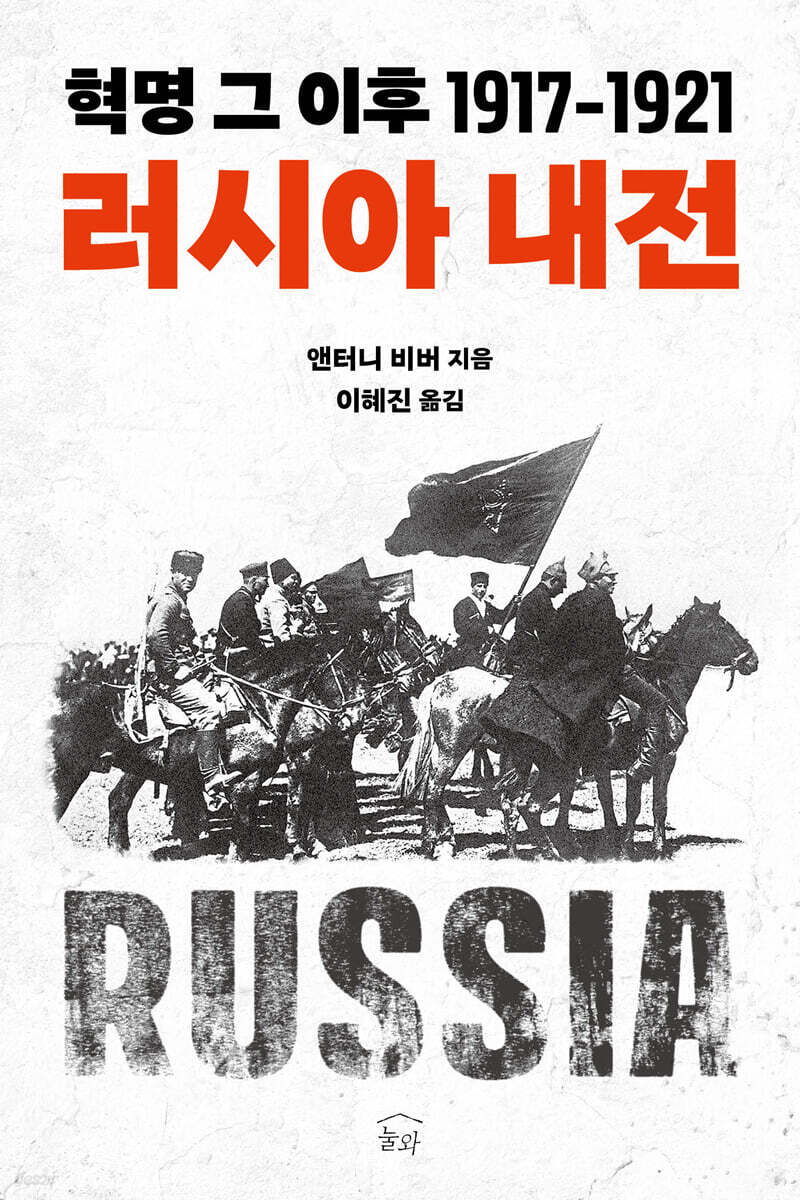 |
Description
Book Introduction
After the revolution, a huge and catastrophic civil war engulfed Russia in blood.
A masterpiece by Antony Beevor, a master of modern war history
The collapse of the empire following the Russian Revolution in 1917 was followed by a devastating civil war that is estimated to have killed up to 12 million people.
This war, also called the "Red-White Civil War," was fought between the Bolshevik Red Army led by Lenin and Trotsky and the White Army opposing them, and took place across the Eurasian continent, from Poland in the west to Vladivostok in the east.
Antony Beevor, author of The Spanish Civil War and Stalingrad, has presented a remarkably clear account of the complex Russian Civil War.
Drawing on new material from archives in Russia, Poland, Ukraine, and other countries, as well as numerous books and records, this book vividly reconstructs the Russian Civil War through the eyes of a diverse range of characters: workers on the streets of Petrograd, cavalry marching across the "quiet" Don steppes, and nurses in a field hospital.
A masterpiece by Antony Beevor, a master of modern war history
The collapse of the empire following the Russian Revolution in 1917 was followed by a devastating civil war that is estimated to have killed up to 12 million people.
This war, also called the "Red-White Civil War," was fought between the Bolshevik Red Army led by Lenin and Trotsky and the White Army opposing them, and took place across the Eurasian continent, from Poland in the west to Vladivostok in the east.
Antony Beevor, author of The Spanish Civil War and Stalingrad, has presented a remarkably clear account of the complex Russian Civil War.
Drawing on new material from archives in Russia, Poland, Ukraine, and other countries, as well as numerous books and records, this book vividly reconstructs the Russian Civil War through the eyes of a diverse range of characters: workers on the streets of Petrograd, cavalry marching across the "quiet" Don steppes, and nurses in a field hospital.
- You can preview some of the book's contents.
Preview
index
List of maps
introduction
Part 1 1912-1917
01 Europe's Self-Destruction · 1912-1916
February Revolution · January–March 1917
03 The Fall of the Double-Headed Eagle · February–March 1917
04 From Despotism to Chaos · March-April 1917
05 Pregnant Widow · March–May 1917
06 Kerensky Offensive and the July Days · June–July 1917
07 Kornilov · July-September 1917
October Revolution, September–November 1917
09 The Children's Crusade - The Junkers' Rebellion, October-November 1917
10 The Murder of a Newborn Democracy · November–December 1917
Part 2 1918
11 Breaking the Formwork · January–February 1918
12 Brest-Litovsk · December 1917–March 1918
Ice March of the 13th Volunteer Army, January–March 1918
14 German troops enter · March–April 1918
15 Enemies on the Frontier · Spring and Summer 1918
16. Czech Legion and Left Social Revolutionary Party Uprising, May–July 1918
17 Red Terror, Summer 1918
18 Battle of the Volga and the Red Army, Summer 1918
From the Volga to Siberia, Fall 1918
20 Allied Withdrawal · Fall-Winter 1918
21 The Baltic Sea and Northern Russia, Fall-Winter 1918
Part 3 1919
22 Fatal Compromises · January–March 1919
23 Siberia · January–May 1919
24 Money and Ukraine · April–June 1919
25 Murmansk and Arkhangelsk, Spring and Summer 1919
26 Siberia · June–September 1919
27 Baltic Summer · May–August 1919
March on Moscow, July–October 1919
29 Surprise Attack in the Baltic Sea, Autumn 1919
30 Evacuation from Siberia · September–December 1919
31 Turning Points · September–November 1919
32 Retreat from the South · November–December 1919
Part 4 1920
33 The Siberian Ice March · December 1919–February 1920
Fall of Odessa, January 1920
The Last Cry of the White Cavalry, January–March 1920
36 Commander-in-Chief Wrangel and the Poles who occupied Kiev, Spring and Summer 1920
37 Poland in the West, Wrangel in the South · June–September 1920
38 The Miracle on the Vistula · August–September 1920
39 Hades's Resort · September–December 1920
40 The End of Hope · 1920-1921
Conclusion: The Devil's Disciple
Glossary of Terms
Acknowledgements
List of illustrations
abbreviation
Americas
References
Search
introduction
Part 1 1912-1917
01 Europe's Self-Destruction · 1912-1916
February Revolution · January–March 1917
03 The Fall of the Double-Headed Eagle · February–March 1917
04 From Despotism to Chaos · March-April 1917
05 Pregnant Widow · March–May 1917
06 Kerensky Offensive and the July Days · June–July 1917
07 Kornilov · July-September 1917
October Revolution, September–November 1917
09 The Children's Crusade - The Junkers' Rebellion, October-November 1917
10 The Murder of a Newborn Democracy · November–December 1917
Part 2 1918
11 Breaking the Formwork · January–February 1918
12 Brest-Litovsk · December 1917–March 1918
Ice March of the 13th Volunteer Army, January–March 1918
14 German troops enter · March–April 1918
15 Enemies on the Frontier · Spring and Summer 1918
16. Czech Legion and Left Social Revolutionary Party Uprising, May–July 1918
17 Red Terror, Summer 1918
18 Battle of the Volga and the Red Army, Summer 1918
From the Volga to Siberia, Fall 1918
20 Allied Withdrawal · Fall-Winter 1918
21 The Baltic Sea and Northern Russia, Fall-Winter 1918
Part 3 1919
22 Fatal Compromises · January–March 1919
23 Siberia · January–May 1919
24 Money and Ukraine · April–June 1919
25 Murmansk and Arkhangelsk, Spring and Summer 1919
26 Siberia · June–September 1919
27 Baltic Summer · May–August 1919
March on Moscow, July–October 1919
29 Surprise Attack in the Baltic Sea, Autumn 1919
30 Evacuation from Siberia · September–December 1919
31 Turning Points · September–November 1919
32 Retreat from the South · November–December 1919
Part 4 1920
33 The Siberian Ice March · December 1919–February 1920
Fall of Odessa, January 1920
The Last Cry of the White Cavalry, January–March 1920
36 Commander-in-Chief Wrangel and the Poles who occupied Kiev, Spring and Summer 1920
37 Poland in the West, Wrangel in the South · June–September 1920
38 The Miracle on the Vistula · August–September 1920
39 Hades's Resort · September–December 1920
40 The End of Hope · 1920-1921
Conclusion: The Devil's Disciple
Glossary of Terms
Acknowledgements
List of illustrations
abbreviation
Americas
References
Search
Publisher's Review
A record of the most catastrophic and massive civil war in history
A masterpiece by Antony Beevor, a master of modern war history
After the collapse of the empire in the Russian Revolution of 1917, a terrible and massive civil war broke out, with an estimated 12 million people killed.
This war, also called the "Red-White Civil War," was fought between the Bolshevik Red Army led by Lenin and Trotsky and the White Army opposing them, and took place across the Eurasian continent, from Poland in the west to Vladivostok in the east.
There have been many books about the Russian Revolution, but the civil war that followed was often dealt with briefly or omitted entirely.
However, the Russian Civil War is inextricably linked to the Russian Revolution, and is a crucial event of the 20th century that must be understood if one wishes to properly understand subsequent history.
The Russian Civil War was not simply a 'civil war' in one country, but an international conflict involving the Allied Powers, including Germany, an enemy of World War I, and Britain and France, former allies, as well as the new nations of Finland, Poland, and the Baltic states, which were seeking independence after the collapse of the Russian Empire.
Furthermore, both the Red and White armies committed massacres and torture, making the war even more horrific than a war with another country. This is also an example of what kind of tragedy occurs when political and ideological conflicts within a country reach extremes and an attempt is made to forcibly obliterate the existence of the other side.
Antony Beevor, author of The Spanish Civil War and Stalingrad, has presented a remarkably clear account of the complex Russian Civil War.
Drawing on new material from archives in Russia, Poland, Ukraine, and other countries, as well as numerous books and records, this book vividly reconstructs the Russian Civil War through the eyes of a diverse range of characters: workers on the streets of Petrograd, cavalry marching across the "quiet" Don steppes, and nurses in a field hospital.
The February Revolution, the October Revolution, and the Beginning of the Civil War
The Russian Empire in 1917 was at its limit.
Russia's anachronistic absolute monarchy had long since been exposed as a serious problem by the Bloody Sunday incident in 1905, and the First World War, which had been going on for three years since 1914, dealt a fatal blow to it.
Food was scarce in the city, and the soldiers' discontent was growing.
Even in a situation where the empire was clearly on the verge of collapse, Tsar Nicholas II was so out of touch with reality that he responded to the advice to form a cabinet of Duma (parliament) members to appease the people by saying, “Shouldn’t the people have my trust?”
Ultimately, as a result of the February Revolution in Petrograd, Nicholas II abdicated and his younger brother, Grand Duke Mikhail, also renounced the throne, bringing an end to the empire.
However, the provisional government also lost support from the citizens as the war with Germany continued, and the Bolsheviks led by Lenin overthrew the provisional government in October through an armed uprising mobilizing the Red Guard and sailors, and put forward the Council of People's Commissars established by the Bolshevik leadership (Lenin, Trotsky, Stalin, etc.) as the power organ.
In November, elections to the Constituent Assembly were held, and the Socialist Revolutionary Party received the most votes, but Lenin had no intention of handing over power to the Constituent Assembly, and the Constituent Assembly never convened again after only one meeting.
During the February Revolution, which brought down the empire, there was little opposition from any group, but after the Bolshevik October Revolution, rebellions broke out in various places by officers, Cossacks, Right-wing Socialist-Revolutionaries, and the Czech Legion (originally part of the Austrian army, but after being captured, they decided to fight for the independence of their country and were incorporated into the Russian army), and from this point on, the civil war began in earnest.
A devastating civil war set in the vast expanse of Eurasia
The Russian Civil War unfolded in a way that was very different from any other war of the 20th century.
Russia, which became a battlefield, was so vast that fighting took place along railways and rivers.
The endless plains, the Trans-Siberian Railway stretching thousands of kilometers through coniferous forests, and the Volga River, the longest river in Europe, became the main battlefields, and one side would gain momentum and advance hundreds of kilometers, only to be counterattacked and retreat hundreds of kilometers again when its fighting strength was exhausted.
In this environment, cavalry was considered a very important force, and cavalry charges, reminiscent of the Napoleonic era a hundred years earlier, were utilized as a useful tactic.
The weapon that symbolizes the Russian Civil War is the Tachanka, a machine gun mounted on a horse-drawn cart.
Both the Red Army and the White Army had to fight in a harsh environment where their systems had collapsed, so supplying supplies from the rear to the front was often virtually impossible, and the most important method of supply was capturing enemy military supplies.
Another major feature of the Russian Civil War was its brutality.
The Red Army, which harbored anger toward the ruling class that maintained an oppressive system, and the White Army, which had lost everything in the revolution, both sides fostered hatred toward each other and committed atrocities.
Martin Latsis, a high-ranking official in the Cheka (predecessor of the KGB), the Bolshevik secret police, wrote in Izvestia in August 1918 that “established war practices” were useless.
“To slaughter all the wounded who fought you.
This is the law of civil war.”
The methods of execution and torture were also often particularly brutal.
The White Army would burn captured Communist political commissars alive, and Cheka agents deployed into Red-occupied areas would commit torture that was horrific enough to read about, such as boiling the hands of arrested opponents to peel off the skin, or nailing shoulder straps to their shoulders.
A massacre identical to the Nazi ethnic cleansing 20 years later also occurred, in which captured enemy soldiers were forced to dig holes, killed, and buried.
In the midst of this chaos, the Jews, who had been persecuted from the beginning, once again became victims.
The Russian Empire was originally hostile to Jews to the extent that Tsar Nicholas II personally supported the anti-Semitic organization "Black Hundreds." The White Army that followed in their footsteps intensified its oppression of the Bolsheviks because there were many intellectuals of Jewish origin among them, and to a lesser extent, the Red Army was also not friendly to Jews.
During the civil war, numerous large-scale pogroms (riots and looting targeting Jews) occurred, with an estimated 50,000 to 60,000 Jews murdered in Ukraine alone.
The outbreak and conclusion of the Russian Civil War
It is clear that the leadership of the Red Army during the Russian Civil War was the Bolsheviks led by Lenin and Trotsky.
In contrast, the White Army, at its peak, was divided into three factions: Kolchak, the White 'supreme leader' in the east, Denikin in the south, and Yudenich in the northwest.
At first glance, it seemed as though the Bolsheviks were surrounded on all sides and in danger, but in reality, the Red Army not only occupied the core of Russia's population and industry, but was also able to gain the upper hand by concentrating its forces on one front, defeating the enemy, and then moving troops to another front.
In addition, Trotsky, the People's Commissar for Military Affairs of the Bolshevik regime, hired officers from the old Russian Imperial Army, whom he had previously thoroughly rejected, under the name of "military experts," and selected capable non-commissioned officers to be commanders, thereby improving the overall capabilities of the Red Army.
Trotsky even displayed his heroic side by personally leading armored trains to various parts of the front in times of crisis and leading counterattacks.
The first to collapse under the Red Army's counterattack was Kolchak's army in western Siberia.
Kolchak's army, which had lost the transportation hubs of Ufa and Omsk in succession, was forced to retreat endlessly eastward along the Trans-Siberian Railway, and eventually, after a feud with the Ufa Socialist Revolutionary Party and the Czech Legion near Irkutsk, Kolchak was handed over to the Bolsheviks and executed.
In southern Russia, the White Army led by Denikin once occupied Oryol and threatened Tula, the gateway to Moscow, while in the northwest, Yudenich advanced right up to Petrograd, but was ultimately defeated.
By the winter of 1919, the only White force left was Wrangel's army, trapped in the Crimean Peninsula at the southern tip of Russia.
In eastern Siberia, there still remained White warlords notorious for corruption and brutality, but the tide had already turned.
The following year, in the fall of 1920, the Red Army, having ended the war with Poland, launched a large-scale attack on the Crimean Peninsula to wipe out the White forces, and the Whites, with the support of the Allies who sent warships to ports throughout the Crimean Peninsula, boarded ships and left Russia with over 200,000 people.
It was the de facto end of the Russian Civil War.
Meanwhile, in February 1921, the following year, the Baltic Fleet sailors, who had originally been at the forefront of the revolution and whom Trotsky himself had praised as “the pride and glory of the Russian Revolution,” withdrew their support for the Communist Party and rose up in revolt due to the continued Communist dictatorship and food shortages.
However, Tukhachevsky, under Trotsky's direction, ruthlessly suppressed it, and the ideals of the revolution faded along with it.
Why did the Russian Civil War end in victory for the Red Army?
Although the Bolsheviks had seized power through revolution, their situation at the outbreak of the civil war was by no means optimistic.
As a result of the revolution, the army completely collapsed as most of its officers deserted.
The number of volunteers who gathered under the slogan of protecting the revolution was so insufficient that they eventually had to be conscripted.
During the armistice negotiations with Germany, the country was militarily inferior, and Trotsky's miscalculation led to the Treaty of Brest-Litovsk, which gave up Poland, Belarus, Ukraine, and all of the Baltic states.
Industry and agriculture also suffered severely as a result of flawed policies, especially the indiscriminate requisition of rural populations under the pretext of supplying food for the cities, which led to fierce resistance from the peasants.
As a result of the Bolsheviks' near-genocidal repression and massacre of the Cossacks, who had remained loyal to the Russian tsar, most of them, Russia's most important military resource, turned against the Bolsheviks and joined the White Army.
Moreover, the Left Socialist Revolutionary Party, which had once collaborated with the Bolsheviks, revolted against the Bolshevik dictatorship and the humiliating peace treaty with Germany, and experienced a crisis in which its leaders, including Lenin, were almost assassinated.
But still, the Red Army won.
Antony Beevor points out that the most important factor was that the Bolsheviks had a much more centralized system.
The Red Army also committed as many errors and showed as much incompetence as the White Army, but it was natural that they would win against the divided White Army because they had thoroughly concentrated decision-making in the leadership.
The White Army was made up of various factions with completely different positions, including the Right Socialist Revolutionaries who opposed the Bolshevik dictatorship, officers who wanted to restore the imperial system, and the Cossacks and Siberian warlords who had become virtually independent forces, making proper cooperation impossible from the beginning.
The only thing they had in common was their hatred of the Bolsheviks.
While claiming to be opposing the Bolshevik dictatorship and usurpation of power by neutralizing the elected Constituent Assembly, Kolchak, the "supreme leader," consistently carried out a reactionary military dictatorship, such as overthrowing the administration formed by the members of the Constituent Assembly through a coup.
In addition, no effort was made to reform essential social systems, such as land reform, which led to severe internal divisions and a lack of popular support.
In addition, the White Army never gave up its "Greater Russia" policy of maintaining the territory of the Russian Empire intact, and even while losing in the immediate battle against the Red Army, it did not abandon its hostile attitude toward newly independent states that could become powerful allies.
In contrast, Lenin showed his adherence to realpolitik by concluding agreements with Finland and Estonia in strategically unfavorable situations to focus on more important fronts.
The Russian Civil War as an international war that changed the map of Eastern Europe
If we view the Russian Civil War only as a Russian 'civil war', we cannot properly approach its true nature.
The Russian Empire ruled a vast territory that included present-day Finland, the Baltic states (Estonia, Latvia, and Lithuania), Poland, and Ukraine, and its collapse immediately sparked independence movements in these regions.
Finland, which was originally under Russian rule with the Russian Tsar also serving as Grand Duke of Finland, attempted independence and succeeded in achieving independence when a civil war within the country ended in victory for the conservatives (White Army).
Other regions also saw their independence movements ignited after the Bolshevik Revolution, when they broke free from Russian rule as a result of Lenin's Treaty of Brest-Litovsk with the Central Powers.
After Germany's defeat, the Bolsheviks declared the treaty null and void, and after securing a clear victory in the civil war, they attempted to occupy these regions again and further advance into Germany and other European countries to lay the foundation for world revolution.
However, their ambitions were inevitably frustrated by Poland's miraculous counterattack in front of the capital, Warsaw.
The Soviet Union annexed or brought these regions into its sphere of influence again 20 years later, around the time of World War II, but was forced to give them up again after the collapse of the Soviet Union.
The reason why the Baltic states, including Poland, are taking the hardest stance in the current Russo-Ukrainian war can be easily understood by looking at the development of the Russian Civil War.
The intervention of the Allied Powers, including Britain, and the international communists
The White Army received support from the Allied Powers, including Britain and France, which had been its allies during the war.
The Russian Revolution occurred in the midst of World War I, and if Russia, which was at war with Germany in the east, were to withdraw from the war, the Western Front would also be in great danger.
Because of this, the Allied Powers demanded that the provisional government that came into power after the collapse of the empire continue the war, which went against the will of the Russian people who wanted an immediate end to the war, and it also became a pretext for Lenin and the Bolsheviks he led to overthrow the provisional government.
The Allies supported the Whites, who still regarded Germany as an enemy, in an attempt to draw Russia back into the anti-German front, and continued to support them after World War I to prevent the spread of communism.
It was Britain that intervened particularly actively. Winston Churchill, then Britain's Secretary of State for War (and later Britain's Prime Minister during World War II), was convinced that Bolshevik rule over Russia would be disastrous for Britain, and so he strongly supported the Whites by providing large amounts of weapons and supplies, as well as sending tank units and air force units.
However, Prime Minister Lloyd George, concerned about the situation in his country, which had already been devastated by four years of war, had no choice but to withdraw his intention, drawing a line against further intervention.
It is a great irony of history that Churchill, who had been like this, went to Yalta in Crimea (the place where the White Army met its destruction) some 20 years later to hold talks with Stalin about reorganizing the world order after World War II.
It is difficult to talk about the Red Army without mentioning international communists from other countries.
A rifle unit composed of Latvians served as the bodyguard of the then-fragile Bolshevik regime immediately after the revolution, and Felix Dzerzhinsky, the head of the infamous secret police Cheka (the predecessor of the KGB), was Polish.
There were also those like Bélé Kun, who had fled Hungary after a failed attempt to establish a communist regime, and German and Austrian prisoners of war who were recruited by communism and fought on the side of the Red Army.
It is also interesting that many Chinese people served as Red Army soldiers or Cheka agents.
The Chinese, who had originally been employed as laborers and scattered throughout Russia during World War I, found themselves with nowhere to go in the chaos following the collapse of the Russian Empire. The communist regime, taking note of this, actively recruited them, forming numerous units comprised entirely of Chinese, and they played a significant role in the civil war.
A masterpiece by Antony Beevor, a master of modern war history
After the collapse of the empire in the Russian Revolution of 1917, a terrible and massive civil war broke out, with an estimated 12 million people killed.
This war, also called the "Red-White Civil War," was fought between the Bolshevik Red Army led by Lenin and Trotsky and the White Army opposing them, and took place across the Eurasian continent, from Poland in the west to Vladivostok in the east.
There have been many books about the Russian Revolution, but the civil war that followed was often dealt with briefly or omitted entirely.
However, the Russian Civil War is inextricably linked to the Russian Revolution, and is a crucial event of the 20th century that must be understood if one wishes to properly understand subsequent history.
The Russian Civil War was not simply a 'civil war' in one country, but an international conflict involving the Allied Powers, including Germany, an enemy of World War I, and Britain and France, former allies, as well as the new nations of Finland, Poland, and the Baltic states, which were seeking independence after the collapse of the Russian Empire.
Furthermore, both the Red and White armies committed massacres and torture, making the war even more horrific than a war with another country. This is also an example of what kind of tragedy occurs when political and ideological conflicts within a country reach extremes and an attempt is made to forcibly obliterate the existence of the other side.
Antony Beevor, author of The Spanish Civil War and Stalingrad, has presented a remarkably clear account of the complex Russian Civil War.
Drawing on new material from archives in Russia, Poland, Ukraine, and other countries, as well as numerous books and records, this book vividly reconstructs the Russian Civil War through the eyes of a diverse range of characters: workers on the streets of Petrograd, cavalry marching across the "quiet" Don steppes, and nurses in a field hospital.
The February Revolution, the October Revolution, and the Beginning of the Civil War
The Russian Empire in 1917 was at its limit.
Russia's anachronistic absolute monarchy had long since been exposed as a serious problem by the Bloody Sunday incident in 1905, and the First World War, which had been going on for three years since 1914, dealt a fatal blow to it.
Food was scarce in the city, and the soldiers' discontent was growing.
Even in a situation where the empire was clearly on the verge of collapse, Tsar Nicholas II was so out of touch with reality that he responded to the advice to form a cabinet of Duma (parliament) members to appease the people by saying, “Shouldn’t the people have my trust?”
Ultimately, as a result of the February Revolution in Petrograd, Nicholas II abdicated and his younger brother, Grand Duke Mikhail, also renounced the throne, bringing an end to the empire.
However, the provisional government also lost support from the citizens as the war with Germany continued, and the Bolsheviks led by Lenin overthrew the provisional government in October through an armed uprising mobilizing the Red Guard and sailors, and put forward the Council of People's Commissars established by the Bolshevik leadership (Lenin, Trotsky, Stalin, etc.) as the power organ.
In November, elections to the Constituent Assembly were held, and the Socialist Revolutionary Party received the most votes, but Lenin had no intention of handing over power to the Constituent Assembly, and the Constituent Assembly never convened again after only one meeting.
During the February Revolution, which brought down the empire, there was little opposition from any group, but after the Bolshevik October Revolution, rebellions broke out in various places by officers, Cossacks, Right-wing Socialist-Revolutionaries, and the Czech Legion (originally part of the Austrian army, but after being captured, they decided to fight for the independence of their country and were incorporated into the Russian army), and from this point on, the civil war began in earnest.
A devastating civil war set in the vast expanse of Eurasia
The Russian Civil War unfolded in a way that was very different from any other war of the 20th century.
Russia, which became a battlefield, was so vast that fighting took place along railways and rivers.
The endless plains, the Trans-Siberian Railway stretching thousands of kilometers through coniferous forests, and the Volga River, the longest river in Europe, became the main battlefields, and one side would gain momentum and advance hundreds of kilometers, only to be counterattacked and retreat hundreds of kilometers again when its fighting strength was exhausted.
In this environment, cavalry was considered a very important force, and cavalry charges, reminiscent of the Napoleonic era a hundred years earlier, were utilized as a useful tactic.
The weapon that symbolizes the Russian Civil War is the Tachanka, a machine gun mounted on a horse-drawn cart.
Both the Red Army and the White Army had to fight in a harsh environment where their systems had collapsed, so supplying supplies from the rear to the front was often virtually impossible, and the most important method of supply was capturing enemy military supplies.
Another major feature of the Russian Civil War was its brutality.
The Red Army, which harbored anger toward the ruling class that maintained an oppressive system, and the White Army, which had lost everything in the revolution, both sides fostered hatred toward each other and committed atrocities.
Martin Latsis, a high-ranking official in the Cheka (predecessor of the KGB), the Bolshevik secret police, wrote in Izvestia in August 1918 that “established war practices” were useless.
“To slaughter all the wounded who fought you.
This is the law of civil war.”
The methods of execution and torture were also often particularly brutal.
The White Army would burn captured Communist political commissars alive, and Cheka agents deployed into Red-occupied areas would commit torture that was horrific enough to read about, such as boiling the hands of arrested opponents to peel off the skin, or nailing shoulder straps to their shoulders.
A massacre identical to the Nazi ethnic cleansing 20 years later also occurred, in which captured enemy soldiers were forced to dig holes, killed, and buried.
In the midst of this chaos, the Jews, who had been persecuted from the beginning, once again became victims.
The Russian Empire was originally hostile to Jews to the extent that Tsar Nicholas II personally supported the anti-Semitic organization "Black Hundreds." The White Army that followed in their footsteps intensified its oppression of the Bolsheviks because there were many intellectuals of Jewish origin among them, and to a lesser extent, the Red Army was also not friendly to Jews.
During the civil war, numerous large-scale pogroms (riots and looting targeting Jews) occurred, with an estimated 50,000 to 60,000 Jews murdered in Ukraine alone.
The outbreak and conclusion of the Russian Civil War
It is clear that the leadership of the Red Army during the Russian Civil War was the Bolsheviks led by Lenin and Trotsky.
In contrast, the White Army, at its peak, was divided into three factions: Kolchak, the White 'supreme leader' in the east, Denikin in the south, and Yudenich in the northwest.
At first glance, it seemed as though the Bolsheviks were surrounded on all sides and in danger, but in reality, the Red Army not only occupied the core of Russia's population and industry, but was also able to gain the upper hand by concentrating its forces on one front, defeating the enemy, and then moving troops to another front.
In addition, Trotsky, the People's Commissar for Military Affairs of the Bolshevik regime, hired officers from the old Russian Imperial Army, whom he had previously thoroughly rejected, under the name of "military experts," and selected capable non-commissioned officers to be commanders, thereby improving the overall capabilities of the Red Army.
Trotsky even displayed his heroic side by personally leading armored trains to various parts of the front in times of crisis and leading counterattacks.
The first to collapse under the Red Army's counterattack was Kolchak's army in western Siberia.
Kolchak's army, which had lost the transportation hubs of Ufa and Omsk in succession, was forced to retreat endlessly eastward along the Trans-Siberian Railway, and eventually, after a feud with the Ufa Socialist Revolutionary Party and the Czech Legion near Irkutsk, Kolchak was handed over to the Bolsheviks and executed.
In southern Russia, the White Army led by Denikin once occupied Oryol and threatened Tula, the gateway to Moscow, while in the northwest, Yudenich advanced right up to Petrograd, but was ultimately defeated.
By the winter of 1919, the only White force left was Wrangel's army, trapped in the Crimean Peninsula at the southern tip of Russia.
In eastern Siberia, there still remained White warlords notorious for corruption and brutality, but the tide had already turned.
The following year, in the fall of 1920, the Red Army, having ended the war with Poland, launched a large-scale attack on the Crimean Peninsula to wipe out the White forces, and the Whites, with the support of the Allies who sent warships to ports throughout the Crimean Peninsula, boarded ships and left Russia with over 200,000 people.
It was the de facto end of the Russian Civil War.
Meanwhile, in February 1921, the following year, the Baltic Fleet sailors, who had originally been at the forefront of the revolution and whom Trotsky himself had praised as “the pride and glory of the Russian Revolution,” withdrew their support for the Communist Party and rose up in revolt due to the continued Communist dictatorship and food shortages.
However, Tukhachevsky, under Trotsky's direction, ruthlessly suppressed it, and the ideals of the revolution faded along with it.
Why did the Russian Civil War end in victory for the Red Army?
Although the Bolsheviks had seized power through revolution, their situation at the outbreak of the civil war was by no means optimistic.
As a result of the revolution, the army completely collapsed as most of its officers deserted.
The number of volunteers who gathered under the slogan of protecting the revolution was so insufficient that they eventually had to be conscripted.
During the armistice negotiations with Germany, the country was militarily inferior, and Trotsky's miscalculation led to the Treaty of Brest-Litovsk, which gave up Poland, Belarus, Ukraine, and all of the Baltic states.
Industry and agriculture also suffered severely as a result of flawed policies, especially the indiscriminate requisition of rural populations under the pretext of supplying food for the cities, which led to fierce resistance from the peasants.
As a result of the Bolsheviks' near-genocidal repression and massacre of the Cossacks, who had remained loyal to the Russian tsar, most of them, Russia's most important military resource, turned against the Bolsheviks and joined the White Army.
Moreover, the Left Socialist Revolutionary Party, which had once collaborated with the Bolsheviks, revolted against the Bolshevik dictatorship and the humiliating peace treaty with Germany, and experienced a crisis in which its leaders, including Lenin, were almost assassinated.
But still, the Red Army won.
Antony Beevor points out that the most important factor was that the Bolsheviks had a much more centralized system.
The Red Army also committed as many errors and showed as much incompetence as the White Army, but it was natural that they would win against the divided White Army because they had thoroughly concentrated decision-making in the leadership.
The White Army was made up of various factions with completely different positions, including the Right Socialist Revolutionaries who opposed the Bolshevik dictatorship, officers who wanted to restore the imperial system, and the Cossacks and Siberian warlords who had become virtually independent forces, making proper cooperation impossible from the beginning.
The only thing they had in common was their hatred of the Bolsheviks.
While claiming to be opposing the Bolshevik dictatorship and usurpation of power by neutralizing the elected Constituent Assembly, Kolchak, the "supreme leader," consistently carried out a reactionary military dictatorship, such as overthrowing the administration formed by the members of the Constituent Assembly through a coup.
In addition, no effort was made to reform essential social systems, such as land reform, which led to severe internal divisions and a lack of popular support.
In addition, the White Army never gave up its "Greater Russia" policy of maintaining the territory of the Russian Empire intact, and even while losing in the immediate battle against the Red Army, it did not abandon its hostile attitude toward newly independent states that could become powerful allies.
In contrast, Lenin showed his adherence to realpolitik by concluding agreements with Finland and Estonia in strategically unfavorable situations to focus on more important fronts.
The Russian Civil War as an international war that changed the map of Eastern Europe
If we view the Russian Civil War only as a Russian 'civil war', we cannot properly approach its true nature.
The Russian Empire ruled a vast territory that included present-day Finland, the Baltic states (Estonia, Latvia, and Lithuania), Poland, and Ukraine, and its collapse immediately sparked independence movements in these regions.
Finland, which was originally under Russian rule with the Russian Tsar also serving as Grand Duke of Finland, attempted independence and succeeded in achieving independence when a civil war within the country ended in victory for the conservatives (White Army).
Other regions also saw their independence movements ignited after the Bolshevik Revolution, when they broke free from Russian rule as a result of Lenin's Treaty of Brest-Litovsk with the Central Powers.
After Germany's defeat, the Bolsheviks declared the treaty null and void, and after securing a clear victory in the civil war, they attempted to occupy these regions again and further advance into Germany and other European countries to lay the foundation for world revolution.
However, their ambitions were inevitably frustrated by Poland's miraculous counterattack in front of the capital, Warsaw.
The Soviet Union annexed or brought these regions into its sphere of influence again 20 years later, around the time of World War II, but was forced to give them up again after the collapse of the Soviet Union.
The reason why the Baltic states, including Poland, are taking the hardest stance in the current Russo-Ukrainian war can be easily understood by looking at the development of the Russian Civil War.
The intervention of the Allied Powers, including Britain, and the international communists
The White Army received support from the Allied Powers, including Britain and France, which had been its allies during the war.
The Russian Revolution occurred in the midst of World War I, and if Russia, which was at war with Germany in the east, were to withdraw from the war, the Western Front would also be in great danger.
Because of this, the Allied Powers demanded that the provisional government that came into power after the collapse of the empire continue the war, which went against the will of the Russian people who wanted an immediate end to the war, and it also became a pretext for Lenin and the Bolsheviks he led to overthrow the provisional government.
The Allies supported the Whites, who still regarded Germany as an enemy, in an attempt to draw Russia back into the anti-German front, and continued to support them after World War I to prevent the spread of communism.
It was Britain that intervened particularly actively. Winston Churchill, then Britain's Secretary of State for War (and later Britain's Prime Minister during World War II), was convinced that Bolshevik rule over Russia would be disastrous for Britain, and so he strongly supported the Whites by providing large amounts of weapons and supplies, as well as sending tank units and air force units.
However, Prime Minister Lloyd George, concerned about the situation in his country, which had already been devastated by four years of war, had no choice but to withdraw his intention, drawing a line against further intervention.
It is a great irony of history that Churchill, who had been like this, went to Yalta in Crimea (the place where the White Army met its destruction) some 20 years later to hold talks with Stalin about reorganizing the world order after World War II.
It is difficult to talk about the Red Army without mentioning international communists from other countries.
A rifle unit composed of Latvians served as the bodyguard of the then-fragile Bolshevik regime immediately after the revolution, and Felix Dzerzhinsky, the head of the infamous secret police Cheka (the predecessor of the KGB), was Polish.
There were also those like Bélé Kun, who had fled Hungary after a failed attempt to establish a communist regime, and German and Austrian prisoners of war who were recruited by communism and fought on the side of the Red Army.
It is also interesting that many Chinese people served as Red Army soldiers or Cheka agents.
The Chinese, who had originally been employed as laborers and scattered throughout Russia during World War I, found themselves with nowhere to go in the chaos following the collapse of the Russian Empire. The communist regime, taking note of this, actively recruited them, forming numerous units comprised entirely of Chinese, and they played a significant role in the civil war.
GOODS SPECIFICS
- Date of issue: December 16, 2024
- Page count, weight, size: 688 pages | 994g | 150*225*33mm
- ISBN13: 9791189074784
- ISBN10: 1189074788
You may also like
카테고리
korean


korean

![GQ KOREA Mark (Monthly): December [2025]](http://librairie.coreenne.fr/cdn/shop/files/8ef265dbbfbf186523ed75ba7319009d.jpg?v=1765340328&width=3840)


