

Unraveling the Mystery of Culture
 |
Description
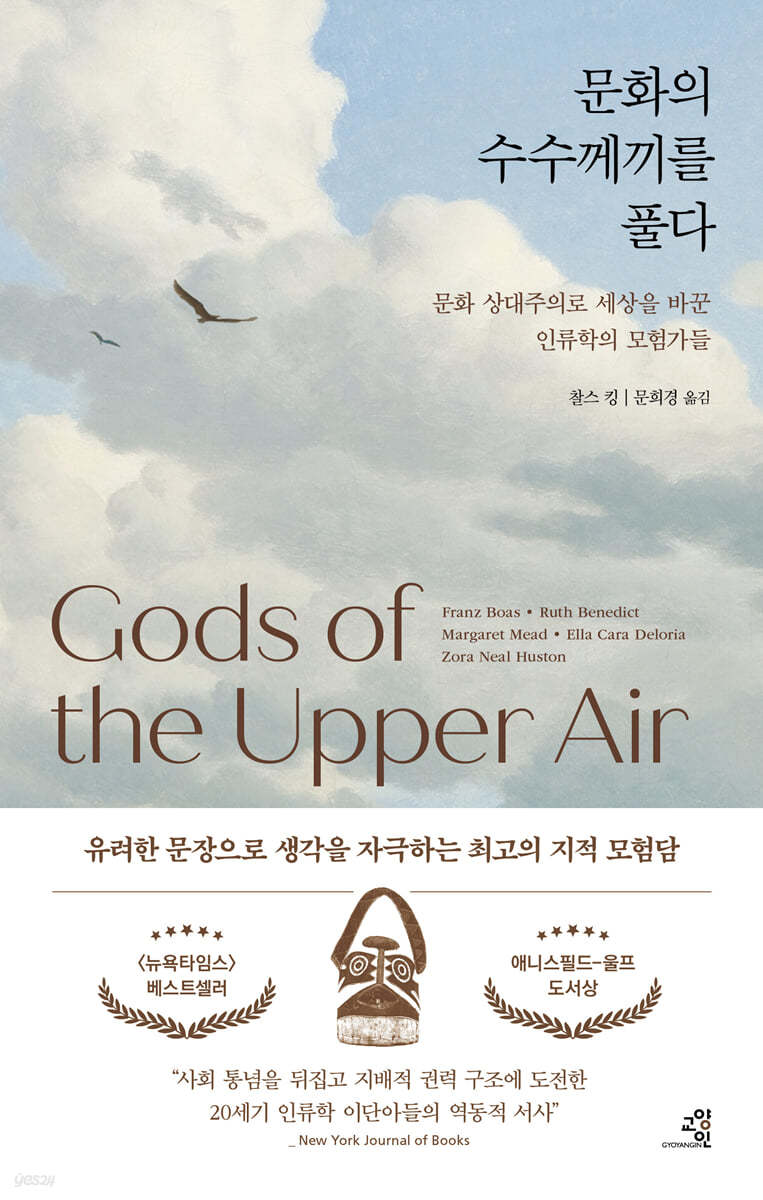
Book Introduction
From Franz Boas to Ruth Benedict and Margaret Mead
The intellectual adventures of unorthodox thinkers who dismantled the conventional wisdom of racism and sexism.
A century ago, race, ethnicity, and gender were destiny.
Everyone believed that it was a factor that determined an individual's intelligence, personality, class, and social status before birth.
Therefore, blacks were inferior to whites, and women were inferior to men.
It was an immutable truth and common sense.
However, Franz Boas, who is considered the founder of American anthropology, and his disciples determined that this common sense was wrong through field research and empirical studies conducted all over the world, from Inuit villages in the frozen Arctic to the streets of Manhattan, New York, the Samoan Islands in the South Pacific, and Haiti where zombies appear.
Boas and his disciples called themselves 'cultural anthropologists' and their theory 'cultural relativism.'
They struggled to prove that all humans, regardless of skin color, gender, ability, or customs, belong to a single species called human, that the concept of race is a biological fiction, and that there is no superiority or inferiority between cultures.
Because of their radical ideas that overturned the existing hierarchical order, Boazian scholars were fired from their jobs and placed under FBI surveillance.
But for them, anthropology was a science of empathy and hope that illuminated a dark era rife with prejudice and discrimination.
This book tells the story of those who stood on the front lines of the most fierce moral battle of our time.
It is a chronicle of the persistent struggle against the scientific racism and social Darwinism that dominated the United States and Europe from the late 19th century to the early 20th century, a history of the progressive concept of cultural relativity, and a collective biography that weaves together the lives and thoughts of the intellectual giants who led cultural anthropology.
Drawing on extensive sources, including the writings, articles, letters, field research notes, and testimonies of those around them, written by Boaz and his disciples, the author vividly recounts the lives of these pioneers who led the history of 20th-century American progress.
The story of these bold and courageous fighters wielding the "science of humanity" (anthropology) as a weapon to fight against such great evils as racial discrimination, oppression of women, and genocide unfolds vividly, like a novel.
The intellectual adventures of unorthodox thinkers who dismantled the conventional wisdom of racism and sexism.
A century ago, race, ethnicity, and gender were destiny.
Everyone believed that it was a factor that determined an individual's intelligence, personality, class, and social status before birth.
Therefore, blacks were inferior to whites, and women were inferior to men.
It was an immutable truth and common sense.
However, Franz Boas, who is considered the founder of American anthropology, and his disciples determined that this common sense was wrong through field research and empirical studies conducted all over the world, from Inuit villages in the frozen Arctic to the streets of Manhattan, New York, the Samoan Islands in the South Pacific, and Haiti where zombies appear.
Boas and his disciples called themselves 'cultural anthropologists' and their theory 'cultural relativism.'
They struggled to prove that all humans, regardless of skin color, gender, ability, or customs, belong to a single species called human, that the concept of race is a biological fiction, and that there is no superiority or inferiority between cultures.
Because of their radical ideas that overturned the existing hierarchical order, Boazian scholars were fired from their jobs and placed under FBI surveillance.
But for them, anthropology was a science of empathy and hope that illuminated a dark era rife with prejudice and discrimination.
This book tells the story of those who stood on the front lines of the most fierce moral battle of our time.
It is a chronicle of the persistent struggle against the scientific racism and social Darwinism that dominated the United States and Europe from the late 19th century to the early 20th century, a history of the progressive concept of cultural relativity, and a collective biography that weaves together the lives and thoughts of the intellectual giants who led cultural anthropology.
Drawing on extensive sources, including the writings, articles, letters, field research notes, and testimonies of those around them, written by Boaz and his disciples, the author vividly recounts the lives of these pioneers who led the history of 20th-century American progress.
The story of these bold and courageous fighters wielding the "science of humanity" (anthropology) as a weapon to fight against such great evils as racial discrimination, oppression of women, and genocide unfolds vividly, like a novel.
- You can preview some of the book's contents.
Preview
index
Chapter 1: How Cultural Relativism Arrived
Chapter 2: Explorers to the North Pole (1858–1885)
Chapter 3: "Civilization is Relative" (1886–1888)
Chapter 4: Confronting Racial Theory (1889–1899)
Chapter 5: The Skull Collectors (1900–1911)
Chapter 6: “All My Best Disciples Were Women” (1911–1924)
Chapter 7: Margaret Mead's Journey to Polynesia (1924–1926)
Chapter 8: America's Fall into Eugenics (1926–1929)
Chapter 9: "I Was the Sacred Black Cow of Barnard College" (1925–1929)
Chapter 10: The First Native Anthropologists (1914–1941)
Chapter 11: Three Anthropologists Driven by Madness (1931–1935)
Chapter 12: The Living, the Dead, and Zombies (1935–1942)
Chapter 13: The Twins of Racism: Germany and the United States (1933–1946)
Chapter 14: The Triumph of Cultural Relativism
Acknowledgements
annotation
References
Search
Chapter 2: Explorers to the North Pole (1858–1885)
Chapter 3: "Civilization is Relative" (1886–1888)
Chapter 4: Confronting Racial Theory (1889–1899)
Chapter 5: The Skull Collectors (1900–1911)
Chapter 6: “All My Best Disciples Were Women” (1911–1924)
Chapter 7: Margaret Mead's Journey to Polynesia (1924–1926)
Chapter 8: America's Fall into Eugenics (1926–1929)
Chapter 9: "I Was the Sacred Black Cow of Barnard College" (1925–1929)
Chapter 10: The First Native Anthropologists (1914–1941)
Chapter 11: Three Anthropologists Driven by Madness (1931–1935)
Chapter 12: The Living, the Dead, and Zombies (1935–1942)
Chapter 13: The Twins of Racism: Germany and the United States (1933–1946)
Chapter 14: The Triumph of Cultural Relativism
Acknowledgements
annotation
References
Search
Detailed image

Into the book
(Franz Boas and his disciples) believed that an analysis based on actual evidence would overturn one of the most ingrained notions of modernity: that certain individuals or groups are scientifically proven to be smarter, more competent, more honest, and more dominant.
…the social categories by which we commonly define ourselves, such as race or gender, are actually artificial.
This means that such categories are in fact the result of artificial strategies embedded in the mental system and unconscious customs of a certain society.
The Boaz school believed that humans are cultural animals and live bound by rules they create themselves.
And within a society that creates rules, the rules are invisible or taken for granted.
--- p.19
They were scientists and thinkers who loved the task of understanding other human beings.
They believed that the most profound science of human nature was not about discovering something deep and unchanging in human nature.
Rather, the science has been to reveal the wide diversity of human society, the vast and colorful variations in manners, customs, morals, and justice.
…Boaz and his disciples were not people who doubted the possibility of truth and the human ability to understand reality.
Rather, they saw the scientific method—the assumption that our conclusions are tentative and subject to refutation by new data—as the greatest achievement in human history.
And he believed that just as science had transformed our understanding of nature, it could also revolutionize our ideas about society.
--- p.24~25
Boaz understood, more than anyone else in his time, that the deepest prejudices of his society arose not from moral arguments but from scientific ones.
For example, it is like this.
“Recent research shows that African Americans are intellectually inferior.” “Women are prevented from holding high positions in society because of research demonstrating their weaknesses and idiosyncrasies.” “Immigrants brought with them the ills of their uncivilized homelands, from disease to crime to social disorder.” … Science that seemed to prove that humanity was inextricably divided was in fact refuted by science that proved otherwise.
Boaz and his disciples did a great job of making Americans, especially, feel a little more familiar with the rest of the world by making themselves feel a little more alien.
--- p.26~27
Boaz spoke harshly without thinking, but he surprisingly had a gentle side.
For over a decade, he has been trying to get more women into gender-neutral graduate programs.
He believed that a science that used only half of the available data (male customs, stories, and rituals) could not be called a science.
…soon Ruth Benedict found herself in the midst of a major demographic shift in anthropology.
Boaz wrote to a colleague:
“Something interesting has happened in graduate school over the past few years.
“All my best disciples are women.”
--- p.174~175
Is there a more "authentic" way to be a teenager than the one Americans invented? Is there a road map for navigating the biological realities of adolescence while avoiding the social turmoil? More importantly, if the society Mead lived in—a society that enforced rigid gender roles, fostered sexual frustration, and kept the "crash" at Barnard College a secret—can't accept someone like Mead, does it really deserve to be called a "culture"?
--- p.206~207
With the blessing of Meyer and Barnard College President Virginia Gildersleeve (who had given the outspoken anti-war Boas refuge across Broadway during World War I), Hurston quickly became a household name.
Young women rushed to offer lunch.
Hurston knew she was a whetstone on which to sharpen people's progressive sensibilities, and she played that role repeatedly whenever a white patron showed interest in her advancement.
“I became Barnard’s sacred black cow,” Hurston later wrote.
--- p.280
Although Deloria stayed more in the Western Plains than in Manhattan, she was a prominent figure in anthropology.
She sought guidance from Boaz for field research, and frequently turned to his capable assistant, Benedict, for editorial clues and advice.
…Delorija wrote down Boazian advice on how to attend lectures and organize research while staying in New York.
I once wrote this:
“Nothing can be achieved without first eliminating prejudice.” He also wrote:
“There may be many cultures, but humanity is one.
Boaz.”
--- p.347
Boaz often wrote prefaces to his students' first books, including Mead's The Samoan Youth and Hurston's Of the Mule and the Man.
But it gave Deloria a rare opportunity.
Deloria wrote to Boaz the year after the book was published.
“People ask about our grammar.
“It is a great honor to be your co-author,” he said. “In fact, it was the first time in Boaz’s career that a co-author’s name was listed next to the author’s name.
--- p.354
Benedict's book Patterns of Culture, published by Houston Mifflin in 1934, was not only the most cited and widely used textbook on the grand theory of anthropology, but also, as Alfred Kroeber put it at the time, "a propaganda piece for the anthropological attitude."
A New York Times critic wrote that Benedict had introduced the “doctrine of cultural relativity” to the general public through this book, marking the first time the expression “cultural relativity” was used in a national newspaper.
Benedict believed that the core of the doctrine was a basic ethic that applied to individuals as well as to society as a whole.
From his childhood, Benedict has struggled to express in some way the idea that "there are no flawed humans" as he experienced the screams of his insane mother, his second-class status as a female professor, and his unnameable love for Mead.
--- p.386~387
The world was destroyed by local investigation.
The marriage failed and the long-term relationship broke up.
The ambitions of youth seemed tedious.
To do anthropology properly, we had to get away from everything familiar.
I had to abandon what I considered common sense and go to another place to try to acquire the knowledge there.
Anthropology itself could cause intellectual vertigo like this.
And what they got in return was a free and original perspective that stripped away the specialness of their own society and saw it as just one of many ways in which humanity structures its social world.
--- p.387~388
Hurston recalled that in Haiti, zombie stories “seeped into the country like a cold current.”
From Port-au-Prince to Acaille, I heard zombie legends everywhere I went.
People spoke of zombies as if they were talking about the weather or an upcoming wedding, though their voices were slightly lowered.
Everyone Huston met had either seen a zombie or knew someone who had.
But it was all just talk.
No words could prepare Houston for the immediate confrontation with the being.
--- p.412
When Boas officially retired from his professorship in 1936, Benedict was ready to take over his role.
There was no one better suited to lead Columbia's anthropology department, one of the most highly regarded in the country, whose alumni also hold positions on the faculties of most other major universities.
Benedict began his career under Boaz's tutelage, first as a teaching assistant and then as a professor.
…but he wrote that there was one obstacle.
“Being a woman was a major obstacle to getting an official position at Columbia.” Columbia administration eventually decided on a new department head, and the position went to an outside scholar, Ralph Linton.
--- p.436
For Boaz, the wave of intolerance was not confined to Hitler's Germany.
At the time, no right-thinking American would have simply worn Nazi symbols, but would have accepted many of the basic ideas espoused by the Nazis as natural and proven truths.
In fact, the Germans did not create a race-obsessed nation in the 1930s, but were preoccupied with catching up to one.
At the time, the United States implemented racial segregation policies not only in areas that had once belonged to the Confederacy, but also in most areas, including schools, government offices, theaters, swimming pools, cemeteries, and public transportation.
Interracial marriages were prohibited, and mixed-race couples were treated as criminals.
Forced sterilization was used as a tool for eugenic improvement and as punishment for prisoners.
--- p.440
If Mead, Benedict, and Boaz were alive, they would have been surprised to hear that they had finally won.
They have lived their whole lives struggling.
They were accustomed to repeating the same philosophical arguments over and over again.
Every year it seemed like another front was being opened in the fight against those who peddled the same old certainties, one that would test the idea that there was nothing to fear from difference.
During their lifetimes, they faced what we today recognize as great moral evils: scientific racism, the subjugation of women, fascism resulting in genocide, and an era that deliberately treated homosexuals as lunatics.
…the social categories by which we commonly define ourselves, such as race or gender, are actually artificial.
This means that such categories are in fact the result of artificial strategies embedded in the mental system and unconscious customs of a certain society.
The Boaz school believed that humans are cultural animals and live bound by rules they create themselves.
And within a society that creates rules, the rules are invisible or taken for granted.
--- p.19
They were scientists and thinkers who loved the task of understanding other human beings.
They believed that the most profound science of human nature was not about discovering something deep and unchanging in human nature.
Rather, the science has been to reveal the wide diversity of human society, the vast and colorful variations in manners, customs, morals, and justice.
…Boaz and his disciples were not people who doubted the possibility of truth and the human ability to understand reality.
Rather, they saw the scientific method—the assumption that our conclusions are tentative and subject to refutation by new data—as the greatest achievement in human history.
And he believed that just as science had transformed our understanding of nature, it could also revolutionize our ideas about society.
--- p.24~25
Boaz understood, more than anyone else in his time, that the deepest prejudices of his society arose not from moral arguments but from scientific ones.
For example, it is like this.
“Recent research shows that African Americans are intellectually inferior.” “Women are prevented from holding high positions in society because of research demonstrating their weaknesses and idiosyncrasies.” “Immigrants brought with them the ills of their uncivilized homelands, from disease to crime to social disorder.” … Science that seemed to prove that humanity was inextricably divided was in fact refuted by science that proved otherwise.
Boaz and his disciples did a great job of making Americans, especially, feel a little more familiar with the rest of the world by making themselves feel a little more alien.
--- p.26~27
Boaz spoke harshly without thinking, but he surprisingly had a gentle side.
For over a decade, he has been trying to get more women into gender-neutral graduate programs.
He believed that a science that used only half of the available data (male customs, stories, and rituals) could not be called a science.
…soon Ruth Benedict found herself in the midst of a major demographic shift in anthropology.
Boaz wrote to a colleague:
“Something interesting has happened in graduate school over the past few years.
“All my best disciples are women.”
--- p.174~175
Is there a more "authentic" way to be a teenager than the one Americans invented? Is there a road map for navigating the biological realities of adolescence while avoiding the social turmoil? More importantly, if the society Mead lived in—a society that enforced rigid gender roles, fostered sexual frustration, and kept the "crash" at Barnard College a secret—can't accept someone like Mead, does it really deserve to be called a "culture"?
--- p.206~207
With the blessing of Meyer and Barnard College President Virginia Gildersleeve (who had given the outspoken anti-war Boas refuge across Broadway during World War I), Hurston quickly became a household name.
Young women rushed to offer lunch.
Hurston knew she was a whetstone on which to sharpen people's progressive sensibilities, and she played that role repeatedly whenever a white patron showed interest in her advancement.
“I became Barnard’s sacred black cow,” Hurston later wrote.
--- p.280
Although Deloria stayed more in the Western Plains than in Manhattan, she was a prominent figure in anthropology.
She sought guidance from Boaz for field research, and frequently turned to his capable assistant, Benedict, for editorial clues and advice.
…Delorija wrote down Boazian advice on how to attend lectures and organize research while staying in New York.
I once wrote this:
“Nothing can be achieved without first eliminating prejudice.” He also wrote:
“There may be many cultures, but humanity is one.
Boaz.”
--- p.347
Boaz often wrote prefaces to his students' first books, including Mead's The Samoan Youth and Hurston's Of the Mule and the Man.
But it gave Deloria a rare opportunity.
Deloria wrote to Boaz the year after the book was published.
“People ask about our grammar.
“It is a great honor to be your co-author,” he said. “In fact, it was the first time in Boaz’s career that a co-author’s name was listed next to the author’s name.
--- p.354
Benedict's book Patterns of Culture, published by Houston Mifflin in 1934, was not only the most cited and widely used textbook on the grand theory of anthropology, but also, as Alfred Kroeber put it at the time, "a propaganda piece for the anthropological attitude."
A New York Times critic wrote that Benedict had introduced the “doctrine of cultural relativity” to the general public through this book, marking the first time the expression “cultural relativity” was used in a national newspaper.
Benedict believed that the core of the doctrine was a basic ethic that applied to individuals as well as to society as a whole.
From his childhood, Benedict has struggled to express in some way the idea that "there are no flawed humans" as he experienced the screams of his insane mother, his second-class status as a female professor, and his unnameable love for Mead.
--- p.386~387
The world was destroyed by local investigation.
The marriage failed and the long-term relationship broke up.
The ambitions of youth seemed tedious.
To do anthropology properly, we had to get away from everything familiar.
I had to abandon what I considered common sense and go to another place to try to acquire the knowledge there.
Anthropology itself could cause intellectual vertigo like this.
And what they got in return was a free and original perspective that stripped away the specialness of their own society and saw it as just one of many ways in which humanity structures its social world.
--- p.387~388
Hurston recalled that in Haiti, zombie stories “seeped into the country like a cold current.”
From Port-au-Prince to Acaille, I heard zombie legends everywhere I went.
People spoke of zombies as if they were talking about the weather or an upcoming wedding, though their voices were slightly lowered.
Everyone Huston met had either seen a zombie or knew someone who had.
But it was all just talk.
No words could prepare Houston for the immediate confrontation with the being.
--- p.412
When Boas officially retired from his professorship in 1936, Benedict was ready to take over his role.
There was no one better suited to lead Columbia's anthropology department, one of the most highly regarded in the country, whose alumni also hold positions on the faculties of most other major universities.
Benedict began his career under Boaz's tutelage, first as a teaching assistant and then as a professor.
…but he wrote that there was one obstacle.
“Being a woman was a major obstacle to getting an official position at Columbia.” Columbia administration eventually decided on a new department head, and the position went to an outside scholar, Ralph Linton.
--- p.436
For Boaz, the wave of intolerance was not confined to Hitler's Germany.
At the time, no right-thinking American would have simply worn Nazi symbols, but would have accepted many of the basic ideas espoused by the Nazis as natural and proven truths.
In fact, the Germans did not create a race-obsessed nation in the 1930s, but were preoccupied with catching up to one.
At the time, the United States implemented racial segregation policies not only in areas that had once belonged to the Confederacy, but also in most areas, including schools, government offices, theaters, swimming pools, cemeteries, and public transportation.
Interracial marriages were prohibited, and mixed-race couples were treated as criminals.
Forced sterilization was used as a tool for eugenic improvement and as punishment for prisoners.
--- p.440
If Mead, Benedict, and Boaz were alive, they would have been surprised to hear that they had finally won.
They have lived their whole lives struggling.
They were accustomed to repeating the same philosophical arguments over and over again.
Every year it seemed like another front was being opened in the fight against those who peddled the same old certainties, one that would test the idea that there was nothing to fear from difference.
During their lifetimes, they faced what we today recognize as great moral evils: scientific racism, the subjugation of women, fascism resulting in genocide, and an era that deliberately treated homosexuals as lunatics.
--- p.490~491
Publisher's Review
Nazi Germany and the United States, twins of racism
― The fight against American eugenics that inspired Hitler
Franz Boas, considered one of the most important figures in the fight against racial prejudice in the United States, was a German-Jewish immigrant who immigrated to the United States in his late 20s.
Boaz had hoped that America, a melting pot of races, would be spared the nationalistic conflicts he had experienced in Europe, but his hopes were soon dashed.
The book features the Boasian school, which advocated cultural diversity and relativity, along with racists like Madison Grant and William Ripley, who, on the other hand, were driven by extreme prejudice.
Grant's book, The End of the Great Race, inspired Hitler's anti-Semitism and was praised as "my Bible."
Boas's book was one of the first to be burned in Germany after Hitler came to power, along with the works of Einstein, Freud, and Lenin.
“All my best disciples are women.”
― Outsiders' Anthropology: Reinventing Race and Gender
Boaz's disciples, like their teacher, were often stubborn and rebellious.
In an era dominated by immigration restrictions, racial segregation, and eugenics, it was significant to be accepted into Columbia University's anthropology department, led by Boas.
This book focuses on four female anthropologists among Boaz's disciples.
From Ruth Benedict, Boas's most important assistant and author of Patterns of Culture, which popularized the concept of cultural relativity, to Margaret Mead, who showed that the gender roles of men and women are not natural or fixed but cultural creations, to Ella Cara Deloria, a Native American who worked to preserve disappearing Native American traditions and was the only Boas disciple to co-author, to Zora Neale Hurston, a black feminist writer who wrote anthropological novels and folklore books based on fieldwork she conducted in the American South and Haiti.
They were all considered outsiders, deviant from the norms and dominant norms of contemporary American society, whether because they were women, people of color, sexual minorities, or physically disabled.
Throughout her career as an anthropologist, she was often denigrated as a communist who denied America's greatness, a "filthy woman," a "sexually promiscuous woman," and a "crazy woman."
Thus, for them, anthropology was also a liberating idea that could break through the barriers surrounding their own identity.
The Birth of Cultural Anthropology and Cultural Relativism
― Anthropologists who dismantled scientific racism and social Darwinism
“Cultural relativism refers to the attitude of trying to understand and evaluate a society’s culture within the specific environment and historical context of that society.
…because each society’s culture has its own unique characteristics and values, it is impossible to determine superiority among cultures.” (Quote from the Ministry of Education blog)
Today, ‘cultural relativism’ and ‘cultural relativity’ have become common sense concepts in our society, to the point that they are included in middle and high school textbooks.
However, on the other hand, cultural relativism is often criticized for “justifying immorality or undermining the very foundations of civilization.”
Does this mean that inhumane practices like honor killings and female genital mutilation in Islamic cultures should be understood and acknowledged as part of cultural diversity? If we must consider the time, place, and context of every object we judge, how can we possibly discern right from wrong? Cultural relativism threatens universal values like human rights, freedom, and life.
But such criticism would be absurd to those who first argued for cultural relativity a little over a century ago, and who called themselves "cultural anthropologists."
(Cultural anthropology, which originated in the United States, is a branch of anthropology that focuses primarily on the study of cultural diversity.) They lived in an era when it was natural to place Western civilization and white people at the top and to classify and discriminate against all humans based on categories such as race, ethnicity, nationality, and gender, and they directly opposed such dominant ideology.
This book is a collective biography of the colorful lives and intellectual journeys of Franz Boas, the founder of cultural anthropology, and his students Ruth Benedict, Margaret Mead, Ella Cara Deloria, and Zora Neale Hurston.
“It is a story about people who lived as globalists in an age of nationalism and social division, and about the origins of the perspectives we today call modern and open.”
The author traces the history of American anthropology through the stories of these radical and pioneering intellectuals.
Another pleasure of reading this book is encountering classics of anthropology, such as Lewis Henry Morgan's Ancient Society, James George Frazer's The Golden Bough, Franz Boas' The Primitive Mind, Ruth Benedict's Patterns of Culture and The Chrysanthemum and the Sword, and Margaret Mead's The Samoan Youth.
“American anthropology owes its origins solely to Franz Boas.”
_ Claude Levi-Strauss (French anthropologist and philosopher)
The book deals with several characters, but at the center of the overall narrative is Franz Boas.
Boas, who is considered “the most important figure in shaping American anthropology in the first half of the 20th century,” was a Jewish immigrant born in Germany in 1858 who immigrated to the United States in the late 1880s.
After taking up a professorship in the Department of Anthropology at Columbia University in 1897, he set the academic direction for American anthropology and nurtured numerous outstanding anthropologists who left a distinct mark on the history of anthropology, including Alfred Kroeber, Melville Herskovitz, Edward Sapir, Ruth Benedict, and Margaret Mead.
But his life wasn't always smooth sailing.
He has always faced fierce attacks from opponents for his direct criticism of America's deep-rooted racism and imperialistic behavior.
This book particularly draws attention to Boas's concept of cultural relativity, his lifelong fight against eugenics and racism, and his story of how he, a rarity at the time, selected numerous female researchers and led them on the path to becoming anthropologists.
― The fight against American eugenics that inspired Hitler
Franz Boas, considered one of the most important figures in the fight against racial prejudice in the United States, was a German-Jewish immigrant who immigrated to the United States in his late 20s.
Boaz had hoped that America, a melting pot of races, would be spared the nationalistic conflicts he had experienced in Europe, but his hopes were soon dashed.
The book features the Boasian school, which advocated cultural diversity and relativity, along with racists like Madison Grant and William Ripley, who, on the other hand, were driven by extreme prejudice.
Grant's book, The End of the Great Race, inspired Hitler's anti-Semitism and was praised as "my Bible."
Boas's book was one of the first to be burned in Germany after Hitler came to power, along with the works of Einstein, Freud, and Lenin.
“All my best disciples are women.”
― Outsiders' Anthropology: Reinventing Race and Gender
Boaz's disciples, like their teacher, were often stubborn and rebellious.
In an era dominated by immigration restrictions, racial segregation, and eugenics, it was significant to be accepted into Columbia University's anthropology department, led by Boas.
This book focuses on four female anthropologists among Boaz's disciples.
From Ruth Benedict, Boas's most important assistant and author of Patterns of Culture, which popularized the concept of cultural relativity, to Margaret Mead, who showed that the gender roles of men and women are not natural or fixed but cultural creations, to Ella Cara Deloria, a Native American who worked to preserve disappearing Native American traditions and was the only Boas disciple to co-author, to Zora Neale Hurston, a black feminist writer who wrote anthropological novels and folklore books based on fieldwork she conducted in the American South and Haiti.
They were all considered outsiders, deviant from the norms and dominant norms of contemporary American society, whether because they were women, people of color, sexual minorities, or physically disabled.
Throughout her career as an anthropologist, she was often denigrated as a communist who denied America's greatness, a "filthy woman," a "sexually promiscuous woman," and a "crazy woman."
Thus, for them, anthropology was also a liberating idea that could break through the barriers surrounding their own identity.
The Birth of Cultural Anthropology and Cultural Relativism
― Anthropologists who dismantled scientific racism and social Darwinism
“Cultural relativism refers to the attitude of trying to understand and evaluate a society’s culture within the specific environment and historical context of that society.
…because each society’s culture has its own unique characteristics and values, it is impossible to determine superiority among cultures.” (Quote from the Ministry of Education blog)
Today, ‘cultural relativism’ and ‘cultural relativity’ have become common sense concepts in our society, to the point that they are included in middle and high school textbooks.
However, on the other hand, cultural relativism is often criticized for “justifying immorality or undermining the very foundations of civilization.”
Does this mean that inhumane practices like honor killings and female genital mutilation in Islamic cultures should be understood and acknowledged as part of cultural diversity? If we must consider the time, place, and context of every object we judge, how can we possibly discern right from wrong? Cultural relativism threatens universal values like human rights, freedom, and life.
But such criticism would be absurd to those who first argued for cultural relativity a little over a century ago, and who called themselves "cultural anthropologists."
(Cultural anthropology, which originated in the United States, is a branch of anthropology that focuses primarily on the study of cultural diversity.) They lived in an era when it was natural to place Western civilization and white people at the top and to classify and discriminate against all humans based on categories such as race, ethnicity, nationality, and gender, and they directly opposed such dominant ideology.
This book is a collective biography of the colorful lives and intellectual journeys of Franz Boas, the founder of cultural anthropology, and his students Ruth Benedict, Margaret Mead, Ella Cara Deloria, and Zora Neale Hurston.
“It is a story about people who lived as globalists in an age of nationalism and social division, and about the origins of the perspectives we today call modern and open.”
The author traces the history of American anthropology through the stories of these radical and pioneering intellectuals.
Another pleasure of reading this book is encountering classics of anthropology, such as Lewis Henry Morgan's Ancient Society, James George Frazer's The Golden Bough, Franz Boas' The Primitive Mind, Ruth Benedict's Patterns of Culture and The Chrysanthemum and the Sword, and Margaret Mead's The Samoan Youth.
“American anthropology owes its origins solely to Franz Boas.”
_ Claude Levi-Strauss (French anthropologist and philosopher)
The book deals with several characters, but at the center of the overall narrative is Franz Boas.
Boas, who is considered “the most important figure in shaping American anthropology in the first half of the 20th century,” was a Jewish immigrant born in Germany in 1858 who immigrated to the United States in the late 1880s.
After taking up a professorship in the Department of Anthropology at Columbia University in 1897, he set the academic direction for American anthropology and nurtured numerous outstanding anthropologists who left a distinct mark on the history of anthropology, including Alfred Kroeber, Melville Herskovitz, Edward Sapir, Ruth Benedict, and Margaret Mead.
But his life wasn't always smooth sailing.
He has always faced fierce attacks from opponents for his direct criticism of America's deep-rooted racism and imperialistic behavior.
This book particularly draws attention to Boas's concept of cultural relativity, his lifelong fight against eugenics and racism, and his story of how he, a rarity at the time, selected numerous female researchers and led them on the path to becoming anthropologists.
GOODS SPECIFICS
- Date of issue: December 13, 2024
- Page count, weight, size: 560 pages | 638g | 140*220*26mm
- ISBN13: 9791193154373
- ISBN10: 1193154375
You may also like
카테고리
korean


korean

![ELLE 엘르 스페셜 에디션 A형 : 12월 [2025]](http://librairie.coreenne.fr/cdn/shop/files/b8e27a3de6c9538896439686c6b0e8fb.jpg?v=1766436872&width=3840)


