

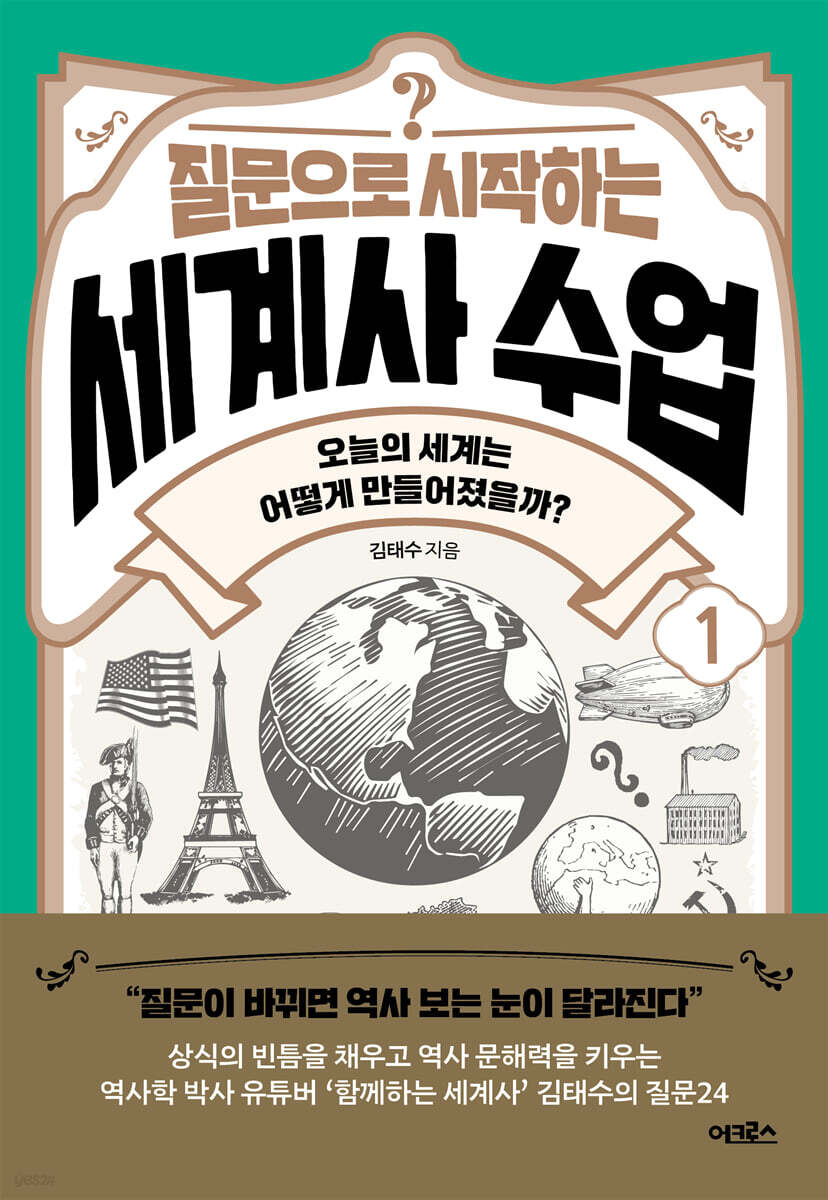
World History Lesson 1: Starting with Questions
 |
Description
Book Introduction
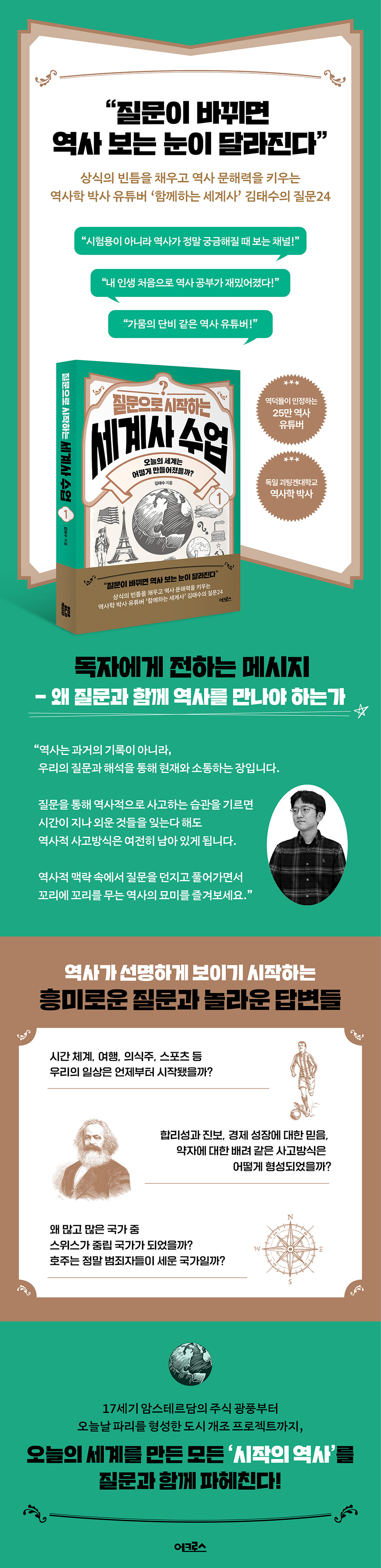
"When the questions change, the perspective on history changes."
Filling in the gaps in common sense and developing historical literacy
Question 24 from Kim Tae-su, a YouTuber with a Ph.D. in History and host of "World History Together."
When did people start traveling, trading stocks, enjoying football, and drinking beer?
Why were heliocentrism, evolutionism, Marxism, and monarchism born?
How did the superpower United States, neutral Switzerland, and Israel, a nation embroiled in constant conflict, emerge into history?
Kim Tae-soo, a YouTuber with 250,000 subscribers who has shed new light on the flow of history and major turning points through interesting questions and surprising answers, sets out to discover all the "history of beginnings" that created today's world.
In "World History Lessons Starting with Questions 1," the author explores historical topics large and small, from the stock market mania in 17th-century Amsterdam to the urban renewal projects that shaped modern Paris, and asks the fundamental question, "How did the world come to be as it is today?"
How unfamiliar and novel were concepts like time systems, travel, and sports, which we take for granted, to people in the past? How were beliefs in rationality, progress, and economic growth formed? Why did Switzerland, among so many countries, become neutral, and why wasn't Australia, as so often claimed, founded by criminals? In "World History Lessons Starting with Questions 1," the author goes beyond simply listing or summarizing historical events. Instead, he helps readers understand the structure of modern society and its historical context through the stories hidden within the flow of history.
He says that by asking questions and solving them within a historical context, we can enjoy the thrill of history, where curiosity and inquisitiveness keep on piling on.
The author emphasizes that “history is not a record of the past, but a place where we communicate with the present through our questions and interpretations,” and presents history not simply as the past, but as a key to understanding the present and future.
"World History Classes Starting with Questions 1" will provide an opportunity to view the world more deeply and broadly through new perspectives and questions about history.
Filling in the gaps in common sense and developing historical literacy
Question 24 from Kim Tae-su, a YouTuber with a Ph.D. in History and host of "World History Together."
When did people start traveling, trading stocks, enjoying football, and drinking beer?
Why were heliocentrism, evolutionism, Marxism, and monarchism born?
How did the superpower United States, neutral Switzerland, and Israel, a nation embroiled in constant conflict, emerge into history?
Kim Tae-soo, a YouTuber with 250,000 subscribers who has shed new light on the flow of history and major turning points through interesting questions and surprising answers, sets out to discover all the "history of beginnings" that created today's world.
In "World History Lessons Starting with Questions 1," the author explores historical topics large and small, from the stock market mania in 17th-century Amsterdam to the urban renewal projects that shaped modern Paris, and asks the fundamental question, "How did the world come to be as it is today?"
How unfamiliar and novel were concepts like time systems, travel, and sports, which we take for granted, to people in the past? How were beliefs in rationality, progress, and economic growth formed? Why did Switzerland, among so many countries, become neutral, and why wasn't Australia, as so often claimed, founded by criminals? In "World History Lessons Starting with Questions 1," the author goes beyond simply listing or summarizing historical events. Instead, he helps readers understand the structure of modern society and its historical context through the stories hidden within the flow of history.
He says that by asking questions and solving them within a historical context, we can enjoy the thrill of history, where curiosity and inquisitiveness keep on piling on.
The author emphasizes that “history is not a record of the past, but a place where we communicate with the present through our questions and interpretations,” and presents history not simply as the past, but as a key to understanding the present and future.
"World History Classes Starting with Questions 1" will provide an opportunity to view the world more deeply and broadly through new perspectives and questions about history.
- You can preview some of the book's contents.
Preview
index
Prologue: The Joy of Historical Thinking
Part 1: Discovering Everyday Life: When did we start living like this?
1 Since when did we start living in the same time?
2 How did the first tourist trip begin?
3 Are 19th century Paris and today's Paris completely different cities?
4 Did Amsterdam also experience a stock market frenzy in 1602?
5 Was the first vaccine discovered while milking a cow?
6 There was a time when Germans hated soccer?
7 Why and when did humans start drinking beer?
Part 2: The Birth of Thought Why do people think that way?
1 Humans were not created but evolved?
2 How did Copernicus discover the heliocentric theory?
3 What is the secret of power that Machiavelli discovered?
4 How did the Industrial Revolution change human life?
5 How did Marx's ideas come into being?
6 How was the Suez Canal built?
7 When did poverty become a misfortune?
8 When did children begin to be considered special?
9 Can humans also be exhibited?
How did the 10 '68 Revolution change Western society?
Part 3: The Origin of the Nation How did the nation emerge into history?
1 How did the superpower America begin?
2 Australia is a country created by British criminals?
3 Why did the dream of independence hero Bolivar fail?
4 How did Italy become a unified nation after 1,400 years?
5 Why did Switzerland decide to become a neutral country?
6 Why did the Soviet Union disintegrate and become Russia?
7 Why are there constant fights around Israel?
Part 1: Discovering Everyday Life: When did we start living like this?
1 Since when did we start living in the same time?
2 How did the first tourist trip begin?
3 Are 19th century Paris and today's Paris completely different cities?
4 Did Amsterdam also experience a stock market frenzy in 1602?
5 Was the first vaccine discovered while milking a cow?
6 There was a time when Germans hated soccer?
7 Why and when did humans start drinking beer?
Part 2: The Birth of Thought Why do people think that way?
1 Humans were not created but evolved?
2 How did Copernicus discover the heliocentric theory?
3 What is the secret of power that Machiavelli discovered?
4 How did the Industrial Revolution change human life?
5 How did Marx's ideas come into being?
6 How was the Suez Canal built?
7 When did poverty become a misfortune?
8 When did children begin to be considered special?
9 Can humans also be exhibited?
How did the 10 '68 Revolution change Western society?
Part 3: The Origin of the Nation How did the nation emerge into history?
1 How did the superpower America begin?
2 Australia is a country created by British criminals?
3 Why did the dream of independence hero Bolivar fail?
4 How did Italy become a unified nation after 1,400 years?
5 Why did Switzerland decide to become a neutral country?
6 Why did the Soviet Union disintegrate and become Russia?
7 Why are there constant fights around Israel?
Detailed image
Into the book
Understanding historical context and asking questions is fundamentally different from simply memorizing the names of kings and generals or the years of major battles.
Once you begin to develop the habit of thinking historically through questions like this, even if you forget what you've memorized over time, your historical mindset will remain.
More importantly, when we encounter other historical events, it leads us to explore them within the context of the flow of history and the complexities of human behavior.
Conversely, without an understanding of the historical context, it is difficult to ask the right questions.
Or, even if you ask a question, you end up asking an anachronistic question that doesn't fit the times.
In this way, history is not a past that is complete in itself, but a living discipline in which the present and the past communicate through our questions and interpretations.
---From the "Prologue"
According to historians who study the history of time, until the 1880s, there were actually more people in favor of each region having its own independent time.
There were several reasons for this.
First of all, the important reason was that the majority of the population still living in rural areas had no reason to ride the train.
To someone who has never ridden a train in their life, the argument that we should abandon the time we have lived with and adopt a unified time nationwide for train operation did not seem very persuasive.
---From "Since when did we start living in the same time?"
The fact that Haussmann reorganized Paris under the orders of Napoleon III shows that, contrary to popular belief, Paris is not a city that has naturally formed over a long history.
Eric Hobsbawm, a famous British historian, once proposed the concept of “invented tradition.”
Hobsbawm, through the concept of “invented tradition,” pointed out that when we trace the historical background of so-called “traditions,” we find that many of them actually began very recently.
Moreover, it has been revealed that many traditions are not simply recent but were sometimes deliberately created by nation-state governments in the 19th century.
---From “Are 19th century Paris and today’s Paris completely different cities?”
In medieval Europe, poverty was not always perceived negatively.
A case that shows the extreme nature of medieval people's perception of poverty is the beggar.
In modern society, passersby might turn their heads away or simply ignore a beggar on the street, but in medieval times, encountering a beggar in the morning was considered good luck to start the day.
If you gave alms to a beggar, that day was considered a day of great blessing.
---From "When Did Poverty Become a Misfortune?"
In fact, most historians today do not accept Schweitzer's argument, because strictly speaking, abandoning a policy of external expansion after defeat in a war and declaring neutrality have different meanings.
(...) However, more important than academic persuasiveness was the fact that this argument accurately captured the concerns of the Swiss in the late 19th and early 20th centuries.
After the success of Schweitzer's book containing these arguments, even Swiss people without accurate knowledge of history came to have a vague belief that neutrality had long been a self-chosen choice by the Swiss people.
And as these shared beliefs became more and more widespread and reproduced within the Swiss community, it became difficult to even question them.
Once you begin to develop the habit of thinking historically through questions like this, even if you forget what you've memorized over time, your historical mindset will remain.
More importantly, when we encounter other historical events, it leads us to explore them within the context of the flow of history and the complexities of human behavior.
Conversely, without an understanding of the historical context, it is difficult to ask the right questions.
Or, even if you ask a question, you end up asking an anachronistic question that doesn't fit the times.
In this way, history is not a past that is complete in itself, but a living discipline in which the present and the past communicate through our questions and interpretations.
---From the "Prologue"
According to historians who study the history of time, until the 1880s, there were actually more people in favor of each region having its own independent time.
There were several reasons for this.
First of all, the important reason was that the majority of the population still living in rural areas had no reason to ride the train.
To someone who has never ridden a train in their life, the argument that we should abandon the time we have lived with and adopt a unified time nationwide for train operation did not seem very persuasive.
---From "Since when did we start living in the same time?"
The fact that Haussmann reorganized Paris under the orders of Napoleon III shows that, contrary to popular belief, Paris is not a city that has naturally formed over a long history.
Eric Hobsbawm, a famous British historian, once proposed the concept of “invented tradition.”
Hobsbawm, through the concept of “invented tradition,” pointed out that when we trace the historical background of so-called “traditions,” we find that many of them actually began very recently.
Moreover, it has been revealed that many traditions are not simply recent but were sometimes deliberately created by nation-state governments in the 19th century.
---From “Are 19th century Paris and today’s Paris completely different cities?”
In medieval Europe, poverty was not always perceived negatively.
A case that shows the extreme nature of medieval people's perception of poverty is the beggar.
In modern society, passersby might turn their heads away or simply ignore a beggar on the street, but in medieval times, encountering a beggar in the morning was considered good luck to start the day.
If you gave alms to a beggar, that day was considered a day of great blessing.
---From "When Did Poverty Become a Misfortune?"
In fact, most historians today do not accept Schweitzer's argument, because strictly speaking, abandoning a policy of external expansion after defeat in a war and declaring neutrality have different meanings.
(...) However, more important than academic persuasiveness was the fact that this argument accurately captured the concerns of the Swiss in the late 19th and early 20th centuries.
After the success of Schweitzer's book containing these arguments, even Swiss people without accurate knowledge of history came to have a vague belief that neutrality had long been a self-chosen choice by the Swiss people.
And as these shared beliefs became more and more widespread and reproduced within the Swiss community, it became difficult to even question them.
---From "Why did Switzerland decide to become a neutral country?"
Publisher's Review
"When the questions change, the perspective on history changes."
Filling in the gaps in common sense and developing historical literacy
Question 24 from Kim Tae-su, a YouTuber with a Ph.D. in History and host of "World History Together."
When did people start traveling, trading stocks, enjoying football, and drinking beer?
Why were heliocentrism, evolutionism, Marxism, and monarchism born?
How did the superpower United States, neutral Switzerland, and Israel, a nation embroiled in constant conflict, emerge into history?
Kim Tae-soo, a YouTuber with 250,000 subscribers who has shed new light on the flow of history and major turning points through interesting questions and surprising answers, sets out to discover all the "history of beginnings" that created today's world.
In "World History Lessons Starting with Questions 1," the author explores historical topics large and small, from the stock market mania in 17th-century Amsterdam to the urban renewal projects that shaped modern Paris, and asks the fundamental question, "How did the world come to be as it is today?"
How unfamiliar and novel were concepts like time systems, travel, and sports, which we take for granted, to people in the past? How were beliefs in rationality, progress, and economic growth formed? Why did Switzerland, among so many countries, become neutral, and why wasn't Australia, as so often claimed, founded by criminals? In "World History Lessons Starting with Questions 1," the author goes beyond simply listing or summarizing historical events. Instead, he helps readers understand the structure of modern society and its historical context through the stories hidden within the flow of history.
He says that by asking questions and solving them within a historical context, we can enjoy the thrill of history, where curiosity and inquisitiveness keep on piling on.
The author emphasizes that “history is not a record of the past, but a place where we communicate with the present through our questions and interpretations,” and presents history not simply as the past, but as a key to understanding the present and future.
"World History Classes Starting with Questions 1" will provide an opportunity to view the world more deeply and broadly through new perspectives and questions about history.
If you develop the habit of thinking historically,
Things that look new and different
History, as taught through regular education, is often misunderstood as a subject that can only be memorized.
We often mistakenly believe that we understand history simply by memorizing the year 1592, when the Imjin War broke out, or the order of the kings of the Joseon Dynasty.
In "World History Lessons Starting with Questions 1," the author emphasizes that knowing history is not simply memorization, but a process of understanding the context of events and exploring their essence through questions.
This approach does not simply accept historical events as facts, but forces us to consider why they happened and what impact they had.
For example, by asking the question, “Since when have we started living at the same time?”, it explains how industrialization and the development of railroads formed the modern concept of time, and makes us realize that the standard time we take for granted is actually a product of history.
The greatest strength of this book is that it allows us to look at such a familiar subject from a new perspective.
What difference would it make if we approached history this way? The author argues that by starting with good questions and exploring historical facts and events, we can develop the "habit of thinking historically," even if we forget the details over time.
This means that we can judge how each event happened within the historical context of that period, and why a particular person or people had no choice but to make that choice historically, within the flow of history and the complexity of human behavior.
“How is the past connected to the present?”
From everyday discoveries to the birth of ideas
The book is largely divided into three themes: 'The Discovery of Everyday Life', 'The Birth of Thought', and 'The Origin of the Nation'.
Each topic offers readers a fresh perspective by covering a variety of historical events and concepts that form the foundation of modern society.
Part 1, "Discovering the Everyday," explores how the everyday concepts we take for granted were formed, revealing the connections between past and present through topics closely related to our daily lives, such as standard time, the travel industry, and the invention of vaccines.
Through the story of the first large-scale group tour in 19th-century Britain, the author vividly describes how travel transcended mere pleasure and became linked to social change, and fascinatingly unravels how the birth and development of beer contributed to the formation of each region's economy and culture.
Part 2, "The Birth of Thought," which shows the process by which modern thinking was formed, from Copernicus' heliocentric theory to the birth of the theory of evolution, makes us realize how much historical struggle and effort went into forming the framework of thought we take for granted.
Part 3, “The Origins of Nations,” critically examines the birth of various nations, including the United States, Switzerland, and Israel, and raises interesting questions.
It analyzes the reasons why Switzerland became a neutral country through the relationship between international politics and history, and it also captures in detail the religious, ethnic, and political issues hidden in the long-standing historical conflict surrounding Israel.
History is a process of asking questions and seeking answers.
A book that provides a clue to a new understanding of history
Author Kim Tae-su received his master's and doctoral degrees in modern German history from the University of Göttingen in Germany, and is currently conducting research at the German Historical Institute in Paris.
The author's narrative is clear and accessible, yet profound. Drawing on the latest European historical research, he reinterprets history from a modern perspective, providing readers with reliable information.
For example, the section exploring the process of forming the modern concept of 'children' through the question, "Since when have children been considered special beings?" is both interesting and insightful for readers.
Additionally, the experience of communicating with the public gained through running the YouTube channel 'World History Together', which has 250,000 subscribers, further enriches the format and content of this book.
The author does not simply seek answers to his own questions; he encourages readers to ask their own questions and seek answers within history.
A key feature of this book is that rather than describing each incident individually, it explores its background and consequences in an integrated manner.
The question, “Why was the Suez Canal built?” goes beyond simply explaining the process of canal construction, but also provides important clues to understanding the economic and political situation at the time and the context of the spread of imperialism.
"World History Lessons Starting with Questions 1" is a book that provides the "pleasure of historical thinking" to everyone, from readers new to history to those seeking deep historical insight.
The author presents history not simply as a discipline for studying the past, but as a tool for understanding the present and preparing for the future.
It also provides insight that connects the past, present, and future, allowing for a deeper understanding of the world.
Let's read this book, which will provide a valuable opportunity to look at various social issues in a new light and expand our horizons.
Filling in the gaps in common sense and developing historical literacy
Question 24 from Kim Tae-su, a YouTuber with a Ph.D. in History and host of "World History Together."
When did people start traveling, trading stocks, enjoying football, and drinking beer?
Why were heliocentrism, evolutionism, Marxism, and monarchism born?
How did the superpower United States, neutral Switzerland, and Israel, a nation embroiled in constant conflict, emerge into history?
Kim Tae-soo, a YouTuber with 250,000 subscribers who has shed new light on the flow of history and major turning points through interesting questions and surprising answers, sets out to discover all the "history of beginnings" that created today's world.
In "World History Lessons Starting with Questions 1," the author explores historical topics large and small, from the stock market mania in 17th-century Amsterdam to the urban renewal projects that shaped modern Paris, and asks the fundamental question, "How did the world come to be as it is today?"
How unfamiliar and novel were concepts like time systems, travel, and sports, which we take for granted, to people in the past? How were beliefs in rationality, progress, and economic growth formed? Why did Switzerland, among so many countries, become neutral, and why wasn't Australia, as so often claimed, founded by criminals? In "World History Lessons Starting with Questions 1," the author goes beyond simply listing or summarizing historical events. Instead, he helps readers understand the structure of modern society and its historical context through the stories hidden within the flow of history.
He says that by asking questions and solving them within a historical context, we can enjoy the thrill of history, where curiosity and inquisitiveness keep on piling on.
The author emphasizes that “history is not a record of the past, but a place where we communicate with the present through our questions and interpretations,” and presents history not simply as the past, but as a key to understanding the present and future.
"World History Classes Starting with Questions 1" will provide an opportunity to view the world more deeply and broadly through new perspectives and questions about history.
If you develop the habit of thinking historically,
Things that look new and different
History, as taught through regular education, is often misunderstood as a subject that can only be memorized.
We often mistakenly believe that we understand history simply by memorizing the year 1592, when the Imjin War broke out, or the order of the kings of the Joseon Dynasty.
In "World History Lessons Starting with Questions 1," the author emphasizes that knowing history is not simply memorization, but a process of understanding the context of events and exploring their essence through questions.
This approach does not simply accept historical events as facts, but forces us to consider why they happened and what impact they had.
For example, by asking the question, “Since when have we started living at the same time?”, it explains how industrialization and the development of railroads formed the modern concept of time, and makes us realize that the standard time we take for granted is actually a product of history.
The greatest strength of this book is that it allows us to look at such a familiar subject from a new perspective.
What difference would it make if we approached history this way? The author argues that by starting with good questions and exploring historical facts and events, we can develop the "habit of thinking historically," even if we forget the details over time.
This means that we can judge how each event happened within the historical context of that period, and why a particular person or people had no choice but to make that choice historically, within the flow of history and the complexity of human behavior.
“How is the past connected to the present?”
From everyday discoveries to the birth of ideas
The book is largely divided into three themes: 'The Discovery of Everyday Life', 'The Birth of Thought', and 'The Origin of the Nation'.
Each topic offers readers a fresh perspective by covering a variety of historical events and concepts that form the foundation of modern society.
Part 1, "Discovering the Everyday," explores how the everyday concepts we take for granted were formed, revealing the connections between past and present through topics closely related to our daily lives, such as standard time, the travel industry, and the invention of vaccines.
Through the story of the first large-scale group tour in 19th-century Britain, the author vividly describes how travel transcended mere pleasure and became linked to social change, and fascinatingly unravels how the birth and development of beer contributed to the formation of each region's economy and culture.
Part 2, "The Birth of Thought," which shows the process by which modern thinking was formed, from Copernicus' heliocentric theory to the birth of the theory of evolution, makes us realize how much historical struggle and effort went into forming the framework of thought we take for granted.
Part 3, “The Origins of Nations,” critically examines the birth of various nations, including the United States, Switzerland, and Israel, and raises interesting questions.
It analyzes the reasons why Switzerland became a neutral country through the relationship between international politics and history, and it also captures in detail the religious, ethnic, and political issues hidden in the long-standing historical conflict surrounding Israel.
History is a process of asking questions and seeking answers.
A book that provides a clue to a new understanding of history
Author Kim Tae-su received his master's and doctoral degrees in modern German history from the University of Göttingen in Germany, and is currently conducting research at the German Historical Institute in Paris.
The author's narrative is clear and accessible, yet profound. Drawing on the latest European historical research, he reinterprets history from a modern perspective, providing readers with reliable information.
For example, the section exploring the process of forming the modern concept of 'children' through the question, "Since when have children been considered special beings?" is both interesting and insightful for readers.
Additionally, the experience of communicating with the public gained through running the YouTube channel 'World History Together', which has 250,000 subscribers, further enriches the format and content of this book.
The author does not simply seek answers to his own questions; he encourages readers to ask their own questions and seek answers within history.
A key feature of this book is that rather than describing each incident individually, it explores its background and consequences in an integrated manner.
The question, “Why was the Suez Canal built?” goes beyond simply explaining the process of canal construction, but also provides important clues to understanding the economic and political situation at the time and the context of the spread of imperialism.
"World History Lessons Starting with Questions 1" is a book that provides the "pleasure of historical thinking" to everyone, from readers new to history to those seeking deep historical insight.
The author presents history not simply as a discipline for studying the past, but as a tool for understanding the present and preparing for the future.
It also provides insight that connects the past, present, and future, allowing for a deeper understanding of the world.
Let's read this book, which will provide a valuable opportunity to look at various social issues in a new light and expand our horizons.
GOODS SPECIFICS
- Date of issue: December 16, 2024
- Page count, weight, size: 288 pages | 448g | 145*210*18mm
- ISBN13: 9791167741813
You may also like
카테고리
korean


korean

![GQ KOREA Mark (Monthly): December [2025]](http://librairie.coreenne.fr/cdn/shop/files/8ef265dbbfbf186523ed75ba7319009d.jpg?v=1765340328&width=3840)


