

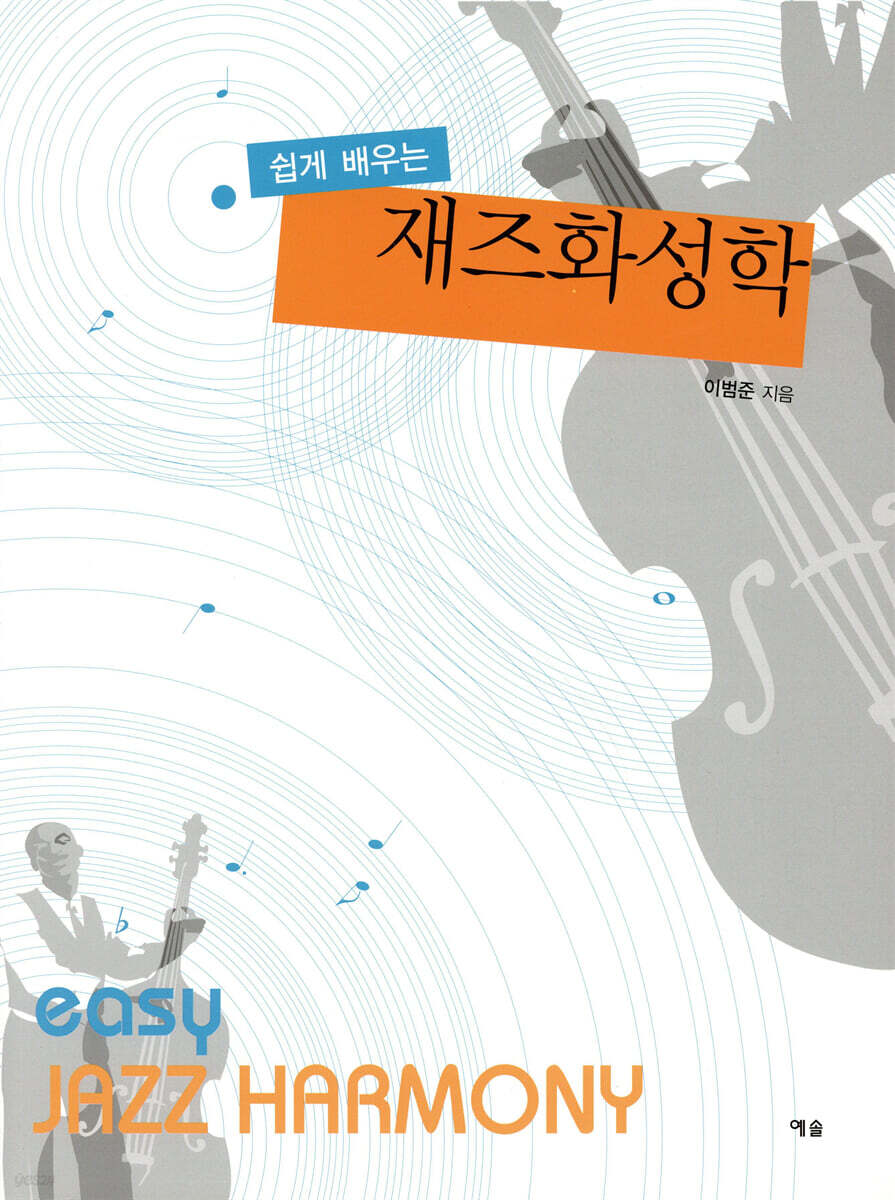
Easy Jazz Harmony
 |
Description
Book Introduction
A book on jazz harmony theory that explains the principles step by step.
A notable feature of this book is that it is organized so that students can effectively understand how the theories presented can be applied through example scores and diagrams, which occupy a significant portion of the entire book.
Additionally, each chapter is organized by key concepts such as Tension, Secondary Dominant, and Modal Interchange, allowing for effective organization of each concept and making it very easy to look up only the parts you are curious about.
A notable feature of this book is that it is organized so that students can effectively understand how the theories presented can be applied through example scores and diagrams, which occupy a significant portion of the entire book.
Additionally, each chapter is organized by key concepts such as Tension, Secondary Dominant, and Modal Interchange, allowing for effective organization of each concept and making it very easy to look up only the parts you are curious about.
index
Preface·5 / Recommendation
01.
Interval
02.
Chord
03.
Tension
04.
Scale (Modes)
05.
Diatonic Harmony of Major Scale
06.
Diatonic Harmony II in Major Scale
07.
Secondary Dominants
08.
Related IImi7
09.
Minor Key Harmony
10.
Chord Scale
11.
Substitute Dominant
12.
Diminished Chords
13.
Modal Interchange
14.
Modulation
01.
Interval
02.
Chord
03.
Tension
04.
Scale (Modes)
05.
Diatonic Harmony of Major Scale
06.
Diatonic Harmony II in Major Scale
07.
Secondary Dominants
08.
Related IImi7
09.
Minor Key Harmony
10.
Chord Scale
11.
Substitute Dominant
12.
Diminished Chords
13.
Modal Interchange
14.
Modulation
Publisher's Review
One of the most famous stories about circular reasoning that everyone is likely familiar with is 'which came first, the chicken or the egg?'
You've probably had a fun conversation with your friends about a question that doesn't have a clear answer.
But if you're wondering what the heck is this chicken-crowding in the introduction to a jazz harmony theory book? What about this question? "Which comes first, music or music theory?" Unlike the previous question, the answer to this one is simple.
Of course, music comes first.
Music theory can be seen as a theoretical system that is thoroughly experience-centered.
For a simple example, when played together, sounds that are comfortable to hear are organized into consonants such as the 3rd and 6th, while sounds that are uncomfortable are organized into dissonant sounds such as the minor 2nd and augmented 4th.
However, as we learn music theory, we often forget this fact and become trapped within the confines of the theory.
This is the result of simply memorizing the theory without knowing the process through which it was organized, and in such cases, music theory is likely to be perceived as something complex and difficult that simply replaces the '1, 2, 3, 4' of mathematics with 'do, re, mi, fa'.
In this respect, the publication of cannot but be very welcome news to those studying practical music.
As the mid-career composer Kim Ki-pyo, who is currently the vice-president of the Seoul Jazz Academy, states in his recommendation, "This book is explained much more easily than any other jazz theory book, so I think that both established musicians and beginner music students will be able to easily approach jazz harmony." The purpose of this book is to help people learn jazz harmony theory step by step, starting from the principles.
The detailed and friendly explanations, like private lessons, will help readers learn jazz harmony theory more easily and comfortably. In particular, the example scores and diagrams, which take up a significant portion of the entire book, are organized to help readers effectively understand how the presented theories can be applied.
Additionally, each chapter is organized by key concepts such as Tension, Secondary Dominant, and Modal Interchange, allowing for effective organization of each concept and making it very easy to look up only the parts you are curious about.
As the author expressed in the preface, this book will serve as a guide to help students and juniors in music who are considering giving up on learning harmony because it is too difficult, musicians who have not yet learned systematic jazz harmony, and classical musicians who are curious about jazz harmony learn jazz harmony easily and enjoyably.
You've probably had a fun conversation with your friends about a question that doesn't have a clear answer.
But if you're wondering what the heck is this chicken-crowding in the introduction to a jazz harmony theory book? What about this question? "Which comes first, music or music theory?" Unlike the previous question, the answer to this one is simple.
Of course, music comes first.
Music theory can be seen as a theoretical system that is thoroughly experience-centered.
For a simple example, when played together, sounds that are comfortable to hear are organized into consonants such as the 3rd and 6th, while sounds that are uncomfortable are organized into dissonant sounds such as the minor 2nd and augmented 4th.
However, as we learn music theory, we often forget this fact and become trapped within the confines of the theory.
This is the result of simply memorizing the theory without knowing the process through which it was organized, and in such cases, music theory is likely to be perceived as something complex and difficult that simply replaces the '1, 2, 3, 4' of mathematics with 'do, re, mi, fa'.
In this respect, the publication of cannot but be very welcome news to those studying practical music.
As the mid-career composer Kim Ki-pyo, who is currently the vice-president of the Seoul Jazz Academy, states in his recommendation, "This book is explained much more easily than any other jazz theory book, so I think that both established musicians and beginner music students will be able to easily approach jazz harmony." The purpose of this book is to help people learn jazz harmony theory step by step, starting from the principles.
The detailed and friendly explanations, like private lessons, will help readers learn jazz harmony theory more easily and comfortably. In particular, the example scores and diagrams, which take up a significant portion of the entire book, are organized to help readers effectively understand how the presented theories can be applied.
Additionally, each chapter is organized by key concepts such as Tension, Secondary Dominant, and Modal Interchange, allowing for effective organization of each concept and making it very easy to look up only the parts you are curious about.
As the author expressed in the preface, this book will serve as a guide to help students and juniors in music who are considering giving up on learning harmony because it is too difficult, musicians who have not yet learned systematic jazz harmony, and classical musicians who are curious about jazz harmony learn jazz harmony easily and enjoyably.
GOODS SPECIFICS
- Date of issue: March 25, 2008
- Page count, weight, size: 170 pages | 544g | 210*297*20mm
- ISBN13: 9788959162147
- ISBN10: 8959162140
You may also like
카테고리
korean


korean

![GQ KOREA Mark (Monthly): December [2025]](http://librairie.coreenne.fr/cdn/shop/files/8ef265dbbfbf186523ed75ba7319009d.jpg?v=1765340328&width=3840)


