

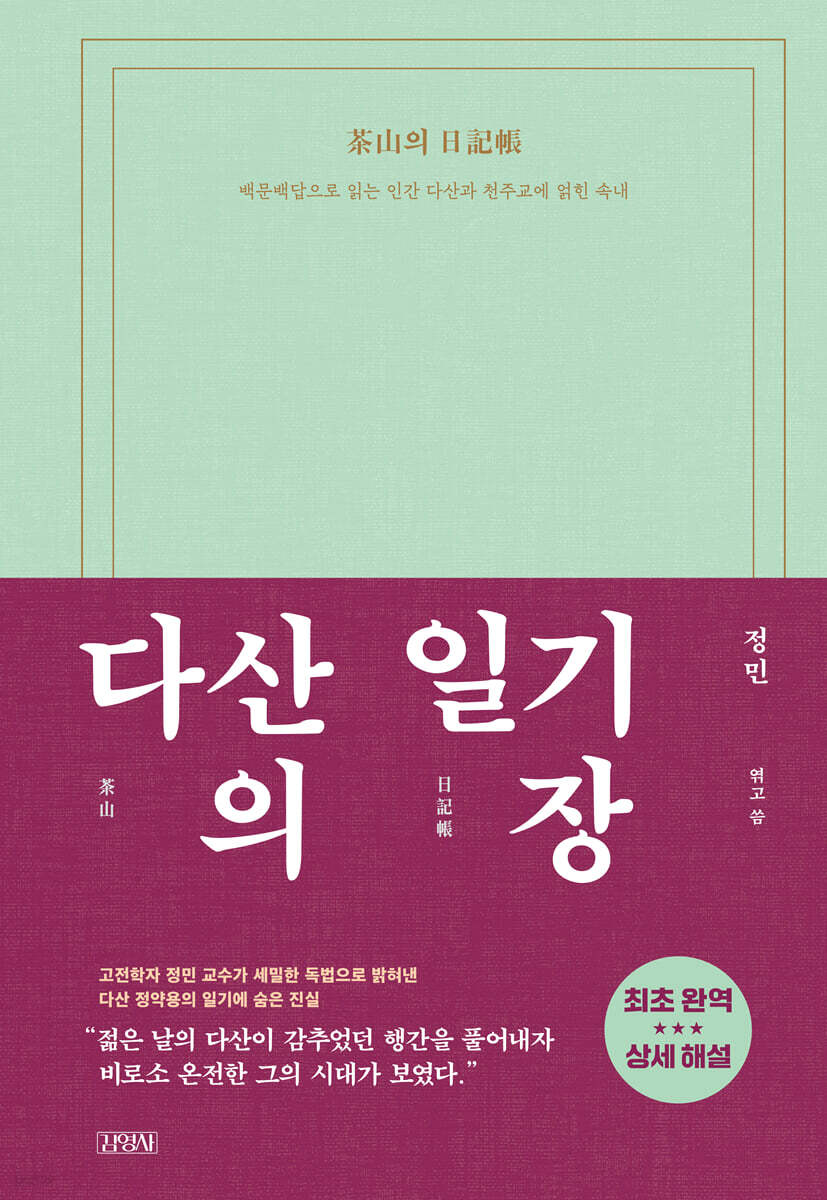
Dasan's Diary
 |
Description
Book Introduction
“Let us unravel the hidden secrets of fertility in our youth.
“Only then did I see his era in its full glory.”
The truth hidden in Dasan Jeong Yak-yong's diary, revealed through a meticulous reading by Professor Jeong Min, a classicist.
What was a diary to Dasan? Why did he so thoroughly exclude emotions, listing only facts? How should we read this diary? At the age of 33, Dasan was accused of the Three Evils of Scholarship (Sahaksamhae), demoted to the countryside, barely making it to the capital, only to be relegated to a foreign post.
By analyzing the two-year diaries, Geumjeong Diary, Jukran Diary, Gyuyeong Diary, and Hamju Illok, from various perspectives, we closely trace Dasan's inner thoughts that he could not express.
Only through careful and meticulous reading and understanding of the historical context surrounding Catholicism can one read the truth about Dasan hidden in the diary.
A masterpiece that vividly and precisely restores the complex inner life of 'Human Dasan', who was a scholar, politician, believer, and apostate.
Finally, we encounter his era more deeply and honestly through Dasan's own voice.
“Only then did I see his era in its full glory.”
The truth hidden in Dasan Jeong Yak-yong's diary, revealed through a meticulous reading by Professor Jeong Min, a classicist.
What was a diary to Dasan? Why did he so thoroughly exclude emotions, listing only facts? How should we read this diary? At the age of 33, Dasan was accused of the Three Evils of Scholarship (Sahaksamhae), demoted to the countryside, barely making it to the capital, only to be relegated to a foreign post.
By analyzing the two-year diaries, Geumjeong Diary, Jukran Diary, Gyuyeong Diary, and Hamju Illok, from various perspectives, we closely trace Dasan's inner thoughts that he could not express.
Only through careful and meticulous reading and understanding of the historical context surrounding Catholicism can one read the truth about Dasan hidden in the diary.
A masterpiece that vividly and precisely restores the complex inner life of 'Human Dasan', who was a scholar, politician, believer, and apostate.
Finally, we encounter his era more deeply and honestly through Dasan's own voice.
- You can preview some of the book's contents.
Preview
index
introduction
Opening a hundred questions and answers
001 What are Dasan's four diaries?
002 When were the four diaries written and organized?
003 How to read Dasan's diary?
004 What was Dasan like in his younger days?
Geumjeong Diary
005 How were the articles and routes of [Geumjeong Ilrok] organized?
006 What is the relationship between the Father Zhou Wenmo's capture incident and [Geumjeong Ilrok]?
007 What was the relationship between Dasan and Han Yeong-ik?
008 Why was Park Jang-seol's petition problematic?
009 Why was Dasan demoted to Geumjeong?
010 What is the reason for King Jeongjo's demotion of Dasan?
011 What is the meaning of the story that Suwon Yusu Jo Sim-tae told Dasan?
012 Why did Dasan call Lee Seung-hoon 'hyung'?
013 What was the building composition and environment of Geumjeong Station like at the time?
014 What was the role of Geumjeongchalbang given to Dasan at the time?
015 What does ‘Jeomminjibang’ mean in the letter sent to the governor, Yu Kang?
016 What is the meaning of the letter that Dasan sent to Pastor Hong Ju-mok?
017 How should we view the Chae clan village and the shadow of the Chae clan around Dasan?
018 What is the content of the letter exchanged between Dasan and Lee Sam-hwan on August 5th?
019 Why did Lee In-seop send a letter to Dasan?
020 What are the details and details of the agitation that took place in Honam at the time?
021 What is your relationship with Seokmun Jinsa Shin Jong-su?
022 What is the true identity of Kim Bok-seong, the Catholic arrested by Dasan?
023 How was the Catholic organization of Kim Bok-seong and the Geumjeong station soldiers formed?
024 What did Dasan do to the Catholic believers in Geumjeong at that time?
025 Why did Lee Ik-un send a poem to Dasan on August 17th?
026 What was the purpose of Dasan's visit to the Hansan Lee clan in Hangang-dong and Cheonbangsan?
027 What did Dasan talk about when he met with Pastor Hong Ju-mok?
028 What is the inside story of the conflict and clash between Dasan and Bangsan Lee Do-myeong?
029 What was the purpose of the tour of Oseosan Mountain?
030 What is the context of the second letter exchanged between Dasan and Lee Sam-hwan?
031 What was the purpose of your visit to Bukgye Jinsa Yun Chwihyeop, and how was your trip to the Baekje ruins with Han Baekwon?
032 Who are Oh Guk-jin and Kwon Gi, who met in Gongju?
033 What does 'The Seongjusan Incident' mean?
034 What are the contents of the successive visits by General Lee Yu-su and Lee Il-un and the reply sent by the governor?
035 When and how was Lee Jong-chang arrested?
036 What is the difference between Yoon Gyu-beom's poem and Lee Ik-un's letter?
037 Why did Lee Gi-gyeong send a letter to Dasan out of the blue?
038 Why was Dasan's reply so intense?
039 What is the context of the letter Dasan sent to Lee Sam-hwan?
040 What is the content of the poem that exposes the disorder of the Princess Changgok administration?
041 Why did Lee Do-myeong send a letter to Dasan right before the lecture?
042 What was the schedule and work of the Seoam River Society like, and what was the atmosphere like?
043 Who attended the Seoam River Conference, and what was the nature of the meeting?
044 What is the content of [Seoam Kanghakgi] and why was it written?
045 Why was Seunghoon Lee omitted from the list of attendees at the [Seoam Lecture]?
046 What is the story behind the letter sent by Lee Gwang-gyo and Dasan's reply?
047 What kind of writing is [Dosansa Sukrok], and why was it written?
048 How did Dasan reflect on himself in [Dosan's Diary]?
049 Why do discussions about the study of Confucianism and Taoism keep coming up?
050 Why did Dasan send a letter to Yun Chwi-hyeop in November, and who was the person named in the letter?
051 What is the context of Dasan's letter of request to Kang I-won regarding Yoon Ki-hwan?
052 What was the atmosphere of the poems written after the lecture?
053 What is the meaning of the letter sent to Seunghoon Lee on November 27th?
054 What kind of person was Lee Chi-hoon?
055 What was Lee Sam-hwan's assessment of Dasan?
056 Why did Lee Sam-hwan specifically mention 'local knowledge'?
057 Why did Dasan throw a feast for the rich people of Yeokchon?
058 What is the context of the letters exchanged with Lee Ga-hwan?
059 Why was Dasan so happy at the news of Heo Jeok's official rank being restored?
060 What was the reason Dasan sent a letter directly to Chae Je-gong?
061 Why was the memory of a warm winter day so fresh?
062 Why did Dasan send a letter to the governor, Yu Kang, at this point?
063 What were Dasan's thoughts after seeing the title of the poem and Lee Jeong-un's poem?
064 What were Dasan's feelings when he finally came to the capital?
065 What kind of memories did Dasan's golden years leave him with?
066 Why did Dasan clash with his brother Lee Ik-un over the Lee Jon-chang issue?
067 What was Dasan's heart in the year-end letter he sent to Seunghoon Lee?
Jukran Diary
068 What are the main contents of [Jukran Diary] and Dasan's situation at the time?
069 Why did Dasan suddenly publish the article on O Tae-jeung's Gyu Gae-il?
070 What is the true nature of Dasan's affection for Yoon Gyu-beom?
071 What was the meaning of King Jeongjo's order to Zhonghua to Dasan?
072 Why did they skip the middle and move on to the issue of the ancestral rites?
073 What is the meaning of the story of a spring without flowers and the article on the 60th birthday celebration?
074 Why did Kim Jong-su suddenly go on a tour of Geumgangsan?
075 What is the meaning of the two poems sent by Kim Sang-woo?
076 What was King Jeongjo's reaction to the disaster of a white rainbow piercing the sun?
077 What is the inside story of the conflict between Lee Ju-guk and Yoon Sook over the issue of military camp number?
078 Why did Dasan briefly report the news of Lee Seung-hoon's release so late?
079 What was the intention behind suddenly quoting Kang Se-jeong's letter?
080 [Jukran Diary] Why did the title and the date of creation of the poem quoted at the end change?
081 Why did [The Diary of Jukran] stop at the end of March?
Gyuyoung's Diary
082 [Gyuyeong Diary] and what were the circumstances surrounding the entry into the Gyuyeongbu royal edict of November 16, 1796?
083 What is the story behind the compilation and publication of the "Sagiyeongseon"?
084 How did Dasan remember this time?
Ham Il-il-rok
085 Why was [Hamjuilrok] grouped separately, and what is the meaning of 'Hamju'?
086 Why did Dasan upload [Byeonbangso] at this point?
087 What was the reaction of Jeongjo and his ministers to Dasan's [Byeonbangso]?
088 What did Mok Man-jung's praise and Hong In-ho's sudden visit mean?
089 What is the context of the lifting of the ban on the 23rd and the incident involving Eoyonggyeom on the 26th?
090 Why did Lee Ik-woon get angry when Jo Jin-gwan suggested embracing Hong Nak-an and Lee Gi-gyeong?
091 What was the most controversial part of [The Frontier]?
092 Why did Shim Hwan-ji support Dasan?
093 What is the meaning between the lines of the revision of the evaluation of Lee Ji-young, the former governor of Goksan?
094 What did Min Jong-hyun ask Dasan?
095 What is the context of the conversation with the judges?
096 What does Training Captain Lee Gyeong-mu's comment on Western learning mean?
097 Why did Lee Byeong-mo criticize Dasan in front of the king and then make excuses in front of Dasan?
098 Why did Sim Hwan-ji not give a public speech in front of Dasan but act like something else?
099 What were Dasan's feelings as he left for Goksan?
What did the diary mean to Dasan?
supplement
A petition to resign from the position of Dongbu Seungji, apologizing for the slander
Dosan's Records
main
References
Find a person's name
Opening a hundred questions and answers
001 What are Dasan's four diaries?
002 When were the four diaries written and organized?
003 How to read Dasan's diary?
004 What was Dasan like in his younger days?
Geumjeong Diary
005 How were the articles and routes of [Geumjeong Ilrok] organized?
006 What is the relationship between the Father Zhou Wenmo's capture incident and [Geumjeong Ilrok]?
007 What was the relationship between Dasan and Han Yeong-ik?
008 Why was Park Jang-seol's petition problematic?
009 Why was Dasan demoted to Geumjeong?
010 What is the reason for King Jeongjo's demotion of Dasan?
011 What is the meaning of the story that Suwon Yusu Jo Sim-tae told Dasan?
012 Why did Dasan call Lee Seung-hoon 'hyung'?
013 What was the building composition and environment of Geumjeong Station like at the time?
014 What was the role of Geumjeongchalbang given to Dasan at the time?
015 What does ‘Jeomminjibang’ mean in the letter sent to the governor, Yu Kang?
016 What is the meaning of the letter that Dasan sent to Pastor Hong Ju-mok?
017 How should we view the Chae clan village and the shadow of the Chae clan around Dasan?
018 What is the content of the letter exchanged between Dasan and Lee Sam-hwan on August 5th?
019 Why did Lee In-seop send a letter to Dasan?
020 What are the details and details of the agitation that took place in Honam at the time?
021 What is your relationship with Seokmun Jinsa Shin Jong-su?
022 What is the true identity of Kim Bok-seong, the Catholic arrested by Dasan?
023 How was the Catholic organization of Kim Bok-seong and the Geumjeong station soldiers formed?
024 What did Dasan do to the Catholic believers in Geumjeong at that time?
025 Why did Lee Ik-un send a poem to Dasan on August 17th?
026 What was the purpose of Dasan's visit to the Hansan Lee clan in Hangang-dong and Cheonbangsan?
027 What did Dasan talk about when he met with Pastor Hong Ju-mok?
028 What is the inside story of the conflict and clash between Dasan and Bangsan Lee Do-myeong?
029 What was the purpose of the tour of Oseosan Mountain?
030 What is the context of the second letter exchanged between Dasan and Lee Sam-hwan?
031 What was the purpose of your visit to Bukgye Jinsa Yun Chwihyeop, and how was your trip to the Baekje ruins with Han Baekwon?
032 Who are Oh Guk-jin and Kwon Gi, who met in Gongju?
033 What does 'The Seongjusan Incident' mean?
034 What are the contents of the successive visits by General Lee Yu-su and Lee Il-un and the reply sent by the governor?
035 When and how was Lee Jong-chang arrested?
036 What is the difference between Yoon Gyu-beom's poem and Lee Ik-un's letter?
037 Why did Lee Gi-gyeong send a letter to Dasan out of the blue?
038 Why was Dasan's reply so intense?
039 What is the context of the letter Dasan sent to Lee Sam-hwan?
040 What is the content of the poem that exposes the disorder of the Princess Changgok administration?
041 Why did Lee Do-myeong send a letter to Dasan right before the lecture?
042 What was the schedule and work of the Seoam River Society like, and what was the atmosphere like?
043 Who attended the Seoam River Conference, and what was the nature of the meeting?
044 What is the content of [Seoam Kanghakgi] and why was it written?
045 Why was Seunghoon Lee omitted from the list of attendees at the [Seoam Lecture]?
046 What is the story behind the letter sent by Lee Gwang-gyo and Dasan's reply?
047 What kind of writing is [Dosansa Sukrok], and why was it written?
048 How did Dasan reflect on himself in [Dosan's Diary]?
049 Why do discussions about the study of Confucianism and Taoism keep coming up?
050 Why did Dasan send a letter to Yun Chwi-hyeop in November, and who was the person named in the letter?
051 What is the context of Dasan's letter of request to Kang I-won regarding Yoon Ki-hwan?
052 What was the atmosphere of the poems written after the lecture?
053 What is the meaning of the letter sent to Seunghoon Lee on November 27th?
054 What kind of person was Lee Chi-hoon?
055 What was Lee Sam-hwan's assessment of Dasan?
056 Why did Lee Sam-hwan specifically mention 'local knowledge'?
057 Why did Dasan throw a feast for the rich people of Yeokchon?
058 What is the context of the letters exchanged with Lee Ga-hwan?
059 Why was Dasan so happy at the news of Heo Jeok's official rank being restored?
060 What was the reason Dasan sent a letter directly to Chae Je-gong?
061 Why was the memory of a warm winter day so fresh?
062 Why did Dasan send a letter to the governor, Yu Kang, at this point?
063 What were Dasan's thoughts after seeing the title of the poem and Lee Jeong-un's poem?
064 What were Dasan's feelings when he finally came to the capital?
065 What kind of memories did Dasan's golden years leave him with?
066 Why did Dasan clash with his brother Lee Ik-un over the Lee Jon-chang issue?
067 What was Dasan's heart in the year-end letter he sent to Seunghoon Lee?
Jukran Diary
068 What are the main contents of [Jukran Diary] and Dasan's situation at the time?
069 Why did Dasan suddenly publish the article on O Tae-jeung's Gyu Gae-il?
070 What is the true nature of Dasan's affection for Yoon Gyu-beom?
071 What was the meaning of King Jeongjo's order to Zhonghua to Dasan?
072 Why did they skip the middle and move on to the issue of the ancestral rites?
073 What is the meaning of the story of a spring without flowers and the article on the 60th birthday celebration?
074 Why did Kim Jong-su suddenly go on a tour of Geumgangsan?
075 What is the meaning of the two poems sent by Kim Sang-woo?
076 What was King Jeongjo's reaction to the disaster of a white rainbow piercing the sun?
077 What is the inside story of the conflict between Lee Ju-guk and Yoon Sook over the issue of military camp number?
078 Why did Dasan briefly report the news of Lee Seung-hoon's release so late?
079 What was the intention behind suddenly quoting Kang Se-jeong's letter?
080 [Jukran Diary] Why did the title and the date of creation of the poem quoted at the end change?
081 Why did [The Diary of Jukran] stop at the end of March?
Gyuyoung's Diary
082 [Gyuyeong Diary] and what were the circumstances surrounding the entry into the Gyuyeongbu royal edict of November 16, 1796?
083 What is the story behind the compilation and publication of the "Sagiyeongseon"?
084 How did Dasan remember this time?
Ham Il-il-rok
085 Why was [Hamjuilrok] grouped separately, and what is the meaning of 'Hamju'?
086 Why did Dasan upload [Byeonbangso] at this point?
087 What was the reaction of Jeongjo and his ministers to Dasan's [Byeonbangso]?
088 What did Mok Man-jung's praise and Hong In-ho's sudden visit mean?
089 What is the context of the lifting of the ban on the 23rd and the incident involving Eoyonggyeom on the 26th?
090 Why did Lee Ik-woon get angry when Jo Jin-gwan suggested embracing Hong Nak-an and Lee Gi-gyeong?
091 What was the most controversial part of [The Frontier]?
092 Why did Shim Hwan-ji support Dasan?
093 What is the meaning between the lines of the revision of the evaluation of Lee Ji-young, the former governor of Goksan?
094 What did Min Jong-hyun ask Dasan?
095 What is the context of the conversation with the judges?
096 What does Training Captain Lee Gyeong-mu's comment on Western learning mean?
097 Why did Lee Byeong-mo criticize Dasan in front of the king and then make excuses in front of Dasan?
098 Why did Sim Hwan-ji not give a public speech in front of Dasan but act like something else?
099 What were Dasan's feelings as he left for Goksan?
What did the diary mean to Dasan?
supplement
A petition to resign from the position of Dongbu Seungji, apologizing for the slander
Dosan's Records
main
References
Find a person's name
Into the book
Why did Dasan leave these records? Why were these diaries omitted from his collected works? What specific intentions did they embody? How can we interpret his intentions? Dasan's four diaries are quite different from the intimate monologues we typically expect from a writer.
In his diary, Dasan presents only facts without revealing his emotions.
Dasan's intention is captured only through the gaze that selects and arranges facts.
(…) There is a certain distance between what Dasan says in his diary and what he wanted to say.
If you read it at face value, you will get away from the intention, so careful reading is required.
The diary has an overall purpose, and each selected episode supports that purpose.
Many of the characters that appear are not people I met by chance that day.
The quoted texts all have meaning.
I selected only the people, spaces, and events that could be converged within my intention and recorded them as if I was not paying attention.
Each one plays separately, but when viewed as a whole, it is an intentional arrangement.
---From "003 How to Read Dasan's Diary"
Dasan in his youth never let things like this pass him by.
Dasan sent [Reply to Bangsan Lee Do-myeong] to clarify his position once again.
I said in the beginning that there is a lot of slander about me in the world, but it is not based on facts.
At the same time, (…) I felt sorry for Lee Do-myeong, who was trapped in his own world while neglecting his studies in literature.
In this way, Dasan and Lee Do-myeong exchanged sharp arguments on two occasions.
This incident shows that there was strong opposition and rejection from some local scholars, represented by Lee Do-myeong, against Dasan's attempt to turn the purge of Seongho users into a symbolic act of a declaration of conversion.
Because of this, the plan to arrange a lecture group for Dasan began to go awry from the beginning.
---From "028 What is the inside story of the conflict and clash between Dasan and Bangsan Lee Do-myeong?"
On September 19, Dasan submitted a report to Sunyoung regarding the ‘Seongjusan incident.’
Here, the 'Seongjusan incident' refers to the incident related to the arrest of Lee Jon-chang, a Catholic leader in the region.
It would have been a report on the location of Lee Jong-chang, which had been discovered through investigation, and an explanation of the progress of the work and the plan for his arrest.
In fact, the fact that it was Jeong Yak-yong who arrested Lee Jon-chang, who had been in hiding for four years since 1791, in September 1795 has not been mentioned at all in studies of church history.
This is because there is no record that clearly states the name, and even in Dasan's diary, the name of Lee Jon-chang is not even mentioned, but rather it is vaguely lumped together as 'the Seongjusan incident.'
When Dasan mentioned matters related to Catholicism, he always used this kind of vague language.
---From "033 What does 'The Seongjusan Incident' mean?"
The words were more like a plea than a threat.
Although he didn't say it out loud, the nuance was, 'Your life is in my hands, so if you want to survive, you have to grant me this request.'
What was the counteroffer? It was a promise to stop further attacks on Dasan, end his demotion, and, furthermore, to use the money to settle a long-standing grudge.
He even added that it would take time to prepare, so it would be okay to send it after the wedding.
In the letter, Lee Ki-kyung openly demanded Dasan's unconditional surrender and a humiliating deal.
Dasan copied all of Lee Gi-gyeong's vulgar letters into his diary.
The intention was to leave a record of clear evidence of threats and persuasion.
---From "037 Why did Lee Ki-kyung send a letter to Dasan out of the blue?"
[Dosansa Sukrok] The organization was the third task that Dasan had to perform in Geumjeong, following the arrest of Catholics and the lecture at Bonggoksa Temple.
In the letter he received from Yi In-seop on August 7th, immediately after his arrival in Geumjeong, he put into practice the order to diligently read Jeong Ju's writings, believe deeply in them, and seek to conform to their teachings, but also to find an example in Toegye.
(…) [Dosan Sasukrok] was not a voluntary reflection.
It was part of a deliberate plan to obtain an indulgence while coming down to Geumjeong.
As a result, this work became a great book with Dasan's excellent writing skills added to serious academic reflection, but the original intention itself was not pure.
---From "047 [Dosan Sasukrok] What kind of writing is it and why was it written?"
In Geumjeong, he said things he didn't mean and did things that were against his usual beliefs.
He brought in people around him and made them his entourage, swearing to the truth.
He did not hesitate to use any means necessary to achieve his goals.
When the other party did not agree with the plan after trying to persuade them, he wrote letters to pressure and threaten them, and tried to avoid the situation by deceiving them.
By operating a close network with the central government, we took preemptive control of the situation.
In my personal opinion, I think Dasan was most ashamed of the period of abstinence in his life.
---From "065 What kind of memories did Dasan's golden years leave him with?"
Dasan concluded his [Diary of Jukran] by writing the poem [Wake up early and recite your feelings].
In fact, this poem is boldly included in Volume 2 of the Dasan Poetry Collection under a different title, ‘Reading the Will of Master Dosan Toegye.’
Judging from the composition of the poetry collection, it is clear that it was written around the end of November 1795.
However, Dasan changed the title here and also changed the time of creation to make it seem like the work was written after moving from Geumjeong to Seoul.
By changing the title and time of creation of the poems in this way, the ending was decorated, and the entirety of [Geumjeong Ilrok] and [Jukran Ilgi] ended with a respectful tribute to Toegye.
(…) This kind of arbitrary arrangement can be read as further evidence that Dasan wrote this diary while constantly being conscious of the gaze of external readers.
Accordingly, each paragraph of the diary continuously transmits meaning outwardly according to its intentional arrangement, and the reader is also made to focus on the progression of that meaning.
---「080 [Jukran Diary] Why did the poem quoted at the end change its title and the date of creation?」
His diary is also a mass of contradictions in that it is the result of such hard work.
At least in this period, it is clear that Dasan decided to follow the path of the monarch between God and the monarch.
However, the spark of his faith did not die out like ashes, and it continued to cause conflict deep within him.
(…) I would like to make it clear once again that my reading of Dasan’s diary in this way has nothing to do with the intention of driving Dasan into a hypocrite or dividing the issue of religious identity into two extremes.
The inconsistencies and sharp conflicts revealed in Dasan's diary contain the enormous contradictions that Dasan and his era faced.
Dasan's conflicting and inconsistent steps are not a sign of his indecision, but rather an indication of the ambiguous stance of 18th-century Joseon when confronted with the vast system of Western learning.
In his diary, Dasan presents only facts without revealing his emotions.
Dasan's intention is captured only through the gaze that selects and arranges facts.
(…) There is a certain distance between what Dasan says in his diary and what he wanted to say.
If you read it at face value, you will get away from the intention, so careful reading is required.
The diary has an overall purpose, and each selected episode supports that purpose.
Many of the characters that appear are not people I met by chance that day.
The quoted texts all have meaning.
I selected only the people, spaces, and events that could be converged within my intention and recorded them as if I was not paying attention.
Each one plays separately, but when viewed as a whole, it is an intentional arrangement.
---From "003 How to Read Dasan's Diary"
Dasan in his youth never let things like this pass him by.
Dasan sent [Reply to Bangsan Lee Do-myeong] to clarify his position once again.
I said in the beginning that there is a lot of slander about me in the world, but it is not based on facts.
At the same time, (…) I felt sorry for Lee Do-myeong, who was trapped in his own world while neglecting his studies in literature.
In this way, Dasan and Lee Do-myeong exchanged sharp arguments on two occasions.
This incident shows that there was strong opposition and rejection from some local scholars, represented by Lee Do-myeong, against Dasan's attempt to turn the purge of Seongho users into a symbolic act of a declaration of conversion.
Because of this, the plan to arrange a lecture group for Dasan began to go awry from the beginning.
---From "028 What is the inside story of the conflict and clash between Dasan and Bangsan Lee Do-myeong?"
On September 19, Dasan submitted a report to Sunyoung regarding the ‘Seongjusan incident.’
Here, the 'Seongjusan incident' refers to the incident related to the arrest of Lee Jon-chang, a Catholic leader in the region.
It would have been a report on the location of Lee Jong-chang, which had been discovered through investigation, and an explanation of the progress of the work and the plan for his arrest.
In fact, the fact that it was Jeong Yak-yong who arrested Lee Jon-chang, who had been in hiding for four years since 1791, in September 1795 has not been mentioned at all in studies of church history.
This is because there is no record that clearly states the name, and even in Dasan's diary, the name of Lee Jon-chang is not even mentioned, but rather it is vaguely lumped together as 'the Seongjusan incident.'
When Dasan mentioned matters related to Catholicism, he always used this kind of vague language.
---From "033 What does 'The Seongjusan Incident' mean?"
The words were more like a plea than a threat.
Although he didn't say it out loud, the nuance was, 'Your life is in my hands, so if you want to survive, you have to grant me this request.'
What was the counteroffer? It was a promise to stop further attacks on Dasan, end his demotion, and, furthermore, to use the money to settle a long-standing grudge.
He even added that it would take time to prepare, so it would be okay to send it after the wedding.
In the letter, Lee Ki-kyung openly demanded Dasan's unconditional surrender and a humiliating deal.
Dasan copied all of Lee Gi-gyeong's vulgar letters into his diary.
The intention was to leave a record of clear evidence of threats and persuasion.
---From "037 Why did Lee Ki-kyung send a letter to Dasan out of the blue?"
[Dosansa Sukrok] The organization was the third task that Dasan had to perform in Geumjeong, following the arrest of Catholics and the lecture at Bonggoksa Temple.
In the letter he received from Yi In-seop on August 7th, immediately after his arrival in Geumjeong, he put into practice the order to diligently read Jeong Ju's writings, believe deeply in them, and seek to conform to their teachings, but also to find an example in Toegye.
(…) [Dosan Sasukrok] was not a voluntary reflection.
It was part of a deliberate plan to obtain an indulgence while coming down to Geumjeong.
As a result, this work became a great book with Dasan's excellent writing skills added to serious academic reflection, but the original intention itself was not pure.
---From "047 [Dosan Sasukrok] What kind of writing is it and why was it written?"
In Geumjeong, he said things he didn't mean and did things that were against his usual beliefs.
He brought in people around him and made them his entourage, swearing to the truth.
He did not hesitate to use any means necessary to achieve his goals.
When the other party did not agree with the plan after trying to persuade them, he wrote letters to pressure and threaten them, and tried to avoid the situation by deceiving them.
By operating a close network with the central government, we took preemptive control of the situation.
In my personal opinion, I think Dasan was most ashamed of the period of abstinence in his life.
---From "065 What kind of memories did Dasan's golden years leave him with?"
Dasan concluded his [Diary of Jukran] by writing the poem [Wake up early and recite your feelings].
In fact, this poem is boldly included in Volume 2 of the Dasan Poetry Collection under a different title, ‘Reading the Will of Master Dosan Toegye.’
Judging from the composition of the poetry collection, it is clear that it was written around the end of November 1795.
However, Dasan changed the title here and also changed the time of creation to make it seem like the work was written after moving from Geumjeong to Seoul.
By changing the title and time of creation of the poems in this way, the ending was decorated, and the entirety of [Geumjeong Ilrok] and [Jukran Ilgi] ended with a respectful tribute to Toegye.
(…) This kind of arbitrary arrangement can be read as further evidence that Dasan wrote this diary while constantly being conscious of the gaze of external readers.
Accordingly, each paragraph of the diary continuously transmits meaning outwardly according to its intentional arrangement, and the reader is also made to focus on the progression of that meaning.
---「080 [Jukran Diary] Why did the poem quoted at the end change its title and the date of creation?」
His diary is also a mass of contradictions in that it is the result of such hard work.
At least in this period, it is clear that Dasan decided to follow the path of the monarch between God and the monarch.
However, the spark of his faith did not die out like ashes, and it continued to cause conflict deep within him.
(…) I would like to make it clear once again that my reading of Dasan’s diary in this way has nothing to do with the intention of driving Dasan into a hypocrite or dividing the issue of religious identity into two extremes.
The inconsistencies and sharp conflicts revealed in Dasan's diary contain the enormous contradictions that Dasan and his era faced.
Dasan's conflicting and inconsistent steps are not a sign of his indecision, but rather an indication of the ambiguous stance of 18th-century Joseon when confronted with the vast system of Western learning.
---From "What did a diary mean to 100 Dasans?"
Publisher's Review
*** First complete translation, detailed commentary
Faced with the huge system called Western learning
A masterpiece that illuminates Dasan and 18th-century Joseon in three dimensions.
A record of the most intense and tense period in Dasan Jeong Yak-yong's life.
Four diaries written by Dasan Jeong Yak-yong, a great scholar of Silhak (practical learning), but not by Dasan Jeong Yak-yong, a man in his 30s who was caught between the king and God, are finally being revealed to the world through the interpretation and interpretation of Professor Jeong Min, a classic scholar.
Professor Jeong Min, who has deeply explored the intellectual history of Joseon in the 18th century, has translated Dasan's diaries, Geumjeong Ilrok (金井日錄), Jukran Ilgi (竹欄日記), Gyuyeong Ilgi (奎瀛日記), and Hamju Illok (含珠日錄), which contain Dasan's 'great victories and defeats', with annotations for the first time in Korea, and has traced the truth hidden by Dasan and his era through the question-and-answer format.
By comprehensively examining the text of the diary, letters and poems included in the Dasan Poetry Collection, the Annals of King Jeongjo, Ilseongnok, the Diaries of the Royal Secretariat, various petitions, records of expulsions, and genealogy, we cross-check the historical facts and circumstances in the diary and empirically uncover Dasan's unspoken intentions and inner thoughts.
This meticulous reading finally reveals “the truth that swept through the inner workings of a great soul who confronted a sealed era with burning questions.”
“These four diaries are all inextricably linked to the issue of Dasan’s Catholic faith.
At that time, it was a close match, and the fate of the family and life or death depended on a single word.
Therefore, Dasan's diary from this period requires a detailed reading.
“It means that there is a hidden meaning in every seemingly indifferent article in the diary.” _From the preface
These four types of diaries are all missing from Dasan's collected works.
These diaries are records of a time when there was heated and fierce debate in the government over punishment for Lee Ga-hwan, Lee Seung-hun, and Jeong Yak-yong, who were designated as the three evil scholars related to Catholicism.
〈Geumjeong Ilrok〉 is a record of the period when Dasan, at the age of 33, was demoted to Geumjeong Patrol Commander in Chungcheong Province after being implicated in the capture of Father Ju Moon-mo in 1795. 〈Jukran Ilgi〉 is a record of his time as Myeongrye Bang, unemployed after barely making it to the capital from Geumjeong in 1796. 〈Gyuyeong Ilgi〉 is a record of his return to the position of Gyuyeongbu Gyosogwan in the same year. 〈Hamju Ilrok〉 is a record of his time up until the time he was demoted to the provincial post of Goksan Busa in Hwanghae Province the following year, 1797.
In particular, the most extensive volume, Geumjeong Ilrok, covers the five months of Dasan's 75-year life that were the most dense and tense.
Why did Dasan keep such a diary, and why was it omitted from his collected works? What was the hidden intention behind it? How should we interpret its meaning? In his new book, "Dasan's Diary," Professor Jeong Min explores the inner thoughts surrounding Dasan and Catholicism, hidden between the lines, that Dasan wanted to express but couldn't.
And after a 'head-on breakthrough', we finally reach a 'truth'.
“The worship dedicated to Dasan’s perfection and purity is sufficiently based on the academic achievements made to date.
The work of proclaiming that Dasan is great in all aspects has been done without exception.
There is no need for any more flawless biographies.
Now is the time to face Dasan and his era more objectively and humanely.
“I want to meet him and his era through voice.” _From the introduction
Meet 100 questions and 100 answers
The Truth About Human Dasan: Scholar, Politician, Believer, and Apostate
The great truth lies deep beneath the surface.
Professor Jeong Min, who has studied Dasan for a long time, has written books such as “Dasan’s Knowledge Management Method,” “Rediscovery of Dasan,” and “Blue,” reviving the complex and multifaceted aspects of Dasan in historical, cultural, and personal contexts.
He then devoted himself to the study of Western learning in the late Joseon Dynasty, including in his book “Western Learning, Penetrating Joseon,” and proved that Dasan was an early Catholic priest, the one who helped Father Zhou Wenmo escape, and the one who arrested church leader Lee Jon-chang.
In the new book, Dasan's Diary, the author discovers the strategist Dasan.
In his diary, Dasan evaded his words at sensitive points, sometimes remained silent about even the things he wanted to say, and sometimes inserted things whose purpose was unclear.
The four diaries are highly calculated political texts. Only by understanding the political context of the time, when discussions about punishment and the battle over petitions related to Western learning were intense, and by approaching them with a meticulous and detailed reading method, can we gain insight into Dasan's inner thoughts and the times he lived in.
The author vividly and precisely restores a character by uncovering even the lines that Dasan censored and concealed himself, such as the reason Dasan was dismissed as a low-ranking local official, King Jeongjo's true intentions in demoting him, Dasan's efforts and inner thoughts to free himself from slander by arresting Catholics, and Dasan's strong and straightforward personality in his youth when he even clashed with fellow Namin members to organize the last works of Seongho Ik.
During this period, the background and meaning of the writings of Dasan's "Seoam Ganghakgi," "Dosan Sasukrok," and "Byeonbangso" are also newly revealed.
“Dasan’s identity cannot be properly understood without considering the Catholic issue, not only in his youth but throughout his life.
Therefore, the author's basic position in this work is that this problem must be tackled head-on.
There can be no pre-determined intention, and there cannot be.
Even if presented as facts, people only trust illusions that have become established as common sense.
I have been fighting against such illusions for a long time.
I won't mind the cold stares in front of me and the chatter behind my back.
Because the point I want to reach is only the truth.” _From the introduction
Professor Jeongmin honestly reveals the sharp, blunt, and contradictory Dasan of his younger days, rather than the flawless Dasan we have known so far.
There was no attempt to clarify whether Dasan was a Catholic or an apostate.
As a classicist who studies literature, he simply reads the writings left behind by Dasan and discovers the truth hidden within them.
This allows us to finally look more deeply and honestly into his era through Dasan's own voice.
What did a diary mean to Dasan?
What did Dasan want to say?
Dasan's diary consists solely of objective facts, rather than daily life fragments or personal reflections.
A letter received one day, news of a reconciliation mentioned carelessly, etc., are difficult to conclude as a specific topic.
Hidden here is the political and strategic intention of Dasan, who was demoted due to the Catholic issue.
He wanted to provide an alibi to clear himself of the Catholic charges and prove his innocence.
So, he left behind a record of objective movements, conversations, and documents exchanged to justify his actions and serve as testimony for the future.
What Dasan wants to say is often contained in letters or poems from other people quoted in the middle.
In other words, Dasan's intention is captured only through the gaze with which he selects and arranges these facts.
Only by carefully and meticulously reading the diary and understanding its strategic arrangement and calculated writing can we discern the hidden truth behind Dasan's apostasy from Catholicism and his complex inner conflicts, hidden between the lines and censored by himself.
“As a result, he achieved the feat of saying everything he wanted to say without necessarily revealing his personal feelings in his writing.
On the other hand, from the reader's perspective, it was difficult to reach the writer's inner thoughts because the reading was limited to what one knew.
Because of this, as I read the diary, I realized that it is truly not easy to fully understand an era and deeply examine the inner self of a person.
“It felt like passing through a dark underground tunnel with secret agencies buried everywhere and hidden weapons.” _From the introduction
After being banished to Geumjeong, he took the lead in arresting Catholic leaders, but no one believed Dasan's sincerity, and he had to constantly prove his innocence.
Dasan's diary is a bundle of contradictions in that it is the result of such hard work.
Dasan's torn path between God and the king is not a sign of his indecision, but rather shows the ambiguous stance of 18th-century Joseon when faced with the massive system of Western learning.
In other words, the contradiction of fertility is no different from the contradiction of the times.
This book allows us to encounter Dasan and 18th century Joseon more objectively and humanely through Dasan's diary.
Finally, Dasan's own voice tells his story of his time.
Meet more deeply and more honestly
· What was King Jeongjo's real intention in banishing Dasan to a low-ranking local government official?
In early 1795, Dasan was a third-rank official and was on a roll as a close associate of King Jeongjo, including accompanying him on his royal procession to Hwaseong.
But suddenly, King Jeongjo demoted Dasan to the position of Geumjeong Chalbang, who was in charge of the Geumjeong post station in Chungcheong Province, saying that he had read a piece of writing that defamed the saint and that he had pursued strange sentences and not corrected his handwriting.
If we examine the diary, we can see that this was actually a temporary move to send Dasan to the countryside to calm public opinion.
After the failure to arrest Father Ju Moon-mo, petitions to punish those behind the Catholic powers continued, and Jeong Yak-yong became the target.
By reprimanding Dasan for his writing style and calligraphy, King Jeongjo wanted to make it clear that although he was familiar with Catholic books, he was not a perpetrator of private education, and to protect him.
The fact that he was sent to Chungcheong Province rather than the remote areas of Namhae or Hamgyeong Province also proves that Dasan's demotion was a form of public opinion suppression.
· Why did Dasan, who was demoted to Geumjeong, actively arrest Catholics?
The main duty of the postmaster is to manage the post station facilities and the horses there.
However, if we look at the poems Dasan wrote before leaving for Geumjeong and the letters he received upon his arrival, recorded in his diary, it is confirmed that the actual mission that King Jeongjo gave him was to evangelize and arrest Catholics.
In fact, just 18 days after taking office, Dasan arrested Kim Bok-seong, a mid-level leader of a nearby Catholic group, and then succeeded in arresting its leader Lee Jon-chang.
Dasan, who had been banished to Geumjeong after being implicated in the incident of the assassination of the Catholic priest Joo Mun-mo, needed a decisive result to clear himself of any Catholic-related charges, and King Jeongjo needed a justification to bring him back to the capital.
In other words, arresting Catholics was the first task that King Jeongjo gave Dasan, and Dasan wanted to prove his apostasy and return to the king's side even for a day.
· Why did Dasan organize the works of Seongho Lee Ik while exchanging sharp arguments with Namin?
When Dasan, who had gone down to Geumjeong, wanted to hold a lecture to organize the manuscripts left behind by Seongho Ik, some of the Nam-in faction of Seongho strongly opposed it.
Lee Sam-hwan, the eldest grandson of Seongho, responded coldly, and Lee Do-myeong, a renowned scholar, sent a sharp letter opposing the lecture.
Even though they were both men, why did they disapprove of Dasan's actions? It was because they believed he was using them to obtain absolution for his Catholic charges.
Dasan had a hard time persuading Yi Sam-hwan and others to hold a lecture and organize the “Seoam Ganghakgi,” and then wrote “Dosan Sasuknok,” which was a collection of his impressions of Toegye Yi Hwang’s letters.
The author states that these two writings were intended to declare that Dasan himself had abandoned Western learning and returned to orthodox learning.
It was essentially a letter of reflection submitted to King Jeongjo following the arrest of Catholics.
· With the return to central government imminent, why did Dasan refuse to take office?
In late 1795, he was finally ordered to go to the capital for his contribution in arresting the Catholic leader Lee Jon-chang.
However, Dasan strongly refused to use this as an excuse for returning.
Despite repeated attempts by the governor under King Jeongjo's command to persuade him, Dasan remained adamant.
In fact, the reason Dasan was able to arrest Lee Jon-chang, who had been difficult to find for years, in just one month was because Lee Jon-chang was caught close to surrendering.
The author speculates that Dasan may have tried to persuade Lee Jon-chang through a Catholic missionary, saying that a scapegoat was needed to divert attention from Father Ju Moon-mo.
In fact, Lee Jong-chang and Dasan knew each other well as they had once been active together in the religious world.
So, Dasan felt ashamed of exchanging the arrest of Lee Jon-chang for his own return.
This is why the author believes that a glimmer of faith remained in Dasan's heart.
· What was the result of Dasan's petition among the ministers who slandered Jeongjo and himself?
Dasan was appointed as Dongbu Seungji about two years after being demoted to Geumjeong.
At this time, Dasan submitted a petition titled “Byeonbangso” to resign from his official position.
This article was intended to declare that he had broken away from Catholicism, stating that he could not advance in government because of the original sin of Western learning.
The response to this adjustment was very heated.
While praise for its prestigious reputation continued, there was also strong opposition, including calls for Dasan's dismissal.
In the end, King Jeongjo could not overcome the controversy and sent Dasan away to become the magistrate of Goksan, Hwanghae Province.
The diary records the reactions of the court officials regarding the “Byeonbangso” like a recording.
By simply repeating the praise, he proved that public opinion was favorable to him, and for some of the criticisms, he indirectly criticized them by borrowing the words of other ministers who supported him.
In this way, Dasan only wrote objective facts, but hid what he wanted to say and his intentions between the lines of his diary.
Faced with the huge system called Western learning
A masterpiece that illuminates Dasan and 18th-century Joseon in three dimensions.
A record of the most intense and tense period in Dasan Jeong Yak-yong's life.
Four diaries written by Dasan Jeong Yak-yong, a great scholar of Silhak (practical learning), but not by Dasan Jeong Yak-yong, a man in his 30s who was caught between the king and God, are finally being revealed to the world through the interpretation and interpretation of Professor Jeong Min, a classic scholar.
Professor Jeong Min, who has deeply explored the intellectual history of Joseon in the 18th century, has translated Dasan's diaries, Geumjeong Ilrok (金井日錄), Jukran Ilgi (竹欄日記), Gyuyeong Ilgi (奎瀛日記), and Hamju Illok (含珠日錄), which contain Dasan's 'great victories and defeats', with annotations for the first time in Korea, and has traced the truth hidden by Dasan and his era through the question-and-answer format.
By comprehensively examining the text of the diary, letters and poems included in the Dasan Poetry Collection, the Annals of King Jeongjo, Ilseongnok, the Diaries of the Royal Secretariat, various petitions, records of expulsions, and genealogy, we cross-check the historical facts and circumstances in the diary and empirically uncover Dasan's unspoken intentions and inner thoughts.
This meticulous reading finally reveals “the truth that swept through the inner workings of a great soul who confronted a sealed era with burning questions.”
“These four diaries are all inextricably linked to the issue of Dasan’s Catholic faith.
At that time, it was a close match, and the fate of the family and life or death depended on a single word.
Therefore, Dasan's diary from this period requires a detailed reading.
“It means that there is a hidden meaning in every seemingly indifferent article in the diary.” _From the preface
These four types of diaries are all missing from Dasan's collected works.
These diaries are records of a time when there was heated and fierce debate in the government over punishment for Lee Ga-hwan, Lee Seung-hun, and Jeong Yak-yong, who were designated as the three evil scholars related to Catholicism.
〈Geumjeong Ilrok〉 is a record of the period when Dasan, at the age of 33, was demoted to Geumjeong Patrol Commander in Chungcheong Province after being implicated in the capture of Father Ju Moon-mo in 1795. 〈Jukran Ilgi〉 is a record of his time as Myeongrye Bang, unemployed after barely making it to the capital from Geumjeong in 1796. 〈Gyuyeong Ilgi〉 is a record of his return to the position of Gyuyeongbu Gyosogwan in the same year. 〈Hamju Ilrok〉 is a record of his time up until the time he was demoted to the provincial post of Goksan Busa in Hwanghae Province the following year, 1797.
In particular, the most extensive volume, Geumjeong Ilrok, covers the five months of Dasan's 75-year life that were the most dense and tense.
Why did Dasan keep such a diary, and why was it omitted from his collected works? What was the hidden intention behind it? How should we interpret its meaning? In his new book, "Dasan's Diary," Professor Jeong Min explores the inner thoughts surrounding Dasan and Catholicism, hidden between the lines, that Dasan wanted to express but couldn't.
And after a 'head-on breakthrough', we finally reach a 'truth'.
“The worship dedicated to Dasan’s perfection and purity is sufficiently based on the academic achievements made to date.
The work of proclaiming that Dasan is great in all aspects has been done without exception.
There is no need for any more flawless biographies.
Now is the time to face Dasan and his era more objectively and humanely.
“I want to meet him and his era through voice.” _From the introduction
Meet 100 questions and 100 answers
The Truth About Human Dasan: Scholar, Politician, Believer, and Apostate
The great truth lies deep beneath the surface.
Professor Jeong Min, who has studied Dasan for a long time, has written books such as “Dasan’s Knowledge Management Method,” “Rediscovery of Dasan,” and “Blue,” reviving the complex and multifaceted aspects of Dasan in historical, cultural, and personal contexts.
He then devoted himself to the study of Western learning in the late Joseon Dynasty, including in his book “Western Learning, Penetrating Joseon,” and proved that Dasan was an early Catholic priest, the one who helped Father Zhou Wenmo escape, and the one who arrested church leader Lee Jon-chang.
In the new book, Dasan's Diary, the author discovers the strategist Dasan.
In his diary, Dasan evaded his words at sensitive points, sometimes remained silent about even the things he wanted to say, and sometimes inserted things whose purpose was unclear.
The four diaries are highly calculated political texts. Only by understanding the political context of the time, when discussions about punishment and the battle over petitions related to Western learning were intense, and by approaching them with a meticulous and detailed reading method, can we gain insight into Dasan's inner thoughts and the times he lived in.
The author vividly and precisely restores a character by uncovering even the lines that Dasan censored and concealed himself, such as the reason Dasan was dismissed as a low-ranking local official, King Jeongjo's true intentions in demoting him, Dasan's efforts and inner thoughts to free himself from slander by arresting Catholics, and Dasan's strong and straightforward personality in his youth when he even clashed with fellow Namin members to organize the last works of Seongho Ik.
During this period, the background and meaning of the writings of Dasan's "Seoam Ganghakgi," "Dosan Sasukrok," and "Byeonbangso" are also newly revealed.
“Dasan’s identity cannot be properly understood without considering the Catholic issue, not only in his youth but throughout his life.
Therefore, the author's basic position in this work is that this problem must be tackled head-on.
There can be no pre-determined intention, and there cannot be.
Even if presented as facts, people only trust illusions that have become established as common sense.
I have been fighting against such illusions for a long time.
I won't mind the cold stares in front of me and the chatter behind my back.
Because the point I want to reach is only the truth.” _From the introduction
Professor Jeongmin honestly reveals the sharp, blunt, and contradictory Dasan of his younger days, rather than the flawless Dasan we have known so far.
There was no attempt to clarify whether Dasan was a Catholic or an apostate.
As a classicist who studies literature, he simply reads the writings left behind by Dasan and discovers the truth hidden within them.
This allows us to finally look more deeply and honestly into his era through Dasan's own voice.
What did a diary mean to Dasan?
What did Dasan want to say?
Dasan's diary consists solely of objective facts, rather than daily life fragments or personal reflections.
A letter received one day, news of a reconciliation mentioned carelessly, etc., are difficult to conclude as a specific topic.
Hidden here is the political and strategic intention of Dasan, who was demoted due to the Catholic issue.
He wanted to provide an alibi to clear himself of the Catholic charges and prove his innocence.
So, he left behind a record of objective movements, conversations, and documents exchanged to justify his actions and serve as testimony for the future.
What Dasan wants to say is often contained in letters or poems from other people quoted in the middle.
In other words, Dasan's intention is captured only through the gaze with which he selects and arranges these facts.
Only by carefully and meticulously reading the diary and understanding its strategic arrangement and calculated writing can we discern the hidden truth behind Dasan's apostasy from Catholicism and his complex inner conflicts, hidden between the lines and censored by himself.
“As a result, he achieved the feat of saying everything he wanted to say without necessarily revealing his personal feelings in his writing.
On the other hand, from the reader's perspective, it was difficult to reach the writer's inner thoughts because the reading was limited to what one knew.
Because of this, as I read the diary, I realized that it is truly not easy to fully understand an era and deeply examine the inner self of a person.
“It felt like passing through a dark underground tunnel with secret agencies buried everywhere and hidden weapons.” _From the introduction
After being banished to Geumjeong, he took the lead in arresting Catholic leaders, but no one believed Dasan's sincerity, and he had to constantly prove his innocence.
Dasan's diary is a bundle of contradictions in that it is the result of such hard work.
Dasan's torn path between God and the king is not a sign of his indecision, but rather shows the ambiguous stance of 18th-century Joseon when faced with the massive system of Western learning.
In other words, the contradiction of fertility is no different from the contradiction of the times.
This book allows us to encounter Dasan and 18th century Joseon more objectively and humanely through Dasan's diary.
Finally, Dasan's own voice tells his story of his time.
Meet more deeply and more honestly
· What was King Jeongjo's real intention in banishing Dasan to a low-ranking local government official?
In early 1795, Dasan was a third-rank official and was on a roll as a close associate of King Jeongjo, including accompanying him on his royal procession to Hwaseong.
But suddenly, King Jeongjo demoted Dasan to the position of Geumjeong Chalbang, who was in charge of the Geumjeong post station in Chungcheong Province, saying that he had read a piece of writing that defamed the saint and that he had pursued strange sentences and not corrected his handwriting.
If we examine the diary, we can see that this was actually a temporary move to send Dasan to the countryside to calm public opinion.
After the failure to arrest Father Ju Moon-mo, petitions to punish those behind the Catholic powers continued, and Jeong Yak-yong became the target.
By reprimanding Dasan for his writing style and calligraphy, King Jeongjo wanted to make it clear that although he was familiar with Catholic books, he was not a perpetrator of private education, and to protect him.
The fact that he was sent to Chungcheong Province rather than the remote areas of Namhae or Hamgyeong Province also proves that Dasan's demotion was a form of public opinion suppression.
· Why did Dasan, who was demoted to Geumjeong, actively arrest Catholics?
The main duty of the postmaster is to manage the post station facilities and the horses there.
However, if we look at the poems Dasan wrote before leaving for Geumjeong and the letters he received upon his arrival, recorded in his diary, it is confirmed that the actual mission that King Jeongjo gave him was to evangelize and arrest Catholics.
In fact, just 18 days after taking office, Dasan arrested Kim Bok-seong, a mid-level leader of a nearby Catholic group, and then succeeded in arresting its leader Lee Jon-chang.
Dasan, who had been banished to Geumjeong after being implicated in the incident of the assassination of the Catholic priest Joo Mun-mo, needed a decisive result to clear himself of any Catholic-related charges, and King Jeongjo needed a justification to bring him back to the capital.
In other words, arresting Catholics was the first task that King Jeongjo gave Dasan, and Dasan wanted to prove his apostasy and return to the king's side even for a day.
· Why did Dasan organize the works of Seongho Lee Ik while exchanging sharp arguments with Namin?
When Dasan, who had gone down to Geumjeong, wanted to hold a lecture to organize the manuscripts left behind by Seongho Ik, some of the Nam-in faction of Seongho strongly opposed it.
Lee Sam-hwan, the eldest grandson of Seongho, responded coldly, and Lee Do-myeong, a renowned scholar, sent a sharp letter opposing the lecture.
Even though they were both men, why did they disapprove of Dasan's actions? It was because they believed he was using them to obtain absolution for his Catholic charges.
Dasan had a hard time persuading Yi Sam-hwan and others to hold a lecture and organize the “Seoam Ganghakgi,” and then wrote “Dosan Sasuknok,” which was a collection of his impressions of Toegye Yi Hwang’s letters.
The author states that these two writings were intended to declare that Dasan himself had abandoned Western learning and returned to orthodox learning.
It was essentially a letter of reflection submitted to King Jeongjo following the arrest of Catholics.
· With the return to central government imminent, why did Dasan refuse to take office?
In late 1795, he was finally ordered to go to the capital for his contribution in arresting the Catholic leader Lee Jon-chang.
However, Dasan strongly refused to use this as an excuse for returning.
Despite repeated attempts by the governor under King Jeongjo's command to persuade him, Dasan remained adamant.
In fact, the reason Dasan was able to arrest Lee Jon-chang, who had been difficult to find for years, in just one month was because Lee Jon-chang was caught close to surrendering.
The author speculates that Dasan may have tried to persuade Lee Jon-chang through a Catholic missionary, saying that a scapegoat was needed to divert attention from Father Ju Moon-mo.
In fact, Lee Jong-chang and Dasan knew each other well as they had once been active together in the religious world.
So, Dasan felt ashamed of exchanging the arrest of Lee Jon-chang for his own return.
This is why the author believes that a glimmer of faith remained in Dasan's heart.
· What was the result of Dasan's petition among the ministers who slandered Jeongjo and himself?
Dasan was appointed as Dongbu Seungji about two years after being demoted to Geumjeong.
At this time, Dasan submitted a petition titled “Byeonbangso” to resign from his official position.
This article was intended to declare that he had broken away from Catholicism, stating that he could not advance in government because of the original sin of Western learning.
The response to this adjustment was very heated.
While praise for its prestigious reputation continued, there was also strong opposition, including calls for Dasan's dismissal.
In the end, King Jeongjo could not overcome the controversy and sent Dasan away to become the magistrate of Goksan, Hwanghae Province.
The diary records the reactions of the court officials regarding the “Byeonbangso” like a recording.
By simply repeating the praise, he proved that public opinion was favorable to him, and for some of the criticisms, he indirectly criticized them by borrowing the words of other ministers who supported him.
In this way, Dasan only wrote objective facts, but hid what he wanted to say and his intentions between the lines of his diary.
GOODS SPECIFICS
- Date of issue: December 9, 2024
- Format: Hardcover book binding method guide
- Page count, weight, size: 688 pages | 152*225*35mm
- ISBN13: 9791194330530
- ISBN10: 1194330533
You may also like
카테고리
korean


korean

![ELLE 엘르 스페셜 에디션 A형 : 12월 [2025]](http://librairie.coreenne.fr/cdn/shop/files/b8e27a3de6c9538896439686c6b0e8fb.jpg?v=1766436872&width=3840)


