

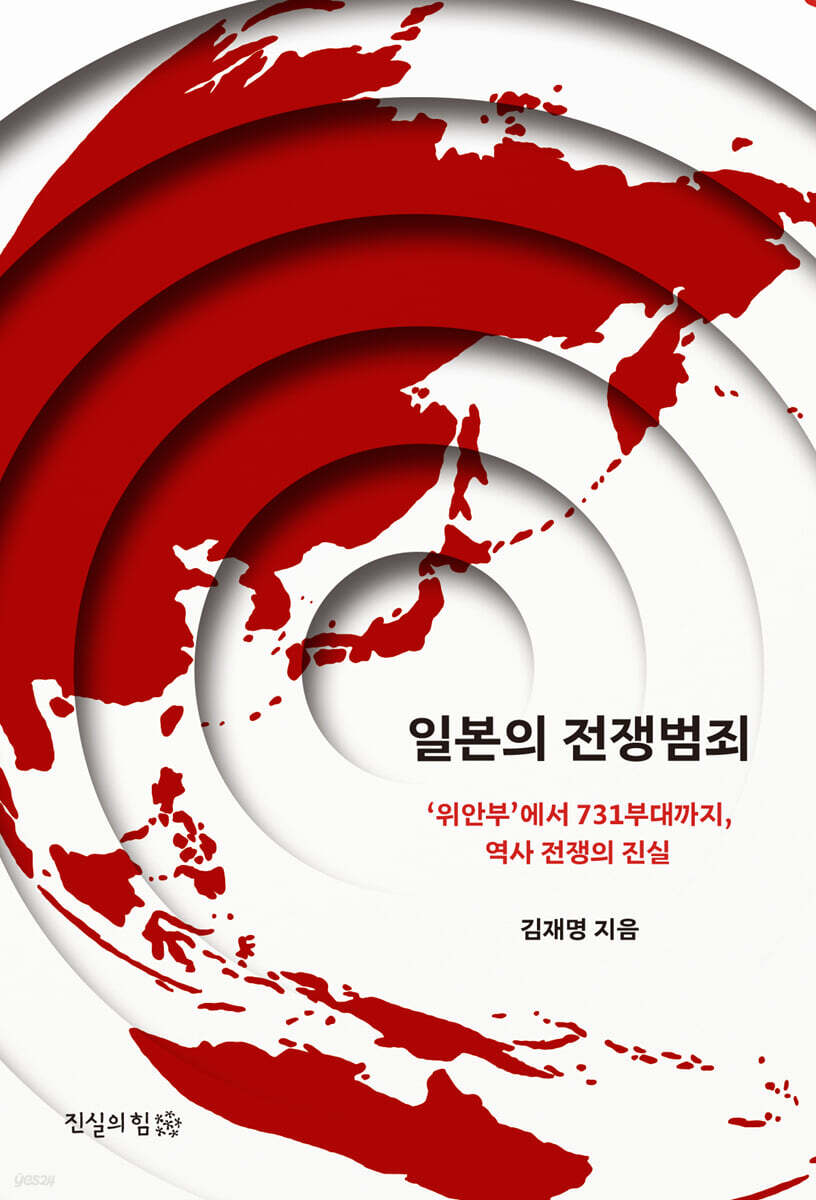
Japanese war crimes
 |
Description
Book Introduction
In a Korean society in the midst of a historical war
Talking about the past between Korea and Japan again
From 'comfort women' to Unit 731,
Japanese War Crimes in One Volume
Korea is now in a historical war.
Under the Yoon Seok-yeol administration, figures from the New Right faction were appointed to lead major education and history-related organizations one after another, and controversy arose over the appointment of Kim Hyung-seok as director of the Independence Hall of Korea, leading to the cancellation of the Independence Hall of Korea's Liberation Day celebration.
There were even comments like, “What’s important is Japan’s heart” (Kim Tae-hyo, First Vice Director of the National Security Office) and “Japan has apologized dozens of times, so we are very tired” (Office of the President).
Such remarks are not unique to today, but what is different from the past dictatorship era is that back then, “pro-Japanese activities were shameful and therefore should not be spoken of” (Han Hong-gu, Professor Emeritus at Sungkonghoe University).
The New Right now shamelessly claims that the prosperity of Korean capitalism today is thanks to Japan and the pro-Japanese collaborators who learned about new civilizations in Japan.
Korean society is now once again in the midst of a fierce historical war.
Kim Jae-myung, a journalist specializing in international conflicts, has published a new book, “Japan’s War Crimes,” which he describes as “a book so essential to our current reality that it makes you wish it had been published a little sooner” (Han Hong-gu).
The author delves deeply into various topics related to the still-hot history of Korea and Japan, including 'comfort women,' history textbooks, Dokdo sovereignty, and the Yasukuni Shrine, based on objective data and reporting, focusing on vivid examples.
The author, who has published books such as “Today’s World Conflicts” and “Palestine, Land of Tears” after conducting in-depth research on conflict zones such as Palestine, Iraq, Afghanistan, and East Timor, denounces the atrocities committed by Japan from a universal perspective based on his long experience traveling to conflict zones around the world.
As an expert on international conflict, the author's perspective moves beyond a narrow nationalist perspective and extends to East Asia as a whole.
“Japan’s War Crimes” properly examines “the problems of East Asia’s dark past,” including Unit 731’s biological experiments and the Nanjing Massacre.
The author, who analyzed Japan's war crimes based on his experience covering countless atrocities and tragedies around the world, said, "While covering conflict zones, I saw scenes of violence and death as part of everyday life, but the records of Japan's atrocities were far more horrific" (p. 626).
“Japan’s War Crimes” does not stop at accusing Japan.
It can be said to be a definitive edition that comprehensively covers almost all issues surrounding Japan's war crimes, as it points out the injustice of the process by which the United States selectively punished war crimes and seeks solutions to the complexly intertwined issues of the past.
For those who wonder why the logic of the Japanese far right and New Right is problematic, what their purpose is in making such claims, and how we can end this exhausting historical war and move forward, "Japan's War Crimes" will provide the answers.
Talking about the past between Korea and Japan again
From 'comfort women' to Unit 731,
Japanese War Crimes in One Volume
Korea is now in a historical war.
Under the Yoon Seok-yeol administration, figures from the New Right faction were appointed to lead major education and history-related organizations one after another, and controversy arose over the appointment of Kim Hyung-seok as director of the Independence Hall of Korea, leading to the cancellation of the Independence Hall of Korea's Liberation Day celebration.
There were even comments like, “What’s important is Japan’s heart” (Kim Tae-hyo, First Vice Director of the National Security Office) and “Japan has apologized dozens of times, so we are very tired” (Office of the President).
Such remarks are not unique to today, but what is different from the past dictatorship era is that back then, “pro-Japanese activities were shameful and therefore should not be spoken of” (Han Hong-gu, Professor Emeritus at Sungkonghoe University).
The New Right now shamelessly claims that the prosperity of Korean capitalism today is thanks to Japan and the pro-Japanese collaborators who learned about new civilizations in Japan.
Korean society is now once again in the midst of a fierce historical war.
Kim Jae-myung, a journalist specializing in international conflicts, has published a new book, “Japan’s War Crimes,” which he describes as “a book so essential to our current reality that it makes you wish it had been published a little sooner” (Han Hong-gu).
The author delves deeply into various topics related to the still-hot history of Korea and Japan, including 'comfort women,' history textbooks, Dokdo sovereignty, and the Yasukuni Shrine, based on objective data and reporting, focusing on vivid examples.
The author, who has published books such as “Today’s World Conflicts” and “Palestine, Land of Tears” after conducting in-depth research on conflict zones such as Palestine, Iraq, Afghanistan, and East Timor, denounces the atrocities committed by Japan from a universal perspective based on his long experience traveling to conflict zones around the world.
As an expert on international conflict, the author's perspective moves beyond a narrow nationalist perspective and extends to East Asia as a whole.
“Japan’s War Crimes” properly examines “the problems of East Asia’s dark past,” including Unit 731’s biological experiments and the Nanjing Massacre.
The author, who analyzed Japan's war crimes based on his experience covering countless atrocities and tragedies around the world, said, "While covering conflict zones, I saw scenes of violence and death as part of everyday life, but the records of Japan's atrocities were far more horrific" (p. 626).
“Japan’s War Crimes” does not stop at accusing Japan.
It can be said to be a definitive edition that comprehensively covers almost all issues surrounding Japan's war crimes, as it points out the injustice of the process by which the United States selectively punished war crimes and seeks solutions to the complexly intertwined issues of the past.
For those who wonder why the logic of the Japanese far right and New Right is problematic, what their purpose is in making such claims, and how we can end this exhausting historical war and move forward, "Japan's War Crimes" will provide the answers.
- You can preview some of the book's contents.
Preview
index
Recommendation by Han Hong-gu
Entering
Part 1: Historical Distortion and the "New Pro-Japanese Faction"
Chapter 1: Yukichi Fukuzawa: The Roots of the Reckless Statements That Fueled the Invasion of Joseon
Chapter 2: Yasukuni Shrine, a sacred site for Japan's far-right
Chapter 3: Is Dokdo a Disputed Territory?
Chapter 4: Japanese Textbooks That Changed Invasion into "Advance"
Chapter 5: Korea? Japan? A History Textbook of Unknown Nationality That Protects Pro-Japanese Collaborators
Chapter 6: The "New Pro-Japanese Faction" Distorting History with Pro-Japanese Forgeries
Part 2: Turning Colonial Korea into a Living Hell
Chapter 1: The "Barbaric Age" Crushed by Violent Exploitation
Chapter 2: The Barbaric "Human Hunt" of Forced Mobilization and Slave Labor
Chapter 3: "My Misfortune Began When I Stepped into a Comfort Station"
War crimes masterminds who shied away from responsibility
Chapter 1: The Monster Born of Imperial Fascism, Hideki Tojo
Chapter 2: Emperor Hirohito, who avoided punishment for war crimes
Chapter 3: Shiro Ishii, the leader of the "Ishii Agency"
Part 4: The Worst East Asian War Crimes of the 20th Century
Chapter 1: The Brutal and Bizarre Nanjing Massacre
Chapter 2: Unit 731's "Devils"' Vivisection and Germ Warfare
Chapter 3: The "Dirty Deal" of Bartering Germ Information for War Crimes Punishment
Chapter 4: The "Devil's Doctors" of Unit 731: Unreflective Aftermath of Defeat
Chapter 5: Kyushu Medical School's Vivisection of American Soldiers: A Breeding of War's Madness
Part 5: Another War Crime: Air Raids and the Atomic Bomb
Chapter 1: "The Brutal" LeMay Burned Japan and the Korean Peninsula
Chapter 2: The Atomic Bomb Myth That Justified America's War Crimes
Chapter 3: The Key Factors Leading to Japan's Surrender: The Atomic Bomb or the Soviet Union's Entry into the War?
Chapter 4: Pacifism Born from the Atomic Bombing
Part 6: War crimes trials without justice
Chapter 1: Are war crimes trials a "victor's trial"?
Chapter 2: The Tokyo War Crimes Trials Followed the American Script
Chapter 3: Joseon's Class B War Criminals Accused of Being "Perpetrators"
Part 7: Repeated gaffes and faded apologies
Chapter 1: Was Colonial Rule Beneficial to Korea? A History of Repeated Absurdities
Chapter 2: "New Pro-Japanese Factions" Cause Secondary Harm with "Comfort Women" Remarks
Chapter 3: Apology and Forgiveness: Who Should Do What?
In closing
main
Photo source
References
Search
Entering
Part 1: Historical Distortion and the "New Pro-Japanese Faction"
Chapter 1: Yukichi Fukuzawa: The Roots of the Reckless Statements That Fueled the Invasion of Joseon
Chapter 2: Yasukuni Shrine, a sacred site for Japan's far-right
Chapter 3: Is Dokdo a Disputed Territory?
Chapter 4: Japanese Textbooks That Changed Invasion into "Advance"
Chapter 5: Korea? Japan? A History Textbook of Unknown Nationality That Protects Pro-Japanese Collaborators
Chapter 6: The "New Pro-Japanese Faction" Distorting History with Pro-Japanese Forgeries
Part 2: Turning Colonial Korea into a Living Hell
Chapter 1: The "Barbaric Age" Crushed by Violent Exploitation
Chapter 2: The Barbaric "Human Hunt" of Forced Mobilization and Slave Labor
Chapter 3: "My Misfortune Began When I Stepped into a Comfort Station"
War crimes masterminds who shied away from responsibility
Chapter 1: The Monster Born of Imperial Fascism, Hideki Tojo
Chapter 2: Emperor Hirohito, who avoided punishment for war crimes
Chapter 3: Shiro Ishii, the leader of the "Ishii Agency"
Part 4: The Worst East Asian War Crimes of the 20th Century
Chapter 1: The Brutal and Bizarre Nanjing Massacre
Chapter 2: Unit 731's "Devils"' Vivisection and Germ Warfare
Chapter 3: The "Dirty Deal" of Bartering Germ Information for War Crimes Punishment
Chapter 4: The "Devil's Doctors" of Unit 731: Unreflective Aftermath of Defeat
Chapter 5: Kyushu Medical School's Vivisection of American Soldiers: A Breeding of War's Madness
Part 5: Another War Crime: Air Raids and the Atomic Bomb
Chapter 1: "The Brutal" LeMay Burned Japan and the Korean Peninsula
Chapter 2: The Atomic Bomb Myth That Justified America's War Crimes
Chapter 3: The Key Factors Leading to Japan's Surrender: The Atomic Bomb or the Soviet Union's Entry into the War?
Chapter 4: Pacifism Born from the Atomic Bombing
Part 6: War crimes trials without justice
Chapter 1: Are war crimes trials a "victor's trial"?
Chapter 2: The Tokyo War Crimes Trials Followed the American Script
Chapter 3: Joseon's Class B War Criminals Accused of Being "Perpetrators"
Part 7: Repeated gaffes and faded apologies
Chapter 1: Was Colonial Rule Beneficial to Korea? A History of Repeated Absurdities
Chapter 2: "New Pro-Japanese Factions" Cause Secondary Harm with "Comfort Women" Remarks
Chapter 3: Apology and Forgiveness: Who Should Do What?
In closing
main
Photo source
References
Search
Publisher's Review
Japanese far-right and South Korean neo-pro-Japanese factions erased war crimes from history textbooks.
The main battlefield of the 'history war' is history textbooks.
In both Korea and Japan, there have been attempts to downplay, distort, and glorify Japanese war crimes in history textbooks.
In Japan, Fusosha's "New History Textbook" is representative.
This textbook clearly exposes the perceptions of far-right forces, such as the “Korean Peninsula as a Weapon Theory” that “the Korean Peninsula is in a position where it can easily become a weapon for Japan” and the claim that Japanese war crimes “were unavoidable events during the war.”
Although few schools adopted the Fusosha textbooks, their efforts to erase war crimes and colonial rule were successful.
Nihon Shoseki, which published textbooks that dealt relatively faithfully with the "comfort women" issue, closed in 2003 after suffering protests from far-right forces.
Since then, most textbooks have not addressed the 'comfort women' issue, and the adoption rate of textbooks containing extreme right-wing views has been increasing.
The Japanese far-right is celebrating this, saying, “We have won the war of history.”
In Korea, there was a 'Kyohaksa scandal'.
The Kyogaksa textbook, written by New Right researchers, contains the "pro-Japanese accomplice theory," which states that all people who lived during the Japanese colonial period collaborated with Japan to varying degrees, and the "colonial modernization theory," which states that many railroads and schools were built in Joseon thanks to colonial rule.
It was even criticized as “Kyohaksa textbooks glorify Japanese colonial rule and defend pro-Japanese collaborators more blatantly than Fusosha textbooks” (Lee Jun-sik, former director of the Independence Hall of Korea).
This is why 『Japan's War Crimes』 calls the New Right 'new pro-Japanese faction.'
Japan is behind the pro-Japanese faction.
Lee Woo-yeon, co-author of “Anti-Japanese Racism,” attended the UN Human Rights Council with airfare and accommodations provided by Shunichi Fujiki, a Japanese right-wing extremist, and gave a speech stating, “There was no forced mobilization during the Japanese colonial period.”
The Naksungdae Economic Research Institute, to which Lee Young-hoon, the representative author of 『Anti-Japanese Racism』, and his mentor Ahn Byeong-jik belong, have received support from the Toyota Foundation.
The author criticizes the arguments put forward by the pro-Japanese faction with Japanese support, saying, “It is nothing more than a ‘comforting’ logic that caters to the feelings of the Japanese far right who dream of the revival of Japanese militarism” (p. 11).
"Japan's War Crimes" refutes the arguments of the Japanese far-right and neo-pro-Japanese faction by refuting their logic point by point on issues such as the Yasukuni Shrine, Dokdo sovereignty, and forced mobilization.
How Pro-Japanese Collaborators Distort History
"Japan's War Crimes" analyzes the ways in which pro-Japanese groups distort historical truth, focusing on issues such as the land survey project and the "comfort women" issue.
The pro-Japanese faction emphasizes the positive aspects of the land survey project, saying that Japan forcibly took almost no land and that various data created during the land survey project are still useful today.
They only take issue with physical violence and claim that 'there was no coercion or violence'.
But in reality, ‘exploitation through systems and policies’ took place within the more fundamental and structural violence of colonial rule.
The increase in the area of land owned by Japanese people proves this.
In 1910, the area of rice paddies owned by Japanese people was 5.1 percent of all rice paddies in Korea, but by 1932, it had increased to 16.1 percent.
In the latter half of the Japanese colonial period, Japanese people, who made up only 0.2 percent of the agricultural population of Joseon, owned about one-fifth of Joseon's rice paddies.
Economist Jeon Kang-su argues that the significant increase in Japanese land ownership was undoubtedly due to the “institutional environment created by the land survey project, Japan’s authoritarian coercion and landlord-centered agricultural policy, and the will of large Japanese landowners to annex land.” He asks, “If this isn’t land expropriation, what else can we call it?”
Contrary to the claims of the pro-Japanese faction, there was also physical violence.
During a land ownership dispute, there were incidents where Japanese police beat a farmer with 90 lashes with a stick, and Japanese military police kicked a woman to death with their boots.
Regarding the 'comfort women', the pro-Japanese faction also claims that there was no 'coercion in the narrow sense'.
They say that the Japanese military did not directly force the women into becoming "comfort women"; they only tricked or kidnapped them.
However, the author, through historian Yasumaru Yoshio, counters that ‘coercion in a narrow sense’ is not the key.
Yasumaru is highly critical of the Japanese far-right's cunning attempts to erase the past by invoking "coercion in a narrow sense."
He emphasized that “the fact that the ‘comfort women’ who were deceived or forced into that hellish situation eventually gave up and adapted to the situation is not unrelated to coercion or violence.”
He then asks, “Aren’t the practices of coercion, human trafficking, kidnapping, and daily management on site ‘coercion’?” (p. 182)
In addition, citing historian Ha Jong-moon, who studied the Jinjung Ilji (official Japanese military records), he points out that the Japanese military's operations and movements were deeply connected with the establishment and operation of comfort stations.
It is difficult to find any information about individual 'comfort women' in Jinjung Ilji.
However, a careful examination of the military diary clearly reveals that the routine movements of military units—movements, stationing, operations, training—and the establishment and use of comfort stations were inseparable "parts" of the Japanese military's actions. (p. 178)
The pro-Japanese faction tries to minimize Japan's war crimes by narrowly interpreting the meaning of exploitation and coercion, saying, "Even if it was cheap, it wasn't exploitation because the price was paid," and "There was no 'coercion in the narrow sense.'"
They turn a blind eye to the structural violence of colonial rule and distort history by claiming that the violence that clearly existed and the involvement of the Japanese military did not even exist.
Japanese War Crimes in East Asia: The Nanjing Massacre and Unit 731's Vivisection
The author, a journalist specializing in international conflicts, focuses on war crimes committed across East Asia, beyond the two countries of Korea and Japan.
The Nanjing Massacre, perpetrated by the Japanese military in 1937-1938, was particularly brutal among Japan's numerous war crimes.
The Japanese army lined up captured Chinese soldiers (then under Chiang Kai-shek's Kuomintang army) along the Yangtze River and massacred them with machine guns.
Japanese military officers even held a '100-person beheading contest' to see who could behead the most prisoners of war.
Civilians passing by were also captured and buried alive.
In short, all sorts of brutal war crimes were committed simultaneously in Nanjing. (pp. 266-267)
Sexual assault was also serious, with an estimated 20,000 to 80,000 victims.
Iris Chang, the writer who brought the Nanjing Massacre to the public's attention, wrote, "The Rape of Nanjing will go down in history as the greatest mass rape."
The biological experiments carried out by Unit 731 were also unprecedentedly brutal war crimes.
The Japanese military believed that germ weapons would be a way to win the war, so they used living people as tools for biological experiments to develop germ weapons.
An estimated 3,000 to 10,000 'Marutas' died after repeated vivisection experiments.
Once captured and taken to the Unit 731 building, people were treated like 'Maruta (logs)' and suffered through numerous biological experiments before finally escaping after death.
…If you survived one vivisection, the next experiment awaited you, and after going through a series of sadistic processes, you eventually died.
If they had survived, they would have died from poison gas experiments and been taken to the incinerator.
There is no one who has been a 'Maruta' and come out alive.
Those captured by Unit 731 and turned into "human guinea pigs" endured a painful, if short, period of death before finally dying (pp. 279-280).
'Maruta' were mostly non-Japanese people with anti-Japanese tendencies, but there were exceptions.
When a Japanese agent working with Unit 731 was infected with the plague during a vivisection, they used him as a test subject, saying, “This is all to show loyalty to His Majesty the Emperor!”
The author points out that “this would not have happened if I had not been crazy about bacterial research” (p. 295).
Unpunished crimes and a distorted sense of victimhood
The war crimes committed by Japanese imperialism were in themselves a serious violation of justice, but the way the United States dealt with them was also unjust.
The United States minimized punishment for war crimes in order to make Japan a partner in the Cold War.
Emperor Hirohito, who was in charge, was not even indicted.
Unit 731 members were not punished in exchange for receiving information on germs.
Although some high-ranking officials, including Army Minister and Army Chief of Staff Hideki Tojo, were punished, the punishments were light compared to the crimes committed by Japan.
Rather, the number of Korean war criminals executed (23) who were mobilized to the war against their will as prisoner of war camp guards and other such people was greater than the number of Japanese war criminals executed (7).
As a result of major war criminals such as Hirohito not being punished, the Japanese people were unable to sense the severity of Japan's war crimes and what responsibility they had to bear.
Above all, the Japanese who saw Hirohito simply remain in the position of 'Emperor' felt less complicit in war crimes.
The atmosphere spread that 'if the king does not take responsibility for the war, then we are not responsible either.'
In December 1948, the major criminals were released without indictment, leading to the perception that 'the punishment of war criminals was now complete.'
…The United States' failure to properly punish Japan's war crimes, including the war mastermind Hirohito, has left many issues unresolved, often referred to as "past history." (p. 240)
Rather than being punished, there were those who used their war crimes records as a means to achieve great success.
High-ranking officers of Unit 731 received high military pensions and, using the knowledge and surgical skills they gained through vivisection, worked as professors at medical schools or researchers at large pharmaceutical companies.
As war criminals were not properly punished, the perception that the Japanese were also victims of war spread instead of a sense of guilt.
In particular, the Tokyo air raids, which are estimated to have killed over 100,000 people, and the two atomic bombings fueled the sense of victimization.
There was no room for apology or reflection in a distorted sense of victimhood that forgot the fact that the number of victims of Japan's war of aggression reached 20 million and only emphasized their own suffering.
Rather, those who reflect on Japan's colonial rule and war crimes are being criticized for being 'caught up in a self-deprecating view of history.'
How to End the History Wars
Fueled by this perception in Japanese society, far-right forces and politicians have rationalized war crimes with outrageous statements such as, “The annexation of Korea by Japan was legal,” “We had no choice but to go to war to protect Japan,” and “Colonial rule was beneficial to Koreans as well.”
Japan has apologized dozens of times, including the Kono Statement, which acknowledged the Japanese military's involvement in recruiting "comfort women," and the Murayama Statement, which acknowledged government responsibility for colonial rule and war. However, it is difficult to view these apologies as sincere.
They often say they will 'carry on the Murayama statement' as a formality, but then quickly blurt out nonsense.
Ultimately, the focus is on Japan's apology behavior.
The problem is that the same things have been repeated like a hamster wheel: denying war crimes committed in the past, apologizing but lacking sincerity and only offering lip service, or immediately making absurd remarks after apologizing.
If there's a characteristic of the "Japanese-style apology," it's that when the prime minister apologizes, his cabinet members make absurd remarks that backfire, and then tout that fact as a badge of honor during elections. (p. 606)
However, towards those who say, “It’s in the past now, so let’s forget everything and forgive,” “Japanese War Crimes” emphasizes that “only the victims are the ones who can forgive,” and quotes Bernhard Schlink, the well-known author of the original film “The Reader.”
The right not to forgive, and the right to forgive, are rights that only the victim has in his relationship with the criminal.
Neither the families of the perpetrators, nor their descendants, nor their friends, nor even politicians, can ask for forgiveness for what the victims refuse to forgive. (p. 621)
How can we end this historical war? The author argues that this can only happen when the perpetrators offer a sincere apology and compensation, and only then can reconciliation become possible.
For reconciliation between Korea and Japan, and even more broadly, for reconciliation in East Asia, we must pass through the path of "forgiveness."
Forgiveness will be achieved through a process of sincere apology, truth-finding, and appropriate compensation.
A third party other than the victim (or their bereaved family) cannot speak of forgiveness and reconciliation. (p. 623)
Beyond accusing Japan of colonial rule and war crimes, "Japan's War Crimes" seeks to end the current historical war and foster reconciliation and solidarity in East Asia.
Reading "Japan's War Crimes" is a way to calmly examine the major debates over the past history between Korea and Japan, which remain heated, and it will also be an opportunity to "critically look back on the issues of the past that still cast a long shadow and think about the future of peace on the Korean Peninsula and in East Asia" (p. 626).
The message of "Japan's War Crimes" resonates deeply not only with the Japanese, who brood over the damage they suffered while turning a blind eye to the harm they committed, but also with us on the Korean Peninsula and the citizens of countless conflict zones where war crimes are still taking place.
“It is not just remembering my own pain, but realizing that other people in other regions have suffered the same pain as me. This is the starting point of solidarity in suffering that will lead us one step closer to peace” (Han Hong-gu).
The main battlefield of the 'history war' is history textbooks.
In both Korea and Japan, there have been attempts to downplay, distort, and glorify Japanese war crimes in history textbooks.
In Japan, Fusosha's "New History Textbook" is representative.
This textbook clearly exposes the perceptions of far-right forces, such as the “Korean Peninsula as a Weapon Theory” that “the Korean Peninsula is in a position where it can easily become a weapon for Japan” and the claim that Japanese war crimes “were unavoidable events during the war.”
Although few schools adopted the Fusosha textbooks, their efforts to erase war crimes and colonial rule were successful.
Nihon Shoseki, which published textbooks that dealt relatively faithfully with the "comfort women" issue, closed in 2003 after suffering protests from far-right forces.
Since then, most textbooks have not addressed the 'comfort women' issue, and the adoption rate of textbooks containing extreme right-wing views has been increasing.
The Japanese far-right is celebrating this, saying, “We have won the war of history.”
In Korea, there was a 'Kyohaksa scandal'.
The Kyogaksa textbook, written by New Right researchers, contains the "pro-Japanese accomplice theory," which states that all people who lived during the Japanese colonial period collaborated with Japan to varying degrees, and the "colonial modernization theory," which states that many railroads and schools were built in Joseon thanks to colonial rule.
It was even criticized as “Kyohaksa textbooks glorify Japanese colonial rule and defend pro-Japanese collaborators more blatantly than Fusosha textbooks” (Lee Jun-sik, former director of the Independence Hall of Korea).
This is why 『Japan's War Crimes』 calls the New Right 'new pro-Japanese faction.'
Japan is behind the pro-Japanese faction.
Lee Woo-yeon, co-author of “Anti-Japanese Racism,” attended the UN Human Rights Council with airfare and accommodations provided by Shunichi Fujiki, a Japanese right-wing extremist, and gave a speech stating, “There was no forced mobilization during the Japanese colonial period.”
The Naksungdae Economic Research Institute, to which Lee Young-hoon, the representative author of 『Anti-Japanese Racism』, and his mentor Ahn Byeong-jik belong, have received support from the Toyota Foundation.
The author criticizes the arguments put forward by the pro-Japanese faction with Japanese support, saying, “It is nothing more than a ‘comforting’ logic that caters to the feelings of the Japanese far right who dream of the revival of Japanese militarism” (p. 11).
"Japan's War Crimes" refutes the arguments of the Japanese far-right and neo-pro-Japanese faction by refuting their logic point by point on issues such as the Yasukuni Shrine, Dokdo sovereignty, and forced mobilization.
How Pro-Japanese Collaborators Distort History
"Japan's War Crimes" analyzes the ways in which pro-Japanese groups distort historical truth, focusing on issues such as the land survey project and the "comfort women" issue.
The pro-Japanese faction emphasizes the positive aspects of the land survey project, saying that Japan forcibly took almost no land and that various data created during the land survey project are still useful today.
They only take issue with physical violence and claim that 'there was no coercion or violence'.
But in reality, ‘exploitation through systems and policies’ took place within the more fundamental and structural violence of colonial rule.
The increase in the area of land owned by Japanese people proves this.
In 1910, the area of rice paddies owned by Japanese people was 5.1 percent of all rice paddies in Korea, but by 1932, it had increased to 16.1 percent.
In the latter half of the Japanese colonial period, Japanese people, who made up only 0.2 percent of the agricultural population of Joseon, owned about one-fifth of Joseon's rice paddies.
Economist Jeon Kang-su argues that the significant increase in Japanese land ownership was undoubtedly due to the “institutional environment created by the land survey project, Japan’s authoritarian coercion and landlord-centered agricultural policy, and the will of large Japanese landowners to annex land.” He asks, “If this isn’t land expropriation, what else can we call it?”
Contrary to the claims of the pro-Japanese faction, there was also physical violence.
During a land ownership dispute, there were incidents where Japanese police beat a farmer with 90 lashes with a stick, and Japanese military police kicked a woman to death with their boots.
Regarding the 'comfort women', the pro-Japanese faction also claims that there was no 'coercion in the narrow sense'.
They say that the Japanese military did not directly force the women into becoming "comfort women"; they only tricked or kidnapped them.
However, the author, through historian Yasumaru Yoshio, counters that ‘coercion in a narrow sense’ is not the key.
Yasumaru is highly critical of the Japanese far-right's cunning attempts to erase the past by invoking "coercion in a narrow sense."
He emphasized that “the fact that the ‘comfort women’ who were deceived or forced into that hellish situation eventually gave up and adapted to the situation is not unrelated to coercion or violence.”
He then asks, “Aren’t the practices of coercion, human trafficking, kidnapping, and daily management on site ‘coercion’?” (p. 182)
In addition, citing historian Ha Jong-moon, who studied the Jinjung Ilji (official Japanese military records), he points out that the Japanese military's operations and movements were deeply connected with the establishment and operation of comfort stations.
It is difficult to find any information about individual 'comfort women' in Jinjung Ilji.
However, a careful examination of the military diary clearly reveals that the routine movements of military units—movements, stationing, operations, training—and the establishment and use of comfort stations were inseparable "parts" of the Japanese military's actions. (p. 178)
The pro-Japanese faction tries to minimize Japan's war crimes by narrowly interpreting the meaning of exploitation and coercion, saying, "Even if it was cheap, it wasn't exploitation because the price was paid," and "There was no 'coercion in the narrow sense.'"
They turn a blind eye to the structural violence of colonial rule and distort history by claiming that the violence that clearly existed and the involvement of the Japanese military did not even exist.
Japanese War Crimes in East Asia: The Nanjing Massacre and Unit 731's Vivisection
The author, a journalist specializing in international conflicts, focuses on war crimes committed across East Asia, beyond the two countries of Korea and Japan.
The Nanjing Massacre, perpetrated by the Japanese military in 1937-1938, was particularly brutal among Japan's numerous war crimes.
The Japanese army lined up captured Chinese soldiers (then under Chiang Kai-shek's Kuomintang army) along the Yangtze River and massacred them with machine guns.
Japanese military officers even held a '100-person beheading contest' to see who could behead the most prisoners of war.
Civilians passing by were also captured and buried alive.
In short, all sorts of brutal war crimes were committed simultaneously in Nanjing. (pp. 266-267)
Sexual assault was also serious, with an estimated 20,000 to 80,000 victims.
Iris Chang, the writer who brought the Nanjing Massacre to the public's attention, wrote, "The Rape of Nanjing will go down in history as the greatest mass rape."
The biological experiments carried out by Unit 731 were also unprecedentedly brutal war crimes.
The Japanese military believed that germ weapons would be a way to win the war, so they used living people as tools for biological experiments to develop germ weapons.
An estimated 3,000 to 10,000 'Marutas' died after repeated vivisection experiments.
Once captured and taken to the Unit 731 building, people were treated like 'Maruta (logs)' and suffered through numerous biological experiments before finally escaping after death.
…If you survived one vivisection, the next experiment awaited you, and after going through a series of sadistic processes, you eventually died.
If they had survived, they would have died from poison gas experiments and been taken to the incinerator.
There is no one who has been a 'Maruta' and come out alive.
Those captured by Unit 731 and turned into "human guinea pigs" endured a painful, if short, period of death before finally dying (pp. 279-280).
'Maruta' were mostly non-Japanese people with anti-Japanese tendencies, but there were exceptions.
When a Japanese agent working with Unit 731 was infected with the plague during a vivisection, they used him as a test subject, saying, “This is all to show loyalty to His Majesty the Emperor!”
The author points out that “this would not have happened if I had not been crazy about bacterial research” (p. 295).
Unpunished crimes and a distorted sense of victimhood
The war crimes committed by Japanese imperialism were in themselves a serious violation of justice, but the way the United States dealt with them was also unjust.
The United States minimized punishment for war crimes in order to make Japan a partner in the Cold War.
Emperor Hirohito, who was in charge, was not even indicted.
Unit 731 members were not punished in exchange for receiving information on germs.
Although some high-ranking officials, including Army Minister and Army Chief of Staff Hideki Tojo, were punished, the punishments were light compared to the crimes committed by Japan.
Rather, the number of Korean war criminals executed (23) who were mobilized to the war against their will as prisoner of war camp guards and other such people was greater than the number of Japanese war criminals executed (7).
As a result of major war criminals such as Hirohito not being punished, the Japanese people were unable to sense the severity of Japan's war crimes and what responsibility they had to bear.
Above all, the Japanese who saw Hirohito simply remain in the position of 'Emperor' felt less complicit in war crimes.
The atmosphere spread that 'if the king does not take responsibility for the war, then we are not responsible either.'
In December 1948, the major criminals were released without indictment, leading to the perception that 'the punishment of war criminals was now complete.'
…The United States' failure to properly punish Japan's war crimes, including the war mastermind Hirohito, has left many issues unresolved, often referred to as "past history." (p. 240)
Rather than being punished, there were those who used their war crimes records as a means to achieve great success.
High-ranking officers of Unit 731 received high military pensions and, using the knowledge and surgical skills they gained through vivisection, worked as professors at medical schools or researchers at large pharmaceutical companies.
As war criminals were not properly punished, the perception that the Japanese were also victims of war spread instead of a sense of guilt.
In particular, the Tokyo air raids, which are estimated to have killed over 100,000 people, and the two atomic bombings fueled the sense of victimization.
There was no room for apology or reflection in a distorted sense of victimhood that forgot the fact that the number of victims of Japan's war of aggression reached 20 million and only emphasized their own suffering.
Rather, those who reflect on Japan's colonial rule and war crimes are being criticized for being 'caught up in a self-deprecating view of history.'
How to End the History Wars
Fueled by this perception in Japanese society, far-right forces and politicians have rationalized war crimes with outrageous statements such as, “The annexation of Korea by Japan was legal,” “We had no choice but to go to war to protect Japan,” and “Colonial rule was beneficial to Koreans as well.”
Japan has apologized dozens of times, including the Kono Statement, which acknowledged the Japanese military's involvement in recruiting "comfort women," and the Murayama Statement, which acknowledged government responsibility for colonial rule and war. However, it is difficult to view these apologies as sincere.
They often say they will 'carry on the Murayama statement' as a formality, but then quickly blurt out nonsense.
Ultimately, the focus is on Japan's apology behavior.
The problem is that the same things have been repeated like a hamster wheel: denying war crimes committed in the past, apologizing but lacking sincerity and only offering lip service, or immediately making absurd remarks after apologizing.
If there's a characteristic of the "Japanese-style apology," it's that when the prime minister apologizes, his cabinet members make absurd remarks that backfire, and then tout that fact as a badge of honor during elections. (p. 606)
However, towards those who say, “It’s in the past now, so let’s forget everything and forgive,” “Japanese War Crimes” emphasizes that “only the victims are the ones who can forgive,” and quotes Bernhard Schlink, the well-known author of the original film “The Reader.”
The right not to forgive, and the right to forgive, are rights that only the victim has in his relationship with the criminal.
Neither the families of the perpetrators, nor their descendants, nor their friends, nor even politicians, can ask for forgiveness for what the victims refuse to forgive. (p. 621)
How can we end this historical war? The author argues that this can only happen when the perpetrators offer a sincere apology and compensation, and only then can reconciliation become possible.
For reconciliation between Korea and Japan, and even more broadly, for reconciliation in East Asia, we must pass through the path of "forgiveness."
Forgiveness will be achieved through a process of sincere apology, truth-finding, and appropriate compensation.
A third party other than the victim (or their bereaved family) cannot speak of forgiveness and reconciliation. (p. 623)
Beyond accusing Japan of colonial rule and war crimes, "Japan's War Crimes" seeks to end the current historical war and foster reconciliation and solidarity in East Asia.
Reading "Japan's War Crimes" is a way to calmly examine the major debates over the past history between Korea and Japan, which remain heated, and it will also be an opportunity to "critically look back on the issues of the past that still cast a long shadow and think about the future of peace on the Korean Peninsula and in East Asia" (p. 626).
The message of "Japan's War Crimes" resonates deeply not only with the Japanese, who brood over the damage they suffered while turning a blind eye to the harm they committed, but also with us on the Korean Peninsula and the citizens of countless conflict zones where war crimes are still taking place.
“It is not just remembering my own pain, but realizing that other people in other regions have suffered the same pain as me. This is the starting point of solidarity in suffering that will lead us one step closer to peace” (Han Hong-gu).
GOODS SPECIFICS
- Date of issue: November 28, 2024
- Page count, weight, size: 672 pages | 854g | 153*225*32mm
- ISBN13: 9791198505637
- ISBN10: 119850563X
You may also like
카테고리
korean


korean

![GQ KOREA Mark (Monthly): December [2025]](http://librairie.coreenne.fr/cdn/shop/files/8ef265dbbfbf186523ed75ba7319009d.jpg?v=1765340328&width=3840)


