

World War II
 |
Description
Book Introduction
A balanced history of World War II, not biased to either side
This book is a translation of 『The Second World War』 (published in 2004) from the Essential Histories series by Osprey, a world-renowned military publisher in the UK. Nine world-renowned researchers who have studied each theater of World War II objectively and in-depthly examine the European Front, the War at Sea, the Mediterranean Front, the Pacific War, the Eastern Front, and the Northwestern European Front, sufficient to satisfy the regrets readers have felt so far (problems with objectivity, biased selection of historical materials, and descriptions that are biased toward one theater).
As I also noted in this book, “From a military perspective, the most important events of World War II were the battles between the German and Soviet armies.
Between 1941 and 1945, 29 million Soviet citizens died in battles, mainly on Russian territory, while 80 percent of all German casualties occurred on the Eastern Front.” The Eastern Front was thus instrumental in the collapse of the Nazi regime.
Readers who have been disappointed by the lack of attention paid to the Eastern Front or the Pacific War in World War II history will be satisfied with this book, which covers both the Eastern Front and the Pacific War in detail.
This book is a translation of 『The Second World War』 (published in 2004) from the Essential Histories series by Osprey, a world-renowned military publisher in the UK. Nine world-renowned researchers who have studied each theater of World War II objectively and in-depthly examine the European Front, the War at Sea, the Mediterranean Front, the Pacific War, the Eastern Front, and the Northwestern European Front, sufficient to satisfy the regrets readers have felt so far (problems with objectivity, biased selection of historical materials, and descriptions that are biased toward one theater).
As I also noted in this book, “From a military perspective, the most important events of World War II were the battles between the German and Soviet armies.
Between 1941 and 1945, 29 million Soviet citizens died in battles, mainly on Russian territory, while 80 percent of all German casualties occurred on the Eastern Front.” The Eastern Front was thus instrumental in the collapse of the Nazi regime.
Readers who have been disappointed by the lack of attention paid to the Eastern Front or the Pacific War in World War II history will be satisfied with this book, which covers both the Eastern Front and the Pacific War in detail.
index
Introduction: The Significance of World War II in Human History
Introduction _ A great window through which we can view the enormous tragedy of human history as a single entity.
Part 1: European Front 1939–1943
Background _ Calm Before the Storm
Participating Countries _ The Road to War
The outbreak of war _ “I have decided to resolve this issue by force.”
Battle _ Hitler's Attack
Portrait of a Soldier _ Donald Edgar
Portrait of a Citizen _ Colin Perry
End of first half _ End of beginning
Part 2: War at Sea
Background of the War _ Naval Power of Each Country
Participating countries - A fight they don't want to fight
The outbreak of war _ Movement of the prelude
Battles _ Battles fought on the seas around the world
Portrait of a Sailor _ Peter Herbert Owen, Royal Navy Midshipman
Portrait of a Citizen _ John Delany-Nash, Merchant Mariner
The End of the Naval Battle - The Destroyed German Navy
Part 3: Mediterranean Front 1940–1945
Background to the War: Italy's Imperialist Ambitions
Participating nations: Italy's political propaganda, Germany's professionalism, and the Allied industrial capabilities.
The Outbreak of War _ Parallel War
Battle _ Simultaneous all-round battle
Portrait of a Soldier _ A Humble Hero
Portrait of a civilian _ A boy on the besieged island of Malta, 1940-1943
The End of the Battle in the Mediterranean _ Peace Still a Distant Thing
Part 4: The Pacific War
Background of the War _ Expansion of the Japanese Empire
Participating countries: Japan faces certain defeat
The outbreak of war _ The international situation heading toward war
Battle _ The Development of the Pacific War
Portrait of a Soldier - Thomas Curry Derek, who fought with his comrades until the end.
Portrait of a Civilian _ Gwen Harold Terasaki's Experience of Japanese Life during Wartime
The End of the War - Japan's Surrender
Part 5: Eastern Front 1941–1945
Background of the War: Dictators' Backroom Deals and Betrayals
Participating Nations - Germany's Gamble on a Short-Term War
The outbreak of war - German forces succeed in a surprise attack
Battle _ The Red Army, which endured to the end despite the hardships
Portrait of a Soldier _ The War as Seen by Germans and Soviets
Portrait of a Citizen _ "We were mobilized to wage war just as much as the soldiers."
The End of the War: Germany's Surrender and Stalin's Entry into the War Against Japan
Part 6 Northwest European Front 1944–1945
Background of the War _ Preparations for the Normandy Landings
Participating Nations - Comparison of the Forces of Both Sides
The outbreak of war _ the Allied invasion of France
Battles _ From the Normandy Landings to Final Victory
Portrait of a Soldier _ Donald Burgett, Survivor of Hell's Gate
Portrait of a Citizen _ Female Nurse Brenda McBride
The End of the War - Victory on the European Front
International situation during World War II - Domestic situations in each country
The End of the War and Its Aftermath _ Finale
World War II Chronology
References
Search
Introduction _ A great window through which we can view the enormous tragedy of human history as a single entity.
Part 1: European Front 1939–1943
Background _ Calm Before the Storm
Participating Countries _ The Road to War
The outbreak of war _ “I have decided to resolve this issue by force.”
Battle _ Hitler's Attack
Portrait of a Soldier _ Donald Edgar
Portrait of a Citizen _ Colin Perry
End of first half _ End of beginning
Part 2: War at Sea
Background of the War _ Naval Power of Each Country
Participating countries - A fight they don't want to fight
The outbreak of war _ Movement of the prelude
Battles _ Battles fought on the seas around the world
Portrait of a Sailor _ Peter Herbert Owen, Royal Navy Midshipman
Portrait of a Citizen _ John Delany-Nash, Merchant Mariner
The End of the Naval Battle - The Destroyed German Navy
Part 3: Mediterranean Front 1940–1945
Background to the War: Italy's Imperialist Ambitions
Participating nations: Italy's political propaganda, Germany's professionalism, and the Allied industrial capabilities.
The Outbreak of War _ Parallel War
Battle _ Simultaneous all-round battle
Portrait of a Soldier _ A Humble Hero
Portrait of a civilian _ A boy on the besieged island of Malta, 1940-1943
The End of the Battle in the Mediterranean _ Peace Still a Distant Thing
Part 4: The Pacific War
Background of the War _ Expansion of the Japanese Empire
Participating countries: Japan faces certain defeat
The outbreak of war _ The international situation heading toward war
Battle _ The Development of the Pacific War
Portrait of a Soldier - Thomas Curry Derek, who fought with his comrades until the end.
Portrait of a Civilian _ Gwen Harold Terasaki's Experience of Japanese Life during Wartime
The End of the War - Japan's Surrender
Part 5: Eastern Front 1941–1945
Background of the War: Dictators' Backroom Deals and Betrayals
Participating Nations - Germany's Gamble on a Short-Term War
The outbreak of war - German forces succeed in a surprise attack
Battle _ The Red Army, which endured to the end despite the hardships
Portrait of a Soldier _ The War as Seen by Germans and Soviets
Portrait of a Citizen _ "We were mobilized to wage war just as much as the soldiers."
The End of the War: Germany's Surrender and Stalin's Entry into the War Against Japan
Part 6 Northwest European Front 1944–1945
Background of the War _ Preparations for the Normandy Landings
Participating Nations - Comparison of the Forces of Both Sides
The outbreak of war _ the Allied invasion of France
Battles _ From the Normandy Landings to Final Victory
Portrait of a Soldier _ Donald Burgett, Survivor of Hell's Gate
Portrait of a Citizen _ Female Nurse Brenda McBride
The End of the War - Victory on the European Front
International situation during World War II - Domestic situations in each country
The End of the War and Its Aftermath _ Finale
World War II Chronology
References
Search
Publisher's Review
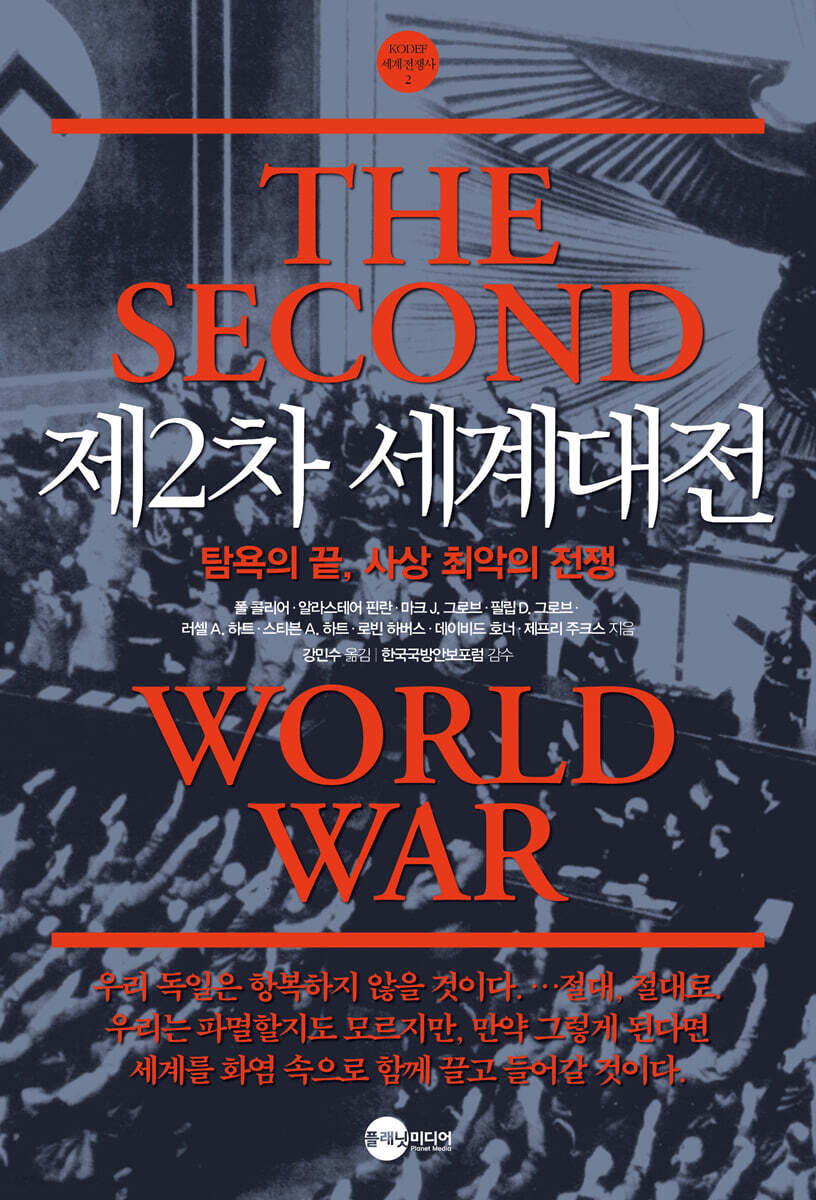
We, Germany, will not surrender.
… never, never.
We may be destroyed, but if we do, we will drag the world into flames together.
★
World War II, the 'Armageddon of the 20th century'
An objective and in-depth look at the tragic human tragedy as a single entity.
The essence of World War II history!
★
A balanced history of World War II, not biased to either side
World War II, which was described as “the greatest and worst war of the 20th century” and “a major event that changed the political, military, economic, and social landscape of the world,” left deep scars on many people, to the point that it continues to be the subject of numerous books and films even though it has been over 80 years since the war ended.
World War II, as the name suggests, was the largest and worst war of the 20th century, with over 56 countries participating in the conflict across five oceans and six continents, and 55 million casualties.
Moreover, with the end of the war, many colonies gained independence from colonial empires such as Britain, France, and Italy, and with the emergence of the United States and the Soviet Union, the victors of World War II, as the two superpowers, the world map shifted to the Cold War system where capitalism and communism were at odds. Within this, South Korea was divided into South and North, a situation that has persisted to this day.
In this way, World War II was a tremendous historical event that changed many things around the world.
Therefore, it is not easy for even the most excellent military historian to objectively and in detail view the entire vast history of World War II.
Looking at books on World War II published in Korea to date, it is common to find cases where the author's historical narrative is biased, resulting in a lack of objectivity, or where the narrative focuses on one side of the conflict, especially the European front.
This book is a translation of 『The Second World War』 (published in 2004) from the Essential Histories series by Osprey, a world-renowned military publisher in the UK. Nine world-renowned researchers who have studied each theater of World War II objectively and in-depthly examine the European Front, the War at Sea, the Mediterranean Front, the Pacific War, the Eastern Front, and the Northwestern European Front, sufficient to satisfy the regrets readers have felt so far (problems with objectivity, biased selection of historical materials, and descriptions that are biased toward one theater).
As I also noted in this book, “From a military perspective, the most important events of World War II were the battles between the German and Soviet armies.
Between 1941 and 1945, 29 million Soviet citizens died in battles, mainly on Russian territory, while 80 percent of all German casualties occurred on the Eastern Front.” The Eastern Front was thus instrumental in the collapse of the Nazi regime.
Readers who have been disappointed by the lack of attention paid to the Eastern Front or the Pacific War in World War II history will be satisfied with this book, which covers both the Eastern Front and the Pacific War in detail.
A true history of war that captures both the macro and micro aspects of World War II.
This book is broadly divided into the European Front (1939-1943), the War at Sea, the Mediterranean Front (1940-1945), the Pacific War, the Eastern Front (1941-1945), and the Northwest European Front (1944-1945). It explains the background that made the war inevitable and the political, military, economic, and social situations of the participating countries at the time in an easy-to-understand manner, and conveys in detail the major operational plans and battle developments that took place on each front.
And finally, by covering in detail the impact of World War II on the world after its end, it provides an opportunity to reflect on the meaning World War II holds for us today.
In addition, this book details the complex and subtle relationships and the war of nerves between Churchill, the Prime Minister of the British Empire, which was gradually losing its former power; Roosevelt, the President of the United States, who initially took a neutral stance but then decided to enter the war by emphasizing its formidable industrial capabilities; Hitler of Germany, who started the war with the delusion of proving the superiority of the Germanic race, destroying competing races and ideologies, and unifying Europe under German leadership; Stalin, the dictator of the Soviet Union, who initially sided with Germany for his own interests but then switched to the Allies; Mussolini of Italy, who distrusted Hitler and had no will to fight but joined hands with Hitler only to easily reap the fruits of victory; and Hideki Tojo, who signed the Tripartite Pact with Germany and Italy and attempted to establish a new order called the Greater East Asia Co-Prosperity Sphere in Asia.
It is quite interesting as it explains in detail the inside story of difficult-to-understand events such as the situation in which the Allies had no choice but to join hands with Stalin, a dictator of equal brutality, in order to eliminate Hitler, a Nazi whom Churchill defined as an absolute evil; how Hitler and Stalin, who could be said to have an ideologically like-minded relationship, once formed an alliance; and how Hitler and Mussolini formed the Axis alliance despite not trusting each other.
This book also examines in detail the background of how Germany was able to secretly build up its military power despite losing a lot of territory and facing significant military restrictions due to the Treaty of Versailles after the end of World War I; how the German army was able to effectively lead the war in the early stages of the war by utilizing a mission-based command system and wireless communication; how Britain and France, despite having an advantage in tanks, failed to utilize them properly and were forced into a blitzkrieg led by Germany's tanks; the strategies of the Allied and Axis leaders and their secret struggles; the role of Britain's Ultra codebreakers in countering Germany's Enigma code; the information warfare between the United States and Japan; the espionage warfare utilizing German and Soviet informants; and how technological advancements at the time affected the war.
And the unique feature of this book is that at the end of each chapter, it includes the voices and records of soldiers who actually had to fight with guns on the battlefield where life and death were intertwined, and of citizens who stayed in their homeland and sacrificed everything for their country's war effort, allowing individuals to take a close look at the war they experienced with their whole bodies.
This book vividly conveys the horror and devastation of war through the testimonies of those who experienced it.
In addition, this book includes 240 vivid photographs that capture the situation at the time, 68 detailed maps depicting major operations and battle situations, and a chronological table that provides a clear overview of the history of World War II, helping readers understand the situation.
To better understand the background of World War II, it would be helpful to read World War I: The War to End All Wars (Planet Media).
The implications of World War II for us in an age when peace is far away
History is like the flow of a great river; it does not stop at events that once existed, but flows and flows, influencing the present and even the future.
Just 20 years after the end of World War I, which seemed to end all wars, World War II broke out, shattered countless records set by World War I.
And even now, somewhere in the world, there is a war going on.
According to an American researcher, seven of the top ten bestselling books in the New York Times in 2002 were related to World War II, which took place between 1939 and 1945.
Why is there such a strong fascination with World War II? Will the world's fascination with this period ever wane? We should hope that it doesn't.
This period is a source of never-ending moral, military, and political lessons for us, and if we forget the lessons of World War II, the worst disaster the world has ever experienced, we may face even more horrific events in the future.
This book goes beyond simply explaining World War II, a catastrophe in human history, as a historical event. It asks what meaning it holds for us in an age when peace is still a distant prospect, and makes us reflect on that meaning.
… never, never.
We may be destroyed, but if we do, we will drag the world into flames together.
★
World War II, the 'Armageddon of the 20th century'
An objective and in-depth look at the tragic human tragedy as a single entity.
The essence of World War II history!
★
A balanced history of World War II, not biased to either side
World War II, which was described as “the greatest and worst war of the 20th century” and “a major event that changed the political, military, economic, and social landscape of the world,” left deep scars on many people, to the point that it continues to be the subject of numerous books and films even though it has been over 80 years since the war ended.
World War II, as the name suggests, was the largest and worst war of the 20th century, with over 56 countries participating in the conflict across five oceans and six continents, and 55 million casualties.
Moreover, with the end of the war, many colonies gained independence from colonial empires such as Britain, France, and Italy, and with the emergence of the United States and the Soviet Union, the victors of World War II, as the two superpowers, the world map shifted to the Cold War system where capitalism and communism were at odds. Within this, South Korea was divided into South and North, a situation that has persisted to this day.
In this way, World War II was a tremendous historical event that changed many things around the world.
Therefore, it is not easy for even the most excellent military historian to objectively and in detail view the entire vast history of World War II.
Looking at books on World War II published in Korea to date, it is common to find cases where the author's historical narrative is biased, resulting in a lack of objectivity, or where the narrative focuses on one side of the conflict, especially the European front.
This book is a translation of 『The Second World War』 (published in 2004) from the Essential Histories series by Osprey, a world-renowned military publisher in the UK. Nine world-renowned researchers who have studied each theater of World War II objectively and in-depthly examine the European Front, the War at Sea, the Mediterranean Front, the Pacific War, the Eastern Front, and the Northwestern European Front, sufficient to satisfy the regrets readers have felt so far (problems with objectivity, biased selection of historical materials, and descriptions that are biased toward one theater).
As I also noted in this book, “From a military perspective, the most important events of World War II were the battles between the German and Soviet armies.
Between 1941 and 1945, 29 million Soviet citizens died in battles, mainly on Russian territory, while 80 percent of all German casualties occurred on the Eastern Front.” The Eastern Front was thus instrumental in the collapse of the Nazi regime.
Readers who have been disappointed by the lack of attention paid to the Eastern Front or the Pacific War in World War II history will be satisfied with this book, which covers both the Eastern Front and the Pacific War in detail.
A true history of war that captures both the macro and micro aspects of World War II.
This book is broadly divided into the European Front (1939-1943), the War at Sea, the Mediterranean Front (1940-1945), the Pacific War, the Eastern Front (1941-1945), and the Northwest European Front (1944-1945). It explains the background that made the war inevitable and the political, military, economic, and social situations of the participating countries at the time in an easy-to-understand manner, and conveys in detail the major operational plans and battle developments that took place on each front.
And finally, by covering in detail the impact of World War II on the world after its end, it provides an opportunity to reflect on the meaning World War II holds for us today.
In addition, this book details the complex and subtle relationships and the war of nerves between Churchill, the Prime Minister of the British Empire, which was gradually losing its former power; Roosevelt, the President of the United States, who initially took a neutral stance but then decided to enter the war by emphasizing its formidable industrial capabilities; Hitler of Germany, who started the war with the delusion of proving the superiority of the Germanic race, destroying competing races and ideologies, and unifying Europe under German leadership; Stalin, the dictator of the Soviet Union, who initially sided with Germany for his own interests but then switched to the Allies; Mussolini of Italy, who distrusted Hitler and had no will to fight but joined hands with Hitler only to easily reap the fruits of victory; and Hideki Tojo, who signed the Tripartite Pact with Germany and Italy and attempted to establish a new order called the Greater East Asia Co-Prosperity Sphere in Asia.
It is quite interesting as it explains in detail the inside story of difficult-to-understand events such as the situation in which the Allies had no choice but to join hands with Stalin, a dictator of equal brutality, in order to eliminate Hitler, a Nazi whom Churchill defined as an absolute evil; how Hitler and Stalin, who could be said to have an ideologically like-minded relationship, once formed an alliance; and how Hitler and Mussolini formed the Axis alliance despite not trusting each other.
This book also examines in detail the background of how Germany was able to secretly build up its military power despite losing a lot of territory and facing significant military restrictions due to the Treaty of Versailles after the end of World War I; how the German army was able to effectively lead the war in the early stages of the war by utilizing a mission-based command system and wireless communication; how Britain and France, despite having an advantage in tanks, failed to utilize them properly and were forced into a blitzkrieg led by Germany's tanks; the strategies of the Allied and Axis leaders and their secret struggles; the role of Britain's Ultra codebreakers in countering Germany's Enigma code; the information warfare between the United States and Japan; the espionage warfare utilizing German and Soviet informants; and how technological advancements at the time affected the war.
And the unique feature of this book is that at the end of each chapter, it includes the voices and records of soldiers who actually had to fight with guns on the battlefield where life and death were intertwined, and of citizens who stayed in their homeland and sacrificed everything for their country's war effort, allowing individuals to take a close look at the war they experienced with their whole bodies.
This book vividly conveys the horror and devastation of war through the testimonies of those who experienced it.
In addition, this book includes 240 vivid photographs that capture the situation at the time, 68 detailed maps depicting major operations and battle situations, and a chronological table that provides a clear overview of the history of World War II, helping readers understand the situation.
To better understand the background of World War II, it would be helpful to read World War I: The War to End All Wars (Planet Media).
The implications of World War II for us in an age when peace is far away
History is like the flow of a great river; it does not stop at events that once existed, but flows and flows, influencing the present and even the future.
Just 20 years after the end of World War I, which seemed to end all wars, World War II broke out, shattered countless records set by World War I.
And even now, somewhere in the world, there is a war going on.
According to an American researcher, seven of the top ten bestselling books in the New York Times in 2002 were related to World War II, which took place between 1939 and 1945.
Why is there such a strong fascination with World War II? Will the world's fascination with this period ever wane? We should hope that it doesn't.
This period is a source of never-ending moral, military, and political lessons for us, and if we forget the lessons of World War II, the worst disaster the world has ever experienced, we may face even more horrific events in the future.
This book goes beyond simply explaining World War II, a catastrophe in human history, as a historical event. It asks what meaning it holds for us in an age when peace is still a distant prospect, and makes us reflect on that meaning.
GOODS SPECIFICS
- Date of issue: November 13, 2024
- Page count, weight, size: 952 pages | 153*224*40mm
- ISBN13: 9791187822899
- ISBN10: 1187822892
You may also like
카테고리
korean


korean

![GQ KOREA Mark (Monthly): December [2025]](http://librairie.coreenne.fr/cdn/shop/files/8ef265dbbfbf186523ed75ba7319009d.jpg?v=1765340328&width=3840)


