

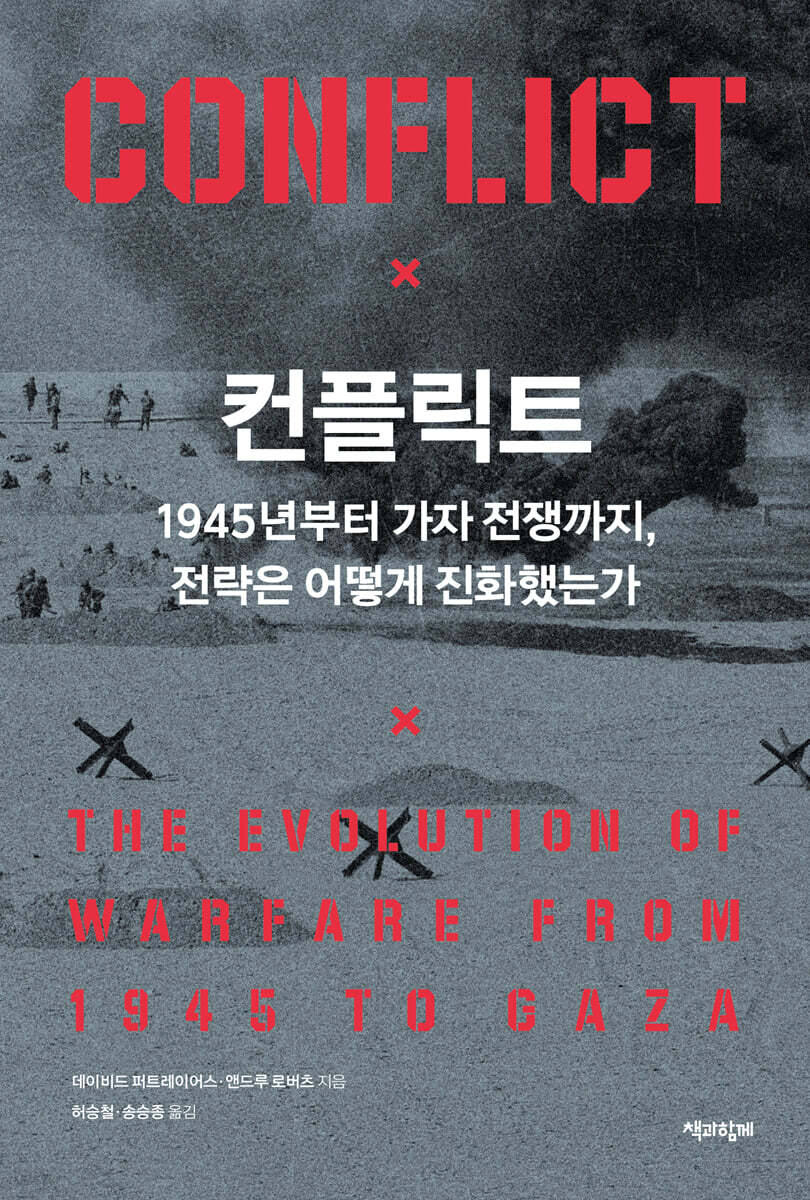
Conflict
 |
Description
Book Introduction
- A word from MD
-
A History of Modern Warfare Through StrategyAfter the advent of the atomic bomb in 1945, war entered a new trajectory.
The importance of strategy has been further highlighted, and it has become a key factor in determining victory or defeat.
From the Chinese Civil War to the Russo-Ukrainian War and the conflict in the Gaza Strip, this book retraces the history of modern warfare, offering a new milestone in understanding modern warfare.
November 29, 2024. History PD Ahn Hyun-jae
The History of Modern Warfare from the Perspective of the 'Evolution of Strategy'
Which strategies succeed and which fail on the battlefield?
With the outbreak of the 2022 Russia-Ukraine War, the 2023 Israel-Hamas War, and the 2024 Israel-Hezbollah War, insight into how wars are fought in the 21st century is urgently needed.
The 19th-century Prussian military thinker Carl von Clausewitz described war as “politics by other means,” and just as politics did not end after 1945, war did not disappear either.
Somewhere on earth, conflict continues, and so war remains worthy of deep study.
Conflict is the result of a keen analysis of the evolution of war over the past 80 years, from World War II to the Gaza War, by renowned American military strategist David Petraeus and renowned British military historian Andrew Roberts.
By analyzing all the factors that influence the outcome of war, including the emergence of new military technologies and weapons, military training, military doctrine, conspiracies, alliances, the role of non-commissioned officers, and information competition, it derives the characteristics of strategies that determine success or failure.
This book, which points out what leaders have overlooked in recent wars and provides insightful predictions about the nature of future wars, is a must-read for understanding modern warfare.
Which strategies succeed and which fail on the battlefield?
With the outbreak of the 2022 Russia-Ukraine War, the 2023 Israel-Hamas War, and the 2024 Israel-Hezbollah War, insight into how wars are fought in the 21st century is urgently needed.
The 19th-century Prussian military thinker Carl von Clausewitz described war as “politics by other means,” and just as politics did not end after 1945, war did not disappear either.
Somewhere on earth, conflict continues, and so war remains worthy of deep study.
Conflict is the result of a keen analysis of the evolution of war over the past 80 years, from World War II to the Gaza War, by renowned American military strategist David Petraeus and renowned British military historian Andrew Roberts.
By analyzing all the factors that influence the outcome of war, including the emergence of new military technologies and weapons, military training, military doctrine, conspiracies, alliances, the role of non-commissioned officers, and information competition, it derives the characteristics of strategies that determine success or failure.
This book, which points out what leaders have overlooked in recent wars and provides insightful predictions about the nature of future wars, is a must-read for understanding modern warfare.
- You can preview some of the book's contents.
Preview
index
introduction
Chapter 1: The Death of the Dream of Peace 1945-1953
Chapter 2: The Decolonization War 1947–1975
Chapter 3: The Vietnam War, 1964–1975
Chapter 4: From the Sinai Peninsula to the Falkland Islands, 1967–1982
Chapter 5: The End of the Cold War 1979–1993
Chapter 6: The New World Disorder 1991-1999
Chapter 7: The Afghanistan War 2001–2021
Chapter 8: The Iraq War, 2003–2011
Chapter 9: Putin and Ukraine's War for Survival 2022-
Chapter 10 Israel and the Gaza Strip 2023-
Chapter 11: The War of the Future
Acknowledgements
Translator's Note
map
References
main
Search
Chapter 1: The Death of the Dream of Peace 1945-1953
Chapter 2: The Decolonization War 1947–1975
Chapter 3: The Vietnam War, 1964–1975
Chapter 4: From the Sinai Peninsula to the Falkland Islands, 1967–1982
Chapter 5: The End of the Cold War 1979–1993
Chapter 6: The New World Disorder 1991-1999
Chapter 7: The Afghanistan War 2001–2021
Chapter 8: The Iraq War, 2003–2011
Chapter 9: Putin and Ukraine's War for Survival 2022-
Chapter 10 Israel and the Gaza Strip 2023-
Chapter 11: The War of the Future
Acknowledgements
Translator's Note
map
References
main
Search
Detailed image
.jpg)
Into the book
Despite the profusion of books addressing the war's political, economic, and geopolitical contexts following Russia's invasion of Ukraine, we found that there was little literature addressing it in a military historical context.
In a world where vast amounts of money and energy are being invested in developing precision weapons and smart bombs, Russia has deliberately adopted a brutal World War II-style—or, in some areas of Donbas, World War I-style—war style.
Given the significant advancements in military strategy and tactics since 1945, and the diverse ways in which each war offers lessons, as the following chapters will explore, how can we explain Russia's choice of a regressive battle that evokes the Great Patriotic War (the Russian term for World War II), except this time Russia was the aggressor, not the victim?
---From the "Preface"
MacArthur's central problem in the Korean War was that he ultimately misconceived the "big picture" of the war, the most important and essential quality of a strategic leader.
His grand plan was that the United States' superior firepower would defeat the North Korean army with relative ease, and that even if the Chinese sent reinforcements across the Yalu River to aid the North, they could still deal with them.
He had no advisors around him to challenge these two fundamentally wrong beliefs.
It didn't help that he commanded the war from Tokyo, 965 kilometers from the battlefield, and rarely visited Korea.
The best-proven lesson of war is that commanders need not necessarily be at the front lines, but at least be in the country where they are fighting.
---From "Chapter 1: The Death of the Dream of Peace"
The war of 1948 remains one of the wars of the late 1940s that shaped the future of the world to this day.
“Israel was born in battle.
“That army was forged in the flames of conflict and the subsequent struggle for survival, which has been the hallmark of the state since its founding,” said Chaim Herzog, who served as head of intelligence for the Israel Defense Forces (IDF) during the War of Independence and would later become Israel’s president.
But, according to Marshal Michael Carver, the war was "unprecise" compared to the highly precise military power that made Israel famous.
This is because the war was fought against the backdrop of a ceasefire called for by the UN General Assembly resolution.
So both sides tried to quickly seize as much territory as possible to use as bargaining chips in case a ceasefire was implemented.
---From "Chapter 2: The Decolonization War"
The defeat in the Vietnam War was a huge blow to the United States.
A "Vietnam no more" sentiment was created that would haunt American military thinking about the use of force for the next 30 years.
The mistaken belief that the US military should not accept demands for such wars unless it enhances its ability to conduct counterinsurgency operations diminished its ability to do so for decades after the Vietnam withdrawal and through the interventions in Iraq and Afghanistan.
However, a thorough investigation into all of America's actions during the Vietnam War led to substantial reforms in many areas of the US military.
---From "Chapter 3: The Vietnam War"
But even if the airstrikes against the hospital had a tactical justification, they were portrayed horribly in newspaper headlines, TV reports, social media posts, and memes, and as the operation continued, Israel suffered repeated defeats in the court of international opinion.
At one point, for every pro-Israel video viewed on TikTok in the US, there were more than 50 pro-Palestinian videos viewed.
In the UK, the figure is even higher, at a ratio of 1 to 65.
For those aged 12-15, TikTok was the single most used news source, followed by YouTube and Instagram.
Anti-Semitic incidents have increased as the global media has overwhelmingly reported on anti-Israel issues.
In the UK alone, for example, there was an increase of more than 400 percent year-on-year.
In a world where vast amounts of money and energy are being invested in developing precision weapons and smart bombs, Russia has deliberately adopted a brutal World War II-style—or, in some areas of Donbas, World War I-style—war style.
Given the significant advancements in military strategy and tactics since 1945, and the diverse ways in which each war offers lessons, as the following chapters will explore, how can we explain Russia's choice of a regressive battle that evokes the Great Patriotic War (the Russian term for World War II), except this time Russia was the aggressor, not the victim?
---From the "Preface"
MacArthur's central problem in the Korean War was that he ultimately misconceived the "big picture" of the war, the most important and essential quality of a strategic leader.
His grand plan was that the United States' superior firepower would defeat the North Korean army with relative ease, and that even if the Chinese sent reinforcements across the Yalu River to aid the North, they could still deal with them.
He had no advisors around him to challenge these two fundamentally wrong beliefs.
It didn't help that he commanded the war from Tokyo, 965 kilometers from the battlefield, and rarely visited Korea.
The best-proven lesson of war is that commanders need not necessarily be at the front lines, but at least be in the country where they are fighting.
---From "Chapter 1: The Death of the Dream of Peace"
The war of 1948 remains one of the wars of the late 1940s that shaped the future of the world to this day.
“Israel was born in battle.
“That army was forged in the flames of conflict and the subsequent struggle for survival, which has been the hallmark of the state since its founding,” said Chaim Herzog, who served as head of intelligence for the Israel Defense Forces (IDF) during the War of Independence and would later become Israel’s president.
But, according to Marshal Michael Carver, the war was "unprecise" compared to the highly precise military power that made Israel famous.
This is because the war was fought against the backdrop of a ceasefire called for by the UN General Assembly resolution.
So both sides tried to quickly seize as much territory as possible to use as bargaining chips in case a ceasefire was implemented.
---From "Chapter 2: The Decolonization War"
The defeat in the Vietnam War was a huge blow to the United States.
A "Vietnam no more" sentiment was created that would haunt American military thinking about the use of force for the next 30 years.
The mistaken belief that the US military should not accept demands for such wars unless it enhances its ability to conduct counterinsurgency operations diminished its ability to do so for decades after the Vietnam withdrawal and through the interventions in Iraq and Afghanistan.
However, a thorough investigation into all of America's actions during the Vietnam War led to substantial reforms in many areas of the US military.
---From "Chapter 3: The Vietnam War"
But even if the airstrikes against the hospital had a tactical justification, they were portrayed horribly in newspaper headlines, TV reports, social media posts, and memes, and as the operation continued, Israel suffered repeated defeats in the court of international opinion.
At one point, for every pro-Israel video viewed on TikTok in the US, there were more than 50 pro-Palestinian videos viewed.
In the UK, the figure is even higher, at a ratio of 1 to 65.
For those aged 12-15, TikTok was the single most used news source, followed by YouTube and Instagram.
Anti-Semitic incidents have increased as the global media has overwhelmingly reported on anti-Israel issues.
In the UK alone, for example, there was an increase of more than 400 percent year-on-year.
---From "Chapter 10 Israel and the Gaza Strip"
Publisher's Review
New York Times, Publisher's Weekly, and Amazon bestseller
Book of the Year by The Critic, Aspects of History, and the Institute for Modern Warfare
The History of Modern Warfare from the Perspective of the 'Evolution of Strategy'
Which strategies succeed and which fail on the battlefield?
As the Russo-Ukrainian War, the first full-scale war between nations on the European continent since World War II, enters its third year, wars between Israel and Hamas and Israel and Hezbollah have erupted, and the possibility of an Israel-Iran war looms large, insight into how wars are fought in the 21st century has become increasingly urgent.
The 19th-century Prussian military thinker Carl von Clausewitz described war as “politics by other means,” and just as politics did not end after 1945, war did not disappear either.
Somewhere on earth, conflict continues, and so war remains worthy of deep study.
Conflict is the result of a keen analysis of the evolution of war over the past 80 years, from World War II to the Gaza War, by renowned American military strategist David Petraeus and renowned British military historian Andrew Roberts.
By analyzing all the factors that influence the outcome of war, including the emergence of new military technologies and weapons, military training, military doctrine, conspiracies, alliances, the role of non-commissioned officers, and information competition, it derives the characteristics of strategies that determine success or failure.
This book, which points out what leaders have overlooked in recent wars and provides insightful predictions about the nature of future wars, is a must-read for understanding modern warfare.
The ultimate collaboration between a star general and a master historian.
The author of this book, David Petraeus, is a star general who commanded the U.S.-led coalition forces in the Iraq and Afghanistan wars and established counterinsurgency doctrine.
He offers expert perspectives on political and military strategy in this book, and he wrote the entire chapter on the wars in Afghanistan and Iraq, drawing on his own experience participating in them.
Another author, Andrew Roberts, has made his mark on the academic world by studying the history of war with a cool-headed realist perspective for over 30 years.
In this book, Roberts delves deeply into the wars that have lasted nearly 80 years, drawing important insights and lessons.
This book, written by leading experts in two fields, each bringing their own unique expertise to bear, will present a new horizon for the study of modern warfare.
From 1945 to the recent Russo-Ukrainian War and the Gaza War,
A comprehensive overview of key modern warfare strategies that have influenced the evolution of warfare.
This book does not cover all the wars that have occurred since 1945, nor does it analyze the causes of the wars.
It only covers conflicts that have influenced the evolution of war, and also focuses only on what happens on the battlefield when war breaks out.
In other words, if a war showed any evolution in tactics, new weapons, or other ways, it was included in this book.
For example, the Yom Kippur War, which featured increased accuracy in anti-tank weapons, and the Gulf War, which employed large-scale tank assault tactics, were covered, but wars that taught the same strategic lessons as other wars or were merely guerrilla conflicts were not examined.
The Chinese Civil War, which opens the book, was a war that demonstrated that Mao Zedong's small guerrilla force could win against a Western-backed government.
The Korean War demonstrated that limited war could be waged even in the era of "mutually assured destruction" following the development of nuclear weapons, and it gave the United States a firsthand experience of the problems it would later face in Vietnam, Afghanistan, and Iraq: working with an undemocratic and unpopular government and fighting an underestimated enemy.
In addition, 28 modern wars that demonstrate the evolution of war are covered, including the Israeli War of Independence, where a desperate citizen army defeated a five-nation coalition; the Battle of Dien Bien Phu, where the Viet Minh forces, inspired by the doctrine of the Chinese army, overwhelmed the French army; the Six-Day War (the Third Middle East War), a classic surprise war; and the El Salvador Civil War, a typical example of a proxy war.
What failed leaders overlook
Four Challenges for Strategic Leaders
On November 19, 2024, the Russo-Ukrainian war escalated when Ukraine launched an attack on Russian soil.
The war launched by Putin in February 2022 deliberately chose World War II-style hostilities, with devastating consequences for both Ukraine and Russia.
By showing how war has evolved in various political contexts since 1945, the authors point out how regressive the Russo-Ukrainian War was, emphasizing above all the importance of strategic leadership.
Successful strategic leadership can turn even a hopeless situation for the better, but a failed strategy can turn even seemingly certain success into defeat.
The authors suggest four tasks that strategic leaders must accomplish:
First, we must grasp the overall strategic situation in war and draw up a 'big picture (grand strategy)' accordingly.
Second, we must communicate closely with all departments and stakeholders in the organization about the big picture.
Third, we must thoroughly and resolutely execute the global plan and supervise the implementation of the big picture.
Fourth, we must continuously repeat and perform the three tasks above while refining, adjusting, and politicizing the big picture.
Chiang Kai-shek in the Chinese Civil War, MacArthur in the Korean War, and the U.S. government in the Vietnam War, Afghanistan War, and Iraq War are examples of leadership failures.
These wars clearly demonstrate the irreversible consequences of leadership failures, whether they misjudge the bigger picture, overlook the importance of local popular sentiment, or overestimate the strength of one's own forces while underestimating that of the enemy.
There are also examples of outstanding strategic leadership that led to success, such as British General Templar, who set an example of counter-guerrilla warfare during the martial law crisis in the Malay Peninsula; Colonel John Akehurst and Sultan Qaboos of the Dhofar Rebellion, who achieved victory through the meeting of outstanding local leaders and military commanders; and the air strategy of the Kosovo War, which gave the Allied forces a casualty-free victory.
These examples of success and failure can teach future policymakers and military strategists what choices to make.
Predicting future war patterns through past wars
One of the most interesting sections in this book is the chapter on future warfare.
The economic sanctions, social media manipulation, and consumer activism that unfolded during the Russia-Ukraine War, as well as Israel's crushing defeat in the international court of public opinion during the Gaza War, provide clues to how future wars may unfold.
Just as Elon Musk was able to thwart Russian cyberattacks by providing Ukraine with the Starlink satellite internet system, the authors argue that individual tycoons like Mark Zuckerberg and Jeff Bezos could wield immense power in future wars.
Advances in technologies like artificial intelligence, robotics, deepfakes, and supercomputing mean future wars are likely to be fought in new dimensions, such as space and virtual space.
This book presents a fascinating look at many of the elements of future warfare analyzed by the authors, including the mass use of low-cost drones, targeted attacks on social infrastructure, the power of social media, and the support of external forces.
Book of the Year by The Critic, Aspects of History, and the Institute for Modern Warfare
The History of Modern Warfare from the Perspective of the 'Evolution of Strategy'
Which strategies succeed and which fail on the battlefield?
As the Russo-Ukrainian War, the first full-scale war between nations on the European continent since World War II, enters its third year, wars between Israel and Hamas and Israel and Hezbollah have erupted, and the possibility of an Israel-Iran war looms large, insight into how wars are fought in the 21st century has become increasingly urgent.
The 19th-century Prussian military thinker Carl von Clausewitz described war as “politics by other means,” and just as politics did not end after 1945, war did not disappear either.
Somewhere on earth, conflict continues, and so war remains worthy of deep study.
Conflict is the result of a keen analysis of the evolution of war over the past 80 years, from World War II to the Gaza War, by renowned American military strategist David Petraeus and renowned British military historian Andrew Roberts.
By analyzing all the factors that influence the outcome of war, including the emergence of new military technologies and weapons, military training, military doctrine, conspiracies, alliances, the role of non-commissioned officers, and information competition, it derives the characteristics of strategies that determine success or failure.
This book, which points out what leaders have overlooked in recent wars and provides insightful predictions about the nature of future wars, is a must-read for understanding modern warfare.
The ultimate collaboration between a star general and a master historian.
The author of this book, David Petraeus, is a star general who commanded the U.S.-led coalition forces in the Iraq and Afghanistan wars and established counterinsurgency doctrine.
He offers expert perspectives on political and military strategy in this book, and he wrote the entire chapter on the wars in Afghanistan and Iraq, drawing on his own experience participating in them.
Another author, Andrew Roberts, has made his mark on the academic world by studying the history of war with a cool-headed realist perspective for over 30 years.
In this book, Roberts delves deeply into the wars that have lasted nearly 80 years, drawing important insights and lessons.
This book, written by leading experts in two fields, each bringing their own unique expertise to bear, will present a new horizon for the study of modern warfare.
From 1945 to the recent Russo-Ukrainian War and the Gaza War,
A comprehensive overview of key modern warfare strategies that have influenced the evolution of warfare.
This book does not cover all the wars that have occurred since 1945, nor does it analyze the causes of the wars.
It only covers conflicts that have influenced the evolution of war, and also focuses only on what happens on the battlefield when war breaks out.
In other words, if a war showed any evolution in tactics, new weapons, or other ways, it was included in this book.
For example, the Yom Kippur War, which featured increased accuracy in anti-tank weapons, and the Gulf War, which employed large-scale tank assault tactics, were covered, but wars that taught the same strategic lessons as other wars or were merely guerrilla conflicts were not examined.
The Chinese Civil War, which opens the book, was a war that demonstrated that Mao Zedong's small guerrilla force could win against a Western-backed government.
The Korean War demonstrated that limited war could be waged even in the era of "mutually assured destruction" following the development of nuclear weapons, and it gave the United States a firsthand experience of the problems it would later face in Vietnam, Afghanistan, and Iraq: working with an undemocratic and unpopular government and fighting an underestimated enemy.
In addition, 28 modern wars that demonstrate the evolution of war are covered, including the Israeli War of Independence, where a desperate citizen army defeated a five-nation coalition; the Battle of Dien Bien Phu, where the Viet Minh forces, inspired by the doctrine of the Chinese army, overwhelmed the French army; the Six-Day War (the Third Middle East War), a classic surprise war; and the El Salvador Civil War, a typical example of a proxy war.
What failed leaders overlook
Four Challenges for Strategic Leaders
On November 19, 2024, the Russo-Ukrainian war escalated when Ukraine launched an attack on Russian soil.
The war launched by Putin in February 2022 deliberately chose World War II-style hostilities, with devastating consequences for both Ukraine and Russia.
By showing how war has evolved in various political contexts since 1945, the authors point out how regressive the Russo-Ukrainian War was, emphasizing above all the importance of strategic leadership.
Successful strategic leadership can turn even a hopeless situation for the better, but a failed strategy can turn even seemingly certain success into defeat.
The authors suggest four tasks that strategic leaders must accomplish:
First, we must grasp the overall strategic situation in war and draw up a 'big picture (grand strategy)' accordingly.
Second, we must communicate closely with all departments and stakeholders in the organization about the big picture.
Third, we must thoroughly and resolutely execute the global plan and supervise the implementation of the big picture.
Fourth, we must continuously repeat and perform the three tasks above while refining, adjusting, and politicizing the big picture.
Chiang Kai-shek in the Chinese Civil War, MacArthur in the Korean War, and the U.S. government in the Vietnam War, Afghanistan War, and Iraq War are examples of leadership failures.
These wars clearly demonstrate the irreversible consequences of leadership failures, whether they misjudge the bigger picture, overlook the importance of local popular sentiment, or overestimate the strength of one's own forces while underestimating that of the enemy.
There are also examples of outstanding strategic leadership that led to success, such as British General Templar, who set an example of counter-guerrilla warfare during the martial law crisis in the Malay Peninsula; Colonel John Akehurst and Sultan Qaboos of the Dhofar Rebellion, who achieved victory through the meeting of outstanding local leaders and military commanders; and the air strategy of the Kosovo War, which gave the Allied forces a casualty-free victory.
These examples of success and failure can teach future policymakers and military strategists what choices to make.
Predicting future war patterns through past wars
One of the most interesting sections in this book is the chapter on future warfare.
The economic sanctions, social media manipulation, and consumer activism that unfolded during the Russia-Ukraine War, as well as Israel's crushing defeat in the international court of public opinion during the Gaza War, provide clues to how future wars may unfold.
Just as Elon Musk was able to thwart Russian cyberattacks by providing Ukraine with the Starlink satellite internet system, the authors argue that individual tycoons like Mark Zuckerberg and Jeff Bezos could wield immense power in future wars.
Advances in technologies like artificial intelligence, robotics, deepfakes, and supercomputing mean future wars are likely to be fought in new dimensions, such as space and virtual space.
This book presents a fascinating look at many of the elements of future warfare analyzed by the authors, including the mass use of low-cost drones, targeted attacks on social infrastructure, the power of social media, and the support of external forces.
GOODS SPECIFICS
- Date of issue: November 25, 2024
- Page count, weight, size: 760 pages | 1,080g | 152*225*37mm
- ISBN13: 9791192913896
- ISBN10: 1192913892
You may also like
카테고리
korean


korean

![GQ KOREA Mark (Monthly): December [2025]](http://librairie.coreenne.fr/cdn/shop/files/8ef265dbbfbf186523ed75ba7319009d.jpg?v=1765340328&width=3840)


