

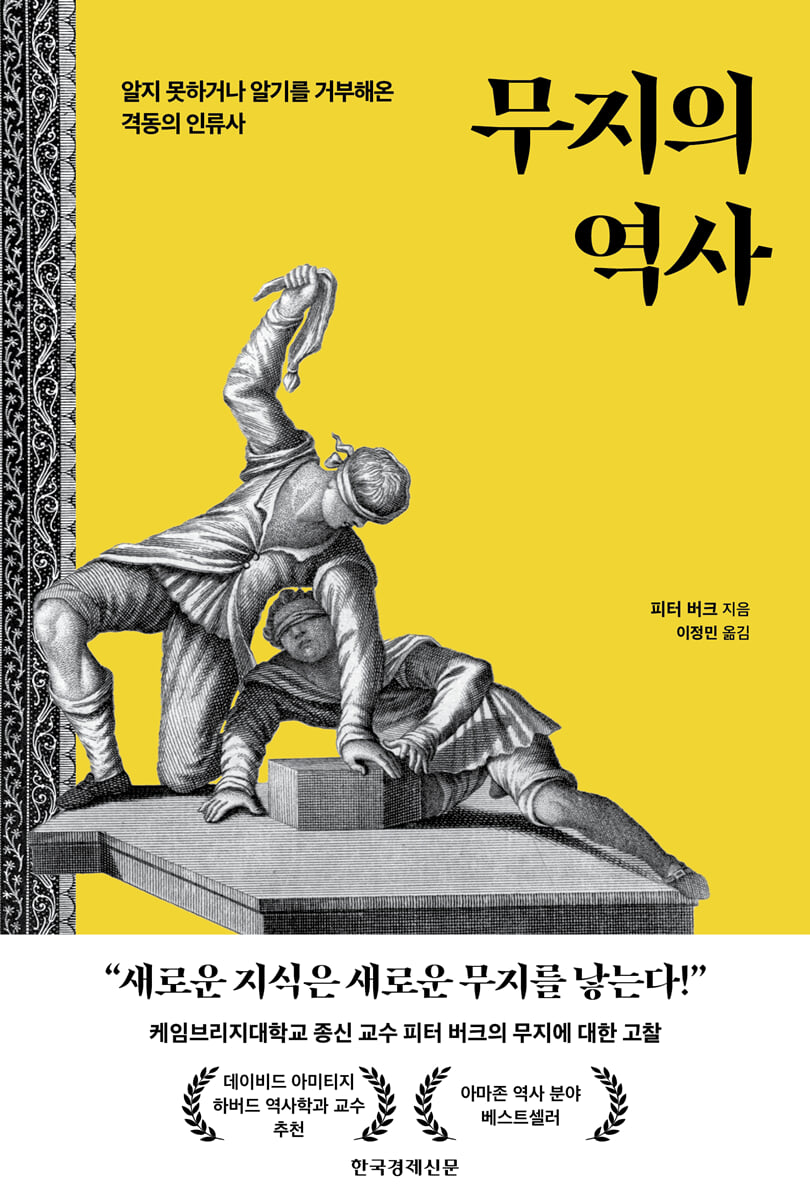
History of ignorance
 |
Description
Book Introduction
*Recommended by David Armitage, Professor of History at Harvard*
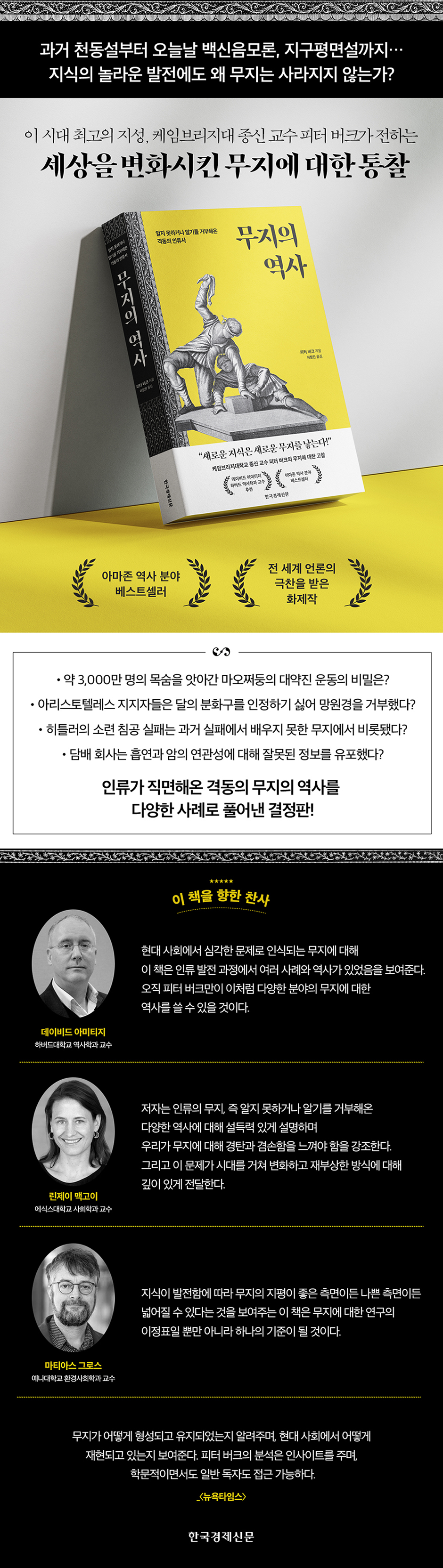
Flat Earth theory, vaccine conspiracy theory still believed by many people…
Can we really say that we are not more ignorant than humans in the past?
Peter Burke, a lifetime professor at Cambridge University
A Historical Reflection on Ignorance and the Progress of Humanity
Every age has thought that its own was richer in knowledge than the previous age.
Renaissance humanists viewed the Middle Ages as a dark age, Enlightenment thinkers sought to sweep away superstition with reason, and modern states sought to eliminate the giant of ignorance.
And in today's Internet age, information is readily available whenever you need it.
But are we really less ignorant than past humans?
Peter Burke, a lifetime professor at Cambridge University and one of the greatest intellectuals of our time who has captivated millions of readers around the world with works such as Cultural Hybridity, Polymaths, and The Social History of Knowledge, has written a new book exploring the history of human ignorance.
A History of Ignorance explores the origins of ignorance, the role society plays in exploiting it, and how ignorance may not simply be incompetence but may sometimes be a deliberate or even inevitable choice.
In this book, he presents a remarkable account of ignorance in its many forms, spanning religion and science, war and politics, business and disaster.
In particular, it addresses ignorance in various historical contexts, from the Black Death in the past to climate change in the present, and explains how ignorance was formed, maintained, and even exploited for specific purposes in each era and society.
Flat Earth theory, vaccine conspiracy theory still believed by many people…
Can we really say that we are not more ignorant than humans in the past?
Peter Burke, a lifetime professor at Cambridge University
A Historical Reflection on Ignorance and the Progress of Humanity
Every age has thought that its own was richer in knowledge than the previous age.
Renaissance humanists viewed the Middle Ages as a dark age, Enlightenment thinkers sought to sweep away superstition with reason, and modern states sought to eliminate the giant of ignorance.
And in today's Internet age, information is readily available whenever you need it.
But are we really less ignorant than past humans?
Peter Burke, a lifetime professor at Cambridge University and one of the greatest intellectuals of our time who has captivated millions of readers around the world with works such as Cultural Hybridity, Polymaths, and The Social History of Knowledge, has written a new book exploring the history of human ignorance.
A History of Ignorance explores the origins of ignorance, the role society plays in exploiting it, and how ignorance may not simply be incompetence but may sometimes be a deliberate or even inevitable choice.
In this book, he presents a remarkable account of ignorance in its many forms, spanning religion and science, war and politics, business and disaster.
In particular, it addresses ignorance in various historical contexts, from the Black Death in the past to climate change in the present, and explains how ignorance was formed, maintained, and even exploited for specific purposes in each era and society.
- You can preview some of the book's contents.
Preview
index
Entering_On the unknown realm of ignorance
Part 1: Ignorance of Society
Chapter 1 What is ignorance?
Chapter 2: Philosophers' Views on Ignorance
Chapter 3: Group Ignorance
Chapter 4: The Study of Ignorance
Chapter 5: The History of Ignorance
Chapter 6: Ignorance of Religion
Chapter 7: Ignorance of Science
Chapter 8: Ignorance of Geography
Part 2: The Consequences of Ignorance
Chapter 9: The Ignorance of War
Chapter 10: Ignorance in Business
Chapter 11: Ignorance of Politics
Chapter 12: Surprises and Calamities
Chapter 13 Secrets and Lies
Chapter 14: An Uncertain Future
Chapter 15: Ignorance of the Past
Conclusion_New knowledge and new ignorance
Appendix_Glossary of Ignorant Terms
main
Part 1: Ignorance of Society
Chapter 1 What is ignorance?
Chapter 2: Philosophers' Views on Ignorance
Chapter 3: Group Ignorance
Chapter 4: The Study of Ignorance
Chapter 5: The History of Ignorance
Chapter 6: Ignorance of Religion
Chapter 7: Ignorance of Science
Chapter 8: Ignorance of Geography
Part 2: The Consequences of Ignorance
Chapter 9: The Ignorance of War
Chapter 10: Ignorance in Business
Chapter 11: Ignorance of Politics
Chapter 12: Surprises and Calamities
Chapter 13 Secrets and Lies
Chapter 14: An Uncertain Future
Chapter 15: Ignorance of the Past
Conclusion_New knowledge and new ignorance
Appendix_Glossary of Ignorant Terms
main
Detailed image
Into the book
If there is a sociology of knowledge, then there is also a sociology of ignorance.
A sociology of ignorance would begin with the question, 'Who does not know what?'
'We are all ignorant.
'The only difference is the object of ignorance.' Readers need to remember this famous quote by American novelist Mark Twain.
For example, there are over 6,000 languages spoken around the world today, yet even multilingual people don't know 99.9 percent of them.
As another example, epidemiologists predicted the spread of coronavirus by identifying the risk of various diseases jumping from wild animals to humans.
Yet, governments around the world were either unaware of this prediction or unwilling to know, leaving them defenseless against the pandemic.
---From Chapter 1: What is Ignorance?
Historians who study ignorance face a fundamental problem.
The question is how to study ‘nothingness.’
Social scientists can study ignorance by examining things like "voter ignorance," but how and where can we study the history of something that never existed in the first place?
---From "Chapter 5: The History of Ignorance"
In the 'dark corners' of early modern Europe, the situation was even more grim.
Some missionaries, when visiting certain areas, began asking questions that were much more difficult than those asked during a bishop's visit.
In the mid-17th century, in Eboli, southern Italy, several Jesuit missionaries met a group of shepherds. When the missionaries asked them, "How many gods do you know?", the shepherds gave answers ranging from a hundred to over a thousand.
---From "Chapter 6: Ignorance of Religion"
The blank spaces on the map created by outsiders were filled with imagination.
As I pointed out before, humans naturally hate blank spaces.
So, we collectively used our imaginations, born of curiosity, hope, and fear, to fill in the gaps, sometimes with rumors, sometimes with legends and myths.
A representative example is the 'monster race'.
The ancient Greeks and Romans believed that non-human races lived in distant parts of the world, such as Asia and Africa.
There are many different types, including the dog-headed Kynokephaloi, the Skiapodes with one huge foot, the Blemmyae with heads growing below their shoulders as depicted in Shakespeare's Othello, and the Plinian race, described in the encyclopedia Naturalis Historia by the ancient Roman Gaius Plinius Secundus.
---From "Chapter 8: Ignorance of Geography"
In the 17th century, during the era of absolute monarchy, when King Louis XIII of France ruled with the help of the powerful Cardinal Richelieu, Richelieu asserted with a tone no less cool than Machiavelli that while ignorance can be detrimental to a state, so too can knowledge.
For example, if farmers and agricultural workers are educated, it could ruin their crops and make conscription more difficult.
Moreover, if we educate everyone, we increase the number of people who can 'raise questions', but we do not have the ability to solve problems.
A sociology of ignorance would begin with the question, 'Who does not know what?'
'We are all ignorant.
'The only difference is the object of ignorance.' Readers need to remember this famous quote by American novelist Mark Twain.
For example, there are over 6,000 languages spoken around the world today, yet even multilingual people don't know 99.9 percent of them.
As another example, epidemiologists predicted the spread of coronavirus by identifying the risk of various diseases jumping from wild animals to humans.
Yet, governments around the world were either unaware of this prediction or unwilling to know, leaving them defenseless against the pandemic.
---From Chapter 1: What is Ignorance?
Historians who study ignorance face a fundamental problem.
The question is how to study ‘nothingness.’
Social scientists can study ignorance by examining things like "voter ignorance," but how and where can we study the history of something that never existed in the first place?
---From "Chapter 5: The History of Ignorance"
In the 'dark corners' of early modern Europe, the situation was even more grim.
Some missionaries, when visiting certain areas, began asking questions that were much more difficult than those asked during a bishop's visit.
In the mid-17th century, in Eboli, southern Italy, several Jesuit missionaries met a group of shepherds. When the missionaries asked them, "How many gods do you know?", the shepherds gave answers ranging from a hundred to over a thousand.
---From "Chapter 6: Ignorance of Religion"
The blank spaces on the map created by outsiders were filled with imagination.
As I pointed out before, humans naturally hate blank spaces.
So, we collectively used our imaginations, born of curiosity, hope, and fear, to fill in the gaps, sometimes with rumors, sometimes with legends and myths.
A representative example is the 'monster race'.
The ancient Greeks and Romans believed that non-human races lived in distant parts of the world, such as Asia and Africa.
There are many different types, including the dog-headed Kynokephaloi, the Skiapodes with one huge foot, the Blemmyae with heads growing below their shoulders as depicted in Shakespeare's Othello, and the Plinian race, described in the encyclopedia Naturalis Historia by the ancient Roman Gaius Plinius Secundus.
---From "Chapter 8: Ignorance of Geography"
In the 17th century, during the era of absolute monarchy, when King Louis XIII of France ruled with the help of the powerful Cardinal Richelieu, Richelieu asserted with a tone no less cool than Machiavelli that while ignorance can be detrimental to a state, so too can knowledge.
For example, if farmers and agricultural workers are educated, it could ruin their crops and make conscription more difficult.
Moreover, if we educate everyone, we increase the number of people who can 'raise questions', but we do not have the ability to solve problems.
---From "Chapter 11: Ignorance of Politics"
Publisher's Review
Why should we focus on ignorance now?
New knowledge breeds new ignorance!
An intellectual journey into the light and darkness of humanity, told by the greatest minds of our time.
Ignorance has played a significant role in human history, affecting almost everything from epidemics to wars and famines, from the collapse of empires to the collapse of financial systems.
While ignorance is sometimes caused by the public's lack of knowledge, there are also countless instances where the ruling class intentionally hides or distorts certain information to control the public or maintain their power.
There are also historical situations where knowledge has been limited by technological, economic, and social resource limitations.
Peter Burke takes us on an intellectual journey, providing a wealth of examples.
Part 1 examines the definition of ignorance and how research on ignorance has progressed, and explains its influence on religion, science, and geography.
And Part 2 focuses on the fundamental role and consequences of ignorance, from past to present, in war, business, politics, the environment, climate, and industry in general.
Vivid examples of ignorance can be found in many diseases.
From the plague that struck Asia and Europe in 1348-1349, the smallpox outbreak in Central and South America in the 1520s, the resurgence of plague in the 17th century, cholera in 19th-century Europe, the Spanish flu that spread globally in 1918, and even the recent coronavirus, doctors have been ignorant of the causes, transmission methods, prevention, and patient care of pandemics.
In the past, fear was heightened because contagion was invisible.
One of the main theories about the cause of the outbreak was that it was a disaster sent by the gods to punish people for their sins.
At that time, Europeans responded to the epidemic with faith.
People marched to appease God's wrath, sometimes even whipping themselves to prove their repentance.
However, crowded churches and street parades increased the likelihood of the disease spreading through physical contact.
This ignorance continued, with smallpox vaccinations being a subject of fierce debate until they were accepted in 18th-century Europe, and more recently, the coronavirus outbreak has sparked anti-vaccine movements in the United States and elsewhere around the world.
It's the same in war.
There have been many instances where politicians and generals have ignored past experience and made decisions that resulted in unfortunate outcomes.
Napoleon's failed invasion of Russia in 1812 and Hitler's failed invasion of the Soviet Union in 1941 stemmed from ignorance of Russian geography and weather, and the three invasions of Afghanistan by Britain in 1839, the Soviet Union in 1979, and the United States in 2001 also resulted from failure to learn from past mistakes, leading to the same mistakes being repeated.
There are also many instances where individuals or groups with specific knowledge have attempted to hide that knowledge from enemies, competitors, or the general public.
They hide information through disinformation, fake news, and cover-ups.
In the past, Europe censored books by designating a list of banned books, and in modern times, newspapers, political cartoons, and plays were suppressed.
Even in times of disaster, there are many cases where the government hides information.
For example, the Soviet government denied the Chernobyl disaster and then claimed it was a minor accident.
It was only after the collapse of the Soviet Union that secret KGB reports on negligence in the power plant's construction and the initial emergency came to light.
It is undeniable that the consequences of ignorance, whether intentional or unintentional, in every aspect of our lives are becoming increasingly evident.
“Ignorance is not simply a negative concept, but a complex social phenomenon!”
The power to turn new ignorance into opportunity
Since ancient times, ignorance has been criticized for various reasons and motives.
The biggest reason why individuals were ignorant in the past was because there was too little information circulating in society.
Some knowledge was recorded in manuscripts and hidden, and in some cases it has remained hidden until now due to the church or state's refusal to make it public.
Information overload is also a problem these days.
In the midst of a flood of information, individuals are unable to select the information they truly need. This condition is also called 'filtering failure.'
Ultimately, the information age is spreading ignorance as well as knowledge.
Peter Burke points out that it would be both humble and accurate to say that every age is an age of ignorance.
For the following three reasons:
First, the remarkable growth in collective knowledge over the past two centuries has not been reflected in the knowledge of most individuals.
Although humanity as a whole may have more knowledge than ever before, most individuals know only a little more than their ancestors.
Second, when new knowledge spreads, other knowledge often becomes lost.
As knowledge of global languages such as English, Spanish, Arabic, and Chinese increases, the rate of extinction of other languages is accelerating.
It is predicted that 50 to 90 percent of the world's approximately 7,000 languages will disappear before 2100.
Knowledge stored in the mind and passed down orally, like the tribes living in the Amazon region today, is at greater risk of disappearing.
When the elders of a small tribe die, the oral wisdom disappears with them.
Third, while the amount of information has increased rapidly in recent decades, this is clearly different from an increase in knowledge.
This is because, unlike information, knowledge must go through a process of verification, digestion, and classification.
Through this book, the author explores the boundaries between knowledge and ignorance, expanding our vague understanding of ignorance and prompting us to reconsider the nature of knowledge.
It also provides an opportunity to reflect on how past ignorance is connected to our society today, and offers readers a philosophical reflection on how they should use this as an opportunity to overcome the new ignorance that comes with new knowledge and leap forward into a new future.
Therefore, this book will be of great help to readers who wish to explore the complex relationship between knowledge and ignorance.
New knowledge breeds new ignorance!
An intellectual journey into the light and darkness of humanity, told by the greatest minds of our time.
Ignorance has played a significant role in human history, affecting almost everything from epidemics to wars and famines, from the collapse of empires to the collapse of financial systems.
While ignorance is sometimes caused by the public's lack of knowledge, there are also countless instances where the ruling class intentionally hides or distorts certain information to control the public or maintain their power.
There are also historical situations where knowledge has been limited by technological, economic, and social resource limitations.
Peter Burke takes us on an intellectual journey, providing a wealth of examples.
Part 1 examines the definition of ignorance and how research on ignorance has progressed, and explains its influence on religion, science, and geography.
And Part 2 focuses on the fundamental role and consequences of ignorance, from past to present, in war, business, politics, the environment, climate, and industry in general.
Vivid examples of ignorance can be found in many diseases.
From the plague that struck Asia and Europe in 1348-1349, the smallpox outbreak in Central and South America in the 1520s, the resurgence of plague in the 17th century, cholera in 19th-century Europe, the Spanish flu that spread globally in 1918, and even the recent coronavirus, doctors have been ignorant of the causes, transmission methods, prevention, and patient care of pandemics.
In the past, fear was heightened because contagion was invisible.
One of the main theories about the cause of the outbreak was that it was a disaster sent by the gods to punish people for their sins.
At that time, Europeans responded to the epidemic with faith.
People marched to appease God's wrath, sometimes even whipping themselves to prove their repentance.
However, crowded churches and street parades increased the likelihood of the disease spreading through physical contact.
This ignorance continued, with smallpox vaccinations being a subject of fierce debate until they were accepted in 18th-century Europe, and more recently, the coronavirus outbreak has sparked anti-vaccine movements in the United States and elsewhere around the world.
It's the same in war.
There have been many instances where politicians and generals have ignored past experience and made decisions that resulted in unfortunate outcomes.
Napoleon's failed invasion of Russia in 1812 and Hitler's failed invasion of the Soviet Union in 1941 stemmed from ignorance of Russian geography and weather, and the three invasions of Afghanistan by Britain in 1839, the Soviet Union in 1979, and the United States in 2001 also resulted from failure to learn from past mistakes, leading to the same mistakes being repeated.
There are also many instances where individuals or groups with specific knowledge have attempted to hide that knowledge from enemies, competitors, or the general public.
They hide information through disinformation, fake news, and cover-ups.
In the past, Europe censored books by designating a list of banned books, and in modern times, newspapers, political cartoons, and plays were suppressed.
Even in times of disaster, there are many cases where the government hides information.
For example, the Soviet government denied the Chernobyl disaster and then claimed it was a minor accident.
It was only after the collapse of the Soviet Union that secret KGB reports on negligence in the power plant's construction and the initial emergency came to light.
It is undeniable that the consequences of ignorance, whether intentional or unintentional, in every aspect of our lives are becoming increasingly evident.
“Ignorance is not simply a negative concept, but a complex social phenomenon!”
The power to turn new ignorance into opportunity
Since ancient times, ignorance has been criticized for various reasons and motives.
The biggest reason why individuals were ignorant in the past was because there was too little information circulating in society.
Some knowledge was recorded in manuscripts and hidden, and in some cases it has remained hidden until now due to the church or state's refusal to make it public.
Information overload is also a problem these days.
In the midst of a flood of information, individuals are unable to select the information they truly need. This condition is also called 'filtering failure.'
Ultimately, the information age is spreading ignorance as well as knowledge.
Peter Burke points out that it would be both humble and accurate to say that every age is an age of ignorance.
For the following three reasons:
First, the remarkable growth in collective knowledge over the past two centuries has not been reflected in the knowledge of most individuals.
Although humanity as a whole may have more knowledge than ever before, most individuals know only a little more than their ancestors.
Second, when new knowledge spreads, other knowledge often becomes lost.
As knowledge of global languages such as English, Spanish, Arabic, and Chinese increases, the rate of extinction of other languages is accelerating.
It is predicted that 50 to 90 percent of the world's approximately 7,000 languages will disappear before 2100.
Knowledge stored in the mind and passed down orally, like the tribes living in the Amazon region today, is at greater risk of disappearing.
When the elders of a small tribe die, the oral wisdom disappears with them.
Third, while the amount of information has increased rapidly in recent decades, this is clearly different from an increase in knowledge.
This is because, unlike information, knowledge must go through a process of verification, digestion, and classification.
Through this book, the author explores the boundaries between knowledge and ignorance, expanding our vague understanding of ignorance and prompting us to reconsider the nature of knowledge.
It also provides an opportunity to reflect on how past ignorance is connected to our society today, and offers readers a philosophical reflection on how they should use this as an opportunity to overcome the new ignorance that comes with new knowledge and leap forward into a new future.
Therefore, this book will be of great help to readers who wish to explore the complex relationship between knowledge and ignorance.
GOODS SPECIFICS
- Date of issue: September 30, 2024
- Page count, weight, size: 412 pages | 718g | 152*225*24mm
- ISBN13: 9788947549738
- ISBN10: 8947549738
You may also like
카테고리
korean


korean

![GQ KOREA Mark (Monthly): December [2025]](http://librairie.coreenne.fr/cdn/shop/files/8ef265dbbfbf186523ed75ba7319009d.jpg?v=1765340328&width=3840)


