

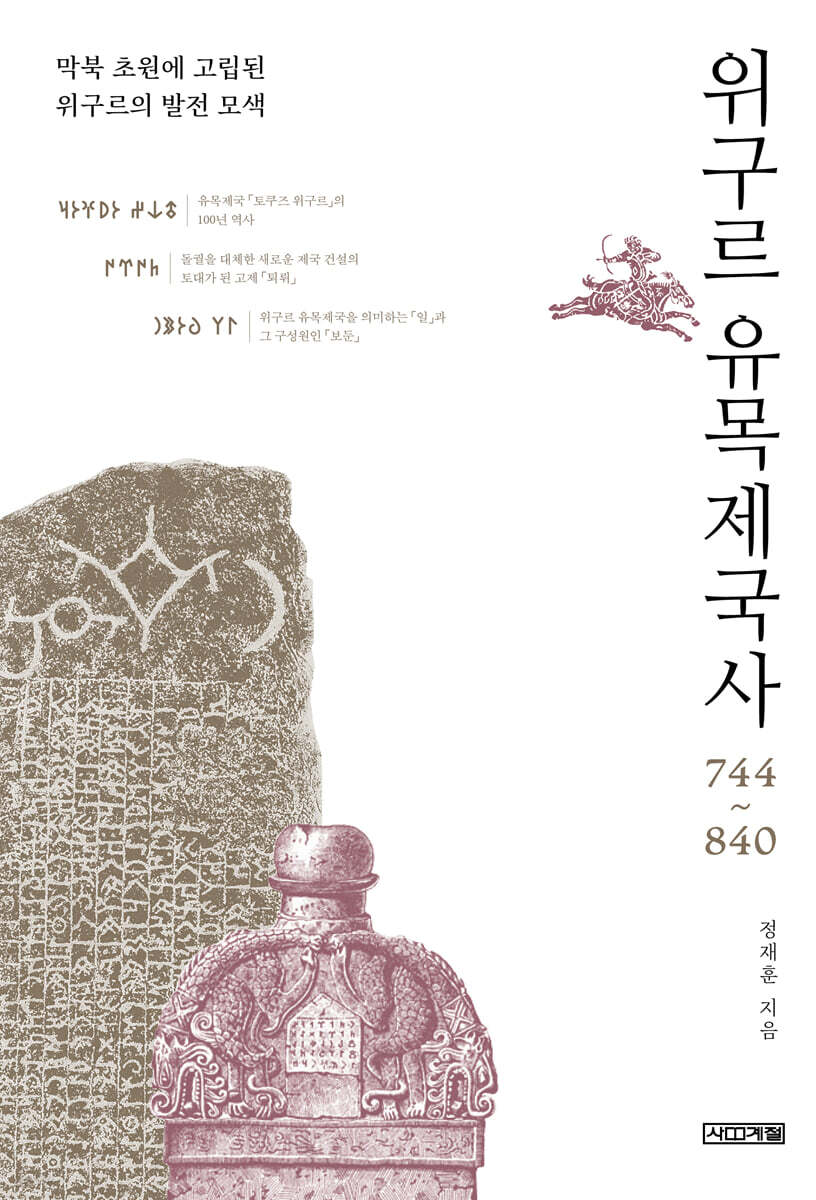
History of the Uyghur Nomadic Empire 744–840
 |
Description
Book Introduction
The first and only comprehensive history of the Uyghur nomadic empire in Korea
Professor Jeong Jae-hoon of Gyeongsang National University, the first Korean to receive the 2016 International Council of Asian Scholars (ICAS) Best Academic Book Award, has published 『History of the Uyghur Nomadic Empire』, following 『History of the Turkic Nomadic Empire』 (2016) and 『History of the Xiongnu Nomadic Empire』 (2023).
The Uyghurs, who emerged as a nomadic state that replaced the Gokturks and dominated the Mongolian steppe in the mid-8th century, established friendly relations with the Tang Dynasty to secure supplies, and by collaborating with Sogdian merchants skilled in commerce and administration, they led trade between the East and the West, growing into a huge nomadic empire that stretched from the Xing'an Mountains in the east to the Central Asian oasis region in the west.
Although their history as a nation lasted less than a century, the Uyghur historical legacy had a significant impact on the subsequent restructuring of the East Asian world and the Turkification of Central Asia.
Professor Jeong Jae-hoon synthesized ancient Turkic inscriptions, Chinese documents, and the latest research and excavation findings to reconstruct the history of the Uyghurs, focusing on the nomadic perspective.
This book is the first and only comprehensive history of the Uyghur nomadic empire in Korea, offering a new perspective on the history of the nomadic and settled worlds from the perspective of "exchange" and "coexistence," rather than "separation" and "conflict."
Professor Jeong Jae-hoon of Gyeongsang National University, the first Korean to receive the 2016 International Council of Asian Scholars (ICAS) Best Academic Book Award, has published 『History of the Uyghur Nomadic Empire』, following 『History of the Turkic Nomadic Empire』 (2016) and 『History of the Xiongnu Nomadic Empire』 (2023).
The Uyghurs, who emerged as a nomadic state that replaced the Gokturks and dominated the Mongolian steppe in the mid-8th century, established friendly relations with the Tang Dynasty to secure supplies, and by collaborating with Sogdian merchants skilled in commerce and administration, they led trade between the East and the West, growing into a huge nomadic empire that stretched from the Xing'an Mountains in the east to the Central Asian oasis region in the west.
Although their history as a nation lasted less than a century, the Uyghur historical legacy had a significant impact on the subsequent restructuring of the East Asian world and the Turkification of Central Asia.
Professor Jeong Jae-hoon synthesized ancient Turkic inscriptions, Chinese documents, and the latest research and excavation findings to reconstruct the history of the Uyghurs, focusing on the nomadic perspective.
This book is the first and only comprehensive history of the Uyghur nomadic empire in Korea, offering a new perspective on the history of the nomadic and settled worlds from the perspective of "exchange" and "coexistence," rather than "separation" and "conflict."
- You can preview some of the book's contents.
Preview
index
At the beginning of the book
Note
introduction
1.
Stage: Makbuk Grassland and the City Network within the Grassland
2.
Source: Linking Chinese and ancient Turkic inscriptions
3.
Review: The Nature of the Uyghur Nomadic Empire Debate
4.
Content: Exploring the development of Uyghurs isolated in the Makbuk grasslands.
Part 1: Founding and Growth: Establishing Legitimacy and Unifying the Makbuk Plains (744–755)
Chapter 1: Nation Building
1.
The restoration of Yaglakar's "Törü (Gōje)" and the construction of a "Il (nation)"
2.
Military expeditions and securing the 'Bodun (people)'
Chapter 2 System Reorganization
1.
The Organization of Bodun: The Reorganization of Tokuz Oghuz and the Uyghurs
2.
Establishing an authoritarian regime: securing a loyal army and vassalage
Chapter 3: Efforts to Secure Base and Status
1.
Karluk Khagan's seasonal migrations and the securing of his base, Oetüken
2.
The scope of the Makbuk Grassland
3.
Negotiations with the Party and the Status of the Uyghurs
Part 2: Taking Power and Isolation: Strengthening Relations with the Party and the Limits of Efforts to Take Power (755–787)
Chapter 1 Military Intervention and Phase Change
1.
Military assistance for the suppression of An Lushan (756) and establishment of a marriage relationship with the Tang Dynasty
2.
The reign of Boegui Khagan (762) and the reorganization of the East Asian world
Chapter 2: Efforts to Take Power and Internal Conflict
1.
Expansion of urban construction and acceptance of Manichaeism
2.
The Sogdian Merchant Problem and the Ton Baga Tarkan Coup (780)
Chapter 3: Conflict and Isolation with the Tang Dynasty in the 780s
1.
The assassination of the Uyghur envoy Todun (782) and the suppression of Sogdian merchants by Alp Kutluq Bilge Khagan
2.
The Qing-Shui Alliance (783) between Tang and Tibet and the diplomatic isolation of the Uyghurs
Part 3: Expansion and Development: Overcoming Isolation and Sophistication of the Makbuk System (787–839)
Chapter 1: The Northern Expedition and the Change of the Ruling Group
1.
Efforts to break the isolation and advance into the North (787)
2.
The re-entry of the Northern Expedition (789-791) and the internal conflict within the ruling Yaglakar group
3.
Kutluk's conquest of the north and his rise to power (791), and the replacement of the ruling group by Ediz (795)
Chapter 2: Oasis Management and External Development
1.
Oasis Management and Expanding Horse Trade with the Tang
2.
Peace with the Tang Dynasty and Western Expeditions in the 820s
3.
External expansion efforts and the development of Manichaeism
Part 4: Dispersion and Memory: The Big Bang and the Past Memories of Uyghur Descendants (839–848)
Chapter 1 Collapse (840) and Dispersion
1.
Collapse: Ruling Group Conflict, Natural Disasters, and Kyrgyz Attacks
2.
Lee San and the Reorganization of the Surrounding World
Chapter 2: The Mongolian Steppes and Ancestors Remembered by Uyghur Descendants in the 14th Century
1.
Memories of a glorious nomadic empire
2.
Memories of the Two Rivers and the Holy Mountain
3.
The Legend of the Bögü Khagan and the Uyghur Heritage
Conclusion: Uyghur Efforts to Overcome Isolation in the Makbuk Grassland and Their Legacy
supplement
1.
Study of Ancient Turkic Inscriptions
2.
Translations of ancient Turkic inscriptions: Tes Inscription, Tariat Inscription, and Sine Ussu Inscription
3.
Khagan's lineage and titles
Search
Note
introduction
1.
Stage: Makbuk Grassland and the City Network within the Grassland
2.
Source: Linking Chinese and ancient Turkic inscriptions
3.
Review: The Nature of the Uyghur Nomadic Empire Debate
4.
Content: Exploring the development of Uyghurs isolated in the Makbuk grasslands.
Part 1: Founding and Growth: Establishing Legitimacy and Unifying the Makbuk Plains (744–755)
Chapter 1: Nation Building
1.
The restoration of Yaglakar's "Törü (Gōje)" and the construction of a "Il (nation)"
2.
Military expeditions and securing the 'Bodun (people)'
Chapter 2 System Reorganization
1.
The Organization of Bodun: The Reorganization of Tokuz Oghuz and the Uyghurs
2.
Establishing an authoritarian regime: securing a loyal army and vassalage
Chapter 3: Efforts to Secure Base and Status
1.
Karluk Khagan's seasonal migrations and the securing of his base, Oetüken
2.
The scope of the Makbuk Grassland
3.
Negotiations with the Party and the Status of the Uyghurs
Part 2: Taking Power and Isolation: Strengthening Relations with the Party and the Limits of Efforts to Take Power (755–787)
Chapter 1 Military Intervention and Phase Change
1.
Military assistance for the suppression of An Lushan (756) and establishment of a marriage relationship with the Tang Dynasty
2.
The reign of Boegui Khagan (762) and the reorganization of the East Asian world
Chapter 2: Efforts to Take Power and Internal Conflict
1.
Expansion of urban construction and acceptance of Manichaeism
2.
The Sogdian Merchant Problem and the Ton Baga Tarkan Coup (780)
Chapter 3: Conflict and Isolation with the Tang Dynasty in the 780s
1.
The assassination of the Uyghur envoy Todun (782) and the suppression of Sogdian merchants by Alp Kutluq Bilge Khagan
2.
The Qing-Shui Alliance (783) between Tang and Tibet and the diplomatic isolation of the Uyghurs
Part 3: Expansion and Development: Overcoming Isolation and Sophistication of the Makbuk System (787–839)
Chapter 1: The Northern Expedition and the Change of the Ruling Group
1.
Efforts to break the isolation and advance into the North (787)
2.
The re-entry of the Northern Expedition (789-791) and the internal conflict within the ruling Yaglakar group
3.
Kutluk's conquest of the north and his rise to power (791), and the replacement of the ruling group by Ediz (795)
Chapter 2: Oasis Management and External Development
1.
Oasis Management and Expanding Horse Trade with the Tang
2.
Peace with the Tang Dynasty and Western Expeditions in the 820s
3.
External expansion efforts and the development of Manichaeism
Part 4: Dispersion and Memory: The Big Bang and the Past Memories of Uyghur Descendants (839–848)
Chapter 1 Collapse (840) and Dispersion
1.
Collapse: Ruling Group Conflict, Natural Disasters, and Kyrgyz Attacks
2.
Lee San and the Reorganization of the Surrounding World
Chapter 2: The Mongolian Steppes and Ancestors Remembered by Uyghur Descendants in the 14th Century
1.
Memories of a glorious nomadic empire
2.
Memories of the Two Rivers and the Holy Mountain
3.
The Legend of the Bögü Khagan and the Uyghur Heritage
Conclusion: Uyghur Efforts to Overcome Isolation in the Makbuk Grassland and Their Legacy
supplement
1.
Study of Ancient Turkic Inscriptions
2.
Translations of ancient Turkic inscriptions: Tes Inscription, Tariat Inscription, and Sine Ussu Inscription
3.
Khagan's lineage and titles
Search
Into the book
A 'city network' built on the grassland
From the early days of the Uyghur state, before establishing trade networks with the West, they built so-called "caravansarai" or "cities", walled trading posts on the Makbuk grasslands.
It was a facility for various non-nomadic peoples, such as the international merchants, caravans from Sogdiana who were active in trade, as well as the Chinese who came in with their princesses through marriages with Tang.
These facilities expanded to include the fiefdoms of nomadic monarchs and other locations that moved with the seasons.
These seemingly disparate cities, built along the grassland trade routes, formed a network, becoming a space of 'coexistence' where seasonal nomads and various foreign residents could mingle.
The Uyghurs developed on the Makbek grasslands and the "urban network" that stretched across them, and after the collapse in 840, they expanded their activities further by leaving the grasslands and explosively spreading into the surrounding world.
--- p.20~21
Chinese Uyghur historical research subordinated to political objectives
Research in China has been linked to a 'political' objective of explaining the process of ethnic fusion that led to the incorporation of the Uyghurs as a Chinese minority and the impact of their cultural development on Chinese culture.
At first, the direction was to organize the history of individual ethnic minorities, but later, a new organization was made based on the position of 'forming one China based on multiple centers (pluralistic and unified structure).'
Since the 2000s, as part of efforts to maintain internal stability in China, research has focused on the "border history" rather than the "ethnic history" of individual ethnic minorities.
Entering the 2010s, policies emphasizing the formation of a "Chinese ethnic community" were promoted, and as the Uyghurs were dealt with only within that scope, research on ethnic history was further suppressed.
--- p.28~29
The Uyghur ruling ideology of 'Teury' as recorded in inscriptions
The process of building a 'state' can be approached by analyzing Karl Khagan's perception of the 'old system', which was the standard for the state-building plan remaining in the inscriptions.
If we understand the process of restoring the Toeryu, which was the basis for the concept of nation-building and the establishment of legitimacy, we can also understand how he organized the 'Bodun (people)' and his 'territory' through expeditions.
The Törü that Karl Khagan tried to restore was the basis for founding and ruling the country.
In a narrow sense, it is 'ancestral law (traditional and customary unwritten law)', and in a broad sense, it is 'tangible and intangible traditions inherited from teŋri (heaven or god) and ata (ancestors)'.
It is a similar concept to the ‘Shangdi’ and ‘Jongmyo Sajik’, which the Chinese emperor must respect and follow when ruling the world.
Karl Khagan used this as the basis for his rule to secure his authority in the nomadic world and establish the 'legitimacy' of his new state.
--- p.45~46
The Rise of the Uyghurs and the Reorganization of the East Asian World in the Mid-8th Century
During the Tang Dynasty's civil war that lasted more than ten years following An Lushan's uprising, the Qimi control over the Maknan grassland completely collapsed.
Not only the Tang Dynasty, but also the Turkic nomadic power of the Maknam steppe, represented by the Fugohui Eun, was weakened.
The Turkic nomads (Göktürk clans) who had been under the rule of the Qimi began to weaken from the mid-7th century, and in the mid-740s, the last southern Göktürk clans that had moved south after the collapse of the Göktürks also challenged the Tang Dynasty with a revival movement and were eventually annihilated.
As the existing order centered around the Party completely collapsed, a new ‘order of the nomadic world’ was reorganized.
In the process, the Uyghurs took control of the Makbuk grassland and monopolized economic relations with the Tang.
Boegui Khagan established a brotherly relationship with the Tang emperor and established himself as a single point of contact in economic negotiations.
As a result, they were able to monopolize profits, including not only the spoils of war but also a huge amount of tax revenue.
He also gained recognition from his rivals, the Karluks, the Kyrgyz, and the Khitans.
In this way, the Uyghurs were the biggest beneficiaries of the East Asian power reorganization that unfolded after An Lushan's uprising, completely replacing the authority of the Turkic people who had ruled the steppes for over 200 years.
Although it did not grow to the point of ruling the Maknam Grassland on behalf of the Tang Dynasty, it became the 'only power' representing the nomadic world centered around Makbuk.
--- p.172~173
Sogdian merchants involved in foreign trade and state administration
The activities of Sogdian merchants are also confirmed in Uyghur.
Katlik Khagan built cities for settled people from the beginning, and built Bai Balik near the Selenge River for Sogdian traders and Chinese who followed the British princess.
… … The role of Sogdian merchants is related to the horse trade that took place after Princess Yonghui came to Uyghur in 769.
The fact that when the Uyghurs sent an envoy to the Tang Dynasty, they said they were “accompanied by nine surname Hu (Sogdian merchants)” clearly shows that Sogdian merchants were engaged in trade between the Uyghurs and the Tang Dynasty.
… … There are records that there were about 1,000 Sogdian merchants in Chang’an who received support from the Uyghurs and that they amassed enormous wealth.
… … Sogdian merchants played an important role not only in foreign trade but also in state administration.
Therefore, in order to strengthen his own power, Boegui Khagan had to satisfy the needs of the Sogdian merchants.
The combination of the Khagan and the merchant bureaucracy that supported him gave rise to an 'authoritarian merchant bureaucracy'.
In this way, the Uyghur Empire established a 'heterogeneous and combined' state system in which a nomadic grassland economy coexisted with foreign elements of a 'sedentary' nature.
In this trend, various facilities necessary for the lives of residents from the settled area began to be built in the grassland.
--- p.181~183
Uyghurs' adoption of Manichaeism
The Manichaeans secured their position by offering the Uyghur rulers who had come to Luoyang in 762 the necessary assistance in running the country and negotiating with the Tang.
The Boegy Khagan was not exclusive to Manichaeism like other states or parties in Central Asia.
Rather, they showed a tolerant attitude, saying that they would accept anything if it helped the country's operation and development.
From the perspective of the Uyghurs, who sought to develop trade between the East and the West centered on the grasslands, it was natural to associate with capable merchants from the oasis.
At this time, Sogdian merchants armed with Manichaeism were actively operating.
The inscription that says, “He was well versed in the art of arithmetic” shows that the Manichaeans also had excellent commercial abilities.
Based on these abilities, they provided various advice necessary for national management.
It is a well-known fact that in ancient times, the monk class was an elite group with the highest intellect and was deeply involved in the running of the country.
--- p.209~210
The "Guseonghoegolgahan Stele," which shows the Uyghur expansion to the West
The Uyghurs have secured their largest territory since their western expansion in the late 820s.
Around this time, the Uyghurs produced the "Guseonghoegolgahanbimun" to boast about this development.
The inscription is estimated to be about 3.38 meters in size, and its four sides are written in three different scripts: ancient Turkic, Sogdian, and Chinese characters.
The fact that three different characters were engraved separately on a single inscription shows the active cultural exchange that was taking place at the time and the level of development of Uyghur society.
… … The most detailed information is about the spread of Manichaeism, the succession of the Khagan in 795, and the expansion into the West in the 800s.
It is also very important historically in that it contains the official name of the Khagan that is not confirmed in other sources.
… … The existing 《Guseonghoegolgahanbimun》 contains both the character of a qigong stele and the aspect of praising the development of Manichaeism.
A higher religion accepted by a nomadic state not only became an 'ideology of unification', but could also provide a religious justification for waging a 'holy war' based on it.
--- p.273~283
Exploring the Possibility of an Anthrax Epidemic as a Cause of the Uyghur Collapse and Migration
Anthrax can easily infect herbivores that have frequent contact with soil.
It is particularly deadly to nomads because sheep, which make up the largest proportion of nomads, are the least resistant to anthrax.
The reason sheep are more likely to get sick than cattle or horses is because they often come into contact with the soil due to their habit of eating the roots of plants.
This habit of sheep is also the reason why nomads move to prevent the destruction of pastures.
… … Moreover, because the malnutrition had already worsened due to famine, anthrax spread more easily, ultimately leading to mass deaths of livestock.
The reproductive structure of the nomadic economy, which relies on livestock, was inevitably destroyed.
… … The impact of the epidemic did not end with the collapse of the empire and the migration of the Uyghurs.
The Kyrgyz, who had defeated the Uyghurs, also attempted to strengthen their power here, but soon returned to their highlands in the Yenisei River basin.
As a result, the grasslands here remained hollowed out for a considerable period until the Mongoloid groups from the east migrated in.
Although the reasons why nomads abandoned the grasslands were not solely due to disasters and epidemics, it is clear that these aspects should also be given significant consideration.
--- p.300~302
The resilience of the Uyghurs, who actively embraced foreign cultures.
Given the diversity-accepting and culturally transformative capacities of the Gochang Uyghurs, the consequentialist explanation that they had no choice but to settle completely after migrating to the oasis because foreign elements such as urban networks and advanced religions had penetrated deeply during the nomadic empire period demands reflection.
This understanding is based on the preconception that nomads must live only on the grasslands, and that they must settle down once they leave the grasslands.
Furthermore, it was a failure to properly appreciate that foreign elements of a sedentary nature, such as urban networks and advanced religions, whether in the grasslands or oases, continued to play an important role as means of running the Uyghur state and maintaining power.
It should be noted that not only the Uyghurs of the Mongolian steppe, but also their descendants, the Gaochang Uyghurs, had the 'elasticity' to actively accept and transform foreign cultures.
From the early days of the Uyghur state, before establishing trade networks with the West, they built so-called "caravansarai" or "cities", walled trading posts on the Makbuk grasslands.
It was a facility for various non-nomadic peoples, such as the international merchants, caravans from Sogdiana who were active in trade, as well as the Chinese who came in with their princesses through marriages with Tang.
These facilities expanded to include the fiefdoms of nomadic monarchs and other locations that moved with the seasons.
These seemingly disparate cities, built along the grassland trade routes, formed a network, becoming a space of 'coexistence' where seasonal nomads and various foreign residents could mingle.
The Uyghurs developed on the Makbek grasslands and the "urban network" that stretched across them, and after the collapse in 840, they expanded their activities further by leaving the grasslands and explosively spreading into the surrounding world.
--- p.20~21
Chinese Uyghur historical research subordinated to political objectives
Research in China has been linked to a 'political' objective of explaining the process of ethnic fusion that led to the incorporation of the Uyghurs as a Chinese minority and the impact of their cultural development on Chinese culture.
At first, the direction was to organize the history of individual ethnic minorities, but later, a new organization was made based on the position of 'forming one China based on multiple centers (pluralistic and unified structure).'
Since the 2000s, as part of efforts to maintain internal stability in China, research has focused on the "border history" rather than the "ethnic history" of individual ethnic minorities.
Entering the 2010s, policies emphasizing the formation of a "Chinese ethnic community" were promoted, and as the Uyghurs were dealt with only within that scope, research on ethnic history was further suppressed.
--- p.28~29
The Uyghur ruling ideology of 'Teury' as recorded in inscriptions
The process of building a 'state' can be approached by analyzing Karl Khagan's perception of the 'old system', which was the standard for the state-building plan remaining in the inscriptions.
If we understand the process of restoring the Toeryu, which was the basis for the concept of nation-building and the establishment of legitimacy, we can also understand how he organized the 'Bodun (people)' and his 'territory' through expeditions.
The Törü that Karl Khagan tried to restore was the basis for founding and ruling the country.
In a narrow sense, it is 'ancestral law (traditional and customary unwritten law)', and in a broad sense, it is 'tangible and intangible traditions inherited from teŋri (heaven or god) and ata (ancestors)'.
It is a similar concept to the ‘Shangdi’ and ‘Jongmyo Sajik’, which the Chinese emperor must respect and follow when ruling the world.
Karl Khagan used this as the basis for his rule to secure his authority in the nomadic world and establish the 'legitimacy' of his new state.
--- p.45~46
The Rise of the Uyghurs and the Reorganization of the East Asian World in the Mid-8th Century
During the Tang Dynasty's civil war that lasted more than ten years following An Lushan's uprising, the Qimi control over the Maknan grassland completely collapsed.
Not only the Tang Dynasty, but also the Turkic nomadic power of the Maknam steppe, represented by the Fugohui Eun, was weakened.
The Turkic nomads (Göktürk clans) who had been under the rule of the Qimi began to weaken from the mid-7th century, and in the mid-740s, the last southern Göktürk clans that had moved south after the collapse of the Göktürks also challenged the Tang Dynasty with a revival movement and were eventually annihilated.
As the existing order centered around the Party completely collapsed, a new ‘order of the nomadic world’ was reorganized.
In the process, the Uyghurs took control of the Makbuk grassland and monopolized economic relations with the Tang.
Boegui Khagan established a brotherly relationship with the Tang emperor and established himself as a single point of contact in economic negotiations.
As a result, they were able to monopolize profits, including not only the spoils of war but also a huge amount of tax revenue.
He also gained recognition from his rivals, the Karluks, the Kyrgyz, and the Khitans.
In this way, the Uyghurs were the biggest beneficiaries of the East Asian power reorganization that unfolded after An Lushan's uprising, completely replacing the authority of the Turkic people who had ruled the steppes for over 200 years.
Although it did not grow to the point of ruling the Maknam Grassland on behalf of the Tang Dynasty, it became the 'only power' representing the nomadic world centered around Makbuk.
--- p.172~173
Sogdian merchants involved in foreign trade and state administration
The activities of Sogdian merchants are also confirmed in Uyghur.
Katlik Khagan built cities for settled people from the beginning, and built Bai Balik near the Selenge River for Sogdian traders and Chinese who followed the British princess.
… … The role of Sogdian merchants is related to the horse trade that took place after Princess Yonghui came to Uyghur in 769.
The fact that when the Uyghurs sent an envoy to the Tang Dynasty, they said they were “accompanied by nine surname Hu (Sogdian merchants)” clearly shows that Sogdian merchants were engaged in trade between the Uyghurs and the Tang Dynasty.
… … There are records that there were about 1,000 Sogdian merchants in Chang’an who received support from the Uyghurs and that they amassed enormous wealth.
… … Sogdian merchants played an important role not only in foreign trade but also in state administration.
Therefore, in order to strengthen his own power, Boegui Khagan had to satisfy the needs of the Sogdian merchants.
The combination of the Khagan and the merchant bureaucracy that supported him gave rise to an 'authoritarian merchant bureaucracy'.
In this way, the Uyghur Empire established a 'heterogeneous and combined' state system in which a nomadic grassland economy coexisted with foreign elements of a 'sedentary' nature.
In this trend, various facilities necessary for the lives of residents from the settled area began to be built in the grassland.
--- p.181~183
Uyghurs' adoption of Manichaeism
The Manichaeans secured their position by offering the Uyghur rulers who had come to Luoyang in 762 the necessary assistance in running the country and negotiating with the Tang.
The Boegy Khagan was not exclusive to Manichaeism like other states or parties in Central Asia.
Rather, they showed a tolerant attitude, saying that they would accept anything if it helped the country's operation and development.
From the perspective of the Uyghurs, who sought to develop trade between the East and the West centered on the grasslands, it was natural to associate with capable merchants from the oasis.
At this time, Sogdian merchants armed with Manichaeism were actively operating.
The inscription that says, “He was well versed in the art of arithmetic” shows that the Manichaeans also had excellent commercial abilities.
Based on these abilities, they provided various advice necessary for national management.
It is a well-known fact that in ancient times, the monk class was an elite group with the highest intellect and was deeply involved in the running of the country.
--- p.209~210
The "Guseonghoegolgahan Stele," which shows the Uyghur expansion to the West
The Uyghurs have secured their largest territory since their western expansion in the late 820s.
Around this time, the Uyghurs produced the "Guseonghoegolgahanbimun" to boast about this development.
The inscription is estimated to be about 3.38 meters in size, and its four sides are written in three different scripts: ancient Turkic, Sogdian, and Chinese characters.
The fact that three different characters were engraved separately on a single inscription shows the active cultural exchange that was taking place at the time and the level of development of Uyghur society.
… … The most detailed information is about the spread of Manichaeism, the succession of the Khagan in 795, and the expansion into the West in the 800s.
It is also very important historically in that it contains the official name of the Khagan that is not confirmed in other sources.
… … The existing 《Guseonghoegolgahanbimun》 contains both the character of a qigong stele and the aspect of praising the development of Manichaeism.
A higher religion accepted by a nomadic state not only became an 'ideology of unification', but could also provide a religious justification for waging a 'holy war' based on it.
--- p.273~283
Exploring the Possibility of an Anthrax Epidemic as a Cause of the Uyghur Collapse and Migration
Anthrax can easily infect herbivores that have frequent contact with soil.
It is particularly deadly to nomads because sheep, which make up the largest proportion of nomads, are the least resistant to anthrax.
The reason sheep are more likely to get sick than cattle or horses is because they often come into contact with the soil due to their habit of eating the roots of plants.
This habit of sheep is also the reason why nomads move to prevent the destruction of pastures.
… … Moreover, because the malnutrition had already worsened due to famine, anthrax spread more easily, ultimately leading to mass deaths of livestock.
The reproductive structure of the nomadic economy, which relies on livestock, was inevitably destroyed.
… … The impact of the epidemic did not end with the collapse of the empire and the migration of the Uyghurs.
The Kyrgyz, who had defeated the Uyghurs, also attempted to strengthen their power here, but soon returned to their highlands in the Yenisei River basin.
As a result, the grasslands here remained hollowed out for a considerable period until the Mongoloid groups from the east migrated in.
Although the reasons why nomads abandoned the grasslands were not solely due to disasters and epidemics, it is clear that these aspects should also be given significant consideration.
--- p.300~302
The resilience of the Uyghurs, who actively embraced foreign cultures.
Given the diversity-accepting and culturally transformative capacities of the Gochang Uyghurs, the consequentialist explanation that they had no choice but to settle completely after migrating to the oasis because foreign elements such as urban networks and advanced religions had penetrated deeply during the nomadic empire period demands reflection.
This understanding is based on the preconception that nomads must live only on the grasslands, and that they must settle down once they leave the grasslands.
Furthermore, it was a failure to properly appreciate that foreign elements of a sedentary nature, such as urban networks and advanced religions, whether in the grasslands or oases, continued to play an important role as means of running the Uyghur state and maintaining power.
It should be noted that not only the Uyghurs of the Mongolian steppe, but also their descendants, the Gaochang Uyghurs, had the 'elasticity' to actively accept and transform foreign cultures.
--- p.357~358
Publisher's Review
Restoring the 1,000-year history of the nomadic empire that changed the course of world history.
The trilogy on the history of ancient nomadic empires, spanning the Huns, Turks, and Uighurs, is now complete.
The trilogy on the history of ancient nomadic empires, produced in collaboration with Professor Jeong Jae-hoon, a leading researcher of Central Asian history in Korea, and Sageseul Publishing, which has been consistently publishing academic and general books on Central Asian history since 1998, has finally been completed.
Professor Jeong Jae-hoon published 『History of the Turkic Nomadic Empire』 in 2016, followed by 『History of the Xiongnu Nomadic Empire』 in 2023. He also rewrote 『History of the Uyghur Nomadic Empire』, which was originally published in 2005 based on his doctoral dissertation, in a new format and system, putting an end to a long journey of eight years.
The new book, "History of the Uyghur Nomadic Empire," comprehensively reviews and reflects the latest research findings from the global Central Asian history community, and is supplemented with maps, illustrations, original and translated texts of ancient Turkic inscriptions, and diagrams of state structure and Khagan genealogy, making it the most faithful and balanced comprehensive history of the Uyghur Nomadic Empire available to date.
Professor Jeong Jae-hoon's 'History of Ancient Nomadic Empires' trilogy was an attempt to restore the approximately 1,000-year history that unfolded in North Asia from the mid-3rd century BC to the mid-9th century AD.
It focuses on the Huns, Turks, and Uyghurs who formed empires, but also covers the long and short histories of countless other nomadic powers that emerged in the North Asian steppes.
Through this trilogy, Professor Jeong sought to evoke the world-historical status and significance of nomadic empires and establish the "grasslands," the stage where nomads thrived, as a single historical unit equal to the settled world.
Through this trilogy, readers will be able to view East Asian history, which is centered on China, from a different perspective and confirm that nomads were not "barbaric" beings who engaged in destruction and slaughter, but rather dynamic actors who connected the East and West and changed the course of world history.
The Uyghurs were a nomadic empire that aimed to become a trading nation.
Redefining the Uyghur position in world history by moving beyond the civilizational and Sino-centric view of history.
The Uyghurs, who first appeared in history as a member of the Goryeo dynasty in the mid-5th century, maintained their power by repeatedly serving in the military or surrendering to the Turks under the rule of the Tang dynasty, and then declaring the founding of a state in 744.
After the founding of the country, he successively subjugated surrounding powers such as Karluk and Basmil, and actively cooperated in the defense of the Tang Dynasty's borders by demonstrating his 'military specialties' as a mounted archer.
When the princess from Tang married the Khagan, he established a settlement on the grassland and accepted a large number of settlers. He also gained enormous economic benefits by distributing silk obtained from the horse trade with Tang to the West through Sogdian merchants.
In 787, when the trade route between Tang and Tibet was blocked due to the conflict between Tang and Tibet, the "Hoegol Road" was connected from Tang to Beiding (Beshi Balik) through the Makbuk grassland, and using this as a stepping stone, in the early 790s, the territory expanded to the western oasis region, becoming a major player in trade between the East and the West.
From the beginning, the Uyghurs built so-called "caravanserai" or cities, which were trading posts surrounded by walls on the grasslands, and as these cities were connected along trade routes, a "city network" was formed on the grasslands.
These cities became spaces where nomads on seasonal migrations, merchants coming and going for trade, and people from the settled world including China interacted and coexisted. The Uyghurs, who operated these cities and aimed to become a trading nation, developed into a large nomadic empire by the 9th century.
A combination of natural disasters, epidemics, and succession disputes led to its sudden collapse in 840, but its descendants, who were scattered throughout the world, maintained their identity as "Uyghurs" and left a great influence and legacy on the development of world history thereafter.
Although the Uyghurs operated a vast empire connecting the East and the West, their historical status has not been properly evaluated.
The inclusive and resilient attitude of the Uyghurs, including residential facilities for settled people in the grasslands, cooperation with the Sogdians who were skilled in commerce and administration, acceptance of the higher religion Manichaeism, use of writing, and active exchanges with the Tang Dynasty, were interpreted by Japanese and Western scholars as a "sedentary orientation."
In other words, nomads had no choice but to gradually 'assimilate' into the settled world in order to improve their living conditions, and the Uyghurs also actively accepted 'settled elements' and gradually took the path of 'civilization'.
It has also been suggested that after the collapse, they migrated to surrounding areas, causing the 'Turkification' of Central Asia.
On the other hand, there was also a discussion that defined the Uyghurs as a transitional nomadic state that marked the end of the ancient nomadic state and the background of the conquering dynasty, in connection with the emergence of the Khitan, the so-called "conquering dynasty" that simultaneously ruled over agricultural areas and grasslands during the period of ethnic migration in the early 10th century.
However, Professor Jeong Jae-hoon points out that this logic is not only a kind of civilizational view of history that says that an 'inferior' nomadic nation develops toward a 'superior' settled nation, but also stems from a lack of understanding of how nomadic empires operate.
Professor Jeong, who has studied the unique survival methods of nomadic empires, from the Huns and Turks to the Uyghurs, argues that coexistence with various foreign elements is an essential characteristic of nomadic empires.
Especially for the Uyghurs, who were isolated in a relatively narrow region, namely the Makbuk steppe, compared to the Huns and the Turks, actively embracing settled elements and developing into a trading nation was the way to strengthen and maintain their system.
If the construction of cities that were also trading hubs was the acquisition of the empire's "hardware," the acceptance of advanced religions like Manichaeism could be said to have been the completion of the "software" that allowed the acceptance of the entire culture of foreign groups with diverse abilities and used it as a driving force for national development.
… … In the 760s, the Uyghurs desperately needed the help of Manichaean merchants to establish a trading system based on the massive amounts of silk they had secured from the Tang.
Boegy Khagan built a city for them to stay in and accepted Manichaeism.
This was one of the basic elements necessary for running a nomadic state.
In order to overcome the spatial limitations of the Makbuk grassland and develop a nomadic empire, it was necessary to accept various external factors.
Contrary to what previous studies have pointed out, the Uyghurs' acceptance of foreign elements with a sedentary nature was not a prerequisite for 'civilization', but rather a means of settling down in oases and other places after the collapse.
It was absolutely necessary to upgrade the system in order to develop into a trading nation.
- Pages 204-212
Another reason why the history of the nomadic Uyghur empire has not been fully evaluated is that the political situation in the Xinjiang Uyghur Autonomous Region, part of modern Chinese territory, makes objective historical research difficult.
Recently, in China, due to political considerations of integrating the Uyghur minority into a single China, research is being conducted in a direction that emphasizes only the friendly relationship between the Party and the Uyghurs or downplays the unique "ethnic history" of the Uyghurs.
Professor Jeong Jae-hoon sought to correct the biased view of China from a third-party perspective and to present a more objective and balanced history by adding the perspective of the nomads.
Therefore, this book can be evaluated as a work that re-establishes the world historical status of the Uyghurs, focusing on a nomadic perspective, breaking away from the view of civilization and the view of history centered on the 'Chinese ethnic community'.
Linking ancient Turkic inscriptions with Chinese texts
A compilation of research on Turkic inscriptions and Uyghur history over the past 100 years.
The method Professor Jeong Jae-hoon chose to write a historical narrative closer to the nomads' perspective was to directly read and interpret original sources, especially ancient Turkic inscriptions left by the Uyghurs, and connect them with Chinese materials.
The history of nomads can only be studied through the vast amount of historical materials left behind by the settled world. Fortunately, the Turks, Uyghurs, and others left their own records in the form of inscriptions written in ancient Turkic script.
In particular, the Uyghurs left inscriptions not only in ancient Turkic script, but also in the script of the Sogdians, who were active as merchants and officials, and in Chinese characters, which allows us to infer their own perspectives and positions.
It is also possible to critically review the content of somewhat biased Chinese materials and fill in gaps in the records.
This book approaches the 'truth' of the Uyghur nomadic empire by comparing the records of the Tes Stele and the Tariat Stele, which were erected by the second Uyghur Khagan, Karluk Khagan, to commemorate the victories of his military expeditions and to boast of his achievements, the Sine Usu Stele, which is the tombstone of Karluk Khagan, and the Guseonghoegolgahan Stele, which was inscribed in ancient Turkic, Sogdian, and Chinese characters during the reign of the 12th Khagan, Soleil Khagan, with historical materials from China such as the Old Book of Tang, the New Book of Tang, the Zizhi Tongjian, and the Book of Changes.
The book's highlight is its examination of both ancient Turkic and Chinese sources, persuasively interpreting any discrepancies or gaps between the two records in light of the specificities of nomadic power and the operational methods of the nomadic economy.
Since the personal abilities of the monarch and the degree of concentration of power had a decisive impact on the existence of a nomadic state, Professor Jeong traces the development of Uyghur history, focusing in particular on the analysis of the "Kaganate."
Previous studies have concluded that the Uyghur state structure is not significantly different from that of the Turkic state structure.
There were views that took a general approach to the ruling system based on Chinese sources, or that emphasized the influence of the Uyghurs under Tang rule in the late 7th century by noting their adoption of Chinese-style official titles.
However, this was only a rudimentary review based only on Chinese characters without considering inscriptional materials.
A new approach to the structure of the state is possible through the restoration of inscriptional materials.
In particular, the inscriptions left by the second Khagan, Karluk Khagan, contain information about the process of founding the state together with his father before the founding of the state, and the subsequent reorganization of the system.
Among these, taking into account the fact that the founding monument, the Taryat Inscription, erected by Karluk Khagan in 753, declared the completion of the founding of the nation, the period around this time can be set as the 'founding period' and the 'process of national construction and growth' can be summarized.
- Pages 44-45
In addition, Professor Jeong Jae-hoon presents clear views on various controversial topics in academic circles, such as, "Where is Ötüken, the center of the nomadic world?", "Is the person recorded in Chinese documents as Hilgangasa?干迦斯 or Hilugasa?于迦斯 the same Kutluk who later took power as the Huishin Khagan?", "What was the nature of the Uyghurs' adoption of Manichaeism?", and "The reason the Uyghurs left the Makbuk steppe after the collapse and the outbreak of infectious diseases (anthrax)?"
Through faithful translations of the original sources, interpretations free from the biases prevalent in Chinese and Western academia, incorporation of veterinary knowledge on animal epidemics, and careful review of research from not only the English-speaking world but also Europe, Japan, China, Russia, and Mongolia, the author's narrative allows readers to approach the true face of the Uyghur nomadic empire.
Additionally, this book contains field knowledge that synthesizes the excavation results accumulated over 100 years since the discovery and investigation by European explorers in the late 19th century and the author's actual field research results.
The author is a historian whose research focuses on literature, but has spent over 20 years personally exploring the Mongolian steppe, examining the local topography and climate that gave rise to the nomadic mode of production, and investigating the relics and remains left behind by nomads in their interactions with the settled world.
This book is packed with not only photographs taken by the author himself, but also maps and diagrams created based on those photographs.
Therefore, it is no exaggeration to say that this book is the culmination of literature research and excavation results accumulated over the past 100 years.
Through an analysis of the myths left behind by the descendants of the Uyghurs after the collapse
Confirming the historical heritage and identity of the Uyghurs
Unlike the Huns and Turks who appeared earlier, there is a land of Uyghurs that still carries on the name 'Uyghur', and the people living there recall the Uyghur nomadic empire as the basis for their historical awareness.
Why has the identity of "Uyghur" persisted so persistently? Professor Jeong Jae-hoon focuses on the mythological record of the "Yeokdoho Gochang Wang Sehunbi," created in the 14th century by King Gochang, a descendant of the Gochang Uyghurs who were scattered across the region after the collapse of the Uyghur Empire. This monument, built to commemorate the Mongolian steppe and the pride of continuing the legitimacy of the nomadic world, was produced.
By comparing the Chinese version of the myth of the birth of the founder recorded in the first part of the inscription with the Persian record (Zubei's 『History of the Conquerors of the World』, Rashid ad-Din's 『The Butler』), we extract mythological motifs such as the sacred tree, sunlight, and the sacred number '5', and connect them with the river presented as the geographical background of the myth, the Tu River, the original home of the Fugu, the ruling group of the Gaochang Uyghurs, and the tomb ruins remaining there.
This reveals the historical awareness of King Gochang, who, as a descendant of the Uyghurs and a descendant of the restoration that dates back to the 5th century 'Obugocha', sought to inherit the legitimacy of the Turkic nomads.
For King Gaochang, a descendant of the Uyghurs who were under the rule of the Mongol Empire in the 14th century, the historical experience left behind by his ancestors who had ruled the Mongolian steppe in the past was extremely important.
Having handed over his ancestral land to a new power, the Mongol immigrants, and being ruled by them who had built a great empire, he stayed in Haseo, and while reminiscing about the past, he wanted to create a glorious history again.
They wanted to reveal their self-consciousness as an indigenous people who built a nomadic empire on the Mongolian steppe, and to write a new history by showing a different historical perception from the Mongol Empire, the ruling power of the time.
… … The history of the Turkic nomads who scattered to various places with their legacy after the fall of the Uyghurs deserves attention in that it had a huge impact on the entire Central Asian region and even on the course of world history.
- Pages 345-346
Another reason why the Uyghur identity has persisted for a long time is that the Uyghurs created a new 'Uyghur script', which is a modified version of the Sogdian script, instead of the ancient Turkic script they had borrowed from the steppes in the past, in order to maintain their own language and use it effectively.
The Uyghurs use their own script and language, and have assimilated some of the indigenous peoples of the oasis regions, resulting in the expansion of Turkic-speaking populations in Central Asia.
After the collapse of the Uyghur Empire, the Mongolian steppe was no longer the land of Turkic nomads, but its historical legacy endured for a long time, leaving behind descendants who carried on its name.
This book clearly demonstrates why the steppe world should be viewed as a single historical unit, encompassing the impact of the collapse of the Uyghur Empire on the subsequent reorganization of power in East Asia and the course of world history.
The trilogy on the history of ancient nomadic empires, spanning the Huns, Turks, and Uighurs, is now complete.
The trilogy on the history of ancient nomadic empires, produced in collaboration with Professor Jeong Jae-hoon, a leading researcher of Central Asian history in Korea, and Sageseul Publishing, which has been consistently publishing academic and general books on Central Asian history since 1998, has finally been completed.
Professor Jeong Jae-hoon published 『History of the Turkic Nomadic Empire』 in 2016, followed by 『History of the Xiongnu Nomadic Empire』 in 2023. He also rewrote 『History of the Uyghur Nomadic Empire』, which was originally published in 2005 based on his doctoral dissertation, in a new format and system, putting an end to a long journey of eight years.
The new book, "History of the Uyghur Nomadic Empire," comprehensively reviews and reflects the latest research findings from the global Central Asian history community, and is supplemented with maps, illustrations, original and translated texts of ancient Turkic inscriptions, and diagrams of state structure and Khagan genealogy, making it the most faithful and balanced comprehensive history of the Uyghur Nomadic Empire available to date.
Professor Jeong Jae-hoon's 'History of Ancient Nomadic Empires' trilogy was an attempt to restore the approximately 1,000-year history that unfolded in North Asia from the mid-3rd century BC to the mid-9th century AD.
It focuses on the Huns, Turks, and Uyghurs who formed empires, but also covers the long and short histories of countless other nomadic powers that emerged in the North Asian steppes.
Through this trilogy, Professor Jeong sought to evoke the world-historical status and significance of nomadic empires and establish the "grasslands," the stage where nomads thrived, as a single historical unit equal to the settled world.
Through this trilogy, readers will be able to view East Asian history, which is centered on China, from a different perspective and confirm that nomads were not "barbaric" beings who engaged in destruction and slaughter, but rather dynamic actors who connected the East and West and changed the course of world history.
The Uyghurs were a nomadic empire that aimed to become a trading nation.
Redefining the Uyghur position in world history by moving beyond the civilizational and Sino-centric view of history.
The Uyghurs, who first appeared in history as a member of the Goryeo dynasty in the mid-5th century, maintained their power by repeatedly serving in the military or surrendering to the Turks under the rule of the Tang dynasty, and then declaring the founding of a state in 744.
After the founding of the country, he successively subjugated surrounding powers such as Karluk and Basmil, and actively cooperated in the defense of the Tang Dynasty's borders by demonstrating his 'military specialties' as a mounted archer.
When the princess from Tang married the Khagan, he established a settlement on the grassland and accepted a large number of settlers. He also gained enormous economic benefits by distributing silk obtained from the horse trade with Tang to the West through Sogdian merchants.
In 787, when the trade route between Tang and Tibet was blocked due to the conflict between Tang and Tibet, the "Hoegol Road" was connected from Tang to Beiding (Beshi Balik) through the Makbuk grassland, and using this as a stepping stone, in the early 790s, the territory expanded to the western oasis region, becoming a major player in trade between the East and the West.
From the beginning, the Uyghurs built so-called "caravanserai" or cities, which were trading posts surrounded by walls on the grasslands, and as these cities were connected along trade routes, a "city network" was formed on the grasslands.
These cities became spaces where nomads on seasonal migrations, merchants coming and going for trade, and people from the settled world including China interacted and coexisted. The Uyghurs, who operated these cities and aimed to become a trading nation, developed into a large nomadic empire by the 9th century.
A combination of natural disasters, epidemics, and succession disputes led to its sudden collapse in 840, but its descendants, who were scattered throughout the world, maintained their identity as "Uyghurs" and left a great influence and legacy on the development of world history thereafter.
Although the Uyghurs operated a vast empire connecting the East and the West, their historical status has not been properly evaluated.
The inclusive and resilient attitude of the Uyghurs, including residential facilities for settled people in the grasslands, cooperation with the Sogdians who were skilled in commerce and administration, acceptance of the higher religion Manichaeism, use of writing, and active exchanges with the Tang Dynasty, were interpreted by Japanese and Western scholars as a "sedentary orientation."
In other words, nomads had no choice but to gradually 'assimilate' into the settled world in order to improve their living conditions, and the Uyghurs also actively accepted 'settled elements' and gradually took the path of 'civilization'.
It has also been suggested that after the collapse, they migrated to surrounding areas, causing the 'Turkification' of Central Asia.
On the other hand, there was also a discussion that defined the Uyghurs as a transitional nomadic state that marked the end of the ancient nomadic state and the background of the conquering dynasty, in connection with the emergence of the Khitan, the so-called "conquering dynasty" that simultaneously ruled over agricultural areas and grasslands during the period of ethnic migration in the early 10th century.
However, Professor Jeong Jae-hoon points out that this logic is not only a kind of civilizational view of history that says that an 'inferior' nomadic nation develops toward a 'superior' settled nation, but also stems from a lack of understanding of how nomadic empires operate.
Professor Jeong, who has studied the unique survival methods of nomadic empires, from the Huns and Turks to the Uyghurs, argues that coexistence with various foreign elements is an essential characteristic of nomadic empires.
Especially for the Uyghurs, who were isolated in a relatively narrow region, namely the Makbuk steppe, compared to the Huns and the Turks, actively embracing settled elements and developing into a trading nation was the way to strengthen and maintain their system.
If the construction of cities that were also trading hubs was the acquisition of the empire's "hardware," the acceptance of advanced religions like Manichaeism could be said to have been the completion of the "software" that allowed the acceptance of the entire culture of foreign groups with diverse abilities and used it as a driving force for national development.
… … In the 760s, the Uyghurs desperately needed the help of Manichaean merchants to establish a trading system based on the massive amounts of silk they had secured from the Tang.
Boegy Khagan built a city for them to stay in and accepted Manichaeism.
This was one of the basic elements necessary for running a nomadic state.
In order to overcome the spatial limitations of the Makbuk grassland and develop a nomadic empire, it was necessary to accept various external factors.
Contrary to what previous studies have pointed out, the Uyghurs' acceptance of foreign elements with a sedentary nature was not a prerequisite for 'civilization', but rather a means of settling down in oases and other places after the collapse.
It was absolutely necessary to upgrade the system in order to develop into a trading nation.
- Pages 204-212
Another reason why the history of the nomadic Uyghur empire has not been fully evaluated is that the political situation in the Xinjiang Uyghur Autonomous Region, part of modern Chinese territory, makes objective historical research difficult.
Recently, in China, due to political considerations of integrating the Uyghur minority into a single China, research is being conducted in a direction that emphasizes only the friendly relationship between the Party and the Uyghurs or downplays the unique "ethnic history" of the Uyghurs.
Professor Jeong Jae-hoon sought to correct the biased view of China from a third-party perspective and to present a more objective and balanced history by adding the perspective of the nomads.
Therefore, this book can be evaluated as a work that re-establishes the world historical status of the Uyghurs, focusing on a nomadic perspective, breaking away from the view of civilization and the view of history centered on the 'Chinese ethnic community'.
Linking ancient Turkic inscriptions with Chinese texts
A compilation of research on Turkic inscriptions and Uyghur history over the past 100 years.
The method Professor Jeong Jae-hoon chose to write a historical narrative closer to the nomads' perspective was to directly read and interpret original sources, especially ancient Turkic inscriptions left by the Uyghurs, and connect them with Chinese materials.
The history of nomads can only be studied through the vast amount of historical materials left behind by the settled world. Fortunately, the Turks, Uyghurs, and others left their own records in the form of inscriptions written in ancient Turkic script.
In particular, the Uyghurs left inscriptions not only in ancient Turkic script, but also in the script of the Sogdians, who were active as merchants and officials, and in Chinese characters, which allows us to infer their own perspectives and positions.
It is also possible to critically review the content of somewhat biased Chinese materials and fill in gaps in the records.
This book approaches the 'truth' of the Uyghur nomadic empire by comparing the records of the Tes Stele and the Tariat Stele, which were erected by the second Uyghur Khagan, Karluk Khagan, to commemorate the victories of his military expeditions and to boast of his achievements, the Sine Usu Stele, which is the tombstone of Karluk Khagan, and the Guseonghoegolgahan Stele, which was inscribed in ancient Turkic, Sogdian, and Chinese characters during the reign of the 12th Khagan, Soleil Khagan, with historical materials from China such as the Old Book of Tang, the New Book of Tang, the Zizhi Tongjian, and the Book of Changes.
The book's highlight is its examination of both ancient Turkic and Chinese sources, persuasively interpreting any discrepancies or gaps between the two records in light of the specificities of nomadic power and the operational methods of the nomadic economy.
Since the personal abilities of the monarch and the degree of concentration of power had a decisive impact on the existence of a nomadic state, Professor Jeong traces the development of Uyghur history, focusing in particular on the analysis of the "Kaganate."
Previous studies have concluded that the Uyghur state structure is not significantly different from that of the Turkic state structure.
There were views that took a general approach to the ruling system based on Chinese sources, or that emphasized the influence of the Uyghurs under Tang rule in the late 7th century by noting their adoption of Chinese-style official titles.
However, this was only a rudimentary review based only on Chinese characters without considering inscriptional materials.
A new approach to the structure of the state is possible through the restoration of inscriptional materials.
In particular, the inscriptions left by the second Khagan, Karluk Khagan, contain information about the process of founding the state together with his father before the founding of the state, and the subsequent reorganization of the system.
Among these, taking into account the fact that the founding monument, the Taryat Inscription, erected by Karluk Khagan in 753, declared the completion of the founding of the nation, the period around this time can be set as the 'founding period' and the 'process of national construction and growth' can be summarized.
- Pages 44-45
In addition, Professor Jeong Jae-hoon presents clear views on various controversial topics in academic circles, such as, "Where is Ötüken, the center of the nomadic world?", "Is the person recorded in Chinese documents as Hilgangasa?干迦斯 or Hilugasa?于迦斯 the same Kutluk who later took power as the Huishin Khagan?", "What was the nature of the Uyghurs' adoption of Manichaeism?", and "The reason the Uyghurs left the Makbuk steppe after the collapse and the outbreak of infectious diseases (anthrax)?"
Through faithful translations of the original sources, interpretations free from the biases prevalent in Chinese and Western academia, incorporation of veterinary knowledge on animal epidemics, and careful review of research from not only the English-speaking world but also Europe, Japan, China, Russia, and Mongolia, the author's narrative allows readers to approach the true face of the Uyghur nomadic empire.
Additionally, this book contains field knowledge that synthesizes the excavation results accumulated over 100 years since the discovery and investigation by European explorers in the late 19th century and the author's actual field research results.
The author is a historian whose research focuses on literature, but has spent over 20 years personally exploring the Mongolian steppe, examining the local topography and climate that gave rise to the nomadic mode of production, and investigating the relics and remains left behind by nomads in their interactions with the settled world.
This book is packed with not only photographs taken by the author himself, but also maps and diagrams created based on those photographs.
Therefore, it is no exaggeration to say that this book is the culmination of literature research and excavation results accumulated over the past 100 years.
Through an analysis of the myths left behind by the descendants of the Uyghurs after the collapse
Confirming the historical heritage and identity of the Uyghurs
Unlike the Huns and Turks who appeared earlier, there is a land of Uyghurs that still carries on the name 'Uyghur', and the people living there recall the Uyghur nomadic empire as the basis for their historical awareness.
Why has the identity of "Uyghur" persisted so persistently? Professor Jeong Jae-hoon focuses on the mythological record of the "Yeokdoho Gochang Wang Sehunbi," created in the 14th century by King Gochang, a descendant of the Gochang Uyghurs who were scattered across the region after the collapse of the Uyghur Empire. This monument, built to commemorate the Mongolian steppe and the pride of continuing the legitimacy of the nomadic world, was produced.
By comparing the Chinese version of the myth of the birth of the founder recorded in the first part of the inscription with the Persian record (Zubei's 『History of the Conquerors of the World』, Rashid ad-Din's 『The Butler』), we extract mythological motifs such as the sacred tree, sunlight, and the sacred number '5', and connect them with the river presented as the geographical background of the myth, the Tu River, the original home of the Fugu, the ruling group of the Gaochang Uyghurs, and the tomb ruins remaining there.
This reveals the historical awareness of King Gochang, who, as a descendant of the Uyghurs and a descendant of the restoration that dates back to the 5th century 'Obugocha', sought to inherit the legitimacy of the Turkic nomads.
For King Gaochang, a descendant of the Uyghurs who were under the rule of the Mongol Empire in the 14th century, the historical experience left behind by his ancestors who had ruled the Mongolian steppe in the past was extremely important.
Having handed over his ancestral land to a new power, the Mongol immigrants, and being ruled by them who had built a great empire, he stayed in Haseo, and while reminiscing about the past, he wanted to create a glorious history again.
They wanted to reveal their self-consciousness as an indigenous people who built a nomadic empire on the Mongolian steppe, and to write a new history by showing a different historical perception from the Mongol Empire, the ruling power of the time.
… … The history of the Turkic nomads who scattered to various places with their legacy after the fall of the Uyghurs deserves attention in that it had a huge impact on the entire Central Asian region and even on the course of world history.
- Pages 345-346
Another reason why the Uyghur identity has persisted for a long time is that the Uyghurs created a new 'Uyghur script', which is a modified version of the Sogdian script, instead of the ancient Turkic script they had borrowed from the steppes in the past, in order to maintain their own language and use it effectively.
The Uyghurs use their own script and language, and have assimilated some of the indigenous peoples of the oasis regions, resulting in the expansion of Turkic-speaking populations in Central Asia.
After the collapse of the Uyghur Empire, the Mongolian steppe was no longer the land of Turkic nomads, but its historical legacy endured for a long time, leaving behind descendants who carried on its name.
This book clearly demonstrates why the steppe world should be viewed as a single historical unit, encompassing the impact of the collapse of the Uyghur Empire on the subsequent reorganization of power in East Asia and the course of world history.
GOODS SPECIFICS
- Date of issue: September 6, 2024
- Page count, weight, size: 416 pages | 796g | 153*225*30mm
- ISBN13: 9791169813310
- ISBN10: 1169813313
You may also like
카테고리
korean


korean

![GQ KOREA Mark (Monthly): December [2025]](http://librairie.coreenne.fr/cdn/shop/files/8ef265dbbfbf186523ed75ba7319009d.jpg?v=1765340328&width=3840)


