

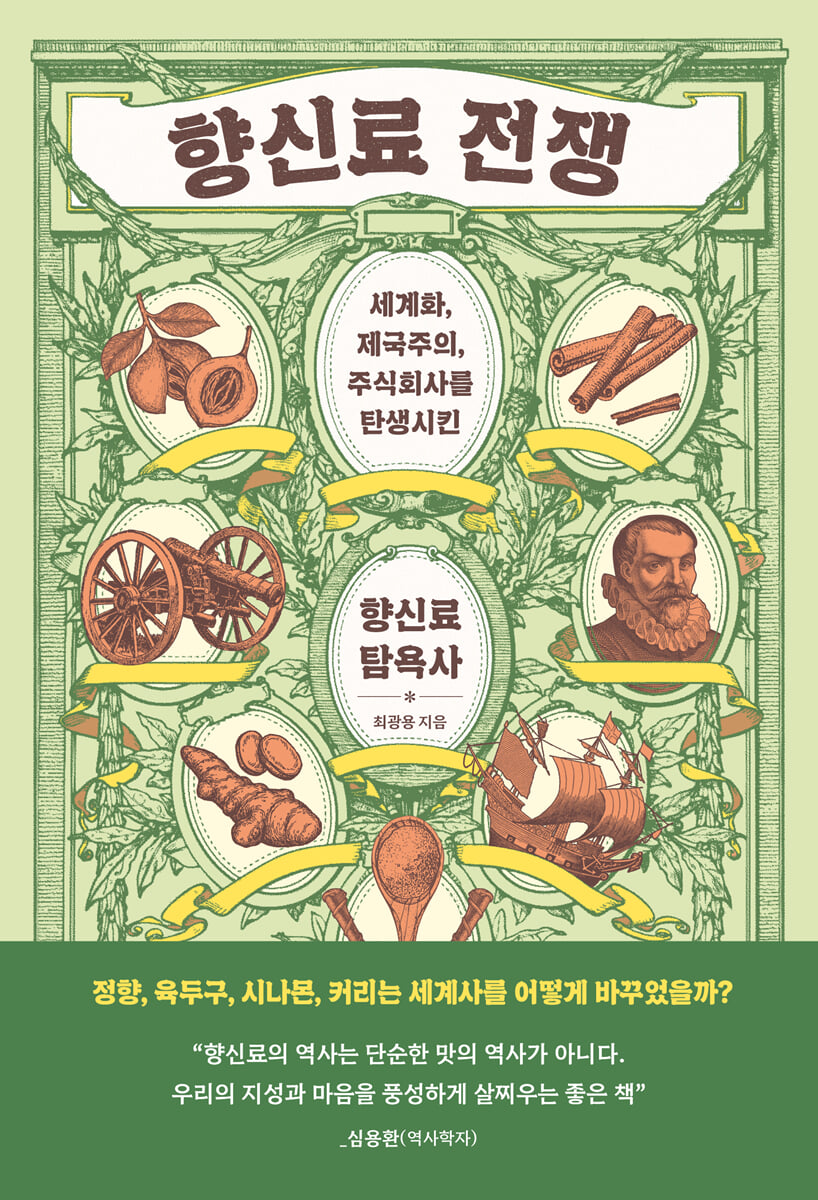
Spice Wars
 |
Description
Book Introduction
How did cloves, nutmeg, pepper, and cinnamon change world history?
The 16th century Age of Exploration,
A spice scramble filled with the flavors of adventure and the aroma of greed.
“The history of spices is not simply the history of taste.
“A good book that enriches our intellect and heart.”
_Sim Yong-hwan (historian)
What's the most valuable company in human history? Apple? Microsoft? It's the Dutch East India Company, founded in 1602.
It was a massive organization with bases across the globe, including Asia, Africa, and the Americas, and employed millions of people. At its peak, its market capitalization was a staggering $8.3 trillion in today's currency.
Apple and Microsoft combined will be worth $6.4 trillion (as of August 2024), giving you an idea of how massive this is.
However, in 1800, it suddenly declared bankruptcy and was dissolved.
The reasons for the collapse of this powerful company, which lasted for nearly 200 years, were complex, but one of them was its defeat in the Spice Wars against the British East India Company.
In medieval Europe, where culinary culture was not developed, spices such as cloves, nutmeg, pepper, and cinnamon were very rare and luxurious items.
So the spice trade was the goose that laid the golden eggs.
Because a grain of pepper was more expensive than a pearl, it brought investors tens or hundreds of times the profits.
Cloves and nutmeg, which were especially popular, were produced only in the Maluku Islands (also known as the Spice Islands) located in the Indonesian Peninsula.
So whoever secured this trade route and, furthermore, took control of the region itself, could seize enormous wealth and maritime supremacy.
The Spice Wars were fierce competitions between European powers over the Maluku Islands.
The new book, "The Spice Wars," is a historical textbook that dramatically recounts the history of culture, economy, society, politics, war, and adventure surrounding spices.
The author of this book has been doing business and traveling to over 80 countries for over 30 years.
Among them, while working in countries that were major spice producing regions and were under European colonial rule, such as Malaysia, Indonesia, Eritrea, and India, I personally experienced the history and culture of those countries and became completely captivated by the allure of spices.
The author, who developed a great curiosity about spices, decided to become an independent researcher studying the history of spices.
While researching the history of the spice trade through foreign books and online information, I learned that spices not only changed our taste buds, but also the course of world history.
For example, the voyages of explorers to open spice trade routes led to the first circumnavigation of the world, the discovery of America, and the opening of the Northern Sea Route, which laid the foundation for globalization.
The East India Company, which was founded to monopolize the spice trade, was the world's first joint-stock company.
The European East India Companies marked the beginning of full-scale imperialism by occupying and colonizing parts of Asia.
In this way, human desire and greed for spices gave birth to countless adventures and myths, and sometimes became the starting point of trade and war.
The Spice Wars is a thrilling and exciting story about the fierce battle between European powers over the Spice Islands and the exploitation of the islanders who lost their homes and lives as a result.
It is also full of useful information, such as the spice thief Poivre, Hamel, the protagonist of Hamel's Journal who was an employee of the Dutch East India Company, Ralph Fitch, the spice merchant who appears in Shakespeare's work, the difference between cinnamon and cassia, and the characteristics of the world's three major scents: ambergris, musk, and agarwood.
Thanks to this, both adult and young readers will be able to enjoy the fun and excitement of watching a scene from a historical drama or a strategy simulation game.
It also allows us to look at world history from a new perspective.
The 16th century Age of Exploration,
A spice scramble filled with the flavors of adventure and the aroma of greed.
“The history of spices is not simply the history of taste.
“A good book that enriches our intellect and heart.”
_Sim Yong-hwan (historian)
What's the most valuable company in human history? Apple? Microsoft? It's the Dutch East India Company, founded in 1602.
It was a massive organization with bases across the globe, including Asia, Africa, and the Americas, and employed millions of people. At its peak, its market capitalization was a staggering $8.3 trillion in today's currency.
Apple and Microsoft combined will be worth $6.4 trillion (as of August 2024), giving you an idea of how massive this is.
However, in 1800, it suddenly declared bankruptcy and was dissolved.
The reasons for the collapse of this powerful company, which lasted for nearly 200 years, were complex, but one of them was its defeat in the Spice Wars against the British East India Company.
In medieval Europe, where culinary culture was not developed, spices such as cloves, nutmeg, pepper, and cinnamon were very rare and luxurious items.
So the spice trade was the goose that laid the golden eggs.
Because a grain of pepper was more expensive than a pearl, it brought investors tens or hundreds of times the profits.
Cloves and nutmeg, which were especially popular, were produced only in the Maluku Islands (also known as the Spice Islands) located in the Indonesian Peninsula.
So whoever secured this trade route and, furthermore, took control of the region itself, could seize enormous wealth and maritime supremacy.
The Spice Wars were fierce competitions between European powers over the Maluku Islands.
The new book, "The Spice Wars," is a historical textbook that dramatically recounts the history of culture, economy, society, politics, war, and adventure surrounding spices.
The author of this book has been doing business and traveling to over 80 countries for over 30 years.
Among them, while working in countries that were major spice producing regions and were under European colonial rule, such as Malaysia, Indonesia, Eritrea, and India, I personally experienced the history and culture of those countries and became completely captivated by the allure of spices.
The author, who developed a great curiosity about spices, decided to become an independent researcher studying the history of spices.
While researching the history of the spice trade through foreign books and online information, I learned that spices not only changed our taste buds, but also the course of world history.
For example, the voyages of explorers to open spice trade routes led to the first circumnavigation of the world, the discovery of America, and the opening of the Northern Sea Route, which laid the foundation for globalization.
The East India Company, which was founded to monopolize the spice trade, was the world's first joint-stock company.
The European East India Companies marked the beginning of full-scale imperialism by occupying and colonizing parts of Asia.
In this way, human desire and greed for spices gave birth to countless adventures and myths, and sometimes became the starting point of trade and war.
The Spice Wars is a thrilling and exciting story about the fierce battle between European powers over the Spice Islands and the exploitation of the islanders who lost their homes and lives as a result.
It is also full of useful information, such as the spice thief Poivre, Hamel, the protagonist of Hamel's Journal who was an employee of the Dutch East India Company, Ralph Fitch, the spice merchant who appears in Shakespeare's work, the difference between cinnamon and cassia, and the characteristics of the world's three major scents: ambergris, musk, and agarwood.
Thanks to this, both adult and young readers will be able to enjoy the fun and excitement of watching a scene from a historical drama or a strategy simulation game.
It also allows us to look at world history from a new perspective.
- You can preview some of the book's contents.
Preview
index
Introduction: A Spice Odyssey of Enchantment and Cruelty that Changed World History
Chapter 1: The Age of Exploration Begins in Search of Spices
Black Treasure and the Pioneers of the Indian Sea Route | Europe's Desire for Spices | The Spice Islands, Home of Cloves and Nutmeg | Are the Spice Islands Real? | Spain and Portugal's Rivalry for Leadership
Chapter 2: The Great Powers' Rivalry Over the Spice Trade
The Decline of Portugal and the Rise of the Dutch | The First Joint Stock Company, the Dutch East India Company | The Spanish Armada's Collapse at the Battle of Calais | Francis Drake's Circumnavigation of the World | Ralph Fitch's Overland Adventures that Shakespeare Pays Attention to | James Lancaster's Indian Ocean Voyage | The Birth of the British East India Company | The Maluku Islands and the Dutch's Bloodless Entry
Chapter 3: Will the Northern Sea Route Become a New Breakthrough?
Breaking the North Pole to India? | The Brutal History of the Northeast Passage | Henry Hudson's Northwest Passage | Hudson Arrives in New York | Adventurers Who Braved the Icy Sea
Chapter 4: The Spice Wars between the Dutch and the English
The peculiarities of the spice trade | The Dutch preoccupation and the British dilemma | The prelude to the Spice Wars | The massacre on Neira Island in the Banda Islands | John Jourdain of England vs. Jan Coon of the Netherlands | War clouds gathering over the Maluku Islands | The Battle of Aisle and the Dutch defeat | Jourdain's intervention and Jan Coon's warning
Chapter 5: The Spice Islands, Drenched in Blood: Who Will Win?
Nathaniel Korthoff's Run Island Shooting | The Beginning of the Country on Which the Sun Never Sets | The Battle of Banten | Jourdain's Death and Jan Koon's Occupation of Run Island | The Agreement between the Two Powers and the Establishment of Batavia | The Dutch Offensive and the Banda Massacre | Jan Koon: Hero or Massacre | The Ambon Massacre and the Operation to Recapture Run Island | The First and Second Anglo-Dutch Wars | The Bankruptcy of the Dutch East India Company
Chapter 6: The Adventures of Spice Spreading Out into the World
The migration of species cannot be stopped | Pierre Poivre, the spice thief | The British eventually seized the Spice Islands | Spice cultivation spreads around the world
Appendix: The more you know about spices, the more fragrant they become.
Is cinnamon and cassia cinnamon? |The world's three major spices and the spices in the Bible |Mentholatum and tiger balm, the panaceas (?) |Basil and coriander, the two distinct tastes |Curry powder, which revolutionized British cuisine |Turmeric and yellow rice
Good books to read together
Chapter 1: The Age of Exploration Begins in Search of Spices
Black Treasure and the Pioneers of the Indian Sea Route | Europe's Desire for Spices | The Spice Islands, Home of Cloves and Nutmeg | Are the Spice Islands Real? | Spain and Portugal's Rivalry for Leadership
Chapter 2: The Great Powers' Rivalry Over the Spice Trade
The Decline of Portugal and the Rise of the Dutch | The First Joint Stock Company, the Dutch East India Company | The Spanish Armada's Collapse at the Battle of Calais | Francis Drake's Circumnavigation of the World | Ralph Fitch's Overland Adventures that Shakespeare Pays Attention to | James Lancaster's Indian Ocean Voyage | The Birth of the British East India Company | The Maluku Islands and the Dutch's Bloodless Entry
Chapter 3: Will the Northern Sea Route Become a New Breakthrough?
Breaking the North Pole to India? | The Brutal History of the Northeast Passage | Henry Hudson's Northwest Passage | Hudson Arrives in New York | Adventurers Who Braved the Icy Sea
Chapter 4: The Spice Wars between the Dutch and the English
The peculiarities of the spice trade | The Dutch preoccupation and the British dilemma | The prelude to the Spice Wars | The massacre on Neira Island in the Banda Islands | John Jourdain of England vs. Jan Coon of the Netherlands | War clouds gathering over the Maluku Islands | The Battle of Aisle and the Dutch defeat | Jourdain's intervention and Jan Coon's warning
Chapter 5: The Spice Islands, Drenched in Blood: Who Will Win?
Nathaniel Korthoff's Run Island Shooting | The Beginning of the Country on Which the Sun Never Sets | The Battle of Banten | Jourdain's Death and Jan Koon's Occupation of Run Island | The Agreement between the Two Powers and the Establishment of Batavia | The Dutch Offensive and the Banda Massacre | Jan Koon: Hero or Massacre | The Ambon Massacre and the Operation to Recapture Run Island | The First and Second Anglo-Dutch Wars | The Bankruptcy of the Dutch East India Company
Chapter 6: The Adventures of Spice Spreading Out into the World
The migration of species cannot be stopped | Pierre Poivre, the spice thief | The British eventually seized the Spice Islands | Spice cultivation spreads around the world
Appendix: The more you know about spices, the more fragrant they become.
Is cinnamon and cassia cinnamon? |The world's three major spices and the spices in the Bible |Mentholatum and tiger balm, the panaceas (?) |Basil and coriander, the two distinct tastes |Curry powder, which revolutionized British cuisine |Turmeric and yellow rice
Good books to read together
Detailed image

Into the book
The first person to discover a sea route to India was Vasco da Gama.
He sailed 42,000 kilometers over two years before returning to Lisbon via India, his destination.
They set sail with 170 men on four ships, but when they returned home, only two ships and 55 survivors remained.
So why did Vasco da Gama undertake such a reckless voyage? Why did the Portuguese king invest so heavily in an adventure that bordered on gambling?
Since Columbus and Vasco da Gama, many ships have left Spanish and Portuguese ports.
A century later, explorations followed in the Netherlands and England.
Many people died during the voyage, but they did not stop their adventure.
There must have been many reasons why they risked their lives to go to India, but one of them was spices.
What Columbus ultimately failed to find was pepper, the spice that Europeans were crazy about.
--- p.17~18
The Spice Islands are islands in the sea known as Maluku or Molucca.
From Malacca, going southeast through the strait, you reach the Java Sea between Borneo and Java Island.
From there, go east and go north along the island of Sulawesi, and that is the Maluku Sea.
Over the years, countless Europeans have tried to find this place.
After building a fleet and passing the Canary Islands in the Atlantic Ocean off the west coast of Africa, they had to endure months of being stuck in a windless zone, and they had to suffer from unpredictable storms near the Cape of Good Hope at the southern tip of Africa.
It wasn't just the weather that plagued them.
He continued his voyage, dying from an illness (scurvy) of unknown cause at the time.
In the early 16th century, Portuguese and Spanish fleets took these risks, as did Dutch and English fleets a century later.
--- p.38~39
It is said that the number of ships owned by Dutch merchants at that time was greater than that of all other European countries combined.
Rotterdam in the Netherlands served as a hub for European shipping, not only in the 16th and 17th centuries, but even today.
A significant portion of Russian cargo is shipped to the port of Rotterdam.
Geographically, it is adjacent to the northwestern Atlantic Ocean, making it very advantageous for trade.
Towards the north lies the North Sea, which connects Britain and Scandinavia, and towards the continent lies between France and Germany, with access to the Iberian Peninsula by land and sea.
By land, it connects Eastern Europe to Russia.
This means that all transportation is possible, including the North Sea, the North Atlantic, the Mediterranean Sea, and even land transportation.
A large number of ships means that the shipbuilding industry is developed.
At that time, the cost of building Dutch ships was less than half that of the British.
Because the standardization work, which is the basis of mass production, was done ahead of time, costs were reduced and design capabilities were also excellent.
--- p.61
Let's take a moment to learn about Francis Drake, who is revered as the hero of the Battle of Calais.
If you look at his profile, you'll see that he's a soldier, pirate, captain, adventurer, and knight.
The most famous battle he participated in was the Battle of Calais, and he also participated in several smaller battles with Spain.
Piracy, the plundering of Spanish merchant ships in the Caribbean, was also a major activity.
Circumnavigating the world was also an important achievement, as historically Ferdinand Magellan was the first to circumnavigate the globe (in fact, he died in the Philippines before completing the journey), and Drake was the second (though he would have been the first if it had been done perfectly).
By comparison, Magellan sailed to the Maluku Islands in search of spices, while Drake circumnavigated the world searching for Spanish merchant ships with the goal of plundering.
Magellan may have used his telescope from the deck of his Pacific voyage to find land, and Drake may have used his telescope to find Spanish galleons.
Drake's circumnavigation of the world began in 1577 in Plymouth, a port city in southwestern England, and ended in 1580.
--- p.76~77
Barents, which was advancing north of Novaya Zemlya, eventually became trapped in the ice.
The team consisted of 16 sailors and one boy servant.
The Barents party disembarked from the ship in the unbearable cold.
They made a home on the island of Novaya Zemlya, built a hut with planks taken from the deck, and survived for eight months.
The following June, when the ice had melted somewhat, they escaped in a lifeboat.
Several had already died and Barents was seriously ill.
A week after his escape, Barents died on an ice island.
The remaining survivors met Russian fishermen along the way, obtained food, and sailed 1,000 kilometers by oars.
When they reached the Kola Peninsula in Murmansk, they were fortunately rescued by a Dutch ship.
The hut where they lived while trapped in the ice was discovered by a Norwegian hunter in 1871, 170 years later.
Surprisingly, Barents's logbook was preserved there, and it was so detailed that it described the route and weather conditions, making it an invaluable resource for explorers.
--- p.126~128
In the beginning, there was a lot of friction with the locals.
It was mostly a misunderstanding due to cultural differences, but as two generations passed, an atmosphere of coexistence naturally took hold.
Ambon is located between Ternate and Tidore, the clove producing regions, and the Banda Islands, the nutmeg producing regions.
Moreover, a local broker personally brought the items to me.
The wind direction in the Banda Sea was unpredictable and the waves were frequent, so it was by no means a comfortable sea route.
There was no reason to take risks.
The Portuguese initially attempted to trade directly with several islands in the Banda Archipelago, but were met with a poor welcome and even suffered the murder of several people.
The locals were instinctively hostile to white people, including the Portuguese.
I was sick and tired of all the lies and deception.
Then, one day in 1605, a Dutch ship appeared in Ambon.
A ship that looked like a galleon appeared on the horizon and gradually approached the shore.
Even at first glance, its majesty was impressive.
Before I could even count how many masts were under sail, I could see the cannons gaping open beneath the deck.
The soldiers standing on the deck with muskets slung around their shoulders looked quite menacing.
Another ship appeared on the horizon.
And then another ship, and then another ship… .
On this day, nine Dutch ships entered Ambon.
All anyone could do was stare open-mouthed at the Portuguese commander as he approached the large ship.
--- p.159
In October 1616, John Jourdain, chief sales officer of the British East India Company in Banten, appointed Nathaniel Cotehope as commander and dispatched two ships, the Swan and the Defence, to Run Island in Banda.
Run Island was the only island in the Maluku and Banda Seas that remained outside the Dutch East India Company's monopoly.
It was the only hope left after the island of Aisle, seven kilometers off the coast of Run Island, fell into Dutch hands.
It is the smallest island in the Banda Archipelago and cannot be marked on most maps, but the entire island is covered with nutmeg trees, so the production is considerable.
The British East India Company decided to defend Run Island, its last stronghold in the Banda Sea.
(syncopation)
“There is a way, but I am afraid you will misunderstand,” said Kothoff when they were in a difficult situation.
"What's the method? A misunderstanding? That's ridiculous.
“Just say the word.” The orangkayas’ ears perked up at the thought that there was a way.
“The way is for you all to become subjects of our British King.
This island is ceded to the King of England, and you become subjects of His Majesty the King.
“Then His Majesty the King will fight to protect you from your enemies,” said Kothoff firmly.
--- p.194~197
In this conquest, 2,500 people were shot dead or starved to death.
There were countless people who jumped off cliffs, saying they would rather commit suicide than surrender.
Fewer than 300 people barely managed to escape to a nearby island and survive.
As a result, only about 1,000 of the estimated 15,000 Banda Islands population survived, and some were sent to Batavia as slaves.
However, many of them also died during the voyage.
From Banda to Batavia, it is a distance that can only be reached by sailing across Dalpo.
(syncopation)
Personally, I had to stop writing this story for almost three weeks.
The atrocities committed by Europeans were not limited to the Banda Islands.
In addition to the genocide of the Incas in the Americas and the slave hunts throughout Africa, there are many others.
Among them, the story of the Bandains who fought and perished like butterflies rushing toward the light was particularly heartbreaking.
For reference, there are currently about 700 ethnic groups with different languages living together in Indonesia.
When I was staying in Jakarta, my senior, Mr. Shin, told me this story after visiting the Irian Jaya region of New Guinea.
They said that even if you just go over the hill right next to it, communication with the neighboring village is impossible because their language is different.
It was hard to believe at the time, but it was probably true.
--- p.227~228
Cromwell was startled.
The once-thriving East India Company is now bankrupt! Since dissolving Parliament and seizing power in 1653, the company has been ignoring various proposals for approval, saying, "You rich bastards, why are you so greedy? Just get on with your work. What's the point of India?"
To do as the petition requested, navigation ordinances had to be enacted and business licenses had to be granted.
However, the Navigation Ordinance was very likely to be a cause of diplomatic disputes with other countries, and the patent gave the company the right to wage war on Indian territory.
In other words, it was a matter of handing over all diplomatic rights, including possession of military forces, declaration of war, and occupation of territory.
If it had been a monarchy, it would have been up to the king to decide, but since it was a republic without a king, Cromwell could not grant such special privileges.
I don't know if it would be possible in Congress.
When Cromwell heard the news that the East India Company had gone bankrupt, he persuaded the parliament, which was half on his side, to approve the petition.
William Cockayne's drastic prescription worked.
--- p.243
The British doctor, concerned that the wound would fester and endanger his life, amputated Poivre's arm.
And he was dropped off in Batavia, Dutch Indonesia.
While receiving treatment there, I was amazed to witness the vibrant spice trade scene.
Ships from many countries came and went from the port of Batavia, all loaded with spices.
Ships from Japan, China, Siam (Thailand), Bengal, Malabar, Sri Lanka, and Sumatra were seen.
Above all, I was amazed by the wealth of the Dutch merchants.
Most of them became very wealthy through the clove trade in Maluku and the nutmeg trade in the Banda Islands.
And I also learned how strictly the Netherlands controls the export of seeds and seedlings of these crops.
(syncopation)
“Cloves and nutmeg aren’t necessarily found only in places they control.
Do you know how large a region Maluku and Banda are?” Poivre now knew the path he had to take and he was determined to give his life for it.
It was a matter of stealing cloves and nutmeg trees.
--- p.265~266
The British drove out the Dutch and occupied Maluku and Banda.
The nutmeg of Ternate and Tidore, Ambon, and all the islands of the Banda, a region which the Dutch had defended with all their might for more than two centuries, was now in the hands of the British.
So what should the British do now? Britain had no intention of occupying and colonizing this place permanently.
Spices were no longer the goose that laid the golden eggs.
Prices had dropped significantly, new spices had been discovered, and cooking methods had changed.
Britain was developing other profitable products besides spices.
It was clear what Britain had to do, as it would eventually leave the area.
It was to transplant cloves and nutmeg into their colonies.
First, the Malay Peninsula, which was firmly under British control, was considered.
Governor Raffles of Singapore was a politician and botanist who knew this well.
He actively supported businessmen by providing them with land and funds to establish farms.
As a result, Singapore and Penang Island became new spice hubs.
Pinang Island was where Raffles worked before becoming the acting governor of Java, so he was familiar with the local situation.
This broke the Dutch East Indies spice monopoly.
Spice cultivation spread throughout many tropical regions of the world.
He sailed 42,000 kilometers over two years before returning to Lisbon via India, his destination.
They set sail with 170 men on four ships, but when they returned home, only two ships and 55 survivors remained.
So why did Vasco da Gama undertake such a reckless voyage? Why did the Portuguese king invest so heavily in an adventure that bordered on gambling?
Since Columbus and Vasco da Gama, many ships have left Spanish and Portuguese ports.
A century later, explorations followed in the Netherlands and England.
Many people died during the voyage, but they did not stop their adventure.
There must have been many reasons why they risked their lives to go to India, but one of them was spices.
What Columbus ultimately failed to find was pepper, the spice that Europeans were crazy about.
--- p.17~18
The Spice Islands are islands in the sea known as Maluku or Molucca.
From Malacca, going southeast through the strait, you reach the Java Sea between Borneo and Java Island.
From there, go east and go north along the island of Sulawesi, and that is the Maluku Sea.
Over the years, countless Europeans have tried to find this place.
After building a fleet and passing the Canary Islands in the Atlantic Ocean off the west coast of Africa, they had to endure months of being stuck in a windless zone, and they had to suffer from unpredictable storms near the Cape of Good Hope at the southern tip of Africa.
It wasn't just the weather that plagued them.
He continued his voyage, dying from an illness (scurvy) of unknown cause at the time.
In the early 16th century, Portuguese and Spanish fleets took these risks, as did Dutch and English fleets a century later.
--- p.38~39
It is said that the number of ships owned by Dutch merchants at that time was greater than that of all other European countries combined.
Rotterdam in the Netherlands served as a hub for European shipping, not only in the 16th and 17th centuries, but even today.
A significant portion of Russian cargo is shipped to the port of Rotterdam.
Geographically, it is adjacent to the northwestern Atlantic Ocean, making it very advantageous for trade.
Towards the north lies the North Sea, which connects Britain and Scandinavia, and towards the continent lies between France and Germany, with access to the Iberian Peninsula by land and sea.
By land, it connects Eastern Europe to Russia.
This means that all transportation is possible, including the North Sea, the North Atlantic, the Mediterranean Sea, and even land transportation.
A large number of ships means that the shipbuilding industry is developed.
At that time, the cost of building Dutch ships was less than half that of the British.
Because the standardization work, which is the basis of mass production, was done ahead of time, costs were reduced and design capabilities were also excellent.
--- p.61
Let's take a moment to learn about Francis Drake, who is revered as the hero of the Battle of Calais.
If you look at his profile, you'll see that he's a soldier, pirate, captain, adventurer, and knight.
The most famous battle he participated in was the Battle of Calais, and he also participated in several smaller battles with Spain.
Piracy, the plundering of Spanish merchant ships in the Caribbean, was also a major activity.
Circumnavigating the world was also an important achievement, as historically Ferdinand Magellan was the first to circumnavigate the globe (in fact, he died in the Philippines before completing the journey), and Drake was the second (though he would have been the first if it had been done perfectly).
By comparison, Magellan sailed to the Maluku Islands in search of spices, while Drake circumnavigated the world searching for Spanish merchant ships with the goal of plundering.
Magellan may have used his telescope from the deck of his Pacific voyage to find land, and Drake may have used his telescope to find Spanish galleons.
Drake's circumnavigation of the world began in 1577 in Plymouth, a port city in southwestern England, and ended in 1580.
--- p.76~77
Barents, which was advancing north of Novaya Zemlya, eventually became trapped in the ice.
The team consisted of 16 sailors and one boy servant.
The Barents party disembarked from the ship in the unbearable cold.
They made a home on the island of Novaya Zemlya, built a hut with planks taken from the deck, and survived for eight months.
The following June, when the ice had melted somewhat, they escaped in a lifeboat.
Several had already died and Barents was seriously ill.
A week after his escape, Barents died on an ice island.
The remaining survivors met Russian fishermen along the way, obtained food, and sailed 1,000 kilometers by oars.
When they reached the Kola Peninsula in Murmansk, they were fortunately rescued by a Dutch ship.
The hut where they lived while trapped in the ice was discovered by a Norwegian hunter in 1871, 170 years later.
Surprisingly, Barents's logbook was preserved there, and it was so detailed that it described the route and weather conditions, making it an invaluable resource for explorers.
--- p.126~128
In the beginning, there was a lot of friction with the locals.
It was mostly a misunderstanding due to cultural differences, but as two generations passed, an atmosphere of coexistence naturally took hold.
Ambon is located between Ternate and Tidore, the clove producing regions, and the Banda Islands, the nutmeg producing regions.
Moreover, a local broker personally brought the items to me.
The wind direction in the Banda Sea was unpredictable and the waves were frequent, so it was by no means a comfortable sea route.
There was no reason to take risks.
The Portuguese initially attempted to trade directly with several islands in the Banda Archipelago, but were met with a poor welcome and even suffered the murder of several people.
The locals were instinctively hostile to white people, including the Portuguese.
I was sick and tired of all the lies and deception.
Then, one day in 1605, a Dutch ship appeared in Ambon.
A ship that looked like a galleon appeared on the horizon and gradually approached the shore.
Even at first glance, its majesty was impressive.
Before I could even count how many masts were under sail, I could see the cannons gaping open beneath the deck.
The soldiers standing on the deck with muskets slung around their shoulders looked quite menacing.
Another ship appeared on the horizon.
And then another ship, and then another ship… .
On this day, nine Dutch ships entered Ambon.
All anyone could do was stare open-mouthed at the Portuguese commander as he approached the large ship.
--- p.159
In October 1616, John Jourdain, chief sales officer of the British East India Company in Banten, appointed Nathaniel Cotehope as commander and dispatched two ships, the Swan and the Defence, to Run Island in Banda.
Run Island was the only island in the Maluku and Banda Seas that remained outside the Dutch East India Company's monopoly.
It was the only hope left after the island of Aisle, seven kilometers off the coast of Run Island, fell into Dutch hands.
It is the smallest island in the Banda Archipelago and cannot be marked on most maps, but the entire island is covered with nutmeg trees, so the production is considerable.
The British East India Company decided to defend Run Island, its last stronghold in the Banda Sea.
(syncopation)
“There is a way, but I am afraid you will misunderstand,” said Kothoff when they were in a difficult situation.
"What's the method? A misunderstanding? That's ridiculous.
“Just say the word.” The orangkayas’ ears perked up at the thought that there was a way.
“The way is for you all to become subjects of our British King.
This island is ceded to the King of England, and you become subjects of His Majesty the King.
“Then His Majesty the King will fight to protect you from your enemies,” said Kothoff firmly.
--- p.194~197
In this conquest, 2,500 people were shot dead or starved to death.
There were countless people who jumped off cliffs, saying they would rather commit suicide than surrender.
Fewer than 300 people barely managed to escape to a nearby island and survive.
As a result, only about 1,000 of the estimated 15,000 Banda Islands population survived, and some were sent to Batavia as slaves.
However, many of them also died during the voyage.
From Banda to Batavia, it is a distance that can only be reached by sailing across Dalpo.
(syncopation)
Personally, I had to stop writing this story for almost three weeks.
The atrocities committed by Europeans were not limited to the Banda Islands.
In addition to the genocide of the Incas in the Americas and the slave hunts throughout Africa, there are many others.
Among them, the story of the Bandains who fought and perished like butterflies rushing toward the light was particularly heartbreaking.
For reference, there are currently about 700 ethnic groups with different languages living together in Indonesia.
When I was staying in Jakarta, my senior, Mr. Shin, told me this story after visiting the Irian Jaya region of New Guinea.
They said that even if you just go over the hill right next to it, communication with the neighboring village is impossible because their language is different.
It was hard to believe at the time, but it was probably true.
--- p.227~228
Cromwell was startled.
The once-thriving East India Company is now bankrupt! Since dissolving Parliament and seizing power in 1653, the company has been ignoring various proposals for approval, saying, "You rich bastards, why are you so greedy? Just get on with your work. What's the point of India?"
To do as the petition requested, navigation ordinances had to be enacted and business licenses had to be granted.
However, the Navigation Ordinance was very likely to be a cause of diplomatic disputes with other countries, and the patent gave the company the right to wage war on Indian territory.
In other words, it was a matter of handing over all diplomatic rights, including possession of military forces, declaration of war, and occupation of territory.
If it had been a monarchy, it would have been up to the king to decide, but since it was a republic without a king, Cromwell could not grant such special privileges.
I don't know if it would be possible in Congress.
When Cromwell heard the news that the East India Company had gone bankrupt, he persuaded the parliament, which was half on his side, to approve the petition.
William Cockayne's drastic prescription worked.
--- p.243
The British doctor, concerned that the wound would fester and endanger his life, amputated Poivre's arm.
And he was dropped off in Batavia, Dutch Indonesia.
While receiving treatment there, I was amazed to witness the vibrant spice trade scene.
Ships from many countries came and went from the port of Batavia, all loaded with spices.
Ships from Japan, China, Siam (Thailand), Bengal, Malabar, Sri Lanka, and Sumatra were seen.
Above all, I was amazed by the wealth of the Dutch merchants.
Most of them became very wealthy through the clove trade in Maluku and the nutmeg trade in the Banda Islands.
And I also learned how strictly the Netherlands controls the export of seeds and seedlings of these crops.
(syncopation)
“Cloves and nutmeg aren’t necessarily found only in places they control.
Do you know how large a region Maluku and Banda are?” Poivre now knew the path he had to take and he was determined to give his life for it.
It was a matter of stealing cloves and nutmeg trees.
--- p.265~266
The British drove out the Dutch and occupied Maluku and Banda.
The nutmeg of Ternate and Tidore, Ambon, and all the islands of the Banda, a region which the Dutch had defended with all their might for more than two centuries, was now in the hands of the British.
So what should the British do now? Britain had no intention of occupying and colonizing this place permanently.
Spices were no longer the goose that laid the golden eggs.
Prices had dropped significantly, new spices had been discovered, and cooking methods had changed.
Britain was developing other profitable products besides spices.
It was clear what Britain had to do, as it would eventually leave the area.
It was to transplant cloves and nutmeg into their colonies.
First, the Malay Peninsula, which was firmly under British control, was considered.
Governor Raffles of Singapore was a politician and botanist who knew this well.
He actively supported businessmen by providing them with land and funds to establish farms.
As a result, Singapore and Penang Island became new spice hubs.
Pinang Island was where Raffles worked before becoming the acting governor of Java, so he was familiar with the local situation.
This broke the Dutch East Indies spice monopoly.
Spice cultivation spread throughout many tropical regions of the world.
--- p.279~280
Publisher's Review
The Greed for Spices Ushered in the Age of Exploration and Globalization
The Spice Wars brought about three crucial turning points in world history, the first of which was that they paved the way for globalization.
In the 17th century, Europeans had little specific knowledge of where spices were produced.
I knew pepper and cinnamon came from India, but I guessed cloves and nutmeg came from somewhere in Asia.
Even if I knew, there was no way to find it.
Because the land route was rough and there was a high risk of encountering disasters and robbers.
Neither success nor safety could be guaranteed.
However, the spices that came through the Silk Road were the best 'high risk, high return' business items that were worth the price.
Merchants and nobles willing to invest in even the smallest possibilities, explorers unafraid of a challenge, and sailors seeking work to make a living could not afford to miss out on this.
I willingly embarked on a voyage, completely unaware of how many years it would take, what would happen along the way, or what awaited me at the end. (p. 120)
Great explorers such as Bartolomeu Diaz, who advanced to the Cape of Good Hope at the southern tip of Africa; Christopher Columbus, who discovered the American continent; Vasco da Gama, who pioneered the sea route to India; Ferdinand Magellan, who successfully circumnavigated the world for the first time by crossing the Pacific; Francis Drake, the pirate hero who successfully circumnavigated the world for the second time; Ralph Fitch, who traveled overland to Malacca in the Malay Peninsula, a key point in trade between the East and the West at the time; and Henry Hudson, who pioneered the northern route by cutting through the icy sea, all had one goal in common.
The goal was to find the Spice Islands, known for their cloves and nutmeg.
But the Spice Islands were a mysterious land whose existence was not even certain, and rumors abounded that the islands, "filled with a foul and noxious air," were inhabited by cannibals with "shield-like faces and horse-tail hair" (p. 37).
The Age of Exploration, ushered in by the spice trade in the late 15th century, continued for hundreds of years.
The average voyage lasted about three years, and there were countless fleets that never returned.
Many were swept away by storms and drowned, starved to death when food ran out, and died from scurvy, dysentery, endemic diseases, and malaria.
Some people lost their lives after reaching an unknown land and clashing with the local natives.
Those who ventured to the North Pole to discover the Northern Sea Route were trapped in the ice and frozen to death. (p. 192) The Spice Wars vividly portrays the perilous journey of explorers who, despite this, never gave up.
Thanks to this, readers are left in awe of the indomitable will and courage they displayed.
The heroes of the Age of Exploration made the entire world a single stage connected by sea routes.
Another great achievement was the discovery of the Spice Islands, a previously unknown territory.
The first to occupy this place was Portugal.
In the early 16th century, the Portuguese captured Malacca and used it as an outpost, eventually discovering the Spice Islands.
It was the Maluku Islands, part of the Malay Archipelago, and the Banda Islands, which consist of ten small islands.
Portugal was so diligent in keeping the location and shipping routes of the Spice Islands secret that anyone revealing them was put to death in order to monopolize the clove and nutmeg trade.
Because information was not shared to that extent, each European country continued to challenge itself, despite numerous failures and difficulties, to forge its own path.
As a result, the Dutch and British followed in the footsteps of the Portuguese and set foot in the Maluku Islands.
The world's first joint-stock company enters the spice trade.
The second turning point in world history brought about by the Spice Wars was the birth of the joint stock company.
The establishment of the East India Company brought about a great revolution in global economic history.
In the late 16th century, demand for spices such as cloves, nutmeg, and pepper increased in England.
However, they had to watch helplessly as Portuguese merchants who had taken over the Maluku Islands monopolized trade and made a fortune.
In 1600, London merchants and adventurers founded the East India Company to establish a more efficient shipping route and send a fleet to the East Indies.
Elizabeth I, considered one of the greatest monarchs in British history, also supported them.
The fleet, led by merchant James Lancaster, arrived at Banten in the Java Sea and achieved diplomatic successes, such as opening a trading post (a large foreign-run store) and establishing a resident agent, but most importantly, they returned with five ships loaded with spices.
The British East India Company was a type of limited partnership that distributed the profits according to the investment amount and settled the accounts after the voyage was over.
The enormous profits from the spice sales were distributed to investors. (p. 102)
The Netherlands, greatly inspired by the great success of the British East India Company, also established the East India Company in 1602.
At that time, the Netherlands had accumulated great wealth through various businesses after gaining independence from Spain.
So, with his strong financial power and excellent shipbuilding and navigation skills, he entered the spice business.
At this time, Dutch merchants distributed documents proving ownership to investors, which is the precursor to today's stocks.
It wasn't just merchants, nobles, and the wealthy who invested in the world's first joint-stock company.
There were many small investors, and even some maids followed their masters' lead. (Page 68)
Following Britain and the Netherlands, European countries such as France, Denmark, and Sweden also rushed to establish East India Companies.
These companies competed fiercely to drive out their rivals and expand their influence in the Asian region.
Among them, the British and Dutch East India Companies stood out.
However, the fortunes of the two companies were sharply divided depending on operational flexibility and the outcome of the spice war.
The British East India Company abandoned its partnership form and transformed into a joint stock company in 1657.
With the influx of massive investment, the company's capabilities significantly expanded, diversifying its business portfolio and markets beyond spices to include silk, cotton, saltpeter (a raw material for gunpowder), tea, and opium, laying the foundation for the British Empire, the "kingdom on which the sun never sets." (p. 243)
In a capitalist economy, companies seek to maximize profits by monopolizing production and sales.
But this strategy is risky.
Those who want to survive in competition develop endurance and the ability to overcome difficulties, but monopolists do not make such efforts.
As a result, it is likely to become vulnerable both internally and externally.
The Dutch East India Company did so.
The Dutch East India Company, once the most valuable corporation in human history, chose complacency over change.
This gradually led to internal rifts within the huge organization, leading to widespread corruption, inefficiency, and laziness.
In 1800, the Dutch East India Company finally declared bankruptcy. (p. 250) Meanwhile, Britain attacked the weakened Dutch colonies and incorporated them into its own colonies.
In 1809, Britain drove the Dutch out of the Maluku and Banda Islands, becoming the ultimate victor of the Spice Wars.
The activities of the British and Dutch East India Companies opened a new chapter in modern financial history.
But the process was not entirely positive.
The East India Company's expansion into Asia to seize spices was an invasion for some.
The Spice Wars were at the origin of imperialism and the Japanese colonial period.
In the early 1980s, the author, who was working for a construction company, was transferred to the Sri Lankan branch.
Sri Lanka was a newly independent country that gained independence from British colonial rule in 1948, but it was later found that it was successively colonized by Portugal, the Netherlands, and Britain for about 440 years starting in the early 16th century.
Only after studying the history of spices did the author finally understand why Western powers flocked to this distant land to establish colonies. (p. 5) The third turning point in world history brought about by the Spice Wars was the beginning of imperialism.
The 17th century Europeans' love of spices led to the unfortunate consequence of colonial rule by Asian countries.
At that time, the European powers' exploration of new sea routes was tantamount to heralding colonial competition.
They used any means necessary to increase their influence in their respective frontiers, with colonization and coercive control being representative examples.
Malacca on the Malay Peninsula, which the Portuguese used as a forward base in search of the Spice Islands, was originally a place where merchants from many countries traded peacefully.
However, after Portugal invaded by force, the peaceful economic activity was interrupted, and the country was forced to become a colony for over four centuries. (p. 34)
Although the East India Company's primary purpose was trade, it actually focused on colonial administration, retaining the right to conduct judicial, diplomatic, and military activities within its territory.
In effect, it played the role of the Governor-General.
They were so obsessed with profit that they did not hesitate to plunder and massacre.
The Spice Wars vividly demonstrate the boundless greed and brutality of humankind.
A representative example is Jan Kuhn, who served twice as governor of the Dutch East India Company.
Although he is revered as a leader who laid the foundation for colonial rule in Indonesia, from the perspective of the Maluku and Banda indigenous peoples, he is nothing more than an invader and plunderer.
The Dutch army led by Jan Kuhn, along with hundreds of Japanese samurai mercenaries, carried out massacres on the islands of Ai, Run, Rontor, and Ambon, so mercilessly that only about 1,000 of the entire Banda Islands' population of 15,000 survived.
Even on the Isle of Run, the first British colony, all the nutmeg trees were uprooted, devastating the entire island and making it impossible for it to grow again. (p. 209) Thus, even within the Netherlands, Jan Kuhn is widely regarded as a national hero and a murderer. (p. 229)
In world history, the causes of genocide are usually political interests or religious conflicts.
However, the massacre of Jan Kun was for the monopoly trade in the spice nutmeg.
The author was so shocked by Jan Kuhn's story that he had to stop writing for nearly three weeks (p. 228). Nevertheless, he chose to tell Jan Kuhn's story so vividly because it allows us to reflect on the values we should pursue.
The process of European powers entering Southeast Asia under the pretext of trade and ultimately colonizing it brings to mind the Japanese colonial period in Korea.
In 1908, Japan established the Oriental Development Company to monopolize trade with Korea, modeled after the East India Company.
It would be no exaggeration to say that our country's heartbreaking history traces its origins back to the Spice Wars.
The Spice Wars delivers a weighty message to readers: the human error of imperialism and the resulting wounds must never be repeated.
The Spice Wars brought about three crucial turning points in world history, the first of which was that they paved the way for globalization.
In the 17th century, Europeans had little specific knowledge of where spices were produced.
I knew pepper and cinnamon came from India, but I guessed cloves and nutmeg came from somewhere in Asia.
Even if I knew, there was no way to find it.
Because the land route was rough and there was a high risk of encountering disasters and robbers.
Neither success nor safety could be guaranteed.
However, the spices that came through the Silk Road were the best 'high risk, high return' business items that were worth the price.
Merchants and nobles willing to invest in even the smallest possibilities, explorers unafraid of a challenge, and sailors seeking work to make a living could not afford to miss out on this.
I willingly embarked on a voyage, completely unaware of how many years it would take, what would happen along the way, or what awaited me at the end. (p. 120)
Great explorers such as Bartolomeu Diaz, who advanced to the Cape of Good Hope at the southern tip of Africa; Christopher Columbus, who discovered the American continent; Vasco da Gama, who pioneered the sea route to India; Ferdinand Magellan, who successfully circumnavigated the world for the first time by crossing the Pacific; Francis Drake, the pirate hero who successfully circumnavigated the world for the second time; Ralph Fitch, who traveled overland to Malacca in the Malay Peninsula, a key point in trade between the East and the West at the time; and Henry Hudson, who pioneered the northern route by cutting through the icy sea, all had one goal in common.
The goal was to find the Spice Islands, known for their cloves and nutmeg.
But the Spice Islands were a mysterious land whose existence was not even certain, and rumors abounded that the islands, "filled with a foul and noxious air," were inhabited by cannibals with "shield-like faces and horse-tail hair" (p. 37).
The Age of Exploration, ushered in by the spice trade in the late 15th century, continued for hundreds of years.
The average voyage lasted about three years, and there were countless fleets that never returned.
Many were swept away by storms and drowned, starved to death when food ran out, and died from scurvy, dysentery, endemic diseases, and malaria.
Some people lost their lives after reaching an unknown land and clashing with the local natives.
Those who ventured to the North Pole to discover the Northern Sea Route were trapped in the ice and frozen to death. (p. 192) The Spice Wars vividly portrays the perilous journey of explorers who, despite this, never gave up.
Thanks to this, readers are left in awe of the indomitable will and courage they displayed.
The heroes of the Age of Exploration made the entire world a single stage connected by sea routes.
Another great achievement was the discovery of the Spice Islands, a previously unknown territory.
The first to occupy this place was Portugal.
In the early 16th century, the Portuguese captured Malacca and used it as an outpost, eventually discovering the Spice Islands.
It was the Maluku Islands, part of the Malay Archipelago, and the Banda Islands, which consist of ten small islands.
Portugal was so diligent in keeping the location and shipping routes of the Spice Islands secret that anyone revealing them was put to death in order to monopolize the clove and nutmeg trade.
Because information was not shared to that extent, each European country continued to challenge itself, despite numerous failures and difficulties, to forge its own path.
As a result, the Dutch and British followed in the footsteps of the Portuguese and set foot in the Maluku Islands.
The world's first joint-stock company enters the spice trade.
The second turning point in world history brought about by the Spice Wars was the birth of the joint stock company.
The establishment of the East India Company brought about a great revolution in global economic history.
In the late 16th century, demand for spices such as cloves, nutmeg, and pepper increased in England.
However, they had to watch helplessly as Portuguese merchants who had taken over the Maluku Islands monopolized trade and made a fortune.
In 1600, London merchants and adventurers founded the East India Company to establish a more efficient shipping route and send a fleet to the East Indies.
Elizabeth I, considered one of the greatest monarchs in British history, also supported them.
The fleet, led by merchant James Lancaster, arrived at Banten in the Java Sea and achieved diplomatic successes, such as opening a trading post (a large foreign-run store) and establishing a resident agent, but most importantly, they returned with five ships loaded with spices.
The British East India Company was a type of limited partnership that distributed the profits according to the investment amount and settled the accounts after the voyage was over.
The enormous profits from the spice sales were distributed to investors. (p. 102)
The Netherlands, greatly inspired by the great success of the British East India Company, also established the East India Company in 1602.
At that time, the Netherlands had accumulated great wealth through various businesses after gaining independence from Spain.
So, with his strong financial power and excellent shipbuilding and navigation skills, he entered the spice business.
At this time, Dutch merchants distributed documents proving ownership to investors, which is the precursor to today's stocks.
It wasn't just merchants, nobles, and the wealthy who invested in the world's first joint-stock company.
There were many small investors, and even some maids followed their masters' lead. (Page 68)
Following Britain and the Netherlands, European countries such as France, Denmark, and Sweden also rushed to establish East India Companies.
These companies competed fiercely to drive out their rivals and expand their influence in the Asian region.
Among them, the British and Dutch East India Companies stood out.
However, the fortunes of the two companies were sharply divided depending on operational flexibility and the outcome of the spice war.
The British East India Company abandoned its partnership form and transformed into a joint stock company in 1657.
With the influx of massive investment, the company's capabilities significantly expanded, diversifying its business portfolio and markets beyond spices to include silk, cotton, saltpeter (a raw material for gunpowder), tea, and opium, laying the foundation for the British Empire, the "kingdom on which the sun never sets." (p. 243)
In a capitalist economy, companies seek to maximize profits by monopolizing production and sales.
But this strategy is risky.
Those who want to survive in competition develop endurance and the ability to overcome difficulties, but monopolists do not make such efforts.
As a result, it is likely to become vulnerable both internally and externally.
The Dutch East India Company did so.
The Dutch East India Company, once the most valuable corporation in human history, chose complacency over change.
This gradually led to internal rifts within the huge organization, leading to widespread corruption, inefficiency, and laziness.
In 1800, the Dutch East India Company finally declared bankruptcy. (p. 250) Meanwhile, Britain attacked the weakened Dutch colonies and incorporated them into its own colonies.
In 1809, Britain drove the Dutch out of the Maluku and Banda Islands, becoming the ultimate victor of the Spice Wars.
The activities of the British and Dutch East India Companies opened a new chapter in modern financial history.
But the process was not entirely positive.
The East India Company's expansion into Asia to seize spices was an invasion for some.
The Spice Wars were at the origin of imperialism and the Japanese colonial period.
In the early 1980s, the author, who was working for a construction company, was transferred to the Sri Lankan branch.
Sri Lanka was a newly independent country that gained independence from British colonial rule in 1948, but it was later found that it was successively colonized by Portugal, the Netherlands, and Britain for about 440 years starting in the early 16th century.
Only after studying the history of spices did the author finally understand why Western powers flocked to this distant land to establish colonies. (p. 5) The third turning point in world history brought about by the Spice Wars was the beginning of imperialism.
The 17th century Europeans' love of spices led to the unfortunate consequence of colonial rule by Asian countries.
At that time, the European powers' exploration of new sea routes was tantamount to heralding colonial competition.
They used any means necessary to increase their influence in their respective frontiers, with colonization and coercive control being representative examples.
Malacca on the Malay Peninsula, which the Portuguese used as a forward base in search of the Spice Islands, was originally a place where merchants from many countries traded peacefully.
However, after Portugal invaded by force, the peaceful economic activity was interrupted, and the country was forced to become a colony for over four centuries. (p. 34)
Although the East India Company's primary purpose was trade, it actually focused on colonial administration, retaining the right to conduct judicial, diplomatic, and military activities within its territory.
In effect, it played the role of the Governor-General.
They were so obsessed with profit that they did not hesitate to plunder and massacre.
The Spice Wars vividly demonstrate the boundless greed and brutality of humankind.
A representative example is Jan Kuhn, who served twice as governor of the Dutch East India Company.
Although he is revered as a leader who laid the foundation for colonial rule in Indonesia, from the perspective of the Maluku and Banda indigenous peoples, he is nothing more than an invader and plunderer.
The Dutch army led by Jan Kuhn, along with hundreds of Japanese samurai mercenaries, carried out massacres on the islands of Ai, Run, Rontor, and Ambon, so mercilessly that only about 1,000 of the entire Banda Islands' population of 15,000 survived.
Even on the Isle of Run, the first British colony, all the nutmeg trees were uprooted, devastating the entire island and making it impossible for it to grow again. (p. 209) Thus, even within the Netherlands, Jan Kuhn is widely regarded as a national hero and a murderer. (p. 229)
In world history, the causes of genocide are usually political interests or religious conflicts.
However, the massacre of Jan Kun was for the monopoly trade in the spice nutmeg.
The author was so shocked by Jan Kuhn's story that he had to stop writing for nearly three weeks (p. 228). Nevertheless, he chose to tell Jan Kuhn's story so vividly because it allows us to reflect on the values we should pursue.
The process of European powers entering Southeast Asia under the pretext of trade and ultimately colonizing it brings to mind the Japanese colonial period in Korea.
In 1908, Japan established the Oriental Development Company to monopolize trade with Korea, modeled after the East India Company.
It would be no exaggeration to say that our country's heartbreaking history traces its origins back to the Spice Wars.
The Spice Wars delivers a weighty message to readers: the human error of imperialism and the resulting wounds must never be repeated.
GOODS SPECIFICS
- Date of issue: August 23, 2024
- Page count, weight, size: 316 pages | 444g | 148*217*16mm
- ISBN13: 9791172131005
You may also like
카테고리
korean


korean

![GQ KOREA Mark (Monthly): December [2025]](http://librairie.coreenne.fr/cdn/shop/files/8ef265dbbfbf186523ed75ba7319009d.jpg?v=1765340328&width=3840)


