

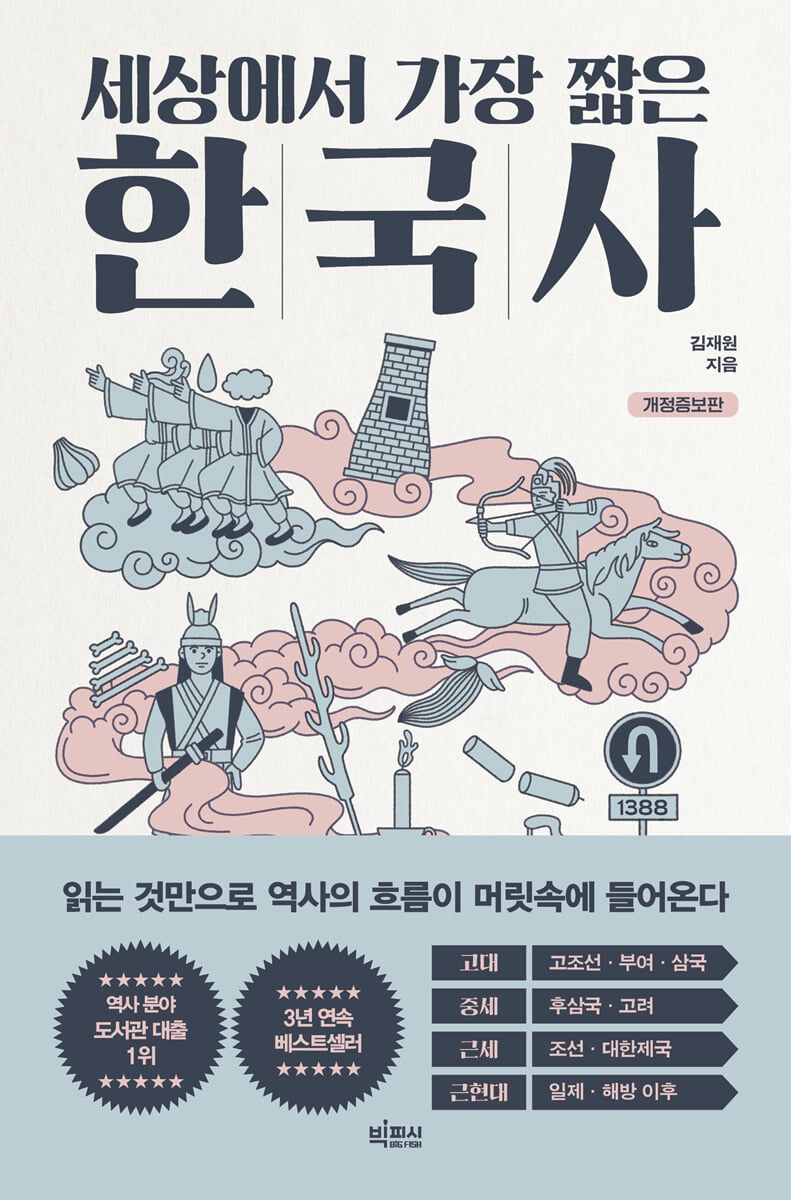
The shortest Korean history in the world
 |
Description
Book Introduction
#1 bestseller and library loaner for three consecutive years
Revised and expanded edition of "The World's Shortest History of Korea" published!
“The only book I ever read in full, despite my limited knowledge of history.”
“This is the most interesting Korean history book I’ve ever read!” _From a reader review
《The World's Shortest History of Korea》 introduces the most important moments in Korean history from ancient times to modern times, helping you grasp the flow of history in a single volume.
In particular, historian Kim Jae-won, who has become a hot topic through his appearances on various channels such as MBC's "Guys Who Cross the Line Season 5" and YouTube's "SBS DALI" "Over-immersive Joseon History," explains history as if it were a novel, constantly connecting the past and present.
Listening to his stories of Korean history, which are easy but not light, interesting but unforgettable, you realize that history is not an academic discipline confined to textbooks, but a story that connects with you today.
Now is the time to read thousands of years of Korean history in one volume.
Sometimes you may feel out of breath, and other times you may find yourself so absorbed that you lose track of time.
But if we carefully understand the stories from long ago in one context, at some point when we reach the last chapter, we will meet the present us.
Revised and expanded edition of "The World's Shortest History of Korea" published!
“The only book I ever read in full, despite my limited knowledge of history.”
“This is the most interesting Korean history book I’ve ever read!” _From a reader review
《The World's Shortest History of Korea》 introduces the most important moments in Korean history from ancient times to modern times, helping you grasp the flow of history in a single volume.
In particular, historian Kim Jae-won, who has become a hot topic through his appearances on various channels such as MBC's "Guys Who Cross the Line Season 5" and YouTube's "SBS DALI" "Over-immersive Joseon History," explains history as if it were a novel, constantly connecting the past and present.
Listening to his stories of Korean history, which are easy but not light, interesting but unforgettable, you realize that history is not an academic discipline confined to textbooks, but a story that connects with you today.
Now is the time to read thousands of years of Korean history in one volume.
Sometimes you may feel out of breath, and other times you may find yourself so absorbed that you lose track of time.
But if we carefully understand the stories from long ago in one context, at some point when we reach the last chapter, we will meet the present us.
- You can preview some of the book's contents.
Preview
index
prolog.
An easy but not light journey through Korean history
Chapter 1.
youth of the world
If you ask whether the Dangun myth is true,
A time when being from Buyeo was a symbol of power.
There was life there too: Okjeo, Dongye, Samhan
Goguryeo's Alley Leader Meets Gwanggaeto the Great
An Apology for Baekje, a Country Filled with Dark History
The epic of betrayal written by the hero of reversal, Silla
Gaya's way of survival: choosing power over peace
A Full-Scale Clash of Worldviews: Goguryeo vs. the Unified Chinese Dynasty
King Uija, the tragic life that led to the end of Baekje
The family crisis that brought about Goguryeo's crisis
The Unification of the Three Kingdoms: A History of Division and Integration
Chapter 2.
Goryeo Dynasty
Heroes who revived a fallen nation
Goryeo, forging a new nation with love
The Secret of King Hyejong, the Unwelcome "Mat King"
The bold challenge of King Gwangjong, the king called Emperor
From a slutty woman to a remarkable heroine
The northern nations were too powerful to be ignored
Those who moved Goryeo, the aristocracy
The Strange Tale of the Fairy Master Myocheong
The Musin Coup: No One in the World Deserves to Be Ignored
The Mongol Empire, the Great Empire that Conquered the World, Meets Goryeo
A time when marriage moved politics
King Gongmin, a figure standing between a reformist monarch and a corrupt politician
Chapter 3.
Joseon Dynasty
It all started with real estate
Yi Bang-won, the ultimate victor of the revolution, and the country he dreamed of.
Gye-Yu-Jeong-Nan: Peace is a luxury for a newborn nation.
Yeonsangun, the son of a tyrant and a saintly king
The East Asian World War that occurred in the year of Imjin
The war changed everything
Hwan-guk shakes up Joseon politics
The mentally ill crown prince caused by his father's desires
The father of the king who dreamed of 'retro', Daewongun
In those days, when one year felt like a hundred, the man who became king, Gojong
Chapter 4.
Modern and contemporary times
Why Koreans Had to Leave for Hawaii in 1903
Why is Mokpo a place that encapsulates the history of Korean cities?
Koreans' enthusiasm for education began during the Japanese colonial period.
What Happened on Gunhamdo, a Symbol of Forced Conscription
In fact, the Korean War began in 1948.
Syngman Rhee and the Liberal Party's obsession with power
The crisis born of revolution creates a world for soldiers.
There is no such thing as a free democracy.
The day the symbol of Korea's economic growth collapsed
References
An easy but not light journey through Korean history
Chapter 1.
youth of the world
If you ask whether the Dangun myth is true,
A time when being from Buyeo was a symbol of power.
There was life there too: Okjeo, Dongye, Samhan
Goguryeo's Alley Leader Meets Gwanggaeto the Great
An Apology for Baekje, a Country Filled with Dark History
The epic of betrayal written by the hero of reversal, Silla
Gaya's way of survival: choosing power over peace
A Full-Scale Clash of Worldviews: Goguryeo vs. the Unified Chinese Dynasty
King Uija, the tragic life that led to the end of Baekje
The family crisis that brought about Goguryeo's crisis
The Unification of the Three Kingdoms: A History of Division and Integration
Chapter 2.
Goryeo Dynasty
Heroes who revived a fallen nation
Goryeo, forging a new nation with love
The Secret of King Hyejong, the Unwelcome "Mat King"
The bold challenge of King Gwangjong, the king called Emperor
From a slutty woman to a remarkable heroine
The northern nations were too powerful to be ignored
Those who moved Goryeo, the aristocracy
The Strange Tale of the Fairy Master Myocheong
The Musin Coup: No One in the World Deserves to Be Ignored
The Mongol Empire, the Great Empire that Conquered the World, Meets Goryeo
A time when marriage moved politics
King Gongmin, a figure standing between a reformist monarch and a corrupt politician
Chapter 3.
Joseon Dynasty
It all started with real estate
Yi Bang-won, the ultimate victor of the revolution, and the country he dreamed of.
Gye-Yu-Jeong-Nan: Peace is a luxury for a newborn nation.
Yeonsangun, the son of a tyrant and a saintly king
The East Asian World War that occurred in the year of Imjin
The war changed everything
Hwan-guk shakes up Joseon politics
The mentally ill crown prince caused by his father's desires
The father of the king who dreamed of 'retro', Daewongun
In those days, when one year felt like a hundred, the man who became king, Gojong
Chapter 4.
Modern and contemporary times
Why Koreans Had to Leave for Hawaii in 1903
Why is Mokpo a place that encapsulates the history of Korean cities?
Koreans' enthusiasm for education began during the Japanese colonial period.
What Happened on Gunhamdo, a Symbol of Forced Conscription
In fact, the Korean War began in 1948.
Syngman Rhee and the Liberal Party's obsession with power
The crisis born of revolution creates a world for soldiers.
There is no such thing as a free democracy.
The day the symbol of Korea's economic growth collapsed
References
Detailed image
Into the book
Although it is briefly mentioned in textbooks and often appears as a test question, the only things we remember about Buyeo are that there was a noble class that named livestock after them and that they held a sacrificial rite called 'Yeonggo'.
And if you look a little deeper, you will find that Jumong, the founder of Goguryeo, and Onjo, the founder of Baekje, came from Buyeo.
This fact is too significant to just pass over.
Because Buyeo still existed when Goguryeo and Baekje were created.
If you think about it, isn't it a bit odd? The people of a perfectly healthy country would go so far south, even further south, to establish a new nation, and even proudly proclaim, "I'm from Buyeo."
Regardless of whether they truly came from Buyeo, what does it mean that the Goguryeo and Baekje people of the time used "coming from Buyeo" as a symbol of power? And why did the two countries that later came to dominate the Korean Peninsula proclaim each other, "My roots are in Buyeo"?
---From "The Time When Being from 'Buyeo' Was a Symbol of Power"
To Joseon's Neo-Confucian scholars, Empress Dowager Cheonchu was a strange figure.
He was a strange being born from a strong (close) incestuous marriage, and continued to have children through incest.
Moreover, as the Empress Dowager, she had children through an affair and even tried to place a Kim family member, not a Wang family member, on the throne.
How dare you talk about women.
(…) We must consider how Empress Dowager Cheonchu’s actions would have been perceived from the perspective of Goryeo, not from the perspective of the Joseon Dynasty’s Neo-Confucian scholars who evaluated her.
Empress Dowager Cheonchu's incestuous marriage was a tradition of the Goryeo royal family that was not at all strange.
The same goes for the act of trying to make a Kim, not a Wang, king.
In Goryeo, matrilineality was just as important as patrilineality.
Crucially, her communication wasn't going to be a big problem either.
In Goryeo, it was not a big deal for a young woman who had lost her husband to fall in love with another man.
Although they could have been a bit stricter because they were royalty, considering Empress Dowager Cheonchu's influence, the love affair itself could not have been a flaw.
Does Empress Dowager Cheonchu still appear as a sentimental woman blinded by love, or as a politician determined to do politics properly? It's not too late for us to decide.
---From "From a Slutty Woman to an Outstanding Heroine"
The country was in shambles after the war between Goryeo and Mongolia.
Many people died, and naturally the population decreased.
(…) Goryeo’s finances, unable to collect taxes, gradually dried up.
They tried to settle the nomads and carry out reclamation projects to raise money somehow, but it was not enough.
Goryeo's system had already collapsed.
As it became difficult to cultivate farmland directly, Goryeo began to distribute wasteland to the powerful and encourage cultivation.
The powerful, who had an abundance of money and people, jumped into the land reclamation business without hesitation.
(…) From the king’s close associates to the royal family and the so-called Buwon faction, everyone was obsessed with competing to take over the country.
It was precisely this reality of Goryeo that people began to murmur, saying, “There is no place to stick an awl.”
(…) Of course, there were some politicians who tried to save the country and its people.
They are the new generation of scholars.
Among them, there were those who thought, 'While we're at it, let's change the name of the country and the king too!', while there were others who thought, 'Isn't it a bit much to change the king too?'
But at least they did not deny that Goryeo's biggest problem was real estate (land).
---From "It All Started with Real Estate"
The spring of 1980 in Seoul and the lonely struggle in Gwangju were isolated in their regions, but the June Struggle of 1987 could have led to nationwide protests.
It was significant that not only opposition politicians, university students, and pro-democracy activists outside the establishment, but also the middle class, which had grown rapidly during the boom of the three lows, participated.
This is because it means that the common value of democracy is shared among the people of the Republic of Korea beyond the issue of making a living.
In October 1987, the current constitution, the so-called Constitution of the Sixth Republic, was promulgated, which included a direct presidential election system and strengthened presidential control and basic rights for the people.
The democracy we now take for granted is the fruit of a hard-won, bloody struggle.
And even now, Korean spring days are still struggling to overcome the occasional chill of spring cold that brings warmth.
Because there is no such thing as a free lunch.
---From "There is no such thing as free democracy in the world"
Sampoong Department Store suffered its worst disaster at 5:55 PM on June 29, 1995, when the entire building A collapsed.
It was a disaster that was predicted because everything from design to construction, maintenance, and management was flawed.
Who would have imagined that the symbol of Gangnam would crumble?
(…) This collapse was a foreshadowing of the IMF crisis that would occur two years later.
No one could have predicted that the wealth that South Korea had accumulated would lead to bankruptcy.
The sudden and compressed growth was a little unsettling, but that was it.
Moreover, 1997, when the IMF crisis broke out, was called the golden age of Korean capitalist history.
(…) For these Koreans, the collapse of the Sampoong Department Store was an exceptional disaster caused by greedy business owners trying to save money.
It had to be that way.
But the reality was not like that.
Just as the Sampoong Department Store was built, Korea's economic growth process was festering from within. As evidenced by the 648 billion won in unpaid wages reported to the Ministry of Labor just before the IMF crisis, companies were on the verge of bankruptcy, but banks appeared to be forcibly preventing them.
Among the numerous companies facing bankruptcy, a significant number were construction companies. It's no coincidence that the Hanbo Group, which built the Eunma Apartments in Gangnam, was the trigger for the IMF crisis.
And if you look a little deeper, you will find that Jumong, the founder of Goguryeo, and Onjo, the founder of Baekje, came from Buyeo.
This fact is too significant to just pass over.
Because Buyeo still existed when Goguryeo and Baekje were created.
If you think about it, isn't it a bit odd? The people of a perfectly healthy country would go so far south, even further south, to establish a new nation, and even proudly proclaim, "I'm from Buyeo."
Regardless of whether they truly came from Buyeo, what does it mean that the Goguryeo and Baekje people of the time used "coming from Buyeo" as a symbol of power? And why did the two countries that later came to dominate the Korean Peninsula proclaim each other, "My roots are in Buyeo"?
---From "The Time When Being from 'Buyeo' Was a Symbol of Power"
To Joseon's Neo-Confucian scholars, Empress Dowager Cheonchu was a strange figure.
He was a strange being born from a strong (close) incestuous marriage, and continued to have children through incest.
Moreover, as the Empress Dowager, she had children through an affair and even tried to place a Kim family member, not a Wang family member, on the throne.
How dare you talk about women.
(…) We must consider how Empress Dowager Cheonchu’s actions would have been perceived from the perspective of Goryeo, not from the perspective of the Joseon Dynasty’s Neo-Confucian scholars who evaluated her.
Empress Dowager Cheonchu's incestuous marriage was a tradition of the Goryeo royal family that was not at all strange.
The same goes for the act of trying to make a Kim, not a Wang, king.
In Goryeo, matrilineality was just as important as patrilineality.
Crucially, her communication wasn't going to be a big problem either.
In Goryeo, it was not a big deal for a young woman who had lost her husband to fall in love with another man.
Although they could have been a bit stricter because they were royalty, considering Empress Dowager Cheonchu's influence, the love affair itself could not have been a flaw.
Does Empress Dowager Cheonchu still appear as a sentimental woman blinded by love, or as a politician determined to do politics properly? It's not too late for us to decide.
---From "From a Slutty Woman to an Outstanding Heroine"
The country was in shambles after the war between Goryeo and Mongolia.
Many people died, and naturally the population decreased.
(…) Goryeo’s finances, unable to collect taxes, gradually dried up.
They tried to settle the nomads and carry out reclamation projects to raise money somehow, but it was not enough.
Goryeo's system had already collapsed.
As it became difficult to cultivate farmland directly, Goryeo began to distribute wasteland to the powerful and encourage cultivation.
The powerful, who had an abundance of money and people, jumped into the land reclamation business without hesitation.
(…) From the king’s close associates to the royal family and the so-called Buwon faction, everyone was obsessed with competing to take over the country.
It was precisely this reality of Goryeo that people began to murmur, saying, “There is no place to stick an awl.”
(…) Of course, there were some politicians who tried to save the country and its people.
They are the new generation of scholars.
Among them, there were those who thought, 'While we're at it, let's change the name of the country and the king too!', while there were others who thought, 'Isn't it a bit much to change the king too?'
But at least they did not deny that Goryeo's biggest problem was real estate (land).
---From "It All Started with Real Estate"
The spring of 1980 in Seoul and the lonely struggle in Gwangju were isolated in their regions, but the June Struggle of 1987 could have led to nationwide protests.
It was significant that not only opposition politicians, university students, and pro-democracy activists outside the establishment, but also the middle class, which had grown rapidly during the boom of the three lows, participated.
This is because it means that the common value of democracy is shared among the people of the Republic of Korea beyond the issue of making a living.
In October 1987, the current constitution, the so-called Constitution of the Sixth Republic, was promulgated, which included a direct presidential election system and strengthened presidential control and basic rights for the people.
The democracy we now take for granted is the fruit of a hard-won, bloody struggle.
And even now, Korean spring days are still struggling to overcome the occasional chill of spring cold that brings warmth.
Because there is no such thing as a free lunch.
---From "There is no such thing as free democracy in the world"
Sampoong Department Store suffered its worst disaster at 5:55 PM on June 29, 1995, when the entire building A collapsed.
It was a disaster that was predicted because everything from design to construction, maintenance, and management was flawed.
Who would have imagined that the symbol of Gangnam would crumble?
(…) This collapse was a foreshadowing of the IMF crisis that would occur two years later.
No one could have predicted that the wealth that South Korea had accumulated would lead to bankruptcy.
The sudden and compressed growth was a little unsettling, but that was it.
Moreover, 1997, when the IMF crisis broke out, was called the golden age of Korean capitalist history.
(…) For these Koreans, the collapse of the Sampoong Department Store was an exceptional disaster caused by greedy business owners trying to save money.
It had to be that way.
But the reality was not like that.
Just as the Sampoong Department Store was built, Korea's economic growth process was festering from within. As evidenced by the 648 billion won in unpaid wages reported to the Ministry of Labor just before the IMF crisis, companies were on the verge of bankruptcy, but banks appeared to be forcibly preventing them.
Among the numerous companies facing bankruptcy, a significant number were construction companies. It's no coincidence that the Hanbo Group, which built the Eunma Apartments in Gangnam, was the trigger for the IMF crisis.
---From "The Day the Symbol of Korean Economic Growth Collapsed"
Publisher's Review
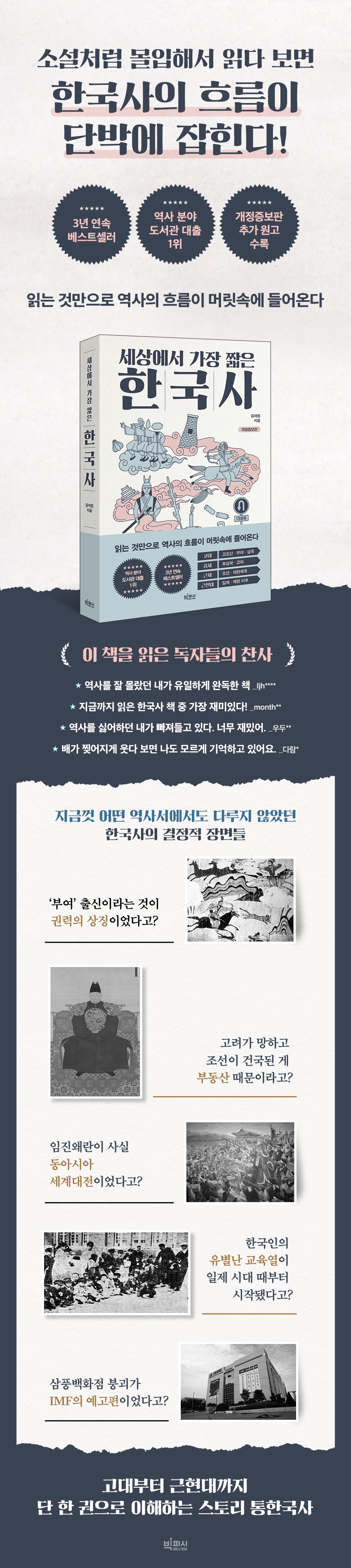
If you read it with such immersion that it feels like a novel, you'll instantly grasp the flow of history.
Although I have been exposed to history through various contents since I was young, I don't actually remember much of it.
I've often heard that history has a flow, but it's hard to remember even a single event, let alone the flow.
Why is that?
Kim Jae-won, author of “The Shortest Korean History in the World,” says that this is because the past and present cannot be connected.
History is the sum total of countless cause-and-effect relationships.
This means that it is not a list of fragmented facts that we have learned by memorizing them.
《The World's Shortest History of Korea》 firmly connects the major threads of historical facts from ancient times to modern times, explaining how the past and present have influenced each other.
For example, the collapse of the Sampoong Department Store was a simple accident, but historically, it was a preview of the IMF crisis and a cross-section of the history of South Korea's economic growth.
The problems of Seoul's real estate today can also be understood from the Sampoong Department Store.
Historian Kim Jae-won, who has garnered attention through his appearances on various channels such as MBC's "Guys Who Cross the Line Season 5" and YouTube's "SBS DALI" "Over-immersive Joseon History," explains history as if it were a novel, constantly connecting the past and present.
Additionally, this revised and expanded edition includes a new article on 'Spring in Seoul,' which was also made into a movie and became a hot topic.
As you listen to his stories of Korean history, which are easy but not light, interesting but unforgettable, you will realize that history is not an academic discipline confined to textbooks, but a story that connects with you today.
The definitive edition of exciting, cutting-edge historical research never before covered in any Korean history book.
- Being from Buyeo was a symbol of power?
- Is it because of real estate that Goryeo fell and Joseon was founded?
- The Imjin War, known as the Imjin War, was actually a world war in East Asia?
- Are you saying that Koreans' unusual enthusiasm for education began during the Japanese colonial period?
《The World's Shortest History of Korea》 introduces new historical perspectives never before presented in popular history books through the latest research materials, and corrects previously held misconceptions.
Was the relationship between Goryeo and Mongolia, long considered a history of humiliation, truly a humiliation for the Goryeo people, especially the Goryeo king? Was the Imjin War, long referred to as the Imjin War, truly a war between Korea and Japan? What is the assessment of Gojong, the last emperor of the Korean Empire? Was Joseon truly confined within the Korean Peninsula, unaware of the evolving world, and was Gojong simply an incompetent ruler?
On the one hand, it also raises this question:
We all know names like Okjeo, Dongye, and Samhan, but why do seemingly small and insignificant nations appear in textbooks? The author argues that there's a clear reason why these nations, once considered minor and marginal, are included in textbooks, and explains why.
This book examines and interprets these historical facts in the context of East Asian and world history, beyond the history of the Korean Peninsula.
This is because all historical facts inevitably arise in relation to various surrounding countries.
A single volume of story-based Korean history from ancient times to modern times.
《The World's Shortest History of Korea》 introduces the most important moments in Korean history from ancient times to modern times, helping you understand the flow of Korean history in just one volume.
As we immerse ourselves in reading and discover how the historical events we knew in fragments are connected and intertwined, we will naturally experience the flow of history entering our minds.
If this book allows us to walk through the past, shatter erroneous historical stereotypes, think beyond textbooks, and seek the causes of our current problems from the past, that will be more valuable than the weight of history.
Although I have been exposed to history through various contents since I was young, I don't actually remember much of it.
I've often heard that history has a flow, but it's hard to remember even a single event, let alone the flow.
Why is that?
Kim Jae-won, author of “The Shortest Korean History in the World,” says that this is because the past and present cannot be connected.
History is the sum total of countless cause-and-effect relationships.
This means that it is not a list of fragmented facts that we have learned by memorizing them.
《The World's Shortest History of Korea》 firmly connects the major threads of historical facts from ancient times to modern times, explaining how the past and present have influenced each other.
For example, the collapse of the Sampoong Department Store was a simple accident, but historically, it was a preview of the IMF crisis and a cross-section of the history of South Korea's economic growth.
The problems of Seoul's real estate today can also be understood from the Sampoong Department Store.
Historian Kim Jae-won, who has garnered attention through his appearances on various channels such as MBC's "Guys Who Cross the Line Season 5" and YouTube's "SBS DALI" "Over-immersive Joseon History," explains history as if it were a novel, constantly connecting the past and present.
Additionally, this revised and expanded edition includes a new article on 'Spring in Seoul,' which was also made into a movie and became a hot topic.
As you listen to his stories of Korean history, which are easy but not light, interesting but unforgettable, you will realize that history is not an academic discipline confined to textbooks, but a story that connects with you today.
The definitive edition of exciting, cutting-edge historical research never before covered in any Korean history book.
- Being from Buyeo was a symbol of power?
- Is it because of real estate that Goryeo fell and Joseon was founded?
- The Imjin War, known as the Imjin War, was actually a world war in East Asia?
- Are you saying that Koreans' unusual enthusiasm for education began during the Japanese colonial period?
《The World's Shortest History of Korea》 introduces new historical perspectives never before presented in popular history books through the latest research materials, and corrects previously held misconceptions.
Was the relationship between Goryeo and Mongolia, long considered a history of humiliation, truly a humiliation for the Goryeo people, especially the Goryeo king? Was the Imjin War, long referred to as the Imjin War, truly a war between Korea and Japan? What is the assessment of Gojong, the last emperor of the Korean Empire? Was Joseon truly confined within the Korean Peninsula, unaware of the evolving world, and was Gojong simply an incompetent ruler?
On the one hand, it also raises this question:
We all know names like Okjeo, Dongye, and Samhan, but why do seemingly small and insignificant nations appear in textbooks? The author argues that there's a clear reason why these nations, once considered minor and marginal, are included in textbooks, and explains why.
This book examines and interprets these historical facts in the context of East Asian and world history, beyond the history of the Korean Peninsula.
This is because all historical facts inevitably arise in relation to various surrounding countries.
A single volume of story-based Korean history from ancient times to modern times.
《The World's Shortest History of Korea》 introduces the most important moments in Korean history from ancient times to modern times, helping you understand the flow of Korean history in just one volume.
As we immerse ourselves in reading and discover how the historical events we knew in fragments are connected and intertwined, we will naturally experience the flow of history entering our minds.
If this book allows us to walk through the past, shatter erroneous historical stereotypes, think beyond textbooks, and seek the causes of our current problems from the past, that will be more valuable than the weight of history.
GOODS SPECIFICS
- Date of issue: August 28, 2024
- Page count, weight, size: 392 pages | 644g | 145*220*24mm
- ISBN13: 9791194033257
- ISBN10: 1194033253
You may also like
카테고리
korean


korean

![GQ KOREA Mark (Monthly): December [2025]](http://librairie.coreenne.fr/cdn/shop/files/8ef265dbbfbf186523ed75ba7319009d.jpg?v=1765340328&width=3840)


