

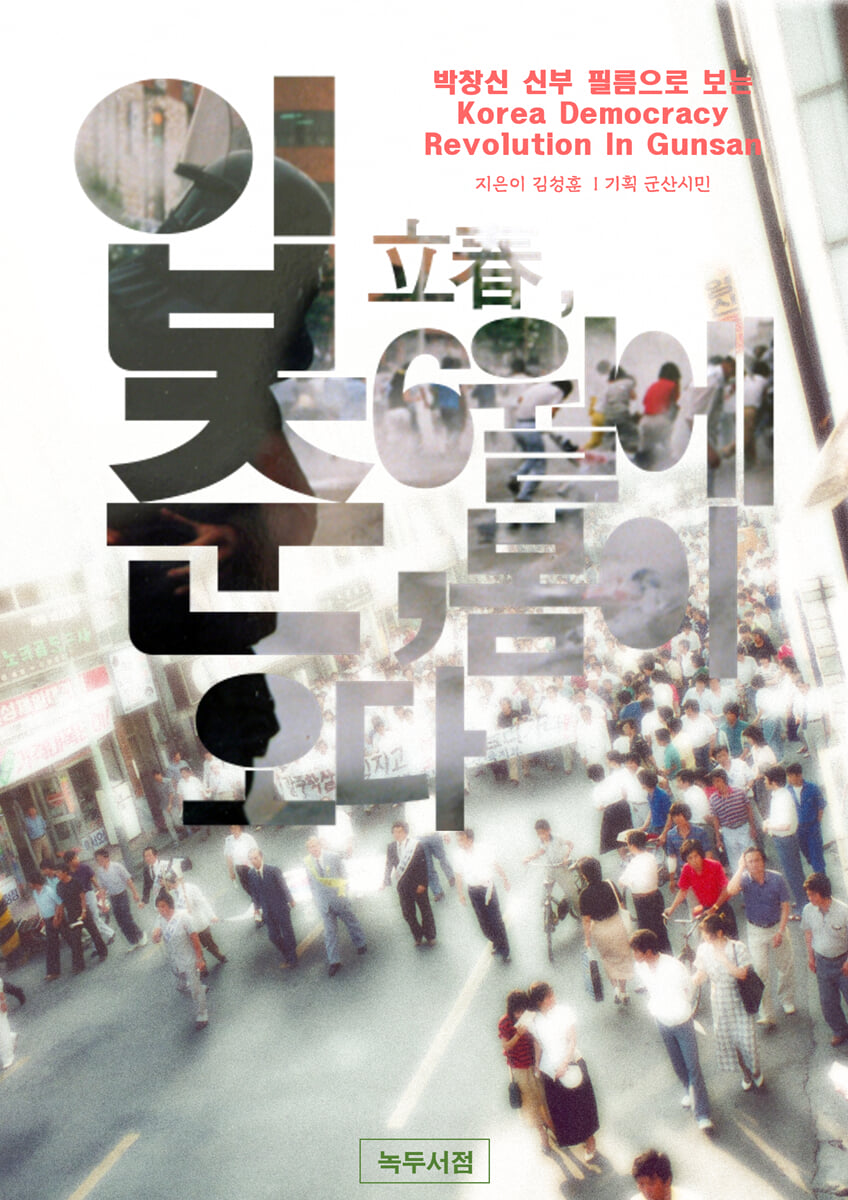
Beginning of Spring (立春), spring comes in June
 |
Description
Book Introduction
This book contains films of local democratization movements.
The person who took those films was Father Park Chang-shin.
Additionally, last year, there was a research project for 'Collection and Digitalization of Records of the Democratization Movement' in Jeollabuk-do, and the 'Jeonbuk Democratization Movement Commemoration Association' was in charge of the 'Digital DB' project.
Most of the photos in this book are of Father Park Chang-shin.
A few photos of other groups are also included.
The photo of martyr Lee Han-yeol was taken with the cooperation of the Lee Han-yeol Memorial Association.
Some photos of former President Kim Dae-jung were provided with the cooperation of the Yonsei University Kim Dae-jung Library.
This book is a record of the author's youth.
It is the result of a young man in his 20s talking to the past.
And this book is one that was completed together by citizens.
The author went out to the streets of Gunsan every month every year and tried to find out the small meaning of each photo.
They wrote down the facts they remembered little by little.
Although the story of Gunsan's democratization movement is quite interesting and suggests many lessons, there was no organized material on it.
After personal research, the author discovered that Park Chang-shin's film was a good film to intuitively show the course of the Gunsan June Uprising.
And furthermore, I came to think that this might be the only film that could systematically and properly show the course of the local June Struggle.
With these films, the author develops the content through conversations with activists.
And as I talk to them, I gradually come to realize the truth of history.
The truth is that you, the citizen readers who are reading this book, are changing the world.
The process by which the author came to realize this fact while talking with activists was very natural.
And we will record the entire process and share it with our readers.
What you see in this book is not 'boring history' but a 'story'.
It's just the story of your lives and the story of your future lives.
The author aimed to organize the records while simultaneously sending a message to the citizen readers.
This book aims to show what kind of change can happen when all generations join forces and understand each other in a society where hatred and indifference are perpetuated.
I wanted to show how civic spirit has brought about social change in recent history.
Although there were some changes in the narrative style to reduce boredom in each part, the narrative message of the citizens' 'social concern' and 'pure sense of justice' was maintained.
Because it contributed greatly to changing society.
Our goal should be to create the 'common good' found in communities built on human connectedness.
The person who took those films was Father Park Chang-shin.
Additionally, last year, there was a research project for 'Collection and Digitalization of Records of the Democratization Movement' in Jeollabuk-do, and the 'Jeonbuk Democratization Movement Commemoration Association' was in charge of the 'Digital DB' project.
Most of the photos in this book are of Father Park Chang-shin.
A few photos of other groups are also included.
The photo of martyr Lee Han-yeol was taken with the cooperation of the Lee Han-yeol Memorial Association.
Some photos of former President Kim Dae-jung were provided with the cooperation of the Yonsei University Kim Dae-jung Library.
This book is a record of the author's youth.
It is the result of a young man in his 20s talking to the past.
And this book is one that was completed together by citizens.
The author went out to the streets of Gunsan every month every year and tried to find out the small meaning of each photo.
They wrote down the facts they remembered little by little.
Although the story of Gunsan's democratization movement is quite interesting and suggests many lessons, there was no organized material on it.
After personal research, the author discovered that Park Chang-shin's film was a good film to intuitively show the course of the Gunsan June Uprising.
And furthermore, I came to think that this might be the only film that could systematically and properly show the course of the local June Struggle.
With these films, the author develops the content through conversations with activists.
And as I talk to them, I gradually come to realize the truth of history.
The truth is that you, the citizen readers who are reading this book, are changing the world.
The process by which the author came to realize this fact while talking with activists was very natural.
And we will record the entire process and share it with our readers.
What you see in this book is not 'boring history' but a 'story'.
It's just the story of your lives and the story of your future lives.
The author aimed to organize the records while simultaneously sending a message to the citizen readers.
This book aims to show what kind of change can happen when all generations join forces and understand each other in a society where hatred and indifference are perpetuated.
I wanted to show how civic spirit has brought about social change in recent history.
Although there were some changes in the narrative style to reduce boredom in each part, the narrative message of the citizens' 'social concern' and 'pure sense of justice' was maintained.
Because it contributed greatly to changing society.
Our goal should be to create the 'common good' found in communities built on human connectedness.
index
Preface - We haven't forgotten you.
- I love you and I believe in you.
Part 1: The Bride Who Resembles Nan
Part 2: Oryong-dong Cathedral Citizen Lecture
Park Chang-shin, who took office in 1984 in a barren land of the democratization movement.
1985: The launch and promotion of citizen lectures
Topics and awareness of citizen lectures
Strict surveillance by the police and the Agency for National Security Planning, and citizens gathering
Hidden Helpers Inside the Cathedral
Part 3: Sepung Plywood Labor Struggle
The hardships and simple lives of Sepung plywood workers
Revolutionary of Sepung Plywood, Gyeongam Girls' High School Student and the February Struggle
Love between priests, Seo Cheol-sim and his students
The bond between youth, students, and workers in Oryong-dong
April 15th 'We Shout'
April 16th, breaking through the dormitory confinement and into the auditorium!
April 17, support and assistance from the Jeonbuk Democratization Movement Council
April 18, the company's deceptive negotiations and the Oryong-dong Cathedral (former) convent
Life in the auditorium, Mokwoojeulpung (沐雨櫛風)
The End of the Siege (April 19th) and the Unfinished Fight
Oryong-dong Cathedral and Sepung Plywood Prayer Meeting
May class boycott and hunger strike at Gunsan Prison
Sepung Plywood's legal battle: "Release the Sepung detainees immediately!"
Looking back on the Sepung Plywood incident
The life of advanced workers after the labor struggle
Meeting with the student leader of Gyeongam Girls' High School
Part 4: Gunsan June Struggle
October 1986.
9th New Democratic Party Direct Election Constitutional Amendment Promotion Conference
Background of the June Struggle
The June Struggle Preliminaries and the Death of Lee Han-yeol
Organizations participating in the Gunsan June Struggle
June 10th, preparations for the Gunsan Citizens' Rally to Condemn the Cover-Up of the Torture and Murder of Private Park Jong-cheol and to Abolish the Constitution
June 10th, a peace march by 10,000 Gunsan citizens
After June 10th, protests have calmed down.
June 18th, tear gas ban rally
June 19, Gunsan National University Democratic Student Association and Oryong-dong Cathedral all-night sit-in
The largest crowd in Gunsan history gathers for the June 26th National Peace March for a Democratic Constitution!
On the 27th, Democracy Day, the courage and fighting spirit of citizens can be heard through the tear gas.
"Gunsan citizens are alive, hula hula"
Freedom Day on the 28th: The Beginning of the Crackdown
Citizens, enraged by the harsh crackdown, march to City Hall with Molotov cocktails!
On the morning of the 28th and 29th, ominous rumors spread from citizens' mouths.
June 29th, Unification Day and Roh Tae-woo's Declaration
But the citizens of Gunsan did not stop.
June 30th, I am a citizen of Gunsan! I will fight to the end!
Now I can say it.
Oryong-dong youth and Gunsan Minchuhyup
Behind the Scenes, Those People Back Then
After achieving the 5th direct election system,
Lee Han-yeol's Democratic National Medal
Movement to Release Prisoners of Conscience
Election Struggle 1 (Kim Dae-jung)
Election Struggle 2 (Roh Tae-woo)
The assault of Private Jeong Yeon-gwan and the "Yohan" incident
Part 6: The Great Workers' Struggle
Workers and Martyr Lee Seok-gyu after the achievement of direct elections
Memories of the National Military Prison Branch and the Workers
Jeonbuk Passenger Service Gunsan Branch Struggle
Gunsan Taxi Union Struggle
Gunsan Doosan Glass Workers' Struggle
A long history of workers' struggles
Extraordinary Osonghoe Incident
Conclusion - I haven't forgotten you.
- I love you and I believe in you.
Part 1: The Bride Who Resembles Nan
Part 2: Oryong-dong Cathedral Citizen Lecture
Park Chang-shin, who took office in 1984 in a barren land of the democratization movement.
1985: The launch and promotion of citizen lectures
Topics and awareness of citizen lectures
Strict surveillance by the police and the Agency for National Security Planning, and citizens gathering
Hidden Helpers Inside the Cathedral
Part 3: Sepung Plywood Labor Struggle
The hardships and simple lives of Sepung plywood workers
Revolutionary of Sepung Plywood, Gyeongam Girls' High School Student and the February Struggle
Love between priests, Seo Cheol-sim and his students
The bond between youth, students, and workers in Oryong-dong
April 15th 'We Shout'
April 16th, breaking through the dormitory confinement and into the auditorium!
April 17, support and assistance from the Jeonbuk Democratization Movement Council
April 18, the company's deceptive negotiations and the Oryong-dong Cathedral (former) convent
Life in the auditorium, Mokwoojeulpung (沐雨櫛風)
The End of the Siege (April 19th) and the Unfinished Fight
Oryong-dong Cathedral and Sepung Plywood Prayer Meeting
May class boycott and hunger strike at Gunsan Prison
Sepung Plywood's legal battle: "Release the Sepung detainees immediately!"
Looking back on the Sepung Plywood incident
The life of advanced workers after the labor struggle
Meeting with the student leader of Gyeongam Girls' High School
Part 4: Gunsan June Struggle
October 1986.
9th New Democratic Party Direct Election Constitutional Amendment Promotion Conference
Background of the June Struggle
The June Struggle Preliminaries and the Death of Lee Han-yeol
Organizations participating in the Gunsan June Struggle
June 10th, preparations for the Gunsan Citizens' Rally to Condemn the Cover-Up of the Torture and Murder of Private Park Jong-cheol and to Abolish the Constitution
June 10th, a peace march by 10,000 Gunsan citizens
After June 10th, protests have calmed down.
June 18th, tear gas ban rally
June 19, Gunsan National University Democratic Student Association and Oryong-dong Cathedral all-night sit-in
The largest crowd in Gunsan history gathers for the June 26th National Peace March for a Democratic Constitution!
On the 27th, Democracy Day, the courage and fighting spirit of citizens can be heard through the tear gas.
"Gunsan citizens are alive, hula hula"
Freedom Day on the 28th: The Beginning of the Crackdown
Citizens, enraged by the harsh crackdown, march to City Hall with Molotov cocktails!
On the morning of the 28th and 29th, ominous rumors spread from citizens' mouths.
June 29th, Unification Day and Roh Tae-woo's Declaration
But the citizens of Gunsan did not stop.
June 30th, I am a citizen of Gunsan! I will fight to the end!
Now I can say it.
Oryong-dong youth and Gunsan Minchuhyup
Behind the Scenes, Those People Back Then
After achieving the 5th direct election system,
Lee Han-yeol's Democratic National Medal
Movement to Release Prisoners of Conscience
Election Struggle 1 (Kim Dae-jung)
Election Struggle 2 (Roh Tae-woo)
The assault of Private Jeong Yeon-gwan and the "Yohan" incident
Part 6: The Great Workers' Struggle
Workers and Martyr Lee Seok-gyu after the achievement of direct elections
Memories of the National Military Prison Branch and the Workers
Jeonbuk Passenger Service Gunsan Branch Struggle
Gunsan Taxi Union Struggle
Gunsan Doosan Glass Workers' Struggle
A long history of workers' struggles
Extraordinary Osonghoe Incident
Conclusion - I haven't forgotten you.
Detailed image

Into the book
Since when have we been living without believing in our own strength?
And this is pervasive throughout society.
We have to overcome this.
We must not look at society with a totalitarian attitude.
And we must believe in the power of our attention.
Don't look at the group, open your ears.
For example, the biased investigation conducted by the Yoon Seok-yeol administration is problematic.
And the Democratic Party's immoral and criminal actions are also a problem.
We need to move forward while criticizing both sides of this.
Even if it seems like nothing is changing, you have to speak up.
Even if it seems like nothing has changed, we as citizens must take an interest.
I think about this so seriously that I have talked about it many times with people around me.
It is not simply a case of political apathy.
The forms of loathing and indifference that arise from loneliness are revealed.
--- p.43
After the terrorist attack at Yeosan Cathedral, Father Park Chang-shin overcame adversity and rose again.
Then I started taking pictures, which became a legacy and record for future generations.
And this book was planned with the films he took.
Naturally, this book was also structured around the events he witnessed.
And I arranged the photos to fit the description of the process.
Technically speaking, he is not a professional photographer.
But the ordinariness of his rough photographs speaks volumes about the history of ordinary heroes.
I hope that as you read this book, you will understand the events of the Gunsan Uprising and discover the hidden values within them.
--- p.52
Next, if you look at the back, you can see expressions such as ‘Let’s listen and pass it on together’, ‘Let’s pass it on to each other’, ‘Let’s pass it on to each other for the people’s democracy and national unification’, and ‘Let’s pass it on to each other’.
This is the phrase that Father Park Chang-shin and the youth used while spreading lecture tapes throughout Gunsan City.
This shows Father Park Chang-shin's belief in consciousness.
Park Chang-shin “What I consider most important is… raising awareness of a person.
If you raise awareness in even one person, that one person will spread it to others.
Again, those two people spread the word to another person.
Again, I believe that the four of you… will become more conscious of each other and ultimately contribute to changing the world.” For Father Park Chang-shin, consciousness-raising was a struggle to change the world.
That was the reason why he moved forward despite numerous obstacles.
--- p.98
Q.
“I heard the police were watching you. Do you remember anything about that?”
Ok Geum-su: “I also went outside to check the net and report the situation.
Because you never know what the police might do.
…, there is a Peace Supermarket in front of Oryong-dong Cathedral.
“In front of that, the detectives were watching us to see where we were going.” In the early stages of the citizen lecture, the citizens were frozen by the police surveillance.
The priest had to give a lecture centered on the believers.
However, the continued efforts of priests and young people, coupled with the nationwide atmosphere of constitutional revision, have led to the popularity of citizen lectures.
This course was able to continue thanks to the citizens who participated in it despite the strict police surveillance.
Just by taking an interest in society, you can become an unsung hero.
That is what a citizen is.
--- p.109
Lim Hyeon-sun: “(With a truly pitiful expression) The students’ menstrual problems, that was actually a big problem.
I was a man at the time, so I didn't know it was that serious.
That was blocked, and the students said, "Hyunsoon, go to the bathroom." I didn't know that students relieved themselves in such a poor place.
The water isn't draining so my sneakers are sinking into the urine.
So how did the students relieve themselves here? There were pads floating around, and I just poked through them with my bare hands.
How do you do it?
The water needs to drain.
I told you that I took all the sanitary pads out and put them in the trash can, and did it with my bare hands.
I remember breaking through that.
I really am… still like that.
I wonder what the students thought of that poor bathroom... It was really bad.
When students like that do it without any plan, without any of that, just… just look at it like that (sob)”
To us, what we see in this photo is just a torn piece of wallpaper.
And we can confirm through oral testimony that the female students used things like folding screens to write.
For us, this may be just that.
Readers might think, "What a shame that there was such a thing as a torn piece of paper to write on."
But it can't be just that, a photo.
If you don't understand what I mean, just look at the attitude of the workers on the ground.
The workers who saw this photo (Kim Cheol-gyu and Lim Hyeon-sun) are different from us.
I understood, recalled, and expressed my emotions beyond what I could express in text.
The fact that we must see through this photo is also at the end of their gaze.
--- p.171
The citizens of Gwangju were isolated from the outside world by the military.
However, internally, citizens cooperated with each other.
Within this, civil autonomy without violence or looting was realized.
German journalist Hinzpeter went to Gwangju to cover the story and was deeply moved by the people's innocence and realization of autonomy.
Foreigners also risked their lives to spread the word about this to the outside world.
In this way, the common good was realized in a community formed by human rights in Gwangju.
The people took care of the families of those who were injured and killed by the tyranny of Chun Doo-hwan's military junta.
He recognized himself and his neighbors as a single entity called 'Gwangju citizens.'
What made it possible was a pure sense of justice without any price.
This incident marked the beginning of many democratic forces, including students, beginning to believe in the power of the people.
People from various sectors came together and fought until the end.
I realized the need for a mass movement.
What contributed to student activists' devotion to social movements was the civic consciousness blossoming from the sense of justice and love of the Gwangju people.
--- p.241
We held our own event until 3pm.
From 4 p.m., police and about 1,000 citizens staged a sit-in protest at City Hall.
At around 6 p.m., four girls from the military camp near the Gunsan US military base also participated, holding the Taegeukgi flag.
Citizens sang songs such as March for You, May Song, and Our Wish is Unification, and around 6 PM, they demanded that the police release those arrested and pay for the hospital bills and responsible treatment of the patients.
Now the citizens were joining together and fighting for the injured.
They left their own comfort behind for their neighbors.
I didn't know the names or faces of the neighbors I fought with.
However, we have all come this far through hardship, sharing the same incident and the same story.
That's why they were colleagues.
In response, the police responded with tear gas.
The citizens' anger had already reached the sky.
Students threw the stones they had collected since morning.
The stone-throwing battle unfolded again.
--- p.341
Ok Geum-su: “That was all done by the citizens.
This is like telling us not to come over to our side anymore.
The positive thing is that when we set up barricades here, we say, ‘This is our own space of liberation.’ That’s what we do.”
The Gukbon Gunok branch and the youth were surprised by the citizens' strength more than once during the protests.
Citizens have consistently defied the predictions of the leaders leading the protests.
In fact, it was easy to predict that the larger the scale of the protest and the longer it lasted, the more forceful the police would be.
However, the resistance of the citizens was unpredictable.
That was also a big concern.
It's strange that I'm not worried, considering what the public showed me before June.
However, not only did they resist the police's harsh suppression, they actively set up barricades and engaged in stone-throwing.
The people and students of the National Police Agency were rather taken aback by the active Gunsan citizens.
And I was impressed by the way they trusted each other and fought until the end.
--- p.346
There was a student who, without belonging to any group, took to the streets before 1987, encouraged citizens to participate, and fought alone.
His name is Hwang Kyung-soo (policy advisor to the Minister of Government Administration and Home Affairs under the Roh Moo-hyun administration).
Hwang Gyeong-su: “(Before the June Struggle) there was a series of tortures and the Bucheon sexual torture incident.
Is it right to see such things and remain silent without being angry or sympathetic? Is that right? I think it's actually abnormal.
No, there's no one who doesn't know that that's wrong.
But you can't say that? You don't come forward? We can all come forward together.
“It’s the same with anything.”
--- p.367
The reason that direct election constitutional amendment was possible was the mobilization of citizens.
Therefore, the name of the declaration must contain the subjectivity of the citizens.
If we call it the June 29th Declaration, it is difficult to emphasize that the subject was citizens.
Moreover, the fragmentary fact that "Roh Tae-woo announced the June 29th Declaration" can, if mistakenly succumb to a leader-centered view of history, obscure Roh Tae-woo's mistakes and lead to the perception of him as a politician who contributed to democratization.
Although Roh Tae-woo was the one who simply issued the declaration, it was the citizens who created this history.
So, I would like to call the declaration itself about this declaration the 'Declaration for Achieving Direct Election'.
In that way, we can emphasize history in which the public is the main subject.
The June Struggle is a history won by the citizens.
--- p.380
Police: "You little shit, think about it among the living."
Park Jeong-seok “…Every time torture was inflicted, the name of an unrelated person would come out like a groan.
I think that's when the names of Father Moon Gyu-hyun and Teacher Jo Seong-yong came up.
It left me with a constant sense of shame and guilt.”
Who should live with a guilty conscience? Is it Mr. Park Jeong-seok, tortured and scarred for life under the McCarthyism of the new military regime? Or is it those who, hoping for a special promotion, tortured and reduced a living man to a corpse?
And this is pervasive throughout society.
We have to overcome this.
We must not look at society with a totalitarian attitude.
And we must believe in the power of our attention.
Don't look at the group, open your ears.
For example, the biased investigation conducted by the Yoon Seok-yeol administration is problematic.
And the Democratic Party's immoral and criminal actions are also a problem.
We need to move forward while criticizing both sides of this.
Even if it seems like nothing is changing, you have to speak up.
Even if it seems like nothing has changed, we as citizens must take an interest.
I think about this so seriously that I have talked about it many times with people around me.
It is not simply a case of political apathy.
The forms of loathing and indifference that arise from loneliness are revealed.
--- p.43
After the terrorist attack at Yeosan Cathedral, Father Park Chang-shin overcame adversity and rose again.
Then I started taking pictures, which became a legacy and record for future generations.
And this book was planned with the films he took.
Naturally, this book was also structured around the events he witnessed.
And I arranged the photos to fit the description of the process.
Technically speaking, he is not a professional photographer.
But the ordinariness of his rough photographs speaks volumes about the history of ordinary heroes.
I hope that as you read this book, you will understand the events of the Gunsan Uprising and discover the hidden values within them.
--- p.52
Next, if you look at the back, you can see expressions such as ‘Let’s listen and pass it on together’, ‘Let’s pass it on to each other’, ‘Let’s pass it on to each other for the people’s democracy and national unification’, and ‘Let’s pass it on to each other’.
This is the phrase that Father Park Chang-shin and the youth used while spreading lecture tapes throughout Gunsan City.
This shows Father Park Chang-shin's belief in consciousness.
Park Chang-shin “What I consider most important is… raising awareness of a person.
If you raise awareness in even one person, that one person will spread it to others.
Again, those two people spread the word to another person.
Again, I believe that the four of you… will become more conscious of each other and ultimately contribute to changing the world.” For Father Park Chang-shin, consciousness-raising was a struggle to change the world.
That was the reason why he moved forward despite numerous obstacles.
--- p.98
Q.
“I heard the police were watching you. Do you remember anything about that?”
Ok Geum-su: “I also went outside to check the net and report the situation.
Because you never know what the police might do.
…, there is a Peace Supermarket in front of Oryong-dong Cathedral.
“In front of that, the detectives were watching us to see where we were going.” In the early stages of the citizen lecture, the citizens were frozen by the police surveillance.
The priest had to give a lecture centered on the believers.
However, the continued efforts of priests and young people, coupled with the nationwide atmosphere of constitutional revision, have led to the popularity of citizen lectures.
This course was able to continue thanks to the citizens who participated in it despite the strict police surveillance.
Just by taking an interest in society, you can become an unsung hero.
That is what a citizen is.
--- p.109
Lim Hyeon-sun: “(With a truly pitiful expression) The students’ menstrual problems, that was actually a big problem.
I was a man at the time, so I didn't know it was that serious.
That was blocked, and the students said, "Hyunsoon, go to the bathroom." I didn't know that students relieved themselves in such a poor place.
The water isn't draining so my sneakers are sinking into the urine.
So how did the students relieve themselves here? There were pads floating around, and I just poked through them with my bare hands.
How do you do it?
The water needs to drain.
I told you that I took all the sanitary pads out and put them in the trash can, and did it with my bare hands.
I remember breaking through that.
I really am… still like that.
I wonder what the students thought of that poor bathroom... It was really bad.
When students like that do it without any plan, without any of that, just… just look at it like that (sob)”
To us, what we see in this photo is just a torn piece of wallpaper.
And we can confirm through oral testimony that the female students used things like folding screens to write.
For us, this may be just that.
Readers might think, "What a shame that there was such a thing as a torn piece of paper to write on."
But it can't be just that, a photo.
If you don't understand what I mean, just look at the attitude of the workers on the ground.
The workers who saw this photo (Kim Cheol-gyu and Lim Hyeon-sun) are different from us.
I understood, recalled, and expressed my emotions beyond what I could express in text.
The fact that we must see through this photo is also at the end of their gaze.
--- p.171
The citizens of Gwangju were isolated from the outside world by the military.
However, internally, citizens cooperated with each other.
Within this, civil autonomy without violence or looting was realized.
German journalist Hinzpeter went to Gwangju to cover the story and was deeply moved by the people's innocence and realization of autonomy.
Foreigners also risked their lives to spread the word about this to the outside world.
In this way, the common good was realized in a community formed by human rights in Gwangju.
The people took care of the families of those who were injured and killed by the tyranny of Chun Doo-hwan's military junta.
He recognized himself and his neighbors as a single entity called 'Gwangju citizens.'
What made it possible was a pure sense of justice without any price.
This incident marked the beginning of many democratic forces, including students, beginning to believe in the power of the people.
People from various sectors came together and fought until the end.
I realized the need for a mass movement.
What contributed to student activists' devotion to social movements was the civic consciousness blossoming from the sense of justice and love of the Gwangju people.
--- p.241
We held our own event until 3pm.
From 4 p.m., police and about 1,000 citizens staged a sit-in protest at City Hall.
At around 6 p.m., four girls from the military camp near the Gunsan US military base also participated, holding the Taegeukgi flag.
Citizens sang songs such as March for You, May Song, and Our Wish is Unification, and around 6 PM, they demanded that the police release those arrested and pay for the hospital bills and responsible treatment of the patients.
Now the citizens were joining together and fighting for the injured.
They left their own comfort behind for their neighbors.
I didn't know the names or faces of the neighbors I fought with.
However, we have all come this far through hardship, sharing the same incident and the same story.
That's why they were colleagues.
In response, the police responded with tear gas.
The citizens' anger had already reached the sky.
Students threw the stones they had collected since morning.
The stone-throwing battle unfolded again.
--- p.341
Ok Geum-su: “That was all done by the citizens.
This is like telling us not to come over to our side anymore.
The positive thing is that when we set up barricades here, we say, ‘This is our own space of liberation.’ That’s what we do.”
The Gukbon Gunok branch and the youth were surprised by the citizens' strength more than once during the protests.
Citizens have consistently defied the predictions of the leaders leading the protests.
In fact, it was easy to predict that the larger the scale of the protest and the longer it lasted, the more forceful the police would be.
However, the resistance of the citizens was unpredictable.
That was also a big concern.
It's strange that I'm not worried, considering what the public showed me before June.
However, not only did they resist the police's harsh suppression, they actively set up barricades and engaged in stone-throwing.
The people and students of the National Police Agency were rather taken aback by the active Gunsan citizens.
And I was impressed by the way they trusted each other and fought until the end.
--- p.346
There was a student who, without belonging to any group, took to the streets before 1987, encouraged citizens to participate, and fought alone.
His name is Hwang Kyung-soo (policy advisor to the Minister of Government Administration and Home Affairs under the Roh Moo-hyun administration).
Hwang Gyeong-su: “(Before the June Struggle) there was a series of tortures and the Bucheon sexual torture incident.
Is it right to see such things and remain silent without being angry or sympathetic? Is that right? I think it's actually abnormal.
No, there's no one who doesn't know that that's wrong.
But you can't say that? You don't come forward? We can all come forward together.
“It’s the same with anything.”
--- p.367
The reason that direct election constitutional amendment was possible was the mobilization of citizens.
Therefore, the name of the declaration must contain the subjectivity of the citizens.
If we call it the June 29th Declaration, it is difficult to emphasize that the subject was citizens.
Moreover, the fragmentary fact that "Roh Tae-woo announced the June 29th Declaration" can, if mistakenly succumb to a leader-centered view of history, obscure Roh Tae-woo's mistakes and lead to the perception of him as a politician who contributed to democratization.
Although Roh Tae-woo was the one who simply issued the declaration, it was the citizens who created this history.
So, I would like to call the declaration itself about this declaration the 'Declaration for Achieving Direct Election'.
In that way, we can emphasize history in which the public is the main subject.
The June Struggle is a history won by the citizens.
--- p.380
Police: "You little shit, think about it among the living."
Park Jeong-seok “…Every time torture was inflicted, the name of an unrelated person would come out like a groan.
I think that's when the names of Father Moon Gyu-hyun and Teacher Jo Seong-yong came up.
It left me with a constant sense of shame and guilt.”
Who should live with a guilty conscience? Is it Mr. Park Jeong-seok, tortured and scarred for life under the McCarthyism of the new military regime? Or is it those who, hoping for a special promotion, tortured and reduced a living man to a corpse?
--- p.503
Publisher's Review
What is the role of citizens? Ultimately, we must strive to make individualism more collectivist, and collectivism more individualistic (satisfying the values of community and individualism to the greatest extent possible, recognizing that this process requires compromise).
Is it the right of the individual or the good of society? Is it my justice or the best for the community? Is it freedom or camaraderie?) One of these two freedoms must be put aside within the appropriate limit.
However, depending on your values, these choices are not necessarily mutually exclusive.
Throughout history, human rights issues have been the subject of considerable debate.
Sometimes it even helped indirectly or directly with the problems of other countries.
There are people who, regardless of their country of origin, are helping to help the famine and refugees in Africa.
Human rights issues have been advancing to realize the common good by viewing humanity itself as a community.
It was not limited to the national community.
We have overcome national identity by focusing on humanity itself and the connectedness that humanity possesses.
Herein lies a hint of where we must ultimately reach for the common good.
At this point, human rights are both individual and community values.
Because my rights and your rights are everyone's rights, we build empathy and help each other.
Human connectivity and relationships are uniquely different from those of other animals.
There is a unique aspect to cooperation between different groups.
The Gunsan June Struggle also illustrates these aspects very well.
It's not just Gunsan, but the June Struggle itself.
People from all generations and all walks of life were present at the scene of this historic change.
Nationalists, social democrats, communists, liberals, conservatives, and progressives all jumped in.
Of course, politicians had a purpose.
However, it was not for ordinary citizens.
How could people with such diverse backgrounds and goals come together and fight? Given today's society, does that seem possible?
I wrote this book to let people know that there was such a history.
Political apathy continues.
I understand.
Politics seems distant from us.
Moreover, they are busy defending policies that make hateful remarks or excessively increase working hours.
Even those who call themselves progressive are forming totalitarianism.
Real problems have become so structured that they are difficult to solve.
Even the president is acting without communication.
Dear readers, it was not easy to escape the oppression and fear of the new military regime.
I hope that through this book, you will realize what the "real driving force" was that helped you overcome the terror of the new military regime, and that its essence is something you all already possess.
Let's love everyone! And in the spirit of love, let's care for the problems of our neighbors! Let's dismantle totalitarian identities!
I love you all.
I believe in you all living in this world, loving one another.
I believe in those of you who are concerned about social issues and the economy.
I believe that you too are sitting at your desk feeling lonely.
I believe that because of human connection, we will overcome difficult problems together.
Let's all take the first step toward changing the world with a little effort, a little concern! And when that concern comes together through the forgotten value of the June Struggle, let's experience the social change it brings!
Is it the right of the individual or the good of society? Is it my justice or the best for the community? Is it freedom or camaraderie?) One of these two freedoms must be put aside within the appropriate limit.
However, depending on your values, these choices are not necessarily mutually exclusive.
Throughout history, human rights issues have been the subject of considerable debate.
Sometimes it even helped indirectly or directly with the problems of other countries.
There are people who, regardless of their country of origin, are helping to help the famine and refugees in Africa.
Human rights issues have been advancing to realize the common good by viewing humanity itself as a community.
It was not limited to the national community.
We have overcome national identity by focusing on humanity itself and the connectedness that humanity possesses.
Herein lies a hint of where we must ultimately reach for the common good.
At this point, human rights are both individual and community values.
Because my rights and your rights are everyone's rights, we build empathy and help each other.
Human connectivity and relationships are uniquely different from those of other animals.
There is a unique aspect to cooperation between different groups.
The Gunsan June Struggle also illustrates these aspects very well.
It's not just Gunsan, but the June Struggle itself.
People from all generations and all walks of life were present at the scene of this historic change.
Nationalists, social democrats, communists, liberals, conservatives, and progressives all jumped in.
Of course, politicians had a purpose.
However, it was not for ordinary citizens.
How could people with such diverse backgrounds and goals come together and fight? Given today's society, does that seem possible?
I wrote this book to let people know that there was such a history.
Political apathy continues.
I understand.
Politics seems distant from us.
Moreover, they are busy defending policies that make hateful remarks or excessively increase working hours.
Even those who call themselves progressive are forming totalitarianism.
Real problems have become so structured that they are difficult to solve.
Even the president is acting without communication.
Dear readers, it was not easy to escape the oppression and fear of the new military regime.
I hope that through this book, you will realize what the "real driving force" was that helped you overcome the terror of the new military regime, and that its essence is something you all already possess.
Let's love everyone! And in the spirit of love, let's care for the problems of our neighbors! Let's dismantle totalitarian identities!
I love you all.
I believe in you all living in this world, loving one another.
I believe in those of you who are concerned about social issues and the economy.
I believe that you too are sitting at your desk feeling lonely.
I believe that because of human connection, we will overcome difficult problems together.
Let's all take the first step toward changing the world with a little effort, a little concern! And when that concern comes together through the forgotten value of the June Struggle, let's experience the social change it brings!
GOODS SPECIFICS
- Date of issue: July 12, 2024
- Page count, weight, size: 544 pages | 152*215*35mm
- ISBN13: 9791198337931
- ISBN10: 1198337931
You may also like
카테고리
korean


korean

![GQ KOREA Mark (Monthly): December [2025]](http://librairie.coreenne.fr/cdn/shop/files/8ef265dbbfbf186523ed75ba7319009d.jpg?v=1765340328&width=3840)


