

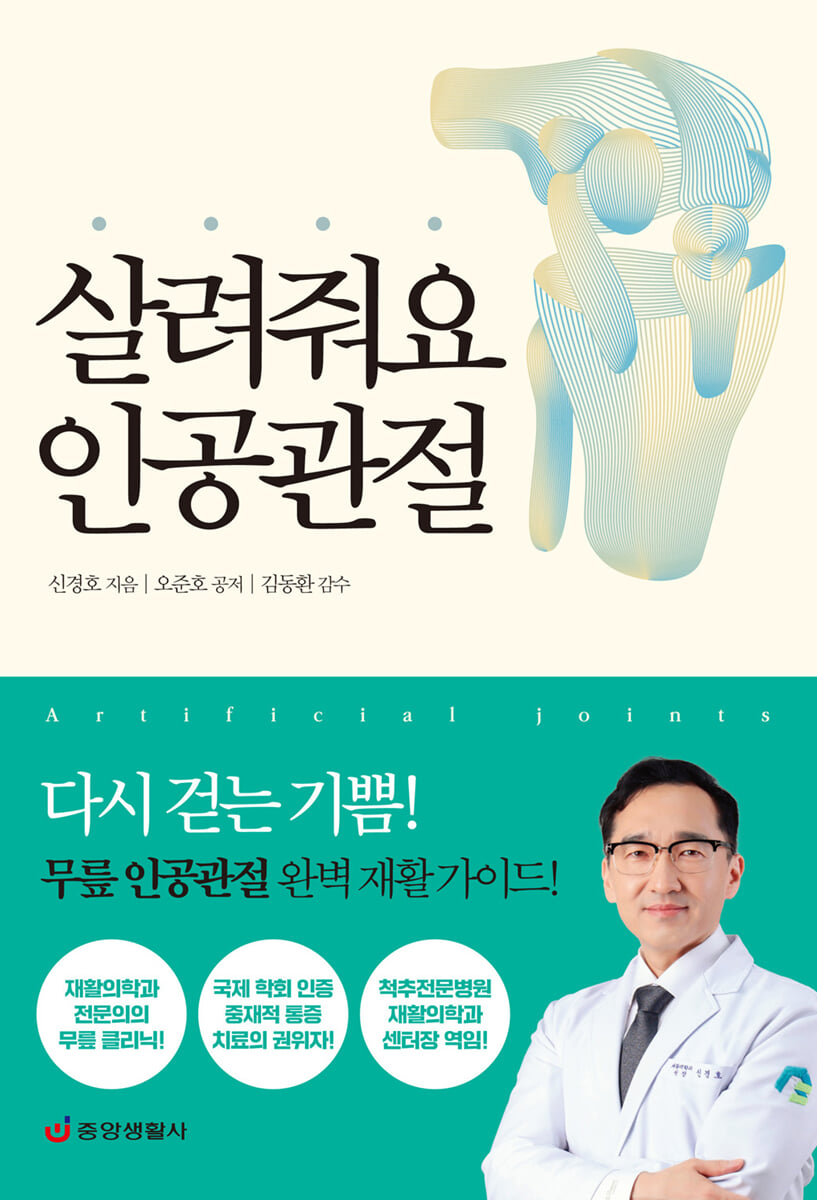
Save me, artificial joint
 |
Description
Book Introduction
* The comprehensive guidebook for artificial joints that 3 million patients have been waiting for!
* Guiding patients through their entire journey, from pre-operative anxiety to rehabilitation!
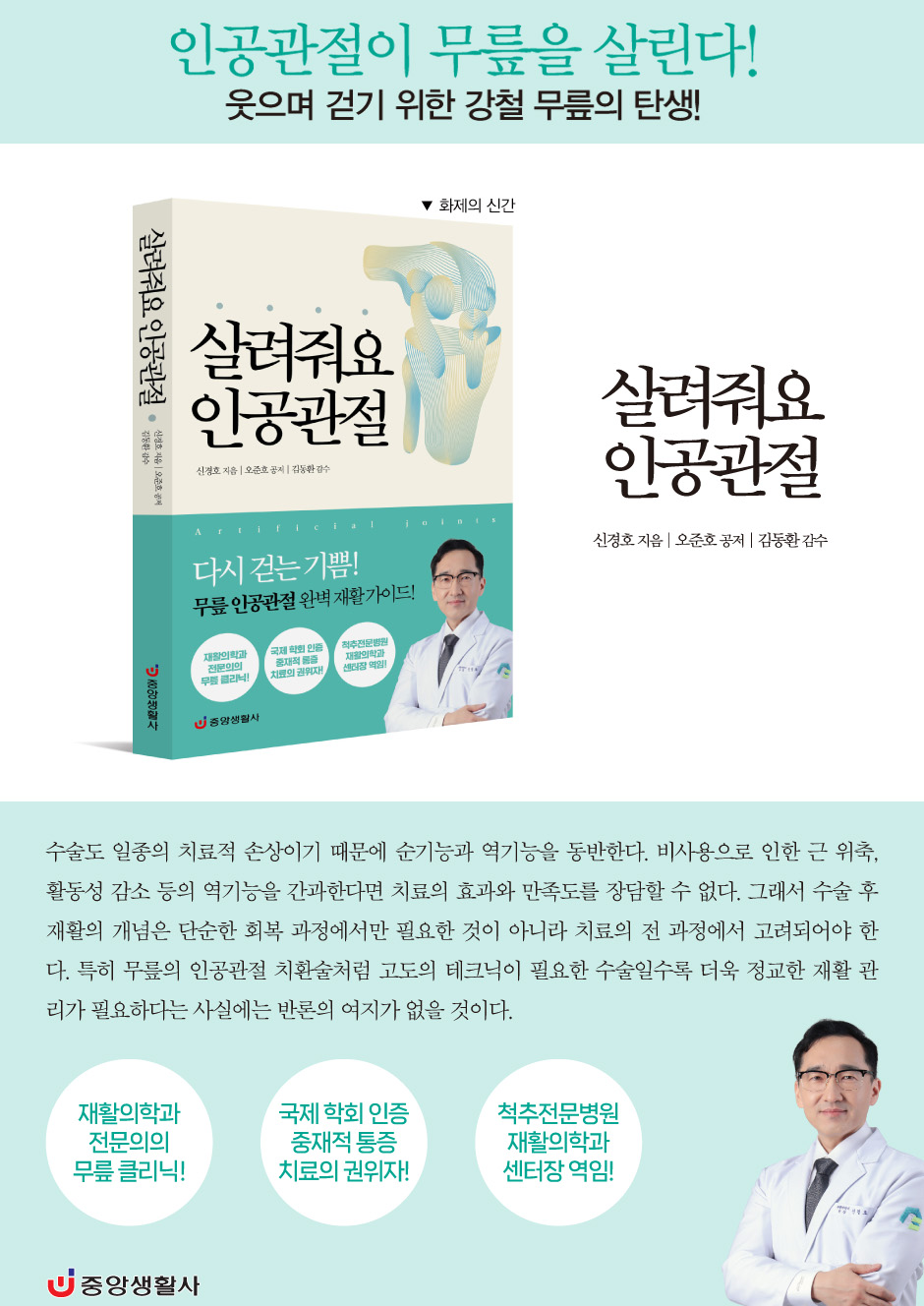
The author of this book, Dr. Shin Kyung-ho, is a rehabilitation medicine specialist with over 30 years of clinical experience. Based on this experience, he has explained the entire process of artificial joint surgery, from pre-operative rehabilitation, the surgical process, and post-operative rehabilitation, in an easy-to-understand manner.
Therefore, this book not only conveys medical knowledge, but also serves as a warm guide that understands patients' anxieties and fears and aims to restore their quality of life.
Instead of using complex medical terms, we provide explanations that are easy for patients to understand, and we have included abundant on-site photos and illustrations, as well as QR codes, to help with the surgical process and rehabilitation, so that patients and their families can easily follow along.
In addition, it contains all the practical information that patients are most curious about, such as pre-operative preparation, dealing with complications, and post-discharge care.
Not only that, it also covers ways to relieve psychological fear and depression, and delicately cares for the patient's 'body and mind'.
This book will help patients view artificial joint surgery not as a "final choice" but as "the beginning of a new life." Through this book, patients will be able to experience the joy of walking again, their families will be able to feel reassured, and medical staff will gain trust.
* Guiding patients through their entire journey, from pre-operative anxiety to rehabilitation!
The author of this book, Dr. Shin Kyung-ho, is a rehabilitation medicine specialist with over 30 years of clinical experience. Based on this experience, he has explained the entire process of artificial joint surgery, from pre-operative rehabilitation, the surgical process, and post-operative rehabilitation, in an easy-to-understand manner.
Therefore, this book not only conveys medical knowledge, but also serves as a warm guide that understands patients' anxieties and fears and aims to restore their quality of life.
Instead of using complex medical terms, we provide explanations that are easy for patients to understand, and we have included abundant on-site photos and illustrations, as well as QR codes, to help with the surgical process and rehabilitation, so that patients and their families can easily follow along.
In addition, it contains all the practical information that patients are most curious about, such as pre-operative preparation, dealing with complications, and post-discharge care.
Not only that, it also covers ways to relieve psychological fear and depression, and delicately cares for the patient's 'body and mind'.
This book will help patients view artificial joint surgery not as a "final choice" but as "the beginning of a new life." Through this book, patients will be able to experience the joy of walking again, their families will be able to feel reassured, and medical staff will gain trust.
- You can preview some of the book's contents.
Preview
index
Recommendation | Acknowledgments | Preface
Chapter 1 Why do knees hurt and do I really need artificial joint surgery?
1.
Why do my knees hurt?
Causes of Knee Pain | Diagnosis of Arthritis | [Can I Ask This?] About the Symptoms
2.
How to preserve joint cartilage?
Our Attitude to Coping with Knee Pain | Drug Treatment | Injection Treatment | Hyaluronic Acid vs. Polynucleotide | [Can I Ask This?] About Treatment
3.
Types of surgeries prior to artificial joint replacement
Arthroscopy | Cartilage regeneration therapy | Osteotomy surgery | [Can I ask this?] About surgery
4.
Understanding Artificial Joint Surgery
Timing of artificial joint replacement surgery | [Can I ask this?] About artificial joint replacement surgery | Preparation at home before artificial joint replacement surgery | [Can I ask this?] About preparation for surgery
Chapter 2: Artificial Joint Surgery: Everything from Admission to Discharge
1.
What to prepare before surgery
Preparation at the hospital before surgery
2.
How will the surgical procedure proceed?
Preview of the artificial joint surgery process | Possible complications after artificial joint surgery | [Can I ask this?] About post-operative complications | Pain and other possible complications | [Can I ask this?] About various reactions after surgery | Why does it still hurt after surgery?
3.
From surgery to discharge
The first day after surgery | From the second to the fifth day after surgery | Other personal care | Checkpoints upon discharge | [Can I ask this?] About early rehabilitation exercises
Chapter 3: Rehabilitation Methods for Living with Steel Knees for the Rest of Your Life After Discharge
1.
Artificial Joint Rehabilitation Elementary Course [Weeks 1-4]
First week of rehabilitation: “Home? To a rehabilitation hospital?”|[Can I ask this?] About the first week of rehabilitation|Second week of rehabilitation: “Will I be able to walk like before again?”|[Can I ask this?] About the second week of rehabilitation|Third to fourth weeks of rehabilitation: “I was worried for nothing!”|[Can I ask this?] About the third to fourth weeks of rehabilitation|Aquatic rehabilitation: “Can I do rehabilitation in the water?”|[Can I ask this?] About aquatic rehabilitation treatment
2.
Artificial Joint Rehabilitation Intermediate Course [Weeks 5-6 of Rehabilitation]
Rehabilitation Weeks 5-6: “Let’s start dynamic exercises” | [Can I ask you something like this?] About Weeks 5-6 of Rehabilitation
3.
Advanced Artificial Joint Rehabilitation Course [7 weeks to 3 months of rehabilitation]
Rehabilitation 7 weeks to 3 months: “Artificial joint rehabilitation, it’s not time to stop yet!”|[Can I ask this?] About the 7th to 3rd month of rehabilitation
4.
Artificial joint rehabilitation completion process [4-6 months of rehabilitation]
Rehabilitation 4-6 months: “Lifelong precautions for artificial joint holders” | [Can I ask this?] About the 4-6 month rehabilitation period
5.
Artificial Joint Rehabilitation Lifelong Course [After 6 Months of Rehabilitation]
Within 1 year after 6 months of rehabilitation: “The artificial joint that has become a part of my body” | [Can I ask this?] About within 1 year after 6 months of rehabilitation | After 1 year after rehabilitation: “How to manage a steel knee” | [Can I ask this?] About after 1 year of rehabilitation
References
Chapter 1 Why do knees hurt and do I really need artificial joint surgery?
1.
Why do my knees hurt?
Causes of Knee Pain | Diagnosis of Arthritis | [Can I Ask This?] About the Symptoms
2.
How to preserve joint cartilage?
Our Attitude to Coping with Knee Pain | Drug Treatment | Injection Treatment | Hyaluronic Acid vs. Polynucleotide | [Can I Ask This?] About Treatment
3.
Types of surgeries prior to artificial joint replacement
Arthroscopy | Cartilage regeneration therapy | Osteotomy surgery | [Can I ask this?] About surgery
4.
Understanding Artificial Joint Surgery
Timing of artificial joint replacement surgery | [Can I ask this?] About artificial joint replacement surgery | Preparation at home before artificial joint replacement surgery | [Can I ask this?] About preparation for surgery
Chapter 2: Artificial Joint Surgery: Everything from Admission to Discharge
1.
What to prepare before surgery
Preparation at the hospital before surgery
2.
How will the surgical procedure proceed?
Preview of the artificial joint surgery process | Possible complications after artificial joint surgery | [Can I ask this?] About post-operative complications | Pain and other possible complications | [Can I ask this?] About various reactions after surgery | Why does it still hurt after surgery?
3.
From surgery to discharge
The first day after surgery | From the second to the fifth day after surgery | Other personal care | Checkpoints upon discharge | [Can I ask this?] About early rehabilitation exercises
Chapter 3: Rehabilitation Methods for Living with Steel Knees for the Rest of Your Life After Discharge
1.
Artificial Joint Rehabilitation Elementary Course [Weeks 1-4]
First week of rehabilitation: “Home? To a rehabilitation hospital?”|[Can I ask this?] About the first week of rehabilitation|Second week of rehabilitation: “Will I be able to walk like before again?”|[Can I ask this?] About the second week of rehabilitation|Third to fourth weeks of rehabilitation: “I was worried for nothing!”|[Can I ask this?] About the third to fourth weeks of rehabilitation|Aquatic rehabilitation: “Can I do rehabilitation in the water?”|[Can I ask this?] About aquatic rehabilitation treatment
2.
Artificial Joint Rehabilitation Intermediate Course [Weeks 5-6 of Rehabilitation]
Rehabilitation Weeks 5-6: “Let’s start dynamic exercises” | [Can I ask you something like this?] About Weeks 5-6 of Rehabilitation
3.
Advanced Artificial Joint Rehabilitation Course [7 weeks to 3 months of rehabilitation]
Rehabilitation 7 weeks to 3 months: “Artificial joint rehabilitation, it’s not time to stop yet!”|[Can I ask this?] About the 7th to 3rd month of rehabilitation
4.
Artificial joint rehabilitation completion process [4-6 months of rehabilitation]
Rehabilitation 4-6 months: “Lifelong precautions for artificial joint holders” | [Can I ask this?] About the 4-6 month rehabilitation period
5.
Artificial Joint Rehabilitation Lifelong Course [After 6 Months of Rehabilitation]
Within 1 year after 6 months of rehabilitation: “The artificial joint that has become a part of my body” | [Can I ask this?] About within 1 year after 6 months of rehabilitation | After 1 year after rehabilitation: “How to manage a steel knee” | [Can I ask this?] About after 1 year of rehabilitation
References
Detailed image
Into the book
It is important to review your daily life to see if there are any factors that could be causing knee pain, and eliminate them one by one as much as possible, rather than getting injections or taking medication.
So, if you feel knee pain, the first thing to look at is improving your habits in your daily life.
--- p.
44
In the past, it was said that the interval between surgeries on both knees was about 3 months, so the other knee was operated on when the knee that was operated on first was almost recovered and rehabilitation was completed.
However, if the surgery is performed in two stages on both knees, there is a disadvantage in that the total recovery and rehabilitation period is considerably longer.
So the recent trend has changed to performing both knee surgeries on the same day or at the latest with an interval of 1 to 2 weeks.
--- p.
76
The first step to successful rehabilitation is, paradoxically, rest to focus on recovering from the temporary debilitating effects of surgery.
So, on the first day after surgery, it is better to rest and relax in bed rather than trying to do too much activity.
However, you should begin warm-up exercises for walking even while lying in bed.
Of course, at first it's not easy enough to surprise yourself.
Because the first thing I realized was that it was difficult to move my legs as I wanted.
--- p.
128
Stair training begins in the second week of rehabilitation, and there are some principles that must be remembered.
'The principle is 'healthy leg up, surgical leg down!' When going up or down stairs, your legs will spread forward and backward, and this means that the healthy leg should be on top and the leg that was operated on should be on the bottom.
You can understand this as a process of raising the healthy leg first when going up and lowering the operated leg first when going down.
--- p.
177
After artificial joint surgery, the knee does not bend completely.
So, I can't do the kneeling position well.
However, if you force yourself to kneel, you may put strain on the artificial joint and the surrounding muscles and bone tissue, so you must be careful not to unknowingly assume this position.
So, if you feel knee pain, the first thing to look at is improving your habits in your daily life.
--- p.
44
In the past, it was said that the interval between surgeries on both knees was about 3 months, so the other knee was operated on when the knee that was operated on first was almost recovered and rehabilitation was completed.
However, if the surgery is performed in two stages on both knees, there is a disadvantage in that the total recovery and rehabilitation period is considerably longer.
So the recent trend has changed to performing both knee surgeries on the same day or at the latest with an interval of 1 to 2 weeks.
--- p.
76
The first step to successful rehabilitation is, paradoxically, rest to focus on recovering from the temporary debilitating effects of surgery.
So, on the first day after surgery, it is better to rest and relax in bed rather than trying to do too much activity.
However, you should begin warm-up exercises for walking even while lying in bed.
Of course, at first it's not easy enough to surprise yourself.
Because the first thing I realized was that it was difficult to move my legs as I wanted.
--- p.
128
Stair training begins in the second week of rehabilitation, and there are some principles that must be remembered.
'The principle is 'healthy leg up, surgical leg down!' When going up or down stairs, your legs will spread forward and backward, and this means that the healthy leg should be on top and the leg that was operated on should be on the bottom.
You can understand this as a process of raising the healthy leg first when going up and lowering the operated leg first when going down.
--- p.
177
After artificial joint surgery, the knee does not bend completely.
So, I can't do the kneeling position well.
However, if you force yourself to kneel, you may put strain on the artificial joint and the surrounding muscles and bone tissue, so you must be careful not to unknowingly assume this position.
--- p.
221
221
Publisher's Review
* Covers everything from pre-surgery rehabilitation to post-recovery life!
* A knee textbook for patients and their families to read together!
This book is a practical medical book that covers the entire process of knee replacement surgery. It explains the complex surgical procedures and rehabilitation process from a patient's perspective, making it easy for anyone to read.
The author, based on his clinical experience, answers the most frequently asked questions from patients in the field, such as “Do I really need surgery?” and “How long will rehabilitation take?” In addition to medical explanations, he also includes precautions for daily life, exercise methods, and psychological recovery methods.
This book will help patients and their guardians fill in the gaps that medical staff's explanations alone cannot.
You will also find in this book a solid guide to living your life with strong knees.
Combining expertise and warmth, this book serves as a bridge between patients and medical professionals and a new benchmark for artificial joint treatment.
This book will be an essential textbook for maintaining knee health and a guide for all of us living in a super-aging society.
* Artificial joint surgery is now a hope, not a fear!
* From anxiety to recovery, accompanying patients on their journey!
Knee replacement surgery is no longer just a problem for the elderly.
With life expectancy increasing, this is a reality that even people in their 40s and 50s will inevitably face at some point.
Therefore, this book delivers a preventative message to those in their 40s and 50s to prepare for knee health in advance and presents lifelong guidelines for artificial joint care.
What is noteworthy about this book is that it was written from a patient-centered perspective, rather than a doctor-centered one.
In my clinic, I have heard countless stories of patients who have been up all night with knee pain and their families who are anxious about surgery.
That is why, when patients and their guardians read this book, which is filled with the author's experiences, they can empathize with it and feel that it is "their story."
Additionally, the author meticulously explains how patients' lives change after artificial joint surgery and even long-term management methods.
Furthermore, it emphasizes that rehabilitation goes beyond simple exercise methods and is a process through which patients regain their social roles and daily independence.
This book is a comprehensive medical book on the knee, organically blending voices from the medical field and patient experiences.
It is designed so that patients and their families can read and discuss it together, and is highly usable in actual clinical settings.
This book goes beyond simple guidelines, discussing not only knee health but also quality of life and human recovery.
This book is a medical companion that transforms fear into hope, and a health guide for all generations.
* A knee textbook for patients and their families to read together!
This book is a practical medical book that covers the entire process of knee replacement surgery. It explains the complex surgical procedures and rehabilitation process from a patient's perspective, making it easy for anyone to read.
The author, based on his clinical experience, answers the most frequently asked questions from patients in the field, such as “Do I really need surgery?” and “How long will rehabilitation take?” In addition to medical explanations, he also includes precautions for daily life, exercise methods, and psychological recovery methods.
This book will help patients and their guardians fill in the gaps that medical staff's explanations alone cannot.
You will also find in this book a solid guide to living your life with strong knees.
Combining expertise and warmth, this book serves as a bridge between patients and medical professionals and a new benchmark for artificial joint treatment.
This book will be an essential textbook for maintaining knee health and a guide for all of us living in a super-aging society.
* Artificial joint surgery is now a hope, not a fear!
* From anxiety to recovery, accompanying patients on their journey!
Knee replacement surgery is no longer just a problem for the elderly.
With life expectancy increasing, this is a reality that even people in their 40s and 50s will inevitably face at some point.
Therefore, this book delivers a preventative message to those in their 40s and 50s to prepare for knee health in advance and presents lifelong guidelines for artificial joint care.
What is noteworthy about this book is that it was written from a patient-centered perspective, rather than a doctor-centered one.
In my clinic, I have heard countless stories of patients who have been up all night with knee pain and their families who are anxious about surgery.
That is why, when patients and their guardians read this book, which is filled with the author's experiences, they can empathize with it and feel that it is "their story."
Additionally, the author meticulously explains how patients' lives change after artificial joint surgery and even long-term management methods.
Furthermore, it emphasizes that rehabilitation goes beyond simple exercise methods and is a process through which patients regain their social roles and daily independence.
This book is a comprehensive medical book on the knee, organically blending voices from the medical field and patient experiences.
It is designed so that patients and their families can read and discuss it together, and is highly usable in actual clinical settings.
This book goes beyond simple guidelines, discussing not only knee health but also quality of life and human recovery.
This book is a medical companion that transforms fear into hope, and a health guide for all generations.
GOODS SPECIFICS
- Date of issue: September 25, 2025
- Page count, weight, size: 256 pages | 464g | 153*225*15mm
- ISBN13: 9788961413336
- ISBN10: 8961413333
You may also like
카테고리
korean


korean

![GQ KOREA Mark (Monthly): December [2025]](http://librairie.coreenne.fr/cdn/shop/files/8ef265dbbfbf186523ed75ba7319009d.jpg?v=1765340328&width=3840)


