

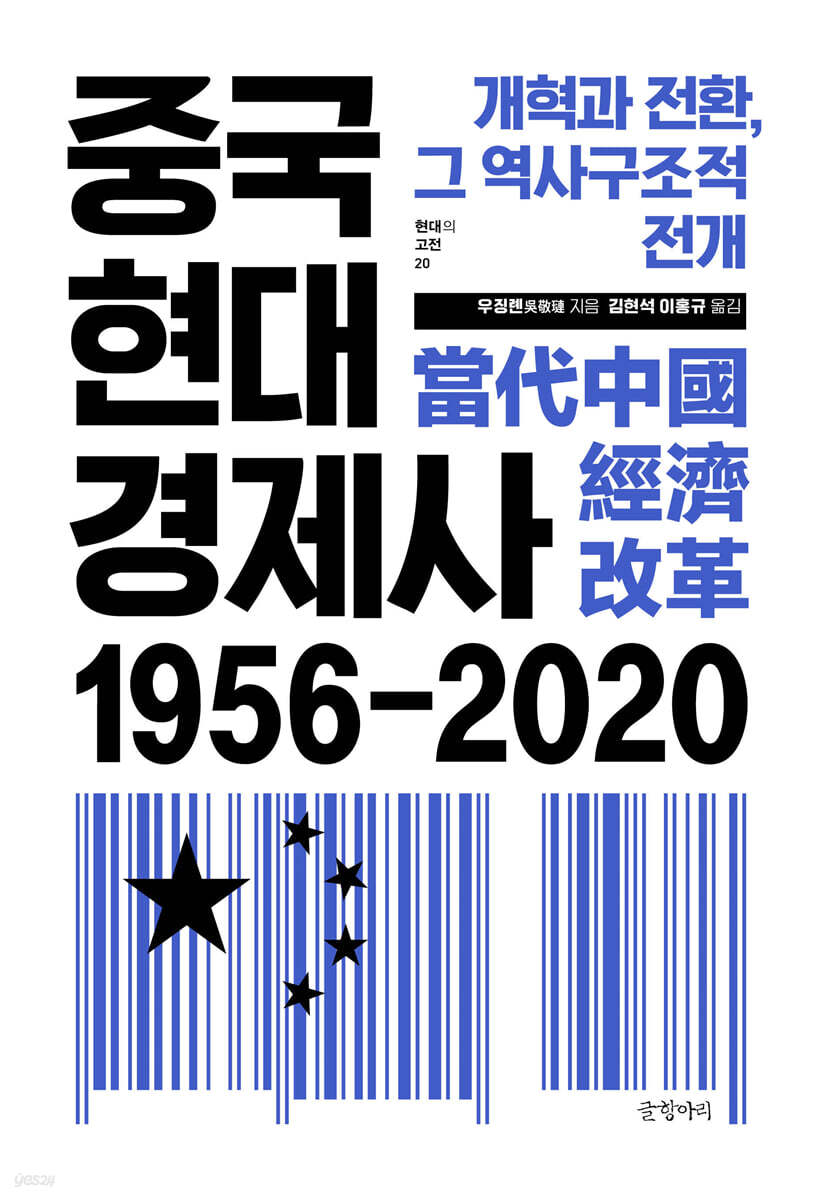
Modern Chinese Economic History 1956–2020
 |
Description
Book Introduction
The godfather of Chinese market economics
The most influential economist
Wu Jinglian talks about 70 years of Chinese economic reform!
Wu Jinglian, known as "Mr. Market" and a leading theorist of the socialist market economy, has been at the center of China's economic reform since the 1980s and has covered over 70 years of economic history, from the early planned economy in the founding of the People's Republic of China to the transitional period of market-oriented reform, and from the comprehensive reform and opening-up policy to the present.
Theoretically, it covers everything from the economic models of Marx, Engels, Lenin, and Stalin to modern economics, and historically, it covers cases of economic reform in the Soviet Union, Eastern Europe, and East Asia, and even the current reality of China in the 2020s. It also covers China's rural reform, corporate reform, and financial reform in detail, so it can be called a comprehensive summary of China's economic reform and a textbook on reform and opening up.
This is especially significant because it is the work of Wu Jinglian, a "living conscience" of the economics community who is not just a mere public figure but has provided a practical theoretical framework for the modern Chinese economy and continues to criticize the Chinese leadership to this day.
A must-read for anyone who wants to understand the past and present of the Chinese economy.
The most influential economist
Wu Jinglian talks about 70 years of Chinese economic reform!
Wu Jinglian, known as "Mr. Market" and a leading theorist of the socialist market economy, has been at the center of China's economic reform since the 1980s and has covered over 70 years of economic history, from the early planned economy in the founding of the People's Republic of China to the transitional period of market-oriented reform, and from the comprehensive reform and opening-up policy to the present.
Theoretically, it covers everything from the economic models of Marx, Engels, Lenin, and Stalin to modern economics, and historically, it covers cases of economic reform in the Soviet Union, Eastern Europe, and East Asia, and even the current reality of China in the 2020s. It also covers China's rural reform, corporate reform, and financial reform in detail, so it can be called a comprehensive summary of China's economic reform and a textbook on reform and opening up.
This is especially significant because it is the work of Wu Jinglian, a "living conscience" of the economics community who is not just a mere public figure but has provided a practical theoretical framework for the modern Chinese economy and continues to criticize the Chinese leadership to this day.
A must-read for anyone who wants to understand the past and present of the Chinese economy.
- You can preview some of the book's contents.
Preview
index
Part 1 General Provisions
Chapter 1: Raising the Issue of Establishing and Reforming a Planned Economy
1.
Socialist economic system concept
1.1 The ideal society of early socialists
1.2 Marx's 'scientific socialism' and 'social factory' model
1.3 The Division of the 20th-Century Socialist Movement and the 'Welfare State' Model
2.
Establishment of a Soviet-style socialist system
2.1 Lenin's 'State Syndicate' Model
2.2 Stalin's regime
3.
Economic Analysis of Centralized Planned Economic Systems
3.1 Neoclassical economists' arguments on the feasibility of a planned economy
3.2 The Socialist Debate in Western Economics in the 1920s and 1930s
3.3 Re-examination of the planned economy in the late 20th century
4.
Economic reforms in the Soviet Union and Eastern Europe
4.1 Soviet economic improvement efforts and failures
4.2 Yugoslavia's 'autonomous socialist' reforms
4.3 Hungary's 'New Economic Mechanism'
4.4 Polish reforms, repeatedly promoted and halted
4.5 The half-hearted Prague Spring in Czechoslovakia
4.6 Sintering
5.
Raising the Issue of Establishing and Reforming China's Planned Economic System
5.1 The Formation of China's Centralized Planned Economic System
5.2 Raising the Issue of China's Reform
Chapter 2: The Evolution of China's Reform Strategy
1.
Administrative decentralization (1958–1978)
1.1 Confirmation of the 'system downgrade' policy
1.2 Implementation of 'system downgrade'
1.3 Economic chaos and recovery caused by 'system downgrade'
1.4 Economic Analysis of Administrative Decentralization
2.
Increased Reform (1979-1993)
2.1 Initial Discussion on Reform Goals
2.2 Failed "Reforms to Expand Corporate Sovereignty Within the System"
2.3 From ‘within the system’ reform to ‘outside the system’ reform
2.4 The Birth and Development of the Private Economy
2.5 The Formation of the 'Dual Track System (Dual Pricing System)' and Socioeconomic Problems
3.
Comprehensive promotion (1994-present)
3.1 1984–1986: The first attempt at comprehensive reform
3.2 1993: The Third Plenary Session of the 14th Central Committee of the Communist Party of China, which ushered in a new era of comprehensive reforms.
3.3 Progress and Problems of Economic Reform in the Transitional Era
Part 2: Specific theories by field
Chapter 3 Rural Reform
1.
The status of agriculture in the national economy and the special characteristics of agricultural management systems
1.1 The status and role of agriculture in the process of economic development
1.2 Agriculture: A production sector suitable for household management
2.
Agricultural management methods and organizational forms before the contracting system reform
2.1 From ‘Cooperation’ to ‘People’s Communization’
2.2 Basic Situation of Chinese Rural Areas under the 'People's Commune' System
3.
Promotion and effectiveness of agricultural contract management (Posandoho)
3.1 Three pushes and three suspensions before 1976
3.2 Rapid spread of Posan Island (Pogan Island) since 1980
3.3 Promoting rapid growth in agricultural production in Posan Island
3.4 Improving the standard of living and increasing the wealth of farmers
3.5 The emergence of new rural enterprises and the movement of surplus rural labor.
4.
Prospects for rural reform after the introduction of the household contract system
4.1 Accelerate the transfer of surplus rural labor through urban-rural integration.
4.2 Improving the land system and protecting farmers' land rights
4.3 Securing micro-level vitality and consolidating the marketization of the food distribution system
4.4 The development of specialized cooperative organizations in rural areas: Resolving the contradiction between small-scale farmers and large-scale markets.
Chapter 4 Corporate Reform
1.
Corporate systems and modern companies
1.1 Corporations and Ownership
1.2 Three legal forms of corporations
1.3 The Birth of Modern Stock-Based Companies
1.4 The governance structure of modern companies
2.
Traditional state-owned enterprise system and reforms focused on devolution of power and profit
2.1 Key Features of the Traditional State-Owned Enterprise System
2.2 The 'Bangkwon Yangni' reform that fell short of expectations and its causes
2.3 The Effects and Side Effects of the Reform of the Two Powers
3.
corporatization of state-owned enterprises
3.1 Reform of the corporate structure of large state-owned enterprises
3.2 Governance issues in reorganized companies
3.3 Reform of state-owned enterprises after the establishment of the State-owned Assets Supervision and Management Commission
4.
Improving corporate governance in large corporations
4.1 International Trends in Corporate Governance Reform
4.2 Strengthening shareholder rights protection and information disclosure
4.3 Sound Board of Directors Governance System
4.4 Sufficient utilization of the market system and strengthening of the company's external governance structure
Chapter 5 Development of the Private Economy
1.
The worship of national ownership and its overcoming
1.1 Establishment of a nationalized unified system
1.2 The Birth and Gradual Growth of the Private Economy
1.3 Debate on the Ownership System and the Establishment of a "Basic Economic System"
2.
Adjustment of the distribution of state-owned economy and growth of the private sector
2.1 Establishment of a strategic adjustment policy for the distribution of nationalized economies
2.2 Autonomy and revitalization of small and medium-sized state-owned enterprises
2.3 1998: Large-scale support for the development of private small and medium-sized enterprises
2.4 Formation of a multi-ownership economy and its joint development phase
3.
Obstacles to the further development of the private economy and overcoming them
3.1 Improving the business environment of the private economy
3.2 Efforts to strengthen private enterprises are needed.
3.3 Technological advancement and industrial advancement of small and medium-sized enterprises
Chapter 6 Financial Reform
1.
Currency and Finance in Market and Planned Economies
1.1 Money and Finance in a Market Economy
1.2 Currency and Finance in a Planned Economy
2.
Establishment and development of financial markets
2.1 Formation of the financial system in the 1980s
2.2 Establishment and Development of the Currency Market
2.3 Foreign Exchange Market
2.4 Credit Loan Market
2.5 Bond Market
2.6 Stock Market
2.7 Insurance Market
2.8 Commodity Futures and Other Derivatives Markets
3.
Reform and development of financial institutions and establishment of a financial supervision system
3.1 Development of financial institution reform and the rudimentary establishment of a financial supervision system in the 1990s
3.2 Development of financial institution reform and establishment of a financial division management and supervision system in the early 21st century
4.
China's agenda for deepening financial reform
4.1 Internal Opening and Development of the Banking Industry
4.2 The Urgent Need to Strengthen Securities Market Reform
4.3 Financial Innovation and Financial Supervision
Chapter 7 Reform of the Fiscal and Taxation Systems
1.
Finance in a market economy and a planned economy
1.1 Fiscal and taxation system of a market economy
1.2 China's fiscal and taxation system before reform
2.
1980-1993: Fiscal and tax reform centered on the fiscal contracting system
2.1 Changes in the fiscal relationship between the central and local governments
2.2 Changes in the financial relationship between government and corporations
2.3 Institutional flaws in the financial contract system
3.
Comprehensive reform of the fiscal and taxation system in 1994
3.1 Comprehensive Reform of the Fiscal System: Replacing the "Commissioning System" with the "Divisional Tax System"
3.2 Comprehensive reform of the tax system
3.3 Internal adjustments to the fiscal and tax systems since 1994
3.4 Effects of fiscal and tax system reform
4.
The Challenge of Completing a 21st Century Financial System
4.1 Realizing the transition to a public finance system
4.2 Improving intergovernmental fiscal relations
4.3 Other tax reforms
Chapter 8 Openness to the Outside World
1.
China's Transition from an Inward-Looking to an Outward-Looking Economy
1.1 Basic Types of Foreign Economic Relations in Developing Countries
1.2 Trends in economic globalization
1.3 Changes in China's Foreign Economic Development Strategy
2.
Development of import and export trade
2.1 The process of reforming the foreign relations system
2.2 Development of Foreign Trade
3.
Establishment of special economic zones and expansion of open areas
3.1 Establishment of a Special Economic Zone and an External Open Base in the 1980s
3.2 1990s: Regional expansion of external openness
3.3 Millennium: Openness promotes development, and rapid development of inland and Bohai regions
3.4 Development prospects for special economic zones
4.
Foreign direct investment
4.1 Expanding the scale and improving the quality of foreign direct investment
4.2 Promotion of the Mainland Economy
5.
Prospects for China's Opening to the Outside World
5.1 Major challenges facing China's current openness to the outside world
5.2 New Positioning and Goals of China's Foreign Economic Relations
5.3 Prospects for China's Foreign Economic Relations
Part 3: Macroeconomics and Social Issues
Chapter 9: Establishing a New Social Security System
1.
Functions and Classification of Social Security Systems
1.1 The Origins of Social Security
1.2 Analysis of social security system types
1.3 Experiences in implementing social security in each country
2.
The pre-reform social security system and the 1993 reform plan
2.1 Establishment of the social security system after 1949
2.2 Defects of the traditional social security system
2.3 Social Security Reform Goals Established by the Third Plenary Session of the 14th Central Committee of the Communist Party of China
2.4 The World Bank's 'Multi-Shareholder System' for Old-Age Pensions
3.
Reforms implemented since 1995
3.1 Establishment of a national minimum living security system
3.2 Nursing care reform
3.3 Medical System Reform
3.4 Regarding unemployment insurance
Chapter 10 Macroeconomic Policies in the Transitional Period
1.
Short-term and long-term analysis of the macroeconomy
1.1 The Keynesian Revolution and the Birth of Macroeconomics
1.2 The Debate Between Neoliberalism and Keynesianism
1.3 Historical Changes in Long-Term Macroeconomic Analysis and Economic Growth Models
2.
Four economic crises between 1979 and 1996
2.1 Inflation: A Common Problem for Transitional Countries
2.2 The first economic crisis (1979–1983)
2.3 The second economic crisis of 1984–1986
2.4 The Third Economic Wave (1987-1990)
2.5 The Fourth Economic Wave (1991-1995)
3.
Macroeconomic fluctuations amid economic globalization from 1997 to 2008
3.1 1996–2002: Economic prosperity through exports and response to the shock of the Asian financial crisis
3.2 2003–2008: Prosperity amidst excess liquidity
3.3 China's Economy in the Global Financial Crisis
4.
Long-Term Problems for China's Macroeconomy: Shifting Economic Growth Patterns
4.1 Introduction of external growth methods and their impact on long-term growth
4.2 A Key Source of China's Long-Term Economic Problems: Extensive Growth
4.3 Transforming Growth Patterns and Achieving Long-Term, Stable Development of the Chinese Economy
Chapter 11: Social Relations and Political Reform in the Period of Systemic Transition
1.
The interactive relationship between political and economic systems
1.1 Basic features of the Soviet-style political system
1.2 China's political system during the Mao Zedong era
1.3 The Need for Political System Reform
1.4 The Role of Government During Social Transition
2.
The Chinese government's political reform plan and progress
2.1 1980: Deng Xiaoping proposes political reform
2.2 1986-1987: Deng Xiaoping's proposal to accelerate political reform and the reform plan of the 13th National Congress of the Communist Party of China
2.3 Political reform after the 15th National Congress of the Communist Party of China in 1997
3.
Social contradictions during China's transition
3.1 Period of Systemic Transition: A Time When Social Relations Tend to Tension
3.2 Intensifying social contradictions due to deepening corruption and widening gap between rich and poor
3.3 Different attitudes of each group toward reform
3.4 The Third Reform Debate that Started in 2004
4.
Active and prudent political system reform
4.1 Overall Goals of Political Reform
4.2 Political system reform starting with the establishment of the rule of law
4.3 Government Reform: The Key to Promoting Political Reform
Chapter 12 Conclusion
1.
The rudimentary establishment and development prospects of a market economy
2.
Comprehensive reforms and the establishment of a market economy
References | Index
Chapter 1: Raising the Issue of Establishing and Reforming a Planned Economy
1.
Socialist economic system concept
1.1 The ideal society of early socialists
1.2 Marx's 'scientific socialism' and 'social factory' model
1.3 The Division of the 20th-Century Socialist Movement and the 'Welfare State' Model
2.
Establishment of a Soviet-style socialist system
2.1 Lenin's 'State Syndicate' Model
2.2 Stalin's regime
3.
Economic Analysis of Centralized Planned Economic Systems
3.1 Neoclassical economists' arguments on the feasibility of a planned economy
3.2 The Socialist Debate in Western Economics in the 1920s and 1930s
3.3 Re-examination of the planned economy in the late 20th century
4.
Economic reforms in the Soviet Union and Eastern Europe
4.1 Soviet economic improvement efforts and failures
4.2 Yugoslavia's 'autonomous socialist' reforms
4.3 Hungary's 'New Economic Mechanism'
4.4 Polish reforms, repeatedly promoted and halted
4.5 The half-hearted Prague Spring in Czechoslovakia
4.6 Sintering
5.
Raising the Issue of Establishing and Reforming China's Planned Economic System
5.1 The Formation of China's Centralized Planned Economic System
5.2 Raising the Issue of China's Reform
Chapter 2: The Evolution of China's Reform Strategy
1.
Administrative decentralization (1958–1978)
1.1 Confirmation of the 'system downgrade' policy
1.2 Implementation of 'system downgrade'
1.3 Economic chaos and recovery caused by 'system downgrade'
1.4 Economic Analysis of Administrative Decentralization
2.
Increased Reform (1979-1993)
2.1 Initial Discussion on Reform Goals
2.2 Failed "Reforms to Expand Corporate Sovereignty Within the System"
2.3 From ‘within the system’ reform to ‘outside the system’ reform
2.4 The Birth and Development of the Private Economy
2.5 The Formation of the 'Dual Track System (Dual Pricing System)' and Socioeconomic Problems
3.
Comprehensive promotion (1994-present)
3.1 1984–1986: The first attempt at comprehensive reform
3.2 1993: The Third Plenary Session of the 14th Central Committee of the Communist Party of China, which ushered in a new era of comprehensive reforms.
3.3 Progress and Problems of Economic Reform in the Transitional Era
Part 2: Specific theories by field
Chapter 3 Rural Reform
1.
The status of agriculture in the national economy and the special characteristics of agricultural management systems
1.1 The status and role of agriculture in the process of economic development
1.2 Agriculture: A production sector suitable for household management
2.
Agricultural management methods and organizational forms before the contracting system reform
2.1 From ‘Cooperation’ to ‘People’s Communization’
2.2 Basic Situation of Chinese Rural Areas under the 'People's Commune' System
3.
Promotion and effectiveness of agricultural contract management (Posandoho)
3.1 Three pushes and three suspensions before 1976
3.2 Rapid spread of Posan Island (Pogan Island) since 1980
3.3 Promoting rapid growth in agricultural production in Posan Island
3.4 Improving the standard of living and increasing the wealth of farmers
3.5 The emergence of new rural enterprises and the movement of surplus rural labor.
4.
Prospects for rural reform after the introduction of the household contract system
4.1 Accelerate the transfer of surplus rural labor through urban-rural integration.
4.2 Improving the land system and protecting farmers' land rights
4.3 Securing micro-level vitality and consolidating the marketization of the food distribution system
4.4 The development of specialized cooperative organizations in rural areas: Resolving the contradiction between small-scale farmers and large-scale markets.
Chapter 4 Corporate Reform
1.
Corporate systems and modern companies
1.1 Corporations and Ownership
1.2 Three legal forms of corporations
1.3 The Birth of Modern Stock-Based Companies
1.4 The governance structure of modern companies
2.
Traditional state-owned enterprise system and reforms focused on devolution of power and profit
2.1 Key Features of the Traditional State-Owned Enterprise System
2.2 The 'Bangkwon Yangni' reform that fell short of expectations and its causes
2.3 The Effects and Side Effects of the Reform of the Two Powers
3.
corporatization of state-owned enterprises
3.1 Reform of the corporate structure of large state-owned enterprises
3.2 Governance issues in reorganized companies
3.3 Reform of state-owned enterprises after the establishment of the State-owned Assets Supervision and Management Commission
4.
Improving corporate governance in large corporations
4.1 International Trends in Corporate Governance Reform
4.2 Strengthening shareholder rights protection and information disclosure
4.3 Sound Board of Directors Governance System
4.4 Sufficient utilization of the market system and strengthening of the company's external governance structure
Chapter 5 Development of the Private Economy
1.
The worship of national ownership and its overcoming
1.1 Establishment of a nationalized unified system
1.2 The Birth and Gradual Growth of the Private Economy
1.3 Debate on the Ownership System and the Establishment of a "Basic Economic System"
2.
Adjustment of the distribution of state-owned economy and growth of the private sector
2.1 Establishment of a strategic adjustment policy for the distribution of nationalized economies
2.2 Autonomy and revitalization of small and medium-sized state-owned enterprises
2.3 1998: Large-scale support for the development of private small and medium-sized enterprises
2.4 Formation of a multi-ownership economy and its joint development phase
3.
Obstacles to the further development of the private economy and overcoming them
3.1 Improving the business environment of the private economy
3.2 Efforts to strengthen private enterprises are needed.
3.3 Technological advancement and industrial advancement of small and medium-sized enterprises
Chapter 6 Financial Reform
1.
Currency and Finance in Market and Planned Economies
1.1 Money and Finance in a Market Economy
1.2 Currency and Finance in a Planned Economy
2.
Establishment and development of financial markets
2.1 Formation of the financial system in the 1980s
2.2 Establishment and Development of the Currency Market
2.3 Foreign Exchange Market
2.4 Credit Loan Market
2.5 Bond Market
2.6 Stock Market
2.7 Insurance Market
2.8 Commodity Futures and Other Derivatives Markets
3.
Reform and development of financial institutions and establishment of a financial supervision system
3.1 Development of financial institution reform and the rudimentary establishment of a financial supervision system in the 1990s
3.2 Development of financial institution reform and establishment of a financial division management and supervision system in the early 21st century
4.
China's agenda for deepening financial reform
4.1 Internal Opening and Development of the Banking Industry
4.2 The Urgent Need to Strengthen Securities Market Reform
4.3 Financial Innovation and Financial Supervision
Chapter 7 Reform of the Fiscal and Taxation Systems
1.
Finance in a market economy and a planned economy
1.1 Fiscal and taxation system of a market economy
1.2 China's fiscal and taxation system before reform
2.
1980-1993: Fiscal and tax reform centered on the fiscal contracting system
2.1 Changes in the fiscal relationship between the central and local governments
2.2 Changes in the financial relationship between government and corporations
2.3 Institutional flaws in the financial contract system
3.
Comprehensive reform of the fiscal and taxation system in 1994
3.1 Comprehensive Reform of the Fiscal System: Replacing the "Commissioning System" with the "Divisional Tax System"
3.2 Comprehensive reform of the tax system
3.3 Internal adjustments to the fiscal and tax systems since 1994
3.4 Effects of fiscal and tax system reform
4.
The Challenge of Completing a 21st Century Financial System
4.1 Realizing the transition to a public finance system
4.2 Improving intergovernmental fiscal relations
4.3 Other tax reforms
Chapter 8 Openness to the Outside World
1.
China's Transition from an Inward-Looking to an Outward-Looking Economy
1.1 Basic Types of Foreign Economic Relations in Developing Countries
1.2 Trends in economic globalization
1.3 Changes in China's Foreign Economic Development Strategy
2.
Development of import and export trade
2.1 The process of reforming the foreign relations system
2.2 Development of Foreign Trade
3.
Establishment of special economic zones and expansion of open areas
3.1 Establishment of a Special Economic Zone and an External Open Base in the 1980s
3.2 1990s: Regional expansion of external openness
3.3 Millennium: Openness promotes development, and rapid development of inland and Bohai regions
3.4 Development prospects for special economic zones
4.
Foreign direct investment
4.1 Expanding the scale and improving the quality of foreign direct investment
4.2 Promotion of the Mainland Economy
5.
Prospects for China's Opening to the Outside World
5.1 Major challenges facing China's current openness to the outside world
5.2 New Positioning and Goals of China's Foreign Economic Relations
5.3 Prospects for China's Foreign Economic Relations
Part 3: Macroeconomics and Social Issues
Chapter 9: Establishing a New Social Security System
1.
Functions and Classification of Social Security Systems
1.1 The Origins of Social Security
1.2 Analysis of social security system types
1.3 Experiences in implementing social security in each country
2.
The pre-reform social security system and the 1993 reform plan
2.1 Establishment of the social security system after 1949
2.2 Defects of the traditional social security system
2.3 Social Security Reform Goals Established by the Third Plenary Session of the 14th Central Committee of the Communist Party of China
2.4 The World Bank's 'Multi-Shareholder System' for Old-Age Pensions
3.
Reforms implemented since 1995
3.1 Establishment of a national minimum living security system
3.2 Nursing care reform
3.3 Medical System Reform
3.4 Regarding unemployment insurance
Chapter 10 Macroeconomic Policies in the Transitional Period
1.
Short-term and long-term analysis of the macroeconomy
1.1 The Keynesian Revolution and the Birth of Macroeconomics
1.2 The Debate Between Neoliberalism and Keynesianism
1.3 Historical Changes in Long-Term Macroeconomic Analysis and Economic Growth Models
2.
Four economic crises between 1979 and 1996
2.1 Inflation: A Common Problem for Transitional Countries
2.2 The first economic crisis (1979–1983)
2.3 The second economic crisis of 1984–1986
2.4 The Third Economic Wave (1987-1990)
2.5 The Fourth Economic Wave (1991-1995)
3.
Macroeconomic fluctuations amid economic globalization from 1997 to 2008
3.1 1996–2002: Economic prosperity through exports and response to the shock of the Asian financial crisis
3.2 2003–2008: Prosperity amidst excess liquidity
3.3 China's Economy in the Global Financial Crisis
4.
Long-Term Problems for China's Macroeconomy: Shifting Economic Growth Patterns
4.1 Introduction of external growth methods and their impact on long-term growth
4.2 A Key Source of China's Long-Term Economic Problems: Extensive Growth
4.3 Transforming Growth Patterns and Achieving Long-Term, Stable Development of the Chinese Economy
Chapter 11: Social Relations and Political Reform in the Period of Systemic Transition
1.
The interactive relationship between political and economic systems
1.1 Basic features of the Soviet-style political system
1.2 China's political system during the Mao Zedong era
1.3 The Need for Political System Reform
1.4 The Role of Government During Social Transition
2.
The Chinese government's political reform plan and progress
2.1 1980: Deng Xiaoping proposes political reform
2.2 1986-1987: Deng Xiaoping's proposal to accelerate political reform and the reform plan of the 13th National Congress of the Communist Party of China
2.3 Political reform after the 15th National Congress of the Communist Party of China in 1997
3.
Social contradictions during China's transition
3.1 Period of Systemic Transition: A Time When Social Relations Tend to Tension
3.2 Intensifying social contradictions due to deepening corruption and widening gap between rich and poor
3.3 Different attitudes of each group toward reform
3.4 The Third Reform Debate that Started in 2004
4.
Active and prudent political system reform
4.1 Overall Goals of Political Reform
4.2 Political system reform starting with the establishment of the rule of law
4.3 Government Reform: The Key to Promoting Political Reform
Chapter 12 Conclusion
1.
The rudimentary establishment and development prospects of a market economy
2.
Comprehensive reforms and the establishment of a market economy
References | Index
Publisher's Review
Wu Jinglian's 『Contemporary Chinese Economic Reform and Reform Process』, a classic of Chinese economic history that was a must-read for Chinese economics students and a must-reference for foreign researchers studying the Chinese economy, has been translated into Korean under the title 『Modern Chinese Economic History』.
This book was co-translated by Professor Kim Hyeon-seok of Seoul City University and Professor Lee Hong-gyu of Dongseo University, who have been researching this field for a long time and have accumulated numerous research achievements.
This book was based on the author's lecture on 'Chinese Economy' that he taught in the doctoral program of the Department of Economics at the Graduate School of the Chinese Academy of Social Sciences in 1995.
The author divided the 1998 lecture notes into 12 chapters and published them in 1999 under the title “Contemporary Chinese Economic Reform: Strategy and Implementation.” He later began using this book as a textbook for his Ph.D. course at the Department of Economics at Peking University.
At the time, interest in the Chinese economy was rising worldwide, so this book was soon published in English, Japanese, and Traditional Chinese.
The author has repeatedly revised the book to reflect changing economic conditions over time. In 2003, he published a revised edition, revising the entire book within the original chapter and section framework based on changed circumstances and advanced perceptions.
The Korean version was translated based on the revised third edition, which was published in 2021 with additional revisions.
Therefore, the fact that it also includes the most recent economic situation is a great advantage for Korean readers.
This book, which can only be described as a masterpiece, offers a macroscopic and theoretical bird's-eye view of the vast entity that is the Chinese economy from high above, while at the same time, as a person responsible for leading reform tasks in the field, it reveals to us in three dimensions the clear footprints of the reform machine that has trodden the earth. Through this dual track, it presents the history and structure of reform from 1956 to the 2000s like a long scroll painting.
The book is divided into four parts.
Part 1 is a general introduction, and Part 2 is a detailed introduction by sector.
Part 3 discusses macroeconomic and social issues, and Part 4 consists of a brief conclusion.
Part 1 is divided into two chapters.
Chapter 1 poses a question:
The reason China was called upon to reform its traditional centralized planned economic system in the 1950s was because of the huge problems that existed within this economic system.
However, this economic system was presented as an ideal institution that could cure social ills by socialists in the late 19th century and early 20th century.
Therefore, there are two questions that must be answered.
(1) How can socialism, a social ideal that pursues social justice and common prosperity, be gradually embodied in a state-led, centrally planned economic system? (2) After this economic system, promised as an ideal, was established, why does each socialist country demand reforms, as if by promise? Chapter 1 focuses on these questions.
Chapter 2 provides a bird's-eye view of the entire process of China's 50-year economic reform.
Since 1956, China has been exploring reform for over half a century, and the author believes that throughout this historical process, various reforms have been carried out in a complex manner at each stage.
In this chapter, the author divides China's reform process into three stages, based on the major reform measures of each period.
(1) 1958~1978: Administrative decentralization reform, (2) 1979~1993: Increased reform, (3) 1994 to present: After overall promotion, a comprehensive market economic system was gradually established.
The six chapters in Part 2 deal with sectoral reforms.
The establishment of China's planned economic system began with the bulk purchasing and sale of grain, and the breakthrough for reforms after 1978 was the overthrow of the rural collective economy and the implementation of the household contract system.
Therefore, rural reform was considered a priority task (Chapter 3).
Next, we examine the transformation of the corporate sector, that is, how the Chinese national economy transformed from a vast, all-powerful state syndicate into an organism in which various ownership economies developed together.
The transformation proceeds along three paths: first, the transformation of state-owned "units" into modern enterprises commensurate with the market economy; second, the gradual withdrawal of state-owned capital from the general competitive sphere; and third, the development of the private economy in various forms, making it an "important part of the socialist market economy."
These three parts are discussed in Chapters 4 and 5 respectively.
Chapter 6 examines the construction of the financial system, which consists of financial institutions, financial markets, and financial supervisory authorities, one of the most important structures of the modern economy.
Chapter 7 introduces the fiscal and tax system reforms of the two periods before and after 1993.
Chapter 8 is about external openness as an interaction with economic reform.
After achieving significant results in expanding foreign trade, establishing special economic zones, opening cities to the outside world, and attracting foreign direct investment, China finally entered a new stage of comprehensive opening by joining the World Trade Organization (WTO) in December 2001.
Part 3 discusses macroeconomic and socio-political issues and consists of three chapters.
Chapter 9 examines the issue of establishing a new social security system and discusses the political economic issues related to the establishment of a new social security system.
Chapter 10 examines macroeconomic issues of transition from both short-term and long-term perspectives, including a frequently overlooked question: how to transform economic growth models and improve industrial quality to achieve sustainable and stable development.
Chapter 11 examines social relations and government functions during the transition period.
A period of transition is a time when social contradictions are complexly intertwined and even sharp social contradictions are formed.
Since China's reform and opening up, there have been positive changes in its social structure. For example, the middle class, or middle class, which is mainly composed of professional workers (office workers) and pursues social harmony and stability has grown.
But at the same time, new social contradictions such as rampant corruption and a widening gap between rich and poor are also prominent.
Under the influence of these social contradictions, the two social forces that advocated for a protective command economy and market-oriented reform in the early stages of reform in the late 1970s diverged into a third social force that advocated for the maintenance and strengthening of administrative power and the expansion of the rental environment under the dual system.
These special interest groups, seeking to profit by seeking taxes, are trying to turn the historical wheel of market reform away from the direction of a law-based market economy and toward the crossroads of power capitalism or bureaucratic capitalism.
Therefore, the question of what kind of economic and political system to establish became a sharp socio-political issue at the turning point.
At its core, it's about how to keep society fair even in the midst of great upheaval.
Therefore, it is particularly important how the government fulfills its social responsibility in economic transformation.
To ensure that the government performs its duties, we must accelerate political reform, improve political civilization, establish democratic politics, and build a country governed by the rule of law.
The final part briefly concludes the book in twelve chapters.
Among them, the author's thoughts on the unfinished reform tasks of a socialist market economy, that is, a market economy that aims for social fairness and common prosperity are summarized.
Key contents of each chapter
Chapter 1: Raising the Issue of Establishing and Reforming a Planned Economy
If we count back to the decision to promote 'economic management system reform' at the 8th National Congress of the Communist Party of China in 1956, China's economic system reform has already been going on for over half a century.
On a global scale, China's reform efforts are not an isolated phenomenon.
At the same time, many other socialist countries also attempted to overcome the inefficiency of their Soviet-style centrally planned economy (also called a "command economy") by reforming to introduce market forces to a greater or lesser extent.
Although the reform of the centrally planned economic system was a global phenomenon, the following questions cannot be avoided.
Why did socialist countries adopt a centralized planned economy as the standard economic model for socialism? Why did socialist countries, following the establishment of this system, successively propose economic reforms? This chapter discusses these two questions from a historical and logical perspective.
Chapter 2: The Evolution of China's Reform Strategy
China's economic reform began in 1956 when the 8th National Congress of the Communist Party of China (hereinafter referred to as the 8th Congress of the Communist Party of China) proposed 'economic management system reform.'
Over the next half-century or so of reforms, China implemented a variety of measures to transform its centrally planned economic system.
Because these measures were based on various economic theories and reform ideas, their reform directions often differed or even contradicted.
Moreover, the various measures at each stage were intertwined, so that reforms implemented at the previous stage often contained the seeds of major reform measures to be implemented at the next stage, or the legacies of the previous stage remained in the reforms implemented at the next stage.
If we were to examine these reform measures one by one in the historical order in which they occurred, the clues to reform would become tangled like a tangled web, making in-depth analysis difficult.
Taking these points into account, this chapter will divide the course of China's economic reform into three periods based on the major reform measures, and analyze the pros and cons of these reform measures and the reform ideology behind them: (1) 1958–1978: This was the period when administrative decentralization was implemented, and the focus of the reform was on the central government delegating power and benefits to lower-level governments.
(2) 1979-1993: This was a period of incremental reform, primarily pursued in economic sectors outside the state-owned sector, and led to the development of the national economy through the growth of the private economy. (3) 1994-present: This was a period of comprehensive reforms implemented with the goal of establishing a market economic system.
Chapter 3 Rural Reform
Since the start of the "economic management system reform" in the mid-1950s, China has focused its reforms on the state-run commercial and industrial sectors in cities, but despite continued efforts, the results have not been evident.
It was only after the large-scale implementation of the farm household contract management system in rural areas in the fall of 1980 that a new phase emerged in the Chinese economy, where "hope finally emerged from the difficulties."
Therefore, rural reform is the true starting point of China's economic reform.
The role of this chapter is to analyze the causes, achievements, and future prospects of rural reform.
Chapter 4 Corporate Reform
One important aspect of the transition from a planned economy to a market economy was the transformation of the basic economic entities of the corporate sector from non-autonomous 'units' of the state syndicate into true enterprises.
There are three fundamental paths to corporate transformation: first, the growth of private enterprises; second, the withdrawal of state-owned capital from the competitive sphere; and third, the improvement of corporate governance.
Only when these three aspects are well integrated can we gradually form a phase of joint development of diverse ownership economies and form the micro-foundations of a modern market economy.
As we saw in Chapter 2, which deals with implementation strategies, the growth of the private sector plays the most fundamental role among the three aspects of reform mentioned above.
However, the first thing raised in the early stages of reform was to reform the internal management of state-owned enterprises without adjusting the distribution structure centered on the state-owned economy and without touching the basic governance structure of state-owned enterprises.
After this was accomplished, the restructuring of the national economy and the development of private enterprises were put on the agenda.
Therefore, in this chapter, we will first discuss the reform of state-owned enterprises, and the first and second issues will be addressed in Chapter 5.
Chapter 5 Development of the Private Economy
Within a 'state syndicate' composed of a single owner, market exchange, that is, exchange of property rights between different owners, cannot actually exist.
To establish a market system, we must break down the old system of state ownership and allow the private economy to grow from nothing to something, from the bottom up.
The growth and strengthening of the private economy also acted as competitive pressure to transform and reform state-owned enterprises.
In this way, a new foundation for the joint development of various types of ownership economies in China's market economy was gradually formed.
In an environment where the state-owned economy holds a dominant position, the growth and strengthening of China's private economy has gone through many twists and turns.
The private economy was first paved during the process of incremental reform after 1978, and by the mid-1980s it had already occupied an important position in China's national economy.
However, it was not until the 15th National Congress of the Communist Party of China in 1997 that the myth of state ownership was finally dispelled, and the private economy was freed from ideological oppression and incorporated into the Constitution of the People's Republic of China as an "important component of the market economy."
Chapter 6 Financial Reform
The financial system, which consists of financial markets, financial intermediation, and financial management systems, is one of the most important components of the modern economy.
The key to transitioning from a planned economy to a market economy is to establish a new financial system according to the demands of a market economy.
We develop our discussion on this topic by distinguishing between the financial systems of a planned economy and those of a market economy.
Chapter 7 Reform of the Fiscal and Taxation Systems
After the founding of the People's Republic of China in 1949, a highly centralized fiscal and taxation system was gradually established, based on the Soviet model, without separation of government and enterprises.
This system had already taken a major step toward administrative decentralization in 1958, but after the failure of the Great Leap Forward, it strengthened administrative centralization to resolve the chaos and returned to a relatively unified fiscal system.
Since the start of the reform, a significant step was taken to establish an 'independent accounting and finance' system of administrative decentralization in 1980, and in 1988, this was further clarified as a 'fiscal responsibility system.'
This fiscal system of administrative decentralization was not only incompatible with the then-emerging market economy, but rather exacerbated the inherent contradictions of the fiscal and taxation system and gradually reduced budgetary revenue, especially that of the central government, leading to a worsening of the government's balance sheet imbalance.
In 1993, the Third Plenary Session of the 14th Central Committee of the Communist Party of China decided to comprehensively reform the fiscal and taxation systems, and smoothly entered the orbit of a new fiscal and taxation system, establishing a fiscal and taxation system structure that is interconnected with the market economy system.
Since 2003, in response to demands for improvement in the socialist market economic system, the fiscal and taxation systems have taken new steps toward reform in important areas.
Chapter 8 Openness to the Outside World
China began reforming its domestic economic system in the late 1970s, simultaneously transitioning from an inward-looking to an outward-looking economy.
After over 30 years of reform and opening up, China has become the largest developing country in terms of foreign direct investment and the world's second-largest trading nation.
Domestic reform and external opening-up have mutually promoted each other, leading to rapid economic growth in China. After China formally joined the World Trade Organization in November 2001, China entered a new era of comprehensively building an open economy.
Chapter 9: Establishing a New Social Security System
After the founding of the People's Republic of China, a social security system covering the entire city was established in the state-owned sector.
Workers at state-owned enterprises and government employees within the scope of this welfare system received state-sponsored medical care, old-age care, and industrial accident compensation benefits based on established earnings standards.
However, the scope of this social security system was limited, and there were serious flaws in the system deployment process, leading to numerous problems during implementation.
Since the market reforms began in the late 1970s, the social structure has been significantly restructured, making it more urgent to provide a social safety net through the rapid establishment of a social security system encompassing the entire society.
Chapter 10 Macroeconomic Policies in the Transitional Period
A characteristic of a centrally planned economy is that the entire society is turned into a 'state syndicate' supervised by the government.
The government manages this nation-state from head to toe, from the macroeconomy to the microeconomy.
The government directly allocates resources among the nation's productive units ('enterprises') and decides what, how much, and for whom they will produce.
So all economic problems become 'macroeconomic problems' and the distinction between microeconomics and macroeconomics disappears.
As the economy transitioned from a planned economy to a market economy, each enterprise began to independently decide microeconomic issues, albeit to varying degrees, and thus the distinction between macroeconomics and microeconomics emerged.
Therefore, we need to look specifically at the transitional macroeconomy.
Chapter 11: Social Relations and Political Reform in the Period of Systemic Transition
China's transition from a planned economy to a market economy was carried out through reform, not revolution.
This means that this transition did not occur under the conditions of a change in regime, but was realized gradually under the leadership of the original ruling party and government.
This approach has the distinct advantage of avoiding major social upheaval, as it allows economic reform to begin in a stable socio-political environment.
However, changes in the economic system inevitably lead to changes in the social structure, which inevitably leads to corresponding changes in the social superstructure, such as politics and culture.
If reforms do not proceed in line with the economic foundation and do not proceed in the superstructure, friction and conflict will arise between the two, and ultimately, economic reform cannot proceed smoothly.
Accordingly, the issue of political reform, including reform of the government itself, which must accompany the process of economic reform, has become an issue that receives increasing attention.
Political reform in a socialist country is inherently a very large and complex task, and its study is far beyond the scope of this book.
Here, I would like to briefly and concisely discuss only the socio-political issues directly related to economic reform.
Chapter 12 Conclusion
After 30 years of market-oriented reforms, China has already established the basic framework of a socialist market economy.
Of the eleven chapters that follow, Chapter 1 examines the starting point of this transition, namely the centrally planned economy, while the remaining ten chapters analyze the transition process in each sector.
Here we briefly conclude the preceding discussion.
This book was co-translated by Professor Kim Hyeon-seok of Seoul City University and Professor Lee Hong-gyu of Dongseo University, who have been researching this field for a long time and have accumulated numerous research achievements.
This book was based on the author's lecture on 'Chinese Economy' that he taught in the doctoral program of the Department of Economics at the Graduate School of the Chinese Academy of Social Sciences in 1995.
The author divided the 1998 lecture notes into 12 chapters and published them in 1999 under the title “Contemporary Chinese Economic Reform: Strategy and Implementation.” He later began using this book as a textbook for his Ph.D. course at the Department of Economics at Peking University.
At the time, interest in the Chinese economy was rising worldwide, so this book was soon published in English, Japanese, and Traditional Chinese.
The author has repeatedly revised the book to reflect changing economic conditions over time. In 2003, he published a revised edition, revising the entire book within the original chapter and section framework based on changed circumstances and advanced perceptions.
The Korean version was translated based on the revised third edition, which was published in 2021 with additional revisions.
Therefore, the fact that it also includes the most recent economic situation is a great advantage for Korean readers.
This book, which can only be described as a masterpiece, offers a macroscopic and theoretical bird's-eye view of the vast entity that is the Chinese economy from high above, while at the same time, as a person responsible for leading reform tasks in the field, it reveals to us in three dimensions the clear footprints of the reform machine that has trodden the earth. Through this dual track, it presents the history and structure of reform from 1956 to the 2000s like a long scroll painting.
The book is divided into four parts.
Part 1 is a general introduction, and Part 2 is a detailed introduction by sector.
Part 3 discusses macroeconomic and social issues, and Part 4 consists of a brief conclusion.
Part 1 is divided into two chapters.
Chapter 1 poses a question:
The reason China was called upon to reform its traditional centralized planned economic system in the 1950s was because of the huge problems that existed within this economic system.
However, this economic system was presented as an ideal institution that could cure social ills by socialists in the late 19th century and early 20th century.
Therefore, there are two questions that must be answered.
(1) How can socialism, a social ideal that pursues social justice and common prosperity, be gradually embodied in a state-led, centrally planned economic system? (2) After this economic system, promised as an ideal, was established, why does each socialist country demand reforms, as if by promise? Chapter 1 focuses on these questions.
Chapter 2 provides a bird's-eye view of the entire process of China's 50-year economic reform.
Since 1956, China has been exploring reform for over half a century, and the author believes that throughout this historical process, various reforms have been carried out in a complex manner at each stage.
In this chapter, the author divides China's reform process into three stages, based on the major reform measures of each period.
(1) 1958~1978: Administrative decentralization reform, (2) 1979~1993: Increased reform, (3) 1994 to present: After overall promotion, a comprehensive market economic system was gradually established.
The six chapters in Part 2 deal with sectoral reforms.
The establishment of China's planned economic system began with the bulk purchasing and sale of grain, and the breakthrough for reforms after 1978 was the overthrow of the rural collective economy and the implementation of the household contract system.
Therefore, rural reform was considered a priority task (Chapter 3).
Next, we examine the transformation of the corporate sector, that is, how the Chinese national economy transformed from a vast, all-powerful state syndicate into an organism in which various ownership economies developed together.
The transformation proceeds along three paths: first, the transformation of state-owned "units" into modern enterprises commensurate with the market economy; second, the gradual withdrawal of state-owned capital from the general competitive sphere; and third, the development of the private economy in various forms, making it an "important part of the socialist market economy."
These three parts are discussed in Chapters 4 and 5 respectively.
Chapter 6 examines the construction of the financial system, which consists of financial institutions, financial markets, and financial supervisory authorities, one of the most important structures of the modern economy.
Chapter 7 introduces the fiscal and tax system reforms of the two periods before and after 1993.
Chapter 8 is about external openness as an interaction with economic reform.
After achieving significant results in expanding foreign trade, establishing special economic zones, opening cities to the outside world, and attracting foreign direct investment, China finally entered a new stage of comprehensive opening by joining the World Trade Organization (WTO) in December 2001.
Part 3 discusses macroeconomic and socio-political issues and consists of three chapters.
Chapter 9 examines the issue of establishing a new social security system and discusses the political economic issues related to the establishment of a new social security system.
Chapter 10 examines macroeconomic issues of transition from both short-term and long-term perspectives, including a frequently overlooked question: how to transform economic growth models and improve industrial quality to achieve sustainable and stable development.
Chapter 11 examines social relations and government functions during the transition period.
A period of transition is a time when social contradictions are complexly intertwined and even sharp social contradictions are formed.
Since China's reform and opening up, there have been positive changes in its social structure. For example, the middle class, or middle class, which is mainly composed of professional workers (office workers) and pursues social harmony and stability has grown.
But at the same time, new social contradictions such as rampant corruption and a widening gap between rich and poor are also prominent.
Under the influence of these social contradictions, the two social forces that advocated for a protective command economy and market-oriented reform in the early stages of reform in the late 1970s diverged into a third social force that advocated for the maintenance and strengthening of administrative power and the expansion of the rental environment under the dual system.
These special interest groups, seeking to profit by seeking taxes, are trying to turn the historical wheel of market reform away from the direction of a law-based market economy and toward the crossroads of power capitalism or bureaucratic capitalism.
Therefore, the question of what kind of economic and political system to establish became a sharp socio-political issue at the turning point.
At its core, it's about how to keep society fair even in the midst of great upheaval.
Therefore, it is particularly important how the government fulfills its social responsibility in economic transformation.
To ensure that the government performs its duties, we must accelerate political reform, improve political civilization, establish democratic politics, and build a country governed by the rule of law.
The final part briefly concludes the book in twelve chapters.
Among them, the author's thoughts on the unfinished reform tasks of a socialist market economy, that is, a market economy that aims for social fairness and common prosperity are summarized.
Key contents of each chapter
Chapter 1: Raising the Issue of Establishing and Reforming a Planned Economy
If we count back to the decision to promote 'economic management system reform' at the 8th National Congress of the Communist Party of China in 1956, China's economic system reform has already been going on for over half a century.
On a global scale, China's reform efforts are not an isolated phenomenon.
At the same time, many other socialist countries also attempted to overcome the inefficiency of their Soviet-style centrally planned economy (also called a "command economy") by reforming to introduce market forces to a greater or lesser extent.
Although the reform of the centrally planned economic system was a global phenomenon, the following questions cannot be avoided.
Why did socialist countries adopt a centralized planned economy as the standard economic model for socialism? Why did socialist countries, following the establishment of this system, successively propose economic reforms? This chapter discusses these two questions from a historical and logical perspective.
Chapter 2: The Evolution of China's Reform Strategy
China's economic reform began in 1956 when the 8th National Congress of the Communist Party of China (hereinafter referred to as the 8th Congress of the Communist Party of China) proposed 'economic management system reform.'
Over the next half-century or so of reforms, China implemented a variety of measures to transform its centrally planned economic system.
Because these measures were based on various economic theories and reform ideas, their reform directions often differed or even contradicted.
Moreover, the various measures at each stage were intertwined, so that reforms implemented at the previous stage often contained the seeds of major reform measures to be implemented at the next stage, or the legacies of the previous stage remained in the reforms implemented at the next stage.
If we were to examine these reform measures one by one in the historical order in which they occurred, the clues to reform would become tangled like a tangled web, making in-depth analysis difficult.
Taking these points into account, this chapter will divide the course of China's economic reform into three periods based on the major reform measures, and analyze the pros and cons of these reform measures and the reform ideology behind them: (1) 1958–1978: This was the period when administrative decentralization was implemented, and the focus of the reform was on the central government delegating power and benefits to lower-level governments.
(2) 1979-1993: This was a period of incremental reform, primarily pursued in economic sectors outside the state-owned sector, and led to the development of the national economy through the growth of the private economy. (3) 1994-present: This was a period of comprehensive reforms implemented with the goal of establishing a market economic system.
Chapter 3 Rural Reform
Since the start of the "economic management system reform" in the mid-1950s, China has focused its reforms on the state-run commercial and industrial sectors in cities, but despite continued efforts, the results have not been evident.
It was only after the large-scale implementation of the farm household contract management system in rural areas in the fall of 1980 that a new phase emerged in the Chinese economy, where "hope finally emerged from the difficulties."
Therefore, rural reform is the true starting point of China's economic reform.
The role of this chapter is to analyze the causes, achievements, and future prospects of rural reform.
Chapter 4 Corporate Reform
One important aspect of the transition from a planned economy to a market economy was the transformation of the basic economic entities of the corporate sector from non-autonomous 'units' of the state syndicate into true enterprises.
There are three fundamental paths to corporate transformation: first, the growth of private enterprises; second, the withdrawal of state-owned capital from the competitive sphere; and third, the improvement of corporate governance.
Only when these three aspects are well integrated can we gradually form a phase of joint development of diverse ownership economies and form the micro-foundations of a modern market economy.
As we saw in Chapter 2, which deals with implementation strategies, the growth of the private sector plays the most fundamental role among the three aspects of reform mentioned above.
However, the first thing raised in the early stages of reform was to reform the internal management of state-owned enterprises without adjusting the distribution structure centered on the state-owned economy and without touching the basic governance structure of state-owned enterprises.
After this was accomplished, the restructuring of the national economy and the development of private enterprises were put on the agenda.
Therefore, in this chapter, we will first discuss the reform of state-owned enterprises, and the first and second issues will be addressed in Chapter 5.
Chapter 5 Development of the Private Economy
Within a 'state syndicate' composed of a single owner, market exchange, that is, exchange of property rights between different owners, cannot actually exist.
To establish a market system, we must break down the old system of state ownership and allow the private economy to grow from nothing to something, from the bottom up.
The growth and strengthening of the private economy also acted as competitive pressure to transform and reform state-owned enterprises.
In this way, a new foundation for the joint development of various types of ownership economies in China's market economy was gradually formed.
In an environment where the state-owned economy holds a dominant position, the growth and strengthening of China's private economy has gone through many twists and turns.
The private economy was first paved during the process of incremental reform after 1978, and by the mid-1980s it had already occupied an important position in China's national economy.
However, it was not until the 15th National Congress of the Communist Party of China in 1997 that the myth of state ownership was finally dispelled, and the private economy was freed from ideological oppression and incorporated into the Constitution of the People's Republic of China as an "important component of the market economy."
Chapter 6 Financial Reform
The financial system, which consists of financial markets, financial intermediation, and financial management systems, is one of the most important components of the modern economy.
The key to transitioning from a planned economy to a market economy is to establish a new financial system according to the demands of a market economy.
We develop our discussion on this topic by distinguishing between the financial systems of a planned economy and those of a market economy.
Chapter 7 Reform of the Fiscal and Taxation Systems
After the founding of the People's Republic of China in 1949, a highly centralized fiscal and taxation system was gradually established, based on the Soviet model, without separation of government and enterprises.
This system had already taken a major step toward administrative decentralization in 1958, but after the failure of the Great Leap Forward, it strengthened administrative centralization to resolve the chaos and returned to a relatively unified fiscal system.
Since the start of the reform, a significant step was taken to establish an 'independent accounting and finance' system of administrative decentralization in 1980, and in 1988, this was further clarified as a 'fiscal responsibility system.'
This fiscal system of administrative decentralization was not only incompatible with the then-emerging market economy, but rather exacerbated the inherent contradictions of the fiscal and taxation system and gradually reduced budgetary revenue, especially that of the central government, leading to a worsening of the government's balance sheet imbalance.
In 1993, the Third Plenary Session of the 14th Central Committee of the Communist Party of China decided to comprehensively reform the fiscal and taxation systems, and smoothly entered the orbit of a new fiscal and taxation system, establishing a fiscal and taxation system structure that is interconnected with the market economy system.
Since 2003, in response to demands for improvement in the socialist market economic system, the fiscal and taxation systems have taken new steps toward reform in important areas.
Chapter 8 Openness to the Outside World
China began reforming its domestic economic system in the late 1970s, simultaneously transitioning from an inward-looking to an outward-looking economy.
After over 30 years of reform and opening up, China has become the largest developing country in terms of foreign direct investment and the world's second-largest trading nation.
Domestic reform and external opening-up have mutually promoted each other, leading to rapid economic growth in China. After China formally joined the World Trade Organization in November 2001, China entered a new era of comprehensively building an open economy.
Chapter 9: Establishing a New Social Security System
After the founding of the People's Republic of China, a social security system covering the entire city was established in the state-owned sector.
Workers at state-owned enterprises and government employees within the scope of this welfare system received state-sponsored medical care, old-age care, and industrial accident compensation benefits based on established earnings standards.
However, the scope of this social security system was limited, and there were serious flaws in the system deployment process, leading to numerous problems during implementation.
Since the market reforms began in the late 1970s, the social structure has been significantly restructured, making it more urgent to provide a social safety net through the rapid establishment of a social security system encompassing the entire society.
Chapter 10 Macroeconomic Policies in the Transitional Period
A characteristic of a centrally planned economy is that the entire society is turned into a 'state syndicate' supervised by the government.
The government manages this nation-state from head to toe, from the macroeconomy to the microeconomy.
The government directly allocates resources among the nation's productive units ('enterprises') and decides what, how much, and for whom they will produce.
So all economic problems become 'macroeconomic problems' and the distinction between microeconomics and macroeconomics disappears.
As the economy transitioned from a planned economy to a market economy, each enterprise began to independently decide microeconomic issues, albeit to varying degrees, and thus the distinction between macroeconomics and microeconomics emerged.
Therefore, we need to look specifically at the transitional macroeconomy.
Chapter 11: Social Relations and Political Reform in the Period of Systemic Transition
China's transition from a planned economy to a market economy was carried out through reform, not revolution.
This means that this transition did not occur under the conditions of a change in regime, but was realized gradually under the leadership of the original ruling party and government.
This approach has the distinct advantage of avoiding major social upheaval, as it allows economic reform to begin in a stable socio-political environment.
However, changes in the economic system inevitably lead to changes in the social structure, which inevitably leads to corresponding changes in the social superstructure, such as politics and culture.
If reforms do not proceed in line with the economic foundation and do not proceed in the superstructure, friction and conflict will arise between the two, and ultimately, economic reform cannot proceed smoothly.
Accordingly, the issue of political reform, including reform of the government itself, which must accompany the process of economic reform, has become an issue that receives increasing attention.
Political reform in a socialist country is inherently a very large and complex task, and its study is far beyond the scope of this book.
Here, I would like to briefly and concisely discuss only the socio-political issues directly related to economic reform.
Chapter 12 Conclusion
After 30 years of market-oriented reforms, China has already established the basic framework of a socialist market economy.
Of the eleven chapters that follow, Chapter 1 examines the starting point of this transition, namely the centrally planned economy, while the remaining ten chapters analyze the transition process in each sector.
Here we briefly conclude the preceding discussion.
GOODS SPECIFICS
- Date of issue: July 5, 2024
- Format: Hardcover book binding method guide
- Page count, weight, size: 776 pages | 153*224*40mm
- ISBN13: 9791169092555
- ISBN10: 1169092551
You may also like
카테고리
korean


korean

![GQ KOREA Mark (Monthly): December [2025]](http://librairie.coreenne.fr/cdn/shop/files/8ef265dbbfbf186523ed75ba7319009d.jpg?v=1765340328&width=3840)


