

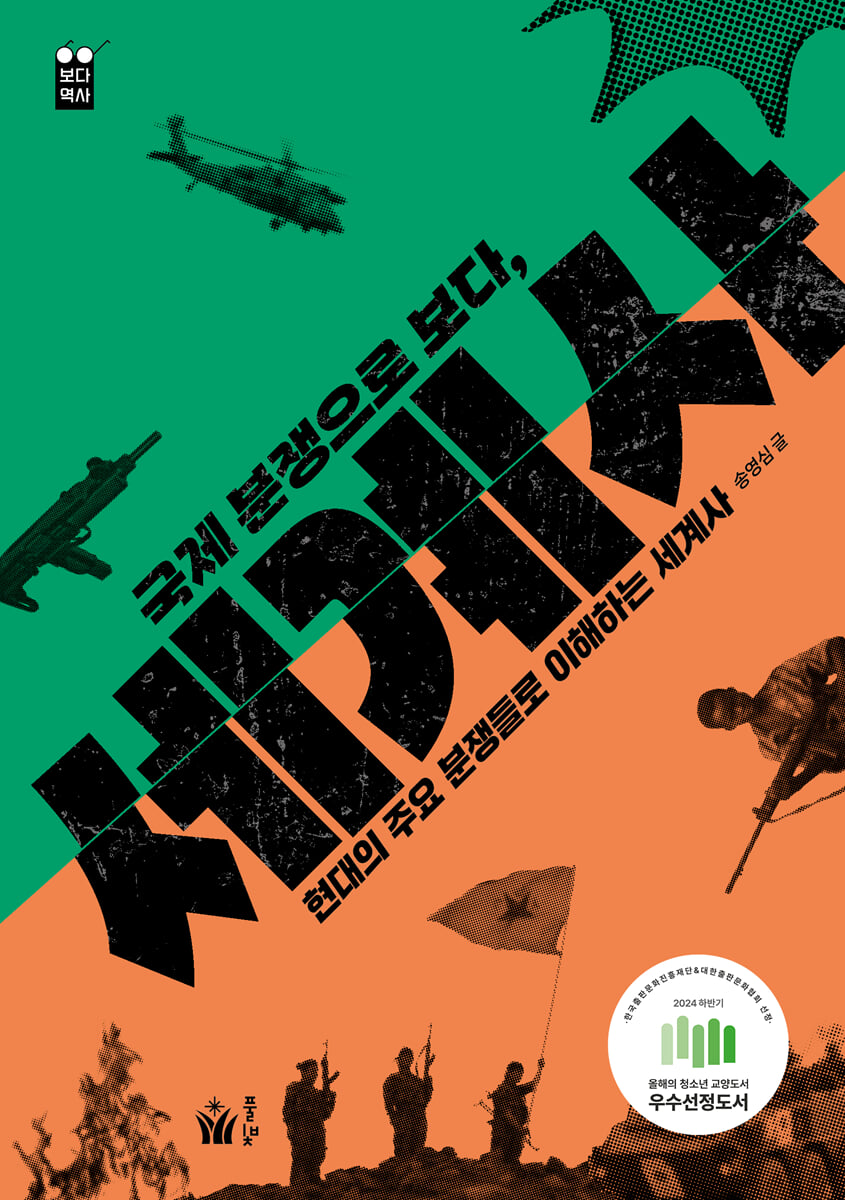
World history as seen through international conflicts
 |
Description
Book Introduction
The conflict has not stopped and is still occurring.
A history of ongoing conflict and strife around the world
The hottest world history story that helps you understand modern human history!
In January 2024, the Doomsday Clock, which warns of Earth's destruction, was announced with only 90 seconds left until midnight, the time set for Earth's destruction.
The second hand, which had been set to '100 seconds before midnight' since 2020, has been moved forward by 10 seconds.
This stemmed from Russia's threat to use nuclear weapons after invading Ukraine.
As the various crises and threats surrounding humanity grow, the second hand of this clock, which approaches midnight, warns of the destruction of humanity due to conflict and strife rather than the destruction of the entire planet.
Even now, sharp conflicts are breaking out all over the world due to complexly intertwined interests over resources and territory, historical conflicts between nations and peoples, and religious and cultural differences.
And because these conflicts are not limited to the individual countries, but have direct and indirect effects on all of humanity, understanding each conflict is tantamount to knowing our future.
This book provides a thorough understanding of the flow and links of modern history that have shaped today's world through the historical perspectives and origins behind the conflict.
As global citizens, I hope we can understand world history through these 13 defining conflicts that we must all understand, and further explore and collectively consider solutions for a peaceful world.
A history of ongoing conflict and strife around the world
The hottest world history story that helps you understand modern human history!
In January 2024, the Doomsday Clock, which warns of Earth's destruction, was announced with only 90 seconds left until midnight, the time set for Earth's destruction.
The second hand, which had been set to '100 seconds before midnight' since 2020, has been moved forward by 10 seconds.
This stemmed from Russia's threat to use nuclear weapons after invading Ukraine.
As the various crises and threats surrounding humanity grow, the second hand of this clock, which approaches midnight, warns of the destruction of humanity due to conflict and strife rather than the destruction of the entire planet.
Even now, sharp conflicts are breaking out all over the world due to complexly intertwined interests over resources and territory, historical conflicts between nations and peoples, and religious and cultural differences.
And because these conflicts are not limited to the individual countries, but have direct and indirect effects on all of humanity, understanding each conflict is tantamount to knowing our future.
This book provides a thorough understanding of the flow and links of modern history that have shaped today's world through the historical perspectives and origins behind the conflict.
As global citizens, I hope we can understand world history through these 13 defining conflicts that we must all understand, and further explore and collectively consider solutions for a peaceful world.
- You can preview some of the book's contents.
Preview
index
Author's Note
Chapter 1.
The long-running conflict between Israel and Palestine over Jerusalem
Chapter 2.
The tragedy of millions of refugees caused by the Syrian civil war
Chapter 3.
Kurds fighting for independence amid opposition from neighboring countries
Chapter 4.
The Kashmir conflict between India and Pakistan, which began with British rule
Chapter 5.
The Kosovo War, a tragic scene of ethnic cleansing caused by religious conflict
Chapter 6.
Ukraine, Europe's granary, sheds tears under Russian invasion
Chapter 7.
Iraq, a victim of an international war over its rich oil resources
Chapter 8.
Sierra Leone fights over the cursed 'blood diamond'
Chapter 9.
Somalia: A Failed State, Stained by Dictatorship and Poverty
Chapter 10.
Myanmar, which has inflicted merciless oppression on the Rohingya
Chapter 11.
Tibetans resisted China's minority rule through self-immolation and exile.
Chapter 12.
Disputes over the Sea: China and Japan Separately Over the Senkaku Islands
Chapter 13.
China's obstruction of independence and Taiwan's resistance to 'One China'
References
Chapter 1.
The long-running conflict between Israel and Palestine over Jerusalem
Chapter 2.
The tragedy of millions of refugees caused by the Syrian civil war
Chapter 3.
Kurds fighting for independence amid opposition from neighboring countries
Chapter 4.
The Kashmir conflict between India and Pakistan, which began with British rule
Chapter 5.
The Kosovo War, a tragic scene of ethnic cleansing caused by religious conflict
Chapter 6.
Ukraine, Europe's granary, sheds tears under Russian invasion
Chapter 7.
Iraq, a victim of an international war over its rich oil resources
Chapter 8.
Sierra Leone fights over the cursed 'blood diamond'
Chapter 9.
Somalia: A Failed State, Stained by Dictatorship and Poverty
Chapter 10.
Myanmar, which has inflicted merciless oppression on the Rohingya
Chapter 11.
Tibetans resisted China's minority rule through self-immolation and exile.
Chapter 12.
Disputes over the Sea: China and Japan Separately Over the Senkaku Islands
Chapter 13.
China's obstruction of independence and Taiwan's resistance to 'One China'
References
Detailed image

Into the book
The reason the Kurds, a nation with a population of over 10 million, cannot achieve independence is because all surrounding countries oppose their independence.
Turkey, Iraq, Iran, and even Syria are blatantly blocking Kurdish independence because if they become independent, the Kurds' enormous economic resources will disappear and their country's territory will be reduced.
Iran, in particular, does not want Kurdish independence because some of its oil resources are located in Kurdish-inhabited areas.
When the Islamic Revolution led by Khomeini took place in Iran in 1979, the Kurds suffered great disaster.
Iran is Shiite, as mentioned in the Syrian civil war, while the Kurds are Sunni.
The revolutionary army attacked Kurds in western Iran, killing over 10,000 people and summarily executing thousands more without trial.
Although currently a minority, people of Kurdish origin have also entered the ranks of influential figures in Iranian politics.
However, the Iranian government still allows autonomy but strongly suppresses separatist movements.
---「Chapter 3.
Among the Kurds who are fighting for independence in the face of opposition from neighboring countries,
Meanwhile, Serbia, a Slavic nation, calls Kosovo the "heart of Serbia" and makes it clear that it is a region it can never give up, and even though 15 years have passed since Kosovo gained independence in 2023, it still calls it the "Autonomous Province of Kosovo-Metohija."
So why do Serbs call Kosovo the "heart of Serbia"? Serbs settled in the northern Balkans in the 6th century and established the Serbian Empire centered around the fertile Kosovo Plain.
Kosovo was the empire's political, economic, and religious center.
However, in 1389, more than 100,000 Serbs lost their lives in the Battle of the Plains of the Black Bird, a defeat for the Ottoman Empire.
The Serbs who lost the war were driven north, and the areas where the Serbs lived were settled by large numbers of Albanians who believed in Islam.
Serbia still celebrates the day the war broke out as an important national religious holiday, called "Saint Vitus Day."
The Serbian Orthodox Church commemorates this day in memory of Saint Prince Lazar and the holy martyrs of Serbia who died in battles against the Ottoman Empire.
However, for Serbia, it is absolutely unacceptable that Kosovo will become another country.
---「Chapter 5.
From “The Kosovo War: A Tragic Ethnic Cleansing Caused by Religious Conflict”
Ukraine eventually falls to the level of one of the poorest countries in Europe, with inflation exceeding 10,000% and prices skyrocketing.
When North Korea tried to sell nuclear weapons to other countries because it lacked the ability to maintain or manage nuclear warheads, the United States and Russia put the brakes on it.
Eventually, under strong urging from major powers, it was decided to abandon nuclear weapons.
To this end, in 1994, the Budapest Memorandum of Understanding was signed with the participation of the United States, the United Kingdom, and Russia, along with Belarus and Kazakhstan, which were in the same situation as Ukraine.
Instead of handing over all of its nuclear weapons to Russia, it agreed to receive $200 million in compensation from the United States, calculated at $1 million per nuclear weapon.
After dismantling its nuclear weapons, Ukraine's independence, sovereignty, and borders would be guaranteed, and it would not be subject to nuclear attack from the United States, the United Kingdom, or Russia. It also promised that if a security threat were to arise, the signatory countries would have to consult with each other.
In this light, Russia's invasion of Ukraine in 2022 could be seen as an act that completely reduced the Budapest Memorandum to scrap paper.
---「Chapter 6.
From "Ukraine, Europe's granary shedding tears at the Russian invasion"
Myanmar was in a state of great social instability due to ethnic minorities each pursuing separatism and forming armed forces.
In 1962, General Ne Win established a dictatorship and suppressed opposition to the regime, maintaining a political climate that was as tense as thin ice.
Martial law was declared and a coercive military dictatorship was established, and the Burma Socialist Platform Party, founded by the military group, maintained power for 26 years until 1988.
As public discontent with military rule grew, the nationwide 888 Uprising broke out in August 1988, but the military continued to suppress the resistance forces and maintain its iron-fisted rule.
And they cleverly turned the public's criticism of the military onto the Rohingya.
By reminding people that the Rohingya were a corrupt force that cooperated with colonial rule and lived off the colonial regime, they drove public opinion to discriminate against and persecute the Rohingya, who practice Islam rather than Buddhism.
Moreover, the Rohingya were excluded from a law that governed citizenship for Myanmar's 135 ethnic minorities, which came into effect in 1982.
This is because the citizenship law revised by the military government recognizes only those who have resided in Myanmar since before the First Anglo-Burmese War as ethnic minorities.
---「Chapter 10.
From "Myanmar's merciless oppression of the Rohingya"
The period after 2010 is called the 'New Cold War era'.
Because the United States, Japan, and the European Union are joining hands to confront Russia and China.
In this new Cold War era, if Japan joins forces with the United States to defend the Senkaku Islands, what diplomatic measures will China take? Naturally, it will align with Russia.
China has bought most of Russia's oil and natural gas, which was blocked from exporting to Europe due to the war in Ukraine.
And under the pretext of avoiding a typhoon, they allowed Russian naval warships to enter the Senkaku Islands.
Afterwards, China's naval vessels also entered the Senkaku Islands, claiming to monitor Russian warships, so Japan cannot help but be surprised.
The ongoing dispute surrounding the Senkaku Islands is raising high tensions, with the possibility of it escalating into a major war in the new Cold War era.
Turkey, Iraq, Iran, and even Syria are blatantly blocking Kurdish independence because if they become independent, the Kurds' enormous economic resources will disappear and their country's territory will be reduced.
Iran, in particular, does not want Kurdish independence because some of its oil resources are located in Kurdish-inhabited areas.
When the Islamic Revolution led by Khomeini took place in Iran in 1979, the Kurds suffered great disaster.
Iran is Shiite, as mentioned in the Syrian civil war, while the Kurds are Sunni.
The revolutionary army attacked Kurds in western Iran, killing over 10,000 people and summarily executing thousands more without trial.
Although currently a minority, people of Kurdish origin have also entered the ranks of influential figures in Iranian politics.
However, the Iranian government still allows autonomy but strongly suppresses separatist movements.
---「Chapter 3.
Among the Kurds who are fighting for independence in the face of opposition from neighboring countries,
Meanwhile, Serbia, a Slavic nation, calls Kosovo the "heart of Serbia" and makes it clear that it is a region it can never give up, and even though 15 years have passed since Kosovo gained independence in 2023, it still calls it the "Autonomous Province of Kosovo-Metohija."
So why do Serbs call Kosovo the "heart of Serbia"? Serbs settled in the northern Balkans in the 6th century and established the Serbian Empire centered around the fertile Kosovo Plain.
Kosovo was the empire's political, economic, and religious center.
However, in 1389, more than 100,000 Serbs lost their lives in the Battle of the Plains of the Black Bird, a defeat for the Ottoman Empire.
The Serbs who lost the war were driven north, and the areas where the Serbs lived were settled by large numbers of Albanians who believed in Islam.
Serbia still celebrates the day the war broke out as an important national religious holiday, called "Saint Vitus Day."
The Serbian Orthodox Church commemorates this day in memory of Saint Prince Lazar and the holy martyrs of Serbia who died in battles against the Ottoman Empire.
However, for Serbia, it is absolutely unacceptable that Kosovo will become another country.
---「Chapter 5.
From “The Kosovo War: A Tragic Ethnic Cleansing Caused by Religious Conflict”
Ukraine eventually falls to the level of one of the poorest countries in Europe, with inflation exceeding 10,000% and prices skyrocketing.
When North Korea tried to sell nuclear weapons to other countries because it lacked the ability to maintain or manage nuclear warheads, the United States and Russia put the brakes on it.
Eventually, under strong urging from major powers, it was decided to abandon nuclear weapons.
To this end, in 1994, the Budapest Memorandum of Understanding was signed with the participation of the United States, the United Kingdom, and Russia, along with Belarus and Kazakhstan, which were in the same situation as Ukraine.
Instead of handing over all of its nuclear weapons to Russia, it agreed to receive $200 million in compensation from the United States, calculated at $1 million per nuclear weapon.
After dismantling its nuclear weapons, Ukraine's independence, sovereignty, and borders would be guaranteed, and it would not be subject to nuclear attack from the United States, the United Kingdom, or Russia. It also promised that if a security threat were to arise, the signatory countries would have to consult with each other.
In this light, Russia's invasion of Ukraine in 2022 could be seen as an act that completely reduced the Budapest Memorandum to scrap paper.
---「Chapter 6.
From "Ukraine, Europe's granary shedding tears at the Russian invasion"
Myanmar was in a state of great social instability due to ethnic minorities each pursuing separatism and forming armed forces.
In 1962, General Ne Win established a dictatorship and suppressed opposition to the regime, maintaining a political climate that was as tense as thin ice.
Martial law was declared and a coercive military dictatorship was established, and the Burma Socialist Platform Party, founded by the military group, maintained power for 26 years until 1988.
As public discontent with military rule grew, the nationwide 888 Uprising broke out in August 1988, but the military continued to suppress the resistance forces and maintain its iron-fisted rule.
And they cleverly turned the public's criticism of the military onto the Rohingya.
By reminding people that the Rohingya were a corrupt force that cooperated with colonial rule and lived off the colonial regime, they drove public opinion to discriminate against and persecute the Rohingya, who practice Islam rather than Buddhism.
Moreover, the Rohingya were excluded from a law that governed citizenship for Myanmar's 135 ethnic minorities, which came into effect in 1982.
This is because the citizenship law revised by the military government recognizes only those who have resided in Myanmar since before the First Anglo-Burmese War as ethnic minorities.
---「Chapter 10.
From "Myanmar's merciless oppression of the Rohingya"
The period after 2010 is called the 'New Cold War era'.
Because the United States, Japan, and the European Union are joining hands to confront Russia and China.
In this new Cold War era, if Japan joins forces with the United States to defend the Senkaku Islands, what diplomatic measures will China take? Naturally, it will align with Russia.
China has bought most of Russia's oil and natural gas, which was blocked from exporting to Europe due to the war in Ukraine.
And under the pretext of avoiding a typhoon, they allowed Russian naval warships to enter the Senkaku Islands.
Afterwards, China's naval vessels also entered the Senkaku Islands, claiming to monitor Russian warships, so Japan cannot help but be surprised.
The ongoing dispute surrounding the Senkaku Islands is raising high tensions, with the possibility of it escalating into a major war in the new Cold War era.
---「Chapter 12.
From "Disputes Surrounding the Sea: China and Japan Across the Senkaku Islands"
From "Disputes Surrounding the Sea: China and Japan Across the Senkaku Islands"
Publisher's Review
The conflict is the bloody result of the intertwining of human historical origins!
Through the causes and aspects of conflicts over ethnicity, nation, culture, and religion
How to read the flow of world history and understand today's international situation
Throughout history, mankind has been engaged in fierce conflicts for various reasons, such as conflicts between nations for their own interests, conflicts between ethnic groups, and even civil wars within the same ethnic group due to religious and power struggles.
We are familiar with ancient wars like the Crusades and the world-shaking events of World Wars I and II, but our understanding of modern international conflicts that have occurred less than 100 years ago is often lacking.
This is because the conflict has become more complex than in previous wars, and the destructive power of nuclear weapons has grown, making it more difficult to predict the course of the conflict or to end it.
《World History Through International Conflicts》 is another way to understand world history, covering 13 major international conflicts that occurred in modern times and continue to impact the world today.
By carefully tracing the historical origins that influenced the outbreak of the full-scale conflict, we were able to understand the relevant world history.
Knowing that the Kashmir conflict between India and Pakistan stems from a rift created by British colonial rule, or that the war between Israel and Palestine, which began with Hamas's bombing of Israel in 2023, is rooted in a deep-rooted religious conflict spanning thousands of years, provides a clearer perspective on the dynamics.
The author, who has worked as a history teacher for decades and recently participated in the writing of a world history textbook, has meticulously and neatly organized the historical facts hidden between the lines of conflict, making the vast knowledge of world history easily understandable.
It also provides an opportunity to understand today's international situation by compiling the latest developments and forecasts of ongoing conflicts.
Within this fierce conflict and strife, "people" live.
What we need to see in the conflict
Let's work together to find solutions for peace and unity.
The author, who has an outstanding ability to tell historical stories, has now developed a world history story with international conflict as the subject, following the first book in the [More History] series, “World History, More Than Movies.”
This book contains the efforts I have made over the past 40 years as a history teacher to realize peace education for a world without war and a society where we can live together.
Above all, I hope that we will not forget the real people who are living difficult lives even today in the midst of this cruel and sharp conflict.
Through the stories of the people there, told at the beginning of each conflict, we sought to reflect on the true purpose of properly understanding and understanding the conflict, and to consider solutions to the conflict and ways to restore peace in the future.
It urges us to take interest in this story not as a story from a distant place, but as a being living in the same era.
Moreover, the story, told through the lens of standing together in a conflict zone and looking at it from the same perspective, ends with information that provides more detailed historical knowledge, which is enough to satisfy intellectual curiosity.
Above all, it provides a detailed map showing the location of the conflict area, a timeline showing the nature of the conflict at a glance, and even a timeline of Korean history at the time to enhance understanding.
Through the causes and aspects of conflicts over ethnicity, nation, culture, and religion
How to read the flow of world history and understand today's international situation
Throughout history, mankind has been engaged in fierce conflicts for various reasons, such as conflicts between nations for their own interests, conflicts between ethnic groups, and even civil wars within the same ethnic group due to religious and power struggles.
We are familiar with ancient wars like the Crusades and the world-shaking events of World Wars I and II, but our understanding of modern international conflicts that have occurred less than 100 years ago is often lacking.
This is because the conflict has become more complex than in previous wars, and the destructive power of nuclear weapons has grown, making it more difficult to predict the course of the conflict or to end it.
《World History Through International Conflicts》 is another way to understand world history, covering 13 major international conflicts that occurred in modern times and continue to impact the world today.
By carefully tracing the historical origins that influenced the outbreak of the full-scale conflict, we were able to understand the relevant world history.
Knowing that the Kashmir conflict between India and Pakistan stems from a rift created by British colonial rule, or that the war between Israel and Palestine, which began with Hamas's bombing of Israel in 2023, is rooted in a deep-rooted religious conflict spanning thousands of years, provides a clearer perspective on the dynamics.
The author, who has worked as a history teacher for decades and recently participated in the writing of a world history textbook, has meticulously and neatly organized the historical facts hidden between the lines of conflict, making the vast knowledge of world history easily understandable.
It also provides an opportunity to understand today's international situation by compiling the latest developments and forecasts of ongoing conflicts.
Within this fierce conflict and strife, "people" live.
What we need to see in the conflict
Let's work together to find solutions for peace and unity.
The author, who has an outstanding ability to tell historical stories, has now developed a world history story with international conflict as the subject, following the first book in the [More History] series, “World History, More Than Movies.”
This book contains the efforts I have made over the past 40 years as a history teacher to realize peace education for a world without war and a society where we can live together.
Above all, I hope that we will not forget the real people who are living difficult lives even today in the midst of this cruel and sharp conflict.
Through the stories of the people there, told at the beginning of each conflict, we sought to reflect on the true purpose of properly understanding and understanding the conflict, and to consider solutions to the conflict and ways to restore peace in the future.
It urges us to take interest in this story not as a story from a distant place, but as a being living in the same era.
Moreover, the story, told through the lens of standing together in a conflict zone and looking at it from the same perspective, ends with information that provides more detailed historical knowledge, which is enough to satisfy intellectual curiosity.
Above all, it provides a detailed map showing the location of the conflict area, a timeline showing the nature of the conflict at a glance, and even a timeline of Korean history at the time to enhance understanding.
GOODS SPECIFICS
- Date of issue: June 25, 2024
- Page count, weight, size: 216 pages | 354g | 148*210*19mm
- ISBN13: 9791161729305
- ISBN10: 1161729305
You may also like
카테고리
korean


korean

![GQ KOREA Mark (Monthly): December [2025]](http://librairie.coreenne.fr/cdn/shop/files/8ef265dbbfbf186523ed75ba7319009d.jpg?v=1765340328&width=3840)


