

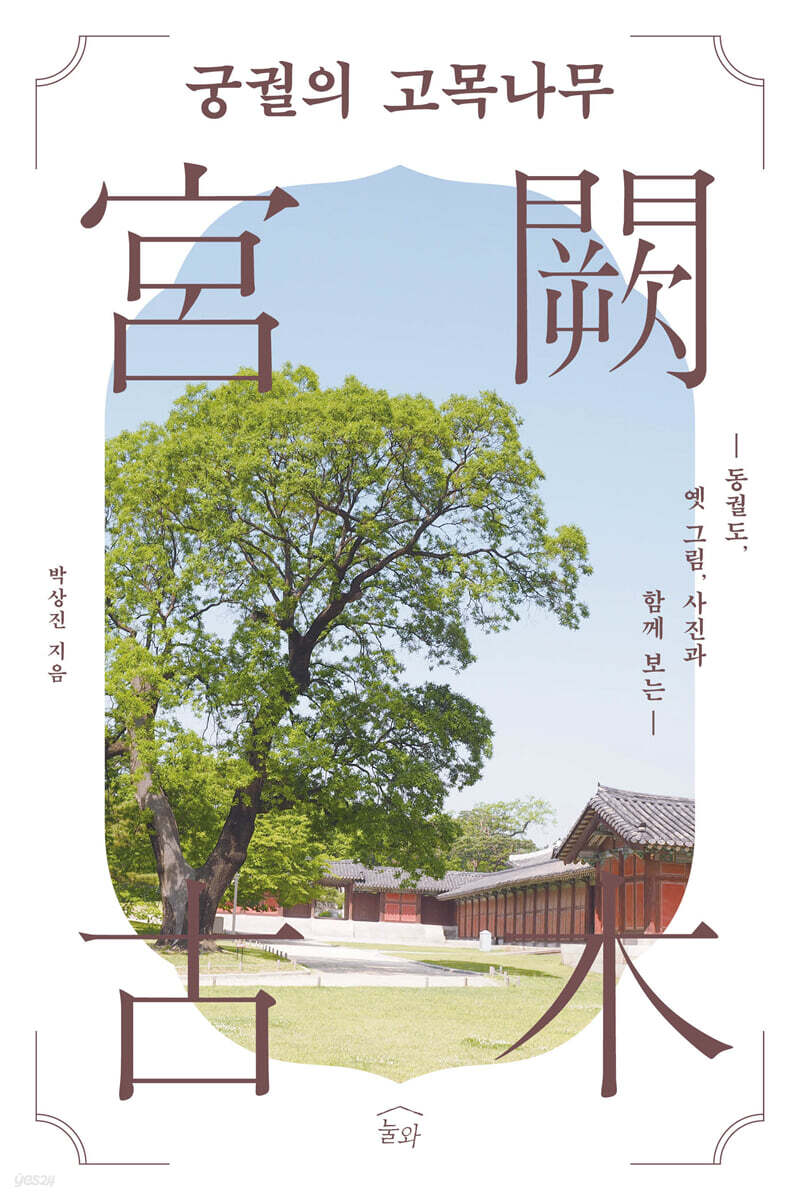
Old tree in the palace
 |
Description
Book Introduction
- A word from MD
- [A Field Trip to Ancient Trees with Donggwoldo and Old Paintings] A new book by author Sangjin Park that examines our trees in the palace.
We take a look into the life of an old tree in the palace, a bridge connecting the past and present.
If you look at the history surrounding the old tree, from its age to its role at the time and its intertwined story, you will be able to feel the old scenery coming back to life along the rings.
- Ahn Hyeon-jae, History PD
The years I have lived are wonderful
Moments spent together are deeply rooted
Special trees found only in palaces
The old scenery comes back to life along the night
Our relationship with trees was the same in the old palace.
Looking into the lives of the ancient palace trees that have been planted, used, enjoyed, and cherished for a long time is another way to imagine a time and space different from outside the palace and meet people of the past.
Professor Park Sang-jin, an authority in the field of tree archaeology, introduces key ancient trees located in the four major palaces of the Joseon Dynasty and examines the significance of these trees at the time with the help of old paintings, photographs, and documents.
We have collected stories that will make your encounter with the ancient tree even more valuable, including its estimated age, which many people are curious about, its role in the palace, and its entangled story.
The stories of lost and restored spaces and trees discovered while exploring the old trees make us realize the transformation of the palace.
The old trees that are still alive today are marked on the ‘Palace Old Tree Map’ and vivid photos are included to help visitors visit and walk around them.
We also introduced some of the old trees located in the Blue House (former rear garden of Gyeongbokgung Palace) and Jongmyo Shrine, as well as some trees that only exist in old paintings and photographs but help us understand the palace space.
As we follow the old trees to the four major palaces of the Joseon Dynasty, the Blue House, and Jongmyo Shrine, we will begin to see ourselves together with the trees in those spaces.
Moments spent together are deeply rooted
Special trees found only in palaces
The old scenery comes back to life along the night
Our relationship with trees was the same in the old palace.
Looking into the lives of the ancient palace trees that have been planted, used, enjoyed, and cherished for a long time is another way to imagine a time and space different from outside the palace and meet people of the past.
Professor Park Sang-jin, an authority in the field of tree archaeology, introduces key ancient trees located in the four major palaces of the Joseon Dynasty and examines the significance of these trees at the time with the help of old paintings, photographs, and documents.
We have collected stories that will make your encounter with the ancient tree even more valuable, including its estimated age, which many people are curious about, its role in the palace, and its entangled story.
The stories of lost and restored spaces and trees discovered while exploring the old trees make us realize the transformation of the palace.
The old trees that are still alive today are marked on the ‘Palace Old Tree Map’ and vivid photos are included to help visitors visit and walk around them.
We also introduced some of the old trees located in the Blue House (former rear garden of Gyeongbokgung Palace) and Jongmyo Shrine, as well as some trees that only exist in old paintings and photographs but help us understand the palace space.
As we follow the old trees to the four major palaces of the Joseon Dynasty, the Blue House, and Jongmyo Shrine, we will begin to see ourselves together with the trees in those spaces.
- You can preview some of the book's contents.
Preview
index
Entering
Old tree in the palace
Donggwoldo and Changdeokgung and Changgyeonggung Palaces
■ The old tree of Changdeokgung Palace_Focusing on the Goryeo version of the painting “Donggwoldo”
01 Donhwamun and Geumcheon Bridge area
The painting tree of Donhwamun Gate | The painting tree of Geumhomun Gate | The willow tree of Geumcheon Bridge | The zelkova tree of Geumcheon Bridge | The painting tree around Geumcheon | The painting tree of Sanguiwon and Danbongmun Gate
02 The Royal Cabinet - Kyujanggak (Imunwon), Seonwonjeon, Okdang
The Gyujanggak (Imunwon) fragrant tree | The Gyujanggak's lost fir tree | The cypress tree of Seonwonjeon, where the king's portrait is enshrined | The zelkova tree and the lost weeping willow tree of Yeonguisa | The lost cypress and pagoda trees of Okdang
03 Around Injeongjeon
The reeds of Injeongjeon's flowerbed | The painting tree north of Injeongjeon | The painting tree on the mountain behind Bincheong
04 Donggung Palace Area - Seongjeonggak, Nakseonjae, and Munhwagak Sites
Plum tree in the Seongjeonggak pavilion | Ash tree in the forest in front of the Donggung Palace | Lost flowering trees in Hongseogak at the site of Nakseonjae | Pear tree at the site of Munhwagak | Zelkova tree at the site of Daejongheon at the entrance to the rear garden
05 Buyongji and Yeonghwadang area
The azalea field of Buyongji Pond has become a forest | What kind of tree was the Juhapnu drinking fountain? | The fir tree in front of Yeongdeungpo Remains Only in Painting | The Zelkova Tree at Yeongdeungpo | The yew tree on the mountain in front of Yeongdeungpo
06 Area of observation area
A mulberry tree with traces of a rite of passage | A chestnut tree on Gwanramji Hill
07 Jondeokjeong and Cheongsimjeong areas
The ginkgo tree of Jondeokjeong | The pine tree of Cheongsimjeong | The ancient tree around Yeongyeongdang | The zelkova tree, the guardian of Daebodan (Hwangdan) | The king of kings of the country of daerae trees | Where have all the pine trees of the garden gone?
■ The old tree of Changgyeonggung Palace_Focusing on the Goryeo version of the painting “Donggwoldo”
The flowering trees of Okcheon Bridge, the peach and plum trees | The paired trees, a wrong encounter | The maple trees around Gwandeokjeong | The zelkova tree of Sochundangji that dodged arrows | The white pine tree of Chundangji | The zelkova tree of Changgyeonggung Palace, where the princess rode the swing (?) | The apricot tree of Hwanghyeongjeon and Daejanggeum | The jujube tree of Sungmundang | The weeping willow tree of Marang and Honghwamun, seen in the "Donggwoldo" | The painting tree of Seoninmun that witnessed the tragedy of Crown Prince Sado
* Trees in the Goryeo and Dong-A University versions of the Donggwoldo
■ Old trees in Gyeongbokgung Palace
01? Current Gyeongbokgung Palace
Gyeongbokgung Palace today | Ginkgo tree at Geonchunmun | Mulberry tree at Jibokjae | Zelkova tree in front of Jibokjae | Willow tree at Gyeonghoeru | Pagoda tree at Haengyangjeong Pavilion at Gyeonghoeru | Old tree at Gyeongbokgung Palace in an old painting
02?Gyeongbokgung Palace Rear Garden (Blue House)
Water Palace Site Attention | Green Garden Pine Tree | Green Garden Bansong | Yeonpungmun Dragon Willow
■ Old tree in Deoksugung Palace
Various weeping willows inside and outside Deoksugung Palace | Pyeongseongmun prickly ash | Seokjojeon plum blossom pattern | Seokjojeon fountain wisteria | Fountain garden yew | Seogeodang apricot tree | Other ancient trees
■ The old tree of Jongmyo
The fragrant tree at the pond in Mangmyoru | The pine tree in the forest south of the Akgongcheong Hall in Jeongjeon | The oak tree in Yeongnyeongjeon Hall | The pine tree on the perimeter path | The weeping willow tree east of Jeongjeon Hall
Key References
Photo source and artifact collection
Search
Old tree in the palace
Donggwoldo and Changdeokgung and Changgyeonggung Palaces
■ The old tree of Changdeokgung Palace_Focusing on the Goryeo version of the painting “Donggwoldo”
01 Donhwamun and Geumcheon Bridge area
The painting tree of Donhwamun Gate | The painting tree of Geumhomun Gate | The willow tree of Geumcheon Bridge | The zelkova tree of Geumcheon Bridge | The painting tree around Geumcheon | The painting tree of Sanguiwon and Danbongmun Gate
02 The Royal Cabinet - Kyujanggak (Imunwon), Seonwonjeon, Okdang
The Gyujanggak (Imunwon) fragrant tree | The Gyujanggak's lost fir tree | The cypress tree of Seonwonjeon, where the king's portrait is enshrined | The zelkova tree and the lost weeping willow tree of Yeonguisa | The lost cypress and pagoda trees of Okdang
03 Around Injeongjeon
The reeds of Injeongjeon's flowerbed | The painting tree north of Injeongjeon | The painting tree on the mountain behind Bincheong
04 Donggung Palace Area - Seongjeonggak, Nakseonjae, and Munhwagak Sites
Plum tree in the Seongjeonggak pavilion | Ash tree in the forest in front of the Donggung Palace | Lost flowering trees in Hongseogak at the site of Nakseonjae | Pear tree at the site of Munhwagak | Zelkova tree at the site of Daejongheon at the entrance to the rear garden
05 Buyongji and Yeonghwadang area
The azalea field of Buyongji Pond has become a forest | What kind of tree was the Juhapnu drinking fountain? | The fir tree in front of Yeongdeungpo Remains Only in Painting | The Zelkova Tree at Yeongdeungpo | The yew tree on the mountain in front of Yeongdeungpo
06 Area of observation area
A mulberry tree with traces of a rite of passage | A chestnut tree on Gwanramji Hill
07 Jondeokjeong and Cheongsimjeong areas
The ginkgo tree of Jondeokjeong | The pine tree of Cheongsimjeong | The ancient tree around Yeongyeongdang | The zelkova tree, the guardian of Daebodan (Hwangdan) | The king of kings of the country of daerae trees | Where have all the pine trees of the garden gone?
■ The old tree of Changgyeonggung Palace_Focusing on the Goryeo version of the painting “Donggwoldo”
The flowering trees of Okcheon Bridge, the peach and plum trees | The paired trees, a wrong encounter | The maple trees around Gwandeokjeong | The zelkova tree of Sochundangji that dodged arrows | The white pine tree of Chundangji | The zelkova tree of Changgyeonggung Palace, where the princess rode the swing (?) | The apricot tree of Hwanghyeongjeon and Daejanggeum | The jujube tree of Sungmundang | The weeping willow tree of Marang and Honghwamun, seen in the "Donggwoldo" | The painting tree of Seoninmun that witnessed the tragedy of Crown Prince Sado
* Trees in the Goryeo and Dong-A University versions of the Donggwoldo
■ Old trees in Gyeongbokgung Palace
01? Current Gyeongbokgung Palace
Gyeongbokgung Palace today | Ginkgo tree at Geonchunmun | Mulberry tree at Jibokjae | Zelkova tree in front of Jibokjae | Willow tree at Gyeonghoeru | Pagoda tree at Haengyangjeong Pavilion at Gyeonghoeru | Old tree at Gyeongbokgung Palace in an old painting
02?Gyeongbokgung Palace Rear Garden (Blue House)
Water Palace Site Attention | Green Garden Pine Tree | Green Garden Bansong | Yeonpungmun Dragon Willow
■ Old tree in Deoksugung Palace
Various weeping willows inside and outside Deoksugung Palace | Pyeongseongmun prickly ash | Seokjojeon plum blossom pattern | Seokjojeon fountain wisteria | Fountain garden yew | Seogeodang apricot tree | Other ancient trees
■ The old tree of Jongmyo
The fragrant tree at the pond in Mangmyoru | The pine tree in the forest south of the Akgongcheong Hall in Jeongjeon | The oak tree in Yeongnyeongjeon Hall | The pine tree on the perimeter path | The weeping willow tree east of Jeongjeon Hall
Key References
Photo source and artifact collection
Search
Detailed image

Publisher's Review
Another piece of history in the palace: the old tree
The first work to cover the palace's major trees!
A new book has been published by Professor Park Sang-jin, a tree scholar who sparked a boom in palace tree tours and who has dedicated his life to the study of wooden cultural assets, crossing over between dendrology and archaeology.
While the best-selling book "Our Trees in the Palace" published in 2001 broadly explained the ecology, history, and culture of tree species found in palaces, this "Ancient Trees in the Palace" provides a detailed introduction to individual noteworthy ancient palace trees and examines their lives.
An old tree is a bridge connecting the past and the present.
Although all of the buildings from the time of Changdeokgung Palace's founding have disappeared, the fragrant tree that has lived since before the founding of the Joseon Dynasty can still be seen today in front of the Bonmodang Hall of Gyujanggak.
On the southern side of Changgyeonggung Palace, at the Seoninmun stone bridge and in the corridor of Myeongjeongjeon, grow two weeping willow trees that must have closely witnessed the tragic death of Crown Prince Sado.
There must be many stories contained in that old tree as it has lived with us, but it was difficult to find those stories.
The tree has escaped the attention of historians, and related literature is scant.
Professor Park Sang-jin, who has always been interested in old palace trees, also turned his attention to old paintings and photographs.
I discovered that some of the old trees of Changdeokgung and Changgyeonggung Palaces can be seen in the national treasure, Donggwoldo, a large-scale palace bird's-eye view from the early 19th century.
Afterwards, I synthesized information about old trees from other old paintings, old photographs from after the Enlightenment Period, classical materials, and tree survey data, as well as my opinion as a tree scientist.
As a result, this book was born, which is the first to comprehensively discuss the major ancient trees of the four major palaces of Joseon.
From its estimated age, the tree's history, related anecdotes, and royal tree culture are colorfully presented.
The Gyujanggak fragrant tree that has been cared for since the Joseon Dynasty?
Trees, space, and people are seen together.
Rich commentary based on extensive literature and pictorial materials
The old trees in the palace, where not a single tree was left in vain, are bound to reflect the character of the space and the lives of its people.
The author focuses on the old trees that grow in the main spaces of Changdeokgung and Changgyeonggung and are also depicted in the “Donggwoldo.”
〈Donggwoldo〉 is a large-scale palace painting produced during the reign of King Sunjo of the Joseon Dynasty. It is a painting that depicts in detail not only the buildings of Changdeokgung and Changgyeonggung Palaces, but also over 4,000 trees in color.
The oldest tree in the palace today is the 'Changdeokgung Gyujanggak Camphor Tree (Natural Monument)'.
It is estimated to be 750 to 760 years old and currently rests on 15 pedestals.
This is because the branches grow low and sideways.
Yu Bon-ye, a scholar during the reigns of King Jeongjo and King Sunjo, recorded that the Gyujanggak fragrant tree flourished and grew thanks to the twelve pillars it was supported by at the time.
Surprisingly, the appearance of it being supported by a pedestal is also depicted in the Donggwoldo.
Why was the Gyujanggak fragrant tree protected at the time? The author notes that in the "Donggwoldo" (Donggwoldo), two beautiful fragrant trees are depicted in the Seonwonjeon Hall near Gyujanggak.
Seonwonjeon was a royal ancestral rite space, and the incense tree was protected as a material for ancestral rites, and thanks to this, the incense tree at Gyujanggak was able to endure for a long time.
According to the records of the Annals of the Joseon Dynasty, the sandalwood was so important that it was procured separately from Ulleungdo and local yellow clay was also requested to be presented to ensure authenticity.
The author reconstructs the life of an old tree and reflects on its significance in the palace and the people of old by encompassing historical and cultural documents related to trees, including the Donggwoldo and various royal court records.
The cypress tree in Seonwonjeon (about 300 years old) gives us a glimpse of the sacred atmosphere of the space where the portraits of past kings are enshrined, the ginkgo tree in Jondeokjeong (about 250 years old) gives us a glimpse of the spirit of honoring Confucius and revering learning, and the old ash tree on the mountain behind Bincheong (in the forest in front of the Donggung Palace) gives us a glimpse of the palace at night, when overtime work and nighttime banquets would have taken place.
With the expert knowledge and imaginative commentary of a tree expert, the palace, once a viewing space, comes to life as a place where trees, space, and people come together.
A 400-year-old plum tree at Seongjeonggak in Changdeokgung Palace?
When did the famous trees start taking root?
What kind of era did you live in?
Some old trees attract many people for reasons such as their beauty, their old trunks, and their abundance of flowers.
This book organizes basic information such as tree age and size based on materials such as the Tree Survey Collection published by the Cultural Heritage Administration (now the National Heritage Administration), and then examines the evidence further to tell stories that make old trees feel more familiar and meaningful.
In spring, the area around Donggung Palace at the entrance to the rear garden of Changdeokgung Palace becomes a famous spot for taking photos of plum blossoms.
You can see two precious Mancheop Hongmae trees with over 20 layers of pink petals. They are said to have been brought from the Ming Dynasty during the Imjin War and are said to be 400 years old.
The actual biological ages of these two trees, which grow in the Seongjeonggak Jasimun and Chilbunseo respectively, are much younger than that.
However, there is a background to seeing it as a successor to the 400-year-old ancient plum tree.
The Daemyeongmae that Gobucheon, who went to the Ming Dynasty as a special envoy during the reign of King Gwanghaegun, received from the Ming Emperor Cheon Gye-je (Hee-jong) is also a Manjeop Hongmae.
Also, if you look at the “Donggwoldo,” you can see a flower tree drawn in front of the Chilbunseok, and in the collected works of Crown Prince Hyomyeong, it is mentioned that “red plum trees welcoming spring grow in the west of the (Donggung) garden.”
The two Mancheop Hongmae trees are the trees in the Donggwoldo that give us a glimpse into the atmosphere of the Donggung Palace, where flowering trees were everywhere.
In front of the Seoninmun Stone Bridge at Changgyeonggung Palace, a crooked, three-branched zelkova tree attracts the attention of visitors with a keen interest in history.
It is a tree that is approximately 300 years old and would have grown around the site of the Im-o Incident, when Crown Prince Sado was locked in a rice chest and died.
The stem is split and the inside is completely rotten, so it is said that it is because of the tragedy at the time.
The author discovers the image of the tree depicted in the “Donggwoldo” and also introduces the painting tree in front of the Namhaenggak Pavilion of Myeongjeongjeon, which is also over 300 years old and closer to the scene of the Im-o Incident.
There are trees that catch your eye even if you don't realize they are old, such as the ginkgo tree at Geumhomun Gate in Changdeokgung Palace, the white pine tree at Chundangji Pond in Changgyeonggung Palace, and the apricot tree at Seogeodang in Deoksugung Palace.
The glory and shame of the Joseon Dynasty, the Korean Empire, and the colonial period are still engraved on the Naite, and it still lives on to this day.
The author, who has been in charge of providing special commentary for the program 'Changdeokgung Tree Tour with Donggwoldo' hosted by the Changdeokgung Management Office of the Cultural Heritage Administration (now the National Heritage Administration) for many years, provides commentary that will make familiar famous trees more familiar and unfamiliar famous trees a pleasant encounter.
Young old trees before and after the Japanese colonial period,
Even the trees that disappeared and were restored…
A tour of ancient trees that show the changes of the times and palaces!
Unlike Changdeokgung and Changgyeonggung Palaces, where old trees hundreds of years old were introduced along with the Donggwoldo, the old trees introduced at Gyeongbokgung and Deoksugung Palaces are quite different.
There are many relatively young trees, some around 100 years old, and the background to this is the history of the palace being severely damaged for various reasons during the Japanese colonial period.
Gyeongbokgung Palace was designed as an exhibition hall to justify colonial rule.
Because of this, most of the buildings and trees were damaged, except for the Blue House, the former site of the royal palace.
At Gyeongbokgung Palace, where there was an article reporting that the Governor-General of Korea personally planted a ginkgo tree in 1918, a ginkgo tree (about 110 years old) pruned in the Japanese style grows.
A great fire broke out at Deoksugung Palace in 1904.
The pine trees (around 300 years old/around 400 years old) growing on the hill between Dondeokjeon and Jeonggwanheon, which were not touched by the fire, and the yew trees (400-500 years old) transplanted during the garden renovation of Seokjojeon in 1938 are hundreds of years old.
The apricot tree in Seogeodang looks like it could be hundreds of years old at first glance, but it was planted after the Seogeodang building burned down and was rebuilt, so it is only 70 years old.
It is difficult to recall the damage that occurred during the modern era in today's neatly decorated palace, but it clearly remains in the old palace trees.
Meanwhile, this book introduces the old trees that remain today, and also includes stories of trees disappearing and being restored.
The story of Okcheon Bridge in Changgyeonggung Palace, which was once planted with cherry blossom trees, a favorite of the Japanese, and then refurbished with traditional Korean flowering trees after liberation, as depicted in the "Donggwoldo," makes us feel the changes of the times and the palace even more vividly.
The 'Palace Tree Map' marked the locations of each major palace tree to aid field investigations.
Both the "Donggwoldo" and the map helpfully list the names of the major buildings and include photos that allow you to examine the spaces and trees, so you can first look around the palace and old trees while sitting down.
The first work to cover the palace's major trees!
A new book has been published by Professor Park Sang-jin, a tree scholar who sparked a boom in palace tree tours and who has dedicated his life to the study of wooden cultural assets, crossing over between dendrology and archaeology.
While the best-selling book "Our Trees in the Palace" published in 2001 broadly explained the ecology, history, and culture of tree species found in palaces, this "Ancient Trees in the Palace" provides a detailed introduction to individual noteworthy ancient palace trees and examines their lives.
An old tree is a bridge connecting the past and the present.
Although all of the buildings from the time of Changdeokgung Palace's founding have disappeared, the fragrant tree that has lived since before the founding of the Joseon Dynasty can still be seen today in front of the Bonmodang Hall of Gyujanggak.
On the southern side of Changgyeonggung Palace, at the Seoninmun stone bridge and in the corridor of Myeongjeongjeon, grow two weeping willow trees that must have closely witnessed the tragic death of Crown Prince Sado.
There must be many stories contained in that old tree as it has lived with us, but it was difficult to find those stories.
The tree has escaped the attention of historians, and related literature is scant.
Professor Park Sang-jin, who has always been interested in old palace trees, also turned his attention to old paintings and photographs.
I discovered that some of the old trees of Changdeokgung and Changgyeonggung Palaces can be seen in the national treasure, Donggwoldo, a large-scale palace bird's-eye view from the early 19th century.
Afterwards, I synthesized information about old trees from other old paintings, old photographs from after the Enlightenment Period, classical materials, and tree survey data, as well as my opinion as a tree scientist.
As a result, this book was born, which is the first to comprehensively discuss the major ancient trees of the four major palaces of Joseon.
From its estimated age, the tree's history, related anecdotes, and royal tree culture are colorfully presented.
The Gyujanggak fragrant tree that has been cared for since the Joseon Dynasty?
Trees, space, and people are seen together.
Rich commentary based on extensive literature and pictorial materials
The old trees in the palace, where not a single tree was left in vain, are bound to reflect the character of the space and the lives of its people.
The author focuses on the old trees that grow in the main spaces of Changdeokgung and Changgyeonggung and are also depicted in the “Donggwoldo.”
〈Donggwoldo〉 is a large-scale palace painting produced during the reign of King Sunjo of the Joseon Dynasty. It is a painting that depicts in detail not only the buildings of Changdeokgung and Changgyeonggung Palaces, but also over 4,000 trees in color.
The oldest tree in the palace today is the 'Changdeokgung Gyujanggak Camphor Tree (Natural Monument)'.
It is estimated to be 750 to 760 years old and currently rests on 15 pedestals.
This is because the branches grow low and sideways.
Yu Bon-ye, a scholar during the reigns of King Jeongjo and King Sunjo, recorded that the Gyujanggak fragrant tree flourished and grew thanks to the twelve pillars it was supported by at the time.
Surprisingly, the appearance of it being supported by a pedestal is also depicted in the Donggwoldo.
Why was the Gyujanggak fragrant tree protected at the time? The author notes that in the "Donggwoldo" (Donggwoldo), two beautiful fragrant trees are depicted in the Seonwonjeon Hall near Gyujanggak.
Seonwonjeon was a royal ancestral rite space, and the incense tree was protected as a material for ancestral rites, and thanks to this, the incense tree at Gyujanggak was able to endure for a long time.
According to the records of the Annals of the Joseon Dynasty, the sandalwood was so important that it was procured separately from Ulleungdo and local yellow clay was also requested to be presented to ensure authenticity.
The author reconstructs the life of an old tree and reflects on its significance in the palace and the people of old by encompassing historical and cultural documents related to trees, including the Donggwoldo and various royal court records.
The cypress tree in Seonwonjeon (about 300 years old) gives us a glimpse of the sacred atmosphere of the space where the portraits of past kings are enshrined, the ginkgo tree in Jondeokjeong (about 250 years old) gives us a glimpse of the spirit of honoring Confucius and revering learning, and the old ash tree on the mountain behind Bincheong (in the forest in front of the Donggung Palace) gives us a glimpse of the palace at night, when overtime work and nighttime banquets would have taken place.
With the expert knowledge and imaginative commentary of a tree expert, the palace, once a viewing space, comes to life as a place where trees, space, and people come together.
A 400-year-old plum tree at Seongjeonggak in Changdeokgung Palace?
When did the famous trees start taking root?
What kind of era did you live in?
Some old trees attract many people for reasons such as their beauty, their old trunks, and their abundance of flowers.
This book organizes basic information such as tree age and size based on materials such as the Tree Survey Collection published by the Cultural Heritage Administration (now the National Heritage Administration), and then examines the evidence further to tell stories that make old trees feel more familiar and meaningful.
In spring, the area around Donggung Palace at the entrance to the rear garden of Changdeokgung Palace becomes a famous spot for taking photos of plum blossoms.
You can see two precious Mancheop Hongmae trees with over 20 layers of pink petals. They are said to have been brought from the Ming Dynasty during the Imjin War and are said to be 400 years old.
The actual biological ages of these two trees, which grow in the Seongjeonggak Jasimun and Chilbunseo respectively, are much younger than that.
However, there is a background to seeing it as a successor to the 400-year-old ancient plum tree.
The Daemyeongmae that Gobucheon, who went to the Ming Dynasty as a special envoy during the reign of King Gwanghaegun, received from the Ming Emperor Cheon Gye-je (Hee-jong) is also a Manjeop Hongmae.
Also, if you look at the “Donggwoldo,” you can see a flower tree drawn in front of the Chilbunseok, and in the collected works of Crown Prince Hyomyeong, it is mentioned that “red plum trees welcoming spring grow in the west of the (Donggung) garden.”
The two Mancheop Hongmae trees are the trees in the Donggwoldo that give us a glimpse into the atmosphere of the Donggung Palace, where flowering trees were everywhere.
In front of the Seoninmun Stone Bridge at Changgyeonggung Palace, a crooked, three-branched zelkova tree attracts the attention of visitors with a keen interest in history.
It is a tree that is approximately 300 years old and would have grown around the site of the Im-o Incident, when Crown Prince Sado was locked in a rice chest and died.
The stem is split and the inside is completely rotten, so it is said that it is because of the tragedy at the time.
The author discovers the image of the tree depicted in the “Donggwoldo” and also introduces the painting tree in front of the Namhaenggak Pavilion of Myeongjeongjeon, which is also over 300 years old and closer to the scene of the Im-o Incident.
There are trees that catch your eye even if you don't realize they are old, such as the ginkgo tree at Geumhomun Gate in Changdeokgung Palace, the white pine tree at Chundangji Pond in Changgyeonggung Palace, and the apricot tree at Seogeodang in Deoksugung Palace.
The glory and shame of the Joseon Dynasty, the Korean Empire, and the colonial period are still engraved on the Naite, and it still lives on to this day.
The author, who has been in charge of providing special commentary for the program 'Changdeokgung Tree Tour with Donggwoldo' hosted by the Changdeokgung Management Office of the Cultural Heritage Administration (now the National Heritage Administration) for many years, provides commentary that will make familiar famous trees more familiar and unfamiliar famous trees a pleasant encounter.
Young old trees before and after the Japanese colonial period,
Even the trees that disappeared and were restored…
A tour of ancient trees that show the changes of the times and palaces!
Unlike Changdeokgung and Changgyeonggung Palaces, where old trees hundreds of years old were introduced along with the Donggwoldo, the old trees introduced at Gyeongbokgung and Deoksugung Palaces are quite different.
There are many relatively young trees, some around 100 years old, and the background to this is the history of the palace being severely damaged for various reasons during the Japanese colonial period.
Gyeongbokgung Palace was designed as an exhibition hall to justify colonial rule.
Because of this, most of the buildings and trees were damaged, except for the Blue House, the former site of the royal palace.
At Gyeongbokgung Palace, where there was an article reporting that the Governor-General of Korea personally planted a ginkgo tree in 1918, a ginkgo tree (about 110 years old) pruned in the Japanese style grows.
A great fire broke out at Deoksugung Palace in 1904.
The pine trees (around 300 years old/around 400 years old) growing on the hill between Dondeokjeon and Jeonggwanheon, which were not touched by the fire, and the yew trees (400-500 years old) transplanted during the garden renovation of Seokjojeon in 1938 are hundreds of years old.
The apricot tree in Seogeodang looks like it could be hundreds of years old at first glance, but it was planted after the Seogeodang building burned down and was rebuilt, so it is only 70 years old.
It is difficult to recall the damage that occurred during the modern era in today's neatly decorated palace, but it clearly remains in the old palace trees.
Meanwhile, this book introduces the old trees that remain today, and also includes stories of trees disappearing and being restored.
The story of Okcheon Bridge in Changgyeonggung Palace, which was once planted with cherry blossom trees, a favorite of the Japanese, and then refurbished with traditional Korean flowering trees after liberation, as depicted in the "Donggwoldo," makes us feel the changes of the times and the palace even more vividly.
The 'Palace Tree Map' marked the locations of each major palace tree to aid field investigations.
Both the "Donggwoldo" and the map helpfully list the names of the major buildings and include photos that allow you to examine the spaces and trees, so you can first look around the palace and old trees while sitting down.
GOODS SPECIFICS
- Date of issue: June 12, 2024
- Page count, weight, size: 356 pages | 150*225*17mm
- ISBN13: 9791189074722
- ISBN10: 1189074729
You may also like
카테고리
korean


korean

![GQ KOREA Mark (Monthly): December [2025]](http://librairie.coreenne.fr/cdn/shop/files/8ef265dbbfbf186523ed75ba7319009d.jpg?v=1765340328&width=3840)


