

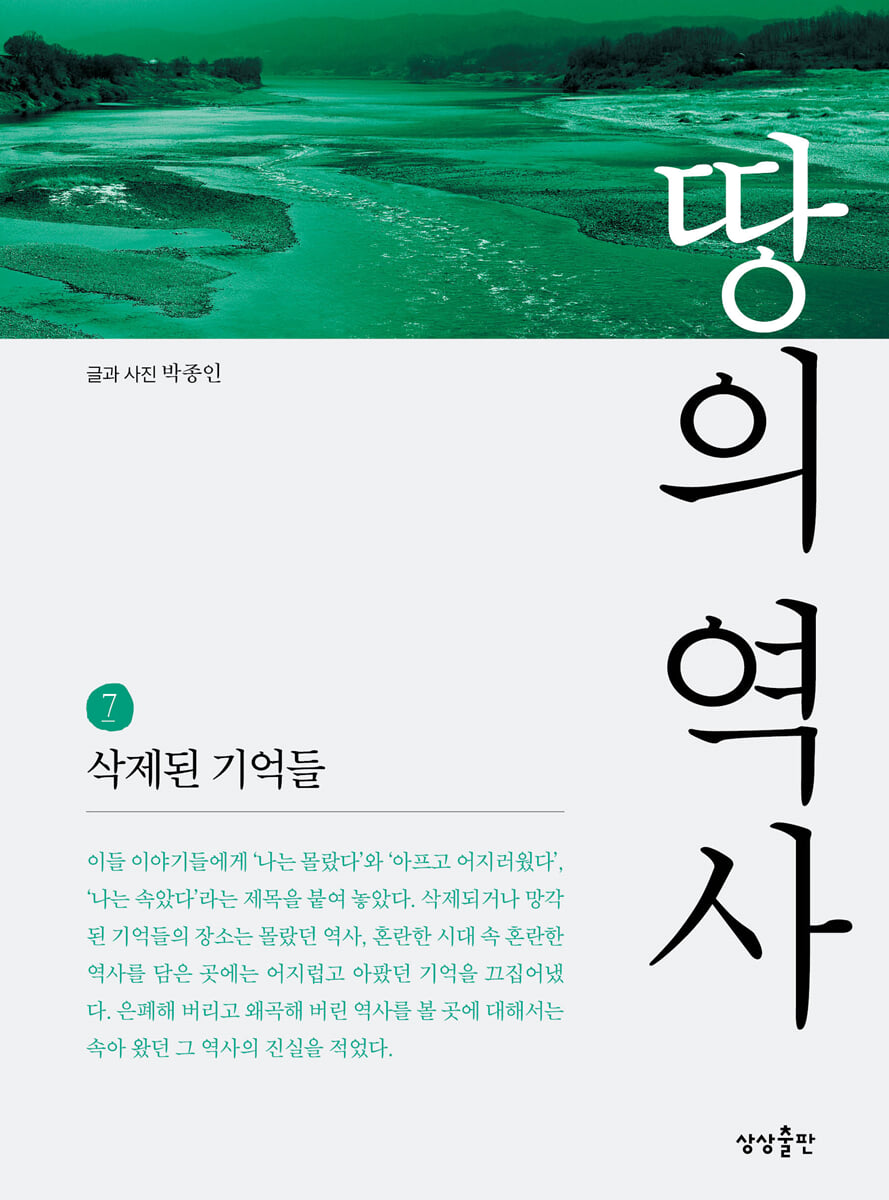
History of the Earth 7
 |
Description
Book Introduction
“The traces left on the ground are the real history!”
Rediscovering History with Travel and History Journalist Park Jong-in
Popular historical and humanities travelogue, by expert reporter Park Jong-in
The seventh story in the "History of the Earth" series
The seventh story in the Chosun Ilbo's popular series, "History of the Land," begins.
What story did travel and history journalist Park Jong-in want to tell after encountering history on the 'land' for 10 years?
It is a story about 'memories' that have been forgotten, distorted, or intentionally deleted, but still leave traces all over the land.
The story of Yeon Gaesomun, who is now praised as a man who glimpsed the continent, but in fact opened the door to the downfall of Goguryeo through his foolishness; Yu Ui-tae, a fake known as Heo Jun's teacher and for whom a monument was erected; and Choi Yang-seon, a sorcerer who bewitched King Sejong with feng shui and disrupted state affairs.
And the frustrating reality of the Cultural Heritage Administration, which distorts rather than preserves past history.
『History of the Land』 7 unravels the threads of history from a monument erected in a quiet neighborhood, from palaces located throughout Seoul, and from a building we pass by on a daily basis.
Readers can visit the sites of the 'field trip guide' included in the book and look up the 'note' materials to further solidify the basis for this.
As we examine the traces of the land in this way, the truth of history becomes clearer.
In the true face of distorted and lost history, we discover traces of the past that remain closer to our lives than we thought.
Only then, facing the challenges of our times, can we follow in their footsteps and move toward the future.
Rediscovering History with Travel and History Journalist Park Jong-in
Popular historical and humanities travelogue, by expert reporter Park Jong-in
The seventh story in the "History of the Earth" series
The seventh story in the Chosun Ilbo's popular series, "History of the Land," begins.
What story did travel and history journalist Park Jong-in want to tell after encountering history on the 'land' for 10 years?
It is a story about 'memories' that have been forgotten, distorted, or intentionally deleted, but still leave traces all over the land.
The story of Yeon Gaesomun, who is now praised as a man who glimpsed the continent, but in fact opened the door to the downfall of Goguryeo through his foolishness; Yu Ui-tae, a fake known as Heo Jun's teacher and for whom a monument was erected; and Choi Yang-seon, a sorcerer who bewitched King Sejong with feng shui and disrupted state affairs.
And the frustrating reality of the Cultural Heritage Administration, which distorts rather than preserves past history.
『History of the Land』 7 unravels the threads of history from a monument erected in a quiet neighborhood, from palaces located throughout Seoul, and from a building we pass by on a daily basis.
Readers can visit the sites of the 'field trip guide' included in the book and look up the 'note' materials to further solidify the basis for this.
As we examine the traces of the land in this way, the truth of history becomes clearer.
In the true face of distorted and lost history, we discover traces of the past that remain closer to our lives than we thought.
Only then, facing the challenges of our times, can we follow in their footsteps and move toward the future.
- You can preview some of the book's contents.
Preview
index
Author's Note | How to Read This Book 008
Chapter 1 - I Didn't Know
It's like the work of a madman
01 The Great Tragedy of 1537 at Gyeonghoeru Pavilion 018
'In front of the king, Chinese envoys flirted with gisaengs until late at night.'
02 The palaces that burned down twice in one year: Changdeokgung and Changgyeonggung 026
King Injo, a corrupt monarch who ignored the people and only pursued power
03 From Goguryeo to the Republic of Korea... History Flowing Through the Imjin River's Gorangpo Port 034
Traces of history encountered in Gorangpo, Yeoncheon
04 The sun shines over the rough waves of Nanyang Bay… 046
Our lives witnessed in Namyang Bay, Hwaseong
05 Yangsan's "World Welcome Monument" and Complicated Love 054
It was all in vain
06 "Myeongwol, how fleeting is time?" 062
The Great Korean Empire's Baek Seon-saeng and An Sun-hwan, the founder of the Gwanghwamun restaurant Myeongwolgwan
07 It was just a dream 072
The empty powers hidden in Bongwonsa Temple in Seoul
08 Pioneers of Smallpox Vaccination Disappeared Due to Partisan Strife 084
Park Je-ga, Lee Jong-in, and Jeong Yak-yong, who were 80 years ahead of Ji Seok-yeong
Chapter 2 - I was sick and dizzy
In front of the pine tree, a man cries
01 I saw the fall of Goguryeo in front of the cave 094
The name of the Jeommal Cave Hwarang and Yeon Gaesomun's fallacy
02 Hideyoshi's Madness and the Empty Mungyeong Pass 104
The Sonjukdo Incident and the Futile Battle of Yongin
03 The Village of Dunjimi Disappeared with a Single Document 114
"Japan may expropriate any Korean territory for military purposes" (1904 Korea-Japan Protocol)
04 Yeonpyeong Island Pine Trees and the Shinmiyangyo 122
What happened to the soldiers that day?
05 Gun-wielding Scholar Park Sang-jin 132
“Recover national sovereignty and establish a republic through armed struggle.”
06 The Secret of the Poisonous Hand on the Monument to Song Si-yeol of Song Woo-am, Jeongeup 142
The shadow of the Noron faction's political maneuvering that ruined the country
07 Seodaemun Yeongeunmun and the Madness of the Four Great States 152
Song Si-yeol's calendar and Jeongjo's belt
08 "Keep that vain sorcerer out of state affairs." 162
Choi Yang-seon, the sorcerer who bewitched King Sejong with feng shui
09 "You're blocking the Seodaemun Gate because you're being noisy?" 174
Seodaemun, which suffered from feng shui and power
Chapter 3 - I Was Deceived
I thought quietly about my life.
01 An Apology for Naju Ssanggyejeong and Shin Sukju 184
'I will become an old tree, so come and rest in peace.'
02 Scholar and Doctor Yu I-tae and Geochang Susungdae 194
A lie that almost won out over the truth
03 Theme parks created by the Cultural Heritage Administration, Gyeongbokgung Palace and Deoksugung Palace 204
Joseon palaces that covered up history without principles
04 Lost Palace Gate 214 Discovered 140 Meters from Gyeongbokgung Palace Management Office
The Real Whereabouts of the Missing Yeongchumun Gate at Gyeongbokgung Palace
05 17th-century Japanese armor at the Tower of London 224
Hamel becomes a clown and Adams becomes a samurai
06 A Woman's Journey 234
A Joseon woman in chains and a bold woman, Geumwon
Chapter 4 - I am home
I was gorgeous
Traces of the "war criminal" civil engineering company Hazamagumi on Hangang-daero 42-gil 246
From the North Korean national emblem at the Suphung Dam to the Yongsan building and the Goyang unclaimed gravestone
02 111 Gyeonji-dong, Footprints of Pro-Japanese Collaborator Lee Jong-man 254
“My dream is to dedicate my efforts to the revitalization of Joseon’s rural areas.”
03 Jeongdong 2-beonji, the cradle of science and technology in Korea 264
They dreamed of a revolution in science and technology in the back alleys of Jeongdong.
04 Yun Deok-yeong's Byeoksusanjang 272, 47-133 Okin-dong
Traces of corrupt officials who failed to change their ways even after the country was ruined
05 Anguk-dong 8-1 I am home 282
100-Year History of Yun Bo-seon's House
Field Trip Guide 292
Week 296
Chapter 1 - I Didn't Know
It's like the work of a madman
01 The Great Tragedy of 1537 at Gyeonghoeru Pavilion 018
'In front of the king, Chinese envoys flirted with gisaengs until late at night.'
02 The palaces that burned down twice in one year: Changdeokgung and Changgyeonggung 026
King Injo, a corrupt monarch who ignored the people and only pursued power
03 From Goguryeo to the Republic of Korea... History Flowing Through the Imjin River's Gorangpo Port 034
Traces of history encountered in Gorangpo, Yeoncheon
04 The sun shines over the rough waves of Nanyang Bay… 046
Our lives witnessed in Namyang Bay, Hwaseong
05 Yangsan's "World Welcome Monument" and Complicated Love 054
It was all in vain
06 "Myeongwol, how fleeting is time?" 062
The Great Korean Empire's Baek Seon-saeng and An Sun-hwan, the founder of the Gwanghwamun restaurant Myeongwolgwan
07 It was just a dream 072
The empty powers hidden in Bongwonsa Temple in Seoul
08 Pioneers of Smallpox Vaccination Disappeared Due to Partisan Strife 084
Park Je-ga, Lee Jong-in, and Jeong Yak-yong, who were 80 years ahead of Ji Seok-yeong
Chapter 2 - I was sick and dizzy
In front of the pine tree, a man cries
01 I saw the fall of Goguryeo in front of the cave 094
The name of the Jeommal Cave Hwarang and Yeon Gaesomun's fallacy
02 Hideyoshi's Madness and the Empty Mungyeong Pass 104
The Sonjukdo Incident and the Futile Battle of Yongin
03 The Village of Dunjimi Disappeared with a Single Document 114
"Japan may expropriate any Korean territory for military purposes" (1904 Korea-Japan Protocol)
04 Yeonpyeong Island Pine Trees and the Shinmiyangyo 122
What happened to the soldiers that day?
05 Gun-wielding Scholar Park Sang-jin 132
“Recover national sovereignty and establish a republic through armed struggle.”
06 The Secret of the Poisonous Hand on the Monument to Song Si-yeol of Song Woo-am, Jeongeup 142
The shadow of the Noron faction's political maneuvering that ruined the country
07 Seodaemun Yeongeunmun and the Madness of the Four Great States 152
Song Si-yeol's calendar and Jeongjo's belt
08 "Keep that vain sorcerer out of state affairs." 162
Choi Yang-seon, the sorcerer who bewitched King Sejong with feng shui
09 "You're blocking the Seodaemun Gate because you're being noisy?" 174
Seodaemun, which suffered from feng shui and power
Chapter 3 - I Was Deceived
I thought quietly about my life.
01 An Apology for Naju Ssanggyejeong and Shin Sukju 184
'I will become an old tree, so come and rest in peace.'
02 Scholar and Doctor Yu I-tae and Geochang Susungdae 194
A lie that almost won out over the truth
03 Theme parks created by the Cultural Heritage Administration, Gyeongbokgung Palace and Deoksugung Palace 204
Joseon palaces that covered up history without principles
04 Lost Palace Gate 214 Discovered 140 Meters from Gyeongbokgung Palace Management Office
The Real Whereabouts of the Missing Yeongchumun Gate at Gyeongbokgung Palace
05 17th-century Japanese armor at the Tower of London 224
Hamel becomes a clown and Adams becomes a samurai
06 A Woman's Journey 234
A Joseon woman in chains and a bold woman, Geumwon
Chapter 4 - I am home
I was gorgeous
Traces of the "war criminal" civil engineering company Hazamagumi on Hangang-daero 42-gil 246
From the North Korean national emblem at the Suphung Dam to the Yongsan building and the Goyang unclaimed gravestone
02 111 Gyeonji-dong, Footprints of Pro-Japanese Collaborator Lee Jong-man 254
“My dream is to dedicate my efforts to the revitalization of Joseon’s rural areas.”
03 Jeongdong 2-beonji, the cradle of science and technology in Korea 264
They dreamed of a revolution in science and technology in the back alleys of Jeongdong.
04 Yun Deok-yeong's Byeoksusanjang 272, 47-133 Okin-dong
Traces of corrupt officials who failed to change their ways even after the country was ruined
05 Anguk-dong 8-1 I am home 282
100-Year History of Yun Bo-seon's House
Field Trip Guide 292
Week 296
Detailed image
.jpg)
Into the book
Field trips are a pleasure for the eyes and mind.
What should I keep in my heart?
It is a matter of interest and lesson.
You see as much as you know, and you get as much as you see.
I think that's how a trip and field trip are complete.
Whatever it may be, if you gain something from the place where history was made, then the journey becomes complete, and I hope this book will be helpful in that journey.
--- p.8, from the author's note
The famous envoys picked flowers and placed them in King Jungjong's Ikseon-gwan. They even made a comical scene by forcing King Jungjong to place two flowers when he was only trying to place one.
The king, dressed in uncomfortable robes, walked through the garden. 'As he led the king of a country through the garden, his robe dragged in the dew, and the king stumbled on the rugged hills and valleys.' When his subjects saw this, they were all indignant at his rudeness and lamented.
--- p.22, from “Chapter 1 I Didn’t Know”
Deokjinjin, where the monument stands, was occupied without bloodshed by the US military.
Chojijin, the site of the first battle of the Shinmiyangyo, was reduced to ashes by just two Japanese warships, the Unyo and a landing ship, in December 1875, four years later.
This is the result of Emperor Gojong, who declared his own rule in 1873 and expelled his father, Prince Daewongun, reducing the budget, troops, and weapons of Jinmuyeong, the main unit on Ganghwa Island.
When memory fades, there is no recollection, no history, and no future.
--- p.131, from “Chapter 2 I was sick and dizzy”
A historical field trip is a journey to revisit history at a living site and experience history firsthand, something you can't experience in textbooks.
In that case, the site must preserve its ancient history to make a worthwhile field trip possible.
However, there are many problems when trying to investigate the late Joseon Dynasty.
There are many relics and ruins that remain from the past, but strangely enough, the traces are embellished, packaged, and distorted, so that the true history is not felt.
The entity leading the transformation work is none other than the Cultural Heritage Administration of the Republic of Korea.
--- p.204, from “Chapter 3 I Was Deceived”
Even during the turbulent times after the late Joseon Dynasty, colonial rule, war, and civil war, the house maintained its place.
The person who built the house was Min Yeong-ju, a powerful figure from the Yeoheung Min clan who once shook the world.
After that, the house changed hands from Park Young-hyo, a key figure in the Gapsin Coup, to a Japanese person, and then to the president of a country and his family.
They are all the main characters who pulled the wheel of history.
Although the size and appearance have changed repeatedly, the traces of history that have been imprinted on the house remain unchanged.
That house tells its own history of 100 years.
What should I keep in my heart?
It is a matter of interest and lesson.
You see as much as you know, and you get as much as you see.
I think that's how a trip and field trip are complete.
Whatever it may be, if you gain something from the place where history was made, then the journey becomes complete, and I hope this book will be helpful in that journey.
--- p.8, from the author's note
The famous envoys picked flowers and placed them in King Jungjong's Ikseon-gwan. They even made a comical scene by forcing King Jungjong to place two flowers when he was only trying to place one.
The king, dressed in uncomfortable robes, walked through the garden. 'As he led the king of a country through the garden, his robe dragged in the dew, and the king stumbled on the rugged hills and valleys.' When his subjects saw this, they were all indignant at his rudeness and lamented.
--- p.22, from “Chapter 1 I Didn’t Know”
Deokjinjin, where the monument stands, was occupied without bloodshed by the US military.
Chojijin, the site of the first battle of the Shinmiyangyo, was reduced to ashes by just two Japanese warships, the Unyo and a landing ship, in December 1875, four years later.
This is the result of Emperor Gojong, who declared his own rule in 1873 and expelled his father, Prince Daewongun, reducing the budget, troops, and weapons of Jinmuyeong, the main unit on Ganghwa Island.
When memory fades, there is no recollection, no history, and no future.
--- p.131, from “Chapter 2 I was sick and dizzy”
A historical field trip is a journey to revisit history at a living site and experience history firsthand, something you can't experience in textbooks.
In that case, the site must preserve its ancient history to make a worthwhile field trip possible.
However, there are many problems when trying to investigate the late Joseon Dynasty.
There are many relics and ruins that remain from the past, but strangely enough, the traces are embellished, packaged, and distorted, so that the true history is not felt.
The entity leading the transformation work is none other than the Cultural Heritage Administration of the Republic of Korea.
--- p.204, from “Chapter 3 I Was Deceived”
Even during the turbulent times after the late Joseon Dynasty, colonial rule, war, and civil war, the house maintained its place.
The person who built the house was Min Yeong-ju, a powerful figure from the Yeoheung Min clan who once shook the world.
After that, the house changed hands from Park Young-hyo, a key figure in the Gapsin Coup, to a Japanese person, and then to the president of a country and his family.
They are all the main characters who pulled the wheel of history.
Although the size and appearance have changed repeatedly, the traces of history that have been imprinted on the house remain unchanged.
That house tells its own history of 100 years.
--- p.283, from “Chapter 4 I am a home”
Publisher's Review
I'm sad because I forgot, and angry because I deleted it
Uncovering the history of this land
Consisting of four chapters, 『History of the Land』 7 unfolds its story following the traces of history left throughout the land, from palaces to tombstones, commercial buildings, and houses.
Chapter 1, “I Didn’t Know,” explores a history that has been forgotten and left untold.
The shameful incident of the Ming envoys' tributary siege at Gyeonghoeru in 1537 and King Injo's lust for power, which led to the burning of Changdeokgung and Changgyeonggung Palaces twice in one year, are things we must never forget, but they are parts of history we have tried to erase.
There are also people who have been forgotten over time.
They include Kwon Soon-do, a member of the conservative faction who loved a British woman, Park Je-ga, Lee Jong-in, and Jeong Yak-yong, who contributed to the treatment of smallpox through the Joseon Dynasty's inoculation method, but whose contributions were erased due to political schemes.
Chapter 2, “Painful and Dizzy,” takes us to the dizzying scenes of history that left their mark on each era.
The current Mungyeong Pass, where flowers bloom and birds sing, was the scene of a terrible massacre and destruction of the Joseon army during the Japanese invasions of 1592.
If you take a step towards Yongsan Park, you can also come across 'Dunjimi Village', where the village has disappeared and only the story remains.
This is a land that was 'arbitrarily' taken over by the Japanese military due to the foolishness of Emperor Gojong, who was blinded by personal grudge and signed the Korea-Japan Protocol.
Chapter 3, “I Was Deceived,” exposes the false history that we thought was true.
Yoo Eui-tae, commonly known as Heo Jun's teacher, is merely a character in the novel Donguibogam and the drama [Obsession].
Yet, papers were written in his honor, and statues and monuments were erected.
The descendants of the scholar doctor 'Yu I-tae' who were hidden behind this are still struggling to correct the lies.
Also, lies were discovered in the Cultural Heritage Administration's historical restoration work carried out under the principle.
The building built by the Japanese is still being used as the Gyeongbokgung Palace Management Office, and even the Dondeokjeon Hall in Deoksugung Palace was personally added by adding a floor to it and is now being used as the Deoksugung Palace Management Office.
Could this be called historical restoration?
In Chapter 4, 'I am a home', we visit the building, the house, that holds history while still maintaining its place.
This building, located on Hangang-daero 42-gil in Yongsan-gu, the heart of Seoul, is a remnant of the war criminal company Hazamagumi.
The red brick building at 111 Gyeonji-dong, where Nonghyup Bank now stands, still retains the traces of pro-Japanese collaborator Lee Jong-man.
However, it is said that Lee Jong-man's dream was to 'dedicate his efforts to the revitalization of Joseon's rural areas.'
Is it right to call him a patriot or to consider him a traitor?
There is a splendid mansion at 8-1 Anguk-dong.
This house, built in 1870 by the mangnani Min Yeong-ju, has a 100-year history and is now the home of former President Yun Bo-seon.
To the 'real history' left on earth
Ask the way forward
Since ancient times, history has been a tool for seeking wisdom in the face of the difficulties of the times.
It is an undeniable fact that mankind has recorded historical events and figures and passed them down to future generations.
Now that we have turned away from such shameful history and distorted it for our own greed, there is no place to seek wisdom in the face of the challenges of our times.
“…I believe that history is made by recording facts and admitting errors.”
What we need most to overcome the difficulties we face now is to uncover our distorted and lost history.
If we uncover and correct it, our future will become clearer.
It is time to approach the traces that silently remember history and keep their place, and ask about our lost true history.
Uncovering the history of this land
Consisting of four chapters, 『History of the Land』 7 unfolds its story following the traces of history left throughout the land, from palaces to tombstones, commercial buildings, and houses.
Chapter 1, “I Didn’t Know,” explores a history that has been forgotten and left untold.
The shameful incident of the Ming envoys' tributary siege at Gyeonghoeru in 1537 and King Injo's lust for power, which led to the burning of Changdeokgung and Changgyeonggung Palaces twice in one year, are things we must never forget, but they are parts of history we have tried to erase.
There are also people who have been forgotten over time.
They include Kwon Soon-do, a member of the conservative faction who loved a British woman, Park Je-ga, Lee Jong-in, and Jeong Yak-yong, who contributed to the treatment of smallpox through the Joseon Dynasty's inoculation method, but whose contributions were erased due to political schemes.
Chapter 2, “Painful and Dizzy,” takes us to the dizzying scenes of history that left their mark on each era.
The current Mungyeong Pass, where flowers bloom and birds sing, was the scene of a terrible massacre and destruction of the Joseon army during the Japanese invasions of 1592.
If you take a step towards Yongsan Park, you can also come across 'Dunjimi Village', where the village has disappeared and only the story remains.
This is a land that was 'arbitrarily' taken over by the Japanese military due to the foolishness of Emperor Gojong, who was blinded by personal grudge and signed the Korea-Japan Protocol.
Chapter 3, “I Was Deceived,” exposes the false history that we thought was true.
Yoo Eui-tae, commonly known as Heo Jun's teacher, is merely a character in the novel Donguibogam and the drama [Obsession].
Yet, papers were written in his honor, and statues and monuments were erected.
The descendants of the scholar doctor 'Yu I-tae' who were hidden behind this are still struggling to correct the lies.
Also, lies were discovered in the Cultural Heritage Administration's historical restoration work carried out under the principle.
The building built by the Japanese is still being used as the Gyeongbokgung Palace Management Office, and even the Dondeokjeon Hall in Deoksugung Palace was personally added by adding a floor to it and is now being used as the Deoksugung Palace Management Office.
Could this be called historical restoration?
In Chapter 4, 'I am a home', we visit the building, the house, that holds history while still maintaining its place.
This building, located on Hangang-daero 42-gil in Yongsan-gu, the heart of Seoul, is a remnant of the war criminal company Hazamagumi.
The red brick building at 111 Gyeonji-dong, where Nonghyup Bank now stands, still retains the traces of pro-Japanese collaborator Lee Jong-man.
However, it is said that Lee Jong-man's dream was to 'dedicate his efforts to the revitalization of Joseon's rural areas.'
Is it right to call him a patriot or to consider him a traitor?
There is a splendid mansion at 8-1 Anguk-dong.
This house, built in 1870 by the mangnani Min Yeong-ju, has a 100-year history and is now the home of former President Yun Bo-seon.
To the 'real history' left on earth
Ask the way forward
Since ancient times, history has been a tool for seeking wisdom in the face of the difficulties of the times.
It is an undeniable fact that mankind has recorded historical events and figures and passed them down to future generations.
Now that we have turned away from such shameful history and distorted it for our own greed, there is no place to seek wisdom in the face of the challenges of our times.
“…I believe that history is made by recording facts and admitting errors.”
What we need most to overcome the difficulties we face now is to uncover our distorted and lost history.
If we uncover and correct it, our future will become clearer.
It is time to approach the traces that silently remember history and keep their place, and ask about our lost true history.
GOODS SPECIFICS
- Date of issue: May 20, 2024
- Page count, weight, size: 304 pages | 498g | 152*205*20mm
- ISBN13: 9791167821973
- ISBN10: 1167821971
You may also like
카테고리
korean


korean

![GQ KOREA Mark (Monthly): December [2025]](http://librairie.coreenne.fr/cdn/shop/files/8ef265dbbfbf186523ed75ba7319009d.jpg?v=1765340328&width=3840)


