

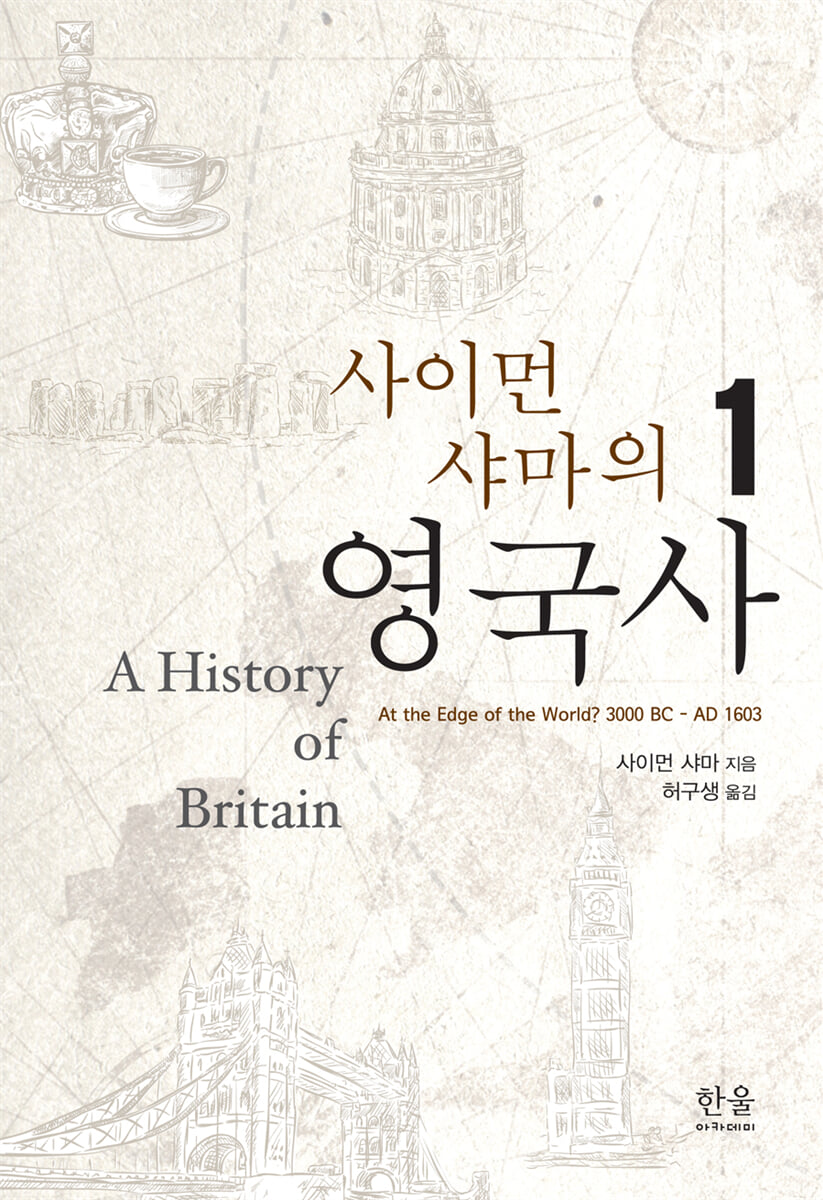
Simon Schama's History of Britain 1
 |
Description
Book Introduction
A History of Britain as Told Through Professor Simon Schama's Narrative
The origin of this book was 'A History of British Television' planned by the British BBC.
Simon Schama, with his extensive historical knowledge across Europe and extensive experience interacting with general audiences in the field of art criticism through his work on PBS television in the United States, was a natural choice to be the writer and presenter of this documentary project.
However, this book cannot be said to be simply a derivative work of the television series.
This is because it is not simply a script for a series, but rather deals with themes and issues of British history in much more detail and specificity than the series.
Another virtue of this book is that it has narratives.
Moreover, because these narratives encompass social and economic issues, the enjoyment of reading can be doubled depending on the reader.
This book, the first of three volumes, unfolds in a captivating narrative of unmissable moments in British history, beginning with prehistoric times, through the arrival of the Romans, the Norman Conquest and the rise of the Angevin Empire, the Black Death, and Queen Elizabeth the Virgin.
The origin of this book was 'A History of British Television' planned by the British BBC.
Simon Schama, with his extensive historical knowledge across Europe and extensive experience interacting with general audiences in the field of art criticism through his work on PBS television in the United States, was a natural choice to be the writer and presenter of this documentary project.
However, this book cannot be said to be simply a derivative work of the television series.
This is because it is not simply a script for a series, but rather deals with themes and issues of British history in much more detail and specificity than the series.
Another virtue of this book is that it has narratives.
Moreover, because these narratives encompass social and economic issues, the enjoyment of reading can be doubled depending on the reader.
This book, the first of three volumes, unfolds in a captivating narrative of unmissable moments in British history, beginning with prehistoric times, through the arrival of the Romans, the Norman Conquest and the rise of the Angevin Empire, the Black Death, and Queen Elizabeth the Virgin.
index
Acknowledgements
introduction
1│At the end of the world?
2│Norman Conquest
3│Liberated sovereignty?
4│Foreigners and indigenous people
5│The King of Death
6│Burning Religious Beliefs
7│The Queen's Body
References
Search
Translator's Note
introduction
1│At the end of the world?
2│Norman Conquest
3│Liberated sovereignty?
4│Foreigners and indigenous people
5│The King of Death
6│Burning Religious Beliefs
7│The Queen's Body
References
Search
Translator's Note
Into the book
It would be more accurate to view Hadrian's Wall as a spine that strengthened and stabilized Roman control over northern Britain rather than a defensive wall.
It is only because the recent discovery of remarkable Roman remains has changed our perception of the lives of the soldiers stationed at the Wall and the surrounding population that we can now imagine a place like the Vindolanda fort, located about halfway along the length of the Wall and about a mile behind, as a not-so-bad arrangement.
Archaeologists spent 25 years dividing the site into sections 23 feet (about 7 meters) deep and wide enough to allow meaningful field identification.
Their aim was to scan the area sideways, a sort of cross-section of the ancient world, in search of postcard-sized wooden tablets, perhaps buried in the earthen clods, on which the men and women of Bindolanda had recorded the daily lives of their ancestors.
--- p.47, from “Chapter 1 At the End of the World?”
Like Canute, Edward had no choice but to use every means at his disposal.
He had to rely on the support of the earls of Mercia and Northumbria to keep the king of Norway out of his comfort zone, and every sight of Godwin, Earl of Wessex, brought back painful reminders of his brother's death, yet nothing could be accomplished without Godwin's help.
… … So when Godwin proposed to him that he marry his daughter Edith, he could not refuse, and she became his official queen.
They had no children, which later led to speculation that Edward had taken a vow of chastity or had an extreme aversion to sex.
It has also been suggested that Edward deliberately distanced himself from Edith in order to thwart Godwin's ambition to insert his family into the line of succession by producing his own grandson, who would become heir to the English throne.
--- p.99~100, from “Chapter 2: The Norman Conquest”
The marriage between Matilda and her second husband, Geoffrey of Anjou, was famously unhappy.
She spoke German, continued to wear imperial formalities (and the honorific title of Empress), and was twenty-six years old.
Geoffrey was raised as a chivalric boy, spoke French, and was fifteen years old.
However, a happy marriage was not a prerequisite for producing an heir; Matilda gave birth to a son in 1133 and gave him to her husband.
The child was named Henry after her father and first husband (Heinrich).
… … It became clear that he inherited from his mother the steely courage and fierce temperament that were not afraid of getting hurt, and from his father the sharp political intellect.
Nevertheless, the quality that those who encountered Henry II most vividly attest to, namely his uncontrollable energy, was his own.
--- p.158, from “Chapter 3 Liberated Sovereignty?”
In 1282, a proclamation was issued in the Kingdom of Gwynedd in north Wales, drawn up by the 'Lords of Snowdonia'.
It stated that 'the people of Snowdon affirm that they will refuse to swear allegiance to any foreigner whose language, customs, or laws are different from theirs, even if their sovereign should hand over the sovereignty to the King of England.'
In 1320, at Arbroath, Scotland, the Scottish barons and earls warned their king:
'We will never accept English rule under any conditions, even if only 100 of us survive.' Two years earlier, the Irish had sent the following warning to the King of England:
'In order to hold the English to account for their incessant treachery, and to throw off the yoke of this cruel and unbearable slavery, and to restore our original liberty, we, the sovereigns of Ireland, are compelled to go to war, ready to die.'
--- p.213, from “Chapter 4: Foreigners and Natives”
Nevertheless, Scotland's decision was a colossal miscalculation.
The Scottish army assembled at Selkirk had not seen any real combat for two generations.
Edward was now nearly sixty, and his long, thick white hair flowed past his shoulders, but he was still tall, thick-boned, and upright, and he still maintained the dignity of a warlord who would be ashamed to be second to him.
His tactics were clearly targeted.
The Scots were simply targets for destruction.
… … It was an attempt to perpetrate a truly horrific massacre on the unfortunate inhabitants of that city, and it was also to serve as a lesson to the people of other areas as to what would happen if they resisted.
The three-day massacre resulted in the deaths of at least 11,000 people, including many women and children.
One chronicler lamented:
'The blood that flowed from the bodies of the dead was so great that it could have turned the mills.' … … All this destruction had taken less than three weeks, and now it seemed as if Scottish liberty had been all but strangled by Edward.
--- p.261, from “Chapter 4: Foreigners and Natives”
In the summer of 1348, the people living a fixed life in this filthy and bustling community did not notice the fleas biting in time, and by the time they did, the terrible scrofula had already appeared.
As hundreds of people died each day, the corpses began to pile up, with the children, the elderly, and the poor, the most vulnerable, falling victim first.
… … Families – contrary to popular belief in medieval England, which was essentially a nuclear family of parents and children – suffered the heartbreaking pain of separation as healthy family members were forced to leave behind sick ones.
Parents who could do nothing for their sick children had no choice but to abandon them, no matter how guilty they felt, in order to save the lives of the remaining children who were not yet infected.
'In those days,' wrote a Westminster monk, 'there was death without sorrow, marriage without love, want without poverty, and flight without escape.'
Everything that had been taken for granted until then suddenly became a subject of question.
For example, with no bakers and most homes not baking bread on the street corners, where can we get bread? With no one working, where can we find herbs? With the decomposing remains of dead bodies causing contact-borne infections, who will clean up the corpses?
--- p.294~295, from “Chapter 5 The King of Death”
Significant changes were taking place in rural communities in England, Wales, and Scotland.
The balance of economic power was shifting dramatically, and for the first time in history it was working on the side of the people rather than the lords.
The manor manager of Farnham, who himself would later die of the Black Death, complained that the harvest cost 12p an acre, twice what it had been before the Black Death.
The number of workers decreased, and wages began to rise in inverse proportion.
It wasn't just Panham, the whole country was in the same situation.
Regardless of whether the Black Death was the cause of this great rural upheaval or merely the trigger for a process that had been underway for generations, the rural areas of late medieval Britain were an irreversibly changed world.
To put it simply, there were no more serfs in that world.
From some point on, it became difficult to force non-free farmers to work without pay.
In the past, they had to haul hay and plow for their lords in exchange for the legal right to occupy land and houses, but now that the laws of supply and demand for labor have clearly favored the survivors, unpaid labor like the past is virtually impossible.
Now, farmers could demand wages for any work they were asked to do by their lords or managers, or even demand higher wages than before.
--- p.301~302, from “Chapter 5 The King of Death”
As the summer of 1526 approached, Henry's courtship of Anne became quite serious.
As he danced with her in front of the queen, the contrast between the two women became stark.
Anne was different from Catherine of Aragon in every way.
At least ten years younger than Catherine, she was more cheerful than the pious Catherine, and was accustomed to the spirited, even teasing, French manners rather than the Spanish manners of being respectful.
Anne offered Henry sexual pleasure, domestic happiness, and above all, the possibility of having a son to succeed him.
Now Henry began to believe that God had cursed his marriage to his dead brother's wife and that he had been in an incestuous relationship for the past 17 years.
--- p.372~373, from “Chapter 6 Burning Religious Beliefs”
Elizabeth was unwilling to repeat the mistake of her sister, that of having her husband's ambition and religion cause him to harm rather than protect England's interests.
Her thinking was that rather than rushing into marriage and risking disaster, it was better to take the time to find the right partner.
However, there were some who considered it a luxury for the queen to have such leisurely time to make her own choices.
Especially from the point of view of Secretary of State Cecil, there was no matter more urgent than the Queen's marriage.
--- p.435, from “Chapter 7 The Queen’s Body”
Her reign bore fruit.
The disaster in Flanders was a gift to England, bringing in capital and skilled workers.
Elizabeth I opened the first stock exchange in England, modeled after Antwerp.
The English economy, though somewhat unstable, was experiencing remarkable industrial expansion.
All kinds of products were produced in England, from tin and iron to linen, lace, glass, soap, and salt.
Even houses of modest size became common with glass windows, and pewter began to replace wood in tableware and cooking utensils.
England was experiencing a very significant change.
Of course, the 'cornucopia' could not distribute its fruits in abundance to everyone because there were too many people.
By the end of the 16th century, England's population had reached 5 million.
(Scotland had 500,000.) This was the largest population increase since the Black Death.
The population to feed increased, but jobs were scarce, and with less bargaining power, workers were forced to accept lower wages than before.
In rural areas, enclosure of common lands to allow for profitable livestock farming was implemented, which in many villages closed off the possibility of self-sufficiency for the people, forcing many into landless wage laborers or joining the ranks of the vast number of wandering paupers.
It is only because the recent discovery of remarkable Roman remains has changed our perception of the lives of the soldiers stationed at the Wall and the surrounding population that we can now imagine a place like the Vindolanda fort, located about halfway along the length of the Wall and about a mile behind, as a not-so-bad arrangement.
Archaeologists spent 25 years dividing the site into sections 23 feet (about 7 meters) deep and wide enough to allow meaningful field identification.
Their aim was to scan the area sideways, a sort of cross-section of the ancient world, in search of postcard-sized wooden tablets, perhaps buried in the earthen clods, on which the men and women of Bindolanda had recorded the daily lives of their ancestors.
--- p.47, from “Chapter 1 At the End of the World?”
Like Canute, Edward had no choice but to use every means at his disposal.
He had to rely on the support of the earls of Mercia and Northumbria to keep the king of Norway out of his comfort zone, and every sight of Godwin, Earl of Wessex, brought back painful reminders of his brother's death, yet nothing could be accomplished without Godwin's help.
… … So when Godwin proposed to him that he marry his daughter Edith, he could not refuse, and she became his official queen.
They had no children, which later led to speculation that Edward had taken a vow of chastity or had an extreme aversion to sex.
It has also been suggested that Edward deliberately distanced himself from Edith in order to thwart Godwin's ambition to insert his family into the line of succession by producing his own grandson, who would become heir to the English throne.
--- p.99~100, from “Chapter 2: The Norman Conquest”
The marriage between Matilda and her second husband, Geoffrey of Anjou, was famously unhappy.
She spoke German, continued to wear imperial formalities (and the honorific title of Empress), and was twenty-six years old.
Geoffrey was raised as a chivalric boy, spoke French, and was fifteen years old.
However, a happy marriage was not a prerequisite for producing an heir; Matilda gave birth to a son in 1133 and gave him to her husband.
The child was named Henry after her father and first husband (Heinrich).
… … It became clear that he inherited from his mother the steely courage and fierce temperament that were not afraid of getting hurt, and from his father the sharp political intellect.
Nevertheless, the quality that those who encountered Henry II most vividly attest to, namely his uncontrollable energy, was his own.
--- p.158, from “Chapter 3 Liberated Sovereignty?”
In 1282, a proclamation was issued in the Kingdom of Gwynedd in north Wales, drawn up by the 'Lords of Snowdonia'.
It stated that 'the people of Snowdon affirm that they will refuse to swear allegiance to any foreigner whose language, customs, or laws are different from theirs, even if their sovereign should hand over the sovereignty to the King of England.'
In 1320, at Arbroath, Scotland, the Scottish barons and earls warned their king:
'We will never accept English rule under any conditions, even if only 100 of us survive.' Two years earlier, the Irish had sent the following warning to the King of England:
'In order to hold the English to account for their incessant treachery, and to throw off the yoke of this cruel and unbearable slavery, and to restore our original liberty, we, the sovereigns of Ireland, are compelled to go to war, ready to die.'
--- p.213, from “Chapter 4: Foreigners and Natives”
Nevertheless, Scotland's decision was a colossal miscalculation.
The Scottish army assembled at Selkirk had not seen any real combat for two generations.
Edward was now nearly sixty, and his long, thick white hair flowed past his shoulders, but he was still tall, thick-boned, and upright, and he still maintained the dignity of a warlord who would be ashamed to be second to him.
His tactics were clearly targeted.
The Scots were simply targets for destruction.
… … It was an attempt to perpetrate a truly horrific massacre on the unfortunate inhabitants of that city, and it was also to serve as a lesson to the people of other areas as to what would happen if they resisted.
The three-day massacre resulted in the deaths of at least 11,000 people, including many women and children.
One chronicler lamented:
'The blood that flowed from the bodies of the dead was so great that it could have turned the mills.' … … All this destruction had taken less than three weeks, and now it seemed as if Scottish liberty had been all but strangled by Edward.
--- p.261, from “Chapter 4: Foreigners and Natives”
In the summer of 1348, the people living a fixed life in this filthy and bustling community did not notice the fleas biting in time, and by the time they did, the terrible scrofula had already appeared.
As hundreds of people died each day, the corpses began to pile up, with the children, the elderly, and the poor, the most vulnerable, falling victim first.
… … Families – contrary to popular belief in medieval England, which was essentially a nuclear family of parents and children – suffered the heartbreaking pain of separation as healthy family members were forced to leave behind sick ones.
Parents who could do nothing for their sick children had no choice but to abandon them, no matter how guilty they felt, in order to save the lives of the remaining children who were not yet infected.
'In those days,' wrote a Westminster monk, 'there was death without sorrow, marriage without love, want without poverty, and flight without escape.'
Everything that had been taken for granted until then suddenly became a subject of question.
For example, with no bakers and most homes not baking bread on the street corners, where can we get bread? With no one working, where can we find herbs? With the decomposing remains of dead bodies causing contact-borne infections, who will clean up the corpses?
--- p.294~295, from “Chapter 5 The King of Death”
Significant changes were taking place in rural communities in England, Wales, and Scotland.
The balance of economic power was shifting dramatically, and for the first time in history it was working on the side of the people rather than the lords.
The manor manager of Farnham, who himself would later die of the Black Death, complained that the harvest cost 12p an acre, twice what it had been before the Black Death.
The number of workers decreased, and wages began to rise in inverse proportion.
It wasn't just Panham, the whole country was in the same situation.
Regardless of whether the Black Death was the cause of this great rural upheaval or merely the trigger for a process that had been underway for generations, the rural areas of late medieval Britain were an irreversibly changed world.
To put it simply, there were no more serfs in that world.
From some point on, it became difficult to force non-free farmers to work without pay.
In the past, they had to haul hay and plow for their lords in exchange for the legal right to occupy land and houses, but now that the laws of supply and demand for labor have clearly favored the survivors, unpaid labor like the past is virtually impossible.
Now, farmers could demand wages for any work they were asked to do by their lords or managers, or even demand higher wages than before.
--- p.301~302, from “Chapter 5 The King of Death”
As the summer of 1526 approached, Henry's courtship of Anne became quite serious.
As he danced with her in front of the queen, the contrast between the two women became stark.
Anne was different from Catherine of Aragon in every way.
At least ten years younger than Catherine, she was more cheerful than the pious Catherine, and was accustomed to the spirited, even teasing, French manners rather than the Spanish manners of being respectful.
Anne offered Henry sexual pleasure, domestic happiness, and above all, the possibility of having a son to succeed him.
Now Henry began to believe that God had cursed his marriage to his dead brother's wife and that he had been in an incestuous relationship for the past 17 years.
--- p.372~373, from “Chapter 6 Burning Religious Beliefs”
Elizabeth was unwilling to repeat the mistake of her sister, that of having her husband's ambition and religion cause him to harm rather than protect England's interests.
Her thinking was that rather than rushing into marriage and risking disaster, it was better to take the time to find the right partner.
However, there were some who considered it a luxury for the queen to have such leisurely time to make her own choices.
Especially from the point of view of Secretary of State Cecil, there was no matter more urgent than the Queen's marriage.
--- p.435, from “Chapter 7 The Queen’s Body”
Her reign bore fruit.
The disaster in Flanders was a gift to England, bringing in capital and skilled workers.
Elizabeth I opened the first stock exchange in England, modeled after Antwerp.
The English economy, though somewhat unstable, was experiencing remarkable industrial expansion.
All kinds of products were produced in England, from tin and iron to linen, lace, glass, soap, and salt.
Even houses of modest size became common with glass windows, and pewter began to replace wood in tableware and cooking utensils.
England was experiencing a very significant change.
Of course, the 'cornucopia' could not distribute its fruits in abundance to everyone because there were too many people.
By the end of the 16th century, England's population had reached 5 million.
(Scotland had 500,000.) This was the largest population increase since the Black Death.
The population to feed increased, but jobs were scarce, and with less bargaining power, workers were forced to accept lower wages than before.
In rural areas, enclosure of common lands to allow for profitable livestock farming was implemented, which in many villages closed off the possibility of self-sufficiency for the people, forcing many into landless wage laborers or joining the ranks of the vast number of wandering paupers.
--- p.469, from “Chapter 7 The Queen’s Body”
Publisher's Review
Maintaining a delicate balance between traditional history and revisionist views
The author's balanced perspective, which permeates the entire book, helps avoid the "traps of British history" that can easily fall into the hands of not only general readers but even specialists.
The trap is to assume that British history is a necessary and enduring history of freedom and democracy, while emphasizing the unique characteristics of Britain.
Simon Schama argues that British history is a complex one, a mixture of accidental events and the influence of foreign institutions and cultures. He argues that this is not a formalized or atomized history, but rather a process of gradual formation of national identity through intermittent advances and retreats.
Maintaining a delicate balance between traditional history and revisionist historiography is not an easy task.
Author Simon Schama unfolds British history with rich storytelling and vivid, colorful detail, skillfully reviving familiar characters and events to create a powerful and compelling narrative.
Drawing on the unflinching depiction of relics and ruins, and the drama of the story itself, he portrays specific events—the formation of the nation-state, the cyclical nature of power, and the struggle between oppressors and oppressed—in Shama's gentle and palatable style.
The author's balanced perspective, which permeates the entire book, helps avoid the "traps of British history" that can easily fall into the hands of not only general readers but even specialists.
The trap is to assume that British history is a necessary and enduring history of freedom and democracy, while emphasizing the unique characteristics of Britain.
Simon Schama argues that British history is a complex one, a mixture of accidental events and the influence of foreign institutions and cultures. He argues that this is not a formalized or atomized history, but rather a process of gradual formation of national identity through intermittent advances and retreats.
Maintaining a delicate balance between traditional history and revisionist historiography is not an easy task.
Author Simon Schama unfolds British history with rich storytelling and vivid, colorful detail, skillfully reviving familiar characters and events to create a powerful and compelling narrative.
Drawing on the unflinching depiction of relics and ruins, and the drama of the story itself, he portrays specific events—the formation of the nation-state, the cyclical nature of power, and the struggle between oppressors and oppressed—in Shama's gentle and palatable style.
GOODS SPECIFICS
- Publication date: August 10, 2022
- Page count, weight, size: 528 pages | 153*224*12mm
- ISBN13: 9788946081994
You may also like
카테고리
korean


korean

![GQ KOREA Mark (Monthly): December [2025]](http://librairie.coreenne.fr/cdn/shop/files/8ef265dbbfbf186523ed75ba7319009d.jpg?v=1765340328&width=3840)


