

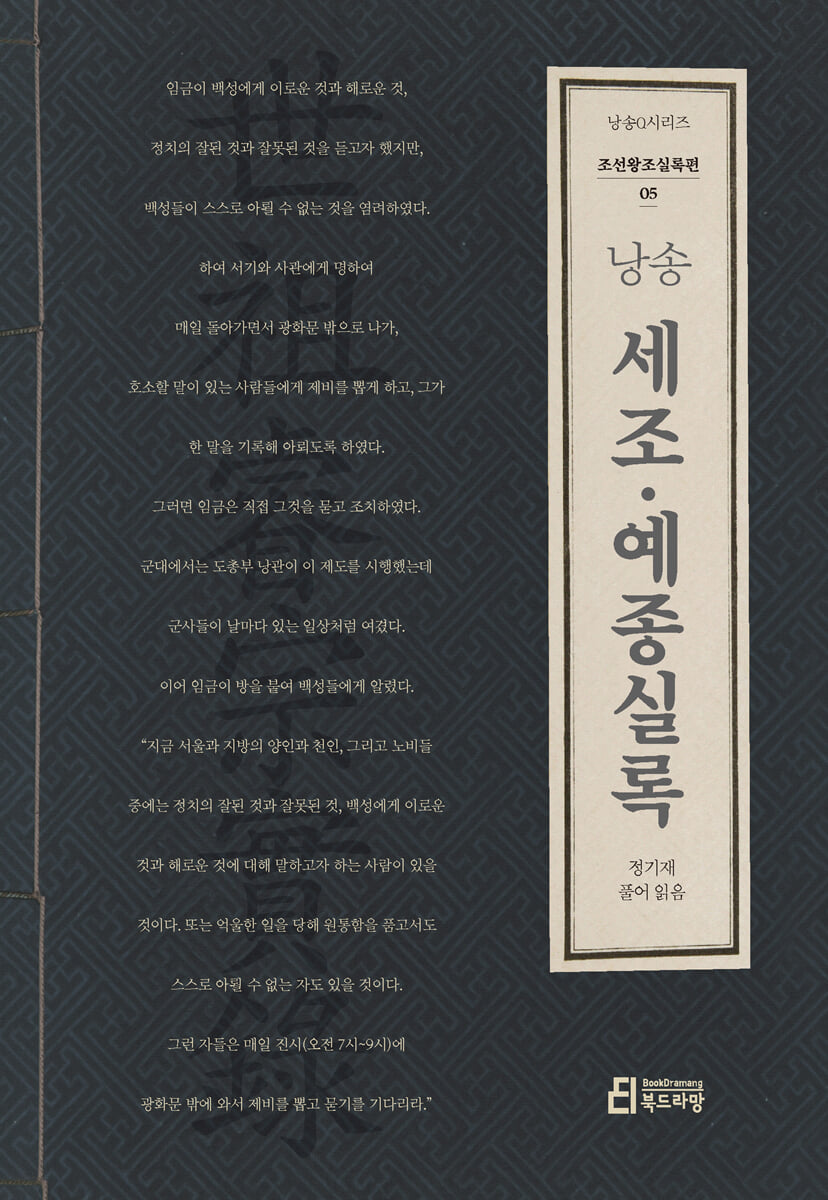
Recitation of the Annals of King Sejo and King Yejong
 |
Description
Book Introduction
Grand Prince Suyang, the usurper who dreamed of a prosperous and strong nation Meeting King Sejo, the king who runs and acts with his body The story of King Sejo (Grand Prince Suyang Lee Yu) and King Yejong from the Annals of the Joseon Dynasty, a recitation series that recounts the history of Joseon. A cruel usurper who took the throne from his young nephew. That is the image that usually comes to mind when we think of Sejo. However, when we look at King Sejo's reign through the Annals of King Sejo, we see a wise king who hated empty talk, boldly introduced policies for the people through his actions, and was also well-versed in academics and the arts. Moreover, he is a rare king who did not have a concubine after ascending to the throne, and he is also the king whose annals contain more stories about his queen than any other king. 『Recitation of the Annals of King Sejo and King Yejong』 is a collection of stories that show both the successful politics of King Sejo's era and the instability behind it. Those who read it in detail say that when Sejo's era is called the 'era of usurpers', they think of it as a time when the people were oppressed under a cold-blooded dictator, but the essence of the 'era of usurpers' is that the desire for a 'usurper' sprouted in the hearts of the people, and so it shows that even though Sejo's era was a time of many achievements and a full national treasury, it was also a time of many large and small rebellions and reports. Sejo, who dreamed of a prosperous and strong nation and possessed the ability, but was ultimately unable to escape the ruthless path to the throne, and the image of his era can be vividly portrayed in 『Recitation of the Annals of King Sejo and King Yejong』. |
- You can preview some of the book's contents.
Preview
index
Preface: A Usurper's Dream and Frustration
Part 1: The Talented Second Prince
1-1.
A body like a ball of fire
1-2.
A prince who excelled in literature and art
1-3.
Political assistants of Sejong and Munjong
1-4.
Wang Jae, recognized by the Ming Dynasty
1-5.
Sejong urges brotherly love
Part 2: Starting point as a usurper of the throne
2-1.
A king who inherited the throne from his nephew
2-2.
The young king of Changdeokgung Palace
2-3.
The King's request was half accepted
2-4.
Attempting to Kill Sejo? ─ The Rebellion of the Four Martyrs ①
2-5.
A brutal retribution?─The Rebellion of the Four Martyrs ②
2-6.
The King's Tacit Approval? ─The Rebellion of the Four Martyrs ③
2-7.
Demotion to Nosan-gun and exile to Yeongwol
2-8.
The public sentiment surrounding the former king
2-10.
The death of Nosangun
Part 3: Sejo's Dream, the Emperor's Politics
3-1.
The Emperor's Sacrifice, the Huanqiu Festival
3-2.
Pureness that travels the world from east to west, south to north
3-3.
A large-scale procession to the north, a tour of Pyongyang
3-4.
Mysterious signs of destiny
3-5.
Suppressing the thieving barbarians?─Gyeongjinbukjeong
3-6.
Both the Jurchen and the Wa are my subjects.
3-7.
A king more like a general than a general
3-8.
All power should belong to the king
3-9.
Gyeongguk Daejeon, revised and revised again
3-10.
All citizens are registered in the household register, household registration law
Part 4: Politics for the People: Actions Speak Louder Than Words
4-1.
A king who is strict about his work, and his subjects who are at a loss
4-2.
The people's blood, sweat, and tears create the standard for national security.
4-3.
Through the rain, to the disaster site!
4-4.
Reclamation that filled the national treasury
4-5.
Give the people the right to sue their governors
4-6.
Sejo's New Archive! Gwanghwamun's Lottery
4-7.
Clearing the name of Baekjeong Shin Cheol-san
4-8.
Catching a tiger that appears in Hanyang
4-9.
『Pharmaceutical Theory』 written by the king himself
4-10.
Learning the Book of Changes through the Body
4-11.
Weeding out the boring Confucian scholars who only study the past
Part 5: The King and His Subject: A Precarious Tightrope Walk
5-1.
Kingmaker, Han Myeong-hoe
5-2.
Kwon Nam, the man of great fortune who triggered the rebellion of King Sejo
5-3.
Shin Suk-ju, Joseon's greatest talent
5-4.
Yu Ja-gwang, who captivated the king with a single petition
5-5.
Jeong In-ji, a scholar who sided with Sejo
5-6.
The king of discipline!
5-7.
A surge of discontent and a tragic ending
5-8.
The caprices of an old and weak king
Part 6: Human Sejo and Tragedies
6-1.
Wife fool
6-2.
A good daughter-in-law, wife, grandmother, Queen Jeonghui
6-3.
I forgave her twice! But the concubine who loved another man
6-4.
The death of the eldest son, Crown Prince Uigyeong
6-5.
The curse of Seongsammun? Rumors about his sons
6-6.
The only remaining son, Crown Prince Yejong
6-7.
The repeated tragedy of descendants
6-8.
A chronic disease
6-9.
King Yeongjong, don't be like me.
6-10.
The road to resolving grudges
6-11.
When you die, you should rot quickly.
Part 7: King Sejo's View of Women and the Women of His Time
7-1.
A man and a woman, saving all sides
7-2.
Mrs. Ko took off her mourning clothes to get a divorce
7-3.
The one-eyed woman who captivates men
7-4.
The story of a traitor's wife and daughter
7-5.
Wife or concubine? Lee So-geun, daughter of a traitor
7-6.
Princess Gyeonghye, King Munjong's only daughter
King Yejong's short reign of 13 months
8-1.
Ascension to the throne a day before Sejo's death
8-2.
Insisting on using Sejo as the father's temple name
8-3.
King Yeongjong preparing for a new era
8-4.
The power of Wonsang that even changed the four seasons
8-5.
Public sentiment is unstable, and the royal power is shaken.
8-6.
Arrest the one who asks for favors from the ministers!
8-7.
Such a sudden death
Part 9: Various Aspects of the Reign of King Sejo and King Yejong
9-1.
The full moon scenery in the palace garden
9-2.
Dancing and singing on the streets of Hanyang
9-3.
Jeju tangerines that made people's spines bend
9-4.
Genealogy of Baekjeong
9-5.
The revenge of the Ming eunuch who returned home in glory
9-6.
King Sejo tells us the secrets of hot spring bathing
9-7.
Choi Kyung, the son of a salt baker and genius painter
9-8.
Master of Requests, Erza Heomojiri
Reference material: Official titles in the Annals of the Joseon Dynasty
Part 1: The Talented Second Prince
1-1.
A body like a ball of fire
1-2.
A prince who excelled in literature and art
1-3.
Political assistants of Sejong and Munjong
1-4.
Wang Jae, recognized by the Ming Dynasty
1-5.
Sejong urges brotherly love
Part 2: Starting point as a usurper of the throne
2-1.
A king who inherited the throne from his nephew
2-2.
The young king of Changdeokgung Palace
2-3.
The King's request was half accepted
2-4.
Attempting to Kill Sejo? ─ The Rebellion of the Four Martyrs ①
2-5.
A brutal retribution?─The Rebellion of the Four Martyrs ②
2-6.
The King's Tacit Approval? ─The Rebellion of the Four Martyrs ③
2-7.
Demotion to Nosan-gun and exile to Yeongwol
2-8.
The public sentiment surrounding the former king
2-10.
The death of Nosangun
Part 3: Sejo's Dream, the Emperor's Politics
3-1.
The Emperor's Sacrifice, the Huanqiu Festival
3-2.
Pureness that travels the world from east to west, south to north
3-3.
A large-scale procession to the north, a tour of Pyongyang
3-4.
Mysterious signs of destiny
3-5.
Suppressing the thieving barbarians?─Gyeongjinbukjeong
3-6.
Both the Jurchen and the Wa are my subjects.
3-7.
A king more like a general than a general
3-8.
All power should belong to the king
3-9.
Gyeongguk Daejeon, revised and revised again
3-10.
All citizens are registered in the household register, household registration law
Part 4: Politics for the People: Actions Speak Louder Than Words
4-1.
A king who is strict about his work, and his subjects who are at a loss
4-2.
The people's blood, sweat, and tears create the standard for national security.
4-3.
Through the rain, to the disaster site!
4-4.
Reclamation that filled the national treasury
4-5.
Give the people the right to sue their governors
4-6.
Sejo's New Archive! Gwanghwamun's Lottery
4-7.
Clearing the name of Baekjeong Shin Cheol-san
4-8.
Catching a tiger that appears in Hanyang
4-9.
『Pharmaceutical Theory』 written by the king himself
4-10.
Learning the Book of Changes through the Body
4-11.
Weeding out the boring Confucian scholars who only study the past
Part 5: The King and His Subject: A Precarious Tightrope Walk
5-1.
Kingmaker, Han Myeong-hoe
5-2.
Kwon Nam, the man of great fortune who triggered the rebellion of King Sejo
5-3.
Shin Suk-ju, Joseon's greatest talent
5-4.
Yu Ja-gwang, who captivated the king with a single petition
5-5.
Jeong In-ji, a scholar who sided with Sejo
5-6.
The king of discipline!
5-7.
A surge of discontent and a tragic ending
5-8.
The caprices of an old and weak king
Part 6: Human Sejo and Tragedies
6-1.
Wife fool
6-2.
A good daughter-in-law, wife, grandmother, Queen Jeonghui
6-3.
I forgave her twice! But the concubine who loved another man
6-4.
The death of the eldest son, Crown Prince Uigyeong
6-5.
The curse of Seongsammun? Rumors about his sons
6-6.
The only remaining son, Crown Prince Yejong
6-7.
The repeated tragedy of descendants
6-8.
A chronic disease
6-9.
King Yeongjong, don't be like me.
6-10.
The road to resolving grudges
6-11.
When you die, you should rot quickly.
Part 7: King Sejo's View of Women and the Women of His Time
7-1.
A man and a woman, saving all sides
7-2.
Mrs. Ko took off her mourning clothes to get a divorce
7-3.
The one-eyed woman who captivates men
7-4.
The story of a traitor's wife and daughter
7-5.
Wife or concubine? Lee So-geun, daughter of a traitor
7-6.
Princess Gyeonghye, King Munjong's only daughter
King Yejong's short reign of 13 months
8-1.
Ascension to the throne a day before Sejo's death
8-2.
Insisting on using Sejo as the father's temple name
8-3.
King Yeongjong preparing for a new era
8-4.
The power of Wonsang that even changed the four seasons
8-5.
Public sentiment is unstable, and the royal power is shaken.
8-6.
Arrest the one who asks for favors from the ministers!
8-7.
Such a sudden death
Part 9: Various Aspects of the Reign of King Sejo and King Yejong
9-1.
The full moon scenery in the palace garden
9-2.
Dancing and singing on the streets of Hanyang
9-3.
Jeju tangerines that made people's spines bend
9-4.
Genealogy of Baekjeong
9-5.
The revenge of the Ming eunuch who returned home in glory
9-6.
King Sejo tells us the secrets of hot spring bathing
9-7.
Choi Kyung, the son of a salt baker and genius painter
9-8.
Master of Requests, Erza Heomojiri
Reference material: Official titles in the Annals of the Joseon Dynasty
Into the book
In February of the 16th year of King Sejong's reign, a hunting competition was held in Pyeonggang, Gangwon-do as a military training exercise. The weather was cold and rainy, and a fierce wind was blowing.
Everyone wore three layers of padded clothing under their leather clothes, covered their ears, and wore hats, but they were shivering from the cold.
However, Prince Suyang wore only a single layer of clothing and rolled up his arms, but his hands were as hot as fireballs, so onlookers thought he was different.
---From the "Sejo Chronicles (Part 1: The Talented Second Prince)"
The king received an inquiry from his ministers and administered state affairs in the royal court.
The king said.
“If a monarch is supported by a country and sits comfortably in his palace, he cannot understand the difficulties of farming and the hardships of the people.
This is not the way of the king.
From now on, I will tour the country and look after the people.”
The king had the Prime Minister Kang Maeng-gyeong and the royal secretaries discuss the procedure for purification, and immediately sent a message to the Ministry of War.
“After the harvest this fall, we will purify Chungcheong and Gyeongsang provinces, so prepare for all matters.”
---From "July 8, Year 3 of King Sejo's reign (1457)" (Part 3, King Sejo's Dream, Emperor's Politics)
Hamgyong Province Governor Shin Suk-ju sent a military officer to report.
“God and his generals went on a journey to subdue the enemy, destroying all their dens and returning.
In the battle, they killed about 430 people, burned down about 900 houses, and burned down the rest of their property.
“The number of cattle and horses killed or stolen is about 1,000.”
The king was delighted and gave gifts to the military officers who brought the news of victory.
And he had the success of the northern expedition reported to the royal ancestral shrine.
As he approached Geunjeongjeon, the high and low officials presented letters of congratulations.
---From "September 11, Year 6 of King Sejo's reign (1460)" (Part 3: King Sejo's Dream, the Emperor's Politics)
The king wanted to create a standard for various expenses used in the country by creating a horizontal table of food rites, but he was worried because it was not completed for a long time.
Accordingly, he ordered Yeongsun-gun Ibu and Ha Seong-wi Jeong Hyeon-jo to lead the government officials and report on the affairs of the Hoenggan every day.
He also made the officials work late into the night at the palace and did not allow them to go out.
The king received the report even though he was ill, and allowed him to return home only after the report was completed.
---From "November 22, 1467, the 9th year of King Sejo's reign (Part 4: Actions speak louder than words! Politics for the people's livelihood through action")
The king sent a telegram to the Royal Secretariat.
“I would like to personally inspect the leaky areas of various government offices within the palace.
“Get the people out of the government office west of the palace.”
The king, together with the queen and the young royal relatives, toured various government offices.
At this time, the porcelain from the Seungjeongwon and the cotton and silk from the Sanguiwon were taken out and distributed to the young royal relatives and palace maids.
---From "February 10, 1464, the 10th year of King Sejo's reign (Part 4: Actions speak louder than words! Politics for the people's livelihood through action)"
After Yi Si-ae's rebellion was suppressed, the king spoke to Kim Guk-gwang and Yun Pil-sang.
“The queen said before, ‘Ishi-ae’s rebellion is not a disaster for the country.
He said, 'This incident has led to the retraining of the military, which is also a process of strengthening the country.'
“I was moved by his heart, so you too should know.”
---From "August 27, 13th year of King Sejo's reign (1467)" (Part 5: King Sejo, the Man, and Tragedies)
In September of the third year after our King Sejo ascended the throne, the crown prince died of illness.
He was twenty years old.
Prince Uigyeong's name is Lee Jang and his pen name is Wonmyeong.
He was born on September 15, 1439, the 21st year of King Sejong's reign.
According to the old system, the wives of many princes were required to go to the private quarters outside the palace when they were about to give birth.
However, Queen Jeonghui, the wife of King Sejo, was especially loved by King Sejong and Queen Soheon and gave birth to the crown prince in the palace.
Prince Uigyeong was of good physique, had a mature personality, and had a neat and elegant appearance.
Sejong personally embraced him and took him with him, treating him differently from other royal descendants.
In January 1445, the 27th year of King Sejong's reign, he was appointed to the position of Jeongui Daeboo and given the title of Dowongun.
On the 6th day of the Eulmyo month in the first year of King Sejo's reign (1455), he was appointed crown prince when King Sejo ascended to the throne.
King Sejo appointed teachers for Crown Prince Seoyeon and did everything he could to educate him, and the Crown Prince also enjoyed his studies and did not neglect them at all.
He also called Seoyeon-gwan three times a day to give lectures.
One day, while reading the Book of Documents, I came across the Shundian section and read a commentary on the celestial observer, Gihyeong.
However, it was difficult to understand the system through text alone.
So, he immediately went up to the observatory with Seo Yeon-gwan and observed the armillary sphere and astronomical observation device, and repeatedly referred to it with what was recorded in the Book of Documents, ensuring that there was no obstruction.
It was the same when I read other articles, if I had any doubts, I would always ask, and after asking, I would always look at it again.
When the crown prince first fell ill, the king was very worried.
He immediately took the crown prince to a private residence outside the palace, prayed earnestly, and used medicinal herbs, doing his best to treat him.
The Crown Prince's condition improved slightly, and the King was very pleased and gave a rank increase to each of the nurses, guards, and officials.
But soon after, his illness worsened again and he never recovered.
The king and queen were greatly saddened, reduced their food, suspended government affairs for five days, and the author was also dismissed for five days.
Although the ministers asked him several times to eat the asura, he did not allow it and instead wore mourning clothes for 30 days.
The royal family, ministers, and even the common people all shed tears in sorrow, and there was no one who did not pay tribute.
People said.
“Our people are not blessed.
“A virtuous person like the Crown Prince passed away before he could live out his life!”
Everyone wore three layers of padded clothing under their leather clothes, covered their ears, and wore hats, but they were shivering from the cold.
However, Prince Suyang wore only a single layer of clothing and rolled up his arms, but his hands were as hot as fireballs, so onlookers thought he was different.
---From the "Sejo Chronicles (Part 1: The Talented Second Prince)"
The king received an inquiry from his ministers and administered state affairs in the royal court.
The king said.
“If a monarch is supported by a country and sits comfortably in his palace, he cannot understand the difficulties of farming and the hardships of the people.
This is not the way of the king.
From now on, I will tour the country and look after the people.”
The king had the Prime Minister Kang Maeng-gyeong and the royal secretaries discuss the procedure for purification, and immediately sent a message to the Ministry of War.
“After the harvest this fall, we will purify Chungcheong and Gyeongsang provinces, so prepare for all matters.”
---From "July 8, Year 3 of King Sejo's reign (1457)" (Part 3, King Sejo's Dream, Emperor's Politics)
Hamgyong Province Governor Shin Suk-ju sent a military officer to report.
“God and his generals went on a journey to subdue the enemy, destroying all their dens and returning.
In the battle, they killed about 430 people, burned down about 900 houses, and burned down the rest of their property.
“The number of cattle and horses killed or stolen is about 1,000.”
The king was delighted and gave gifts to the military officers who brought the news of victory.
And he had the success of the northern expedition reported to the royal ancestral shrine.
As he approached Geunjeongjeon, the high and low officials presented letters of congratulations.
---From "September 11, Year 6 of King Sejo's reign (1460)" (Part 3: King Sejo's Dream, the Emperor's Politics)
The king wanted to create a standard for various expenses used in the country by creating a horizontal table of food rites, but he was worried because it was not completed for a long time.
Accordingly, he ordered Yeongsun-gun Ibu and Ha Seong-wi Jeong Hyeon-jo to lead the government officials and report on the affairs of the Hoenggan every day.
He also made the officials work late into the night at the palace and did not allow them to go out.
The king received the report even though he was ill, and allowed him to return home only after the report was completed.
---From "November 22, 1467, the 9th year of King Sejo's reign (Part 4: Actions speak louder than words! Politics for the people's livelihood through action")
The king sent a telegram to the Royal Secretariat.
“I would like to personally inspect the leaky areas of various government offices within the palace.
“Get the people out of the government office west of the palace.”
The king, together with the queen and the young royal relatives, toured various government offices.
At this time, the porcelain from the Seungjeongwon and the cotton and silk from the Sanguiwon were taken out and distributed to the young royal relatives and palace maids.
---From "February 10, 1464, the 10th year of King Sejo's reign (Part 4: Actions speak louder than words! Politics for the people's livelihood through action)"
After Yi Si-ae's rebellion was suppressed, the king spoke to Kim Guk-gwang and Yun Pil-sang.
“The queen said before, ‘Ishi-ae’s rebellion is not a disaster for the country.
He said, 'This incident has led to the retraining of the military, which is also a process of strengthening the country.'
“I was moved by his heart, so you too should know.”
---From "August 27, 13th year of King Sejo's reign (1467)" (Part 5: King Sejo, the Man, and Tragedies)
In September of the third year after our King Sejo ascended the throne, the crown prince died of illness.
He was twenty years old.
Prince Uigyeong's name is Lee Jang and his pen name is Wonmyeong.
He was born on September 15, 1439, the 21st year of King Sejong's reign.
According to the old system, the wives of many princes were required to go to the private quarters outside the palace when they were about to give birth.
However, Queen Jeonghui, the wife of King Sejo, was especially loved by King Sejong and Queen Soheon and gave birth to the crown prince in the palace.
Prince Uigyeong was of good physique, had a mature personality, and had a neat and elegant appearance.
Sejong personally embraced him and took him with him, treating him differently from other royal descendants.
In January 1445, the 27th year of King Sejong's reign, he was appointed to the position of Jeongui Daeboo and given the title of Dowongun.
On the 6th day of the Eulmyo month in the first year of King Sejo's reign (1455), he was appointed crown prince when King Sejo ascended to the throne.
King Sejo appointed teachers for Crown Prince Seoyeon and did everything he could to educate him, and the Crown Prince also enjoyed his studies and did not neglect them at all.
He also called Seoyeon-gwan three times a day to give lectures.
One day, while reading the Book of Documents, I came across the Shundian section and read a commentary on the celestial observer, Gihyeong.
However, it was difficult to understand the system through text alone.
So, he immediately went up to the observatory with Seo Yeon-gwan and observed the armillary sphere and astronomical observation device, and repeatedly referred to it with what was recorded in the Book of Documents, ensuring that there was no obstruction.
It was the same when I read other articles, if I had any doubts, I would always ask, and after asking, I would always look at it again.
When the crown prince first fell ill, the king was very worried.
He immediately took the crown prince to a private residence outside the palace, prayed earnestly, and used medicinal herbs, doing his best to treat him.
The Crown Prince's condition improved slightly, and the King was very pleased and gave a rank increase to each of the nurses, guards, and officials.
But soon after, his illness worsened again and he never recovered.
The king and queen were greatly saddened, reduced their food, suspended government affairs for five days, and the author was also dismissed for five days.
Although the ministers asked him several times to eat the asura, he did not allow it and instead wore mourning clothes for 30 days.
The royal family, ministers, and even the common people all shed tears in sorrow, and there was no one who did not pay tribute.
People said.
“Our people are not blessed.
“A virtuous person like the Crown Prince passed away before he could live out his life!”
---「From the epitaph of Crown Prince Uigyeong, November 24, 1457, the 3rd year of King Sejo's reign ('Part 5: The Human King Sejo, and the Tragedies')」
Publisher's Review
▶A word from the reader
“While reading the Annals of King Sejo, even one of my standards was cracked.
As the firmness that a usurper is just a usurper faded, other contexts for understanding Sejo began to come into view.
What caught my eye then was Sejo's body, like a ball of fire.
Sejo's body was extraordinary.
Even though I was wearing only one layer of clothing on a cold, windy day, my body felt as hot as a fireball.
Was that all? He was said to be on par with King Taejo Yi Seong-gye in horseback riding and archery, and his talents were as varied as his hot body.
Sejong entrusted state affairs to his second prince early on, and Sejo did a good job.
The implications of this series of events are clear.
“The fact that Suyang, in his 30s, was a king more prepared than anyone else, and that he was desperate to display his talents.”
“Sejo worked diligently as he dreamed big.
Sejong and Sejo had different political styles.
If Sejong was a planning type who discussed and gathered ideas, Sejo was a field type who got involved with his body and soul.
When he thought that reclamation was necessary, he went out into the fields, and when he went out for training, he directly commanded the soldiers.
Sejo despised the scholar-officials who were busy with empty talk and put off practical work, calling them “rotten Confucian scholars.”
That was understandable.
At that time, Joseon was approaching its 70th anniversary.
The aristocrats who had been leading the reforms had become a privileged class that ruled over the people, and they took the people's support for granted.
Sejo did not leave such noblemen alone.
“So, in King Sejo’s court, an idle official could not survive.”
Interview with a Reader of the Annals of King Sejo and King Yejong
1.
You have interpreted and compiled the 『Sejo Sillok』 into 『Recitation of Sejo Sillok』. What are the unique characteristics of 『Sejo Sillok』 that make it different from other annals?
When people hear the word 'Sejo', many people think of Lee Jung-jae from the movie [The Face Reader].
He is remembered as a ruthless usurper who deposed the young King Danjong and usurped the throne.
However, if you look at the Annals of the Joseon Dynasty, you can see that Sejo was not just an ambitious man blinded by power.
I had aspirations to make Joseon a strong and prosperous country.
And after ascending to the throne, he really works hard and runs around.
They say Sejo's body was as hot as a ball of fire.
He hates empty talk and boldly introduces policies for the people.
The results were good too.
Jurchens and Japanese people came to seek out subjects, and systems such as Gyeongguk Daejeon and Hopaebeop were established.
The country's granaries are also full.
It is no exaggeration to say that the spring of Joseon, which came during the reign of King Seongjong, the grandson of King Sejo, began in this granary that King Sejo had filled.
In terms of his achievements, Sejo was not a saintly king, but he could be called a wise king.
But in reality, no one remembers the era of King Sejo as one of peace and prosperity.
I remember it as a dark and bloody time.
The reason is as you know.
Because Sejo's throne was established on the blood of the young Danjong and countless other subjects.
Sejo tries very hard to win the hearts of the people, but the people do not open their hearts easily.
When we think of the Age of Usurpers, we only think of a time when the people were oppressed under a ruthless dictator.
But I think the essence of the era of usurpers is that the desire for a 'usurper' sprouts in people's hearts.
People saw that arrogance triumphed, that power overcame humanity.
So, during the reign of King Sejo, there was a series of large and small rebellions and reports.
Because doubt and greed have taken root in people's hearts.
No matter how full the granaries are, a world where lawlessness reigns cannot be called a peaceful era.
I think that the Annals of King Sejo very well shows the changes that the usurpation of the throne brings about in people's hearts.
The usurper will eventually have no choice but to join the same boat as the traitors of the former king.
I'm always anxious because I don't know who's going to hit me from behind.
Meanwhile, the officials do not forget their share in the usurpation of the throne.
I hope to be rewarded for my efforts.
The Annals of King Sejo are where we can see the world of anxiety and tension they create for themselves.
2.
Please choose one impressive scene from 『Recitation of King Sejo's Annals』 that you would like to introduce to the readers and explain why.
You asked me to pick one, but since the Sejo era should show both successful politics and the instability behind it, I will choose two scenes.
One is an article from May 17th, the 10th year of King Sejo's reign.
This is a scene where Sejo runs to the disaster site wearing only a raincoat called a dorongi in the early morning when heavy rain is pouring down.
When you think of Sejo, the image that comes to mind is that of a usurper who ruled over others without blood or tears.
However, if you look at the Annals of the Joseon Dynasty, you can see that King Sejo was extremely generous to the people.
Almost all of the people's complaints were directly resolved.
This article is what clearly shows Sejo's disposition.
It rained heavily that day, and the soldiers' dormitory north of the city collapsed.
Upon hearing the news, King Sejo, wearing a straw hat and without a horse, rushed to the scene of the disaster at around 4 a.m.
He runs ahead so fast that the escort soldiers can't catch up.
And as I personally work at the disaster site until noon, noon doesn't even pass.
It is an action that does not come easily if you do not have love for the people.
It was impressive to be able to feel Sejo's sincerity towards Joseon and its people.
Another article is from May 22nd, the 13th year of King Sejo's reign.
This article clearly shows the subtle feelings that Sejo had toward his meritorious subjects.
At that time, the Yi Si-ae Rebellion broke out in Hamgyeong Province.
At this time, Lee Si-ae spreads false information to King Sejo that Shin Suk-ju and Han Myeong-hoe were plotting treason.
After hearing the report, King Sejo realized that Yi Si-ae was lying.
Nevertheless, he imprisons Shin Suk-ju and Han Myeong-hoe.
And they put the torture device so tightly on the new host that he can hardly even drink water.
I knew that Shin Suk-ju and Han Myeong-hoe were not at fault, but I couldn't shake off the feeling of unease that was rising in the corner of my heart.
And a few days later, Sejo releases the two men, shedding tears of regret.
This scene leaves an impression on me because it clearly shows Sejo's anxiety and subtle emotional fluctuations.
3.
I understand the "Joseon Dynasty Annals Reading Seminar" has been ongoing for ten years. While reading the Annals, is there a king whose story you've seen most differently? If so, please share your reasons. If not, please share a story about a king who impressed you.
I also compiled a collection of recitations, and I was impressed by the Annals of King Taejo.
Joseon is a country recognized by all as a country of the aristocracy and a country of Neo-Confucianism.
But it is surprising that the country of the nobles was founded by a warrior from that remote region.
Yi Seong-gye was from the northeastern part of Goryeo.
Looking at it now, he is from Hamheung, Hamgyeong Province.
At that time, the northeastern region was called Ssangseong General Office, and was not Goryeo territory but a direct territory of the Yuan Dynasty.
So, Jurchens, Mongols, and Goryeo people lived together, and Yi Seong-gye had a Mongolian name and wore a queue until he was 20.
So to speak, his nationality was Mongolian, his relatives were Jurchen, and his bloodline was Koryo. And from then on, he lived as a general on the battlefield until he ascended to the throne at the age of 58.
Frontier, armed.
I believe these two keywords made Yi Seong-gye the founder of Joseon.
Above all, since Yi Seong-gye lived among Mongols, Jurchens, and Koryo people, he did not rank people by nationality or social status.
Anyone with talent or similar intentions was accepted as a comrade, even enemies.
That is understandable, because on the battlefield, comrades are not simply partners.
The person who has your back, that is, the person you entrust your life to.
Once you become comrades, it means you have entrusted your lives to each other.
So, the relationship between Taejo and his subjects is one of strong loyalty and obligation.
It was no exaggeration to say that they were blood brothers.
This attitude was later applied to the relationship with the nobles.
This is why the alliance between the completely heterogeneous noble class and the Lee Seong-gye faction was possible.
Above all, Taejo maintained this close relationship with the aristocrats even after founding the dynasty.
This may not seem like much, but history shows that it is a very difficult task.
Usually, founding monarchs are afraid of the power of their subjects growing.
Because they lack legitimacy, they think that their subjects might cut off their heads at any moment.
However, Taejo not only favored the meritorious retainers, but also delegated all political authority to the scholar-officials.
They accepted almost all the political systems proposed by the aristocrats and gave them almost complete power.
This was possible because he considered the scholar-officials not simply as political associates, but as his comrades.
Instead, Taejo focuses on just two things.
National defense and the relocation of the capital to Hanyang.
I stubbornly pursue what I do best and what I have no choice but to do.
So, he expanded the border to the Tumen River, and moved the capital to Hanyang just two years after ascending to the throne.
This was something that the Goryeo mainstream, based in Gaeseong, could not do.
Considering only his qualities, Taejo was not an ideal king for a country based on Neo-Confucianism.
I didn't really like studying, and I didn't really have any intention of doing so.
However, his frontier attitude and philosophy of military affairs were ideal for founding Joseon.
I learned that a great king is not someone who is born with outstanding qualities, but is born from circumstances and relationships.
“While reading the Annals of King Sejo, even one of my standards was cracked.
As the firmness that a usurper is just a usurper faded, other contexts for understanding Sejo began to come into view.
What caught my eye then was Sejo's body, like a ball of fire.
Sejo's body was extraordinary.
Even though I was wearing only one layer of clothing on a cold, windy day, my body felt as hot as a fireball.
Was that all? He was said to be on par with King Taejo Yi Seong-gye in horseback riding and archery, and his talents were as varied as his hot body.
Sejong entrusted state affairs to his second prince early on, and Sejo did a good job.
The implications of this series of events are clear.
“The fact that Suyang, in his 30s, was a king more prepared than anyone else, and that he was desperate to display his talents.”
“Sejo worked diligently as he dreamed big.
Sejong and Sejo had different political styles.
If Sejong was a planning type who discussed and gathered ideas, Sejo was a field type who got involved with his body and soul.
When he thought that reclamation was necessary, he went out into the fields, and when he went out for training, he directly commanded the soldiers.
Sejo despised the scholar-officials who were busy with empty talk and put off practical work, calling them “rotten Confucian scholars.”
That was understandable.
At that time, Joseon was approaching its 70th anniversary.
The aristocrats who had been leading the reforms had become a privileged class that ruled over the people, and they took the people's support for granted.
Sejo did not leave such noblemen alone.
“So, in King Sejo’s court, an idle official could not survive.”
Interview with a Reader of the Annals of King Sejo and King Yejong
1.
You have interpreted and compiled the 『Sejo Sillok』 into 『Recitation of Sejo Sillok』. What are the unique characteristics of 『Sejo Sillok』 that make it different from other annals?
When people hear the word 'Sejo', many people think of Lee Jung-jae from the movie [The Face Reader].
He is remembered as a ruthless usurper who deposed the young King Danjong and usurped the throne.
However, if you look at the Annals of the Joseon Dynasty, you can see that Sejo was not just an ambitious man blinded by power.
I had aspirations to make Joseon a strong and prosperous country.
And after ascending to the throne, he really works hard and runs around.
They say Sejo's body was as hot as a ball of fire.
He hates empty talk and boldly introduces policies for the people.
The results were good too.
Jurchens and Japanese people came to seek out subjects, and systems such as Gyeongguk Daejeon and Hopaebeop were established.
The country's granaries are also full.
It is no exaggeration to say that the spring of Joseon, which came during the reign of King Seongjong, the grandson of King Sejo, began in this granary that King Sejo had filled.
In terms of his achievements, Sejo was not a saintly king, but he could be called a wise king.
But in reality, no one remembers the era of King Sejo as one of peace and prosperity.
I remember it as a dark and bloody time.
The reason is as you know.
Because Sejo's throne was established on the blood of the young Danjong and countless other subjects.
Sejo tries very hard to win the hearts of the people, but the people do not open their hearts easily.
When we think of the Age of Usurpers, we only think of a time when the people were oppressed under a ruthless dictator.
But I think the essence of the era of usurpers is that the desire for a 'usurper' sprouts in people's hearts.
People saw that arrogance triumphed, that power overcame humanity.
So, during the reign of King Sejo, there was a series of large and small rebellions and reports.
Because doubt and greed have taken root in people's hearts.
No matter how full the granaries are, a world where lawlessness reigns cannot be called a peaceful era.
I think that the Annals of King Sejo very well shows the changes that the usurpation of the throne brings about in people's hearts.
The usurper will eventually have no choice but to join the same boat as the traitors of the former king.
I'm always anxious because I don't know who's going to hit me from behind.
Meanwhile, the officials do not forget their share in the usurpation of the throne.
I hope to be rewarded for my efforts.
The Annals of King Sejo are where we can see the world of anxiety and tension they create for themselves.
2.
Please choose one impressive scene from 『Recitation of King Sejo's Annals』 that you would like to introduce to the readers and explain why.
You asked me to pick one, but since the Sejo era should show both successful politics and the instability behind it, I will choose two scenes.
One is an article from May 17th, the 10th year of King Sejo's reign.
This is a scene where Sejo runs to the disaster site wearing only a raincoat called a dorongi in the early morning when heavy rain is pouring down.
When you think of Sejo, the image that comes to mind is that of a usurper who ruled over others without blood or tears.
However, if you look at the Annals of the Joseon Dynasty, you can see that King Sejo was extremely generous to the people.
Almost all of the people's complaints were directly resolved.
This article is what clearly shows Sejo's disposition.
It rained heavily that day, and the soldiers' dormitory north of the city collapsed.
Upon hearing the news, King Sejo, wearing a straw hat and without a horse, rushed to the scene of the disaster at around 4 a.m.
He runs ahead so fast that the escort soldiers can't catch up.
And as I personally work at the disaster site until noon, noon doesn't even pass.
It is an action that does not come easily if you do not have love for the people.
It was impressive to be able to feel Sejo's sincerity towards Joseon and its people.
Another article is from May 22nd, the 13th year of King Sejo's reign.
This article clearly shows the subtle feelings that Sejo had toward his meritorious subjects.
At that time, the Yi Si-ae Rebellion broke out in Hamgyeong Province.
At this time, Lee Si-ae spreads false information to King Sejo that Shin Suk-ju and Han Myeong-hoe were plotting treason.
After hearing the report, King Sejo realized that Yi Si-ae was lying.
Nevertheless, he imprisons Shin Suk-ju and Han Myeong-hoe.
And they put the torture device so tightly on the new host that he can hardly even drink water.
I knew that Shin Suk-ju and Han Myeong-hoe were not at fault, but I couldn't shake off the feeling of unease that was rising in the corner of my heart.
And a few days later, Sejo releases the two men, shedding tears of regret.
This scene leaves an impression on me because it clearly shows Sejo's anxiety and subtle emotional fluctuations.
3.
I understand the "Joseon Dynasty Annals Reading Seminar" has been ongoing for ten years. While reading the Annals, is there a king whose story you've seen most differently? If so, please share your reasons. If not, please share a story about a king who impressed you.
I also compiled a collection of recitations, and I was impressed by the Annals of King Taejo.
Joseon is a country recognized by all as a country of the aristocracy and a country of Neo-Confucianism.
But it is surprising that the country of the nobles was founded by a warrior from that remote region.
Yi Seong-gye was from the northeastern part of Goryeo.
Looking at it now, he is from Hamheung, Hamgyeong Province.
At that time, the northeastern region was called Ssangseong General Office, and was not Goryeo territory but a direct territory of the Yuan Dynasty.
So, Jurchens, Mongols, and Goryeo people lived together, and Yi Seong-gye had a Mongolian name and wore a queue until he was 20.
So to speak, his nationality was Mongolian, his relatives were Jurchen, and his bloodline was Koryo. And from then on, he lived as a general on the battlefield until he ascended to the throne at the age of 58.
Frontier, armed.
I believe these two keywords made Yi Seong-gye the founder of Joseon.
Above all, since Yi Seong-gye lived among Mongols, Jurchens, and Koryo people, he did not rank people by nationality or social status.
Anyone with talent or similar intentions was accepted as a comrade, even enemies.
That is understandable, because on the battlefield, comrades are not simply partners.
The person who has your back, that is, the person you entrust your life to.
Once you become comrades, it means you have entrusted your lives to each other.
So, the relationship between Taejo and his subjects is one of strong loyalty and obligation.
It was no exaggeration to say that they were blood brothers.
This attitude was later applied to the relationship with the nobles.
This is why the alliance between the completely heterogeneous noble class and the Lee Seong-gye faction was possible.
Above all, Taejo maintained this close relationship with the aristocrats even after founding the dynasty.
This may not seem like much, but history shows that it is a very difficult task.
Usually, founding monarchs are afraid of the power of their subjects growing.
Because they lack legitimacy, they think that their subjects might cut off their heads at any moment.
However, Taejo not only favored the meritorious retainers, but also delegated all political authority to the scholar-officials.
They accepted almost all the political systems proposed by the aristocrats and gave them almost complete power.
This was possible because he considered the scholar-officials not simply as political associates, but as his comrades.
Instead, Taejo focuses on just two things.
National defense and the relocation of the capital to Hanyang.
I stubbornly pursue what I do best and what I have no choice but to do.
So, he expanded the border to the Tumen River, and moved the capital to Hanyang just two years after ascending to the throne.
This was something that the Goryeo mainstream, based in Gaeseong, could not do.
Considering only his qualities, Taejo was not an ideal king for a country based on Neo-Confucianism.
I didn't really like studying, and I didn't really have any intention of doing so.
However, his frontier attitude and philosophy of military affairs were ideal for founding Joseon.
I learned that a great king is not someone who is born with outstanding qualities, but is born from circumstances and relationships.
GOODS SPECIFICS
- Date of issue: April 25, 2024
- Page count, weight, size: 328 pages | 145*210*30mm
- ISBN13: 9791192128467
- ISBN10: 119212846X
You may also like
카테고리
korean


korean

![GQ KOREA Mark (Monthly): December [2025]](http://librairie.coreenne.fr/cdn/shop/files/8ef265dbbfbf186523ed75ba7319009d.jpg?v=1765340328&width=3840)


