

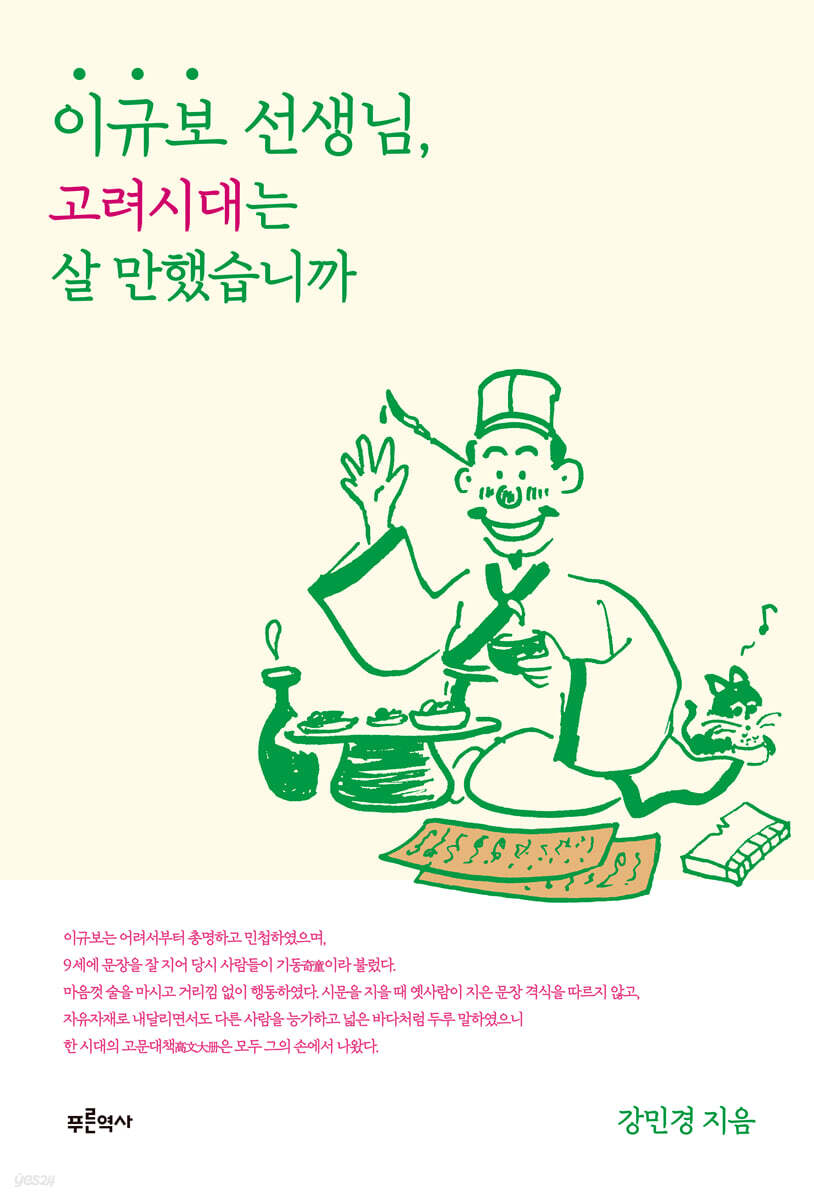
Professor Lee Gyu-bo, was the Goryeo Dynasty worth living in?
 |
Description
Book Introduction
A poet born of alcohol
Going to Goryeo, as sung by Lee Gyu-bo
If you want to know more about Goryeo, you can't miss the name: Lee Gyu-bo.
'What did people think and how did they live back then?' This is a question that anyone who is curious about old stories or immersed in history has likely asked at least once.
Unfortunately, however, the vivid lives and thoughts of the people of that time are often missing from historical content that is readily available, such as historical dramas, history books, and museum exhibitions.
This is because it focuses on widely known figures, major events, and splendid cultural heritage.
In that sense, the name of Baekun Geosa Lee Gyu-bo (1168-1241) is one that cannot be overlooked.
He lived in the Goryeo Dynasty about 800 years ago and left behind a vast record of his true feelings, the Dongguk Yi Sang-guk Collection.
Although there are poems and writings in the Dongguk Yisanggukjip written according to the wishes of those in power or specific needs, there are more poems and writings written by Lee Gyu-bo as he lived, expressing his own circumstances and thoughts.
If you read it carefully, you will vividly see the figure of an intellectual who personally experienced the chaos of Goryeo after the military coup, when military men took power and protected the government.
Let's delve into the Goryeo Dynasty depicted by Lee Gyu-bo, who is considered a flatterer by some and a great writer by others.
Going to Goryeo, as sung by Lee Gyu-bo
If you want to know more about Goryeo, you can't miss the name: Lee Gyu-bo.
'What did people think and how did they live back then?' This is a question that anyone who is curious about old stories or immersed in history has likely asked at least once.
Unfortunately, however, the vivid lives and thoughts of the people of that time are often missing from historical content that is readily available, such as historical dramas, history books, and museum exhibitions.
This is because it focuses on widely known figures, major events, and splendid cultural heritage.
In that sense, the name of Baekun Geosa Lee Gyu-bo (1168-1241) is one that cannot be overlooked.
He lived in the Goryeo Dynasty about 800 years ago and left behind a vast record of his true feelings, the Dongguk Yi Sang-guk Collection.
Although there are poems and writings in the Dongguk Yisanggukjip written according to the wishes of those in power or specific needs, there are more poems and writings written by Lee Gyu-bo as he lived, expressing his own circumstances and thoughts.
If you read it carefully, you will vividly see the figure of an intellectual who personally experienced the chaos of Goryeo after the military coup, when military men took power and protected the government.
Let's delve into the Goryeo Dynasty depicted by Lee Gyu-bo, who is considered a flatterer by some and a great writer by others.
- You can preview some of the book's contents.
Preview
index
Entering
Introduction: Lee Gyu-bo, a man who lived in Goryeo while drinking and writing.
The Young Days of a Genius Writer|Writing Well Isn't Enough|Though His Beginnings Were Humble|His Brush Was Never Dull|Dongguk Yisanggukjip, A Flower Pot of Goryeo History and Culture
1_As for me─Lee Gyu-bo as told by Lee Gyu-bo
Tall and rough-looking|My hair is thinning, my belly is sticking out|I can't stand meat|A gourmet who enjoys raw fish and steamed crab|The scent of mushrooms is fragrant, and the water parsley tastes good|Wine is raining down from the sky|When I lay out a mat|I drink and drink and drink, but I'm still thirsty|Oh, it's itchy, I've suffered from skin disease my whole life|It's sad that my eyes hurt, but I'm fooled by fakes|I'm this kind of person
2_A Moment of Leisure in Weary Footsteps - Lee Gyu-bo, How This Man Lives
I regret not bending|Reading books and soaking my feet in, how could I forget that place|Goryeo's 'butler' Lee Gyu-bo|The poet who strummed the stringless geomungo|I lost, but I cannot surrender|It's a rainy day, just the right time to take a nap|Buddha, I'll have a drink and come see you again|The monk who lives in the mountains covets the moonlight|You who supported me when I was tired|I turn the millstone and turn it again|The poet's house where flowers bloom and grass grows
3_If You Were Not There─Lee Gyu-bo's Family, Friends, and Acquaintances
Lee Gyu-bo's Three Clans|Can't We Tear That Down Right Now|For My Love|Everything is Cheap When Selling and Expensive When Buying|Aren't You Learning to Drink Because You Have Nothing to Learn|Ah, My Son!|The Full Moon Has Risen|It's Okay, My Friend|Alcohol is a Winter Hat|If There Were Hangover Remedies in the Goryeo Dynasty|The World is Wide and There Are Many Masters|A Monkey on a Leash or Me|They say you can't give everything away, but this person gave it all|Leading an Outstanding Junior
4_Just pick up a brush and it's a masterpiece─Lee Gyu-bo's writing
A Strange Homage|Lee Gyu-bo Raises Jeong Ji-sang's Hand|Even if It's a Custom, If It's Wrong...|There Was a Time When I Went Like This|Warning About Writing Poems in a Hurry|My Life as a Guardian of the Tomb All Night|Under the Grapevine|Suddenly, Flowers Bloomed Out of Season!|What Dreams Can I Have on a Celadon Pillow|The Song of the Clay Jar|Fireflies|Lee Gyu-bo's View of Insects|Even the Same Sea Looks Different|Wind, Please Don't Sweep the Ground|Discussing the Writings of Lee Gyu-bo, a Man of Letters of the Joseon Dynasty
5_I am Lee Gyu-bo from Goryeo. Living in Goryeo.
I will live in Gaegyeong|There is a sad legend about Bakyeon Falls|Brewing alcohol in winter|A drinker's companion, praising the gourd wine bottle|An empty jar|Lee Gyu-bo goes to a hot spring|An unfilial son cries|A time when there was no refrigerator|Such a neat ancestral rite|Lee Gyu-bo sees a dolmen|Robbed and restored|Burned to obtain one|Wild monkeys of the Goryeo Dynasty(?)|“Guests have arrived!”|If you don’t want to receive ancestral rite food|Lee Gyu-bo’s thoughts on ‘Silla’|Ritual to those who came to attack ‘our Goguryeo’?
6_I don't think this is it─The times Lee Gyu-bo lived through
Job seeker Lee Gyu-bo, selling his legs|Because he ate some roasted mushrooms|A guy worse than a mole|A society where bribery works|What can you take from my meager salary|Your age is like a rubber band|Ask the woodpecker|Blame the cunning and greedy spider
7_The Untold Story - A Peek into Lee Gyu-bo's Thoughts
Looking at a world map, feeling proud|Goguryeo founder Jumong's trick|Tang Dynasty version of 'Hidden Singer'|Killing a subject who speaks the truth|Just this|Enthusiastic about appreciating paintings|Creating a topic of conversation in paintings 500 years later|Curriculum is difficult|Even during wartime, Dongpo's books must be read|〈Dharma Painting〉|Why is the Rose of Sharon called the Rose of Sharon|This damn fly|Why has the New Year come so early?
Going out
References
List of pictures
Search
Introduction: Lee Gyu-bo, a man who lived in Goryeo while drinking and writing.
The Young Days of a Genius Writer|Writing Well Isn't Enough|Though His Beginnings Were Humble|His Brush Was Never Dull|Dongguk Yisanggukjip, A Flower Pot of Goryeo History and Culture
1_As for me─Lee Gyu-bo as told by Lee Gyu-bo
Tall and rough-looking|My hair is thinning, my belly is sticking out|I can't stand meat|A gourmet who enjoys raw fish and steamed crab|The scent of mushrooms is fragrant, and the water parsley tastes good|Wine is raining down from the sky|When I lay out a mat|I drink and drink and drink, but I'm still thirsty|Oh, it's itchy, I've suffered from skin disease my whole life|It's sad that my eyes hurt, but I'm fooled by fakes|I'm this kind of person
2_A Moment of Leisure in Weary Footsteps - Lee Gyu-bo, How This Man Lives
I regret not bending|Reading books and soaking my feet in, how could I forget that place|Goryeo's 'butler' Lee Gyu-bo|The poet who strummed the stringless geomungo|I lost, but I cannot surrender|It's a rainy day, just the right time to take a nap|Buddha, I'll have a drink and come see you again|The monk who lives in the mountains covets the moonlight|You who supported me when I was tired|I turn the millstone and turn it again|The poet's house where flowers bloom and grass grows
3_If You Were Not There─Lee Gyu-bo's Family, Friends, and Acquaintances
Lee Gyu-bo's Three Clans|Can't We Tear That Down Right Now|For My Love|Everything is Cheap When Selling and Expensive When Buying|Aren't You Learning to Drink Because You Have Nothing to Learn|Ah, My Son!|The Full Moon Has Risen|It's Okay, My Friend|Alcohol is a Winter Hat|If There Were Hangover Remedies in the Goryeo Dynasty|The World is Wide and There Are Many Masters|A Monkey on a Leash or Me|They say you can't give everything away, but this person gave it all|Leading an Outstanding Junior
4_Just pick up a brush and it's a masterpiece─Lee Gyu-bo's writing
A Strange Homage|Lee Gyu-bo Raises Jeong Ji-sang's Hand|Even if It's a Custom, If It's Wrong...|There Was a Time When I Went Like This|Warning About Writing Poems in a Hurry|My Life as a Guardian of the Tomb All Night|Under the Grapevine|Suddenly, Flowers Bloomed Out of Season!|What Dreams Can I Have on a Celadon Pillow|The Song of the Clay Jar|Fireflies|Lee Gyu-bo's View of Insects|Even the Same Sea Looks Different|Wind, Please Don't Sweep the Ground|Discussing the Writings of Lee Gyu-bo, a Man of Letters of the Joseon Dynasty
5_I am Lee Gyu-bo from Goryeo. Living in Goryeo.
I will live in Gaegyeong|There is a sad legend about Bakyeon Falls|Brewing alcohol in winter|A drinker's companion, praising the gourd wine bottle|An empty jar|Lee Gyu-bo goes to a hot spring|An unfilial son cries|A time when there was no refrigerator|Such a neat ancestral rite|Lee Gyu-bo sees a dolmen|Robbed and restored|Burned to obtain one|Wild monkeys of the Goryeo Dynasty(?)|“Guests have arrived!”|If you don’t want to receive ancestral rite food|Lee Gyu-bo’s thoughts on ‘Silla’|Ritual to those who came to attack ‘our Goguryeo’?
6_I don't think this is it─The times Lee Gyu-bo lived through
Job seeker Lee Gyu-bo, selling his legs|Because he ate some roasted mushrooms|A guy worse than a mole|A society where bribery works|What can you take from my meager salary|Your age is like a rubber band|Ask the woodpecker|Blame the cunning and greedy spider
7_The Untold Story - A Peek into Lee Gyu-bo's Thoughts
Looking at a world map, feeling proud|Goguryeo founder Jumong's trick|Tang Dynasty version of 'Hidden Singer'|Killing a subject who speaks the truth|Just this|Enthusiastic about appreciating paintings|Creating a topic of conversation in paintings 500 years later|Curriculum is difficult|Even during wartime, Dongpo's books must be read|〈Dharma Painting〉|Why is the Rose of Sharon called the Rose of Sharon|This damn fly|Why has the New Year come so early?
Going out
References
List of pictures
Search
Into the book
Lee Gyu-bo, an intellectual of that era, was able to write about his life, thoughts, and the things he experienced, saw, and heard.
Fortunately, his writings have survived to this day.
It contains the story of the Goryeo people of 800 years ago, who were similar to us today, but lived in a different way.
This realization is what led to the creation of this book, which unravels the various stories in "Dongguk Yisanggukjip" through text and illustrations.
--- p.7
Lee Gyu-bo called himself 'Sam-ho-ho-seon-saeng, the three most annoying and good teachers.'
It meant that he loved and lived with three things: poetry, alcohol, and the geomungo.
Just by looking at this, you can roughly guess his personality.
Romantic and delicate, he is truly a man of letters.
He wrote poetry and articles whenever he had free time.
There are over 2,000 poems included in the Dongguk Yi Sang Guk Jip alone.
I think I must have written at least 10,000 poems in my lifetime, since I used to burn the writings of my youth from time to time.
--- p.24
He was able to focus not only on grand discourses like ancient history and philosophy, but also on things around him, such as small insects and common liquor jars. With his deep insight, he also saw through the problems of Goryeo society at the time, which was dominated by a military regime.
--- p.24~6
Lee Gyu-bo wrote with dreams of great success, was depressed and spent his time drinking, and eventually rose to a high position.
In particular, the actions he took to obtain official positions were criticized by later generations.
But even so, Lee Gyu-bo's desire to write poetry and his passion for alcohol did not fade.
It made Lee Gyu-bo, a village man who lived 800 years ago, a great writer and a witness to the times.
Lee Gyu-bo, who lived and wrote in Goryeo, left behind a wide and profound story of Goryeo.
--- p.31
〈A Chance Recitation at Namheon〉 is also evaluated as the first record in Korea in which ‘raw fish’ appears.
… … Judging from the fact that a considerable number of fishhooks and net weights for catching fish have been excavated from prehistoric sites, it is presumed that Korea also had a culture of eating raw fish as sashimi for a long time, but there are no written records.
However, it can be said that at least in the early 13th century, when Lee Gyu-bo lived, the people of Goryeo knew how to eat raw fish.
--- p.49
During the Goryeo Dynasty, in the Jeolla region, fermented crabs were enjoyed as a side dish, and its fame seems to have spread all the way to Gaeseong.
Considering that the late Goryeo literati Mok-eun Lee Saek (1328-1396) also mentioned crabs sent from the provinces as a New Year's offering in his poems, it seems that crabs were very popular throughout the Goryeo Dynasty.
--- p.54
No matter what, the food that was most important to Lee Gyu-bo seemed to be alcohol.
In fact, about a third of the poems in his collected works are written while drinking alcohol or are written about alcohol, and the famous “Biography of Mr. Guk” included in literature textbooks also features alcohol as the main character.
For him, alcohol was not just a luxury, but a daily friend and a catalyst for creativity.
It must have been so bad that Lee Gyu-bo himself said that he had shaken off the devil of lust among the three devils that resided within him, but he could not get rid of the devil of poetry and the devil of alcohol.
--- p.59
Lee Gyu-bo suffered from severe illness from a young age.
Not only skin diseases, but also hand pain, headaches, toothaches, asthma, and even indigestion… … .
Throughout "Dongguk Yisanggukjip," there are numerous poems that vividly portray the sorrow of middle-aged people lamenting their miserable bodies.
--- p.65
Even though he had passed the civil service examination in the past, he had not been able to obtain a government post for a long time, and had suffered to the point of skipping meals after being denied the local government position he had finally obtained. It was in 1215, the second year of King Gojong's reign, when he was forty-eight years old, that Lee Gyu-bo finally rose to the position of 6th rank Chamsanggwan.
… … Among the poems he wrote at this time, there is one that is said to be about a spotted rhinoceros belt, or rhinoceros horn belt.
… … I was so moved by the feeling of wanting to show off the Seodae I had just been looking at when I finally got it on my belt, that I wrote a poem about it.
--- p.75~76
No matter how good a job is, it's hard to survive if your coworkers make it difficult.
This truth was not much different 800 years ago.
Lee Gyu-bo had a huge fight with a coworker at his first job, Jeonju Mok, which he had finally secured.
The price was dismissal.
Even after Lee Gyu-bo returned to Gaegyeong, the colleague with whom he had fought continued to harass him.
… … Lee Gyu-bo left behind words of regret, saying, “If I had just endured a little more and not gotten on bad terms with him, this would not have happened.”
It probably means that although fate ultimately made him precious, if he had been more careful in his interpersonal relationships, things would have been smoother.
--- p.80~81
It seems that the rats in Lee Gyu-bo's house were extremely aggressive.
Why else would they have tried to create a ‘Jangtang’s Oksa’?
Zhang Tang (? - 115 BC) was a figure from the time of Emperor Wu of the Han Dynasty. When he was young, his father told him to “take good care of the cupboard.” However, when a rat stole the meat in the cupboard, his father whipped him with a cane.
So, Jang Tang searched the rat hole, caught the rat, wrote a statement like a judge, tortured it, and sentenced it to death, killing it.
The image of 'butler' Lee Gyu-bo, who was so troubled by rats that he had to bring in a cat, finally finding relief is vivid.
--- p.88~89
It seems that Lee Gyu-bo was also quite good at playing baduk.
As is always the case in baduk, there were wins and losses.
There is a poem that was written for the opponent after he lost a big game.
Considering that he called the other person an 'adult', he seems to be an elder, but since he was the one who made a joke by writing a poem, how could Baekwoon Geosa just sit still for the sake of his reputation?
At that time, he responded with a poem.
“……I ask you, should we surrender when the matter has already been decided? / This is the time for the Qin army to wash away its disgrace.”
--- p.94~95
What would you do if you had nothing to do? Most people probably just want to take a nap.
It is said that a proper nap can be a great help in waking up your brain and getting work done in the afternoon.
It seems that Mr. Lee Gyu-bo also really liked naps.
… … 800 years ago or now, it seems that on rainy days, just lying down and taking a nap is the best thing to do.
--- p.97~99
Everyone acknowledges that Buddhism had an influence on society as a whole during the Goryeo Dynasty.
Buddhism was not only a religious aspect, but was also deeply ingrained in people's lives.
Baekun Geosa Lee Gyu-bo was also close to Buddhism.
… … It is said that he memorized the entire 6 volumes of the Surangama Sutra.
However, the drunkard Lee Gyu-bo explains the reason for reading Buddhist scriptures like this.
“I read it all.
"Is the alcohol still far away?" Well, as expected, Lee Gyu-bo was a drinker.
--- p.101~102
“A monk living in the mountains longs for the moonlight/ He filled a bottle with water/ When he reaches the temple, he will finally realize it/ When he tilts the bottle, the moonlight also becomes empty.” … … Among the many Chinese poems left behind by Lee Gyu-bo, this is considered one of the most beautiful.
On a moonlit night, a monk brings water from somewhere.
A soft light illuminates the night sky, and the only sound is the sloshing sound of water.
If even the water in the bottle is full of moonlight, where will the light on the water go when the water is poured?
Whether the monk knew this or not, the scenery captured by the poet's eyes was transferred from his hands to paper.
--- p.103~105
Lee Gyu-bo was not a so-called 'golden spoon'.
However, it is difficult to say that he is from a 'dirt spoon' family.
Should we say we were "likely born with a spoon in our mouths"? We weren't particularly wealthy, so we had a difficult childhood, but we were still a family that wasn't far from government positions.
--- p.122
I am not a virtuous man like Confucius or Mozi/ How could the chimney not be black and the bed not warm/ Wife, child, do not cry out of cold/ I will cut down my medicinal tree and burn it to make charcoal/ It will warm our house and the whole world/ Even in the cold months of December, we will always sweat.
--- p.127
You drink alcohol at such a young age/ I'm afraid your intestines will melt in the future/ Don't learn from your father's habit of always getting drunk/ All your life people will call you crazy/ All your life you've ruined yourself only with alcohol/ What do you even like?/ I regret naming it Sambaek now/ I'm afraid you'll drink three hundred glasses a day.
--- p.132
Before he ascended to office, a friend sent a round fan to the young Lee Gyu-bo.
I gently fanned the fan with white paper and a cool autumn breeze blew.
Even though it wasn't night, the moon rose in Lee Gyu-bo's hand.
Summer is coming, what a wonderful gift this is.
The poetic idea that came to mind in an instant left this debt in history forever.
“It is as clear as the frost on a round fan/ Even when it is not night, the moon is always round/ Even before autumn comes, the wind blows on its own/ Your heart is truly like ice/ When we meet, all my gloomy feelings disappear/ I send it back to the autumn in my heart/ I leave the moon in both of my hands.”
--- p.139~141
Gains and losses in the examination room are like Go / If you fail once, how can you never win big / The jar gave away all the cinnamon trees, don't worry / How can the branch I'm going to give you be gone next year?
--- p.144
It seems that during the Goryeo Dynasty, there was a proverb that said, “Alcohol is the winter hat.”
For the common people who lived without it, things like fur hats or hats stuffed with silkworm cocoons would have been a pipe dream, but they would not have been able to go out without any preparation.
So, I have no choice but to survive the winter by drinking some alcohol that will make my head feel warm.
--- p.147
Seeing the monkey howling while tied up, Lee Gyu-bo's brush moved quickly, perhaps remembering his own fate of having to work hard for a lowly government position.
And soon a poem was born.
“What could a monkey be so angry about? / Standing like a human and howling at me. / …… I too think of living in seclusion in the green mountains, / But in vain I am tormented by the red dust. / ……”
--- p.159
It was impossible for juniors not to gather around Lee Gyu-bo, who loved alcohol and people.
Lee Gyu-bo also did not reject them, but rather spent his days drinking and writing poetry with them, and whenever possible, he tried to help them develop their talents.
--- p.164
It is said that Lee Gyu-bo began to read by pointing at the letters in a book at the age of two, and wrote his first piece at the age of nine.
From his youth he was a gifted writer and wrote prolifically.
At the age of twenty-two, he had a dream in which the star Gyu-seong, who was said to be in charge of the heavenly sentences, told him, “You will definitely pass the civil service examination, so don’t worry.” He changed his name to Gyu-bo.
--- p.172
For the ancients, copying the works of their predecessors or creating works with a similar atmosphere was a form of study.
… … If you don’t master the works of the past, you won’t be able to plagiarize properly, so it’s natural to study them with familiarity, but you must also constantly pursue new meanings.
--- p.174
Lee Gyu-bo was good at writing in a hurry.
One of his nicknames was 'Chief Editor Lee Dang-baek', and he was even mentioned as the chief editor in 'Hanrimbyeolgok'.
Writing poetry is never easy.
This is because you need to know the pronunciation and meaning of some Chinese characters, and you need to weave those characters together to create a literary flavor.
That is why, even at that time, editors had to have great writing skills, and they were a novel sight to others.
Lee Gyu-bo gained fame as such an editor-in-chief.
But he was actually critical of the editor-in-chief.
--- p.189
Although Goryeo history is lacking in data, the Dongguk Yisanggukjip is what provides us with a glimpse into various aspects of Goryeo society.
Korean ceramics history also benefits greatly from this.
This is because some of the celadon and pottery (earthenware) that Lee Gyu-bo wrote about remain in their original form, while others depict objects that are now unknown.
--- p.201
In the middle of the night, when even the insects, let alone people, were all asleep, Lee Gyu-bo happened to be awake.
Then I opened the door and saw a light on and fireflies flying around, decorating the sky.
Born from a pile of rotting grass, flattened by fan blows, forced to forcibly emit light from a pocket, they are pitiful creatures. Yet, if they keep their light burning, even in the rain, and soar high, they might become shooting stars in the sky! To Lee Gyu-bo, fireflies were such beings.
--- p.210~211
Everything is created by the mind! Everything looks different depending on how you set your mind to it.
No matter how good the scenery is, if it is sagging, it will not be satisfactory.
… … Teacher Lee Gyu-bo also had a similar experience.
… … Lee Gyu-bo, who was demoted to the position of deputy governor of Gyeyang Dohobu, was surrounded by a sea of sin, but he did not go out of his way to see it.
… … Two years later, when he went up to Gaegyeong again, the sea that spread out before Lee Gyu-bo’s eyes looked simply beautiful.
… … Lee Gyu-bo, who was enjoying the sea like that, suddenly had an epiphany.
'When I came here, the sea was still the sea, but why is it that the sea I see again now, on my way to Gaegyeong, is so delightful?'
--- p.216~217
“If the person who wrote the history of the Yewonjeon were asked to choose only three people from Silla and Goryeo, Choi Chi-won, Cheon Chaek (1206~?), and Lee Gyu-bo would be chosen.”
--- p.229
When looking at Lee Gyu-bo's writings from his time as a local official, two major points emerge.
One is that Lee Gyu-bo was not a so-called "neungri" type of person who was skilled in administrative work, and the other is that the centralization of the capital during the Goryeo Dynasty had an enormous impact on society as a whole.
… … For the Goryeo people, ‘Gaekyeong’ was an object of even greater aspiration than ‘Seoul’ as we think of it today.
--- p.234~235
“When my father lived in the South and I studied in Seoul, I could see him if I just walked 300 li, even though it was a long distance. Now, the mountainside in the North where you live is only a few steps from the capital city, so even if I could go there in a short while, who would I see?
There is no way I will see you again until the end of my life.
“The words are about to come out of my mouth, but my throat is choked and I find it difficult to speak. I can only express my feelings with this thin glass of wine. Ah, I am so sad.”
--- p.253
“The place where the gods rely is where this tall stone stands,/ and the offerings I make with the rainwater that has gathered on that road./ I pray that you will be pleased with my pure sincerity and grant me further help in my virtuous deeds.” … … It seems that even during the Goryeo Dynasty, large standing stones were the object of public rites held at the county level.
But that offering was nothing more than a bowl of rainwater! The god inhabiting the stone must have been quite frugal.
--- p.262
In “Dongguk Yisanggukjip,” monkey stories appear frequently.
There are people who actually raise monkeys like Gi Hong-su, but there are also many cases where people pass by mountains and rivers and say, “There’s a monkey crying over there.”
… … Roughly counting, it seems like there are easily 30 or so
--- p.274
When different faiths meet, conflict is bound to occur.
However, during the Goryeo Dynasty, the state recognized the role of all such divine beings, guaranteeing the pluralism of religion while also preserving the authority of the state.
This is consistent with the attitude of the Goryeo central government, which, since its founding, has not simply rejected local powers but has striven to incorporate them into its system.
--- p.284
Lee Gyu-bo's perception of Silla is inconsistent.
Sometimes he belittles Silla, but at other times he shows his positive side.
It changed according to political and social situations.
Also, there is no confirmed text that says Goryeo 'inherited' Silla.
It only emphasizes the fact that the last king surrendered to our Taejo, that is, Goryeo absorbed Silla.
This becomes clearer when compared to Goguryeo's perception.
--- p.288
Just as Seo Hee (942-998) rebuked the Khitan general Xiao Sunning (?-998) by saying, “Our country is the successor to Goguryeo!”, the people of Goryeo recognized that Goryeo was a country that succeeded Goguryeo.
This was a fact shared by almost all intellectuals of Goryeo.
The same was true for Lee Gyu-bo.
Lee Gyu-bo, the twenty-six-year-old who wrote the Dongmyeongwangpyeon, still recognized Goguryeo as “our Goguryeo [我高麗]” even though he was middle-aged.
--- p.289
Lee Gyu-bo was not simply a handmaiden to the government.
… … Even if you look at other works he left behind, it is not uncommon to find a tone between the lines that criticizes the society of the time.
He possessed the deep insight of a man of letters and was well aware of the problems in Goryeo society at the time.
Although they failed to come up with specific improvement measures or lead change, they at least had a sense of the problem that this was wrong and that it needed to be corrected.
If he had simply begged for official positions or lived in hiding from the world without such awareness, the path to understanding Goryeo today would have been even narrower.
--- p.294
Even if you use all your talents to write poetry, it is very difficult to get a government position.
… … On his way home after selling his wares, the sunset falls on the shoulders of Lee Gyu-bo, who carries a weight of a thousand pounds.
“I am always without a government post, so I am never able to hold one/ I am not happy to beg for food from all directions/ But I want to avoid the boredom of sending myself away/ Ah! How painful is this fate, given to me in this life.”
--- p.299
The fields are all burnt red/ I can't see any lush sprouts/ Even the rich are already worried about food/ How can the poor survive/ In the noble families, they spit out alcohol at the table every day/ After drinking a hundred cups, my ears feel hot on their own… … I only know that the literary world is flourishing/ I don't worry about the country's instability/ The rotten scholar, although he knows nothing/ I shed tears and sob every time with a choked voice.
--- p.303
When the famine comes and the people are almost dead, / Only bones and skin remain / How much meat is left in the body / You are going to cut and split it all without leaving anything behind / Have you seen a mole drinking from the river / It is only enough to fill its stomach / I ask, how many mouths do you have / That you covet and chew the people's flesh?
--- p.306
Even during the Goryeo Dynasty, it was not that difficult to encounter a woodpecker, as Lee Gyu-bo left behind a poem describing a woodpecker as if he had seen it up close.
“Did you find a bug that dug a hole in the tree? / The sound is like a knock on a door. / You have all the colors of beauty. / Why do you like to peck at bugs?” … … However, the following is added at the end of this poem.
“One version reads, ‘Who will borrow your beak/ To peck out the worms among men?’” When you put this phrase together, you can read the will or sigh of wanting to borrow a woodpecker’s beak to peck out the bad guys of the world.
--- p.317~319
All things of the world are spread out on a few pieces of paper/ The Three Hans are like a small lump in the corner/ Do not say that it is small, you who see it/ In my eyes, it is a little big/ Throughout the ages, virtuous people are constantly born/ Compared to China, there is nothing to be ashamed of/ If there are people, it is a country, if there are not, it is not/ The barbarians have only large land but are like thatch/ Haven't you seen it! The Chinese called us Sojunghwa/ This saying is truly worthy of adoption.
--- p.326~327
Lee Gyu-bo wrote “Dongmyeongwangpyeon” when he was twenty-six years old.
The story of Jumong, the founder of Goguryeo and the holy king of Dongmyeong, was passionately told by Gyu-bo during his youth when his blood was boiling.
With this, Lee Gyu-bo left his immortal name in ancient Korean history.
--- p.331
“If a bear or a tiger bites a person, people don’t think it’s strange, but if something else bites a person, everyone thinks it’s very strange.”
--- p.339
The people of Goryeo were particularly fond of the writings of Dongpo Su Shi (1037-1101), a writer of the Song Dynasty.
When the list of successful candidates for the civil service examination was announced, people who knew a little about writing enjoyed the news of Dongpo, or in other words, the writings of Su Dongpo, to the point where they would say, “There are thirty Dongpo scholars this year too!”
… … Even while the country was being trampled by the Mongol army, a local official of Goryeo tried to publish the Dongpa Munjip and distribute it to the people.
… … If you think about it, even during the harshness of the Japanese colonial period, books were continuously published, and even through the turbulent times of history, from liberation to the Korean War and military dictatorship, people continued to search for books.
I am reminded once again that the power of books is stronger than political power or guns.
--- p.354~357
There was a time when it was fashionable to hang a painting of Dharma at home.
There were many stories about it being good for your health by blocking water veins, and it even warding off evil spirits.
… … It seems that the custom of hanging a portrait of Dharma at home existed even during the Goryeo Dynasty.
Lee Gyu-bo also wrote about the painting "Dalmado"
--- p.358
For us now, the Rose of Sharon is our national flower.
It is also used as a police rank insignia and as a pattern on the roof tiles of government offices.
Because it has symbolism.
… … Then, what did the people of Goryeo think of the Rose of Sharon? … … We can see that the Rose of Sharon was called ‘Rose of Sharon’ even during the Goryeo Dynasty.
But each person had a different theory as to why the Rose of Sharon was called the Rose of Sharon.
… … Lee Gyu-bo says this.
The life of a flower that blooms and falls in a day is so vain that it is said to be 'insignificant'.
--- p.362~365
If you look at the travelogues of Westerners who came to this land during the late Joseon Dynasty, there are many accounts of how it was difficult to sleep properly or eat because there were so many bugs in Seoul and the countryside.
It seems that the situation of having to live with all kinds of bugs in the summer was not much different during the Goryeo Dynasty.
It seems that flies were a particular headache, and Lee Gyu-bo vividly expressed his suffering from flies in his poetry.
--- p.366
This body has lived countless years in its entire life/ Where have all these years piled up/ If I could put them in a pocket/ I would take them out one by one and return them to heaven
Fortunately, his writings have survived to this day.
It contains the story of the Goryeo people of 800 years ago, who were similar to us today, but lived in a different way.
This realization is what led to the creation of this book, which unravels the various stories in "Dongguk Yisanggukjip" through text and illustrations.
--- p.7
Lee Gyu-bo called himself 'Sam-ho-ho-seon-saeng, the three most annoying and good teachers.'
It meant that he loved and lived with three things: poetry, alcohol, and the geomungo.
Just by looking at this, you can roughly guess his personality.
Romantic and delicate, he is truly a man of letters.
He wrote poetry and articles whenever he had free time.
There are over 2,000 poems included in the Dongguk Yi Sang Guk Jip alone.
I think I must have written at least 10,000 poems in my lifetime, since I used to burn the writings of my youth from time to time.
--- p.24
He was able to focus not only on grand discourses like ancient history and philosophy, but also on things around him, such as small insects and common liquor jars. With his deep insight, he also saw through the problems of Goryeo society at the time, which was dominated by a military regime.
--- p.24~6
Lee Gyu-bo wrote with dreams of great success, was depressed and spent his time drinking, and eventually rose to a high position.
In particular, the actions he took to obtain official positions were criticized by later generations.
But even so, Lee Gyu-bo's desire to write poetry and his passion for alcohol did not fade.
It made Lee Gyu-bo, a village man who lived 800 years ago, a great writer and a witness to the times.
Lee Gyu-bo, who lived and wrote in Goryeo, left behind a wide and profound story of Goryeo.
--- p.31
〈A Chance Recitation at Namheon〉 is also evaluated as the first record in Korea in which ‘raw fish’ appears.
… … Judging from the fact that a considerable number of fishhooks and net weights for catching fish have been excavated from prehistoric sites, it is presumed that Korea also had a culture of eating raw fish as sashimi for a long time, but there are no written records.
However, it can be said that at least in the early 13th century, when Lee Gyu-bo lived, the people of Goryeo knew how to eat raw fish.
--- p.49
During the Goryeo Dynasty, in the Jeolla region, fermented crabs were enjoyed as a side dish, and its fame seems to have spread all the way to Gaeseong.
Considering that the late Goryeo literati Mok-eun Lee Saek (1328-1396) also mentioned crabs sent from the provinces as a New Year's offering in his poems, it seems that crabs were very popular throughout the Goryeo Dynasty.
--- p.54
No matter what, the food that was most important to Lee Gyu-bo seemed to be alcohol.
In fact, about a third of the poems in his collected works are written while drinking alcohol or are written about alcohol, and the famous “Biography of Mr. Guk” included in literature textbooks also features alcohol as the main character.
For him, alcohol was not just a luxury, but a daily friend and a catalyst for creativity.
It must have been so bad that Lee Gyu-bo himself said that he had shaken off the devil of lust among the three devils that resided within him, but he could not get rid of the devil of poetry and the devil of alcohol.
--- p.59
Lee Gyu-bo suffered from severe illness from a young age.
Not only skin diseases, but also hand pain, headaches, toothaches, asthma, and even indigestion… … .
Throughout "Dongguk Yisanggukjip," there are numerous poems that vividly portray the sorrow of middle-aged people lamenting their miserable bodies.
--- p.65
Even though he had passed the civil service examination in the past, he had not been able to obtain a government post for a long time, and had suffered to the point of skipping meals after being denied the local government position he had finally obtained. It was in 1215, the second year of King Gojong's reign, when he was forty-eight years old, that Lee Gyu-bo finally rose to the position of 6th rank Chamsanggwan.
… … Among the poems he wrote at this time, there is one that is said to be about a spotted rhinoceros belt, or rhinoceros horn belt.
… … I was so moved by the feeling of wanting to show off the Seodae I had just been looking at when I finally got it on my belt, that I wrote a poem about it.
--- p.75~76
No matter how good a job is, it's hard to survive if your coworkers make it difficult.
This truth was not much different 800 years ago.
Lee Gyu-bo had a huge fight with a coworker at his first job, Jeonju Mok, which he had finally secured.
The price was dismissal.
Even after Lee Gyu-bo returned to Gaegyeong, the colleague with whom he had fought continued to harass him.
… … Lee Gyu-bo left behind words of regret, saying, “If I had just endured a little more and not gotten on bad terms with him, this would not have happened.”
It probably means that although fate ultimately made him precious, if he had been more careful in his interpersonal relationships, things would have been smoother.
--- p.80~81
It seems that the rats in Lee Gyu-bo's house were extremely aggressive.
Why else would they have tried to create a ‘Jangtang’s Oksa’?
Zhang Tang (? - 115 BC) was a figure from the time of Emperor Wu of the Han Dynasty. When he was young, his father told him to “take good care of the cupboard.” However, when a rat stole the meat in the cupboard, his father whipped him with a cane.
So, Jang Tang searched the rat hole, caught the rat, wrote a statement like a judge, tortured it, and sentenced it to death, killing it.
The image of 'butler' Lee Gyu-bo, who was so troubled by rats that he had to bring in a cat, finally finding relief is vivid.
--- p.88~89
It seems that Lee Gyu-bo was also quite good at playing baduk.
As is always the case in baduk, there were wins and losses.
There is a poem that was written for the opponent after he lost a big game.
Considering that he called the other person an 'adult', he seems to be an elder, but since he was the one who made a joke by writing a poem, how could Baekwoon Geosa just sit still for the sake of his reputation?
At that time, he responded with a poem.
“……I ask you, should we surrender when the matter has already been decided? / This is the time for the Qin army to wash away its disgrace.”
--- p.94~95
What would you do if you had nothing to do? Most people probably just want to take a nap.
It is said that a proper nap can be a great help in waking up your brain and getting work done in the afternoon.
It seems that Mr. Lee Gyu-bo also really liked naps.
… … 800 years ago or now, it seems that on rainy days, just lying down and taking a nap is the best thing to do.
--- p.97~99
Everyone acknowledges that Buddhism had an influence on society as a whole during the Goryeo Dynasty.
Buddhism was not only a religious aspect, but was also deeply ingrained in people's lives.
Baekun Geosa Lee Gyu-bo was also close to Buddhism.
… … It is said that he memorized the entire 6 volumes of the Surangama Sutra.
However, the drunkard Lee Gyu-bo explains the reason for reading Buddhist scriptures like this.
“I read it all.
"Is the alcohol still far away?" Well, as expected, Lee Gyu-bo was a drinker.
--- p.101~102
“A monk living in the mountains longs for the moonlight/ He filled a bottle with water/ When he reaches the temple, he will finally realize it/ When he tilts the bottle, the moonlight also becomes empty.” … … Among the many Chinese poems left behind by Lee Gyu-bo, this is considered one of the most beautiful.
On a moonlit night, a monk brings water from somewhere.
A soft light illuminates the night sky, and the only sound is the sloshing sound of water.
If even the water in the bottle is full of moonlight, where will the light on the water go when the water is poured?
Whether the monk knew this or not, the scenery captured by the poet's eyes was transferred from his hands to paper.
--- p.103~105
Lee Gyu-bo was not a so-called 'golden spoon'.
However, it is difficult to say that he is from a 'dirt spoon' family.
Should we say we were "likely born with a spoon in our mouths"? We weren't particularly wealthy, so we had a difficult childhood, but we were still a family that wasn't far from government positions.
--- p.122
I am not a virtuous man like Confucius or Mozi/ How could the chimney not be black and the bed not warm/ Wife, child, do not cry out of cold/ I will cut down my medicinal tree and burn it to make charcoal/ It will warm our house and the whole world/ Even in the cold months of December, we will always sweat.
--- p.127
You drink alcohol at such a young age/ I'm afraid your intestines will melt in the future/ Don't learn from your father's habit of always getting drunk/ All your life people will call you crazy/ All your life you've ruined yourself only with alcohol/ What do you even like?/ I regret naming it Sambaek now/ I'm afraid you'll drink three hundred glasses a day.
--- p.132
Before he ascended to office, a friend sent a round fan to the young Lee Gyu-bo.
I gently fanned the fan with white paper and a cool autumn breeze blew.
Even though it wasn't night, the moon rose in Lee Gyu-bo's hand.
Summer is coming, what a wonderful gift this is.
The poetic idea that came to mind in an instant left this debt in history forever.
“It is as clear as the frost on a round fan/ Even when it is not night, the moon is always round/ Even before autumn comes, the wind blows on its own/ Your heart is truly like ice/ When we meet, all my gloomy feelings disappear/ I send it back to the autumn in my heart/ I leave the moon in both of my hands.”
--- p.139~141
Gains and losses in the examination room are like Go / If you fail once, how can you never win big / The jar gave away all the cinnamon trees, don't worry / How can the branch I'm going to give you be gone next year?
--- p.144
It seems that during the Goryeo Dynasty, there was a proverb that said, “Alcohol is the winter hat.”
For the common people who lived without it, things like fur hats or hats stuffed with silkworm cocoons would have been a pipe dream, but they would not have been able to go out without any preparation.
So, I have no choice but to survive the winter by drinking some alcohol that will make my head feel warm.
--- p.147
Seeing the monkey howling while tied up, Lee Gyu-bo's brush moved quickly, perhaps remembering his own fate of having to work hard for a lowly government position.
And soon a poem was born.
“What could a monkey be so angry about? / Standing like a human and howling at me. / …… I too think of living in seclusion in the green mountains, / But in vain I am tormented by the red dust. / ……”
--- p.159
It was impossible for juniors not to gather around Lee Gyu-bo, who loved alcohol and people.
Lee Gyu-bo also did not reject them, but rather spent his days drinking and writing poetry with them, and whenever possible, he tried to help them develop their talents.
--- p.164
It is said that Lee Gyu-bo began to read by pointing at the letters in a book at the age of two, and wrote his first piece at the age of nine.
From his youth he was a gifted writer and wrote prolifically.
At the age of twenty-two, he had a dream in which the star Gyu-seong, who was said to be in charge of the heavenly sentences, told him, “You will definitely pass the civil service examination, so don’t worry.” He changed his name to Gyu-bo.
--- p.172
For the ancients, copying the works of their predecessors or creating works with a similar atmosphere was a form of study.
… … If you don’t master the works of the past, you won’t be able to plagiarize properly, so it’s natural to study them with familiarity, but you must also constantly pursue new meanings.
--- p.174
Lee Gyu-bo was good at writing in a hurry.
One of his nicknames was 'Chief Editor Lee Dang-baek', and he was even mentioned as the chief editor in 'Hanrimbyeolgok'.
Writing poetry is never easy.
This is because you need to know the pronunciation and meaning of some Chinese characters, and you need to weave those characters together to create a literary flavor.
That is why, even at that time, editors had to have great writing skills, and they were a novel sight to others.
Lee Gyu-bo gained fame as such an editor-in-chief.
But he was actually critical of the editor-in-chief.
--- p.189
Although Goryeo history is lacking in data, the Dongguk Yisanggukjip is what provides us with a glimpse into various aspects of Goryeo society.
Korean ceramics history also benefits greatly from this.
This is because some of the celadon and pottery (earthenware) that Lee Gyu-bo wrote about remain in their original form, while others depict objects that are now unknown.
--- p.201
In the middle of the night, when even the insects, let alone people, were all asleep, Lee Gyu-bo happened to be awake.
Then I opened the door and saw a light on and fireflies flying around, decorating the sky.
Born from a pile of rotting grass, flattened by fan blows, forced to forcibly emit light from a pocket, they are pitiful creatures. Yet, if they keep their light burning, even in the rain, and soar high, they might become shooting stars in the sky! To Lee Gyu-bo, fireflies were such beings.
--- p.210~211
Everything is created by the mind! Everything looks different depending on how you set your mind to it.
No matter how good the scenery is, if it is sagging, it will not be satisfactory.
… … Teacher Lee Gyu-bo also had a similar experience.
… … Lee Gyu-bo, who was demoted to the position of deputy governor of Gyeyang Dohobu, was surrounded by a sea of sin, but he did not go out of his way to see it.
… … Two years later, when he went up to Gaegyeong again, the sea that spread out before Lee Gyu-bo’s eyes looked simply beautiful.
… … Lee Gyu-bo, who was enjoying the sea like that, suddenly had an epiphany.
'When I came here, the sea was still the sea, but why is it that the sea I see again now, on my way to Gaegyeong, is so delightful?'
--- p.216~217
“If the person who wrote the history of the Yewonjeon were asked to choose only three people from Silla and Goryeo, Choi Chi-won, Cheon Chaek (1206~?), and Lee Gyu-bo would be chosen.”
--- p.229
When looking at Lee Gyu-bo's writings from his time as a local official, two major points emerge.
One is that Lee Gyu-bo was not a so-called "neungri" type of person who was skilled in administrative work, and the other is that the centralization of the capital during the Goryeo Dynasty had an enormous impact on society as a whole.
… … For the Goryeo people, ‘Gaekyeong’ was an object of even greater aspiration than ‘Seoul’ as we think of it today.
--- p.234~235
“When my father lived in the South and I studied in Seoul, I could see him if I just walked 300 li, even though it was a long distance. Now, the mountainside in the North where you live is only a few steps from the capital city, so even if I could go there in a short while, who would I see?
There is no way I will see you again until the end of my life.
“The words are about to come out of my mouth, but my throat is choked and I find it difficult to speak. I can only express my feelings with this thin glass of wine. Ah, I am so sad.”
--- p.253
“The place where the gods rely is where this tall stone stands,/ and the offerings I make with the rainwater that has gathered on that road./ I pray that you will be pleased with my pure sincerity and grant me further help in my virtuous deeds.” … … It seems that even during the Goryeo Dynasty, large standing stones were the object of public rites held at the county level.
But that offering was nothing more than a bowl of rainwater! The god inhabiting the stone must have been quite frugal.
--- p.262
In “Dongguk Yisanggukjip,” monkey stories appear frequently.
There are people who actually raise monkeys like Gi Hong-su, but there are also many cases where people pass by mountains and rivers and say, “There’s a monkey crying over there.”
… … Roughly counting, it seems like there are easily 30 or so
--- p.274
When different faiths meet, conflict is bound to occur.
However, during the Goryeo Dynasty, the state recognized the role of all such divine beings, guaranteeing the pluralism of religion while also preserving the authority of the state.
This is consistent with the attitude of the Goryeo central government, which, since its founding, has not simply rejected local powers but has striven to incorporate them into its system.
--- p.284
Lee Gyu-bo's perception of Silla is inconsistent.
Sometimes he belittles Silla, but at other times he shows his positive side.
It changed according to political and social situations.
Also, there is no confirmed text that says Goryeo 'inherited' Silla.
It only emphasizes the fact that the last king surrendered to our Taejo, that is, Goryeo absorbed Silla.
This becomes clearer when compared to Goguryeo's perception.
--- p.288
Just as Seo Hee (942-998) rebuked the Khitan general Xiao Sunning (?-998) by saying, “Our country is the successor to Goguryeo!”, the people of Goryeo recognized that Goryeo was a country that succeeded Goguryeo.
This was a fact shared by almost all intellectuals of Goryeo.
The same was true for Lee Gyu-bo.
Lee Gyu-bo, the twenty-six-year-old who wrote the Dongmyeongwangpyeon, still recognized Goguryeo as “our Goguryeo [我高麗]” even though he was middle-aged.
--- p.289
Lee Gyu-bo was not simply a handmaiden to the government.
… … Even if you look at other works he left behind, it is not uncommon to find a tone between the lines that criticizes the society of the time.
He possessed the deep insight of a man of letters and was well aware of the problems in Goryeo society at the time.
Although they failed to come up with specific improvement measures or lead change, they at least had a sense of the problem that this was wrong and that it needed to be corrected.
If he had simply begged for official positions or lived in hiding from the world without such awareness, the path to understanding Goryeo today would have been even narrower.
--- p.294
Even if you use all your talents to write poetry, it is very difficult to get a government position.
… … On his way home after selling his wares, the sunset falls on the shoulders of Lee Gyu-bo, who carries a weight of a thousand pounds.
“I am always without a government post, so I am never able to hold one/ I am not happy to beg for food from all directions/ But I want to avoid the boredom of sending myself away/ Ah! How painful is this fate, given to me in this life.”
--- p.299
The fields are all burnt red/ I can't see any lush sprouts/ Even the rich are already worried about food/ How can the poor survive/ In the noble families, they spit out alcohol at the table every day/ After drinking a hundred cups, my ears feel hot on their own… … I only know that the literary world is flourishing/ I don't worry about the country's instability/ The rotten scholar, although he knows nothing/ I shed tears and sob every time with a choked voice.
--- p.303
When the famine comes and the people are almost dead, / Only bones and skin remain / How much meat is left in the body / You are going to cut and split it all without leaving anything behind / Have you seen a mole drinking from the river / It is only enough to fill its stomach / I ask, how many mouths do you have / That you covet and chew the people's flesh?
--- p.306
Even during the Goryeo Dynasty, it was not that difficult to encounter a woodpecker, as Lee Gyu-bo left behind a poem describing a woodpecker as if he had seen it up close.
“Did you find a bug that dug a hole in the tree? / The sound is like a knock on a door. / You have all the colors of beauty. / Why do you like to peck at bugs?” … … However, the following is added at the end of this poem.
“One version reads, ‘Who will borrow your beak/ To peck out the worms among men?’” When you put this phrase together, you can read the will or sigh of wanting to borrow a woodpecker’s beak to peck out the bad guys of the world.
--- p.317~319
All things of the world are spread out on a few pieces of paper/ The Three Hans are like a small lump in the corner/ Do not say that it is small, you who see it/ In my eyes, it is a little big/ Throughout the ages, virtuous people are constantly born/ Compared to China, there is nothing to be ashamed of/ If there are people, it is a country, if there are not, it is not/ The barbarians have only large land but are like thatch/ Haven't you seen it! The Chinese called us Sojunghwa/ This saying is truly worthy of adoption.
--- p.326~327
Lee Gyu-bo wrote “Dongmyeongwangpyeon” when he was twenty-six years old.
The story of Jumong, the founder of Goguryeo and the holy king of Dongmyeong, was passionately told by Gyu-bo during his youth when his blood was boiling.
With this, Lee Gyu-bo left his immortal name in ancient Korean history.
--- p.331
“If a bear or a tiger bites a person, people don’t think it’s strange, but if something else bites a person, everyone thinks it’s very strange.”
--- p.339
The people of Goryeo were particularly fond of the writings of Dongpo Su Shi (1037-1101), a writer of the Song Dynasty.
When the list of successful candidates for the civil service examination was announced, people who knew a little about writing enjoyed the news of Dongpo, or in other words, the writings of Su Dongpo, to the point where they would say, “There are thirty Dongpo scholars this year too!”
… … Even while the country was being trampled by the Mongol army, a local official of Goryeo tried to publish the Dongpa Munjip and distribute it to the people.
… … If you think about it, even during the harshness of the Japanese colonial period, books were continuously published, and even through the turbulent times of history, from liberation to the Korean War and military dictatorship, people continued to search for books.
I am reminded once again that the power of books is stronger than political power or guns.
--- p.354~357
There was a time when it was fashionable to hang a painting of Dharma at home.
There were many stories about it being good for your health by blocking water veins, and it even warding off evil spirits.
… … It seems that the custom of hanging a portrait of Dharma at home existed even during the Goryeo Dynasty.
Lee Gyu-bo also wrote about the painting "Dalmado"
--- p.358
For us now, the Rose of Sharon is our national flower.
It is also used as a police rank insignia and as a pattern on the roof tiles of government offices.
Because it has symbolism.
… … Then, what did the people of Goryeo think of the Rose of Sharon? … … We can see that the Rose of Sharon was called ‘Rose of Sharon’ even during the Goryeo Dynasty.
But each person had a different theory as to why the Rose of Sharon was called the Rose of Sharon.
… … Lee Gyu-bo says this.
The life of a flower that blooms and falls in a day is so vain that it is said to be 'insignificant'.
--- p.362~365
If you look at the travelogues of Westerners who came to this land during the late Joseon Dynasty, there are many accounts of how it was difficult to sleep properly or eat because there were so many bugs in Seoul and the countryside.
It seems that the situation of having to live with all kinds of bugs in the summer was not much different during the Goryeo Dynasty.
It seems that flies were a particular headache, and Lee Gyu-bo vividly expressed his suffering from flies in his poetry.
--- p.366
This body has lived countless years in its entire life/ Where have all these years piled up/ If I could put them in a pocket/ I would take them out one by one and return them to heaven
--- p.369
Publisher's Review
A Poem Today, a Drink Tomorrow—Lee Gyu-bo's Story as Told by Lee Gyu-bo
While guiding museum visitors through the pages of history, author Kang Min-kyung (Curator, Jeju National Museum) has also not neglected academic research. She unfolds the life and thoughts of Lee Gyu-bo and the people of Goryeo in 89 chapters.
Each chapter includes illustrations that resemble Lee Gyu-bo's own hand-drawn humor and sharpness, helping readers understand the text.
What would the author have thought of the people of Goryeo 800 years ago, who lived in a similar yet different way to us today, as seen in Lee Gyu-bo's writings?
Lee Gyu-bo, as recorded in the Dongguk Yi Sang Guk Jip, was an unemployed man who, despite passing the civil service examination, was unable to secure a government post and was so desperate to find one that he wrote a poem asking for a government post from high-ranking officials, asking for even a small one. He was also a heavy drinker, to the point that rumors of his liking for alcohol spread to temples, where the monk personally brought out a table of drinks. He was also a ‘village uncle’ who sighed involuntarily as he watched his growing belly and falling hair.
He would say, “When I was young~” and look for a ‘latte’, and he would offer five mal of alcohol as a hangover cure to someone who was shivering from a hangover the day after drinking heavily, and he would act like an old man, harassing his servants to tear down a greenhouse (a type of greenhouse) immediately, saying that it was “against the orders of heaven” since it was the law of nature that it was hot in the summer and cold in the winter.
He looks like a real 'old man'.
So, did Lee Gyu-bo only have an "old man" quality? No.
Lee Gyu-bo was also a man who fought fiercely without losing his warm gaze toward his family and people.
He pledged to his wife and children who were shivering in the cold, “I will cut down young trees and burn them to make charcoal/ To warm our house and the whole world/ So that we will always sweat even in the cold months of December.” He also looked back on his past when he had to bend over to support his family, saying, “If you do not bend like a bow and always stand upright/ You will incur the wrath of others/ … Only a person’s misfortune or fortune/ Depends on how you bend and straighten.”
Even though he suffered from all sorts of illnesses, including skin diseases, hand aches, headaches, toothaches, asthma, indigestion, and even thirst, he struggled to obtain a small government post, and he harshly criticized the exploitation of local officials and local officials, saying, "How many mouths do you have to devour the people?"
He was also a 'butler' who raised a black cat and loved it while advising it, "Don't just eat free food, but exterminate those rats."
Eat, drink, and write about Goryeo
What is especially interesting from the reader's perspective is the everyday life of Goryeo that Lee Gyu-bo eats, drinks, and writes about.
The author takes a look into the lives of the Goryeo people through the writings of Lee Gyu-bo.
Let's start with what we eat first.
In Lee Gyu-bo's poem about making sashimi from 'red fish [紅鱗]' and pouring a glass of alcohol, it is pointed out that at least "at the beginning of the 13th century when Lee Gyu-bo lived, the people of Goryeo knew how to make sashimi from fish and eat it."
Regarding the 'crab' that Lee Gyu-bo especially praised, he added the poem of Mok Eun Yi Saek (1328-1396), a poet from the late Goryeo period who mentioned crab sent from the provinces as a New Year's offering, and the poem 'Mado No. 1' where a bamboo slip with the phrase 'a jar of fermented crab[??]' was excavated, and it is assumed that the people of Goryeo enjoyed crab quite a bit.
There are also stories about 'minari', which is said to be better than fish or pork if you wash off the dirt, boil it in a pot, and eat it with rice, and 'pine mushrooms', which are said to be 'the fastest way to freshness' if you roast them.
Next, let's look at what to drink - the drink that cannot be left out when talking about Lee Gyu-bo.
The author observes Lee Gyu-bo, who sashimi-fried fish and drank alcohol, and takes a close look at what kind of alcohol Lee Gyu-bo might have drunk, considering that these days, people would say, "Soju with raw fish."
While identifying the 'baekju' that Lee Gyu-bo enjoyed as makgeolli, he also kindly informs us of the history of soju in Korea, adding that it is known that soju was introduced through the Yuan Dynasty during the reign of King Chungnyeol of Goryeo in the late 13th century.
Tea is also an indispensable drink for Lee Gyu-bo.
The author shows that matcha, or powdered tea, commonly found in teahouses these days, was made in the Goryeo Dynasty by observing Lee Gyu-bo grinding tea leaves on a tea mill he received from a friend.
He also shows a side of himself that is not typical of a drinker, such as praising tea to a monk who is hosting a drinking party for him, saying, "The pleasure of drinking tea is truly clear and refreshing, so there is no need to get drunk."
What he wrote next - Lee Gyu-bo wrote various things about 'Goryeo'.
In the poem “Jehwaidojangdangu” (題華夷圖長短句), the author looks at a world map called “Hwaido” that depicts Southern Song, Jin, Mongolia, and Goryeo, and sings, “Throughout the ages, virtuous people have been born without end, and compared to China, they are not greatly shameful.”
It is full of pride in Goryeo.
However, this does not mean that the Goryeo Dynasty in which Lee Gyu-bo lived was a peaceful era that could be considered a source of pride.
“The fields are all burnt red/ I can’t see any lush sprouts/ Even the rich are already worried about food/ How can the poor survive?/ Every day in the noble families, they spit out alcohol at the table/ After drinking a hundred cups, my ears feel hot on their own…… They only know about the prosperity of the literary world/ And they don’t worry about the instability of the country/ Even though the rotten scholar knows nothing/ They shed tears and choke up every time,” he says, expressing his pain at reality and sobbing with concern for the country and the people.
Did Goryeo have something like this? It's full of interesting flora and fauna.
Among the writings of Lee Gyu-bo selected by the author, there are a number of interesting flora and fauna that naturally raise the question, "Was there something like this in Goryeo?"
Lee Gyu-bo, seeing a parrot in the house of a powerful family that had been cherishing him, praised it, saying, "It's because the owner knows that scholars are liked by their masters that he is the best at telling people that guests are coming."
How could one write a poem about a parrot that does not live in our country?
In this regard, the author informs us that parrots were already imported from the Tang Dynasty and raised in the royal family during the Silla Dynasty, and that during the Goryeo Dynasty, many parrots were imported, mainly via the Song Dynasty, and were kept as pets in the homes of royal families and high-ranking officials.
Lee Gyu-bo, who saw a very angry monkey in the garden of a powerful family that he often visited, reflects on his own life of trying to get a small government position, saying, "Perhaps you are thinking of the moonlight of Pahyeop and do not want to be tied down by a high-ranking family."
In addition, there are at least 30 articles in the Dongguk Isang Gukjip that feature monkeys, monkey bones have been excavated from Paleolithic sites, and monkey skin was a specialty of Buyeo, so I cautiously imagine that there might have been wild monkeys during the Goryeo Dynasty.
When Lee Gyu-bo saw the pear blossoms that bloomed in spring suddenly blooming in August, he wondered, "Did the heavens have a drink and blow a spring breeze on Gaeseong?"
Now, you may think of global warming, but at the time, you probably just thought, 'What kind of harmony is this?'
Lee Gyu-bo's brush also reaches out to the Rose of Sharon, our national flower.
According to Lee Gyu-bo, the Rose of Sharon existed during the Goryeo Dynasty and was called 'Rose of Sharon'.
Then why is the Rose of Sharon called Rose of Sharon?
The author says:
Lee Gyu-bo said, “The life of a flower that blooms and falls in a day is so vain that it is said to be ‘insignificant.’”
Speaking of 21st-century Korea through 13th-century Goryeo
The image of Lee Gyu-bo contained in the book is not limited to ‘Goryeo.’
'13th century Goryeo' as seen through Lee Gyu-bo's eyes also makes us look back on '21st century Republic of Korea'.
Lee Gyu-bo's efforts to write poems and submit them to high-ranking officials to seek a government position remind me of a young adult who is busy sending out resumes here and there after finishing school.
At first, he hoped to pass the civil service examination and become a local government official, but after obtaining a low-ranking position and being promoted several times, he wanted to shake off his local government position and go to Gaeseong. This shows that the concentration of the capital during the Goryeo Dynasty was as great as that of Seoul today.
The reality of Goryeo, where even the ferryman crossing the river would say, "Time flies, time flies," if he didn't receive a drink, reminds us of the "express fee" that existed until recently (of course, these days it would be "power" and "connections" rather than "money").
In 1217 (the 4th year of King Gojong's reign), when the Khitan army invaded, Lee Gyu-bo's writing that "the monthly salaries of civil and military officials were collected" in order to repel them overlaps with the complaints of civil servants who were forced to withdraw their salaries under the guise of "voluntary donations."
After all, the Goryeo Dynasty was also a time when people lived.
Lee Gyu-bo faithfully recorded the stories of that time in poetry and prose, which made Lee Gyu-bo, a pot-bellied, hunched man, a witness of Goryeo.
The writings he left behind serve as a bridge connecting 800 years ago to this very moment.
This book is a stepping stone that makes crossing that bridge easier, and a magnifying glass that allows us to see Goryeo, which appears far away, up close.
Well, why don't you pick up this book, open it, and step into the Goryeo Dynasty that the poet is chanting about?
While guiding museum visitors through the pages of history, author Kang Min-kyung (Curator, Jeju National Museum) has also not neglected academic research. She unfolds the life and thoughts of Lee Gyu-bo and the people of Goryeo in 89 chapters.
Each chapter includes illustrations that resemble Lee Gyu-bo's own hand-drawn humor and sharpness, helping readers understand the text.
What would the author have thought of the people of Goryeo 800 years ago, who lived in a similar yet different way to us today, as seen in Lee Gyu-bo's writings?
Lee Gyu-bo, as recorded in the Dongguk Yi Sang Guk Jip, was an unemployed man who, despite passing the civil service examination, was unable to secure a government post and was so desperate to find one that he wrote a poem asking for a government post from high-ranking officials, asking for even a small one. He was also a heavy drinker, to the point that rumors of his liking for alcohol spread to temples, where the monk personally brought out a table of drinks. He was also a ‘village uncle’ who sighed involuntarily as he watched his growing belly and falling hair.
He would say, “When I was young~” and look for a ‘latte’, and he would offer five mal of alcohol as a hangover cure to someone who was shivering from a hangover the day after drinking heavily, and he would act like an old man, harassing his servants to tear down a greenhouse (a type of greenhouse) immediately, saying that it was “against the orders of heaven” since it was the law of nature that it was hot in the summer and cold in the winter.
He looks like a real 'old man'.
So, did Lee Gyu-bo only have an "old man" quality? No.
Lee Gyu-bo was also a man who fought fiercely without losing his warm gaze toward his family and people.
He pledged to his wife and children who were shivering in the cold, “I will cut down young trees and burn them to make charcoal/ To warm our house and the whole world/ So that we will always sweat even in the cold months of December.” He also looked back on his past when he had to bend over to support his family, saying, “If you do not bend like a bow and always stand upright/ You will incur the wrath of others/ … Only a person’s misfortune or fortune/ Depends on how you bend and straighten.”
Even though he suffered from all sorts of illnesses, including skin diseases, hand aches, headaches, toothaches, asthma, indigestion, and even thirst, he struggled to obtain a small government post, and he harshly criticized the exploitation of local officials and local officials, saying, "How many mouths do you have to devour the people?"
He was also a 'butler' who raised a black cat and loved it while advising it, "Don't just eat free food, but exterminate those rats."
Eat, drink, and write about Goryeo
What is especially interesting from the reader's perspective is the everyday life of Goryeo that Lee Gyu-bo eats, drinks, and writes about.
The author takes a look into the lives of the Goryeo people through the writings of Lee Gyu-bo.
Let's start with what we eat first.
In Lee Gyu-bo's poem about making sashimi from 'red fish [紅鱗]' and pouring a glass of alcohol, it is pointed out that at least "at the beginning of the 13th century when Lee Gyu-bo lived, the people of Goryeo knew how to make sashimi from fish and eat it."
Regarding the 'crab' that Lee Gyu-bo especially praised, he added the poem of Mok Eun Yi Saek (1328-1396), a poet from the late Goryeo period who mentioned crab sent from the provinces as a New Year's offering, and the poem 'Mado No. 1' where a bamboo slip with the phrase 'a jar of fermented crab[??]' was excavated, and it is assumed that the people of Goryeo enjoyed crab quite a bit.
There are also stories about 'minari', which is said to be better than fish or pork if you wash off the dirt, boil it in a pot, and eat it with rice, and 'pine mushrooms', which are said to be 'the fastest way to freshness' if you roast them.
Next, let's look at what to drink - the drink that cannot be left out when talking about Lee Gyu-bo.
The author observes Lee Gyu-bo, who sashimi-fried fish and drank alcohol, and takes a close look at what kind of alcohol Lee Gyu-bo might have drunk, considering that these days, people would say, "Soju with raw fish."
While identifying the 'baekju' that Lee Gyu-bo enjoyed as makgeolli, he also kindly informs us of the history of soju in Korea, adding that it is known that soju was introduced through the Yuan Dynasty during the reign of King Chungnyeol of Goryeo in the late 13th century.
Tea is also an indispensable drink for Lee Gyu-bo.
The author shows that matcha, or powdered tea, commonly found in teahouses these days, was made in the Goryeo Dynasty by observing Lee Gyu-bo grinding tea leaves on a tea mill he received from a friend.
He also shows a side of himself that is not typical of a drinker, such as praising tea to a monk who is hosting a drinking party for him, saying, "The pleasure of drinking tea is truly clear and refreshing, so there is no need to get drunk."
What he wrote next - Lee Gyu-bo wrote various things about 'Goryeo'.
In the poem “Jehwaidojangdangu” (題華夷圖長短句), the author looks at a world map called “Hwaido” that depicts Southern Song, Jin, Mongolia, and Goryeo, and sings, “Throughout the ages, virtuous people have been born without end, and compared to China, they are not greatly shameful.”
It is full of pride in Goryeo.
However, this does not mean that the Goryeo Dynasty in which Lee Gyu-bo lived was a peaceful era that could be considered a source of pride.
“The fields are all burnt red/ I can’t see any lush sprouts/ Even the rich are already worried about food/ How can the poor survive?/ Every day in the noble families, they spit out alcohol at the table/ After drinking a hundred cups, my ears feel hot on their own…… They only know about the prosperity of the literary world/ And they don’t worry about the instability of the country/ Even though the rotten scholar knows nothing/ They shed tears and choke up every time,” he says, expressing his pain at reality and sobbing with concern for the country and the people.
Did Goryeo have something like this? It's full of interesting flora and fauna.
Among the writings of Lee Gyu-bo selected by the author, there are a number of interesting flora and fauna that naturally raise the question, "Was there something like this in Goryeo?"
Lee Gyu-bo, seeing a parrot in the house of a powerful family that had been cherishing him, praised it, saying, "It's because the owner knows that scholars are liked by their masters that he is the best at telling people that guests are coming."
How could one write a poem about a parrot that does not live in our country?
In this regard, the author informs us that parrots were already imported from the Tang Dynasty and raised in the royal family during the Silla Dynasty, and that during the Goryeo Dynasty, many parrots were imported, mainly via the Song Dynasty, and were kept as pets in the homes of royal families and high-ranking officials.
Lee Gyu-bo, who saw a very angry monkey in the garden of a powerful family that he often visited, reflects on his own life of trying to get a small government position, saying, "Perhaps you are thinking of the moonlight of Pahyeop and do not want to be tied down by a high-ranking family."
In addition, there are at least 30 articles in the Dongguk Isang Gukjip that feature monkeys, monkey bones have been excavated from Paleolithic sites, and monkey skin was a specialty of Buyeo, so I cautiously imagine that there might have been wild monkeys during the Goryeo Dynasty.
When Lee Gyu-bo saw the pear blossoms that bloomed in spring suddenly blooming in August, he wondered, "Did the heavens have a drink and blow a spring breeze on Gaeseong?"
Now, you may think of global warming, but at the time, you probably just thought, 'What kind of harmony is this?'
Lee Gyu-bo's brush also reaches out to the Rose of Sharon, our national flower.
According to Lee Gyu-bo, the Rose of Sharon existed during the Goryeo Dynasty and was called 'Rose of Sharon'.
Then why is the Rose of Sharon called Rose of Sharon?
The author says:
Lee Gyu-bo said, “The life of a flower that blooms and falls in a day is so vain that it is said to be ‘insignificant.’”
Speaking of 21st-century Korea through 13th-century Goryeo
The image of Lee Gyu-bo contained in the book is not limited to ‘Goryeo.’
'13th century Goryeo' as seen through Lee Gyu-bo's eyes also makes us look back on '21st century Republic of Korea'.
Lee Gyu-bo's efforts to write poems and submit them to high-ranking officials to seek a government position remind me of a young adult who is busy sending out resumes here and there after finishing school.
At first, he hoped to pass the civil service examination and become a local government official, but after obtaining a low-ranking position and being promoted several times, he wanted to shake off his local government position and go to Gaeseong. This shows that the concentration of the capital during the Goryeo Dynasty was as great as that of Seoul today.
The reality of Goryeo, where even the ferryman crossing the river would say, "Time flies, time flies," if he didn't receive a drink, reminds us of the "express fee" that existed until recently (of course, these days it would be "power" and "connections" rather than "money").
In 1217 (the 4th year of King Gojong's reign), when the Khitan army invaded, Lee Gyu-bo's writing that "the monthly salaries of civil and military officials were collected" in order to repel them overlaps with the complaints of civil servants who were forced to withdraw their salaries under the guise of "voluntary donations."
After all, the Goryeo Dynasty was also a time when people lived.
Lee Gyu-bo faithfully recorded the stories of that time in poetry and prose, which made Lee Gyu-bo, a pot-bellied, hunched man, a witness of Goryeo.
The writings he left behind serve as a bridge connecting 800 years ago to this very moment.
This book is a stepping stone that makes crossing that bridge easier, and a magnifying glass that allows us to see Goryeo, which appears far away, up close.
Well, why don't you pick up this book, open it, and step into the Goryeo Dynasty that the poet is chanting about?
GOODS SPECIFICS
- Date of issue: April 16, 2024
- Page count, weight, size: 388 pages | 700g | 152*224*24mm
- ISBN13: 9791156122746
- ISBN10: 1156122740
You may also like
카테고리
korean


korean

![GQ KOREA Mark (Monthly): December [2025]](http://librairie.coreenne.fr/cdn/shop/files/8ef265dbbfbf186523ed75ba7319009d.jpg?v=1765340328&width=3840)


