

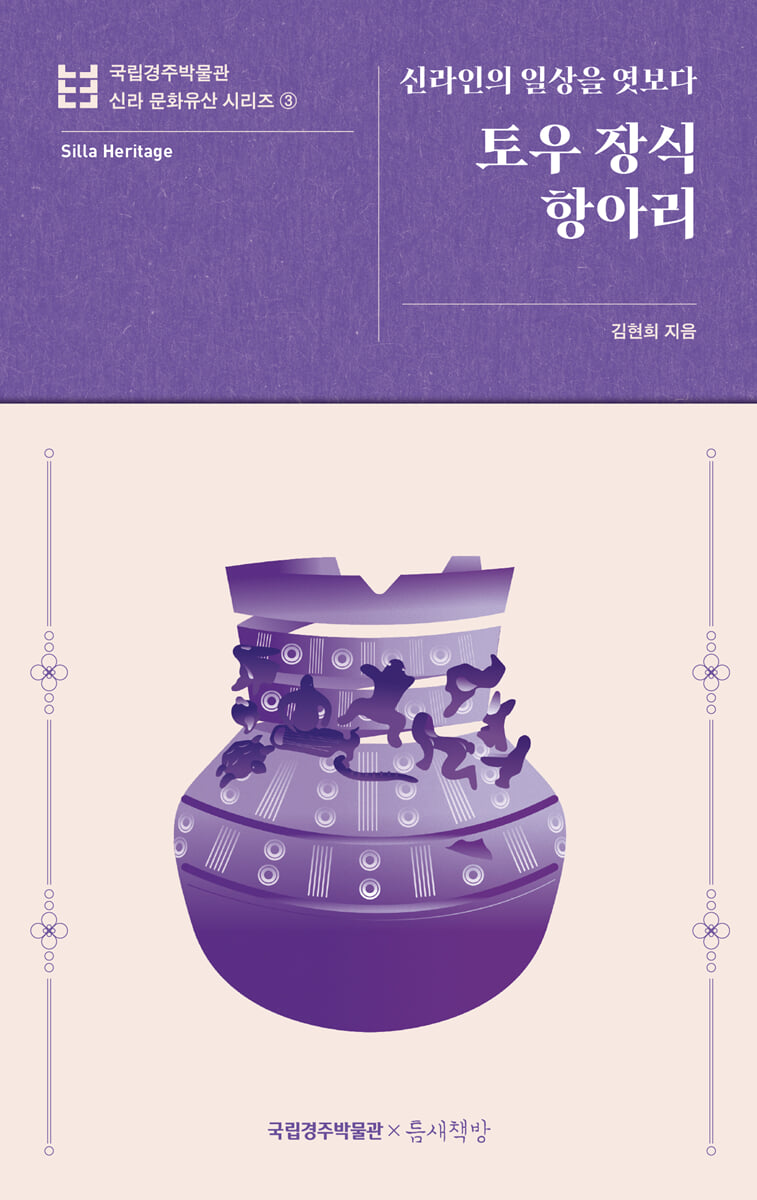
Toe-shaped decorative jar
 |
Description
Book Introduction
·The 'Silla Cultural Heritage Series', which explains 10 treasures of Silla selected by visitors to the Gyeongju National Museum.
·A clue to appreciating clay figurines and tou, which embody the aesthetic sensibility of the Silla people in a rustic yet unique way.
· A guidebook containing insights from those who have dealt with artifacts up close and in the most detail.
The 'Silla Cultural Heritage Series' is a series planned by the Gyeongju National Museum to provide higher-quality and differentiated exhibition commentary.
The following are explained: the Cheonmachong gold crown, golden sword, earthenware-decorated jar, face-patterned water taps, Hwangryongsa chimi, King Seongdeok's new bell, Baekryulsa gilt-bronze Bhaisajyaguru Buddha statue, Gim Eunsa sarira reliquary, Jangchanggok stone Maitreya triad, and gilt-bronze scissors with a wick.
The ten treasures featured in this series were selected through direct voting by visitors to the National Gyeongju Museum.
In other words, it can be said to be the Silla cultural heritage most loved by Koreans.
The "Silla Cultural Heritage Series" was written by current and former curators and Korea's top researchers who are most familiar with and have extensive experience with the artifacts, all written in a way that is accessible to the general public.
It can be said to be a guidebook that combines reliability and popularity in its interpretation of relics.
It contains a wealth of photos of artifacts that cannot be found anywhere else, and difficult historical terms are explained separately to help with understanding.
The third treasure in the ‘Silla Cultural Heritage Series’ is a clay-decorated jar.
A tou is a small clay doll the size of one or two finger joints.
It is a type of miniature that expresses the daily life of the Silla people, including people, animals, and musical instruments.
Two wooden jars decorated with toe decorations are designated as national treasures, and were excavated from Gyerim-ro and Nodong-dong, Gyeongju, respectively.
A rough yet ingenious tow decoration unfolds around the jug's shoulder and neck, almost like a panorama.
《Tou Decorated Jar》 explains in detail the reason why the tou revealed itself after 1,600 years and why the Silla people attached these small clay figurines to earthenware and placed them in tombs.
In this process, not only can we get a glimpse into the Silla people's attitude toward death, but we can also feel a sense of kinship with them despite the long gap of 1,600 years.
·A clue to appreciating clay figurines and tou, which embody the aesthetic sensibility of the Silla people in a rustic yet unique way.
· A guidebook containing insights from those who have dealt with artifacts up close and in the most detail.
The 'Silla Cultural Heritage Series' is a series planned by the Gyeongju National Museum to provide higher-quality and differentiated exhibition commentary.
The following are explained: the Cheonmachong gold crown, golden sword, earthenware-decorated jar, face-patterned water taps, Hwangryongsa chimi, King Seongdeok's new bell, Baekryulsa gilt-bronze Bhaisajyaguru Buddha statue, Gim Eunsa sarira reliquary, Jangchanggok stone Maitreya triad, and gilt-bronze scissors with a wick.
The ten treasures featured in this series were selected through direct voting by visitors to the National Gyeongju Museum.
In other words, it can be said to be the Silla cultural heritage most loved by Koreans.
The "Silla Cultural Heritage Series" was written by current and former curators and Korea's top researchers who are most familiar with and have extensive experience with the artifacts, all written in a way that is accessible to the general public.
It can be said to be a guidebook that combines reliability and popularity in its interpretation of relics.
It contains a wealth of photos of artifacts that cannot be found anywhere else, and difficult historical terms are explained separately to help with understanding.
The third treasure in the ‘Silla Cultural Heritage Series’ is a clay-decorated jar.
A tou is a small clay doll the size of one or two finger joints.
It is a type of miniature that expresses the daily life of the Silla people, including people, animals, and musical instruments.
Two wooden jars decorated with toe decorations are designated as national treasures, and were excavated from Gyerim-ro and Nodong-dong, Gyeongju, respectively.
A rough yet ingenious tow decoration unfolds around the jug's shoulder and neck, almost like a panorama.
《Tou Decorated Jar》 explains in detail the reason why the tou revealed itself after 1,600 years and why the Silla people attached these small clay figurines to earthenware and placed them in tombs.
In this process, not only can we get a glimpse into the Silla people's attitude toward death, but we can also feel a sense of kinship with them despite the long gap of 1,600 years.
- You can preview some of the book's contents.
Preview
index
· Introductory remarks
Ⅰ.
Meet the little clay doll
Ⅱ.
The clay doll we met again
Ⅲ.
A look inside the national treasure earthenware jar
Ⅳ.
Tou that recreates Silla life and its meaning
· Outgoing words
· Glossary of Terms
· References
Ⅰ.
Meet the little clay doll
Ⅱ.
The clay doll we met again
Ⅲ.
A look inside the national treasure earthenware jar
Ⅳ.
Tou that recreates Silla life and its meaning
· Outgoing words
· Glossary of Terms
· References
Into the book
The Silla people mainly decorated the lids of dishes with curved legs or the necks of wooden jars with tou.
It expresses the spiritual world of the Silla people who wish for abundance and fertility.
If you look closely, it has a very simple shape, but it's interesting that you can still figure out what it's expressing.
---From "Introductory Remarks"
We cannot clearly know in which tomb and in what condition the large number of Silla earthenware figures excavated from the Hwangnam-ri stone tomb in Gyeongju were buried.
This is because almost no data was left behind at the time of excavation, and no excavation report was published afterwards.
Additionally, there were many cases where the clay was attached to the pottery at the time of excavation, but fell off due to careless handling, and the clay was stored individually.
The National Museum of Korea is currently working on restoration work to reassemble the separated earthenware and attach it to the pottery.
---From "Meeting a Small Clay Doll"
The earthenware discovered in Hwangnam-dong had not been organized, and the combination of the earthenware and the earthenware had not been perfectly restored, making it difficult to interpret their meaning.
However, the Cheoksam area is a valuable historical site that provides abundant data for the study of pottery decorated with clay, as excavations are being conducted using current advanced technology.
---From "The Clay Doll We Met Again"
The artifacts excavated from Gyerim-ro and Nodong-dong are the same long-necked jars, but their detailed designs are very different.
The Gyerim-ro wooden jar has a round body like a ball, but the Nodong-dong excavated jar has square shoulders and the center of the body is cut in half like a round ball.
---From "Looking into the National Treasure Tou Jar"
Humans are beings bound by finite time.
You can take charge of your own life, but you can also be inevitably dragged along by the will of others due to power, status, or social standing.
Ancient sources that provide a glimpse into the true nature of human existence are very rare.
That is why Silla clay figures, which boldly and sometimes simply show the cycle of birth, aging, illness, and death, come closer than any detailed painting.
---From "Tou that Reproduces Silla Life and Its Meaning"
Looking at the animal figurines, it feels like looking at a zoo from the Silla era.
These animal figurines were attached to the lids of pottery, and they appear in combinations of the same type, different types of animals, or even with people.
Not only animals living in the world of sky, land, and water are confirmed, but even the imaginary animal dragon is confirmed.
It is also very interesting that monkeys, which do not currently live in our country, were made into toucan.
---From "Tou that Reproduces Silla Life and Its Meaning"
The debate over whether the small clay figurines modeled after people, animals, and objects were simply created to capture the daily lives and wishes of the Silla people, or whether they were intended to preserve the memories and performances of shamans, is at another starting point.
It expresses the spiritual world of the Silla people who wish for abundance and fertility.
If you look closely, it has a very simple shape, but it's interesting that you can still figure out what it's expressing.
---From "Introductory Remarks"
We cannot clearly know in which tomb and in what condition the large number of Silla earthenware figures excavated from the Hwangnam-ri stone tomb in Gyeongju were buried.
This is because almost no data was left behind at the time of excavation, and no excavation report was published afterwards.
Additionally, there were many cases where the clay was attached to the pottery at the time of excavation, but fell off due to careless handling, and the clay was stored individually.
The National Museum of Korea is currently working on restoration work to reassemble the separated earthenware and attach it to the pottery.
---From "Meeting a Small Clay Doll"
The earthenware discovered in Hwangnam-dong had not been organized, and the combination of the earthenware and the earthenware had not been perfectly restored, making it difficult to interpret their meaning.
However, the Cheoksam area is a valuable historical site that provides abundant data for the study of pottery decorated with clay, as excavations are being conducted using current advanced technology.
---From "The Clay Doll We Met Again"
The artifacts excavated from Gyerim-ro and Nodong-dong are the same long-necked jars, but their detailed designs are very different.
The Gyerim-ro wooden jar has a round body like a ball, but the Nodong-dong excavated jar has square shoulders and the center of the body is cut in half like a round ball.
---From "Looking into the National Treasure Tou Jar"
Humans are beings bound by finite time.
You can take charge of your own life, but you can also be inevitably dragged along by the will of others due to power, status, or social standing.
Ancient sources that provide a glimpse into the true nature of human existence are very rare.
That is why Silla clay figures, which boldly and sometimes simply show the cycle of birth, aging, illness, and death, come closer than any detailed painting.
---From "Tou that Reproduces Silla Life and Its Meaning"
Looking at the animal figurines, it feels like looking at a zoo from the Silla era.
These animal figurines were attached to the lids of pottery, and they appear in combinations of the same type, different types of animals, or even with people.
Not only animals living in the world of sky, land, and water are confirmed, but even the imaginary animal dragon is confirmed.
It is also very interesting that monkeys, which do not currently live in our country, were made into toucan.
---From "Tou that Reproduces Silla Life and Its Meaning"
The debate over whether the small clay figurines modeled after people, animals, and objects were simply created to capture the daily lives and wishes of the Silla people, or whether they were intended to preserve the memories and performances of shamans, is at another starting point.
---From "Outgoing Words"
Publisher's Review
·A story no one knew, contained in a toucan-decorated jar that everyone knows
· Proposing a proactive historical experience rather than passive information acquisition
Gyeongju National Museum, Korea's representative museum where you can see Silla's history and culture at a glance, has released an in-depth guide to its artifacts.
Among the many exhibits, we have selected the 10 most popular artifacts among visitors to the National Gyeongju Museum.
From a curator's perspective, the exhibition follows a trend of change from the traditional exhibition method that focused on conveying information to the current process of allowing visitors to actively experience various histories.
The photos are as vivid as the splendid relics, making you feel awe and excitement.
Tou, a miniature from the Silla period made of clay
It was during the Japanese colonial period that the clay figurine emerged from the ground for the first time in 1,600 years.
The pottery, which was filled with clay figures of various shapes, was damaged without any records during the haphazard excavation process, and due to careless handling, the clay figures were sometimes separated and stored separately.
Two complete wooden jars, which confirm that these clay figures were attached to pottery, were excavated in the 1970s and designated as national treasures.
In this book, in addition to the national treasure wooden jar, we examine in three dimensions the clay figures decorated on various pottery.
Bold and honest expressions, humorously depicting the lives of the Silla people
Silla clay figures have been discovered in such abundance that they can be used to gauge the mood of the times.
It features a variety of real and imaginary animals, reminiscent of a Silla-era zoo.
While the figures depicting musical instruments, dance, singing, and playing are reminiscent of the entertainment and elegance of the Silla period, the explicit and exaggerated sexual expressions also attract attention.
Although the construction is crude, the unique characteristics of the tows are captured in a unique way. This book contains the insights of a curator at the National Museum who has seen, touched, and handled more tows than anyone else, while dividing and interpreting the types of tows.
Why did the Silla people make and bury clay dolls?
Since prehistoric times, the act of modeling something has been imbued with meaning.
What meaning did the Silla people put into the clay figurines they made in the shape of people, animals, and objects?
What were they trying to symbolize by boldly emphasizing or omitting specific parts of people or animals, thereby simplifying their expression? Why do fixed shapes like snakes and frogs appear in various pottery artifacts discovered in various locations? Let's explore the meanings contained in these pottery artifacts.
Gyeongju National Museum Planning Series: A Complete Guidebook on 10 Popular Treasures Representing Silla's Millennium
Current and former curators at the National Museum of Korea and Korea's leading researchers will reveal stories never before told in the exhibition hall, from the excavation of artifacts to new findings from recent research.
Detailed photos, available only at museums, allow you to see the artifacts more clearly than in real life.
It suggests a way to view and understand relics from a researcher's perspective, while also providing various perspectives on exhibits.
If you visit the National Gyeongju Museum after reading this book, you will feel that your perspective on artifacts has become much deeper and broader.
· Proposing a proactive historical experience rather than passive information acquisition
Gyeongju National Museum, Korea's representative museum where you can see Silla's history and culture at a glance, has released an in-depth guide to its artifacts.
Among the many exhibits, we have selected the 10 most popular artifacts among visitors to the National Gyeongju Museum.
From a curator's perspective, the exhibition follows a trend of change from the traditional exhibition method that focused on conveying information to the current process of allowing visitors to actively experience various histories.
The photos are as vivid as the splendid relics, making you feel awe and excitement.
Tou, a miniature from the Silla period made of clay
It was during the Japanese colonial period that the clay figurine emerged from the ground for the first time in 1,600 years.
The pottery, which was filled with clay figures of various shapes, was damaged without any records during the haphazard excavation process, and due to careless handling, the clay figures were sometimes separated and stored separately.
Two complete wooden jars, which confirm that these clay figures were attached to pottery, were excavated in the 1970s and designated as national treasures.
In this book, in addition to the national treasure wooden jar, we examine in three dimensions the clay figures decorated on various pottery.
Bold and honest expressions, humorously depicting the lives of the Silla people
Silla clay figures have been discovered in such abundance that they can be used to gauge the mood of the times.
It features a variety of real and imaginary animals, reminiscent of a Silla-era zoo.
While the figures depicting musical instruments, dance, singing, and playing are reminiscent of the entertainment and elegance of the Silla period, the explicit and exaggerated sexual expressions also attract attention.
Although the construction is crude, the unique characteristics of the tows are captured in a unique way. This book contains the insights of a curator at the National Museum who has seen, touched, and handled more tows than anyone else, while dividing and interpreting the types of tows.
Why did the Silla people make and bury clay dolls?
Since prehistoric times, the act of modeling something has been imbued with meaning.
What meaning did the Silla people put into the clay figurines they made in the shape of people, animals, and objects?
What were they trying to symbolize by boldly emphasizing or omitting specific parts of people or animals, thereby simplifying their expression? Why do fixed shapes like snakes and frogs appear in various pottery artifacts discovered in various locations? Let's explore the meanings contained in these pottery artifacts.
Gyeongju National Museum Planning Series: A Complete Guidebook on 10 Popular Treasures Representing Silla's Millennium
Current and former curators at the National Museum of Korea and Korea's leading researchers will reveal stories never before told in the exhibition hall, from the excavation of artifacts to new findings from recent research.
Detailed photos, available only at museums, allow you to see the artifacts more clearly than in real life.
It suggests a way to view and understand relics from a researcher's perspective, while also providing various perspectives on exhibits.
If you visit the National Gyeongju Museum after reading this book, you will feel that your perspective on artifacts has become much deeper and broader.
GOODS SPECIFICS
- Date of issue: December 15, 2023
- Page count, weight, size: 76 pages | 152g | 120*190*8mm
- ISBN13: 9791188949571
- ISBN10: 1188949578
You may also like
카테고리
korean


korean

![GQ KOREA Mark (Monthly): December [2025]](http://librairie.coreenne.fr/cdn/shop/files/8ef265dbbfbf186523ed75ba7319009d.jpg?v=1765340328&width=3840)


