

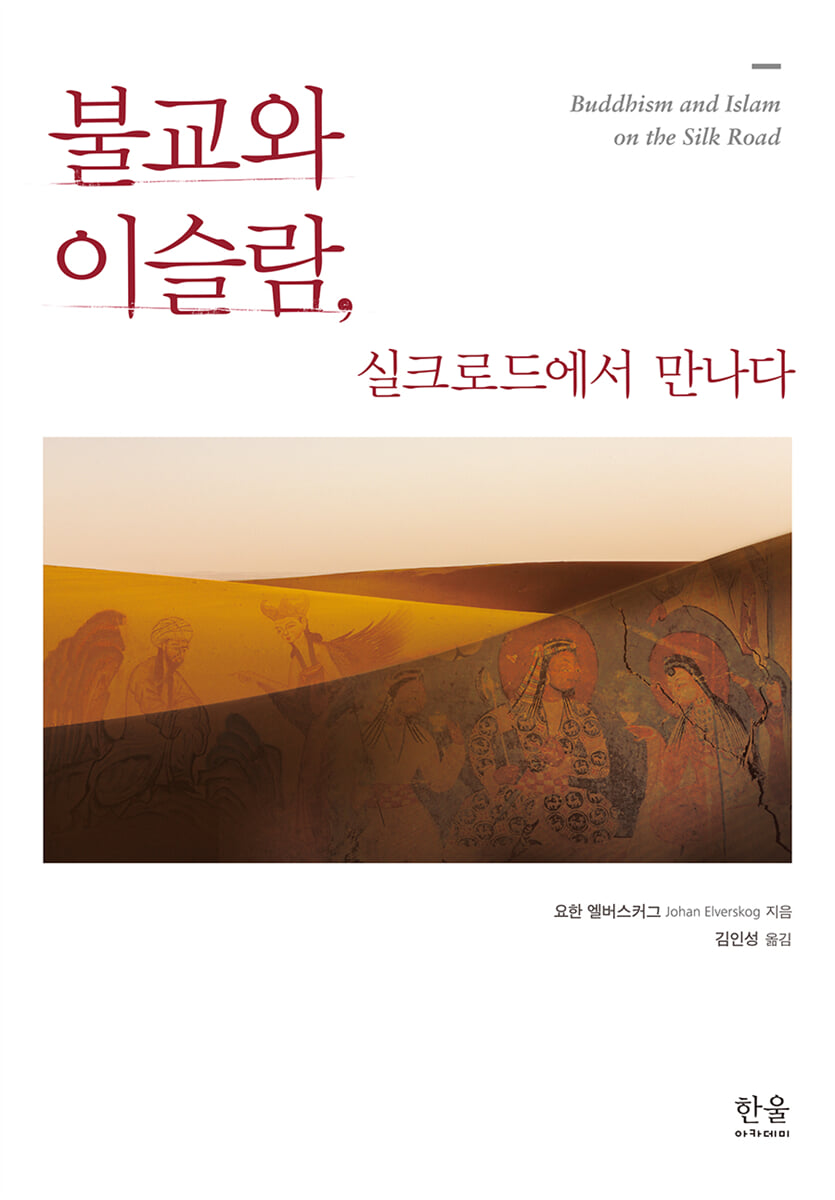
Buddhism and Islam Meet on the Silk Road
 |
Description
Book Introduction
Buddhism and Islam - Two Great Traditions
Encounters, conflicts, and understanding
In many ways, all religions are the same.
In 2001, the Taliban blew up the Bamiyan Buddhas.
Despite an offer to purchase the stone Buddha from the Metropolitan Museum of Art in New York and a campaign to preserve it in various Western countries, the massive stone Buddha that had been preserved for over a thousand years was destroyed in an instant.
The world exploded with anger at the Islamic world's destructive acts of civilization, and once again the exclusivity of Islam and the ignorance of its culture became the target of condemnation.
But what we must not forget is that the stone Buddha is a relic that has been preserved for over a thousand years in the Muslim country of Afghanistan.
Until the Taliban's destruction, the Western world had paid little attention to the Buddha statues, and the Muslims there neither used religion as an excuse to destroy them nor used their existence as a bargaining chip.
In this sense, the Bamiyan Buddhas bear witness to the history of contact between Muslims and Buddhists, while at the same time symbolizing the politicized clash of civilizations in our time.
This book is a translation of Buddhism and Islam on the Silk Road (2010), published by the University of Pennsylvania Press.
Author Johan Elberskog is a professor of history at the University of Texas at Austin. He has long been interested in the intersection of two great religious traditions, Buddhism and Islam, and has consistently published research on the subject.
Encounters, conflicts, and understanding
In many ways, all religions are the same.
In 2001, the Taliban blew up the Bamiyan Buddhas.
Despite an offer to purchase the stone Buddha from the Metropolitan Museum of Art in New York and a campaign to preserve it in various Western countries, the massive stone Buddha that had been preserved for over a thousand years was destroyed in an instant.
The world exploded with anger at the Islamic world's destructive acts of civilization, and once again the exclusivity of Islam and the ignorance of its culture became the target of condemnation.
But what we must not forget is that the stone Buddha is a relic that has been preserved for over a thousand years in the Muslim country of Afghanistan.
Until the Taliban's destruction, the Western world had paid little attention to the Buddha statues, and the Muslims there neither used religion as an excuse to destroy them nor used their existence as a bargaining chip.
In this sense, the Bamiyan Buddhas bear witness to the history of contact between Muslims and Buddhists, while at the same time symbolizing the politicized clash of civilizations in our time.
This book is a translation of Buddhism and Islam on the Silk Road (2010), published by the University of Pennsylvania Press.
Author Johan Elberskog is a professor of history at the University of Texas at Austin. He has long been interested in the intersection of two great religious traditions, Buddhism and Islam, and has consistently published research on the subject.
index
time
Author's Preface to the Korean Edition
introduction
Chapter 1 Contact
The Economy of Salvation / Changing Trade Networks / New Era, New Ideas / The Coming of Islam / Buddhist and Muslim Rule
Chapter 2 Mutual Understanding
Early Muslim Perspectives/The Buddhist-Muslim Divide/Other Muslims, Other Buddhists/Buddhist Responses
Chapter 3: Idolatry
Historical Background/ Mongolia, Buddhism, and Islam/ Rashid al-Din and Buddhism/ Mongolian Visual Culture
Chapter 4 Jihad
Six Pieces of the Puzzle / The Calm Before the Storm / Essen Khan and the Conversion to Buddhism / Interactions on the Front Line / Religion, Politics, and Intolerance
Chapter 5 Halal
Historical and Legal Precedents/ You Are What You Eat/ Islam and the Qing Dynasty/ Injannash and the Islamic Question
conclusion
Author's Preface to the Korean Edition
introduction
Chapter 1 Contact
The Economy of Salvation / Changing Trade Networks / New Era, New Ideas / The Coming of Islam / Buddhist and Muslim Rule
Chapter 2 Mutual Understanding
Early Muslim Perspectives/The Buddhist-Muslim Divide/Other Muslims, Other Buddhists/Buddhist Responses
Chapter 3: Idolatry
Historical Background/ Mongolia, Buddhism, and Islam/ Rashid al-Din and Buddhism/ Mongolian Visual Culture
Chapter 4 Jihad
Six Pieces of the Puzzle / The Calm Before the Storm / Essen Khan and the Conversion to Buddhism / Interactions on the Front Line / Religion, Politics, and Intolerance
Chapter 5 Halal
Historical and Legal Precedents/ You Are What You Eat/ Islam and the Qing Dynasty/ Injannash and the Islamic Question
conclusion
Detailed image
.jpg)
Publisher's Review
Understanding and Misunderstanding the Encounter Between Buddhism and Islam
This book is a translation of Buddhism and Islam on the Silk Road (2010), published by the University of Pennsylvania Press.
Author Johan Elberskog is a professor of history at the University of Texas at Austin. He has long been interested in the intersection of two great religious traditions, Buddhism and Islam, and has consistently published research on the subject.
Professor Elberskog's book urges us to reconsider our common sense, which vaguely assumes that Buddhism and Islam are completely separate phenomena with no connection whatsoever.
To this end, he cites key examples to illustrate the historical transformations that actually unfolded as Buddhism and Islam met.
Of course, the Buddhism and Islam that the author refers to in this book do not refer to doctrines, ideologies, or ideals, but rather to cases where such religious expressions are applied in reality.
Any religion, whether Buddhism, Islam, Christianity, Judaism, or Hinduism, needs more than just the prayers and devout devotion of its believers to thrive in this world.
As the term "economy of salvation" suggests, religions demand economic contributions from their followers in exchange for guaranteeing peace, comfort, and rest after death, and followers acquire "spiritual capital" through which they pursue their own advancement by belonging to religious groups that have built powerful power in reality.
The author's repeated emphasis in this book that Buddhism and Islam are not very different refers to the religious aspects of this current reality.
Against this backdrop, the author focuses not on India or the Arabian Peninsula as a starting point for illuminating the history of Buddhist-Islamic exchanges, but on the vast inland Asia that stretched from Afghanistan to Mongolia, a trading region known as the "Silk Road."
Therefore, the 'Buddhism' or 'Mahayana Buddhism' mentioned in this book does not refer to the Zen Buddhism of East Asia, but to the Buddhism of Tibet, which served as a center of trade in inland Asia and served as the spiritual pillar of northern nomadic peoples such as the Khitans, Mongols, and Manchus, namely 'Esoteric Buddhism' or 'Tantric Buddhism'.
Zen Buddhism in East Asia, including Korea, is not actually a subject of discussion in this book.
The temporal structure is not a hypothetical system that extends from the early stages of the formation of Buddhism or Islam, or from their own doctrinal debates to eschatology, but rather deals with the interaction of these two traditions over a period from the mid-7th century to the 19th century.
Each chapter is arranged chronologically, covering how Islam encountered the Buddhist powers that dominated existing trade routes with the emergence of Islam in the mid-7th century, how they understood and misunderstood each other, leading to conflict and hostility, and even attempts at reconciliation, up to the end of the Qing Dynasty, which included Inner Asia within its territory.
All religions contain the realities of this world.
Professor Elberskog's book is a significant achievement in the study of cultural exchanges and exchanges, not least for its detailed content, but simply for the fact that it brings together two great traditions—Buddhism and Islam—that were previously considered to have no intersection, into a single topic.
Since World War I and II, the number of Christians in Europe has declined significantly, leading to a sharp increase in church closures.
In comparison, the number of Western Buddhists is quietly but steadily increasing.
Korea, too, has undergone changes. Christianity has spread dramatically since the Korean War, while Buddhism, despite its temples scattered across the country, has seen a decline in the number of Buddhists compared to the past.
Yet, despite these changes, the power of tradition and history remains persistent and powerful.
European time is still determined by the Christian church's practices.
One example is that Christmas is considered more important than New Year's Day, not only in a religious sense but also in its dominance of everyday time.
In this way, both Buddhism and Islam are unfamiliar traditions in the West.
Islam is only geographically closer to the West and has had frequent contact and conflicts historically, making it closer to Westerners than Buddhism.
I believe Professor Elberskog's ability to address these two external traditions stemmed from his long-standing interest in diverse cultures and his enthusiasm and perseverance in expressing and refining that interest academically.
When he first published his book, the destruction of the Bamiyan Buddhas was a major issue, but now, as 2023 draws to a close, the Islam we are familiar with has been replaced by Hamas.
Nowadays, the trend is for Judaism and Christianity to be at odds with Islam rather than between Muslims and Buddhists.
If Professor Elberskog's argument is correct, all religions are not very different in that they live in the realities of this world.
They pursue their own economic and political interests and preach peace in doctrine, but they also promote and use violence to secure their own interests.
As the author states in the 'Korean edition preface' of this book, he advises us not to fall for the wrong 'story' and to look at the 'forest rather than the trees'.
Contents of each chapter
Chapter 1 explores the early contacts between Buddhists and Muslims, from about 700 to 1000 AD, through the lens of trade and the connections between religious thought and economic systems.
Chapter 2 also covers the same period, but goes beyond the "economy of salvation" to explore how these two traditions have sought to understand each other through examples.
Chapter 3 goes beyond the period covered in Chapters 1 and 2 and focuses on the Mongol Empire, which lasted from about 1100 to 1400, known as the Pax Mongolica.
While Hellenistic technical and medical knowledge spread through Muslims to inner Asia, particularly Tibet, a far more significant example of Buddhist-Muslim interaction was the influence of the “highly visual tradition” of Buddhist culture, once condemned as idolatrous, on Muslim artistic production.
In contrast, Chapter 4 examines how the conflict between the Buddhist and Muslim worlds arose as the two traditions grew increasingly distant from each other in the period from around 1400 to 1650 after the fall of the Mongol Empire, and introduces the political and economic background that ultimately led to the emergence of the conflict surrounding the concept of "jihad."
Finally, Chapter 5 examines how the seemingly mundane activity of "eating" became a religious debate and a political issue during the Qing Dynasty (1644–1911), when Buddhists and Muslims united under one dynasty.
In fact, the problem of 'halal' is not limited to the Qing Dynasty, but can also be found in the Iberian Peninsula and Italy, where Christianity and Islam clashed greatly. However, the case of the Qing Dynasty is particularly important because it forms the basis of the problems that Muslims in China are facing to this day.
This book is a translation of Buddhism and Islam on the Silk Road (2010), published by the University of Pennsylvania Press.
Author Johan Elberskog is a professor of history at the University of Texas at Austin. He has long been interested in the intersection of two great religious traditions, Buddhism and Islam, and has consistently published research on the subject.
Professor Elberskog's book urges us to reconsider our common sense, which vaguely assumes that Buddhism and Islam are completely separate phenomena with no connection whatsoever.
To this end, he cites key examples to illustrate the historical transformations that actually unfolded as Buddhism and Islam met.
Of course, the Buddhism and Islam that the author refers to in this book do not refer to doctrines, ideologies, or ideals, but rather to cases where such religious expressions are applied in reality.
Any religion, whether Buddhism, Islam, Christianity, Judaism, or Hinduism, needs more than just the prayers and devout devotion of its believers to thrive in this world.
As the term "economy of salvation" suggests, religions demand economic contributions from their followers in exchange for guaranteeing peace, comfort, and rest after death, and followers acquire "spiritual capital" through which they pursue their own advancement by belonging to religious groups that have built powerful power in reality.
The author's repeated emphasis in this book that Buddhism and Islam are not very different refers to the religious aspects of this current reality.
Against this backdrop, the author focuses not on India or the Arabian Peninsula as a starting point for illuminating the history of Buddhist-Islamic exchanges, but on the vast inland Asia that stretched from Afghanistan to Mongolia, a trading region known as the "Silk Road."
Therefore, the 'Buddhism' or 'Mahayana Buddhism' mentioned in this book does not refer to the Zen Buddhism of East Asia, but to the Buddhism of Tibet, which served as a center of trade in inland Asia and served as the spiritual pillar of northern nomadic peoples such as the Khitans, Mongols, and Manchus, namely 'Esoteric Buddhism' or 'Tantric Buddhism'.
Zen Buddhism in East Asia, including Korea, is not actually a subject of discussion in this book.
The temporal structure is not a hypothetical system that extends from the early stages of the formation of Buddhism or Islam, or from their own doctrinal debates to eschatology, but rather deals with the interaction of these two traditions over a period from the mid-7th century to the 19th century.
Each chapter is arranged chronologically, covering how Islam encountered the Buddhist powers that dominated existing trade routes with the emergence of Islam in the mid-7th century, how they understood and misunderstood each other, leading to conflict and hostility, and even attempts at reconciliation, up to the end of the Qing Dynasty, which included Inner Asia within its territory.
All religions contain the realities of this world.
Professor Elberskog's book is a significant achievement in the study of cultural exchanges and exchanges, not least for its detailed content, but simply for the fact that it brings together two great traditions—Buddhism and Islam—that were previously considered to have no intersection, into a single topic.
Since World War I and II, the number of Christians in Europe has declined significantly, leading to a sharp increase in church closures.
In comparison, the number of Western Buddhists is quietly but steadily increasing.
Korea, too, has undergone changes. Christianity has spread dramatically since the Korean War, while Buddhism, despite its temples scattered across the country, has seen a decline in the number of Buddhists compared to the past.
Yet, despite these changes, the power of tradition and history remains persistent and powerful.
European time is still determined by the Christian church's practices.
One example is that Christmas is considered more important than New Year's Day, not only in a religious sense but also in its dominance of everyday time.
In this way, both Buddhism and Islam are unfamiliar traditions in the West.
Islam is only geographically closer to the West and has had frequent contact and conflicts historically, making it closer to Westerners than Buddhism.
I believe Professor Elberskog's ability to address these two external traditions stemmed from his long-standing interest in diverse cultures and his enthusiasm and perseverance in expressing and refining that interest academically.
When he first published his book, the destruction of the Bamiyan Buddhas was a major issue, but now, as 2023 draws to a close, the Islam we are familiar with has been replaced by Hamas.
Nowadays, the trend is for Judaism and Christianity to be at odds with Islam rather than between Muslims and Buddhists.
If Professor Elberskog's argument is correct, all religions are not very different in that they live in the realities of this world.
They pursue their own economic and political interests and preach peace in doctrine, but they also promote and use violence to secure their own interests.
As the author states in the 'Korean edition preface' of this book, he advises us not to fall for the wrong 'story' and to look at the 'forest rather than the trees'.
Contents of each chapter
Chapter 1 explores the early contacts between Buddhists and Muslims, from about 700 to 1000 AD, through the lens of trade and the connections between religious thought and economic systems.
Chapter 2 also covers the same period, but goes beyond the "economy of salvation" to explore how these two traditions have sought to understand each other through examples.
Chapter 3 goes beyond the period covered in Chapters 1 and 2 and focuses on the Mongol Empire, which lasted from about 1100 to 1400, known as the Pax Mongolica.
While Hellenistic technical and medical knowledge spread through Muslims to inner Asia, particularly Tibet, a far more significant example of Buddhist-Muslim interaction was the influence of the “highly visual tradition” of Buddhist culture, once condemned as idolatrous, on Muslim artistic production.
In contrast, Chapter 4 examines how the conflict between the Buddhist and Muslim worlds arose as the two traditions grew increasingly distant from each other in the period from around 1400 to 1650 after the fall of the Mongol Empire, and introduces the political and economic background that ultimately led to the emergence of the conflict surrounding the concept of "jihad."
Finally, Chapter 5 examines how the seemingly mundane activity of "eating" became a religious debate and a political issue during the Qing Dynasty (1644–1911), when Buddhists and Muslims united under one dynasty.
In fact, the problem of 'halal' is not limited to the Qing Dynasty, but can also be found in the Iberian Peninsula and Italy, where Christianity and Islam clashed greatly. However, the case of the Qing Dynasty is particularly important because it forms the basis of the problems that Muslims in China are facing to this day.
GOODS SPECIFICS
- Date of issue: March 8, 2024
- Format: Hardcover book binding method guide
- Page count, weight, size: 480 pages | 153*224*20mm
- ISBN13: 9788946074958
You may also like
카테고리
korean


korean

![GQ KOREA Mark (Monthly): December [2025]](http://librairie.coreenne.fr/cdn/shop/files/8ef265dbbfbf186523ed75ba7319009d.jpg?v=1765340328&width=3840)


