

Chinese history in one go
 |
Description
Book Introduction
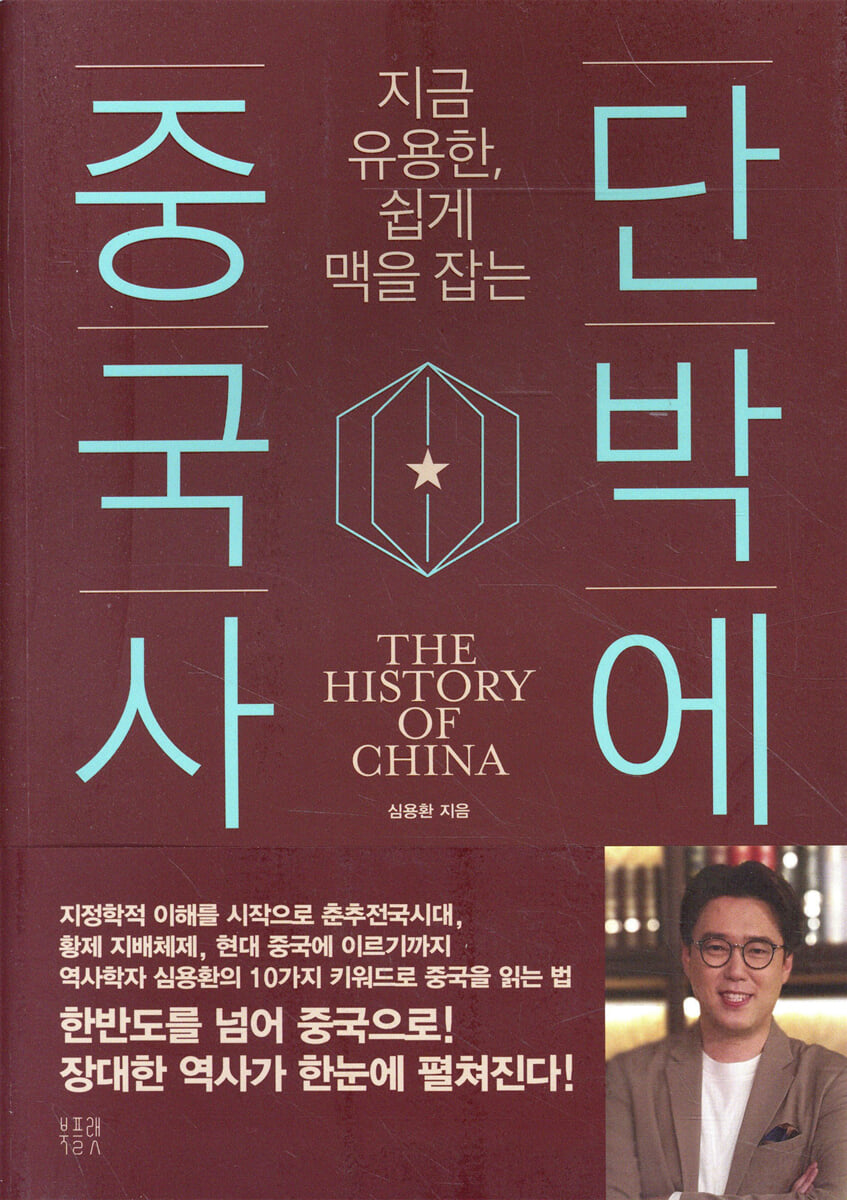
Sim Yong-hwan, Korea's representative history communicator 10 Keyword Guide to Reading China The first in the "In One Shot" world history series by Korea's leading history communicator, Sim Yong-hwan, is "In One Shot Chinese History." This book was written from the perspective of how to understand China, a country that has had a 2,000-year relationship with China and that exerts influence on the world today as a G2 power. The story moves forward without hesitation, starting with the process of determining the current territory of China through repeated periods of division and unification, understanding the Hundred Schools of Thought that overcame the turbulent times of the Spring and Autumn Period and the Warring States Period, from Qin Shi Huang who perfected the imperial ruling system to the reforms and limitations of Emperor Taizong of Tang Li Shimin, the unstoppable advance of the northern nomadic peoples who expanded their power by rejecting Chinese culture while at times absorbing it, the economy of the Song Dynasty, the first commercial empire still worth studying today, and the China designed by Mao Zedong and Deng Xiaoping, through Hong Xiuquan and Sun Yat-sen. Organized in chronological order, it focuses on keywords that must be remembered for each era, allowing readers to read the vast history of China in one sitting. |
- You can preview some of the book's contents.
Preview
index
Introduction: Is what we perceive as China a reality or an emotion?
Lecture 1: The Yellow River and the Yangtze River: How China Became One: Geography and Dynasties
Where Chinese history began
Gangnam Development: China Changes Again
The Song Dynasty's economic revolution also began in Jiangnan.
Why did Manchuria and Tibet become China?
Lecture 2: The Birth of Thought: How to Overcome Chaotic Times: The Spring and Autumn Period and the Hundred Schools of Thought
Shang and Zhou Dynasties: From an Era of Murder and Burying to an Era of Inquiring into Heaven's Will
The Spring and Autumn Period and the Warring States Period: A Time of Unprecedented Chaos, a Time of Resentment and Vengeance
Confucius stood before King Goujian of the Yue Kingdom and said nothing.
Mencius: Debating and Establishing the Direction of Political Thought
Laozi and Zhuangzi: Enemies or Allies of Confucianism?
The Traditions Created by Qin Shi Huang and Emperor Wen of Han: The Imperial System 1
What place does Qin Shi Huang occupy in Chinese history?
The Jin Dynasty's Policy of Unification: From Duke Mu to Duke Xiao and Shi Huang
Unification is not just about winning.
The Han Dynasty, which ruled for 400 years and established true traditions
Emperor Taizong of Tang, Li Shimin, ushered in an era of revival: The Imperial Regime, Part 2
The Sui Dynasty, a unified empire that lasted less than half a century
Sui Dynasty reaches out to Goguryeo
A unified empire achieved through Lee Yeon's prudence and Lee Se-min's boldness
Emperor Taizong of Tang, Li Shimin, ushered in a new era of prosperity.
The emperor and the heavenly lord, even Goguryeo coveted
The World Beyond Liaodong, Unfathomable to China: Manchuria and the Korean Peninsula
The one and only female emperor, Empress Wu Zetian
Lecture 5: The Birth of a New Human: Between Culture and Exams, Learning and Success
Seeking the ideal scholar's life
Past Exams: A New Standard for Selecting Talent in East Asia
The Rise of the Song Dynasty: The Balance Between China and the Surrounding World Disrupted
Reorganizing a new East Asian order centered on the North
The rise of the Jin and Mongols, who trampled the Song Dynasty
The First Experiment: A Great Commercial Empire, and Buddhism and Taoism
Kaifeng, the Song Dynasty capital, was more prosperous than ever before
Imperial power is declining, but the economy is booming.
Wang Anshi's New Law: Maximizing Direct Government Intervention
Sima Guang and Wang Anshi engage in a great debate
Buddhism, Taoism, and Neo-Confucianism: A New World of Spirituality Opens
Another World of Taoism: The Coexistence of the Three Teachings
Lecture 7: How the Silk Road Transformed China: Desert Routes and Sea Routes
It started with Emperor Wu of Han, discovered by Zhang Qian, and created by Guo Qubing in 248.
The miracle of silk
The Maritime Silk Road carried far more goods than the desert route.
Grand Canal: A highway running north to south through China
The Tang Dynasty, the new era of the Silk Road
Ceramics and tea spread throughout the world
Lecture 8: World History Made by Nomads: Genghis Khan and Nurhaci
The Rise of Genghis Khan: Shaking Everything Up
A war of conquest that has reached its limit
The Rise of the Ming Dynasty: A Return to the Traditional Chinese Empire
Neo-Confucianism, Yangmingism, and the European Renaissance
How did the Purification Expedition differ from the European expeditions?
The fall of the Ming Dynasty and the rise of the Manchus
The Rise of the Qing Dynasty: Manchu Rule in China Begins with Nurhaci
Lecture 9: Hong Xiuquan and Sun Yat-sen: Creating a New China: Modern China
Hong Xiuquan, realizing he was the son of God, fought the Manchus.
The Heavenly Empire: The World That Dreamed of a Peaceful Heavenly Kingdom Collapses
The Opium Wars: A Century of Humiliation Begins
The Self-Strengthening Movement ended with the defeat in the Sino-Japanese War.
The Rise of Sun Yat-sen and the Revolutionaries: Drive Out the Manchus and End the Imperial Rule
The Asian Revolutionary Path Advocated by Sun Yat-sen: Nation, Civil Rights, and People's Livelihood
Lecture 10: The New World Designed by Mao Zedong and Deng Xiaoping: Modern China
From Sun Yat-sen to Chiang Kai-shek, from the Kuomintang-Communist cooperation to the Kuomintang era
Japanese Aggression: From the Manchurian Incident to the Second Sino-Japanese War
Mao Zedong's Chinese Communist Party: Practicing Independent Revolution
Mao Zedong vs. Chiang Kai-shek: Who Represents the People?
The Establishment of the People's Republic of China: The Great Leap Forward and the Cultural Revolution
The Age of Deng Xiaoping: Did He Deny Mao Zedong?
The Rise of Neoliberalism: China after Opening Up and Reform
Chronology
Chinese dynasties
References
Lecture 1: The Yellow River and the Yangtze River: How China Became One: Geography and Dynasties
Where Chinese history began
Gangnam Development: China Changes Again
The Song Dynasty's economic revolution also began in Jiangnan.
Why did Manchuria and Tibet become China?
Lecture 2: The Birth of Thought: How to Overcome Chaotic Times: The Spring and Autumn Period and the Hundred Schools of Thought
Shang and Zhou Dynasties: From an Era of Murder and Burying to an Era of Inquiring into Heaven's Will
The Spring and Autumn Period and the Warring States Period: A Time of Unprecedented Chaos, a Time of Resentment and Vengeance
Confucius stood before King Goujian of the Yue Kingdom and said nothing.
Mencius: Debating and Establishing the Direction of Political Thought
Laozi and Zhuangzi: Enemies or Allies of Confucianism?
The Traditions Created by Qin Shi Huang and Emperor Wen of Han: The Imperial System 1
What place does Qin Shi Huang occupy in Chinese history?
The Jin Dynasty's Policy of Unification: From Duke Mu to Duke Xiao and Shi Huang
Unification is not just about winning.
The Han Dynasty, which ruled for 400 years and established true traditions
Emperor Taizong of Tang, Li Shimin, ushered in an era of revival: The Imperial Regime, Part 2
The Sui Dynasty, a unified empire that lasted less than half a century
Sui Dynasty reaches out to Goguryeo
A unified empire achieved through Lee Yeon's prudence and Lee Se-min's boldness
Emperor Taizong of Tang, Li Shimin, ushered in a new era of prosperity.
The emperor and the heavenly lord, even Goguryeo coveted
The World Beyond Liaodong, Unfathomable to China: Manchuria and the Korean Peninsula
The one and only female emperor, Empress Wu Zetian
Lecture 5: The Birth of a New Human: Between Culture and Exams, Learning and Success
Seeking the ideal scholar's life
Past Exams: A New Standard for Selecting Talent in East Asia
The Rise of the Song Dynasty: The Balance Between China and the Surrounding World Disrupted
Reorganizing a new East Asian order centered on the North
The rise of the Jin and Mongols, who trampled the Song Dynasty
The First Experiment: A Great Commercial Empire, and Buddhism and Taoism
Kaifeng, the Song Dynasty capital, was more prosperous than ever before
Imperial power is declining, but the economy is booming.
Wang Anshi's New Law: Maximizing Direct Government Intervention
Sima Guang and Wang Anshi engage in a great debate
Buddhism, Taoism, and Neo-Confucianism: A New World of Spirituality Opens
Another World of Taoism: The Coexistence of the Three Teachings
Lecture 7: How the Silk Road Transformed China: Desert Routes and Sea Routes
It started with Emperor Wu of Han, discovered by Zhang Qian, and created by Guo Qubing in 248.
The miracle of silk
The Maritime Silk Road carried far more goods than the desert route.
Grand Canal: A highway running north to south through China
The Tang Dynasty, the new era of the Silk Road
Ceramics and tea spread throughout the world
Lecture 8: World History Made by Nomads: Genghis Khan and Nurhaci
The Rise of Genghis Khan: Shaking Everything Up
A war of conquest that has reached its limit
The Rise of the Ming Dynasty: A Return to the Traditional Chinese Empire
Neo-Confucianism, Yangmingism, and the European Renaissance
How did the Purification Expedition differ from the European expeditions?
The fall of the Ming Dynasty and the rise of the Manchus
The Rise of the Qing Dynasty: Manchu Rule in China Begins with Nurhaci
Lecture 9: Hong Xiuquan and Sun Yat-sen: Creating a New China: Modern China
Hong Xiuquan, realizing he was the son of God, fought the Manchus.
The Heavenly Empire: The World That Dreamed of a Peaceful Heavenly Kingdom Collapses
The Opium Wars: A Century of Humiliation Begins
The Self-Strengthening Movement ended with the defeat in the Sino-Japanese War.
The Rise of Sun Yat-sen and the Revolutionaries: Drive Out the Manchus and End the Imperial Rule
The Asian Revolutionary Path Advocated by Sun Yat-sen: Nation, Civil Rights, and People's Livelihood
Lecture 10: The New World Designed by Mao Zedong and Deng Xiaoping: Modern China
From Sun Yat-sen to Chiang Kai-shek, from the Kuomintang-Communist cooperation to the Kuomintang era
Japanese Aggression: From the Manchurian Incident to the Second Sino-Japanese War
Mao Zedong's Chinese Communist Party: Practicing Independent Revolution
Mao Zedong vs. Chiang Kai-shek: Who Represents the People?
The Establishment of the People's Republic of China: The Great Leap Forward and the Cultural Revolution
The Age of Deng Xiaoping: Did He Deny Mao Zedong?
The Rise of Neoliberalism: China after Opening Up and Reform
Chronology
Chinese dynasties
References
Detailed image
Into the book
It's time to understand China again.
We need to move beyond negative emotional reactions to a deeper, more reflective, and more macro-level perspective.
This is not to emphasize the necessity of liberal arts.
Geopolitics is a fate that all nations must bear.
Except for the Cold War period that lasted approximately 50 years after the Chinese Communist Party's victory in the Chinese Civil War in 1949, the history of the Korean Peninsula has always faced the history of East Asia centered on China.
Even during the Japanese colonial period, wasn't the place we relied on while fighting for independence also China?
And at least for the rest of our generation, China's actions, categorized as the so-called 'G2,' cannot be ignored.
In other words, studying China is not only beneficial in learning about Chinese civilization and appreciating the value of its classics, but it is also an urgent topic that must be given priority in understanding the present through the past and moving forward into the future.
---From the "Prologue"
The beginning of Chinese history was not Guanzhong, but the Central Plains.
The Yellow River civilization began here.
The Xia Dynasty, known as China's first dynasty, was also based here.
The Central Plains is a place comparable to Guanzhong.
Luoyang is located on the ambiguous border between Guanzhong and Zhongyuan.
It is the place where the Yellow River and the Luo River (also called the Luo River) meet, and it is a very important location where goods from the east and west can be brought together by digging a canal.
Luoyang, along with Xi'an, was the capital of ancient China and a place that created endless political comedies and tragedies.
---From "1. The Yellow River and the Yangtze River: How China Became One"
Regardless of one's emotional attitude toward Qin Shi Huang, and regardless of the rise of modern China and the new vision of the "Chinese Dream," history has long focused on Qin Shi Huang's achievements.
He established the first unified empire in Chinese history and crowned himself emperor.
They defeated all their rivals during the Warring States period and took control of every corner of southern China that had previously been out of reach.
To the north, they repelled the Huns and built the Great Wall.
He divided the country into 36 counties and districts, and made a decisive contribution to unifying the vast land of China into a single civilization by unifying the writing system and weights and measures.
Above all, what was decisive was the creation of the tradition of a unified empire and an imperial ruling system.
---From "Three-Power Emperor System 1"
The past system was an institutionalized place for advancement and self-realization.
Chaotic times like the Spring and Autumn Period and the Warring States Period are not easily repeated.
Making a name for yourself through your own abilities in troubled times? It's not easy, and it's not a path anyone can take.
Moreover, with the repeated emergence of unified empires, small regional power units such as principalities disappeared.
The official path established by the state, the path to assist the emperor and govern the country, the path to save the people, suppress the aristocracy's arrogance, and create a peaceful society.
A very narrow but extremely glorious path.
The scholar's education and Chinese humanistic spirit were absorbed into the national bureaucracy through the civil service examination system.
---From "The Birth of a New Human Being"
Which came first, the road or the object? History isn't made up solely of politics.
Military victories are also always limited.
The amazing magic of ancient history, the exchange between the East and the West, began with a product called ‘silk.’
It is said that when the Silk Road did not exist, Siberian villagers spread silk all the way to Greece.
Silk is a fabric invented in prehistoric China.
At the Hemudu archaeological site in Jeolla Province, tools that confirm silk manufacturing technology from around 5000 BC and vessels engraved with silk patterns were excavated.
At the Huituling archaeological site in Shaanxi Province, a piece of artificially cut silkworm cocoon, estimated to be from around 4000 BC, was discovered.
---From "7 Lectures: How the Silk Road Changed China"
From Hong Xiuquan's Taiping Heavenly Kingdom Movement to Li Hongzhang's Self-War Movement and Sun Yat-sen's advocacy of the Three Principles of the People.
Despite their respective historical roles, their struggles and the turbulent modern history of China that accompanied them achieved meaningful results even in the face of extreme difficulties.
Their efforts helped free most Asian countries from the colonialism they had been forced to submit to, and succeeded in giving a uniquely Asian character to the new ideology of nationalism.
From Korean revolutionaries like Ahn Chang-ho and Kim Gu to Vietnamese independence activists like Phan Boi Chau, revolutionaries in East Asia were greatly influenced by Sun Yat-sen's ideas.
It also had a significant influence on the development of a form of nationalism that embraced traditional ideas and was uniquely Asian, resistant and egalitarian, unlike the far-right national socialism or fascism that emerged in Europe.
We need to move beyond negative emotional reactions to a deeper, more reflective, and more macro-level perspective.
This is not to emphasize the necessity of liberal arts.
Geopolitics is a fate that all nations must bear.
Except for the Cold War period that lasted approximately 50 years after the Chinese Communist Party's victory in the Chinese Civil War in 1949, the history of the Korean Peninsula has always faced the history of East Asia centered on China.
Even during the Japanese colonial period, wasn't the place we relied on while fighting for independence also China?
And at least for the rest of our generation, China's actions, categorized as the so-called 'G2,' cannot be ignored.
In other words, studying China is not only beneficial in learning about Chinese civilization and appreciating the value of its classics, but it is also an urgent topic that must be given priority in understanding the present through the past and moving forward into the future.
---From the "Prologue"
The beginning of Chinese history was not Guanzhong, but the Central Plains.
The Yellow River civilization began here.
The Xia Dynasty, known as China's first dynasty, was also based here.
The Central Plains is a place comparable to Guanzhong.
Luoyang is located on the ambiguous border between Guanzhong and Zhongyuan.
It is the place where the Yellow River and the Luo River (also called the Luo River) meet, and it is a very important location where goods from the east and west can be brought together by digging a canal.
Luoyang, along with Xi'an, was the capital of ancient China and a place that created endless political comedies and tragedies.
---From "1. The Yellow River and the Yangtze River: How China Became One"
Regardless of one's emotional attitude toward Qin Shi Huang, and regardless of the rise of modern China and the new vision of the "Chinese Dream," history has long focused on Qin Shi Huang's achievements.
He established the first unified empire in Chinese history and crowned himself emperor.
They defeated all their rivals during the Warring States period and took control of every corner of southern China that had previously been out of reach.
To the north, they repelled the Huns and built the Great Wall.
He divided the country into 36 counties and districts, and made a decisive contribution to unifying the vast land of China into a single civilization by unifying the writing system and weights and measures.
Above all, what was decisive was the creation of the tradition of a unified empire and an imperial ruling system.
---From "Three-Power Emperor System 1"
The past system was an institutionalized place for advancement and self-realization.
Chaotic times like the Spring and Autumn Period and the Warring States Period are not easily repeated.
Making a name for yourself through your own abilities in troubled times? It's not easy, and it's not a path anyone can take.
Moreover, with the repeated emergence of unified empires, small regional power units such as principalities disappeared.
The official path established by the state, the path to assist the emperor and govern the country, the path to save the people, suppress the aristocracy's arrogance, and create a peaceful society.
A very narrow but extremely glorious path.
The scholar's education and Chinese humanistic spirit were absorbed into the national bureaucracy through the civil service examination system.
---From "The Birth of a New Human Being"
Which came first, the road or the object? History isn't made up solely of politics.
Military victories are also always limited.
The amazing magic of ancient history, the exchange between the East and the West, began with a product called ‘silk.’
It is said that when the Silk Road did not exist, Siberian villagers spread silk all the way to Greece.
Silk is a fabric invented in prehistoric China.
At the Hemudu archaeological site in Jeolla Province, tools that confirm silk manufacturing technology from around 5000 BC and vessels engraved with silk patterns were excavated.
At the Huituling archaeological site in Shaanxi Province, a piece of artificially cut silkworm cocoon, estimated to be from around 4000 BC, was discovered.
---From "7 Lectures: How the Silk Road Changed China"
From Hong Xiuquan's Taiping Heavenly Kingdom Movement to Li Hongzhang's Self-War Movement and Sun Yat-sen's advocacy of the Three Principles of the People.
Despite their respective historical roles, their struggles and the turbulent modern history of China that accompanied them achieved meaningful results even in the face of extreme difficulties.
Their efforts helped free most Asian countries from the colonialism they had been forced to submit to, and succeeded in giving a uniquely Asian character to the new ideology of nationalism.
From Korean revolutionaries like Ahn Chang-ho and Kim Gu to Vietnamese independence activists like Phan Boi Chau, revolutionaries in East Asia were greatly influenced by Sun Yat-sen's ideas.
It also had a significant influence on the development of a form of nationalism that embraced traditional ideas and was uniquely Asian, resistant and egalitarian, unlike the far-right national socialism or fascism that emerged in Europe.
---From "Lecture 9: Hong Xiuquan and Sun Yat-sen, Creating a New China"
Publisher's Review
"Chinese History in a Nutshell": The first journey beyond the Korean Peninsula and into the world.
From geopolitical understanding to the Spring and Autumn Period and Warring States Period, the imperial system, and modern China.
10 Keyword Guide to Reading China
Author Sim Yong-hwan, a leading Korean history communicator, has expanded his horizons to world history following the "Korean History in One Shot" series.
The 'In One Shot' history series is a history book that examines meaningful historical events in the present based on historical context, while examining geopolitical understanding and the political situation of surrounding countries at the time.
As the first step in expanding beyond the Korean Peninsula to the world, I published 『A History of China in One Go』.
The reason I chose China as the first country is that the Korean Peninsula has encountered China for 2,000 years, and as a country that exerts influence on the world today as a G2, I wanted to properly look at China's historical reality rather than respond emotionally.
Author Sim Yong-hwan says that now is the time to “understand China again.”
“Let’s move beyond negative emotional reactions to a level where we can be more thoughtful, reflective, and have a broader perspective.”
It is by no means easy to capture the history of China, a history as complex as that of a vast continent, in a single book.
This book provides an exciting overview of Chinese history, focusing on 10 keywords that must be known for each era to understand present-day China.
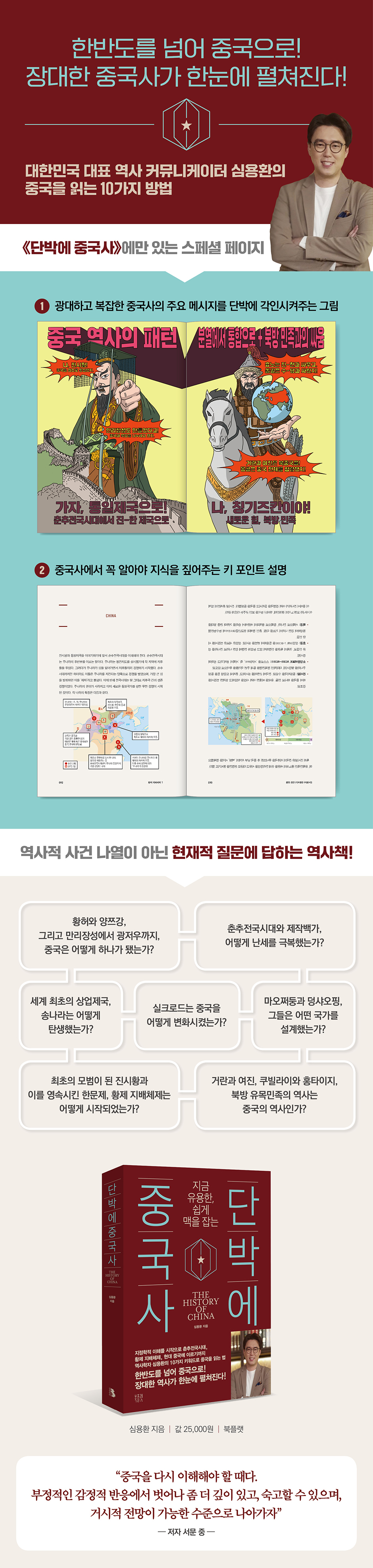
A history book that answers current questions, not just lists historical events!
A feast of deep and broad stories connecting the past and present, China and the world.
The book begins with a general overview of the nature of China, based on its geography and dynasties.
We examine how the vast geographical space, from the Yellow River and the Yangtze River, and the Great Wall to Hangzhou, and then from Manchuria to Tibet, went through repeated periods of division and integration to become what is now China.
While traditional society has consistently been a target of criticism, the current crisis and opportunity overlap when we read about the imperial system of Qin Shi Huang, which has recently been receiving a different evaluation in China, the Han Dynasty that perpetuated it, and the reforms and limitations of Emperor Taizong of Tang, Li Shimin.
Although they have now largely disappeared, the history of the northern nomadic peoples occupies an important place in Chinese history.
The Khitan and Jurchen, proclaiming themselves emperors, attempted to redesign East Asia around the nomadic world, while Kublai Khan and Hong Taiji attempted to unify the North and Central Asia by conquering China.
The book shows the process with a urgency that matches the relentless pace of the nomads.
Also, when talking about China, it focuses on the intellectual history of the Hundred Schools of Thought during the Spring and Autumn Period and the Warring States Period, Buddhism, and Neo-Confucianism, which influenced the politics and culture of East Asia.
Finally, two chapters are devoted to modern and contemporary Chinese history.
As the author says, “All history must answer contemporary questions,” the modern and contemporary history of the past 150 years is crucial for understanding present-day China.
In addition, it is full of interesting stories about people who cannot be left out of Chinese history, such as the Song Dynasty, the world's first commercial empire; the Silk Road that carried Chinese paper, printing technology, silk, and porcelain to the West; the changes brought about by the Grand Canal built by Emperor Yang of Sui; the one and only Empress Wu Zetian; and Wang Anshi, who led the Song Dynasty's reforms.
Eye-catching pictures × A story that unfolds with a sense of urgency
A grand history of China read in one sitting!
This book was written as part of a process of finding answers to useful questions today.
"A Brief History of China," which thoroughly explores historical facts while simultaneously conveying the author's imagination as if he had jumped straight into that era, instantly dispels the preconception that Chinese history is boring and difficult.
Above all, the beginning of each chapter features illustrations by artist Bang Sang-ho that illustrate the core message at a glance and points that must be remembered, making it easy and fun to read for everyone from students studying Chinese history to adults who want to learn Chinese history as a general knowledge.
Starting with this book, “A Brief History of China,” we plan to publish the history of the United States, Japan, and other countries around the world.
Author Sim Yong-hwan's "In One Shot" series, which is both entertaining and profound, is not just a general history book; it will become a powerful weapon that can solve the problems we face today.
From geopolitical understanding to the Spring and Autumn Period and Warring States Period, the imperial system, and modern China.
10 Keyword Guide to Reading China
Author Sim Yong-hwan, a leading Korean history communicator, has expanded his horizons to world history following the "Korean History in One Shot" series.
The 'In One Shot' history series is a history book that examines meaningful historical events in the present based on historical context, while examining geopolitical understanding and the political situation of surrounding countries at the time.
As the first step in expanding beyond the Korean Peninsula to the world, I published 『A History of China in One Go』.
The reason I chose China as the first country is that the Korean Peninsula has encountered China for 2,000 years, and as a country that exerts influence on the world today as a G2, I wanted to properly look at China's historical reality rather than respond emotionally.
Author Sim Yong-hwan says that now is the time to “understand China again.”
“Let’s move beyond negative emotional reactions to a level where we can be more thoughtful, reflective, and have a broader perspective.”
It is by no means easy to capture the history of China, a history as complex as that of a vast continent, in a single book.
This book provides an exciting overview of Chinese history, focusing on 10 keywords that must be known for each era to understand present-day China.
A history book that answers current questions, not just lists historical events!
A feast of deep and broad stories connecting the past and present, China and the world.
The book begins with a general overview of the nature of China, based on its geography and dynasties.
We examine how the vast geographical space, from the Yellow River and the Yangtze River, and the Great Wall to Hangzhou, and then from Manchuria to Tibet, went through repeated periods of division and integration to become what is now China.
While traditional society has consistently been a target of criticism, the current crisis and opportunity overlap when we read about the imperial system of Qin Shi Huang, which has recently been receiving a different evaluation in China, the Han Dynasty that perpetuated it, and the reforms and limitations of Emperor Taizong of Tang, Li Shimin.
Although they have now largely disappeared, the history of the northern nomadic peoples occupies an important place in Chinese history.
The Khitan and Jurchen, proclaiming themselves emperors, attempted to redesign East Asia around the nomadic world, while Kublai Khan and Hong Taiji attempted to unify the North and Central Asia by conquering China.
The book shows the process with a urgency that matches the relentless pace of the nomads.
Also, when talking about China, it focuses on the intellectual history of the Hundred Schools of Thought during the Spring and Autumn Period and the Warring States Period, Buddhism, and Neo-Confucianism, which influenced the politics and culture of East Asia.
Finally, two chapters are devoted to modern and contemporary Chinese history.
As the author says, “All history must answer contemporary questions,” the modern and contemporary history of the past 150 years is crucial for understanding present-day China.
In addition, it is full of interesting stories about people who cannot be left out of Chinese history, such as the Song Dynasty, the world's first commercial empire; the Silk Road that carried Chinese paper, printing technology, silk, and porcelain to the West; the changes brought about by the Grand Canal built by Emperor Yang of Sui; the one and only Empress Wu Zetian; and Wang Anshi, who led the Song Dynasty's reforms.
Eye-catching pictures × A story that unfolds with a sense of urgency
A grand history of China read in one sitting!
This book was written as part of a process of finding answers to useful questions today.
"A Brief History of China," which thoroughly explores historical facts while simultaneously conveying the author's imagination as if he had jumped straight into that era, instantly dispels the preconception that Chinese history is boring and difficult.
Above all, the beginning of each chapter features illustrations by artist Bang Sang-ho that illustrate the core message at a glance and points that must be remembered, making it easy and fun to read for everyone from students studying Chinese history to adults who want to learn Chinese history as a general knowledge.
Starting with this book, “A Brief History of China,” we plan to publish the history of the United States, Japan, and other countries around the world.
Author Sim Yong-hwan's "In One Shot" series, which is both entertaining and profound, is not just a general history book; it will become a powerful weapon that can solve the problems we face today.
GOODS SPECIFICS
- Date of issue: December 26, 2023
- Page count, weight, size: 456 pages | 165*230*27mm
- ISBN13: 9791198493408
- ISBN10: 1198493402
You may also like
카테고리
korean


korean

![GQ KOREA Mark (Monthly): December [2025]](http://librairie.coreenne.fr/cdn/shop/files/8ef265dbbfbf186523ed75ba7319009d.jpg?v=1765340328&width=3840)


