

The Spring and Autumn Period and the Warring States Period, Part 6
 |
Description
Book Introduction
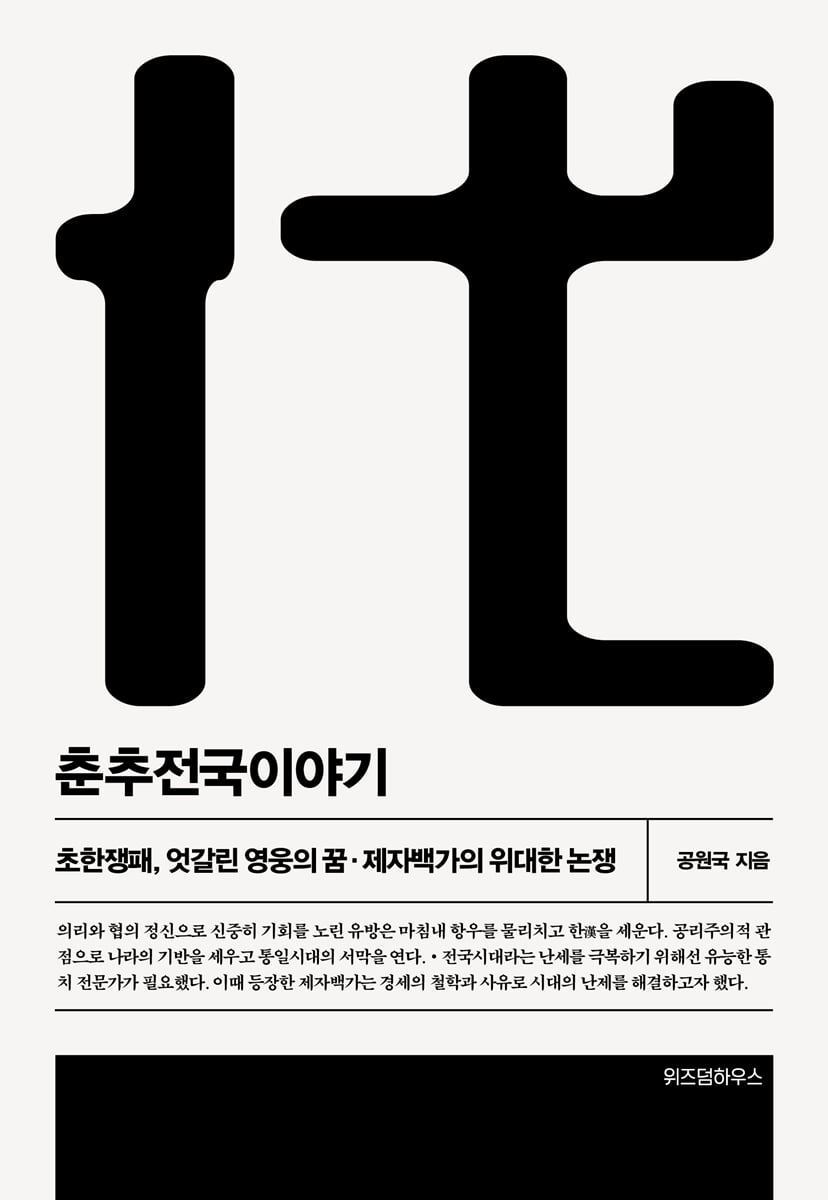
The three great battles between Liu Bang and Xiang Yu for control of the world—a story of the Hundred Schools of Thought armed with the philosophy and ability of statecraft.
This is the revised second edition of 『The Spring and Autumn Annals and Warring States Stories』.
Volume 6 of the series details the fall of the Qin Dynasty and the founding of the Han Dynasty, as well as the confrontation between Liu Bang and Xiang Yu, known as the "Chu-Han Conflict."
In the process, we can understand how Liu Bang, a commoner, founded the Han Dynasty and laid the foundation for the era of unification.
In Part 2, we meet the protagonists of the Hundred Schools of Thought, which blossomed during the political divisions of the Warring States Period.
As Mencius, Han Feizi, Xun Zi, Mozi, and Zhuangzi appear and discuss various topics that dominated the Warring States Period in the form of debate, readers have the opportunity to comprehensively review the thoughts of the Hundred Schools of Thought.
This is the revised second edition of 『The Spring and Autumn Annals and Warring States Stories』.
Volume 6 of the series details the fall of the Qin Dynasty and the founding of the Han Dynasty, as well as the confrontation between Liu Bang and Xiang Yu, known as the "Chu-Han Conflict."
In the process, we can understand how Liu Bang, a commoner, founded the Han Dynasty and laid the foundation for the era of unification.
In Part 2, we meet the protagonists of the Hundred Schools of Thought, which blossomed during the political divisions of the Warring States Period.
As Mencius, Han Feizi, Xun Zi, Mozi, and Zhuangzi appear and discuss various topics that dominated the Warring States Period in the form of debate, readers have the opportunity to comprehensively review the thoughts of the Hundred Schools of Thought.
- You can preview some of the book's contents.
Preview
index
Main Character 4
Part 1: The Chu-Han Conflict: A Hero's Conflicting Dreams
Entering 17
Chapter 1: A Spark Sets the Wilderness ablaze 31
Chapter 2: The Extraordinary and the Ordinary 63
Chapter 3: Crossing the River 89
Chapter 4: Those Who Win People and Those Who Win Victory 115
Chapter 5: The Fall of Jin 145
Chapter 6: The Chu-Han Conflict 1: Rising from Defeat 187
Chapter 7: The Chu-Han Conflict 2: Seven Falls and Eight Fights 209
Chapter 8: The Chu-Han Conflict 3: The Great Battle of Haixia 237
Chapter 9: The Builder's Appearance and Philosophy 255
Chapter 10: Jin and Han Through the Eyes of the Law: Has the World Changed? 285
Part 2: The Great Debate among the Hundred Schools of Thought
Enter 373
Chapter 1: The Age of the Hundred Schools of Thought 383
Chapter 2: The Roots of Governance: Virtue or Law? 423
Chapter 3: Rule of Law, Order, Economy, and War 479
Chapter 4: Class Struggle in the Warring States Period: The Debate Between Mozi and Xunzi on Etiquette 555
Chapter 5: Zhuangzi, Calling for Absolute Life and Equality (647)
Leaving: Ancient Philosophy and Practical Sciences 689
Deep Reading: Ancient China in Light of Plato's Republic 705
Full review Waiting for the next guest 719
supplement
Chronology of the Reigns of the Major States of the Warring States Period, 726
Major Events of the Warring States Period 728
Search 729
Part 1: The Chu-Han Conflict: A Hero's Conflicting Dreams
Entering 17
Chapter 1: A Spark Sets the Wilderness ablaze 31
Chapter 2: The Extraordinary and the Ordinary 63
Chapter 3: Crossing the River 89
Chapter 4: Those Who Win People and Those Who Win Victory 115
Chapter 5: The Fall of Jin 145
Chapter 6: The Chu-Han Conflict 1: Rising from Defeat 187
Chapter 7: The Chu-Han Conflict 2: Seven Falls and Eight Fights 209
Chapter 8: The Chu-Han Conflict 3: The Great Battle of Haixia 237
Chapter 9: The Builder's Appearance and Philosophy 255
Chapter 10: Jin and Han Through the Eyes of the Law: Has the World Changed? 285
Part 2: The Great Debate among the Hundred Schools of Thought
Enter 373
Chapter 1: The Age of the Hundred Schools of Thought 383
Chapter 2: The Roots of Governance: Virtue or Law? 423
Chapter 3: Rule of Law, Order, Economy, and War 479
Chapter 4: Class Struggle in the Warring States Period: The Debate Between Mozi and Xunzi on Etiquette 555
Chapter 5: Zhuangzi, Calling for Absolute Life and Equality (647)
Leaving: Ancient Philosophy and Practical Sciences 689
Deep Reading: Ancient China in Light of Plato's Republic 705
Full review Waiting for the next guest 719
supplement
Chronology of the Reigns of the Major States of the Warring States Period, 726
Major Events of the Warring States Period 728
Search 729
Into the book
The way breasts win people's hearts is not special.
He throws himself into a desperate situation.
When he throws himself into something, several people around him also become a community of destiny with him, either out of necessity or out of inspiration. Once they join together, the breasts become the core of this community of destiny and grow in power.
It is said that even after he achieved great things, he treated even the gatekeeper as if he were an old friend.
There wasn't any special formality.
Whether in his lowly social status or after he became noble, he treated everyone as if they were drinking buddies, but people were undoubtedly impressed by him.
--- p.72~73, from “Part 1, Chapter 2: The Extraordinary and the Ordinary”
The supporting role that brought down Jin was Yoo Bang.
He enters Guanzhong while Xiang Yu is fighting against the main force of Qin and proclaims the 'Three Generals of Medicinal Law'.
Even if it was an unrealistic political slogan, it was the first roar to set right a corrupted world.
When governing the world, battles and laws are of minor importance; only when politics are upright can there be no danger.
A crowd gathers around him who knows how to rule, and who can stand against such a raging crowd?
What Confucius said is not wrong.
A virtuous person is not lonely, so he will definitely have neighbors.
Yes, Jin collapsed.
But who will take over this massive system?
--- p.146, from “Part 1, Chapter 5, The Fall of Jin”
But the more the breasts fought, the more shameless they became and their ambitions grew stronger.
This time, instead of going to Guanzhong, he took Xiahou Ying across the Yellow River and headed to Han Xin's camp.
He entered Han Xin's camp by impersonating a lion and seized his military power in the middle of the night.
It was an absurd thing, but Hanshin accepted it obediently.
Liu Bang ordered Zhang Yi to withdraw the Zhao army and ordered Han Xin to offer sacrifices.
It was the summer of July, and Liu Bang's power was revived when he again obtained Han Xin's army.
The third king, who ran away with only one body, was able to maintain his authority thanks to Han Xin's loyalty and power.
--- p.227, from “Part 1, Chapter 7, The Chu-Han Conflict 2”
The breasts capture Hanshin and immediately move the capital to Guanzhong and take follow-up measures.
He divided the land of Han Xin into two, and appointed Liu Jia, a member of the Liu clan who had distinguished himself on the battlefield, as the King of Jing to rule Huaidong, and his younger brother Liu Jiao as the King of Chu to rule Huaixi.
He then granted his son, Bi, the most fertile and extensive land in the east.
Thus, the important territories of the world were all in the hands of the Liu family, and if the sons and brothers did not betray them, the great cause of Han would not collapse overnight.
As such, what the breasts wanted was the Yu clan's downfall.
--- p.263~264, from “Part 2, Chapter 9, The Builder’s Appearance and Philosophy”
What's the point of recounting their story now, some 2,500 years later? The Hundred Schools of Thought represent, if not all of, Eastern thought, then most of it.
It's more than just a circle.
Until almost the beginning of the 20th century, Eastern thought did not go far beyond the framework of the Hundred Schools of Thought.
Even in China, a country that has undergone socialism in the 21st century, aren't Confucius and Mozi experiencing a revival? Although their teachings may not be as refined as today's specialized disciplines, their broad perspective and seriousness shine brighter with each passing day.
--- p.374, from “Introduction to Part 2”
Ultimately, it's about the power of the monarch and how to exercise that power.
The legalists' argument is clear.
The relationship between the monarch and his subjects is one of superior and subordinate, and the monarch must hide his true intentions and monitor and control his subjects.
However, as Sunja sharply refuted, hiding, surveillance, and control can harm the unity between superiors and subordinates.
Also, as Plato pointed out, a state can be ruined if power is concentrated in the hands of a single monarch who cannot handle the burden of governance.
I found a clue to compromise in 『Guanzi』.
Of course, the head of state must have authority and must maintain his authority.
However, since the state is a huge organization, its leader cannot stop personal cultivation.
Also, since we need to move the military, we need to make our stance on the matter clear.
--- p.475, from “Part 2, Chapter 2: The Fundamentals of Governance”
Confucius warned that if the law were to be the standard, the hierarchical order of hierarchy would collapse.
However, the asset claims that the law is the only means to save the country.
When the Warring States period began, all countries were obsessed with reforming their legal systems.
It was to survive the competition.
There is no way that the Hundred Schools of Thought could have missed this trend.
Because law was both a means of maintaining order and a standard for distributing profits, the struggle between the parties surrounding the law was bound to be fierce.
--- p.480, from “Part 2, Chapter 3: Rule of Law and Order, Economy, and War”
What is the essence of courtesy? And what is the essence of righteousness? Some might misinterpret the term "the essence of courtesy" as an outdated, stale theory, like the Joseon Dynasty's Ye-song (禮訟) controversy, detached from reality.
However, the theory of the Warring States period is a direct reflection of history and reality.
The discussion focuses on sharp issues facing society as a whole, such as 'How should we view the class system centered on the king?', 'How should we distribute wealth between classes?', 'Are the duties and rights between classes reciprocal or unilateral?', and 'What is the meaning of ceremonies as a fundamental principle of governance?'
To put it schematically, the reformists, led by Mozi, said, “The rites you speak of are nothing more than a means to perpetuate discrimination and exploitation,” while the conservatives, led by Xunzi, countered, “Without rites, order will collapse, and when order collapses, the common people will suffer the most catastrophic damage.”
Although it is written in a crude and ancient expression, it is no less relevant to today's progressive-conservative debate.
Therefore, the theory is a class struggle in words.
--- p.556, from “Part 2, Chapter 4, Class Struggle in the Warring States Period, Debate on Etiquette between Mozi and Xunzi”
Although Zhuangzi is often known today as a hermit enjoying nature in a state of stillness, he was a fierce fighter.
A man wearing tattered clothes stands in front of an omnipotent monster that is growing with the momentum of devouring everything.
Although his appearance is poor, he does not retreat even an inch.
For some reason, the monster cannot swallow this poor man and only growls.
Did he know that if he swallowed it, it would be a fireball that would burn him? He was a humanist who stood against the entire Warring States period and a life advocate who opposed all totalitarianism throughout Chinese history.
Today, his ideas have finally transcended the confines of China and gained global universality.
He throws himself into a desperate situation.
When he throws himself into something, several people around him also become a community of destiny with him, either out of necessity or out of inspiration. Once they join together, the breasts become the core of this community of destiny and grow in power.
It is said that even after he achieved great things, he treated even the gatekeeper as if he were an old friend.
There wasn't any special formality.
Whether in his lowly social status or after he became noble, he treated everyone as if they were drinking buddies, but people were undoubtedly impressed by him.
--- p.72~73, from “Part 1, Chapter 2: The Extraordinary and the Ordinary”
The supporting role that brought down Jin was Yoo Bang.
He enters Guanzhong while Xiang Yu is fighting against the main force of Qin and proclaims the 'Three Generals of Medicinal Law'.
Even if it was an unrealistic political slogan, it was the first roar to set right a corrupted world.
When governing the world, battles and laws are of minor importance; only when politics are upright can there be no danger.
A crowd gathers around him who knows how to rule, and who can stand against such a raging crowd?
What Confucius said is not wrong.
A virtuous person is not lonely, so he will definitely have neighbors.
Yes, Jin collapsed.
But who will take over this massive system?
--- p.146, from “Part 1, Chapter 5, The Fall of Jin”
But the more the breasts fought, the more shameless they became and their ambitions grew stronger.
This time, instead of going to Guanzhong, he took Xiahou Ying across the Yellow River and headed to Han Xin's camp.
He entered Han Xin's camp by impersonating a lion and seized his military power in the middle of the night.
It was an absurd thing, but Hanshin accepted it obediently.
Liu Bang ordered Zhang Yi to withdraw the Zhao army and ordered Han Xin to offer sacrifices.
It was the summer of July, and Liu Bang's power was revived when he again obtained Han Xin's army.
The third king, who ran away with only one body, was able to maintain his authority thanks to Han Xin's loyalty and power.
--- p.227, from “Part 1, Chapter 7, The Chu-Han Conflict 2”
The breasts capture Hanshin and immediately move the capital to Guanzhong and take follow-up measures.
He divided the land of Han Xin into two, and appointed Liu Jia, a member of the Liu clan who had distinguished himself on the battlefield, as the King of Jing to rule Huaidong, and his younger brother Liu Jiao as the King of Chu to rule Huaixi.
He then granted his son, Bi, the most fertile and extensive land in the east.
Thus, the important territories of the world were all in the hands of the Liu family, and if the sons and brothers did not betray them, the great cause of Han would not collapse overnight.
As such, what the breasts wanted was the Yu clan's downfall.
--- p.263~264, from “Part 2, Chapter 9, The Builder’s Appearance and Philosophy”
What's the point of recounting their story now, some 2,500 years later? The Hundred Schools of Thought represent, if not all of, Eastern thought, then most of it.
It's more than just a circle.
Until almost the beginning of the 20th century, Eastern thought did not go far beyond the framework of the Hundred Schools of Thought.
Even in China, a country that has undergone socialism in the 21st century, aren't Confucius and Mozi experiencing a revival? Although their teachings may not be as refined as today's specialized disciplines, their broad perspective and seriousness shine brighter with each passing day.
--- p.374, from “Introduction to Part 2”
Ultimately, it's about the power of the monarch and how to exercise that power.
The legalists' argument is clear.
The relationship between the monarch and his subjects is one of superior and subordinate, and the monarch must hide his true intentions and monitor and control his subjects.
However, as Sunja sharply refuted, hiding, surveillance, and control can harm the unity between superiors and subordinates.
Also, as Plato pointed out, a state can be ruined if power is concentrated in the hands of a single monarch who cannot handle the burden of governance.
I found a clue to compromise in 『Guanzi』.
Of course, the head of state must have authority and must maintain his authority.
However, since the state is a huge organization, its leader cannot stop personal cultivation.
Also, since we need to move the military, we need to make our stance on the matter clear.
--- p.475, from “Part 2, Chapter 2: The Fundamentals of Governance”
Confucius warned that if the law were to be the standard, the hierarchical order of hierarchy would collapse.
However, the asset claims that the law is the only means to save the country.
When the Warring States period began, all countries were obsessed with reforming their legal systems.
It was to survive the competition.
There is no way that the Hundred Schools of Thought could have missed this trend.
Because law was both a means of maintaining order and a standard for distributing profits, the struggle between the parties surrounding the law was bound to be fierce.
--- p.480, from “Part 2, Chapter 3: Rule of Law and Order, Economy, and War”
What is the essence of courtesy? And what is the essence of righteousness? Some might misinterpret the term "the essence of courtesy" as an outdated, stale theory, like the Joseon Dynasty's Ye-song (禮訟) controversy, detached from reality.
However, the theory of the Warring States period is a direct reflection of history and reality.
The discussion focuses on sharp issues facing society as a whole, such as 'How should we view the class system centered on the king?', 'How should we distribute wealth between classes?', 'Are the duties and rights between classes reciprocal or unilateral?', and 'What is the meaning of ceremonies as a fundamental principle of governance?'
To put it schematically, the reformists, led by Mozi, said, “The rites you speak of are nothing more than a means to perpetuate discrimination and exploitation,” while the conservatives, led by Xunzi, countered, “Without rites, order will collapse, and when order collapses, the common people will suffer the most catastrophic damage.”
Although it is written in a crude and ancient expression, it is no less relevant to today's progressive-conservative debate.
Therefore, the theory is a class struggle in words.
--- p.556, from “Part 2, Chapter 4, Class Struggle in the Warring States Period, Debate on Etiquette between Mozi and Xunzi”
Although Zhuangzi is often known today as a hermit enjoying nature in a state of stillness, he was a fierce fighter.
A man wearing tattered clothes stands in front of an omnipotent monster that is growing with the momentum of devouring everything.
Although his appearance is poor, he does not retreat even an inch.
For some reason, the monster cannot swallow this poor man and only growls.
Did he know that if he swallowed it, it would be a fireball that would burn him? He was a humanist who stood against the entire Warring States period and a life advocate who opposed all totalitarianism throughout Chinese history.
Today, his ideas have finally transcended the confines of China and gained global universality.
--- p.648, from “Part 2, Chapter 5, Zhuangzi, Calling for Absolute Life and Equality”
Publisher's Review
Three years of planning, ten years of direct exploration across China
Korea's first historical textbook that directly addresses the Spring and Autumn Period and the Warring States Period.
Stories of the Spring and Autumn Annals and the Warring States are back with a new design and meticulous proofreading.
This is the revised second edition of the 『Spring and Autumn Annals and Warring States』 series, planned over three years by traveling humanist Park Won-guk and Wisdom House, and written by the author after exploring all of China for ten years.
After the first edition published in 2010 and the revised edition in 2017, it meets readers in a new form after six years.
In this revision, the composition has changed first and foremost.
The original 11 volumes were changed to a combined 6 volumes to take into account the flow of the story.
Readers can feel a powerful sense of immersion in the feast of stories that continues seamlessly from the Spring and Autumn Period to the Warring States Period and the Hundred Schools of Thought.
The second thing that changes is the design.
The cover design has been renewed to enhance the completeness of the series.
If you unfold the covers of all volumes, it seems as if the 550-year Spring and Autumn Period and the Warring States Period unfolds like a panorama.
As a reader, you can visually feel the thrill of breaking through a brick book and the fulfillment of understanding an era every time you finish reading each volume of 'Spring, Autumn, Jeon, Guk, Poetry, and Dae'.
The main text format was also reduced from the existing new national edition to a national edition and the line spacing was widened to increase readability while allowing readers to enjoy the pleasure of reading.
The third thing that has changed is the proofreading of the entire text.
We have carefully corrected errors in the content, reflected typos and unified terminology, as well as changed spelling.
This series is an unprecedented series that presents a completely new historical perspective through a 'geographical approach' that took a long time to plan and write.
Even in China, the birthplace of 『The Spring and Autumn Annals and the Warring States』, its value was recognized, and in an unusual move, the complete volume was translated and published in Chinese by the Yelin Publishing House under the Jiangsu Phoenix Publishing Group.
As this is a work that is unlikely to be reproduced again in Korean publishing history, we hope that this revision will allow it to be read by readers for a longer period of time.
The origin of East Asian culture and a keyword for understanding modern China.
The Spring and Autumn Period and the Warring States Period, a collection of unprecedented events and characters.
In the overwhelming pleasure of narrative that provides insight into the times,
Read history and gain wisdom to understand life!
The Spring and Autumn Period and the Warring States Period refers to a period of approximately 550 years from 770 BC, when the Zhou Dynasty was forced by the Rong people and moved east to Luoyang (Luoyi), until 221 BC, when the Qin Dynasty unified the country.
Chinese history began with the Shang Dynasty and developed into a vast empire through the Zhou Dynasty and the Warring States Period.
During the Spring and Autumn Period and the Warring States Period, powerful centralized states emerged around major rivers, including the Yellow River.
In addition, the foundation of an agricultural nation was established in which ordinary people took charge of production instead of slaves, and a national tax system and standing army were created.
Towards the end of the Warring States period, Qin finally absorbed the six rival states and formed the first unified empire.
And the Han Dynasty inherited this, and the huge body we call 'China' was born today.
This is why the Spring and Autumn Period and the Warring States Period can be said to be the period when the great framework called 'China' was born, and the flesh of history was added to that framework to create the China of today.
The "Spring and Autumn Annals and Warring States" series does not focus on fragmentary events, but rather examines Chinese history by focusing on the fierce competition and rise and fall of the great powers in a macroscopic way.
Through the rise and fall of numerous nations and the people who played a central role in their development, we can gain wisdom for life through the broad perspective of history.
In addition to known sources, the author meticulously researched the field and examined various bamboo slips, inscriptions, and stone steles to capture the essence of the Spring and Autumn Period and the Warring States Period, a time of constant conflict, convergence, and development.
This series presents a profound insight that allows us to understand the past, reflect on the present, and open the door to the future by intertwining the contemporary assessments of the Spring and Autumn Period and the Warring States Period, the records of later generations, and the author's perspective on them.
You can also look at the flow of the world that creates the joys and sorrows of life, winners and losers.
Based on the geographical background I personally investigated
It presents a completely new historical perspective.
The Four Books and Five Classics, which were required reading for scholars in the Joseon Dynasty, were established during the Spring and Autumn Period and the Warring States Period.
In China, until the Xinhai Revolution, the institutions of the Spring and Autumn Period and the Warring States Period continued to be adopted even when dynasties changed.
Ultimately, the keyword that can help us understand the roots of not only China but also East Asian countries at once is the 'Spring and Autumn Period and Warring States Period'.
Just as there were hundreds of states at the beginning of the Spring and Autumn Period, but only seven remained at the end of the Warring States Period, the Spring and Autumn Period and the Warring States Period were a battleground for survival and competition more fiercely than any other period in history.
In this fierce battlefield, countless heroes and iron men have competed with their strength and wisdom, and tens of millions of people have poured their lives into it.
In the process, the paths of humanity and evil, virtue and power, justification and practicality collided with each other, ultimately creating a crossroads of victory and defeat.
The author has spent several years traveling through China and its neighboring countries, seeking to understand how a small tribal state that began in the Yellow River basin expanded to the limits of nature, and how it integrated diverse cultures to create the vast nation we know today as "China."
And the original form of China was traced back to a special period called the 'Spring and Autumn Period and Warring States Period' two thousand years ago.
Because the author describes the history of the Spring and Autumn Period and the Warring States Period based on the geographical background he personally confirmed through field research, readers will be able to imagine this era in a more three-dimensional way with a broad outline.
Liu Bang and Xiang Yu clash three times for control of the world.
As the misrule of Qin Shi Huang II (Ying Hao Hai?) continued, the people, tired of the harsh political system of the Qin Dynasty, began to ignite the spark of revolution one by one.
After Chen Sheng and Wu Guang from the state of Chu first rose up against Qin, the descendants of the six states scattered throughout the country rose up like wildfire and prepared a counterattack.
Among them, Liu Bang, a commoner from Peixian, and Xiang Yu, from a prominent family in the state of Chu, were talented individuals with the ability to control the cause of the peasant rebellion and possessed military talent.
Liu Bang, who had the charm to attract people, and Xiang Yu, who had nothing to fear on the battlefield, fought three fierce battles (the Chu-Han War), and in the end, Liu Bang won and was able to establish a new unified empire, the Han Dynasty.
Part 1 of this book examines in detail the confrontation between Liu Bang and Xiang Yu, who emerged as powerful figures amidst the chaos of peasant rebellions across the country in the late Qin Dynasty.
The reason why Liu Bang was able to win the Chu-Han War and establish the Han Dynasty was because of his 'ordinary extraordinary nature', which allowed him to treat people with a spirit of righteousness and consultation, while also trying to read the minds of the common people from their perspective and practice their ethics.
Han Xin, Peng Yue, Zhang Liang, Xiao He, and Chen Ping, all men of wisdom, strategy, courage, and spirit, recognized Liu Bang's "ordinary extraordinaryness" and actively assisted him in unifying the world, contributing greatly to his cause.
Thus, Liu Bang, who finally established the Han Dynasty, won the people's support with loose and flexible law enforcement and tax cut policies, and laid the foundation for an era of unification.
His plan to inherit the past system while correcting and reforming its flaws became the driving force behind the dynasty's continued existence for the next 400 years.
The fierce debates of the Hundred Schools of Thought that shaped politics, economy, and society during the Warring States Period
A feast of thinkers discussing true politics in an age of chaos.
The Warring States Period can be said to be the era in which intellectuals enjoyed the broadest ideological freedom throughout history.
In a situation where political unity is achieved under a single power, freedom of thought is likely to be limited.
The political divisions of the Warring States period actually became conditions that enabled the flowering of diverse ideas.
This book provides a glimpse into the political divisions of the Warring States Period through the thoughts of numerous thinkers from the Hundred Schools of Thought who were active during the period.
Representatives of Confucianism, Legalism, Mohism, and Taoism, including Mencius, Han Feizi, Xun Zi, Mozi, and Zhuangzi, gathered together and discussed various topics that dominated the Warring States Period, such as the principles of governing the world, conflicting opinions on the rule of law, economy, and war, and concerns about rites (rites, order, music, funerals, etc.), using the form of a 'debate.'
Although the historical scope of each thinker was large, the concerns of the people of this period were largely similar when compared to the long history of thousands of years, so they could be gathered into a forum for discussion that sought to overcome decades or centuries.
This book summons dead figures into the book to enable readers to grasp the thoughts of the Hundred Schools of Thought at a glance, and uses their vivid voices to understand the situation of the Warring States Period.
Readers will have the opportunity to delve into the heart of this heated debate and gain a comprehensive overview of their thinking.
Korea's first historical textbook that directly addresses the Spring and Autumn Period and the Warring States Period.
Stories of the Spring and Autumn Annals and the Warring States are back with a new design and meticulous proofreading.
This is the revised second edition of the 『Spring and Autumn Annals and Warring States』 series, planned over three years by traveling humanist Park Won-guk and Wisdom House, and written by the author after exploring all of China for ten years.
After the first edition published in 2010 and the revised edition in 2017, it meets readers in a new form after six years.
In this revision, the composition has changed first and foremost.
The original 11 volumes were changed to a combined 6 volumes to take into account the flow of the story.
Readers can feel a powerful sense of immersion in the feast of stories that continues seamlessly from the Spring and Autumn Period to the Warring States Period and the Hundred Schools of Thought.
The second thing that changes is the design.
The cover design has been renewed to enhance the completeness of the series.
If you unfold the covers of all volumes, it seems as if the 550-year Spring and Autumn Period and the Warring States Period unfolds like a panorama.
As a reader, you can visually feel the thrill of breaking through a brick book and the fulfillment of understanding an era every time you finish reading each volume of 'Spring, Autumn, Jeon, Guk, Poetry, and Dae'.
The main text format was also reduced from the existing new national edition to a national edition and the line spacing was widened to increase readability while allowing readers to enjoy the pleasure of reading.
The third thing that has changed is the proofreading of the entire text.
We have carefully corrected errors in the content, reflected typos and unified terminology, as well as changed spelling.
This series is an unprecedented series that presents a completely new historical perspective through a 'geographical approach' that took a long time to plan and write.
Even in China, the birthplace of 『The Spring and Autumn Annals and the Warring States』, its value was recognized, and in an unusual move, the complete volume was translated and published in Chinese by the Yelin Publishing House under the Jiangsu Phoenix Publishing Group.
As this is a work that is unlikely to be reproduced again in Korean publishing history, we hope that this revision will allow it to be read by readers for a longer period of time.
The origin of East Asian culture and a keyword for understanding modern China.
The Spring and Autumn Period and the Warring States Period, a collection of unprecedented events and characters.
In the overwhelming pleasure of narrative that provides insight into the times,
Read history and gain wisdom to understand life!
The Spring and Autumn Period and the Warring States Period refers to a period of approximately 550 years from 770 BC, when the Zhou Dynasty was forced by the Rong people and moved east to Luoyang (Luoyi), until 221 BC, when the Qin Dynasty unified the country.
Chinese history began with the Shang Dynasty and developed into a vast empire through the Zhou Dynasty and the Warring States Period.
During the Spring and Autumn Period and the Warring States Period, powerful centralized states emerged around major rivers, including the Yellow River.
In addition, the foundation of an agricultural nation was established in which ordinary people took charge of production instead of slaves, and a national tax system and standing army were created.
Towards the end of the Warring States period, Qin finally absorbed the six rival states and formed the first unified empire.
And the Han Dynasty inherited this, and the huge body we call 'China' was born today.
This is why the Spring and Autumn Period and the Warring States Period can be said to be the period when the great framework called 'China' was born, and the flesh of history was added to that framework to create the China of today.
The "Spring and Autumn Annals and Warring States" series does not focus on fragmentary events, but rather examines Chinese history by focusing on the fierce competition and rise and fall of the great powers in a macroscopic way.
Through the rise and fall of numerous nations and the people who played a central role in their development, we can gain wisdom for life through the broad perspective of history.
In addition to known sources, the author meticulously researched the field and examined various bamboo slips, inscriptions, and stone steles to capture the essence of the Spring and Autumn Period and the Warring States Period, a time of constant conflict, convergence, and development.
This series presents a profound insight that allows us to understand the past, reflect on the present, and open the door to the future by intertwining the contemporary assessments of the Spring and Autumn Period and the Warring States Period, the records of later generations, and the author's perspective on them.
You can also look at the flow of the world that creates the joys and sorrows of life, winners and losers.
Based on the geographical background I personally investigated
It presents a completely new historical perspective.
The Four Books and Five Classics, which were required reading for scholars in the Joseon Dynasty, were established during the Spring and Autumn Period and the Warring States Period.
In China, until the Xinhai Revolution, the institutions of the Spring and Autumn Period and the Warring States Period continued to be adopted even when dynasties changed.
Ultimately, the keyword that can help us understand the roots of not only China but also East Asian countries at once is the 'Spring and Autumn Period and Warring States Period'.
Just as there were hundreds of states at the beginning of the Spring and Autumn Period, but only seven remained at the end of the Warring States Period, the Spring and Autumn Period and the Warring States Period were a battleground for survival and competition more fiercely than any other period in history.
In this fierce battlefield, countless heroes and iron men have competed with their strength and wisdom, and tens of millions of people have poured their lives into it.
In the process, the paths of humanity and evil, virtue and power, justification and practicality collided with each other, ultimately creating a crossroads of victory and defeat.
The author has spent several years traveling through China and its neighboring countries, seeking to understand how a small tribal state that began in the Yellow River basin expanded to the limits of nature, and how it integrated diverse cultures to create the vast nation we know today as "China."
And the original form of China was traced back to a special period called the 'Spring and Autumn Period and Warring States Period' two thousand years ago.
Because the author describes the history of the Spring and Autumn Period and the Warring States Period based on the geographical background he personally confirmed through field research, readers will be able to imagine this era in a more three-dimensional way with a broad outline.
Liu Bang and Xiang Yu clash three times for control of the world.
As the misrule of Qin Shi Huang II (Ying Hao Hai?) continued, the people, tired of the harsh political system of the Qin Dynasty, began to ignite the spark of revolution one by one.
After Chen Sheng and Wu Guang from the state of Chu first rose up against Qin, the descendants of the six states scattered throughout the country rose up like wildfire and prepared a counterattack.
Among them, Liu Bang, a commoner from Peixian, and Xiang Yu, from a prominent family in the state of Chu, were talented individuals with the ability to control the cause of the peasant rebellion and possessed military talent.
Liu Bang, who had the charm to attract people, and Xiang Yu, who had nothing to fear on the battlefield, fought three fierce battles (the Chu-Han War), and in the end, Liu Bang won and was able to establish a new unified empire, the Han Dynasty.
Part 1 of this book examines in detail the confrontation between Liu Bang and Xiang Yu, who emerged as powerful figures amidst the chaos of peasant rebellions across the country in the late Qin Dynasty.
The reason why Liu Bang was able to win the Chu-Han War and establish the Han Dynasty was because of his 'ordinary extraordinary nature', which allowed him to treat people with a spirit of righteousness and consultation, while also trying to read the minds of the common people from their perspective and practice their ethics.
Han Xin, Peng Yue, Zhang Liang, Xiao He, and Chen Ping, all men of wisdom, strategy, courage, and spirit, recognized Liu Bang's "ordinary extraordinaryness" and actively assisted him in unifying the world, contributing greatly to his cause.
Thus, Liu Bang, who finally established the Han Dynasty, won the people's support with loose and flexible law enforcement and tax cut policies, and laid the foundation for an era of unification.
His plan to inherit the past system while correcting and reforming its flaws became the driving force behind the dynasty's continued existence for the next 400 years.
The fierce debates of the Hundred Schools of Thought that shaped politics, economy, and society during the Warring States Period
A feast of thinkers discussing true politics in an age of chaos.
The Warring States Period can be said to be the era in which intellectuals enjoyed the broadest ideological freedom throughout history.
In a situation where political unity is achieved under a single power, freedom of thought is likely to be limited.
The political divisions of the Warring States period actually became conditions that enabled the flowering of diverse ideas.
This book provides a glimpse into the political divisions of the Warring States Period through the thoughts of numerous thinkers from the Hundred Schools of Thought who were active during the period.
Representatives of Confucianism, Legalism, Mohism, and Taoism, including Mencius, Han Feizi, Xun Zi, Mozi, and Zhuangzi, gathered together and discussed various topics that dominated the Warring States Period, such as the principles of governing the world, conflicting opinions on the rule of law, economy, and war, and concerns about rites (rites, order, music, funerals, etc.), using the form of a 'debate.'
Although the historical scope of each thinker was large, the concerns of the people of this period were largely similar when compared to the long history of thousands of years, so they could be gathered into a forum for discussion that sought to overcome decades or centuries.
This book summons dead figures into the book to enable readers to grasp the thoughts of the Hundred Schools of Thought at a glance, and uses their vivid voices to understand the situation of the Warring States Period.
Readers will have the opportunity to delve into the heart of this heated debate and gain a comprehensive overview of their thinking.
GOODS SPECIFICS
- Date of issue: December 28, 2023
- Page count, weight, size: 736 pages | 145*210*34mm
- ISBN13: 9791171710744
- ISBN10: 1171710747
You may also like
카테고리
korean


korean

![GQ KOREA Mark (Monthly): December [2025]](http://librairie.coreenne.fr/cdn/shop/files/8ef265dbbfbf186523ed75ba7319009d.jpg?v=1765340328&width=3840)


