

The Spring and Autumn Period and the Warring States Period, Part 4
 |
Description
Book Introduction
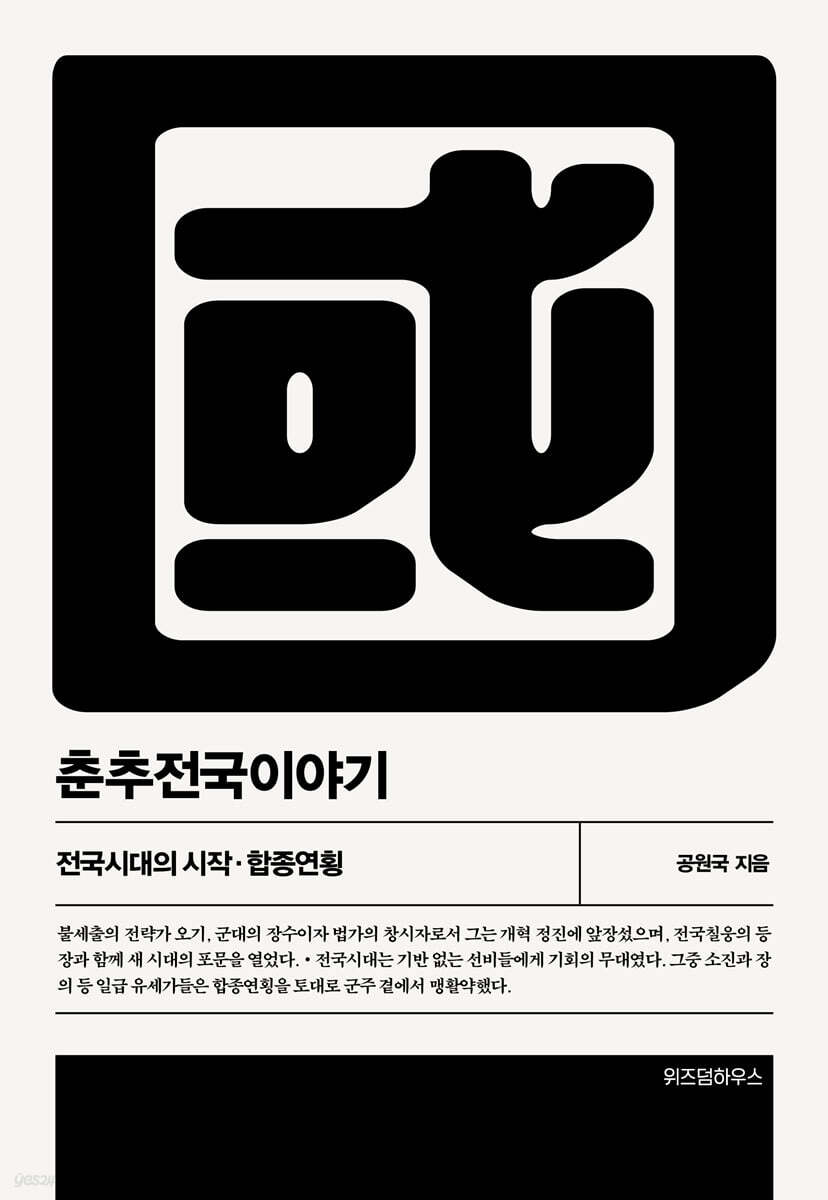
The story of the Wei strategist Wu Qi's exploits and the battle of wits between the political leaders who advocated for "horizontal alliances" unfolds.
This is the revised second edition of 『The Spring and Autumn Annals and Warring States Stories』.
Volume 4 of the series examines the activities, strategies, reformist will, and successors of Wei strategist Wu Qi, set in the early Warring States period, a time of fierce and ruthless competition between the Seven Heroes of the Warring States.
Part 2 depicts the activities of the warlords who gained fame by appealing to the monarchs with their excellent intelligence and strategies during the mid-to-late Warring States period, when the confrontation between the Six Kingdoms and Qin was in full swing.
Through this book, readers will learn the lesson that only a country that maintains a strong internal security even in complex international situations will ultimately seize the initiative of the world.
This is the revised second edition of 『The Spring and Autumn Annals and Warring States Stories』.
Volume 4 of the series examines the activities, strategies, reformist will, and successors of Wei strategist Wu Qi, set in the early Warring States period, a time of fierce and ruthless competition between the Seven Heroes of the Warring States.
Part 2 depicts the activities of the warlords who gained fame by appealing to the monarchs with their excellent intelligence and strategies during the mid-to-late Warring States period, when the confrontation between the Six Kingdoms and Qin was in full swing.
Through this book, readers will learn the lesson that only a country that maintains a strong internal security even in complex international situations will ultimately seize the initiative of the world.
- You can preview some of the book's contents.
Preview
index
Main Character 4
Beginning the Warring States Period 13
Part 1: The Beginning of the Warring States Period
Entering 35
Chapter 1: The Three Clans Divide the Jin 41
Chapter 2: The Wise Monarch Wen of Wei: Laying the Foundation for 200 Years of Wei 89
Chapter 3: The Unfinished Reformer Ogi: Pointing the Way for the Warring States Period 111
Chapter 4: Monarchs Who Repeat Trial and Error: The Collapse of the Western Jin Principle 183
Chapter 5: The Brilliant Tactician, Sun Bin: Shatters Ogi's Dreams 207
Chapter 6: Shang Yang, the Successor of Wu Qi: Holding the Key to Victory through Reforms 247
Going Out: Strategy and Reform 281
Deep Reading: The Warring States Period: The Duet of Justification and Reality 295
Part 2: Alliances and Coalitions
Enter 327
Chapter 1: The Birth of the Theory of Unity: Sojin's Departure from the Church 337
Chapter 2: The Unity Is an Illusion: Jang Yi's Departure 377
Chapter 3: Jang-ui, Defeating the Hapjong 419
Chapter 4: Opportunity in the East 453
Chapter 5: The Jin of Advancement and the Zhao of Strength: The Conquest of Uiyang and the Hufu Knights 491
Chapter 6: The Destruction of the Alliance, the Transformation of the Horizontal and Horizontal Alliances: Meng Shangjun's Second Alliance 545
Chapter 7: The Fall of the Eastern Empire 585
Going Out: Ten-Year Plans and Temporary Expedients 643
Deep Reading: Keyword Reading: Warring States Period Diplomacy: Yongin and Reverse Thinking 653
supplement
Chronology of the Reigns of the Major States of the Warring States Period, 670
Major Events of the Warring States Period 672
Search 673
Beginning the Warring States Period 13
Part 1: The Beginning of the Warring States Period
Entering 35
Chapter 1: The Three Clans Divide the Jin 41
Chapter 2: The Wise Monarch Wen of Wei: Laying the Foundation for 200 Years of Wei 89
Chapter 3: The Unfinished Reformer Ogi: Pointing the Way for the Warring States Period 111
Chapter 4: Monarchs Who Repeat Trial and Error: The Collapse of the Western Jin Principle 183
Chapter 5: The Brilliant Tactician, Sun Bin: Shatters Ogi's Dreams 207
Chapter 6: Shang Yang, the Successor of Wu Qi: Holding the Key to Victory through Reforms 247
Going Out: Strategy and Reform 281
Deep Reading: The Warring States Period: The Duet of Justification and Reality 295
Part 2: Alliances and Coalitions
Enter 327
Chapter 1: The Birth of the Theory of Unity: Sojin's Departure from the Church 337
Chapter 2: The Unity Is an Illusion: Jang Yi's Departure 377
Chapter 3: Jang-ui, Defeating the Hapjong 419
Chapter 4: Opportunity in the East 453
Chapter 5: The Jin of Advancement and the Zhao of Strength: The Conquest of Uiyang and the Hufu Knights 491
Chapter 6: The Destruction of the Alliance, the Transformation of the Horizontal and Horizontal Alliances: Meng Shangjun's Second Alliance 545
Chapter 7: The Fall of the Eastern Empire 585
Going Out: Ten-Year Plans and Temporary Expedients 643
Deep Reading: Keyword Reading: Warring States Period Diplomacy: Yongin and Reverse Thinking 653
supplement
Chronology of the Reigns of the Major States of the Warring States Period, 670
Major Events of the Warring States Period 672
Search 673
Into the book
Ogi was not only an unparalleled strategist, but also the leader of Legalist reform.
When we talk about Legalism, Shang Yang, famous for his reforms, is well known, but the foundations were laid by his predecessors from the Wei Dynasty, including Wu Qi, and Shang Yang simply applied the framework they had laid.
After studying Wu Qi's methods while in Wei, Shang Yang went to the western Jin Dynasty and promoted Legalist reforms.
The core of the Shang Yang Reform, the strategy of farming and fighting, was created by Wu Qi in Western Xia.
--- p.37~38, from “Introduction to Part 1”
The division of Jin was a step backwards in time.
When Jin weakens, Qin should become stronger, but Qin's ambition was incomparable to that of the many states east of Mount Xiao.
However, by being divided and conducting a siege for such a long time, they bought time for the Qin in the west.
Looking at the situation, it was common sense that if the three of them combined their strength, they could defeat Jin, if two of them combined their strength, they could hold off Jin, and if they fought one by one, they would lose.
However, as we saw when the three clans destroyed the Ji clan, the three states of the Three Jins were highly opportunistic and profit-conscious.
Wasn't it also because the three clans divided the country for their own benefit?
--- p.83, from “Part 1, Chapter 1, Samga Bunjin”
Although we cannot be certain of the past events, it is highly unlikely that Ogi killed his wife.
This is best confirmed in the thought itself rather than in miscellaneous anecdotes.
Even in his book on military strategy, 『Wu Qi's Military Strategy』, 『Daoguo』, he clearly stated his identity as a Confucian scholar by saying, "When governing a country and ruling an army, one must educate with propriety, encourage with righteousness, and instill a sense of shame." Everything he said was about trust and propriety.
As we will see later, 『The Art of War by Five Qi』 places much more emphasis on the fundamentals than on improvisation compared to 『The Art of War by Sun Tzu』.
Would someone who killed his wife truly know no shame and utter the word "shame"? Would anyone listen if such a person spoke of propriety?
--- p.123, from “Part 1, Chapter 3, The Unfinished Reformer Ogi”
Son Bin's transformation clearly surpasses Ogi's.
But he is not the kind of person who can create a situation like Ogi.
Broadly speaking, the purpose of Ogi is to strengthen oneself, and the purpose of Son Bin is to weaken the opponent.
Those who are strong in their own right can deal with any opponent, but those who focus on weakening their opponents must waste their intelligence managing the ever-increasing number of variables.
So, as Ogi said, Son Bin cannot be included in the group of talented people who “would ruin the country without him.”
--- p.245, from “Part 1, Chapter 5, The Brilliant Tactician Sun Bin”
The reason why I value Ogi more is first of all because of the difference between the original and the derivative.
Sang-Ang learned everything from Ogi, from the root to the root.
Shang Yang's reforms have already been partially verified in the East.
However, since Ogi was originally a Confucian scholar, he was able to reform the superstructure, but he could not influence the people below him, and only influenced his own military.
Also, there was not much time in the state of Chu.
However, because Shang Yang completely rejected Confucianism, he could treat the people harshly without feeling guilty.
However, it is clear that the law of Shang Yang came from Ogi and Yi Hoe.
However, Shang Yang made the right decision that it was better to trust Duke Xiao and work in Guanzhong to achieve great things than to follow the foolish King Hui and remain in Shandong.
--- p.276, from “Part 1, Chapter 6, Shang Yang, the Successor of Ogi”
The campaigners were people who started from the bottom.
The only way for them to rise from the bottom to the top was through skill.
If one's skills were to decline, one would likely be kicked out or become a victim of rivals from the royal family or powerful families.
Yet some of them survived and carried out their strategy.
--- p.330, from “Introduction to Part 2”
Sojin visits the richest and largest country in the Warring States period.
He tells his country that Jin is not a threat to his country and therefore does not need to serve it, and advises his country to join forces with Chu and become the hegemon in place of Jin.
There are expressions of serving the truth, but they are all rhetorical.
Je and Cho did not need to serve Jin yet.
However, Cho could not help but feel the threat of Jin, as Jin had crossed the rugged Jinling Pass and was aiming for Pachuk in the upper reaches of the Yangtze River.
The content of Su Jin's campaign in his country is identical to that in the "Strategies of the Warring States" (Je-Che) and the "Biographies of Su Jin" (Shi-Records).
Now let's see how Sojin will appeal to my former king.
Sojin first speaks of the strength of his country's army.
--- p.365, from “Part 2, Chapter 1, The Birth of the Theory of Unity”
The alliance was completely broken.
Of course, the spirit of the alliance is not broken just because the alliance is broken.
In the future, we will witness many children born from this union.
However, while the alliance of Sojin was a large-scale plan in which the six countries joined forces to defeat the strong Jin, the alliances that will appear in the future have a stronger character of union and division.
Considering the extent of Zhang Yi's work, it is no exaggeration to say in the Jin Dynasty's history book that "the world benefited from Zhang Yi's virtue."
When a funeral appears, war follows.
Does the Grim Reaper Jang-ui really have enemies?
--- p.452, from “Chapter 3, Part 2, Jang-ui, Defeating the Alliance”
From now on, the true nature of a massive conspiracy, never before revealed in any historical text, is revealed. 1 In order to prevent the intervention of the world, including Jin, Je drove the army of the three Jins into battle and used the opportunity to devour Song. This operation was carried out by the anti-rebel platoon.
So this is also a union, but it is only for the sake of the relationship.
The small group and the small group pretend to participate in this alliance, but inwardly they are trying to drag the world into it and attack the emperor.
There is greed upon greed.
My king was slowly sinking into a swamp.
This time, the platoon was in Zhao and sent a letter to King Min of Zhe.
The platoon assures them not to doubt the plan to set up camp, saying, “Jo, Han, and Wi are on your side, so don’t worry.”
When we talk about Legalism, Shang Yang, famous for his reforms, is well known, but the foundations were laid by his predecessors from the Wei Dynasty, including Wu Qi, and Shang Yang simply applied the framework they had laid.
After studying Wu Qi's methods while in Wei, Shang Yang went to the western Jin Dynasty and promoted Legalist reforms.
The core of the Shang Yang Reform, the strategy of farming and fighting, was created by Wu Qi in Western Xia.
--- p.37~38, from “Introduction to Part 1”
The division of Jin was a step backwards in time.
When Jin weakens, Qin should become stronger, but Qin's ambition was incomparable to that of the many states east of Mount Xiao.
However, by being divided and conducting a siege for such a long time, they bought time for the Qin in the west.
Looking at the situation, it was common sense that if the three of them combined their strength, they could defeat Jin, if two of them combined their strength, they could hold off Jin, and if they fought one by one, they would lose.
However, as we saw when the three clans destroyed the Ji clan, the three states of the Three Jins were highly opportunistic and profit-conscious.
Wasn't it also because the three clans divided the country for their own benefit?
--- p.83, from “Part 1, Chapter 1, Samga Bunjin”
Although we cannot be certain of the past events, it is highly unlikely that Ogi killed his wife.
This is best confirmed in the thought itself rather than in miscellaneous anecdotes.
Even in his book on military strategy, 『Wu Qi's Military Strategy』, 『Daoguo』, he clearly stated his identity as a Confucian scholar by saying, "When governing a country and ruling an army, one must educate with propriety, encourage with righteousness, and instill a sense of shame." Everything he said was about trust and propriety.
As we will see later, 『The Art of War by Five Qi』 places much more emphasis on the fundamentals than on improvisation compared to 『The Art of War by Sun Tzu』.
Would someone who killed his wife truly know no shame and utter the word "shame"? Would anyone listen if such a person spoke of propriety?
--- p.123, from “Part 1, Chapter 3, The Unfinished Reformer Ogi”
Son Bin's transformation clearly surpasses Ogi's.
But he is not the kind of person who can create a situation like Ogi.
Broadly speaking, the purpose of Ogi is to strengthen oneself, and the purpose of Son Bin is to weaken the opponent.
Those who are strong in their own right can deal with any opponent, but those who focus on weakening their opponents must waste their intelligence managing the ever-increasing number of variables.
So, as Ogi said, Son Bin cannot be included in the group of talented people who “would ruin the country without him.”
--- p.245, from “Part 1, Chapter 5, The Brilliant Tactician Sun Bin”
The reason why I value Ogi more is first of all because of the difference between the original and the derivative.
Sang-Ang learned everything from Ogi, from the root to the root.
Shang Yang's reforms have already been partially verified in the East.
However, since Ogi was originally a Confucian scholar, he was able to reform the superstructure, but he could not influence the people below him, and only influenced his own military.
Also, there was not much time in the state of Chu.
However, because Shang Yang completely rejected Confucianism, he could treat the people harshly without feeling guilty.
However, it is clear that the law of Shang Yang came from Ogi and Yi Hoe.
However, Shang Yang made the right decision that it was better to trust Duke Xiao and work in Guanzhong to achieve great things than to follow the foolish King Hui and remain in Shandong.
--- p.276, from “Part 1, Chapter 6, Shang Yang, the Successor of Ogi”
The campaigners were people who started from the bottom.
The only way for them to rise from the bottom to the top was through skill.
If one's skills were to decline, one would likely be kicked out or become a victim of rivals from the royal family or powerful families.
Yet some of them survived and carried out their strategy.
--- p.330, from “Introduction to Part 2”
Sojin visits the richest and largest country in the Warring States period.
He tells his country that Jin is not a threat to his country and therefore does not need to serve it, and advises his country to join forces with Chu and become the hegemon in place of Jin.
There are expressions of serving the truth, but they are all rhetorical.
Je and Cho did not need to serve Jin yet.
However, Cho could not help but feel the threat of Jin, as Jin had crossed the rugged Jinling Pass and was aiming for Pachuk in the upper reaches of the Yangtze River.
The content of Su Jin's campaign in his country is identical to that in the "Strategies of the Warring States" (Je-Che) and the "Biographies of Su Jin" (Shi-Records).
Now let's see how Sojin will appeal to my former king.
Sojin first speaks of the strength of his country's army.
--- p.365, from “Part 2, Chapter 1, The Birth of the Theory of Unity”
The alliance was completely broken.
Of course, the spirit of the alliance is not broken just because the alliance is broken.
In the future, we will witness many children born from this union.
However, while the alliance of Sojin was a large-scale plan in which the six countries joined forces to defeat the strong Jin, the alliances that will appear in the future have a stronger character of union and division.
Considering the extent of Zhang Yi's work, it is no exaggeration to say in the Jin Dynasty's history book that "the world benefited from Zhang Yi's virtue."
When a funeral appears, war follows.
Does the Grim Reaper Jang-ui really have enemies?
--- p.452, from “Chapter 3, Part 2, Jang-ui, Defeating the Alliance”
From now on, the true nature of a massive conspiracy, never before revealed in any historical text, is revealed. 1 In order to prevent the intervention of the world, including Jin, Je drove the army of the three Jins into battle and used the opportunity to devour Song. This operation was carried out by the anti-rebel platoon.
So this is also a union, but it is only for the sake of the relationship.
The small group and the small group pretend to participate in this alliance, but inwardly they are trying to drag the world into it and attack the emperor.
There is greed upon greed.
My king was slowly sinking into a swamp.
This time, the platoon was in Zhao and sent a letter to King Min of Zhe.
The platoon assures them not to doubt the plan to set up camp, saying, “Jo, Han, and Wi are on your side, so don’t worry.”
--- p.601, from “Part 2, Chapter 7, The Fall of the Brotherhood”
Publisher's Review
Three years of planning, ten years of direct exploration across China
Korea's first historical textbook that directly addresses the Spring and Autumn Period and the Warring States Period.
Stories of the Spring and Autumn Annals and the Warring States are back with a new design and meticulous proofreading.
This is the revised second edition of the 『Spring and Autumn Annals and Warring States』 series, planned over three years by traveling humanist Park Won-guk and Wisdom House, and written by the author after exploring all of China for ten years.
After the first edition published in 2010 and the revised edition in 2017, it meets readers in a new form after six years.
In this revision, the composition has changed first and foremost.
The original 11 volumes were changed to a combined 6 volumes to take into account the flow of the story.
Readers can feel a powerful sense of immersion in the feast of stories that continues seamlessly from the Spring and Autumn Period to the Warring States Period and the Hundred Schools of Thought.
The second thing that changes is the design.
The cover design has been renewed to enhance the completeness of the series.
If you unfold the covers of all volumes, it seems as if the 550-year Spring and Autumn Period and the Warring States Period unfolds like a panorama.
As a reader, you can visually feel the thrill of breaking through a brick book and the fulfillment of understanding an era every time you finish reading each volume of 'Spring, Autumn, Jeon, Guk, Poetry, and Dae'.
The main text format was also reduced from the existing new national format to a national format and the line spacing was widened to increase readability while allowing readers to enjoy the pleasure of reading.
The third thing that has changed is the proofreading of the entire text.
We have carefully corrected errors in the content, reflected typos and unified terminology, as well as changed spelling.
This series is an unprecedented series that presents a completely new historical perspective through a 'geographical approach' that took a long time to plan and write.
Even in China, the birthplace of 『The Spring and Autumn Annals and the Warring States』, its value was recognized, and in an unusual move, the complete volume was translated and published in Chinese by the Yelin Publishing House under the Jiangsu Phoenix Publishing Group.
As this is a work that is unlikely to be reproduced again in Korean publishing history, we hope that this revision will allow it to be read by readers for a longer period of time.
The origin of East Asian culture and a keyword for understanding modern China.
The Spring and Autumn Period and the Warring States Period, a collection of unprecedented events and characters.
In the overwhelming pleasure of narrative that provides insight into the times,
Read history and gain wisdom to understand life!
The Spring and Autumn Period and the Warring States Period refers to a period of approximately 550 years from 770 BC, when the Zhou Dynasty was forced by the Rong people and moved east to Luoyang (Luoyi), until 221 BC, when the Qin Dynasty unified the country.
Chinese history began with the Shang Dynasty and developed into a vast empire through the Zhou Dynasty and the Warring States Period.
During the Spring and Autumn Period and the Warring States Period, powerful centralized states emerged around major rivers, including the Yellow River.
In addition, the foundation of an agricultural nation was established in which ordinary people took charge of production instead of slaves, and a national tax system and standing army were created.
Towards the end of the Warring States period, Qin finally absorbed the six rival states and formed the first unified empire.
And the Han Dynasty inherited this, and the huge body we call 'China' was born today.
This is why the Spring and Autumn Period and the Warring States Period can be said to be the period when the great framework called 'China' was born, and the flesh of history was added to that framework to create the China of today.
The "Spring and Autumn Annals and Warring States" series does not focus on fragmentary events, but rather examines Chinese history by focusing on the fierce competition and rise and fall of the great powers in a macroscopic way.
Through the rise and fall of numerous nations and the people who played a central role in their development, we can gain wisdom for life through the broad perspective of history.
In addition to known sources, the author meticulously researched the field and examined various bamboo slips, inscriptions, and stone steles to capture the essence of the Spring and Autumn Period and the Warring States Period, a time of constant conflict, convergence, and development.
This series presents a profound insight that allows us to understand the past, reflect on the present, and open the door to the future by intertwining the contemporary assessments of the Spring and Autumn Period and the Warring States Period, the records of later generations, and the author's perspective on them.
You can also look at the flow of the world that creates the joys and sorrows of life, winners and losers.
Based on the geographical background I personally investigated
It presents a completely new historical perspective.
The Four Books and Five Classics, which were required reading for scholars in the Joseon Dynasty, were established during the Spring and Autumn Period and the Warring States Period.
In China, until the Xinhai Revolution, the institutions of the Spring and Autumn Period and the Warring States Period continued to be adopted even when dynasties changed.
Ultimately, the keyword that can help us understand the roots of not only China but also East Asian countries at once is the 'Spring and Autumn Period and Warring States Period'.
Just as there were hundreds of states at the beginning of the Spring and Autumn Period, but only seven remained at the end of the Warring States Period, the Spring and Autumn Period and the Warring States Period were a battleground for survival and competition more fiercely than any other period in history.
In this fierce battlefield, countless heroes and iron men have competed with their strength and wisdom, and tens of millions of people have poured their lives into it.
In the process, the paths of humanity and evil, virtue and power, justification and practicality collided with each other, ultimately creating a crossroads of victory and defeat.
The author has spent several years traveling through China and its neighboring countries, seeking to understand how a small tribal state that began in the Yellow River basin expanded to the limits of nature, and how it integrated diverse cultures to create the vast nation we know today as "China."
And the original form of China was traced back to a special period called the 'Spring and Autumn Period and Warring States Period' two thousand years ago.
Because the author describes the history of the Spring and Autumn Period and the Warring States Period based on the geographical background he personally confirmed through field research, readers will be able to imagine this era in a more three-dimensional way with a broad outline.
Ogi, who aims to conquer the world, with excellent strategy and love for the people
Dreaming of becoming a true conqueror of the Warring States period
Unlike the Spring and Autumn Period, which valued legitimacy and was relatively peaceful, the Warring States Period was a fierce battle between the Seven Warring States (Han, Wei, Zhao, Qi, Yan, Chu, and Qin) who survived by pursuing practical gains.
In the process of determining winners and losers according to the law of the jungle, not only people but also social systems, production methods, and everything that formed the foundation of society were drastically changed.
Part 1 of 『Spring and Autumn Annals and Warring States Chronicles 4』 is set in the ruthless early Warring States period, and examines the activities and strategies of Wei strategist Wu Qi, his will to reform, and his successors.
Marquis Wei of Wei, a wise and determined monarch, maintained the alliance of the Three Jin dynasties (Han, Wei, and Zhao) and devised a strategy to check the Qin dynasty, which had suddenly emerged as a powerful state. Wu Qi, who was good at utilizing military strategy based on Legalism and Confucianism, received Marquis Wen's full support and defended the Western Xia, the stronghold of Wei, while practicing Legalist reforms and dreaming of unifying the country.
However, after Wei Wenhu died, Wu Qi was unable to carry out any reforms and ended up wandering, meeting a tragic fate in the state of Chu.
After that, the three Jins went their separate ways instead of forming an alliance, and Qin, which had become a powerful nation thanks to Shang Yang's reforms, won the war against the six countries and unified the world.
In the harsh international climate of the Warring States Period, countries that failed to maintain a balanced national structure, strategy, and tactics could not last long.
The states of Wei and Chu, which had promoted Wu Qi, also sought immediate gains and ended up losing victory in their battles with the Qin state.
Although it ended in failure, readers will be able to discover what true reform is and the value of a strategist who led an era through Ogi's will to reform and his spirit of challenge.
You can also simultaneously read about the strategies and tactics of the heroes of the time, as well as the essential conditions for sustainable reform.
The warlords of the Warring States period used strategies of alliance and alliance to shape the world.
As the Seven Heroes of the Warring States' struggle for power became more intense day by day, the monarchs of each country tried to mobilize all their resources and sought out talented people who could make good use of them.
The turbulent Warring States period was a stage of opportunity for scholars without foundation, as anyone with skills could become a talented person.
『Spring and Autumn Annals and Warring States Period 4』 Part 2 examines the activities of the warlords who made a name for themselves by appealing to the monarchs with their excellent intelligence and strategies during the mid-to-late Warring States Period, when the confrontation between the Six Kingdoms and Qin was in full swing.
The scholars were 'guests', that is, people who came as guests but were treated with respect.
They amassed wealth and fame by observing the terrain and topography of their own country and selling that information to their target audience.
Among them, So Jin and Jang Yi are representative examples of statesmen who were loyal and had influence in various countries.
Su Jin, a native of the Zhou Dynasty, proposed the idea of 'unification', which required the six countries to jointly respond to Qin's attack.
He believed that if the six countries were to form a vertical alliance and respond to Qin, they could effectively utilize the terrain of the countries in crisis to send reinforcements and achieve hegemony.
Meanwhile, Zhang Yi, a native of Wei, a rival of Su Jin, went over to Jin and proposed a strategy to end the six kingdoms.
With Jin's strong support, he personally traveled to the six countries and used trickery and deception to break off the alliance and promote cooperation with Jin. Ultimately, he defeated the alliance and laid the foundation for Jin to become stronger.
In addition, you can examine the causes of the downfall of the six countries and the process by which Jin became a loser through the activities of figures in the fierce diplomatic battle, such as the great politician Meng Shangjun of Qi, the reformist monarch King Wuling of Zhao, the military strategist Yue Yi who gave hope to the defeated Yan, and King Min of Qi who fell due to lack of virtue.
Korea's first historical textbook that directly addresses the Spring and Autumn Period and the Warring States Period.
Stories of the Spring and Autumn Annals and the Warring States are back with a new design and meticulous proofreading.
This is the revised second edition of the 『Spring and Autumn Annals and Warring States』 series, planned over three years by traveling humanist Park Won-guk and Wisdom House, and written by the author after exploring all of China for ten years.
After the first edition published in 2010 and the revised edition in 2017, it meets readers in a new form after six years.
In this revision, the composition has changed first and foremost.
The original 11 volumes were changed to a combined 6 volumes to take into account the flow of the story.
Readers can feel a powerful sense of immersion in the feast of stories that continues seamlessly from the Spring and Autumn Period to the Warring States Period and the Hundred Schools of Thought.
The second thing that changes is the design.
The cover design has been renewed to enhance the completeness of the series.
If you unfold the covers of all volumes, it seems as if the 550-year Spring and Autumn Period and the Warring States Period unfolds like a panorama.
As a reader, you can visually feel the thrill of breaking through a brick book and the fulfillment of understanding an era every time you finish reading each volume of 'Spring, Autumn, Jeon, Guk, Poetry, and Dae'.
The main text format was also reduced from the existing new national format to a national format and the line spacing was widened to increase readability while allowing readers to enjoy the pleasure of reading.
The third thing that has changed is the proofreading of the entire text.
We have carefully corrected errors in the content, reflected typos and unified terminology, as well as changed spelling.
This series is an unprecedented series that presents a completely new historical perspective through a 'geographical approach' that took a long time to plan and write.
Even in China, the birthplace of 『The Spring and Autumn Annals and the Warring States』, its value was recognized, and in an unusual move, the complete volume was translated and published in Chinese by the Yelin Publishing House under the Jiangsu Phoenix Publishing Group.
As this is a work that is unlikely to be reproduced again in Korean publishing history, we hope that this revision will allow it to be read by readers for a longer period of time.
The origin of East Asian culture and a keyword for understanding modern China.
The Spring and Autumn Period and the Warring States Period, a collection of unprecedented events and characters.
In the overwhelming pleasure of narrative that provides insight into the times,
Read history and gain wisdom to understand life!
The Spring and Autumn Period and the Warring States Period refers to a period of approximately 550 years from 770 BC, when the Zhou Dynasty was forced by the Rong people and moved east to Luoyang (Luoyi), until 221 BC, when the Qin Dynasty unified the country.
Chinese history began with the Shang Dynasty and developed into a vast empire through the Zhou Dynasty and the Warring States Period.
During the Spring and Autumn Period and the Warring States Period, powerful centralized states emerged around major rivers, including the Yellow River.
In addition, the foundation of an agricultural nation was established in which ordinary people took charge of production instead of slaves, and a national tax system and standing army were created.
Towards the end of the Warring States period, Qin finally absorbed the six rival states and formed the first unified empire.
And the Han Dynasty inherited this, and the huge body we call 'China' was born today.
This is why the Spring and Autumn Period and the Warring States Period can be said to be the period when the great framework called 'China' was born, and the flesh of history was added to that framework to create the China of today.
The "Spring and Autumn Annals and Warring States" series does not focus on fragmentary events, but rather examines Chinese history by focusing on the fierce competition and rise and fall of the great powers in a macroscopic way.
Through the rise and fall of numerous nations and the people who played a central role in their development, we can gain wisdom for life through the broad perspective of history.
In addition to known sources, the author meticulously researched the field and examined various bamboo slips, inscriptions, and stone steles to capture the essence of the Spring and Autumn Period and the Warring States Period, a time of constant conflict, convergence, and development.
This series presents a profound insight that allows us to understand the past, reflect on the present, and open the door to the future by intertwining the contemporary assessments of the Spring and Autumn Period and the Warring States Period, the records of later generations, and the author's perspective on them.
You can also look at the flow of the world that creates the joys and sorrows of life, winners and losers.
Based on the geographical background I personally investigated
It presents a completely new historical perspective.
The Four Books and Five Classics, which were required reading for scholars in the Joseon Dynasty, were established during the Spring and Autumn Period and the Warring States Period.
In China, until the Xinhai Revolution, the institutions of the Spring and Autumn Period and the Warring States Period continued to be adopted even when dynasties changed.
Ultimately, the keyword that can help us understand the roots of not only China but also East Asian countries at once is the 'Spring and Autumn Period and Warring States Period'.
Just as there were hundreds of states at the beginning of the Spring and Autumn Period, but only seven remained at the end of the Warring States Period, the Spring and Autumn Period and the Warring States Period were a battleground for survival and competition more fiercely than any other period in history.
In this fierce battlefield, countless heroes and iron men have competed with their strength and wisdom, and tens of millions of people have poured their lives into it.
In the process, the paths of humanity and evil, virtue and power, justification and practicality collided with each other, ultimately creating a crossroads of victory and defeat.
The author has spent several years traveling through China and its neighboring countries, seeking to understand how a small tribal state that began in the Yellow River basin expanded to the limits of nature, and how it integrated diverse cultures to create the vast nation we know today as "China."
And the original form of China was traced back to a special period called the 'Spring and Autumn Period and Warring States Period' two thousand years ago.
Because the author describes the history of the Spring and Autumn Period and the Warring States Period based on the geographical background he personally confirmed through field research, readers will be able to imagine this era in a more three-dimensional way with a broad outline.
Ogi, who aims to conquer the world, with excellent strategy and love for the people
Dreaming of becoming a true conqueror of the Warring States period
Unlike the Spring and Autumn Period, which valued legitimacy and was relatively peaceful, the Warring States Period was a fierce battle between the Seven Warring States (Han, Wei, Zhao, Qi, Yan, Chu, and Qin) who survived by pursuing practical gains.
In the process of determining winners and losers according to the law of the jungle, not only people but also social systems, production methods, and everything that formed the foundation of society were drastically changed.
Part 1 of 『Spring and Autumn Annals and Warring States Chronicles 4』 is set in the ruthless early Warring States period, and examines the activities and strategies of Wei strategist Wu Qi, his will to reform, and his successors.
Marquis Wei of Wei, a wise and determined monarch, maintained the alliance of the Three Jin dynasties (Han, Wei, and Zhao) and devised a strategy to check the Qin dynasty, which had suddenly emerged as a powerful state. Wu Qi, who was good at utilizing military strategy based on Legalism and Confucianism, received Marquis Wen's full support and defended the Western Xia, the stronghold of Wei, while practicing Legalist reforms and dreaming of unifying the country.
However, after Wei Wenhu died, Wu Qi was unable to carry out any reforms and ended up wandering, meeting a tragic fate in the state of Chu.
After that, the three Jins went their separate ways instead of forming an alliance, and Qin, which had become a powerful nation thanks to Shang Yang's reforms, won the war against the six countries and unified the world.
In the harsh international climate of the Warring States Period, countries that failed to maintain a balanced national structure, strategy, and tactics could not last long.
The states of Wei and Chu, which had promoted Wu Qi, also sought immediate gains and ended up losing victory in their battles with the Qin state.
Although it ended in failure, readers will be able to discover what true reform is and the value of a strategist who led an era through Ogi's will to reform and his spirit of challenge.
You can also simultaneously read about the strategies and tactics of the heroes of the time, as well as the essential conditions for sustainable reform.
The warlords of the Warring States period used strategies of alliance and alliance to shape the world.
As the Seven Heroes of the Warring States' struggle for power became more intense day by day, the monarchs of each country tried to mobilize all their resources and sought out talented people who could make good use of them.
The turbulent Warring States period was a stage of opportunity for scholars without foundation, as anyone with skills could become a talented person.
『Spring and Autumn Annals and Warring States Period 4』 Part 2 examines the activities of the warlords who made a name for themselves by appealing to the monarchs with their excellent intelligence and strategies during the mid-to-late Warring States Period, when the confrontation between the Six Kingdoms and Qin was in full swing.
The scholars were 'guests', that is, people who came as guests but were treated with respect.
They amassed wealth and fame by observing the terrain and topography of their own country and selling that information to their target audience.
Among them, So Jin and Jang Yi are representative examples of statesmen who were loyal and had influence in various countries.
Su Jin, a native of the Zhou Dynasty, proposed the idea of 'unification', which required the six countries to jointly respond to Qin's attack.
He believed that if the six countries were to form a vertical alliance and respond to Qin, they could effectively utilize the terrain of the countries in crisis to send reinforcements and achieve hegemony.
Meanwhile, Zhang Yi, a native of Wei, a rival of Su Jin, went over to Jin and proposed a strategy to end the six kingdoms.
With Jin's strong support, he personally traveled to the six countries and used trickery and deception to break off the alliance and promote cooperation with Jin. Ultimately, he defeated the alliance and laid the foundation for Jin to become stronger.
In addition, you can examine the causes of the downfall of the six countries and the process by which Jin became a loser through the activities of figures in the fierce diplomatic battle, such as the great politician Meng Shangjun of Qi, the reformist monarch King Wuling of Zhao, the military strategist Yue Yi who gave hope to the defeated Yan, and King Min of Qi who fell due to lack of virtue.
GOODS SPECIFICS
- Date of issue: December 28, 2023
- Page count, weight, size: 680 pages | 145*210*35mm
- ISBN13: 9791171710720
- ISBN10: 1171710720
You may also like
카테고리
korean


korean

![GQ KOREA Mark (Monthly): December [2025]](http://librairie.coreenne.fr/cdn/shop/files/8ef265dbbfbf186523ed75ba7319009d.jpg?v=1765340328&width=3840)


