

The Spring and Autumn Period and the Warring States Period 3
 |
Description
Book Introduction
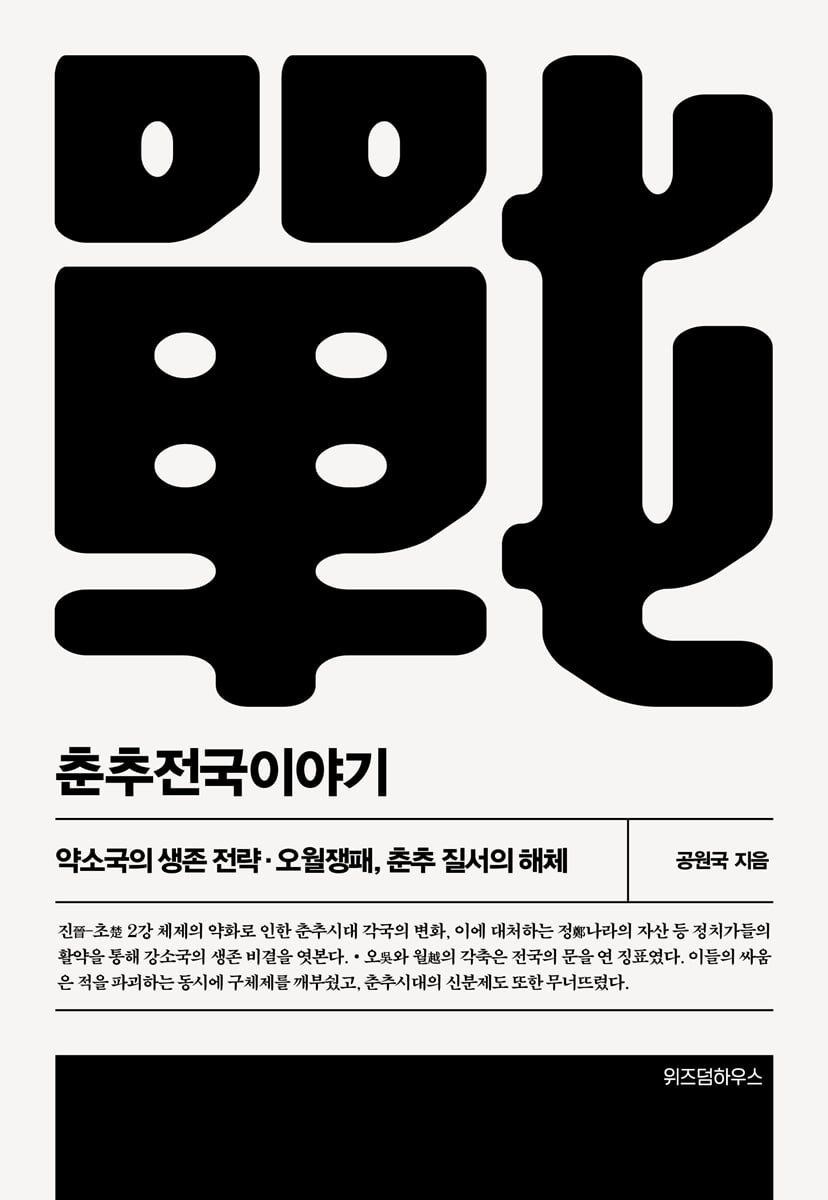
During the Jin-Cho hegemony era, the survival strategies of small states and the fierce competition between Wu and Yue unfold.
This is the revised second edition of 『The Spring and Autumn Annals and Warring States Stories』.
In the third volume of the series, the secret to the survival of a small but strong country is confirmed through the changes in each country during the Spring and Autumn Period due to the weakening of the two-power system of Jin and Chu, and the activities of politicians (Zheng Zizhan, Qi Yan Ying, Jin Shu Xiang, Song Shang Shu, etc.) who responded to these changes.
Part 2 tells the story of the May-Wol Struggle, a bloody era of revenge and fierce competition between the 'May-Dongju' and 'Wasin Sangdam'.
An exciting story unfolds around two axes: the silver coin symbolized by the sword and the collapse of moral politics represented by assassination.
This is the revised second edition of 『The Spring and Autumn Annals and Warring States Stories』.
In the third volume of the series, the secret to the survival of a small but strong country is confirmed through the changes in each country during the Spring and Autumn Period due to the weakening of the two-power system of Jin and Chu, and the activities of politicians (Zheng Zizhan, Qi Yan Ying, Jin Shu Xiang, Song Shang Shu, etc.) who responded to these changes.
Part 2 tells the story of the May-Wol Struggle, a bloody era of revenge and fierce competition between the 'May-Dongju' and 'Wasin Sangdam'.
An exciting story unfolds around two axes: the silver coin symbolized by the sword and the collapse of moral politics represented by assassination.
- You can preview some of the book's contents.
Preview
index
Main Character 4
Part 1: Survival Strategies for Weak Countries
Entering 21
Chapter 1: Central Plains, Home of Talented People 37
Chapter 2: The Last Flame of the Two-Strength System 55
Chapter 3: Domestic and Foreign Troubles Before the Emergence of Assets 75
Chapter 4: Restructuring International Relations and the Deepening of Internal and External Troubles 103
Chapter 5: Signs of the End of the Two-Power System 121
Chapter 6: The Reckless Challenges and Frustration of Our Nation 133
Chapter 7: Starting the Eight-Colored Birds' Asset Politics 167
Chapter 8: The American Soldiers' Alliance: The Triumph of Politics 189
Chapter 9: Behind the Armistice: Oligopoly and Internal Struggle 221
Chapter 10: The Politics of Asset Reform: The Hedgehog Raises Its Thorns 239
Chapter 11: The Shaking Peace: The Turmoil of Chu and the Death of Zhao Wu (259)
Chapter 12: Assets Conduct Politics in the Name of Law 275
Chapter 13: The Ascension of King Yeong and Jasan's Response 291
Chapter 14: The End of Hegemony and the Response of Assets 307
In conclusion: The difference between achievement and criticism 337
Field Trip: The Rising Grave and the Shrinking Grave 357
Part 2: The May Struggle and the Disintegration of the Spring and Autumn Order
Enter 371
Chapter 1: The Road to Gangnam 383
Chapter 2: The Prelude to the Drama of Revenge: The State of Chu Loses the Master Sword Wu Zixu (395)
Chapter 3: The Man with the Sword Hidden in His Belly, Confucius Guang 411
Chapter 4: Signs of the Spring and Autumn Period's Decline 425
Chapter 5: Baekbi, harboring a grudge, flees to the kingdom of Wu (441)
Chapter 6: The Dragon Goes to the Great River: Prince Guang ascends to the throne in a coup d'état (459)
Chapter 7: Heopryeo, the Builder of the Nation 473
Chapter 8: Ojaseo, the Planner of War 503
Chapter 9: Heopryeo Captures the Capital of Chu (529)
Chapter 10: The Resurrection of the State of Chu, 551
Chapter 11: The End of the Central Plains Hegemony 577
Chapter 12: The Beginning of May's Revenge 601
Chapter 13: The Misplaced Ambition and Vanity of the Second Lieutenant 623
Chapter 14: The End of the May-Wol Conflict through Gucheon and Wasin Consultation (655)
Going Out: The May Struggle and the Aftermath, Part 693
Travelogue: O Gwang-wol-yeong: The Ambition and Revenge of the Generals, Their Light and Shadow 709
supplement
Chronology of the Reigns of the Major States of the Spring and Autumn Period, 725
Major Events of the Spring and Autumn Period 733
Search 734
Part 1: Survival Strategies for Weak Countries
Entering 21
Chapter 1: Central Plains, Home of Talented People 37
Chapter 2: The Last Flame of the Two-Strength System 55
Chapter 3: Domestic and Foreign Troubles Before the Emergence of Assets 75
Chapter 4: Restructuring International Relations and the Deepening of Internal and External Troubles 103
Chapter 5: Signs of the End of the Two-Power System 121
Chapter 6: The Reckless Challenges and Frustration of Our Nation 133
Chapter 7: Starting the Eight-Colored Birds' Asset Politics 167
Chapter 8: The American Soldiers' Alliance: The Triumph of Politics 189
Chapter 9: Behind the Armistice: Oligopoly and Internal Struggle 221
Chapter 10: The Politics of Asset Reform: The Hedgehog Raises Its Thorns 239
Chapter 11: The Shaking Peace: The Turmoil of Chu and the Death of Zhao Wu (259)
Chapter 12: Assets Conduct Politics in the Name of Law 275
Chapter 13: The Ascension of King Yeong and Jasan's Response 291
Chapter 14: The End of Hegemony and the Response of Assets 307
In conclusion: The difference between achievement and criticism 337
Field Trip: The Rising Grave and the Shrinking Grave 357
Part 2: The May Struggle and the Disintegration of the Spring and Autumn Order
Enter 371
Chapter 1: The Road to Gangnam 383
Chapter 2: The Prelude to the Drama of Revenge: The State of Chu Loses the Master Sword Wu Zixu (395)
Chapter 3: The Man with the Sword Hidden in His Belly, Confucius Guang 411
Chapter 4: Signs of the Spring and Autumn Period's Decline 425
Chapter 5: Baekbi, harboring a grudge, flees to the kingdom of Wu (441)
Chapter 6: The Dragon Goes to the Great River: Prince Guang ascends to the throne in a coup d'état (459)
Chapter 7: Heopryeo, the Builder of the Nation 473
Chapter 8: Ojaseo, the Planner of War 503
Chapter 9: Heopryeo Captures the Capital of Chu (529)
Chapter 10: The Resurrection of the State of Chu, 551
Chapter 11: The End of the Central Plains Hegemony 577
Chapter 12: The Beginning of May's Revenge 601
Chapter 13: The Misplaced Ambition and Vanity of the Second Lieutenant 623
Chapter 14: The End of the May-Wol Conflict through Gucheon and Wasin Consultation (655)
Going Out: The May Struggle and the Aftermath, Part 693
Travelogue: O Gwang-wol-yeong: The Ambition and Revenge of the Generals, Their Light and Shadow 709
supplement
Chronology of the Reigns of the Major States of the Spring and Autumn Period, 725
Major Events of the Spring and Autumn Period 733
Search 734
Into the book
Since the state of Zheng had helped the state of Chu and stirred up the states of Song, Wei, and Lu, it was natural that the state of Jin would come down to retaliate.
So what was the solution? There was no other option than to come down and surrender and swear an oath.
Fortunately, from the perspective of Jin and Chu, although they could threaten the Zheng state to bring it to their side, they did not yet have a justification for destroying it.
If one side showed such intentions, the Zheng Dynasty would immediately turn its back and join the other side to resist resolutely.
Jeongna-ra still didn't know what the thorns were for, but a hedgehog was a hedgehog.
--- p.115, from “Part 1, Chapter 4: Reorganization of International Relations and Deepening Internal and External Troubles”
Although seemingly ordinary, the asset's actions were highly calculated.
What he aimed for was to control the clans that had grown large among the descendants of the carpenters.
At that time, the descendants of the Mukong Dynasty suppressed the empty houses and commanded private soldiers as they pleased.
So, by distinguishing between national and private roads, they prevented the mobilization of manpower privately, reorganized the hierarchy around official positions rather than clan power, indicated rank through clothing, clearly defined the boundaries of land that could be a source of conflict, and tied the farmers into a system that could be mobilized directly by the state.
This way, the large clans will be unable to exert their power.
Finally, by limiting the consumption of large clans, they attempted to differentiate between the vacancies and the clans.
There was an immediate backlash.
--- p.247, from “Part 1, Chapter 10: Politics of Reform of Assets”
The law was no longer the exclusive domain of the upper nobility.
Today's law is what was created by spreading from the exclusive property of the king to the nobles, and from the nobles to the commoners.
The casting of the form of assets reflected the social changes of the time.
The time will come when state power will mobilize common people in large numbers through the law.
At that time, state power will not be able to control the vast masses of common people through morality alone.
Jasan had already foreseen that such a time would come, and, as he had said to Sukhyang, he declared the law, saying, "I will only try to save the country myself."
This is how the aristocratic society gradually declined.
--- p.290, from “Part 1, Chapter 12: Assets Practice Politics in the Name of Law”
Negotiations are more likely to be successful when the other party feels sorry.
When the state of Qi refused to form an alliance, the state of Jin brought in the state of Zhou.
It was a situation where one needed one's own side.
If Jeong Na-ra takes my side, it will be the icing on the cake.
So now Jeong Na-ra also has negotiating power.
In negotiations, the more persistent one usually wins.
And those with a stronger sense of mission tend to be more persistent.
The Qin dynasty was in a desperate situation where it had to coordinate with its allies, so it could make concessions in extreme situations.
Confucius praised these assets.
“The assets were sufficient to lay the foundation for the nation at this meeting.
In 『Poetry』, it is said, ‘A gentleman who is harmonious and joyful is the pillar of the nation.’
“A person who is a gentleman seeks happiness.”
--- p.328, from “Part 1, Chapter 14, The End of Hegemony and the Response of Assets”
What motivates evil? While it's often said that evil is committed out of selfishness, history often reveals individuals who commit evil without any specific motive, even when we try to find a reason.
Maybe they don't know that their actions are evil.
However, these villains have one thing in common: they possess a genius for creating complex plots in an instant to achieve their goals.
And they always pretend to be good until their evil deeds are revealed.
So they gain the trust of those in power, and the power protects them until the evil deeds of these villains are exposed to the world.
But even those in power end up in trouble with the wicked.
This long and tangled story of the states of Wu, Yue, and Chu begins with one evil man.
A small spark lit by a villain eventually burns brightly and turns into a violent revenge drama, ultimately staining the South with blood.
--- p.396, from “Part 2, Chapter 2: The Prelude to the Revenge”
If you are worried about the state of Wu now and are building a castle in the capital, you are protecting the smallest thing.
How could we not lose our capital when we have shrunk so much? In the old days, the ruler of the Liang state was afraid of a large country, so he dug a moat around the palace, and the people ended up scattering.
If the people abandon their superiors, what can be done but to wait for ruin? If you set the borders straight, organize the land, firmly establish strategic points for army gathering, treat the people kindly, properly understand the signs of the five directions [明其伍候], have officials faithfully observe their duties [omitted], and perfect defenses to prepare for any unfortunate event, then what is there to fear?
--- p.445, from “Part 2, Chapter 5, Baekbi, who harbors a grudge, goes into exile in the country of Wu”
Before the emergence of the Book of Oja, there was no way to fundamentally conquer a large country like the State of Chu, which was in a strategic location with natural advantages.
If they crossed the river and advanced, they would retreat if they were at a disadvantage, so the Han River and the Yangtze River seemed like an absolutely insurmountable barrier for the Central Plains' organization, which relied mainly on chariots and infantry.
So, even when Guan Zhong of his country gathered the armies of the feudal lords and came down south, and even when Duke Wen of Jin was at the height of his power, neither dared to think of crossing the Han River.
But now, a new 'barbarian' nation is trying to overthrow the great nation of Chu.
Ojaseo was the architect of this grand project.
The strategy of the Ojaseo was the weak striking the strong, that is, guerrilla warfare.
--- p.507, from “Part 2, Chapter 8, Ojaseo, the Planner of War”
It took more than ten years for Goocheon, who had been waiting for an opportunity while licking his gall bladder, to finally get his first chance.
After the death of Wu Zixu, Fu Cha's desires went beyond the limit, and he challenged the Jin Dynasty, claiming to be a hegemon in name only.
After killing Wu Zixu, Fucha puts into practice his ambition to become the hegemon who preserves the Zhou royal family on behalf of the Jin Dynasty.
He pioneered Hanseong and connected the Yangtze and Huaihe Rivers, and now he dug ditches along the Sasui River to enable ships to easily pass between the Song and Lu states.
Then, he mobilized as many as 30,000 infantrymen and reached the Hwangji of Jesu-ga.
If there were 30,000 soldiers, it is easy to guess how many supply troops, officials, supplies, and livestock would have been mobilized to follow them.
Never before had any nation mobilized such a large army to the site of a conference.
The attitude of the viceroy was that he would not hesitate to fight the Jin Dynasty if necessary.
So what was the solution? There was no other option than to come down and surrender and swear an oath.
Fortunately, from the perspective of Jin and Chu, although they could threaten the Zheng state to bring it to their side, they did not yet have a justification for destroying it.
If one side showed such intentions, the Zheng Dynasty would immediately turn its back and join the other side to resist resolutely.
Jeongna-ra still didn't know what the thorns were for, but a hedgehog was a hedgehog.
--- p.115, from “Part 1, Chapter 4: Reorganization of International Relations and Deepening Internal and External Troubles”
Although seemingly ordinary, the asset's actions were highly calculated.
What he aimed for was to control the clans that had grown large among the descendants of the carpenters.
At that time, the descendants of the Mukong Dynasty suppressed the empty houses and commanded private soldiers as they pleased.
So, by distinguishing between national and private roads, they prevented the mobilization of manpower privately, reorganized the hierarchy around official positions rather than clan power, indicated rank through clothing, clearly defined the boundaries of land that could be a source of conflict, and tied the farmers into a system that could be mobilized directly by the state.
This way, the large clans will be unable to exert their power.
Finally, by limiting the consumption of large clans, they attempted to differentiate between the vacancies and the clans.
There was an immediate backlash.
--- p.247, from “Part 1, Chapter 10: Politics of Reform of Assets”
The law was no longer the exclusive domain of the upper nobility.
Today's law is what was created by spreading from the exclusive property of the king to the nobles, and from the nobles to the commoners.
The casting of the form of assets reflected the social changes of the time.
The time will come when state power will mobilize common people in large numbers through the law.
At that time, state power will not be able to control the vast masses of common people through morality alone.
Jasan had already foreseen that such a time would come, and, as he had said to Sukhyang, he declared the law, saying, "I will only try to save the country myself."
This is how the aristocratic society gradually declined.
--- p.290, from “Part 1, Chapter 12: Assets Practice Politics in the Name of Law”
Negotiations are more likely to be successful when the other party feels sorry.
When the state of Qi refused to form an alliance, the state of Jin brought in the state of Zhou.
It was a situation where one needed one's own side.
If Jeong Na-ra takes my side, it will be the icing on the cake.
So now Jeong Na-ra also has negotiating power.
In negotiations, the more persistent one usually wins.
And those with a stronger sense of mission tend to be more persistent.
The Qin dynasty was in a desperate situation where it had to coordinate with its allies, so it could make concessions in extreme situations.
Confucius praised these assets.
“The assets were sufficient to lay the foundation for the nation at this meeting.
In 『Poetry』, it is said, ‘A gentleman who is harmonious and joyful is the pillar of the nation.’
“A person who is a gentleman seeks happiness.”
--- p.328, from “Part 1, Chapter 14, The End of Hegemony and the Response of Assets”
What motivates evil? While it's often said that evil is committed out of selfishness, history often reveals individuals who commit evil without any specific motive, even when we try to find a reason.
Maybe they don't know that their actions are evil.
However, these villains have one thing in common: they possess a genius for creating complex plots in an instant to achieve their goals.
And they always pretend to be good until their evil deeds are revealed.
So they gain the trust of those in power, and the power protects them until the evil deeds of these villains are exposed to the world.
But even those in power end up in trouble with the wicked.
This long and tangled story of the states of Wu, Yue, and Chu begins with one evil man.
A small spark lit by a villain eventually burns brightly and turns into a violent revenge drama, ultimately staining the South with blood.
--- p.396, from “Part 2, Chapter 2: The Prelude to the Revenge”
If you are worried about the state of Wu now and are building a castle in the capital, you are protecting the smallest thing.
How could we not lose our capital when we have shrunk so much? In the old days, the ruler of the Liang state was afraid of a large country, so he dug a moat around the palace, and the people ended up scattering.
If the people abandon their superiors, what can be done but to wait for ruin? If you set the borders straight, organize the land, firmly establish strategic points for army gathering, treat the people kindly, properly understand the signs of the five directions [明其伍候], have officials faithfully observe their duties [omitted], and perfect defenses to prepare for any unfortunate event, then what is there to fear?
--- p.445, from “Part 2, Chapter 5, Baekbi, who harbors a grudge, goes into exile in the country of Wu”
Before the emergence of the Book of Oja, there was no way to fundamentally conquer a large country like the State of Chu, which was in a strategic location with natural advantages.
If they crossed the river and advanced, they would retreat if they were at a disadvantage, so the Han River and the Yangtze River seemed like an absolutely insurmountable barrier for the Central Plains' organization, which relied mainly on chariots and infantry.
So, even when Guan Zhong of his country gathered the armies of the feudal lords and came down south, and even when Duke Wen of Jin was at the height of his power, neither dared to think of crossing the Han River.
But now, a new 'barbarian' nation is trying to overthrow the great nation of Chu.
Ojaseo was the architect of this grand project.
The strategy of the Ojaseo was the weak striking the strong, that is, guerrilla warfare.
--- p.507, from “Part 2, Chapter 8, Ojaseo, the Planner of War”
It took more than ten years for Goocheon, who had been waiting for an opportunity while licking his gall bladder, to finally get his first chance.
After the death of Wu Zixu, Fu Cha's desires went beyond the limit, and he challenged the Jin Dynasty, claiming to be a hegemon in name only.
After killing Wu Zixu, Fucha puts into practice his ambition to become the hegemon who preserves the Zhou royal family on behalf of the Jin Dynasty.
He pioneered Hanseong and connected the Yangtze and Huaihe Rivers, and now he dug ditches along the Sasui River to enable ships to easily pass between the Song and Lu states.
Then, he mobilized as many as 30,000 infantrymen and reached the Hwangji of Jesu-ga.
If there were 30,000 soldiers, it is easy to guess how many supply troops, officials, supplies, and livestock would have been mobilized to follow them.
Never before had any nation mobilized such a large army to the site of a conference.
The attitude of the viceroy was that he would not hesitate to fight the Jin Dynasty if necessary.
--- p.674, from “Part 2, Chapter 14, The End of the May Struggle through Gucheon and Wasin Consultation”
Publisher's Review
Three years of planning, ten years of direct exploration across China
Korea's first historical textbook that directly addresses the Spring and Autumn Period and the Warring States Period.
Stories of the Spring and Autumn Annals and the Warring States are back with a new design and meticulous proofreading.
This is the revised second edition of the 『Spring and Autumn Annals and Warring States』 series, planned over three years by traveling humanist Park Won-guk and Wisdom House, and written by the author after exploring all of China for ten years.
After the first edition published in 2010 and the revised edition in 2017, it meets readers in a new form after six years.
In this revision, the composition has changed first and foremost.
The original 11 volumes were changed to a combined 6 volumes to take into account the flow of the story.
Readers can feel a powerful sense of immersion in the feast of stories that continues seamlessly from the Spring and Autumn Period to the Warring States Period and the Hundred Schools of Thought.
The second thing that changes is the design.
The cover design has been renewed to enhance the completeness of the series.
If you unfold the covers of all volumes, it seems as if the 550-year Spring and Autumn Period and the Warring States Period unfolds like a panorama.
As a reader, you can visually feel the thrill of breaking through a brick book and the fulfillment of understanding an era every time you finish reading each volume of 'Spring, Autumn, Jeon, Guk, Poetry, and Dae'.
The main text format was also reduced from the existing new national format to a national format and the line spacing was widened to increase readability while allowing readers to enjoy the pleasure of reading.
The third thing that has changed is the proofreading of the entire text.
We have carefully corrected errors in the content, reflected typos and unified terminology, as well as changed spelling.
This series is an unprecedented series that presents a completely new historical perspective through a 'geographical approach' that took a long time to plan and write.
Even in China, the birthplace of 『The Spring and Autumn Annals and the Warring States』, its value was recognized, and in an unusual move, the complete volume was translated and published in Chinese by the Yelin Publishing House under the Jiangsu Phoenix Publishing Group.
As this is a work that is unlikely to be reproduced again in Korean publishing history, we hope that this revision will allow it to be read by readers for a longer period of time.
The origin of East Asian culture and a keyword for understanding modern China.
The Spring and Autumn Period and the Warring States Period, a collection of unprecedented events and characters.
In the overwhelming pleasure of narrative that provides insight into the times,
Read history and gain wisdom to understand life!
The Spring and Autumn Period and the Warring States Period refers to a period of approximately 550 years from 770 BC, when the Zhou Dynasty was forced by the Rong people and moved east to Luoyang (Luoyi), until 221 BC, when the Qin Dynasty unified the country.
Chinese history began with the Shang Dynasty and developed into a vast empire through the Zhou Dynasty and the Warring States Period.
During the Spring and Autumn Period and the Warring States Period, powerful centralized states emerged around major rivers, including the Yellow River.
In addition, the foundation of an agricultural nation was established in which ordinary people took charge of production instead of slaves, and a national tax system and standing army were created.
Towards the end of the Warring States period, Qin finally absorbed the six rival states and formed the first unified empire.
And the Han Dynasty inherited this, and the huge body we call 'China' was born today.
This is why the Spring and Autumn Period and the Warring States Period can be said to be the period when the great framework called 'China' was born, and the flesh of history was added to that framework to create the China of today.
The "Spring and Autumn Annals and Warring States" series does not focus on fragmentary events, but rather examines Chinese history by focusing on the fierce competition and rise and fall of the great powers in a macroscopic way.
Through the rise and fall of numerous nations and the people who played a central role in their development, we can gain wisdom for life through the broad perspective of history.
In addition to known sources, the author meticulously researched the field and examined various bamboo slips, inscriptions, and stone steles to capture the essence of the Spring and Autumn Period and the Warring States Period, a time of constant conflict, convergence, and development.
This series presents a profound insight that allows us to understand the past, reflect on the present, and open the door to the future by intertwining the contemporary assessments of the Spring and Autumn Period and the Warring States Period, the records of later generations, and the author's perspective on them.
You can also look at the flow of the world that creates the joys and sorrows of life, winners and losers.
Based on the geographical background I personally investigated
It presents a completely new historical perspective.
The Four Books and Five Classics, which were required reading for scholars in the Joseon Dynasty, were established during the Spring and Autumn Period and the Warring States Period.
In China, until the Xinhai Revolution, the institutions of the Spring and Autumn Period and the Warring States Period continued to be adopted even when dynasties changed.
Ultimately, the keyword that can help us understand the roots of not only China but also East Asian countries at once is the 'Spring and Autumn Period and Warring States Period'.
Just as there were hundreds of states at the beginning of the Spring and Autumn Period, but only seven remained at the end of the Warring States Period, the Spring and Autumn Period and the Warring States Period were a battleground for survival and competition more fiercely than any other period in history.
In this fierce battlefield, countless heroes and iron men have competed with their strength and wisdom, and tens of millions of people have poured their lives into it.
In the process, the paths of humanity and evil, virtue and power, justification and practicality collided with each other, ultimately creating a crossroads of victory and defeat.
The author has spent several years traveling through China and its neighboring countries, seeking to understand how a small tribal state that began in the Yellow River basin expanded to the limits of nature, and how it integrated diverse cultures to create the vast nation we know today as "China."
And the original form of China was traced back to a special period called the 'Spring and Autumn Period and Warring States Period' two thousand years ago.
Because the author describes the history of the Spring and Autumn Period and the Warring States Period based on the geographical background he personally confirmed through field research, readers will be able to imagine this era in a more three-dimensional way with a broad outline.
Zichan of the Zheng Dynasty, a real politician based on solid theory
Showing the way to survive as a small country among great powers!
From the mid-Spring and Autumn Period, as the Jin (晉) in the north and the Chu (楚) in the south fought for hegemony, it became routine for the Zheng (鄭) state, which occupied the center of the Central Plains, to surrender to the Chu state in the morning and visit the Jin state in the evening.
Therefore, the most important political action of the officials in charge of politics in the state of Zheng during this period was to judge and decide whether it would be advantageous to side with Jin or Chu.
Then, when both Jin and Chu sent out troops, they went through a pitiful period of hesitation while watching the mood of both countries.
As the tightrope walk between the two states of Jin and Chu continues, a protagonist who can find a way to survive under the pressure of Jin and Chu finally appears.
Jasan (子産), who was born into the highest aristocracy of the Jin Dynasty and developed his political acumen while watching his father and uncles waver between Jin and Chu, was promoted to the rank of Gyeong (卿) and entered the political forefront amidst the power struggle between his uncles of the same surname.
Jasan, a theorist and activist at the same time, appropriately chose the cause and the practicality as the leader of a small country, enabling the state of Jeong to survive under the pressure of constant invasion and tribute from the great powers.
Moreover, his tireless internal reforms, his skill in handling international politics, and his efforts to reduce wars had a great influence on numerous later reformers and thinkers.
Zi Shan was a man of excellent speech, quick in action, fair and just, unselfish, and possessed a balance of strictness and generosity. Confucius regarded him as a model of Confucianism and Han Feizi, seeing his strictness, admired him as a model of Legalism.
In addition, in 『People's History』, Yu So evaluated Jasan as a person with character (virtue), strict principles (law), and political skills (skill).
In this book, you can learn the essentials of politics that anyone in charge of politics in a small country must learn, through the political power of Jasan, which prevented great powers from overlooking Jeong.
The bloody era of revenge in "May 18th, 2015" and "Wasin Sangdam"
The ambition and revenge of the generals, their light and shadow!
When the sword of the Wu kingdom broke one of the pillars of the hegemonic system, the order of the Spring and Autumn Period lost its balance and collapsed.
The period after that was the Warring States Period.
The time has come when we must survive by all means possible, with no one to help us.
The Warring States period was a bloody, 'advanced society', and the May-Wol conflict was a clear sign that the door to this warring state had opened.
Part 2 of this book is a comprehensive textbook on the turbulent history of life, created by the clash of resentment, revenge, desire, and wisdom like swords and spears.
An exciting story unfolds around two axes: the silver coin symbolized by the sword and the collapse of moral politics represented by assassination.
The 『Five-Yue Spring and Autumn Annals』, which features Heopryeo, Bucha, Goucheon, Fanryeo, Wu Zixu, Wenzong, and Baekbi, is a historical drama in itself.
Resentment and revenge, desire and wisdom clash like swords and spears, creating a textbook of human history.
The sayings "Wu and Yue are in the same boat" (吳越同舟), which means that sworn enemies are together, and "Wasindamang" (臥薪嘗膽), which means that one licks gall while sharpening the sword of revenge, all originated from the fight between Wu and Yue.
Revenge begets new revenge, and destroys the hidden dark party.
Within the revenge drama between the Onara and the Wolara, there is another revenge drama hidden that even the parties involved are unaware of.
Numerous Chinese novels have taken the revenge drama of King Fuchai of Wu and King Goujian of Yue as their prototype.
This book tells the story of the May-Wol War, a fierce competition between 'Wasin Consulting'.
In a fierce battle of revenge, even the distinction between winners and losers becomes blurred.
The powerful Wu and Yue states both did not last long.
Victory in battle and victory in war were different.
Korea's first historical textbook that directly addresses the Spring and Autumn Period and the Warring States Period.
Stories of the Spring and Autumn Annals and the Warring States are back with a new design and meticulous proofreading.
This is the revised second edition of the 『Spring and Autumn Annals and Warring States』 series, planned over three years by traveling humanist Park Won-guk and Wisdom House, and written by the author after exploring all of China for ten years.
After the first edition published in 2010 and the revised edition in 2017, it meets readers in a new form after six years.
In this revision, the composition has changed first and foremost.
The original 11 volumes were changed to a combined 6 volumes to take into account the flow of the story.
Readers can feel a powerful sense of immersion in the feast of stories that continues seamlessly from the Spring and Autumn Period to the Warring States Period and the Hundred Schools of Thought.
The second thing that changes is the design.
The cover design has been renewed to enhance the completeness of the series.
If you unfold the covers of all volumes, it seems as if the 550-year Spring and Autumn Period and the Warring States Period unfolds like a panorama.
As a reader, you can visually feel the thrill of breaking through a brick book and the fulfillment of understanding an era every time you finish reading each volume of 'Spring, Autumn, Jeon, Guk, Poetry, and Dae'.
The main text format was also reduced from the existing new national format to a national format and the line spacing was widened to increase readability while allowing readers to enjoy the pleasure of reading.
The third thing that has changed is the proofreading of the entire text.
We have carefully corrected errors in the content, reflected typos and unified terminology, as well as changed spelling.
This series is an unprecedented series that presents a completely new historical perspective through a 'geographical approach' that took a long time to plan and write.
Even in China, the birthplace of 『The Spring and Autumn Annals and the Warring States』, its value was recognized, and in an unusual move, the complete volume was translated and published in Chinese by the Yelin Publishing House under the Jiangsu Phoenix Publishing Group.
As this is a work that is unlikely to be reproduced again in Korean publishing history, we hope that this revision will allow it to be read by readers for a longer period of time.
The origin of East Asian culture and a keyword for understanding modern China.
The Spring and Autumn Period and the Warring States Period, a collection of unprecedented events and characters.
In the overwhelming pleasure of narrative that provides insight into the times,
Read history and gain wisdom to understand life!
The Spring and Autumn Period and the Warring States Period refers to a period of approximately 550 years from 770 BC, when the Zhou Dynasty was forced by the Rong people and moved east to Luoyang (Luoyi), until 221 BC, when the Qin Dynasty unified the country.
Chinese history began with the Shang Dynasty and developed into a vast empire through the Zhou Dynasty and the Warring States Period.
During the Spring and Autumn Period and the Warring States Period, powerful centralized states emerged around major rivers, including the Yellow River.
In addition, the foundation of an agricultural nation was established in which ordinary people took charge of production instead of slaves, and a national tax system and standing army were created.
Towards the end of the Warring States period, Qin finally absorbed the six rival states and formed the first unified empire.
And the Han Dynasty inherited this, and the huge body we call 'China' was born today.
This is why the Spring and Autumn Period and the Warring States Period can be said to be the period when the great framework called 'China' was born, and the flesh of history was added to that framework to create the China of today.
The "Spring and Autumn Annals and Warring States" series does not focus on fragmentary events, but rather examines Chinese history by focusing on the fierce competition and rise and fall of the great powers in a macroscopic way.
Through the rise and fall of numerous nations and the people who played a central role in their development, we can gain wisdom for life through the broad perspective of history.
In addition to known sources, the author meticulously researched the field and examined various bamboo slips, inscriptions, and stone steles to capture the essence of the Spring and Autumn Period and the Warring States Period, a time of constant conflict, convergence, and development.
This series presents a profound insight that allows us to understand the past, reflect on the present, and open the door to the future by intertwining the contemporary assessments of the Spring and Autumn Period and the Warring States Period, the records of later generations, and the author's perspective on them.
You can also look at the flow of the world that creates the joys and sorrows of life, winners and losers.
Based on the geographical background I personally investigated
It presents a completely new historical perspective.
The Four Books and Five Classics, which were required reading for scholars in the Joseon Dynasty, were established during the Spring and Autumn Period and the Warring States Period.
In China, until the Xinhai Revolution, the institutions of the Spring and Autumn Period and the Warring States Period continued to be adopted even when dynasties changed.
Ultimately, the keyword that can help us understand the roots of not only China but also East Asian countries at once is the 'Spring and Autumn Period and Warring States Period'.
Just as there were hundreds of states at the beginning of the Spring and Autumn Period, but only seven remained at the end of the Warring States Period, the Spring and Autumn Period and the Warring States Period were a battleground for survival and competition more fiercely than any other period in history.
In this fierce battlefield, countless heroes and iron men have competed with their strength and wisdom, and tens of millions of people have poured their lives into it.
In the process, the paths of humanity and evil, virtue and power, justification and practicality collided with each other, ultimately creating a crossroads of victory and defeat.
The author has spent several years traveling through China and its neighboring countries, seeking to understand how a small tribal state that began in the Yellow River basin expanded to the limits of nature, and how it integrated diverse cultures to create the vast nation we know today as "China."
And the original form of China was traced back to a special period called the 'Spring and Autumn Period and Warring States Period' two thousand years ago.
Because the author describes the history of the Spring and Autumn Period and the Warring States Period based on the geographical background he personally confirmed through field research, readers will be able to imagine this era in a more three-dimensional way with a broad outline.
Zichan of the Zheng Dynasty, a real politician based on solid theory
Showing the way to survive as a small country among great powers!
From the mid-Spring and Autumn Period, as the Jin (晉) in the north and the Chu (楚) in the south fought for hegemony, it became routine for the Zheng (鄭) state, which occupied the center of the Central Plains, to surrender to the Chu state in the morning and visit the Jin state in the evening.
Therefore, the most important political action of the officials in charge of politics in the state of Zheng during this period was to judge and decide whether it would be advantageous to side with Jin or Chu.
Then, when both Jin and Chu sent out troops, they went through a pitiful period of hesitation while watching the mood of both countries.
As the tightrope walk between the two states of Jin and Chu continues, a protagonist who can find a way to survive under the pressure of Jin and Chu finally appears.
Jasan (子産), who was born into the highest aristocracy of the Jin Dynasty and developed his political acumen while watching his father and uncles waver between Jin and Chu, was promoted to the rank of Gyeong (卿) and entered the political forefront amidst the power struggle between his uncles of the same surname.
Jasan, a theorist and activist at the same time, appropriately chose the cause and the practicality as the leader of a small country, enabling the state of Jeong to survive under the pressure of constant invasion and tribute from the great powers.
Moreover, his tireless internal reforms, his skill in handling international politics, and his efforts to reduce wars had a great influence on numerous later reformers and thinkers.
Zi Shan was a man of excellent speech, quick in action, fair and just, unselfish, and possessed a balance of strictness and generosity. Confucius regarded him as a model of Confucianism and Han Feizi, seeing his strictness, admired him as a model of Legalism.
In addition, in 『People's History』, Yu So evaluated Jasan as a person with character (virtue), strict principles (law), and political skills (skill).
In this book, you can learn the essentials of politics that anyone in charge of politics in a small country must learn, through the political power of Jasan, which prevented great powers from overlooking Jeong.
The bloody era of revenge in "May 18th, 2015" and "Wasin Sangdam"
The ambition and revenge of the generals, their light and shadow!
When the sword of the Wu kingdom broke one of the pillars of the hegemonic system, the order of the Spring and Autumn Period lost its balance and collapsed.
The period after that was the Warring States Period.
The time has come when we must survive by all means possible, with no one to help us.
The Warring States period was a bloody, 'advanced society', and the May-Wol conflict was a clear sign that the door to this warring state had opened.
Part 2 of this book is a comprehensive textbook on the turbulent history of life, created by the clash of resentment, revenge, desire, and wisdom like swords and spears.
An exciting story unfolds around two axes: the silver coin symbolized by the sword and the collapse of moral politics represented by assassination.
The 『Five-Yue Spring and Autumn Annals』, which features Heopryeo, Bucha, Goucheon, Fanryeo, Wu Zixu, Wenzong, and Baekbi, is a historical drama in itself.
Resentment and revenge, desire and wisdom clash like swords and spears, creating a textbook of human history.
The sayings "Wu and Yue are in the same boat" (吳越同舟), which means that sworn enemies are together, and "Wasindamang" (臥薪嘗膽), which means that one licks gall while sharpening the sword of revenge, all originated from the fight between Wu and Yue.
Revenge begets new revenge, and destroys the hidden dark party.
Within the revenge drama between the Onara and the Wolara, there is another revenge drama hidden that even the parties involved are unaware of.
Numerous Chinese novels have taken the revenge drama of King Fuchai of Wu and King Goujian of Yue as their prototype.
This book tells the story of the May-Wol War, a fierce competition between 'Wasin Consulting'.
In a fierce battle of revenge, even the distinction between winners and losers becomes blurred.
The powerful Wu and Yue states both did not last long.
Victory in battle and victory in war were different.
GOODS SPECIFICS
- Date of issue: December 28, 2023
- Page count, weight, size: 752 pages | 145*210*35mm
- ISBN13: 9791171710713
- ISBN10: 1171710712
You may also like
카테고리
korean


korean

![GQ KOREA Mark (Monthly): December [2025]](http://librairie.coreenne.fr/cdn/shop/files/8ef265dbbfbf186523ed75ba7319009d.jpg?v=1765340328&width=3840)


