

The Spring and Autumn Period and the Warring States Period 2
 |
Description
Book Introduction
Duke Wen of Jin and King Zhang of Chu: New Heroes of the Spring and Autumn Period
This is the revised second edition of 『Spring and Autumn Annals and Warring States Stories』, which was completed in 2017.
In Volume 2 of the series, we look at the rise of Jin, which reigned as a defeated state in a situation where the Qin (秦) in the west and the Chu (楚) in the south were fiercely advancing toward the Central Plains, and the activities of Duke Wen who led it.
In Part 2, we learn about the prototype of a great leader through the process of King Zhuang of Chu, who resembles Duke Wen of Jin in terms of strategic thinking and Duke Huan of Qi in terms of boldness, creating a cause and putting it into practice himself to become the ruler of the Central Plains.
This is the revised second edition of 『Spring and Autumn Annals and Warring States Stories』, which was completed in 2017.
In Volume 2 of the series, we look at the rise of Jin, which reigned as a defeated state in a situation where the Qin (秦) in the west and the Chu (楚) in the south were fiercely advancing toward the Central Plains, and the activities of Duke Wen who led it.
In Part 2, we learn about the prototype of a great leader through the process of King Zhuang of Chu, who resembles Duke Wen of Jin in terms of strategic thinking and Duke Huan of Qi in terms of boldness, creating a cause and putting it into practice himself to become the ruler of the Central Plains.
- You can preview some of the book's contents.
Preview
index
Main Character 4
Part 1: The Birth of a Hero
Entering 19
Chapter 1: Taihang Mountain Tour 29
Chapter 2: The Machiavellian Father and the Abandoned Sons 47
Chapter 3: Jung-i Goes into Exile 65
Chapter 4: Duke Heon's Death and Rebellion 81
Chapter 5: Intervention by the Eastern and Western Powers 93
Chapter 6: The Beginning of the East-West War 111
Chapter 7: The Spring and Autumn Period's Main Weapons 121
Chapter 8: The Showdown between Hanwon and Hanwon 143
Chapter 9: Jin's Reforms and Strengthening 159
Chapter 10: Heejung's Odyssey 173
Chapter 11: International Situation at the Time of Duke Wen of Jin's Ascension to the Throne 193
Chapter 12: Duke Wen of Jin ascends the throne (205)
Chapter 13: The Politics of the Duke of Mun 227
Chapter 14: The Battle of Seongbok: Duke Wen Subdues the State of Chu (243)
Chapter 15: Duke Wen Shows the Way of the Loser (273)
Chapter 16: The Chronicles of the Jin Dynasty (Qin Xiaoshan) 297
Chapter 17: After the Battle of Hyosan: The Development of the Three Powers of Jin, Qin, and Chu 315
Leaving: Leadership in the East, Leadership in the West 347
Travelogue: The Wild Taste of the Northwest: Truth in the Desolation 371
Part 2: The Southern Monarch Who Controlled the Central Plains
Enter 393
Chapter 1: The Han River Dragon and the Dragon of the Yangtze: A Journey Through the Lands of the Chu Kingdom, Vol. 415
Chapter 2: International Situation Before the Emergence of King Jang 447
Chapter 3: King Jang's Ascension to the Throne 465
Chapter 4: The Conditions for Progress Are Ripening 481
Chapter 5: The Prelude to a Long Rise 497
Chapter 6: The Wings of the Great Phoenix 523
Chapter 7: The Loser's First Step: Establishing a Cause 549
Chapter 8: The Perfection of Hegemony: The Battle of Phil 567
Chapter 9: Completing the Hegemony in the East (607)
Chapter 10: Lao Tzu and King Zhang: The Taoist Monarchs 625
Chapter 11: The Political Situation After King Jang's Death 653
Chapter 12: The End of the Chu Hegemony: 691
Chapter 13: The Final Chapter: Conditions for Successful Expansion 729
Deep Reading: Who Are the Chu People? 739
Field Trip: Meeting Two Strong Men in the Land of the First 761
supplement
Chronology of the Reigns of the Major States of the Spring and Autumn Period, 774
Major Events of the Spring and Autumn Period 781
Note 782
Search 783
Part 1: The Birth of a Hero
Entering 19
Chapter 1: Taihang Mountain Tour 29
Chapter 2: The Machiavellian Father and the Abandoned Sons 47
Chapter 3: Jung-i Goes into Exile 65
Chapter 4: Duke Heon's Death and Rebellion 81
Chapter 5: Intervention by the Eastern and Western Powers 93
Chapter 6: The Beginning of the East-West War 111
Chapter 7: The Spring and Autumn Period's Main Weapons 121
Chapter 8: The Showdown between Hanwon and Hanwon 143
Chapter 9: Jin's Reforms and Strengthening 159
Chapter 10: Heejung's Odyssey 173
Chapter 11: International Situation at the Time of Duke Wen of Jin's Ascension to the Throne 193
Chapter 12: Duke Wen of Jin ascends the throne (205)
Chapter 13: The Politics of the Duke of Mun 227
Chapter 14: The Battle of Seongbok: Duke Wen Subdues the State of Chu (243)
Chapter 15: Duke Wen Shows the Way of the Loser (273)
Chapter 16: The Chronicles of the Jin Dynasty (Qin Xiaoshan) 297
Chapter 17: After the Battle of Hyosan: The Development of the Three Powers of Jin, Qin, and Chu 315
Leaving: Leadership in the East, Leadership in the West 347
Travelogue: The Wild Taste of the Northwest: Truth in the Desolation 371
Part 2: The Southern Monarch Who Controlled the Central Plains
Enter 393
Chapter 1: The Han River Dragon and the Dragon of the Yangtze: A Journey Through the Lands of the Chu Kingdom, Vol. 415
Chapter 2: International Situation Before the Emergence of King Jang 447
Chapter 3: King Jang's Ascension to the Throne 465
Chapter 4: The Conditions for Progress Are Ripening 481
Chapter 5: The Prelude to a Long Rise 497
Chapter 6: The Wings of the Great Phoenix 523
Chapter 7: The Loser's First Step: Establishing a Cause 549
Chapter 8: The Perfection of Hegemony: The Battle of Phil 567
Chapter 9: Completing the Hegemony in the East (607)
Chapter 10: Lao Tzu and King Zhang: The Taoist Monarchs 625
Chapter 11: The Political Situation After King Jang's Death 653
Chapter 12: The End of the Chu Hegemony: 691
Chapter 13: The Final Chapter: Conditions for Successful Expansion 729
Deep Reading: Who Are the Chu People? 739
Field Trip: Meeting Two Strong Men in the Land of the First 761
supplement
Chronology of the Reigns of the Major States of the Spring and Autumn Period, 774
Major Events of the Spring and Autumn Period 781
Note 782
Search 783
Into the book
Duke Wen of Jin returned home after enduring many hardships, but if it had ended there, it would have been a dull story.
This man, who has finally returned home, takes on the role of a pioneer like Aeneas.
By making himself a loser, he brought Jin to the center stage of Chinese history and expanded the world of China.
His successors pioneered the north, connecting the Spring and Autumn period, which was limited to the narrow world of the Yellow River basin, to the Eurasian steppe world.
Of course, the fruits of that sin were taken away by the later unified empires.
Hardship, overcoming, leap forward – these three classic themes always follow Duke Jin of Wen.
--- p.178, from “Part 1, Chapter 10, Heejung’s Odyssey”
In many ways, the Battle of Seongbok was a landmark event in the Spring and Autumn Period.
This battle was the first international war in which all four powers of the Spring and Autumn Annals were involved.
When the state of Qin threatened the state of Chu at Zhaoling, the powerful states of Jin and Qin had not yet intervened.
And in reality, no battle took place.
However, in the Battle of Chengfu, the Qin of the West and the Qi of the East fought on Duke Wen's side.
Another characteristic is the tendency for the nature of war to gradually change from the existing proxy war to direct confrontation between great powers.
Jin brought in Qi and Qin, but his main force was his own three armies.
In fact, the unit that played a leading role in the Battle of Seongbok was the unit directly under Duke Wen of Jin.
It is not recorded what role the Qin and Qi armies played.
The fact that it was not recorded in the historical description of the Zuo Zhuan indicates that it did not play a major role.
--- p.267, from “Part 1, Chapter 14, The Battle of Seongbok”
They say that resentment breeds rabies. When the Qin Dynasty drove out the Rong, the Rong allied with the Jin Dynasty and attacked the Qin Dynasty.
However, this 'civilized group' called Jin used the Rong tribe whenever something happened after that.
The Yung tribe has become friendly with a country that is not good to become friendly with.
When you are stuck between strong countries, you have to be careful about your actions.
In particular, we must avoid the temptations of mother gods such as Seonjin.
The trust between the brothers and the west that had developed during the time of Mokgong and Mungong was completely broken by the Hyosanjijeon.
Perhaps the greed of those in power cannot be hidden in the first place.
--- p.314, from “Part 1, Chapter 16, Jin-Qin Xiaoshan Zhi Biography”
King Jang is a generous and bold individual.
It can be said that he has the qualities of a monarch of a great nation.
But becoming a loser is not achieved through individual qualities alone.
Government is complex, so it requires an assistant to coordinate everything and lead various talented people.
The people who were talented, such as Duke Huan of Qin's Guan Zhong and Duke Wen of Jin's Ho-Yeon, are examples of such people.
There was Sun Shuo in the state of Chu.
However, Son Suk-o was a completely different person from King Jang.
In King Jang's eyes, Son Suk-oh must have been a person who did not know how to have fun.
However, King Jang was with Son Suk-o.
The very act of appointing Son Suk-oh was a testament to King Jang's ability.
--- p.526, from “Part 2, Chapter 6, The Wings of the Great Phoenix”
The impact of King Jang's actions was great.
First, the first house entered the ranks of the Central Plains.
As the Chu and the Central Plains became equal in terms of not only material but also nominal aspects, the Central Plains-centered view of China began to waver.
In the battle of Pil and the subsequent campaign against the Song Dynasty, King Jang displayed a magnanimity that no northern monarch had ever shown before.
In this way, he 'indirectly' disintegrated the northern alliance centered around Jin.
The state of Qin showed an attitude of not being able to recognize the leadership of the inconsistent state of Qin and instead approached the state of Chu.
Until now, the Chu-Qin alliance was seen as nothing more than a union of barbarians from the perspective of the Central Plains states.
However, the combination of the first and second was different.
I acknowledged Chu as the bearer of the Spring and Autumn Order.
From then until the Warring States period, Chu and Qi maintained an alliance for a long time.
The Jeong Dynasty also began to consider revising its previous preferential policies for the Jin Dynasty.
--- p.623, from “Part 2, Chapter 9, Completing the Hegemony in the East”
Who is a great politician? He is someone who knows that critical point, someone like King Jang.
So, the author said that King Zhang's pause is in line with Lao Tzu's thoughts, and that knowing pause is the duty of a politician.
However, most movements are governed by inertia and cannot stop at equilibrium.
Especially the movement of the explosive device easily passes the equilibrium point.
That was the order that King Jang shook.
The young prince did not have the sense to calculate the balance point.
The more the balance was pushed beyond its limits, the greater the consequences.
--- p.733, from “Part 2, Chapter 13, Final Chapter”
In fact, I don't have the ability to reveal the true nature of superhumans.
Therefore, here I will only critically examine the story conveyed by the records and state that, regardless of the origins of the superhumans, they had a unique culture during the Spring and Autumn Period, different from that of the Central Plains.
This is not to deny the greatness of China from the perspective of the Korean people, who are also seen as a ‘minority’ by China.
However, we will abandon the attitude of relying on fragmentary records and making forced interpretations.
(Omitted) In conclusion, at least 50% of the ancient Chinese records on the origins of peoples are fiction.
The superhumans were originally a completely different race from the people of the Central Plains, originating in the South, not the Central Plains.
This man, who has finally returned home, takes on the role of a pioneer like Aeneas.
By making himself a loser, he brought Jin to the center stage of Chinese history and expanded the world of China.
His successors pioneered the north, connecting the Spring and Autumn period, which was limited to the narrow world of the Yellow River basin, to the Eurasian steppe world.
Of course, the fruits of that sin were taken away by the later unified empires.
Hardship, overcoming, leap forward – these three classic themes always follow Duke Jin of Wen.
--- p.178, from “Part 1, Chapter 10, Heejung’s Odyssey”
In many ways, the Battle of Seongbok was a landmark event in the Spring and Autumn Period.
This battle was the first international war in which all four powers of the Spring and Autumn Annals were involved.
When the state of Qin threatened the state of Chu at Zhaoling, the powerful states of Jin and Qin had not yet intervened.
And in reality, no battle took place.
However, in the Battle of Chengfu, the Qin of the West and the Qi of the East fought on Duke Wen's side.
Another characteristic is the tendency for the nature of war to gradually change from the existing proxy war to direct confrontation between great powers.
Jin brought in Qi and Qin, but his main force was his own three armies.
In fact, the unit that played a leading role in the Battle of Seongbok was the unit directly under Duke Wen of Jin.
It is not recorded what role the Qin and Qi armies played.
The fact that it was not recorded in the historical description of the Zuo Zhuan indicates that it did not play a major role.
--- p.267, from “Part 1, Chapter 14, The Battle of Seongbok”
They say that resentment breeds rabies. When the Qin Dynasty drove out the Rong, the Rong allied with the Jin Dynasty and attacked the Qin Dynasty.
However, this 'civilized group' called Jin used the Rong tribe whenever something happened after that.
The Yung tribe has become friendly with a country that is not good to become friendly with.
When you are stuck between strong countries, you have to be careful about your actions.
In particular, we must avoid the temptations of mother gods such as Seonjin.
The trust between the brothers and the west that had developed during the time of Mokgong and Mungong was completely broken by the Hyosanjijeon.
Perhaps the greed of those in power cannot be hidden in the first place.
--- p.314, from “Part 1, Chapter 16, Jin-Qin Xiaoshan Zhi Biography”
King Jang is a generous and bold individual.
It can be said that he has the qualities of a monarch of a great nation.
But becoming a loser is not achieved through individual qualities alone.
Government is complex, so it requires an assistant to coordinate everything and lead various talented people.
The people who were talented, such as Duke Huan of Qin's Guan Zhong and Duke Wen of Jin's Ho-Yeon, are examples of such people.
There was Sun Shuo in the state of Chu.
However, Son Suk-o was a completely different person from King Jang.
In King Jang's eyes, Son Suk-oh must have been a person who did not know how to have fun.
However, King Jang was with Son Suk-o.
The very act of appointing Son Suk-oh was a testament to King Jang's ability.
--- p.526, from “Part 2, Chapter 6, The Wings of the Great Phoenix”
The impact of King Jang's actions was great.
First, the first house entered the ranks of the Central Plains.
As the Chu and the Central Plains became equal in terms of not only material but also nominal aspects, the Central Plains-centered view of China began to waver.
In the battle of Pil and the subsequent campaign against the Song Dynasty, King Jang displayed a magnanimity that no northern monarch had ever shown before.
In this way, he 'indirectly' disintegrated the northern alliance centered around Jin.
The state of Qin showed an attitude of not being able to recognize the leadership of the inconsistent state of Qin and instead approached the state of Chu.
Until now, the Chu-Qin alliance was seen as nothing more than a union of barbarians from the perspective of the Central Plains states.
However, the combination of the first and second was different.
I acknowledged Chu as the bearer of the Spring and Autumn Order.
From then until the Warring States period, Chu and Qi maintained an alliance for a long time.
The Jeong Dynasty also began to consider revising its previous preferential policies for the Jin Dynasty.
--- p.623, from “Part 2, Chapter 9, Completing the Hegemony in the East”
Who is a great politician? He is someone who knows that critical point, someone like King Jang.
So, the author said that King Zhang's pause is in line with Lao Tzu's thoughts, and that knowing pause is the duty of a politician.
However, most movements are governed by inertia and cannot stop at equilibrium.
Especially the movement of the explosive device easily passes the equilibrium point.
That was the order that King Jang shook.
The young prince did not have the sense to calculate the balance point.
The more the balance was pushed beyond its limits, the greater the consequences.
--- p.733, from “Part 2, Chapter 13, Final Chapter”
In fact, I don't have the ability to reveal the true nature of superhumans.
Therefore, here I will only critically examine the story conveyed by the records and state that, regardless of the origins of the superhumans, they had a unique culture during the Spring and Autumn Period, different from that of the Central Plains.
This is not to deny the greatness of China from the perspective of the Korean people, who are also seen as a ‘minority’ by China.
However, we will abandon the attitude of relying on fragmentary records and making forced interpretations.
(Omitted) In conclusion, at least 50% of the ancient Chinese records on the origins of peoples are fiction.
The superhumans were originally a completely different race from the people of the Central Plains, originating in the South, not the Central Plains.
--- p.741, from “Part 2: In-Depth Reading: Who are the Chu people?”
Publisher's Review
Three years of planning, ten years of direct exploration across China
Korea's first historical textbook that directly addresses the Spring and Autumn Period and the Warring States Period.
Stories of the Spring and Autumn Annals and the Warring States are back with a new design and meticulous proofreading.
This is the revised second edition of the 『Spring and Autumn Annals and Warring States』 series, planned over three years by traveling humanist Park Won-guk and Wisdom House, and written by the author after exploring all of China for ten years.
After the first edition published in 2010 and the revised edition in 2017, it meets readers in a new form after six years.
In this revision, the composition has changed first and foremost.
The original 11 volumes were changed to a combined 6 volumes to take into account the flow of the story.
Readers can feel a powerful sense of immersion in the feast of stories that continues seamlessly from the Spring and Autumn Period to the Warring States Period and the Hundred Schools of Thought.
The second thing that changes is the design.
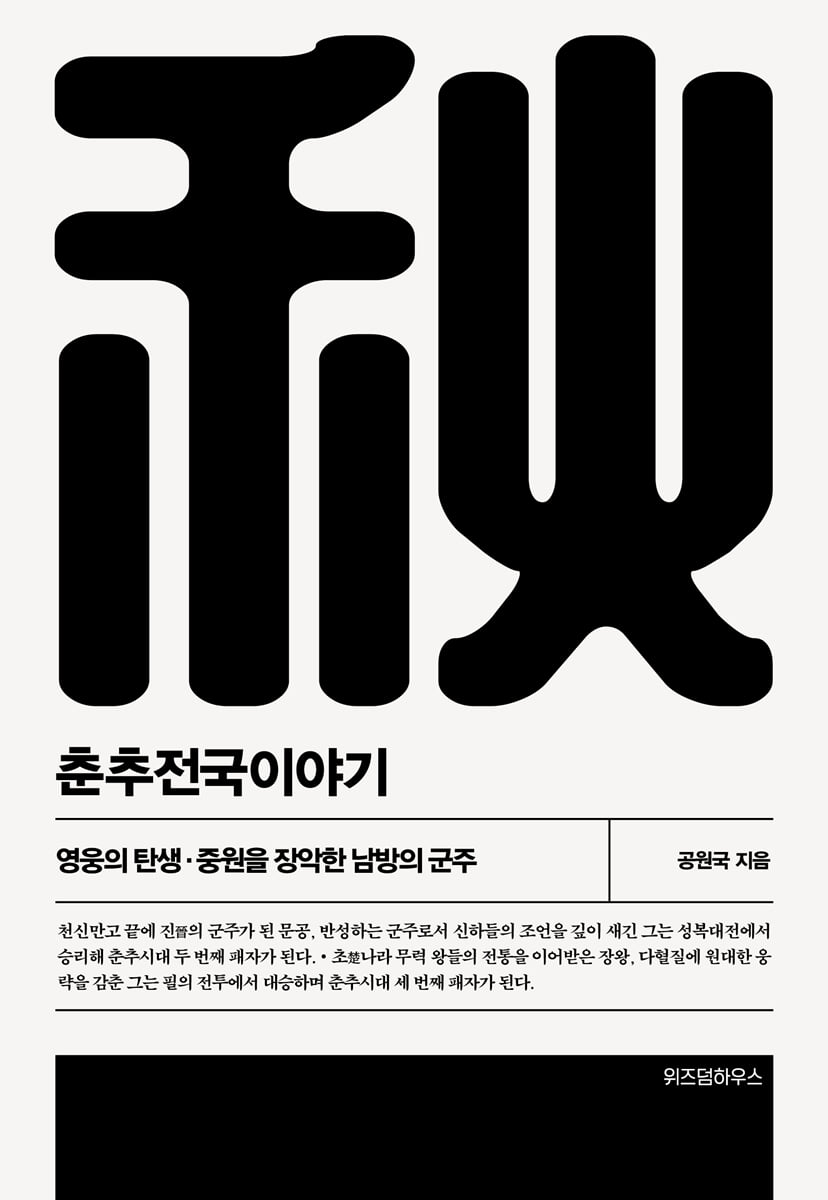
The cover design has been renewed to enhance the completeness of the series.
If you unfold the covers of all volumes, it seems as if the 550-year Spring and Autumn Period and the Warring States Period unfolds like a panorama.
As a reader, you can visually feel the thrill of breaking through a brick book and the fulfillment of understanding an era every time you finish reading each volume of 'Spring, Autumn, Jeon, Guk, Poetry, and Dae'.
The main text format was also reduced from the existing new national format to a national format and the line spacing was widened to increase readability while allowing readers to enjoy the pleasure of reading.
The third thing that has changed is the proofreading of the entire text.
We have carefully corrected errors in the content, reflected typos and unified terminology, as well as changed spelling.
This series is an unprecedented series that presents a completely new historical perspective through a 'geographical approach' that took a long time to plan and write.
Even in China, the birthplace of 『The Spring and Autumn Annals and the Warring States』, its value was recognized, and in an unusual move, the complete volume was translated and published in Chinese by the Yelin Publishing House under the Jiangsu Phoenix Publishing Group.
As this is a work that is unlikely to be reproduced again in Korean publishing history, we hope that this revision will allow it to be read by readers for a longer period of time.
The origin of East Asian culture and a keyword for understanding modern China.
The Spring and Autumn Period and the Warring States Period, a collection of unprecedented events and characters.
In the overwhelming pleasure of narrative that provides insight into the times,
Read history and gain wisdom to understand life!
The Spring and Autumn Period and the Warring States Period refers to a period of approximately 550 years from 770 BC, when the Zhou Dynasty was forced by the Rong people and moved east to Luoyang (Luoyi), until 221 BC, when the Qin Dynasty unified the country.
Chinese history began with the Shang Dynasty and developed into a vast empire through the Zhou Dynasty and the Warring States Period.
During the Spring and Autumn Period and the Warring States Period, powerful centralized states emerged around major rivers, including the Yellow River.
In addition, the foundation of an agricultural nation was established in which ordinary people took charge of production instead of slaves, and a national tax system and standing army were created.
Towards the end of the Warring States period, Qin finally absorbed the six rival states and formed the first unified empire.
And the Han Dynasty inherited this, and the huge body we call 'China' was born today.
This is why the Spring and Autumn Period and the Warring States Period can be said to be the period when the great framework called 'China' was born, and the flesh of history was added to that framework to create the China of today.
The "Spring and Autumn Annals and Warring States" series does not focus on fragmentary events, but rather examines Chinese history by focusing on the fierce competition and rise and fall of the great powers in a macroscopic way.
Through the rise and fall of numerous nations and the people who played a central role in their development, we can gain wisdom for life through the broad perspective of history.
In addition to known sources, the author meticulously researched the field and examined various bamboo slips, inscriptions, and stone steles to capture the essence of the Spring and Autumn Period and the Warring States Period, a time of constant conflict, convergence, and development.
This series presents a profound insight that allows us to understand the past, reflect on the present, and open the door to the future by intertwining the contemporary assessments of the Spring and Autumn Period and the Warring States Period, the records of later generations, and the author's perspective on them.
You can also look at the flow of the world that creates the joys and sorrows of life, winners and losers.
Based on the geographical background I personally investigated
It presents a completely new historical perspective.
The Four Books and Five Classics, which were required reading for scholars in the Joseon Dynasty, were established during the Spring and Autumn Period and the Warring States Period.
In China, until the Xinhai Revolution, the institutions of the Spring and Autumn Period and the Warring States Period continued to be adopted even when dynasties changed.
Ultimately, the keyword that can help us understand the roots of not only China but also East Asian countries at once is the 'Spring and Autumn Period and Warring States Period'.
Just as there were hundreds of states at the beginning of the Spring and Autumn Period, but only seven remained at the end of the Warring States Period, the Spring and Autumn Period and the Warring States Period were a battleground for survival and competition more fiercely than any other period in history.
In this fierce battlefield, countless heroes and iron men have competed with their strength and wisdom, and tens of millions of people have poured their lives into it.
In the process, the paths of humanity and evil, virtue and power, justification and practicality collided with each other, ultimately creating a crossroads of victory and defeat.
The author has spent several years traveling through China and its neighboring countries, seeking to understand how a small tribal state that began in the Yellow River basin expanded to the limits of nature, and how it integrated diverse cultures to create the vast nation we know today as "China."
And the original form of China was traced back to a special period called the 'Spring and Autumn Period and Warring States Period' two thousand years ago.
Because the author describes the history of the Spring and Autumn Period and the Warring States Period based on the geographical background he personally confirmed through field research, readers will be able to imagine this era in a more three-dimensional way with a broad outline.
Jin (晉) - Chu (楚) won the Battle of Chengfu and became the second hegemon of the Spring and Autumn Period.
Duke Wen of Jin, the 'reflective monarch'
During the process of succession to the Jin Dynasty, Zhongyi (later Duke Wen of Jin) was exiled due to the false accusations of Yeo Ji. After 19 years of exile, he returned to his country after enduring many hardships and became the ruler of Jin.
Although Duke Wen did not possess outstanding innate qualities, he was a monarch who always reflected on his actions. He took to heart the advice of his wise ministers, including Hu Yan, Zhao Chou, Ga Tuo, Xian Jin, and Xu Shen, and ended the Jin-Chu Chengfu War with victory, becoming the second hegemon of the Spring and Autumn Period.
Duke Wen of Jin had a weak foundation.
To secure a new support base, he emphasized a fresh start and used a policy of favors to strengthen his weak base.
He emphasized debt consolidation, tax reduction, relief for the poor and the socially disadvantaged, promotion of agriculture and commerce, encouragement of harvest, and encouragement of frugality, and King Mun himself took the lead in promoting frugality.
In addition, military reform is achieved through continuous expansion of the military from the existing two-army system to the three-army system, five-army system, and three-line system.
On this basis, Duke Wen led the Jin-Chu Battle of Chengfu to victory and the Jin-Qin Battle of Xiaoshan, making the Jin Dynasty an unrivaled power.
In Part 1 of 『Story of the Spring and Autumn Annals and the Warring States 2』, we can see the differences between mountainous and plain states, the correlation between material conditions and mental power, centralization, the birth of a rudimentary territorial state, the birth of the study of rulership, and the development of the aristocracy through the rise of Jin, which reigned as a defeated state in a situation where Qin in the west and Chu in the south were fiercely advancing toward the Central Plains. We can also see that Duke Wen, who led the rise of the Qin dynasty, was a true hero equipped with courage and wisdom.
King Zhang of Chu, the 'Taoist monarch' who knew how to stop at the peak,
He won the Battle of Phil(?) and became the third hegemon of the Spring and Autumn Period.
King Jang, who ascended to the throne in the 'barbaric' land of Chu, inheriting the tradition of military kings, fought with the northern leader Jin for hegemony over the Central Plains.
Finally, he personally took the lead in the battle of Pil(?), took up the drumstick, and relentlessly drove down the Jin army, achieving an unprecedented victory during the Spring and Autumn Period, and becoming the third loser during the Spring and Autumn Period.
Wearing a rhinoceros crown and colorfully embroidered clothes, he roams all the hunting grounds and is a lecher who doesn't discriminate between women.
A hot-blooded man who forgets his pride and runs barefoot when he gets angry, and a passionate man who drives a tank at the forefront and rushes into enemy lines.
King Zhang differed in many ways from the traditional image of a monarch created by King Wen of Zhou, and his quixotic magnanimity was unmatched by any other monarch.
During his 23-year reign, King Zhang brought the countries south of the Yellow River to the side of the Chu state, and brought the vast land between the Huai River and the Yangtze River to the east into the territory of the Chu state, leading to the golden age of the Chu state.
If Duke Huan of Qi, the first hegemon of the Spring and Autumn Period who appeared in 『Stories of the Spring and Autumn Annals and Warring States 1』, was a 'Confucian monarch' who showed boundless trust, and Duke Wen of Jin, the protagonist of Part 1 of 『Stories of the Spring and Autumn Annals and Warring States 2』, was a 'Legalist monarch' who valued principles and strict rewards and punishments, then King Zhang of Chu, the protagonist of Part 2, can be seen as a 'Taoist monarch' who knew how to stop at the top.
So King Jang was always eyeing the Central Plains, but he suddenly stopped while driving the Jin army, and after taking over the Chen state, he returned it, and after taking over the Zheng state, he restored it.
When he finally got the results, he stopped.
This is the moment when the 'pause' of 『Lao Tzu』 is felt in him, who has a fiery personality.
In this book, we can see the archetype of a great leader through the process of King Zhang, who resembles Duke Wen of Jin in terms of strategic thinking and Duke Huan of Qi in terms of boldness, creating a cause and putting it into practice himself to become the ruler of the Central Plains. We can also confirm that the culture of the state of Chu, which retained the rough and lively southern style untainted by the teachings of propriety, made King Zhang's success possible.
Korea's first historical textbook that directly addresses the Spring and Autumn Period and the Warring States Period.
Stories of the Spring and Autumn Annals and the Warring States are back with a new design and meticulous proofreading.
This is the revised second edition of the 『Spring and Autumn Annals and Warring States』 series, planned over three years by traveling humanist Park Won-guk and Wisdom House, and written by the author after exploring all of China for ten years.
After the first edition published in 2010 and the revised edition in 2017, it meets readers in a new form after six years.
In this revision, the composition has changed first and foremost.
The original 11 volumes were changed to a combined 6 volumes to take into account the flow of the story.
Readers can feel a powerful sense of immersion in the feast of stories that continues seamlessly from the Spring and Autumn Period to the Warring States Period and the Hundred Schools of Thought.
The second thing that changes is the design.
The cover design has been renewed to enhance the completeness of the series.
If you unfold the covers of all volumes, it seems as if the 550-year Spring and Autumn Period and the Warring States Period unfolds like a panorama.
As a reader, you can visually feel the thrill of breaking through a brick book and the fulfillment of understanding an era every time you finish reading each volume of 'Spring, Autumn, Jeon, Guk, Poetry, and Dae'.
The main text format was also reduced from the existing new national format to a national format and the line spacing was widened to increase readability while allowing readers to enjoy the pleasure of reading.
The third thing that has changed is the proofreading of the entire text.
We have carefully corrected errors in the content, reflected typos and unified terminology, as well as changed spelling.
This series is an unprecedented series that presents a completely new historical perspective through a 'geographical approach' that took a long time to plan and write.
Even in China, the birthplace of 『The Spring and Autumn Annals and the Warring States』, its value was recognized, and in an unusual move, the complete volume was translated and published in Chinese by the Yelin Publishing House under the Jiangsu Phoenix Publishing Group.
As this is a work that is unlikely to be reproduced again in Korean publishing history, we hope that this revision will allow it to be read by readers for a longer period of time.
The origin of East Asian culture and a keyword for understanding modern China.
The Spring and Autumn Period and the Warring States Period, a collection of unprecedented events and characters.
In the overwhelming pleasure of narrative that provides insight into the times,
Read history and gain wisdom to understand life!
The Spring and Autumn Period and the Warring States Period refers to a period of approximately 550 years from 770 BC, when the Zhou Dynasty was forced by the Rong people and moved east to Luoyang (Luoyi), until 221 BC, when the Qin Dynasty unified the country.
Chinese history began with the Shang Dynasty and developed into a vast empire through the Zhou Dynasty and the Warring States Period.
During the Spring and Autumn Period and the Warring States Period, powerful centralized states emerged around major rivers, including the Yellow River.
In addition, the foundation of an agricultural nation was established in which ordinary people took charge of production instead of slaves, and a national tax system and standing army were created.
Towards the end of the Warring States period, Qin finally absorbed the six rival states and formed the first unified empire.
And the Han Dynasty inherited this, and the huge body we call 'China' was born today.
This is why the Spring and Autumn Period and the Warring States Period can be said to be the period when the great framework called 'China' was born, and the flesh of history was added to that framework to create the China of today.
The "Spring and Autumn Annals and Warring States" series does not focus on fragmentary events, but rather examines Chinese history by focusing on the fierce competition and rise and fall of the great powers in a macroscopic way.
Through the rise and fall of numerous nations and the people who played a central role in their development, we can gain wisdom for life through the broad perspective of history.
In addition to known sources, the author meticulously researched the field and examined various bamboo slips, inscriptions, and stone steles to capture the essence of the Spring and Autumn Period and the Warring States Period, a time of constant conflict, convergence, and development.
This series presents a profound insight that allows us to understand the past, reflect on the present, and open the door to the future by intertwining the contemporary assessments of the Spring and Autumn Period and the Warring States Period, the records of later generations, and the author's perspective on them.
You can also look at the flow of the world that creates the joys and sorrows of life, winners and losers.
Based on the geographical background I personally investigated
It presents a completely new historical perspective.
The Four Books and Five Classics, which were required reading for scholars in the Joseon Dynasty, were established during the Spring and Autumn Period and the Warring States Period.
In China, until the Xinhai Revolution, the institutions of the Spring and Autumn Period and the Warring States Period continued to be adopted even when dynasties changed.
Ultimately, the keyword that can help us understand the roots of not only China but also East Asian countries at once is the 'Spring and Autumn Period and Warring States Period'.
Just as there were hundreds of states at the beginning of the Spring and Autumn Period, but only seven remained at the end of the Warring States Period, the Spring and Autumn Period and the Warring States Period were a battleground for survival and competition more fiercely than any other period in history.
In this fierce battlefield, countless heroes and iron men have competed with their strength and wisdom, and tens of millions of people have poured their lives into it.
In the process, the paths of humanity and evil, virtue and power, justification and practicality collided with each other, ultimately creating a crossroads of victory and defeat.
The author has spent several years traveling through China and its neighboring countries, seeking to understand how a small tribal state that began in the Yellow River basin expanded to the limits of nature, and how it integrated diverse cultures to create the vast nation we know today as "China."
And the original form of China was traced back to a special period called the 'Spring and Autumn Period and Warring States Period' two thousand years ago.
Because the author describes the history of the Spring and Autumn Period and the Warring States Period based on the geographical background he personally confirmed through field research, readers will be able to imagine this era in a more three-dimensional way with a broad outline.
Jin (晉) - Chu (楚) won the Battle of Chengfu and became the second hegemon of the Spring and Autumn Period.
Duke Wen of Jin, the 'reflective monarch'
During the process of succession to the Jin Dynasty, Zhongyi (later Duke Wen of Jin) was exiled due to the false accusations of Yeo Ji. After 19 years of exile, he returned to his country after enduring many hardships and became the ruler of Jin.
Although Duke Wen did not possess outstanding innate qualities, he was a monarch who always reflected on his actions. He took to heart the advice of his wise ministers, including Hu Yan, Zhao Chou, Ga Tuo, Xian Jin, and Xu Shen, and ended the Jin-Chu Chengfu War with victory, becoming the second hegemon of the Spring and Autumn Period.
Duke Wen of Jin had a weak foundation.
To secure a new support base, he emphasized a fresh start and used a policy of favors to strengthen his weak base.
He emphasized debt consolidation, tax reduction, relief for the poor and the socially disadvantaged, promotion of agriculture and commerce, encouragement of harvest, and encouragement of frugality, and King Mun himself took the lead in promoting frugality.
In addition, military reform is achieved through continuous expansion of the military from the existing two-army system to the three-army system, five-army system, and three-line system.
On this basis, Duke Wen led the Jin-Chu Battle of Chengfu to victory and the Jin-Qin Battle of Xiaoshan, making the Jin Dynasty an unrivaled power.
In Part 1 of 『Story of the Spring and Autumn Annals and the Warring States 2』, we can see the differences between mountainous and plain states, the correlation between material conditions and mental power, centralization, the birth of a rudimentary territorial state, the birth of the study of rulership, and the development of the aristocracy through the rise of Jin, which reigned as a defeated state in a situation where Qin in the west and Chu in the south were fiercely advancing toward the Central Plains. We can also see that Duke Wen, who led the rise of the Qin dynasty, was a true hero equipped with courage and wisdom.
King Zhang of Chu, the 'Taoist monarch' who knew how to stop at the peak,
He won the Battle of Phil(?) and became the third hegemon of the Spring and Autumn Period.
King Jang, who ascended to the throne in the 'barbaric' land of Chu, inheriting the tradition of military kings, fought with the northern leader Jin for hegemony over the Central Plains.
Finally, he personally took the lead in the battle of Pil(?), took up the drumstick, and relentlessly drove down the Jin army, achieving an unprecedented victory during the Spring and Autumn Period, and becoming the third loser during the Spring and Autumn Period.
Wearing a rhinoceros crown and colorfully embroidered clothes, he roams all the hunting grounds and is a lecher who doesn't discriminate between women.
A hot-blooded man who forgets his pride and runs barefoot when he gets angry, and a passionate man who drives a tank at the forefront and rushes into enemy lines.
King Zhang differed in many ways from the traditional image of a monarch created by King Wen of Zhou, and his quixotic magnanimity was unmatched by any other monarch.
During his 23-year reign, King Zhang brought the countries south of the Yellow River to the side of the Chu state, and brought the vast land between the Huai River and the Yangtze River to the east into the territory of the Chu state, leading to the golden age of the Chu state.
If Duke Huan of Qi, the first hegemon of the Spring and Autumn Period who appeared in 『Stories of the Spring and Autumn Annals and Warring States 1』, was a 'Confucian monarch' who showed boundless trust, and Duke Wen of Jin, the protagonist of Part 1 of 『Stories of the Spring and Autumn Annals and Warring States 2』, was a 'Legalist monarch' who valued principles and strict rewards and punishments, then King Zhang of Chu, the protagonist of Part 2, can be seen as a 'Taoist monarch' who knew how to stop at the top.
So King Jang was always eyeing the Central Plains, but he suddenly stopped while driving the Jin army, and after taking over the Chen state, he returned it, and after taking over the Zheng state, he restored it.
When he finally got the results, he stopped.
This is the moment when the 'pause' of 『Lao Tzu』 is felt in him, who has a fiery personality.
In this book, we can see the archetype of a great leader through the process of King Zhang, who resembles Duke Wen of Jin in terms of strategic thinking and Duke Huan of Qi in terms of boldness, creating a cause and putting it into practice himself to become the ruler of the Central Plains. We can also confirm that the culture of the state of Chu, which retained the rough and lively southern style untainted by the teachings of propriety, made King Zhang's success possible.
GOODS SPECIFICS
- Date of issue: December 28, 2023
- Page count, weight, size: 804 pages | 145*210*37mm
- ISBN13: 9791171710706
- ISBN10: 1171710704
You may also like
카테고리
korean


korean

![GQ KOREA Mark (Monthly): December [2025]](http://librairie.coreenne.fr/cdn/shop/files/8ef265dbbfbf186523ed75ba7319009d.jpg?v=1765340328&width=3840)


