

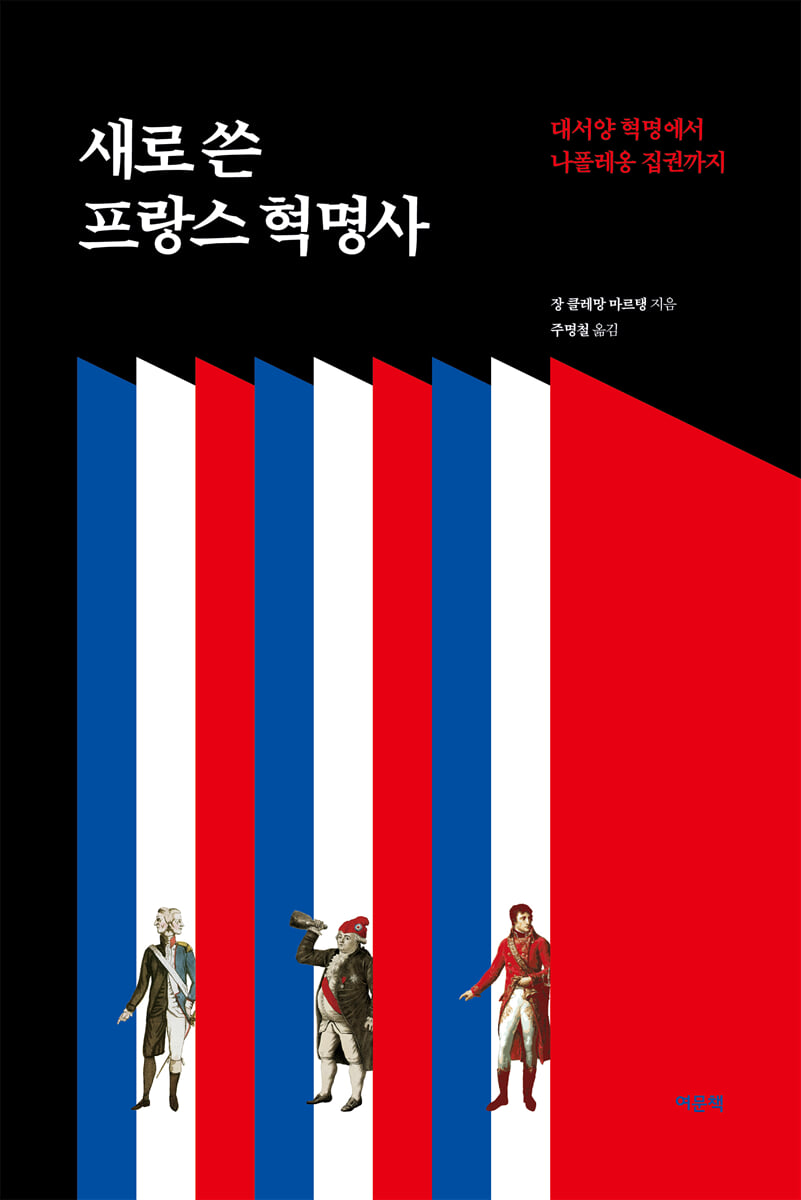
A New History of the French Revolution
 |
Description
Book Introduction
A complete history of the French Revolution, comprehensively reflecting recent sources from the English-speaking world.
"A New History of the French Revolution" is like a detective novel full of potential.
Ultimately, the reader must choose one of several solutions.
―『Annales historiques de la Revolution francaise』
In this book, drawing on a wide range of literature, including English-language studies, Jean-Clément Martin proposes reinterpreting the period from 1770 to 1802 into four monumental moments.
First, the 'revolution from above', started by Louis XV and clumsily continued by Louis XVI, failed in the daring coup known as the 'Take of the Bastille' in 1789.
Then the revolutionary rebirth that almost all French people had been waiting for began.
Then, in 1792, the 'real revolution' led by the Jacobins began.
The Jacobins passionately pursued a new society, but they also committed uncontrollable violence.
Finally, after Robespierre was removed, competition among various political factions disrupted institutional stability, ultimately leading to the rise of a charismatic general in control of the country.
Only after going through so many events did France finally enter the modern era.
Jean-Clément Martin skillfully handled the complex events that occurred in France and abroad during this period as if watching a long historical drama.
"A New History of the French Revolution" is like a detective novel full of potential.
Ultimately, the reader must choose one of several solutions.
―『Annales historiques de la Revolution francaise』
In this book, drawing on a wide range of literature, including English-language studies, Jean-Clément Martin proposes reinterpreting the period from 1770 to 1802 into four monumental moments.
First, the 'revolution from above', started by Louis XV and clumsily continued by Louis XVI, failed in the daring coup known as the 'Take of the Bastille' in 1789.
Then the revolutionary rebirth that almost all French people had been waiting for began.
Then, in 1792, the 'real revolution' led by the Jacobins began.
The Jacobins passionately pursued a new society, but they also committed uncontrollable violence.
Finally, after Robespierre was removed, competition among various political factions disrupted institutional stability, ultimately leading to the rise of a charismatic general in control of the country.
Only after going through so many events did France finally enter the modern era.
Jean-Clément Martin skillfully handled the complex events that occurred in France and abroad during this period as if watching a long historical drama.
- You can preview some of the book's contents.
Preview
index
Note | Preface
Why the Revolution That Started Above Failed
Chapter 1: The Age of Successive Revolutions
Chapter 2: Absolute Monarchy, a Trapped Gulliver?
Chapter 3: The Flaws of the State
Chapter 4: Diverse Opinions
Chapter 5 The Fall of the House of Bourbon
Part 2: The Last Revolution: Rebirth or Revolution?
Chapter 1: From the Revolution of Absolute Monarchy to the Revolution of the Nation-State
Chapter 2: Leading the Revolution
Chapter 3: The Pursuit of Unity
Chapter 4: People, State, and Religion
Chapter 5: The Politicization of Contradiction
Chapter 6: A Vain Victory
Chapter 7 A Divided Nation
Part 3: The Second Revolution: Social Revolution: A Utopian Community or a Warring States?
Chapter 1: The People and Revolutionaries
Chapter 2: A Nation Divided, September 1792–July 1793
Chapter 3: Dominating the War: July 1793–December 1793
Chapter 4: The Revolutionary State: December 1793–April 1794
Chapter 5 Thermidor or Confusion
Part 4: The Forfeited Revolution: Palace Revolutions and Coups
Chapter 1: Between Revolution and Reaction
Chapter 2: The New System
Chapter 3 The Forfeited Republic
Chapter 4: A Revolution in Form
Abbreviations | References | Index | Author's Representative Works
Why the Revolution That Started Above Failed
Chapter 1: The Age of Successive Revolutions
Chapter 2: Absolute Monarchy, a Trapped Gulliver?
Chapter 3: The Flaws of the State
Chapter 4: Diverse Opinions
Chapter 5 The Fall of the House of Bourbon
Part 2: The Last Revolution: Rebirth or Revolution?
Chapter 1: From the Revolution of Absolute Monarchy to the Revolution of the Nation-State
Chapter 2: Leading the Revolution
Chapter 3: The Pursuit of Unity
Chapter 4: People, State, and Religion
Chapter 5: The Politicization of Contradiction
Chapter 6: A Vain Victory
Chapter 7 A Divided Nation
Part 3: The Second Revolution: Social Revolution: A Utopian Community or a Warring States?
Chapter 1: The People and Revolutionaries
Chapter 2: A Nation Divided, September 1792–July 1793
Chapter 3: Dominating the War: July 1793–December 1793
Chapter 4: The Revolutionary State: December 1793–April 1794
Chapter 5 Thermidor or Confusion
Part 4: The Forfeited Revolution: Palace Revolutions and Coups
Chapter 1: Between Revolution and Reaction
Chapter 2: The New System
Chapter 3 The Forfeited Republic
Chapter 4: A Revolution in Form
Abbreviations | References | Index | Author's Representative Works
Into the book
The fact that the storming of the Bastille in July 1789 became a symbol of the French revolution's success should not be interpreted as meaning that the 'revolutionaries' were successful.
Because at that time they were a rare sight.
Rather, it should be understood as evidence to understand how shocked the people of the time were to witness an unbelievable event.
The event was a revolution that succeeded after a series of failures in the most important city of the time.
In an instant, the word 'revolution' took on a completely different meaning.
--- p.24~25
We understand that the storming of the Bastille in 1789 was equivalent to the fall of the Berlin Wall 200 years later.
--- p.69
The French monarchy's absolutist plans had virtually failed before 1780, leaving only the facade of the building Louis XIV had dreamed of.
But the shadow it casts alone is enough to serve as a scarecrow and an excuse.
In all these respects, Louis XVI was dressed much larger than he was.
Ultimately, he will be held responsible for failing to properly control the totality of the contradictions he inherited.
--- p.88
When writing history, we must treat all categories carefully.
For example, the concept of globalization is inappropriate because it treats individuals as actors within a group, forgetting that they act in groups according to dynamics, calculations, and ambitions.
We must be cautious and avoid a [medium- to long-term] perspective that spans centuries.
(Omitted) We must not forget that as the economy developed, society became more divided.
The complex nature of conflict must also be remembered.
(Omitted) The idea that we transitioned from a status society to a class society between 1750 and 1770 may seem plausible at first glance, but we should not accept it without any discussion.
--- p.116~117
A unique political and social atmosphere emerged among the middle and upper classes, intent on resisting all forms of privilege and institutional restrictions.
Unlike other countries where politics did not address every category of society or every aspect of daily life, France questioned all cultural norms.
--- p.144
The relationship between religion and power, between religious people and monarchs, has never been simple or peaceful.
(Omitted) The two forces that controlled the kingdom gradually grew apart, and once the revolution occurred, it had irreversible and serious consequences.
However, very secretly, religious divisions arising from Jansenism and papal supremacy created an atmosphere that endangered Christian monarchy.
--- p.145~146
Historiography favorable to revolutionaries spreads these types of conclusions.
It emphasized the determination of the 'revolutionaries' to join the 'revolutionary crowd' on July 14, while ignoring everything that Epinal's painting did not confirm, which was to justify the legitimacy of the Third Republic.
/ The historical narrative on the other side maintained the same schematic, but denounced their unrealism by highlighting the fact that the revolutionaries had led the country into a 'reign of terror'.
The isolation of Sieyès, the calculations of the counter-revolutionaries who rejected absolutism, the constant mistakes of the king and the court, the tradition of rebellion—all these led to a turning point, which set the country on the path to "revolution" and "constitution" in the true sense of the word within a few months.
--- p.242~243
How did the French Revolution begin? There's no denying that it was a fundamental reorganization of the political landscape.
Religious tolerance shook the supremacy of Catholicism.
Although the king remained de facto divine and 'inviolable' as defined in the yet-to-be-finalized constitution, the kingdom was no longer organized around the king's physical presence.
(Omitted) After July 1789, the regeneration of the kingdom, in which the king had intervened, thus created a common sovereignty.
--- p.273
France, in the traditional sense, was a country where many 'nations' and many 'ethnicities' were loosely united.
(Omitted) The obsession with the 'people' arose from the hope of finding a solid foundation for the system after the king's power was weakened, and from the fear of the demands of the 'people' who would rise up in rebellion.
--- p.286~287
The polarization of revolution/counterrevolution was clearly an expression of antagonisms related to property, social distinctions, skin color, and religion, and it created a mass of events and numerous myths.
However, we must bear in mind that if we apply this dichotomous approach to portray the history of France or of humanity as a whole, we risk missing out on capturing everyone's expectations, struggles, and memories.
--- p.378~379
In writing history, one must essentially criticize all saintly traditions, and one must not easily believe in the truth the pronouncements that justify one's actions, nor invent the view that human beings are inherently cruel rather than ethical.
--- p.469
The inability to recover finances has always been a weakness of the system.
Taxes were not collected, money was scarce, and the government was always running at a loss, even though it expanded its national property sales to Belgium.
Even as buyers have fewer and fewer reliable means of protecting their assets, criticism of them has only increased.
The state paid cash repayment rights to creditors, but even these became targets of speculation.
The circulation of commercial paper overcame the shortage of specie, but only benefited speculators and the wealthy.
The gap between rich and poor has reached its peak.
The rentiers and salaried workers were directly affected by the inflation, and the lack of money circulating in the cities left countless extremely poor people without any help.
The Republic was transformed into a dictatorship to protect the oligarchy, to secure the interests of half of the French population, and to place the army at the center of the system.
--- p.772~773
A look at the country's main budget shows that the military was clearly needed.
Rather, it was because the military always filled the empty national treasury and made the country wealthy.
(Omitted) Some disliked his plunder, but the army completely changed the perception of power.
To counter-revolutionary foreign observers, the army represented the 'dreadful revolution', and Bonaparte was its embodiment.
Because at that time they were a rare sight.
Rather, it should be understood as evidence to understand how shocked the people of the time were to witness an unbelievable event.
The event was a revolution that succeeded after a series of failures in the most important city of the time.
In an instant, the word 'revolution' took on a completely different meaning.
--- p.24~25
We understand that the storming of the Bastille in 1789 was equivalent to the fall of the Berlin Wall 200 years later.
--- p.69
The French monarchy's absolutist plans had virtually failed before 1780, leaving only the facade of the building Louis XIV had dreamed of.
But the shadow it casts alone is enough to serve as a scarecrow and an excuse.
In all these respects, Louis XVI was dressed much larger than he was.
Ultimately, he will be held responsible for failing to properly control the totality of the contradictions he inherited.
--- p.88
When writing history, we must treat all categories carefully.
For example, the concept of globalization is inappropriate because it treats individuals as actors within a group, forgetting that they act in groups according to dynamics, calculations, and ambitions.
We must be cautious and avoid a [medium- to long-term] perspective that spans centuries.
(Omitted) We must not forget that as the economy developed, society became more divided.
The complex nature of conflict must also be remembered.
(Omitted) The idea that we transitioned from a status society to a class society between 1750 and 1770 may seem plausible at first glance, but we should not accept it without any discussion.
--- p.116~117
A unique political and social atmosphere emerged among the middle and upper classes, intent on resisting all forms of privilege and institutional restrictions.
Unlike other countries where politics did not address every category of society or every aspect of daily life, France questioned all cultural norms.
--- p.144
The relationship between religion and power, between religious people and monarchs, has never been simple or peaceful.
(Omitted) The two forces that controlled the kingdom gradually grew apart, and once the revolution occurred, it had irreversible and serious consequences.
However, very secretly, religious divisions arising from Jansenism and papal supremacy created an atmosphere that endangered Christian monarchy.
--- p.145~146
Historiography favorable to revolutionaries spreads these types of conclusions.
It emphasized the determination of the 'revolutionaries' to join the 'revolutionary crowd' on July 14, while ignoring everything that Epinal's painting did not confirm, which was to justify the legitimacy of the Third Republic.
/ The historical narrative on the other side maintained the same schematic, but denounced their unrealism by highlighting the fact that the revolutionaries had led the country into a 'reign of terror'.
The isolation of Sieyès, the calculations of the counter-revolutionaries who rejected absolutism, the constant mistakes of the king and the court, the tradition of rebellion—all these led to a turning point, which set the country on the path to "revolution" and "constitution" in the true sense of the word within a few months.
--- p.242~243
How did the French Revolution begin? There's no denying that it was a fundamental reorganization of the political landscape.
Religious tolerance shook the supremacy of Catholicism.
Although the king remained de facto divine and 'inviolable' as defined in the yet-to-be-finalized constitution, the kingdom was no longer organized around the king's physical presence.
(Omitted) After July 1789, the regeneration of the kingdom, in which the king had intervened, thus created a common sovereignty.
--- p.273
France, in the traditional sense, was a country where many 'nations' and many 'ethnicities' were loosely united.
(Omitted) The obsession with the 'people' arose from the hope of finding a solid foundation for the system after the king's power was weakened, and from the fear of the demands of the 'people' who would rise up in rebellion.
--- p.286~287
The polarization of revolution/counterrevolution was clearly an expression of antagonisms related to property, social distinctions, skin color, and religion, and it created a mass of events and numerous myths.
However, we must bear in mind that if we apply this dichotomous approach to portray the history of France or of humanity as a whole, we risk missing out on capturing everyone's expectations, struggles, and memories.
--- p.378~379
In writing history, one must essentially criticize all saintly traditions, and one must not easily believe in the truth the pronouncements that justify one's actions, nor invent the view that human beings are inherently cruel rather than ethical.
--- p.469
The inability to recover finances has always been a weakness of the system.
Taxes were not collected, money was scarce, and the government was always running at a loss, even though it expanded its national property sales to Belgium.
Even as buyers have fewer and fewer reliable means of protecting their assets, criticism of them has only increased.
The state paid cash repayment rights to creditors, but even these became targets of speculation.
The circulation of commercial paper overcame the shortage of specie, but only benefited speculators and the wealthy.
The gap between rich and poor has reached its peak.
The rentiers and salaried workers were directly affected by the inflation, and the lack of money circulating in the cities left countless extremely poor people without any help.
The Republic was transformed into a dictatorship to protect the oligarchy, to secure the interests of half of the French population, and to place the army at the center of the system.
--- p.772~773
A look at the country's main budget shows that the military was clearly needed.
Rather, it was because the military always filled the empty national treasury and made the country wealthy.
(Omitted) Some disliked his plunder, but the army completely changed the perception of power.
To counter-revolutionary foreign observers, the army represented the 'dreadful revolution', and Bonaparte was its embodiment.
--- p.803~804
Publisher's Review
"A New History of the French Revolution" is like a detective novel full of potential.
Ultimately, the reader must choose one of several solutions.
 ̄『Annales historiques de la Revolution francaise』
◆ The beginning and end of the French Revolution, compiled using a new historical narrative methodology
Author Jean-Clément Martin rejects the class view of history of Albert Soboul, a representative revolutionary historian of the late 20th century.
According to the author, the French Revolution was not only not caused by the bourgeoisie, but the view that that class was a product of the revolution remains to be argued.
Of course, I fully acknowledge and inherit the outstanding research achievements of the previous generation of historians, including Sobul, but I do not agree with the methodology of judging the revolutionary period from an overly mid- to long-term perspective or, in particular, giving priority to political ideology.
In short, the author can be said to be a representative of 'historical revisionism' that was baptized by the Annales School.
Professor Emeritus Joo Myung-cheol, who translated this book, is a leading expert who has written and translated numerous related books, including the 10-part series on the history of the French Revolution. He explains the author's academic background as follows:
“The Annales school broadened the horizons of historical research by asking the questions, ‘What is the essence of history? How should we approach a new history? What is the new object?’ (1974, Faire de l'histoire).
They reread existing materials with new problem-solving and methodologies, and by unearthing notarized documents such as wills and property inventories, including books, they proved that cultural factors such as a social group's level of education and mental attitude were as important as economic factors.
Over the next fifty years, they broadened the horizon of social history from an economic focus to a cultural focus, and paved the way for the field of microhistory, proving the hypothesis that individuals within specific social groups create or consume unique cultures.
The study of the history of the French Revolution was also directly or indirectly involved in this journey and benefited greatly from it.
Jean-Clément Martin has written this book by making full use of his extensive knowledge of revolution and reaction and his vast archive of historical materials. Based on this book, “The French Revolution in Stories and Infographics” helps readers intuitively understand this vast historical fact and flow.”
The author, who has been actively researching the French Revolution over the past 30 years, focusing on numerous "events," emphasizes the importance of establishing a correct historical perspective and narrative attitude in this book, which includes recent research results from the English-speaking world.
“It is important to understand what makes people who have no political sense at all develop complex ideas, confusing great politics with popular politics, rational analysis with prophecy, heroism with sordidness.
(Omitted) I respect the fact that the historical methodology that rationally considers the irrationality of existence and things is particularly applicable to all opposition and division, and I believe that it is possible to speak frankly about past facts without seeking any sacredness.
(Omitted) The key is to understand the ‘moments’ of the revolution.
(Omitted) The purpose of this book is to register these 'moments' within the entire 'period' of the revolution (the 'epoque' as Maistre calls it) and to consider even the minute devices that govern the relationship between the individual and the group.
This book covers the process of experimenting with revolution, beginning with the reforms of an absolute monarchy, extending to the opposition of the nobility and the high court, and finally culminating in the uprising of the "people," as well as the birth of a military state, then a liberal state, and finally the organization of a state centered on a charismatic leader.
(Omitted) To write a history of France's most crucial period, we must criticize the approach of comprehensive analysis and explanations based on pre-determined categories, and consider the leading actions of ordinary individuals, along with the roles they play in groups.
In this case, one has to pay the price of navigating a maze of facts and constantly searching through documents that are bound to have gaps.” _ From the “Preface”
The French Revolution did not occur because of a 'crisis of the old regime'.
In the 18th century, 'revolution' was not the exclusive domain of France.
There was a series of 'Atlantic revolutions' that took place in England, famous for the Glorious Revolution, as well as in Geneva, Poland, Sweden, and especially in the American colonies.
However, it is clear that the revolution that took place in France, an absolutist regime, and the king and queen ending their lives on the guillotine was a huge turning point and shock in history.
Furthermore, what makes it possible to call only the social changes that swept through France between 1789 and 1799 a 'revolution' is that, while the Atlantic Revolution was a 'soft' revolution, one of the 'revolutions' that occurred one after another during the Enlightenment to resolve domestic problems and tensions between social classes or civic communities, most of which failed, the French Revolution was not only completely different from these revolutions that had occurred up until 1789, but was also a 'revolution' that occurred in a new way, and the popular forces were as important as those of the social leaders and demanded a political solution different from the establishment of a leadership system by celebrities.
One of the most important misconceptions that many people have is the dichotomous view that revolution is new and the old system is old, and the French Revolution is simply thought to have occurred because of a crisis in the old system.
The author states that “while the collective consciousness that the threshold of revolution had been crossed clearly arose in 1789, the idea that the structure of the French absolute monarchy was fragile and would eventually collapse dates back some 30 years.
Therefore, in 1789, the key issue was not the destruction of the absolute monarchy, but the name given to the remnants of a system already on the brink of death.
He firmly points out that “the absolutism of the ancien régime was merely a facade covering a building that had been in ruins since 1760-1770” (p. 71), and that “we must not contrast the ‘newness’ of the revolution with the ‘oldness’ of the old regime, thinking that the revolution invented a completely new meaning and thus threw the country into an unfortunate adventure” (p. 154).
The author then diagnoses the cause of the French Revolution as follows:
The moment when the government hesitated over which of the three policies to choose was the clue to the history of the revolution.
Of the three policies that would be crucially influenced by the tax system, first, would France remain a constitutional monarchy with the ability to discuss how to repay its debts? Second, would it become an absolutist state with a professionally participatory government and levying oppressive taxes? Third, would it become a "mixed" monarchy, with the traditional aristocracy acting as a mediator between king and people? In any case, the French Revolution was not a "crisis of the ancien régime," but rather a confluence of circumstances.
(Pages 105-106)
The French Revolution was not a pre-planned reform, but a product of compromise and accidental events.
How does the author, who has studied the history of the French Revolution for over 30 years, view the 'revolution'?
In this massive 888-page book, let's briefly look at just the parts where the author mentions the 'revolution' itself.
Revolution is a process that constantly creates and confirms countless experiences, while fostering expectations that can never be fulfilled and the anxiety of failure.
(Page 17)
Revolution is not a machine that runs wild or goes off the rails, but rather a spiral of interlocking processes of renewal and rebuilding from the ground up, along with processes of exclusion and suppression.
(Page 18)
[In fact] the revolution may have succeeded because of the king's 'weakness'.
Therefore, if he had been a strong personality like Louis XIV or Bonaparte, he would have prevented the revolution.
(Page 70)
A revolution occurs when a group becomes conscious of breaking away from the system and the state's ties to human history.
(Page 95)
Revolutions have never been a single bloc, but rather a shock managed by groups operating under the influence of opposing currents, all working together.
(Page 492)
The centralization and rapid politicization of the state was not a revolution, but rather the result of the intervention of numerous individuals with differing opinions.
(Page 500)
In this way, the author says that we should evaluate the meaning of 'revolution' without prejudging it, and pay attention to the context in which public opinion at the time linked 'revolution' to the domestic and international situations.
“In 1789, the most widely accepted thing in France was regeneration.” (p. 246) In conclusion, it is assessed that France had already begun to experience a revolution before 1789 as a result of the accumulated discontent of the people due to chronic fiscal deficits, tax problems, religious conflicts, and extreme gap between rich and poor.
As evidence, he cites the fact that rebellions and uprisings have continued to occur in rural and urban areas for over 30 years.
The author, who warns against a total historical interpretation that “depends on summaries that encourage ideologically bizarre shortcuts,” emphasizes that “when writing history, we must avoid being tempted by systematic analysis of political philosophy more than ever before,” and that “the historical fact is that the French Revolution was not a premeditated reform, but a compromise and an accidental event.
He points out that “the inability to clearly state that one was demanding a constitution for the kingdom played a greater role than the real revolutionary goal” (p. 241).
And he concludes, “Shouldn’t we read the revolutionary period as the end of the process of inventing a modern state and establishing an absolute monarchy while overcoming all kinds of conflicts starting from the religious wars?” (p. 99).
◆ To contrast the 'Enlightenment' with the 'old system' is to create a historical myth.
The Enlightenment is something that appears without fail in the French Revolution.
Among them, Voltaire and Rousseau can be said to have the greatest weight (Voltaire was buried in the Panthéon in 1791, and Rousseau in 1794).
In particular, Rousseau's proposition of the 'general will' was a concept accepted by both the left and right wings of the National Assembly.
However, the author argues that we should not accept the conventional wisdom that the Enlightenment was the cause of revolution, and criticizes the two centuries of scholars who have devoted their energies to a flawed debate surrounding the relationship between the Enlightenment and revolution.
The author points out the limitations of existing studies as follows.
The reality that the last representatives of the Enlightenment were the targets of criticism after 1790, and that they had to carefully keep silent and hide even in the National Assembly, was hardly taken into account.
We must not forget that there was discord because Voltaire was entombed in the Pantheon in 1791 and Rousseau in 1794.
To understand the diverse realities of history, we must reject the counter-revolutionaries who blame the Enlightenment thinkers and Freemasons for the ruin of French society, as well as the revolutionaries who, like Saint-Just, insist that the entire 18th century should be buried in the Panthéon.
We must also stay away from those who, like Marx, link the Enlightenment to the rise of the bourgeoisie in its fight against feudalism, or like Cassirer, see the Enlightenment as an act of believing in reason as a liberator, or like Adorno, Horkheimer, and Arendt, criticize the Enlightenment as a desire to dominate the real world to the point of eliminating the human element of all society and laying the foundations for totalitarianism, and their followers.
All of these interpretations, while provocative, share the same flaw.
The intention is to encompass and unify movements that are unequal, contradictory, and have different characteristics from country to country.
(Omitted) The accusation that the Enlightenment was responsible for the French Revolution and for destroying its own ambitions is the result of a mixture of numerous realities in the 19th century.
(Omitted) To contrast ‘Enlightenment’ with ‘the old system’ is to create a historical myth.
(Pages 134-135)
The Thermidor Coup and the 'Great Revolutionary' Robespierre
In this book, the author broadly covers the period from the Atlantic Revolution to the period when Napoleon overthrew the First Republic and seized power as the President of the Consulate. The French Revolution itself can be divided into the first and second half, focusing on the ten years from 1789 to 1799.
The latter half of the period was a period of denial of the revolution, and the most notable figure around this time was Robespierre, known as the embodiment of the 'Reign of Terror'.
On July 27, 1794, Robespierre, who led the revolutionary government, was executed.
The incident is called the 'Thermidorian Coup' and is essentially a 'reaction'.
Thus ended the first half of the revolutionary period, and according to the author, “Thermidor was both an event and a concept.”
The author states that the concept of a 'regime of terror' was "an invention of the Thermidorian reactionaries" and that "no government committee until 1793-1794 explicitly spoke of or wanted to establish such a regime.
Let us reiterate that the practices of community protection, swift legal punishment, and political violence existed even during the monarchical period before 1789” (p. 404).
The author expresses his regret that Robespierre, who had been working tirelessly for the revolution day and night, lost his life due to the betrayal of his comrades and was the main character of the 'Reign of Terror' that created a social atmosphere of 'disgust of the guillotine' and was the only one to bear the stigma of being a dictator.
“Could it be that the number of executioners was known because the Revolution had imposed excessive terror and was used to blame it on Robespierre?” (p. 651), “The ‘disgust of the guillotine’ was attributed to the Prairie Laws because Fouquier-Tinville and the Committee of Security deliberately carried out the law indiscriminately.
Accordingly, Robespierre had no choice but to take responsibility without any room for excuses.
Robespierre fell into a trap because he could not find another way to act, just like when playing Go.
The exiles referred to his 'dictatorship' in their publications.
(Omitted) He had conflicts not only with his colleagues in the National Salvation Committee, but also with the Security Committee.
In particular, he isolated himself because he directly threatened the 'enemy within'.
Public opinion also turned its back on him.” (p. 652) However, in later generations, Robespierre was re-evaluated as the embodiment of revolution, and the reason for this is explained as follows.
We know that Robespierre won the hearts of posterity (F.
I don't think it's because, as Furet says, "he represented the most tragic and pure story of the revolution."
There is no doubt that he clearly beat Mirabeau in this field.
He had a rival named Marat, who was more neurotic and dedicated to the revolution, rejecting any compromises from the government.
There is another reason why Robespierre became the embodiment of revolution.
It is because yesterday's comrades [like Barre and Viot Baren] have become eternal enemies, blaming him and holding him alone responsible for the political violence called the "Reign of Terror," and, without even knowing what they are doing, have violently driven the revolution in a completely unexpected and hopeless direction.
His myth was born, oddly enough, through a process of mixing not only his own fame but also the myth of Vendée, where people remembered him as an executioner.
(Page 662)
◆ Revolution confiscated by Napoleon
Napoleon Bonaparte is probably the most famous Frenchman in the world.
The author also acknowledges that he had an extraordinary and attractive side, as he was a man of great character with a colorful life and a mythical protagonist, who brought an end to the French Revolution and ascended to the throne as 'Emperor' in 1804.
However, from the perspective of a historian who values cool-headed and objective narratives, it seems that many of Napoleon's "success stories" of filling the national treasury and expanding territory through foreign expeditions, including those to Italy, were seen as sordid or trivial.
“I want to shatter the myth of Bonaparte, but I also need to try to understand why he was so successful at the time,” the author says, adding that he tells an interesting story.
Bonaparte developed a strategy of controlling Italy, reorganizing Europe, and interfering in the lives of the French people without any constraints.
Directors like Barras had received large sums of money for their preliminary negotiations in Leoben, and Bonaparte knew how to exploit their willingness to pay.
(Omitted) Bonaparte systematically used the policy of terror to suppress the rebellion.
When a revolt broke out in Verona on April 17, 1797, Bonaparte, in a foul manner, took advantage of the hostility of the inhabitants and the army to seize the Republic of Venice.
(Pages 763-764)
The Italian campaign literally placed Bonaparte at the center of national political life.
His exploits were carefully conveyed to France through skillful propaganda, and (omitted) the Italian expedition, although limited and yielding only minor results, not only shook the balance of French politics around the Mediterranean and Bonaparte, but also changed the aims and methods of the war, the relationship between the French and those in power, and its political meaning.
(Page 766)
The author points out that while the propaganda surrounding the Italian campaign was a turning point in the creation of the Napoleon legend, it should not be forgotten that Bonaparte almost lost power because the bigwigs were constantly plotting in the salons.
He added that he had great ambition and extraordinary political energy, as can be seen from the fact that he wanted to become president before he was even thirty, and asked for support from Barras and Tallien, ignoring the constitutional provision that he must be over forty, and eventually received the support of the master of trickery, Talleyrand.
Because the Revolution introduced modernity so rapidly, there was a sense of alienation between the state and the French people, and Bonaparte responded to this with “coercion and seduction.”
“Because the nature of the nation born of the Brumaire Coup was ambiguous, a new perspective opened up: toward an empire, toward Bonapartism, and, in a word, toward an unprecedented political culture” (p. 836).
Finally, the author concludes the book by acknowledging that Napoleon created a modern constitution that embodied his principles, but sharply criticizing his coup of November 9, 1799 (the 18th Brumaire), as “a paltry victory over dagger-armed plotters,” and “a sign of the silencing of history, the muzzling of the memory of the Revolution, and the control of historians” (p. 841).
The reason we still have interest in and should continue to study the great historical events of the past, even more than 200 years ago, is, as the author says, “to participate in today’s intellectual developments and political discussions,” but also because it is an excellent subject for exploring the essence of “human” existence by focusing on the relationships and interactions between individuals and groups who are the subjects of history.
Ultimately, the reader must choose one of several solutions.
 ̄『Annales historiques de la Revolution francaise』
◆ The beginning and end of the French Revolution, compiled using a new historical narrative methodology
Author Jean-Clément Martin rejects the class view of history of Albert Soboul, a representative revolutionary historian of the late 20th century.
According to the author, the French Revolution was not only not caused by the bourgeoisie, but the view that that class was a product of the revolution remains to be argued.
Of course, I fully acknowledge and inherit the outstanding research achievements of the previous generation of historians, including Sobul, but I do not agree with the methodology of judging the revolutionary period from an overly mid- to long-term perspective or, in particular, giving priority to political ideology.
In short, the author can be said to be a representative of 'historical revisionism' that was baptized by the Annales School.
Professor Emeritus Joo Myung-cheol, who translated this book, is a leading expert who has written and translated numerous related books, including the 10-part series on the history of the French Revolution. He explains the author's academic background as follows:
“The Annales school broadened the horizons of historical research by asking the questions, ‘What is the essence of history? How should we approach a new history? What is the new object?’ (1974, Faire de l'histoire).
They reread existing materials with new problem-solving and methodologies, and by unearthing notarized documents such as wills and property inventories, including books, they proved that cultural factors such as a social group's level of education and mental attitude were as important as economic factors.
Over the next fifty years, they broadened the horizon of social history from an economic focus to a cultural focus, and paved the way for the field of microhistory, proving the hypothesis that individuals within specific social groups create or consume unique cultures.
The study of the history of the French Revolution was also directly or indirectly involved in this journey and benefited greatly from it.
Jean-Clément Martin has written this book by making full use of his extensive knowledge of revolution and reaction and his vast archive of historical materials. Based on this book, “The French Revolution in Stories and Infographics” helps readers intuitively understand this vast historical fact and flow.”
The author, who has been actively researching the French Revolution over the past 30 years, focusing on numerous "events," emphasizes the importance of establishing a correct historical perspective and narrative attitude in this book, which includes recent research results from the English-speaking world.
“It is important to understand what makes people who have no political sense at all develop complex ideas, confusing great politics with popular politics, rational analysis with prophecy, heroism with sordidness.
(Omitted) I respect the fact that the historical methodology that rationally considers the irrationality of existence and things is particularly applicable to all opposition and division, and I believe that it is possible to speak frankly about past facts without seeking any sacredness.
(Omitted) The key is to understand the ‘moments’ of the revolution.
(Omitted) The purpose of this book is to register these 'moments' within the entire 'period' of the revolution (the 'epoque' as Maistre calls it) and to consider even the minute devices that govern the relationship between the individual and the group.
This book covers the process of experimenting with revolution, beginning with the reforms of an absolute monarchy, extending to the opposition of the nobility and the high court, and finally culminating in the uprising of the "people," as well as the birth of a military state, then a liberal state, and finally the organization of a state centered on a charismatic leader.
(Omitted) To write a history of France's most crucial period, we must criticize the approach of comprehensive analysis and explanations based on pre-determined categories, and consider the leading actions of ordinary individuals, along with the roles they play in groups.
In this case, one has to pay the price of navigating a maze of facts and constantly searching through documents that are bound to have gaps.” _ From the “Preface”
The French Revolution did not occur because of a 'crisis of the old regime'.
In the 18th century, 'revolution' was not the exclusive domain of France.
There was a series of 'Atlantic revolutions' that took place in England, famous for the Glorious Revolution, as well as in Geneva, Poland, Sweden, and especially in the American colonies.
However, it is clear that the revolution that took place in France, an absolutist regime, and the king and queen ending their lives on the guillotine was a huge turning point and shock in history.
Furthermore, what makes it possible to call only the social changes that swept through France between 1789 and 1799 a 'revolution' is that, while the Atlantic Revolution was a 'soft' revolution, one of the 'revolutions' that occurred one after another during the Enlightenment to resolve domestic problems and tensions between social classes or civic communities, most of which failed, the French Revolution was not only completely different from these revolutions that had occurred up until 1789, but was also a 'revolution' that occurred in a new way, and the popular forces were as important as those of the social leaders and demanded a political solution different from the establishment of a leadership system by celebrities.
One of the most important misconceptions that many people have is the dichotomous view that revolution is new and the old system is old, and the French Revolution is simply thought to have occurred because of a crisis in the old system.
The author states that “while the collective consciousness that the threshold of revolution had been crossed clearly arose in 1789, the idea that the structure of the French absolute monarchy was fragile and would eventually collapse dates back some 30 years.
Therefore, in 1789, the key issue was not the destruction of the absolute monarchy, but the name given to the remnants of a system already on the brink of death.
He firmly points out that “the absolutism of the ancien régime was merely a facade covering a building that had been in ruins since 1760-1770” (p. 71), and that “we must not contrast the ‘newness’ of the revolution with the ‘oldness’ of the old regime, thinking that the revolution invented a completely new meaning and thus threw the country into an unfortunate adventure” (p. 154).
The author then diagnoses the cause of the French Revolution as follows:
The moment when the government hesitated over which of the three policies to choose was the clue to the history of the revolution.
Of the three policies that would be crucially influenced by the tax system, first, would France remain a constitutional monarchy with the ability to discuss how to repay its debts? Second, would it become an absolutist state with a professionally participatory government and levying oppressive taxes? Third, would it become a "mixed" monarchy, with the traditional aristocracy acting as a mediator between king and people? In any case, the French Revolution was not a "crisis of the ancien régime," but rather a confluence of circumstances.
(Pages 105-106)
The French Revolution was not a pre-planned reform, but a product of compromise and accidental events.
How does the author, who has studied the history of the French Revolution for over 30 years, view the 'revolution'?
In this massive 888-page book, let's briefly look at just the parts where the author mentions the 'revolution' itself.
Revolution is a process that constantly creates and confirms countless experiences, while fostering expectations that can never be fulfilled and the anxiety of failure.
(Page 17)
Revolution is not a machine that runs wild or goes off the rails, but rather a spiral of interlocking processes of renewal and rebuilding from the ground up, along with processes of exclusion and suppression.
(Page 18)
[In fact] the revolution may have succeeded because of the king's 'weakness'.
Therefore, if he had been a strong personality like Louis XIV or Bonaparte, he would have prevented the revolution.
(Page 70)
A revolution occurs when a group becomes conscious of breaking away from the system and the state's ties to human history.
(Page 95)
Revolutions have never been a single bloc, but rather a shock managed by groups operating under the influence of opposing currents, all working together.
(Page 492)
The centralization and rapid politicization of the state was not a revolution, but rather the result of the intervention of numerous individuals with differing opinions.
(Page 500)
In this way, the author says that we should evaluate the meaning of 'revolution' without prejudging it, and pay attention to the context in which public opinion at the time linked 'revolution' to the domestic and international situations.
“In 1789, the most widely accepted thing in France was regeneration.” (p. 246) In conclusion, it is assessed that France had already begun to experience a revolution before 1789 as a result of the accumulated discontent of the people due to chronic fiscal deficits, tax problems, religious conflicts, and extreme gap between rich and poor.
As evidence, he cites the fact that rebellions and uprisings have continued to occur in rural and urban areas for over 30 years.
The author, who warns against a total historical interpretation that “depends on summaries that encourage ideologically bizarre shortcuts,” emphasizes that “when writing history, we must avoid being tempted by systematic analysis of political philosophy more than ever before,” and that “the historical fact is that the French Revolution was not a premeditated reform, but a compromise and an accidental event.
He points out that “the inability to clearly state that one was demanding a constitution for the kingdom played a greater role than the real revolutionary goal” (p. 241).
And he concludes, “Shouldn’t we read the revolutionary period as the end of the process of inventing a modern state and establishing an absolute monarchy while overcoming all kinds of conflicts starting from the religious wars?” (p. 99).
◆ To contrast the 'Enlightenment' with the 'old system' is to create a historical myth.
The Enlightenment is something that appears without fail in the French Revolution.
Among them, Voltaire and Rousseau can be said to have the greatest weight (Voltaire was buried in the Panthéon in 1791, and Rousseau in 1794).
In particular, Rousseau's proposition of the 'general will' was a concept accepted by both the left and right wings of the National Assembly.
However, the author argues that we should not accept the conventional wisdom that the Enlightenment was the cause of revolution, and criticizes the two centuries of scholars who have devoted their energies to a flawed debate surrounding the relationship between the Enlightenment and revolution.
The author points out the limitations of existing studies as follows.
The reality that the last representatives of the Enlightenment were the targets of criticism after 1790, and that they had to carefully keep silent and hide even in the National Assembly, was hardly taken into account.
We must not forget that there was discord because Voltaire was entombed in the Pantheon in 1791 and Rousseau in 1794.
To understand the diverse realities of history, we must reject the counter-revolutionaries who blame the Enlightenment thinkers and Freemasons for the ruin of French society, as well as the revolutionaries who, like Saint-Just, insist that the entire 18th century should be buried in the Panthéon.
We must also stay away from those who, like Marx, link the Enlightenment to the rise of the bourgeoisie in its fight against feudalism, or like Cassirer, see the Enlightenment as an act of believing in reason as a liberator, or like Adorno, Horkheimer, and Arendt, criticize the Enlightenment as a desire to dominate the real world to the point of eliminating the human element of all society and laying the foundations for totalitarianism, and their followers.
All of these interpretations, while provocative, share the same flaw.
The intention is to encompass and unify movements that are unequal, contradictory, and have different characteristics from country to country.
(Omitted) The accusation that the Enlightenment was responsible for the French Revolution and for destroying its own ambitions is the result of a mixture of numerous realities in the 19th century.
(Omitted) To contrast ‘Enlightenment’ with ‘the old system’ is to create a historical myth.
(Pages 134-135)
The Thermidor Coup and the 'Great Revolutionary' Robespierre
In this book, the author broadly covers the period from the Atlantic Revolution to the period when Napoleon overthrew the First Republic and seized power as the President of the Consulate. The French Revolution itself can be divided into the first and second half, focusing on the ten years from 1789 to 1799.
The latter half of the period was a period of denial of the revolution, and the most notable figure around this time was Robespierre, known as the embodiment of the 'Reign of Terror'.
On July 27, 1794, Robespierre, who led the revolutionary government, was executed.
The incident is called the 'Thermidorian Coup' and is essentially a 'reaction'.
Thus ended the first half of the revolutionary period, and according to the author, “Thermidor was both an event and a concept.”
The author states that the concept of a 'regime of terror' was "an invention of the Thermidorian reactionaries" and that "no government committee until 1793-1794 explicitly spoke of or wanted to establish such a regime.
Let us reiterate that the practices of community protection, swift legal punishment, and political violence existed even during the monarchical period before 1789” (p. 404).
The author expresses his regret that Robespierre, who had been working tirelessly for the revolution day and night, lost his life due to the betrayal of his comrades and was the main character of the 'Reign of Terror' that created a social atmosphere of 'disgust of the guillotine' and was the only one to bear the stigma of being a dictator.
“Could it be that the number of executioners was known because the Revolution had imposed excessive terror and was used to blame it on Robespierre?” (p. 651), “The ‘disgust of the guillotine’ was attributed to the Prairie Laws because Fouquier-Tinville and the Committee of Security deliberately carried out the law indiscriminately.
Accordingly, Robespierre had no choice but to take responsibility without any room for excuses.
Robespierre fell into a trap because he could not find another way to act, just like when playing Go.
The exiles referred to his 'dictatorship' in their publications.
(Omitted) He had conflicts not only with his colleagues in the National Salvation Committee, but also with the Security Committee.
In particular, he isolated himself because he directly threatened the 'enemy within'.
Public opinion also turned its back on him.” (p. 652) However, in later generations, Robespierre was re-evaluated as the embodiment of revolution, and the reason for this is explained as follows.
We know that Robespierre won the hearts of posterity (F.
I don't think it's because, as Furet says, "he represented the most tragic and pure story of the revolution."
There is no doubt that he clearly beat Mirabeau in this field.
He had a rival named Marat, who was more neurotic and dedicated to the revolution, rejecting any compromises from the government.
There is another reason why Robespierre became the embodiment of revolution.
It is because yesterday's comrades [like Barre and Viot Baren] have become eternal enemies, blaming him and holding him alone responsible for the political violence called the "Reign of Terror," and, without even knowing what they are doing, have violently driven the revolution in a completely unexpected and hopeless direction.
His myth was born, oddly enough, through a process of mixing not only his own fame but also the myth of Vendée, where people remembered him as an executioner.
(Page 662)
◆ Revolution confiscated by Napoleon
Napoleon Bonaparte is probably the most famous Frenchman in the world.
The author also acknowledges that he had an extraordinary and attractive side, as he was a man of great character with a colorful life and a mythical protagonist, who brought an end to the French Revolution and ascended to the throne as 'Emperor' in 1804.
However, from the perspective of a historian who values cool-headed and objective narratives, it seems that many of Napoleon's "success stories" of filling the national treasury and expanding territory through foreign expeditions, including those to Italy, were seen as sordid or trivial.
“I want to shatter the myth of Bonaparte, but I also need to try to understand why he was so successful at the time,” the author says, adding that he tells an interesting story.
Bonaparte developed a strategy of controlling Italy, reorganizing Europe, and interfering in the lives of the French people without any constraints.
Directors like Barras had received large sums of money for their preliminary negotiations in Leoben, and Bonaparte knew how to exploit their willingness to pay.
(Omitted) Bonaparte systematically used the policy of terror to suppress the rebellion.
When a revolt broke out in Verona on April 17, 1797, Bonaparte, in a foul manner, took advantage of the hostility of the inhabitants and the army to seize the Republic of Venice.
(Pages 763-764)
The Italian campaign literally placed Bonaparte at the center of national political life.
His exploits were carefully conveyed to France through skillful propaganda, and (omitted) the Italian expedition, although limited and yielding only minor results, not only shook the balance of French politics around the Mediterranean and Bonaparte, but also changed the aims and methods of the war, the relationship between the French and those in power, and its political meaning.
(Page 766)
The author points out that while the propaganda surrounding the Italian campaign was a turning point in the creation of the Napoleon legend, it should not be forgotten that Bonaparte almost lost power because the bigwigs were constantly plotting in the salons.
He added that he had great ambition and extraordinary political energy, as can be seen from the fact that he wanted to become president before he was even thirty, and asked for support from Barras and Tallien, ignoring the constitutional provision that he must be over forty, and eventually received the support of the master of trickery, Talleyrand.
Because the Revolution introduced modernity so rapidly, there was a sense of alienation between the state and the French people, and Bonaparte responded to this with “coercion and seduction.”
“Because the nature of the nation born of the Brumaire Coup was ambiguous, a new perspective opened up: toward an empire, toward Bonapartism, and, in a word, toward an unprecedented political culture” (p. 836).
Finally, the author concludes the book by acknowledging that Napoleon created a modern constitution that embodied his principles, but sharply criticizing his coup of November 9, 1799 (the 18th Brumaire), as “a paltry victory over dagger-armed plotters,” and “a sign of the silencing of history, the muzzling of the memory of the Revolution, and the control of historians” (p. 841).
The reason we still have interest in and should continue to study the great historical events of the past, even more than 200 years ago, is, as the author says, “to participate in today’s intellectual developments and political discussions,” but also because it is an excellent subject for exploring the essence of “human” existence by focusing on the relationships and interactions between individuals and groups who are the subjects of history.
GOODS SPECIFICS
- Date of issue: December 15, 2023
- Format: Hardcover book binding method guide
- Page count, weight, size: 888 pages | 1,352g | 150*220*48mm
- ISBN13: 9791187700531
You may also like
카테고리
korean


korean

![GQ KOREA Mark (Monthly): December [2025]](http://librairie.coreenne.fr/cdn/shop/files/8ef265dbbfbf186523ed75ba7319009d.jpg?v=1765340328&width=3840)


