

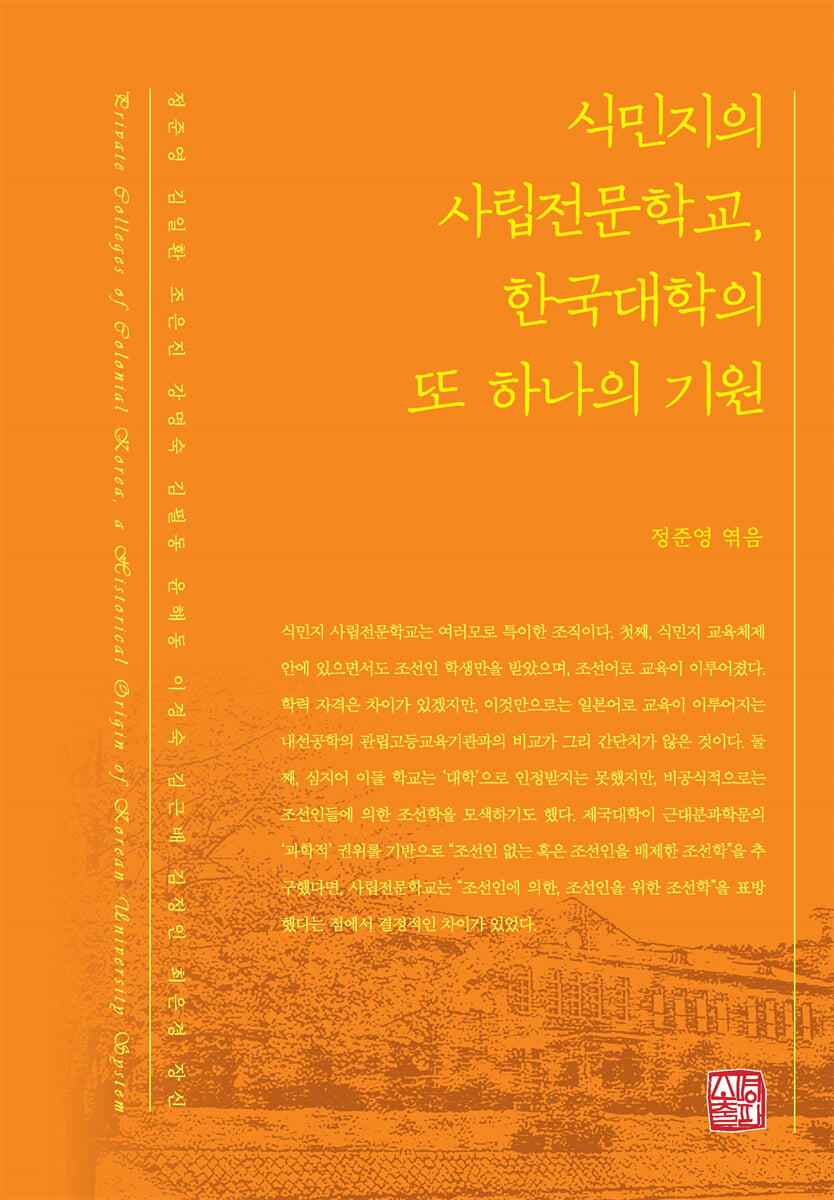
Private vocational schools in the colonies: another origin of Korean universities
 |
Description
Book Introduction
Could it be that Korean universities were not descendants of Gyeongseong Imperial University, but rather of private vocational schools? The essays included in this book, each from a different perspective, demonstrate that the historical experience of private vocational schools during the colonial period was "another origin" for Korean universities after liberation.
The authors examined in detail the unique experiences of colonial private vocational schools and the legacies they left for Korean universities after liberation, each in terms of their institutions and organizations, academics and intellectuals, and professional education experiences.
The authors examined in detail the unique experiences of colonial private vocational schools and the legacies they left for Korean universities after liberation, each in terms of their institutions and organizations, academics and intellectuals, and professional education experiences.
- You can preview some of the book's contents.
Preview
index
Introduction: The Origins of Korean Universities: Rethinking Through Colonial Private Vocational Schools
Part 1
The myth of national private education and the reality of colonial vocational schools
Jeong Jun-yeong | The Colonial Vocational School System or the Dark Side of "National History" - The Case of Joongang Buddhist Vocational School
Kim Il-hwan | Incorporating Private Vocational Schools into Foundations and the Public Context: The Case of Boseong Vocational School
Eun-jin Cho | The Curriculum of Government-Led Vocational Schools and the Inter-Korean Cooperation
Kang Myung-sook | War and Colonial Vocational Schools - Vocational School Policy after 1938
Part 2
Studying at a vocational school and becoming an intellectual in the colony
Kim Pil-dong | Vocational Schools and Sociology Education under Japanese Colonialism
Yun Hae-dong | Confucianism and Higher Education in the Colonial Period: The Case of Myeongnyun College
Lee Kyung-sook | Professor at a Vocational School, Residences of Colonial Intellectuals - The Case of Soongsil College
Part 3
What You Learn at a Vocational School: A Professional Journal That Confronts Colonial Reality
Kim Geun-bae | Scientists and Engineers at Soongsil College - Departments of Science, Agriculture, and Alumni
Kim Jeong-in | Teacher Training: The Direction of Colonial Women's Education - The Case of Ewha Womans College
Eun-kyung Choi | Korean Female Doctors during the Japanese Colonial Period - From Graduation from Tokyo Women's Medical College to the Founding of Gyeongseong Women's Medical College
Jangshin | The Origins of Korean Medical Schools
Search
About the author
Part 1
The myth of national private education and the reality of colonial vocational schools
Jeong Jun-yeong | The Colonial Vocational School System or the Dark Side of "National History" - The Case of Joongang Buddhist Vocational School
Kim Il-hwan | Incorporating Private Vocational Schools into Foundations and the Public Context: The Case of Boseong Vocational School
Eun-jin Cho | The Curriculum of Government-Led Vocational Schools and the Inter-Korean Cooperation
Kang Myung-sook | War and Colonial Vocational Schools - Vocational School Policy after 1938
Part 2
Studying at a vocational school and becoming an intellectual in the colony
Kim Pil-dong | Vocational Schools and Sociology Education under Japanese Colonialism
Yun Hae-dong | Confucianism and Higher Education in the Colonial Period: The Case of Myeongnyun College
Lee Kyung-sook | Professor at a Vocational School, Residences of Colonial Intellectuals - The Case of Soongsil College
Part 3
What You Learn at a Vocational School: A Professional Journal That Confronts Colonial Reality
Kim Geun-bae | Scientists and Engineers at Soongsil College - Departments of Science, Agriculture, and Alumni
Kim Jeong-in | Teacher Training: The Direction of Colonial Women's Education - The Case of Ewha Womans College
Eun-kyung Choi | Korean Female Doctors during the Japanese Colonial Period - From Graduation from Tokyo Women's Medical College to the Founding of Gyeongseong Women's Medical College
Jangshin | The Origins of Korean Medical Schools
Search
About the author
Into the book
Although ‘national history studies’ had limitations as an ‘educational institution within the colonial education system,’ it was incomparable to the colonial government schools.
It was natural that they would virtually take charge of the higher education of Koreans.
From the colonial authorities' perspective, there may have been a realistic judgment that there was no need to incur the resentment of the Korean community as long as these vocational schools complied with the colonial system.
As a result, the reason private vocational schools could be 'national history schools' was to the extent that they conformed to the colonial system.
--- p.33, from Chapter 1
Since its establishment as a foundation, the history of Boseong College has been marked by ongoing debate and conflict surrounding how a private school foundation, as a public entity, should be run, and particularly how to institutionalize the foundation's public operation within the influence of donors who have contributed private assets.
Of course, in private schools where school expenses are not provided by the government, and especially in foundation organizations that tend to be run primarily by asset contributors, the influence of donors was a natural phenomenon.
However, these forces were in constant tension with other forces, such as the unique position of the council in the foundation structure of the 1920s, the intervention of school officials, and the expectations of public opinion.
--- p.86, from Chapter 2
At the time when the engineering school was first implemented, the educational authorities said that "vocational schools were for the convenience of Korean children" and that "for convenience's sake, we will accept Japanese students, but the number of students assigned will be determined within one-third of the number of Korean students." However, the actual situation turned out to be that the number of Korean students enrolled was only about one-third of the number of Japanese students enrolled.
In this situation, the Korean people could not help but lament, "Who are these vocational schools and universities for?"
This soon brought about the terrifying ordeal of 'vocational school admission hell' for Korean students.
--- p.136, from Chapter 3
Due to the provision of abnormal specialized education opportunities, colonial Korean students, who were mainly students at private liberal arts schools, were sent to the battlefield as volunteers or mobilized to production sites, but for Japanese students at government-run vocational schools, medical schools, and teacher training schools, specialized education opportunities could be used as a route to exemption from and deferment of conscription.
The introduction of Japanese studies courses, the expansion of enrollment quotas, and the establishment of a "Japanese" educational system emphasizing the connection between education and learning in colonial Korean vocational schools during the wartime period functioned as a contradictory device that provided opportunities for Japanese people to stand in the sun while increasing the risk of Koreans being pushed into the shadows.
--- p.183, from Chapter 4
In this way, most of the vocational schools established by Koreans or foreign missionaries offered sociology courses.
However, sociology classes were not offered at public vocational schools or Japanese private vocational schools.
This is because the vocational schools established by Koreans or missionaries originally aimed to be general universities, and their educational purpose was to foster awareness of the world, society, and even the nation through sociology.
--- p.251, from Chapter 5
In this situation, the demand for the establishment of specialized Confucian higher education institutions was growing, and what fueled this movement was the rise of imperial Confucianism and the systemic demand for the establishment of a wartime system.
Myungryun College, which was promoted in 1942, was organized into three higher education departments: Confucianism, Law, and Economics.
The specific curriculum and faculty composition are still unknown.
However, as the war deepened, the school was closed in 1944 and the new Myeongnyun Yeonseongso was established.
Thus, the colonial Confucian school ended its short life without producing a single graduate.
--- p.304, from Chapter 6
The homes of colonial intellectuals were somewhere between private vocational schools, secondary schools, newspaper offices, and various forms of social organizations that could be subject to surveillance at any time.
They were everywhere rather than settling in one place.
In particular, the job of a professor at a vocational school, as determined by the colonial power, was limited to 'teaching' advanced academic skills, but as Park Chi-woo put it, the professors at the colonial vocational school did not remain 'academic' but diligently sought to create a new field of knowledge 'today' and 'in this land' and to engage in public research activities.
--- p.316, from Chapter 7
During this period, the role played by Soongsil College in science and technology was by no means small.
Thanks to the establishment and operation of the Department of Science and the Department of Agriculture, many Korean graduates majoring in science and technology were produced.
In addition, in a situation where there were no suitable places for highly educated Korean scientists and engineers to go, many of them were given opportunities for education and research.
Among them, there were several who grew up to be prominent scientists and engineers.
In this way, Soongsil College was a valuable historical asset not only in the field of literature but also in the field of science.
--- p.372~373, from Chapter 8
Ewha Womans University produced kindergarten teachers, a profession once considered exclusive to women; music teachers, essential for missionary work as well as school work; homemaking teachers, who taught women about their roles in the home in a modern way; and English teachers, who were Western-minded and cultured. Graduates from Ewha Womans University have gone on to work as teachers in kindergartens and private girls' high schools across the country.
In a time when women's social advancement was extremely limited, Ewha Womans University graduates who worked as teachers prided themselves on being female intellectuals, and society treated them as such.
Furthermore, the realization of higher education for women and the advancement of graduates into teaching positions have firmly established themselves as a catalyst for women to choose higher education as a stepping stone for their advancement into society.
--- p.432~433, from Chapter 9
What did it mean to be trained as a female doctor in colonial Korea? At the time, the number of medical training institutions offering Western medical training in colonial Korea was minimal.
Especially for women, the only way to become a doctor was to study abroad.
Nevertheless, starting with Heo Yeong-suk, until just before liberation, nearly 100 women chose to study medicine in Japan, including at Tokyo Women's University, despite the perception that it was "hard work for women."
While she received attention at the time as a new woman, a female celebrity, and a new female intellectual, she also took on the role of a leader in the women's movement, women's hygiene movement, and women's medical movement, which were given to her by the times.
--- p.462, from Chapter 10
Two questions arise here.
One is why the US military government decided to use a 6-year 2+4 system instead of an 8-year 4+4 system in Korea, and the other is why Korea, which has the same type as Germany or Japan, did not have a pre-med department in a medical school but instead placed it in a science college (college of natural sciences).
What is the origin of the Korean-style medical school, which is neither American nor Japanese?
(Omitted) The first question about the origin of Korean-style medical schools can only be answered in the unique characteristics of Korean medical education before liberation, or in other words, in the medical education experienced by colonial Koreans in Japan.
The second question must be addressed in the context of medical schools, which were transformed from single-department colleges to departments of comprehensive universities after liberation.
It was natural that they would virtually take charge of the higher education of Koreans.
From the colonial authorities' perspective, there may have been a realistic judgment that there was no need to incur the resentment of the Korean community as long as these vocational schools complied with the colonial system.
As a result, the reason private vocational schools could be 'national history schools' was to the extent that they conformed to the colonial system.
--- p.33, from Chapter 1
Since its establishment as a foundation, the history of Boseong College has been marked by ongoing debate and conflict surrounding how a private school foundation, as a public entity, should be run, and particularly how to institutionalize the foundation's public operation within the influence of donors who have contributed private assets.
Of course, in private schools where school expenses are not provided by the government, and especially in foundation organizations that tend to be run primarily by asset contributors, the influence of donors was a natural phenomenon.
However, these forces were in constant tension with other forces, such as the unique position of the council in the foundation structure of the 1920s, the intervention of school officials, and the expectations of public opinion.
--- p.86, from Chapter 2
At the time when the engineering school was first implemented, the educational authorities said that "vocational schools were for the convenience of Korean children" and that "for convenience's sake, we will accept Japanese students, but the number of students assigned will be determined within one-third of the number of Korean students." However, the actual situation turned out to be that the number of Korean students enrolled was only about one-third of the number of Japanese students enrolled.
In this situation, the Korean people could not help but lament, "Who are these vocational schools and universities for?"
This soon brought about the terrifying ordeal of 'vocational school admission hell' for Korean students.
--- p.136, from Chapter 3
Due to the provision of abnormal specialized education opportunities, colonial Korean students, who were mainly students at private liberal arts schools, were sent to the battlefield as volunteers or mobilized to production sites, but for Japanese students at government-run vocational schools, medical schools, and teacher training schools, specialized education opportunities could be used as a route to exemption from and deferment of conscription.
The introduction of Japanese studies courses, the expansion of enrollment quotas, and the establishment of a "Japanese" educational system emphasizing the connection between education and learning in colonial Korean vocational schools during the wartime period functioned as a contradictory device that provided opportunities for Japanese people to stand in the sun while increasing the risk of Koreans being pushed into the shadows.
--- p.183, from Chapter 4
In this way, most of the vocational schools established by Koreans or foreign missionaries offered sociology courses.
However, sociology classes were not offered at public vocational schools or Japanese private vocational schools.
This is because the vocational schools established by Koreans or missionaries originally aimed to be general universities, and their educational purpose was to foster awareness of the world, society, and even the nation through sociology.
--- p.251, from Chapter 5
In this situation, the demand for the establishment of specialized Confucian higher education institutions was growing, and what fueled this movement was the rise of imperial Confucianism and the systemic demand for the establishment of a wartime system.
Myungryun College, which was promoted in 1942, was organized into three higher education departments: Confucianism, Law, and Economics.
The specific curriculum and faculty composition are still unknown.
However, as the war deepened, the school was closed in 1944 and the new Myeongnyun Yeonseongso was established.
Thus, the colonial Confucian school ended its short life without producing a single graduate.
--- p.304, from Chapter 6
The homes of colonial intellectuals were somewhere between private vocational schools, secondary schools, newspaper offices, and various forms of social organizations that could be subject to surveillance at any time.
They were everywhere rather than settling in one place.
In particular, the job of a professor at a vocational school, as determined by the colonial power, was limited to 'teaching' advanced academic skills, but as Park Chi-woo put it, the professors at the colonial vocational school did not remain 'academic' but diligently sought to create a new field of knowledge 'today' and 'in this land' and to engage in public research activities.
--- p.316, from Chapter 7
During this period, the role played by Soongsil College in science and technology was by no means small.
Thanks to the establishment and operation of the Department of Science and the Department of Agriculture, many Korean graduates majoring in science and technology were produced.
In addition, in a situation where there were no suitable places for highly educated Korean scientists and engineers to go, many of them were given opportunities for education and research.
Among them, there were several who grew up to be prominent scientists and engineers.
In this way, Soongsil College was a valuable historical asset not only in the field of literature but also in the field of science.
--- p.372~373, from Chapter 8
Ewha Womans University produced kindergarten teachers, a profession once considered exclusive to women; music teachers, essential for missionary work as well as school work; homemaking teachers, who taught women about their roles in the home in a modern way; and English teachers, who were Western-minded and cultured. Graduates from Ewha Womans University have gone on to work as teachers in kindergartens and private girls' high schools across the country.
In a time when women's social advancement was extremely limited, Ewha Womans University graduates who worked as teachers prided themselves on being female intellectuals, and society treated them as such.
Furthermore, the realization of higher education for women and the advancement of graduates into teaching positions have firmly established themselves as a catalyst for women to choose higher education as a stepping stone for their advancement into society.
--- p.432~433, from Chapter 9
What did it mean to be trained as a female doctor in colonial Korea? At the time, the number of medical training institutions offering Western medical training in colonial Korea was minimal.
Especially for women, the only way to become a doctor was to study abroad.
Nevertheless, starting with Heo Yeong-suk, until just before liberation, nearly 100 women chose to study medicine in Japan, including at Tokyo Women's University, despite the perception that it was "hard work for women."
While she received attention at the time as a new woman, a female celebrity, and a new female intellectual, she also took on the role of a leader in the women's movement, women's hygiene movement, and women's medical movement, which were given to her by the times.
--- p.462, from Chapter 10
Two questions arise here.
One is why the US military government decided to use a 6-year 2+4 system instead of an 8-year 4+4 system in Korea, and the other is why Korea, which has the same type as Germany or Japan, did not have a pre-med department in a medical school but instead placed it in a science college (college of natural sciences).
What is the origin of the Korean-style medical school, which is neither American nor Japanese?
(Omitted) The first question about the origin of Korean-style medical schools can only be answered in the unique characteristics of Korean medical education before liberation, or in other words, in the medical education experienced by colonial Koreans in Japan.
The second question must be addressed in the context of medical schools, which were transformed from single-department colleges to departments of comprehensive universities after liberation.
--- p.466~467, from “Chapter 11”
Publisher's Review
During the Japanese colonial period, higher education was not limited to only Keijo Imperial University.
However, the only 'university' recognized by the Japanese Government-General of Korea in the colony was Keijo Imperial University.
To go to 'university', one had to go to Gyeongseong Imperial University through fierce competition, or go to Japan or another foreign country to seek education.
However, if higher education is not limited to ‘university,’ there were other paths to higher education even in colonial Korea.
That was the vocational school.
By definition, a 'vocational school' is a school that teaches specialized knowledge or skills.
Among them, 'private vocational schools' occupied the lowest position in the hierarchical higher education structure of the colony throughout the Japanese colonial period.
However, in colonial Korea, private vocational schools were not necessarily 'inferior' institutions limited to practical vocational education and specialized training.
Many students entered these schools with aspirations for higher education, and dreamed of ideals and aspirations different from those of the Japanese-dominated government-run higher education system established and operated by the colonial power.
For Korean intellectuals who had difficulty engaging in academic activities under Japanese-led academia, private vocational schools also served as a means to continue such activities.
Of course, private vocational schools could not shine only as ‘national private schools’ like the myth of later generations.
It was not easy for private vocational schools to escape the magnetic field of colonial power, and the harsh reality of colonialism they faced was that they had no choice but to waver between "colonial power" and "national history" at every moment.
Nevertheless, the significance of these private vocational schools is not small.
After liberation, not only did these schools give rise to a number of prestigious private universities, but the human and institutional legacies they left behind left a significant mark on Korean universities as a whole.
This book contains the results of joint research conducted by researchers in the fields of history, sociology, and educational history since 2019.
This book does not predetermine a consistent system or perspective, nor does it cover all private vocational schools.
In fact, in the current state of our academic world, research on colonial higher education, especially on private vocational schools, is still in its infancy.
Rather, in that sense, this book demonstrates the current state of academia on this issue, and attempts to offer a clue as to how we should view the systems and organizations of private vocational schools, their scholarship and knowledge, and the human legacy they leave behind, as well as what and how we should research in the future.
I hope that readers will broaden their horizons through this book, understanding and empathizing with the fact that colonial private vocational schools were "another origin" of Korean universities, and therefore examining the experiences of colonial private vocational schools offers a new way to read the history of Korean universities.
'Another Origin' of Korean Universities Through the Lens of Colonial Private Vocational Schools - Did Korean Universities Start at Private Vocational Schools, Not Gyeongseong Imperial University?
This book is a compilation of research findings that examine in detail the entire context of colonial private vocational schools, focusing on them as "another origin" of Korean universities.
As is well known, during the colonial period in Joseon, no universities other than Gyeongseong Imperial University, which was directly established by the colonial power, were permitted to be established.
Several groups that aimed to provide higher education for Koreans continuously attempted to establish 'universities', but ultimately had no choice but to settle for the establishment of 'private' 'vocational schools'.
This reflects the fact that studies on the historical origins of the Korean university system have focused on universities after liberation in 1945, or even before that, have limited themselves to analyzing universities such as Keijo Imperial University.
However, the colonial private vocational schools were more than just undeveloped institutions that had not yet become 'universities'.
This is not only to point out that private vocational schools were the predecessors of today's leading private universities.
For example, Gyeongseong Imperial University was close to being an institution from which Koreans were completely excluded from its operation.
Although there were many 'Chosunjin' who graduated from the Imperial University, there were no Koreans who taught or ran an academic program at the Imperial University.
Ultimately, the experiences that Korean intellectuals referenced after liberation when planning and operating new universities were close to those they had accumulated while establishing, teaching, and operating private vocational schools in the colony.
This is why the authors pose the somewhat provocative question, “Couldn’t Korean universities be descendants of private vocational schools rather than Gyeongseong Imperial University?”
The Reality of Colonial Private Vocational Schools as Seen Through Institutions and Organizations, Academics and Intellectuals, and Educational Experience
Private vocational schools in colonial Korea were unique organizations in many ways.
First of all, there was no place in the Japanese Empire's territories, including Taiwan and Manchuria, where the establishment and operation of private vocational schools were as active as in Joseon.
Private vocational schools were clearly part of the colonial higher education system, but they only accepted Korean students and education was conducted in the Korean language.
This is also the background to the rise of private vocational schools as 'national private schools' that stood against the Japanese-dominated Keijo Imperial University and government-run vocational schools.
The authors examine in detail the unique experiences of colonial private vocational schools and the legacies they left for Korean universities after liberation, from the perspectives of institutions and organizations, academics and intellectuals, and professional education experience.
The studies included in Part I address the contradictory existence of private vocational schools that were incorporated into the colonial education system but not fully integrated into it.
This reveals the complexity of private vocational schools, which at times resisted colonial power and pursued independent education, but frequently complied with it, were co-opted by it, and even actively cooperated with it under the pretext of expanding their influence.
In Chapter 1, Jeong Jun-yeong outlines the characteristics of the colonial vocational school system and dissects the myth of ‘national private education’ through the case of the Central Buddhist Vocational School.
In Chapter 2, Kim Il-hwan examines the origins of the Korean private university system, where foundations became the main players in establishing and managing private universities, through the case of Boseong College. He also clarifies the significance of private school foundations being publicly operated in a colonial society.
In Chapter 3, Eun-Jin Cho mainly addresses the issue of admission qualifications for vocational schools and domestic and international studies, focusing on the case of public vocational schools.
In Chapter 4, Kang Myeong-suk analyzes the vocational school policy of the Japanese Government-General of Korea under the wartime system after 1938, and analyzes the way in which vocational school education became formalized during the preparations for war.
Part 2 examines what it meant to be an intellectual and to pursue scholarship in a colony through the lens of private vocational schools.
Although private vocational schools were never recognized as "universities," their significance was significant in that they were the only places where academic pursuits "by Koreans, for Koreans" were institutionally possible in colonial society.
In Chapter 5, Kim Pil-dong meticulously demonstrates, through extensive historical materials, how private vocational schools could become places where Korean sociologists taught sociology to Korean students in the Korean language.
In Chapter 6, Yun Hae-dong examines the reorganization of Confucianism, a traditional knowledge system and religion, into a specialized knowledge system that can be taught in vocational schools through Confucian higher education institutions such as Myeongnyun Academy and Myeongnyun College.
In Chapter 7, Lee Kyung-sook uses the case of Soongsil College to closely trace the path of professor recruitment, the composition of the faculty, and the characteristics of the intellectual network formed through this process.
Part 3 examines what it meant to learn at a colonial vocational school.
Even though the specialized knowledge taught in private vocational schools was of a lower status than that of imperial universities, it was the highest level of knowledge accessible to many colonial intellectuals.
Examining what the elites educated here pursued after liberation is a crucial key to understanding the early formation of Korean universities.
In Chapter 8, Kim Geun-bae examines the careers of Korean scientists and engineers who graduated from the Department of Science and the Department of Agriculture at Sungsil College.
In Chapter 9, Kim Jeong-in examines the significance of the fact that one of the goals of colonial women's education was 'teacher training' through the case of Ewha Women's College.
In Chapter 10, Eun-kyung Choi questions the meaning of being trained as a female doctor and living in a colony through the activities of four female doctors from Tokyo Women's Medical College who led the establishment of Gyeongseong Women's College (but were unable to complete it).
Finally, in Chapter 11, Jang Shin traces the background of how Korean medical education after liberation was institutionalized in a unique form of pre-medical education that was neither Japanese nor American.
Why Private Vocational Schools Now? A History of Private Vocational Schools in the Age of the "University Crisis."
The essays included in this book demonstrate, from different perspectives, that the historical experience of private vocational schools during the colonial period was another origin for Korean universities after liberation.
But why, at this point in time, do we need to revisit the history of private vocational schools?
In fact, the 'crisis theory' of Korean universities has been rampant for a long time.
Moreover, it is difficult to find a methodology for dealing with the mounting crisis.
One of the important reasons for this may be that Korean higher education is overly dependent on private universities.
Private universities in Korea already account for 80% of all universities and about 70% of enrolled students.
Since liberation, public universities have never had an advantage over private universities, and the gap between local public universities and private universities in the metropolitan area is growing wider.
Moreover, although Korean universities are regarded as public property whose importance no one denies, in reality they exist as private property that is privately owned, operated, and managed.
The fact that most universities in Korea are private is a fundamental constraint on fundamentally resolving the university crisis through public intervention.
But how well do we understand the origins of these problems? It wouldn't be an exaggeration to say that the history of private universities in Korea has been too easily glossed over through the myth of "national history" or dismissed as "backward" and "regressive" due to the tyranny of some private school leaders.
Rather, what is truly needed is to trace the diverse origins and sources of the heterogeneous elements that make up the Korean private university system and to understand in detail the resulting effects.
In that sense, this work's tracing of the origins of the problem of private universities in Korea through "private vocational schools" may provide an important opportunity to examine the problems we face more fundamentally.
However, the only 'university' recognized by the Japanese Government-General of Korea in the colony was Keijo Imperial University.
To go to 'university', one had to go to Gyeongseong Imperial University through fierce competition, or go to Japan or another foreign country to seek education.
However, if higher education is not limited to ‘university,’ there were other paths to higher education even in colonial Korea.
That was the vocational school.
By definition, a 'vocational school' is a school that teaches specialized knowledge or skills.
Among them, 'private vocational schools' occupied the lowest position in the hierarchical higher education structure of the colony throughout the Japanese colonial period.
However, in colonial Korea, private vocational schools were not necessarily 'inferior' institutions limited to practical vocational education and specialized training.
Many students entered these schools with aspirations for higher education, and dreamed of ideals and aspirations different from those of the Japanese-dominated government-run higher education system established and operated by the colonial power.
For Korean intellectuals who had difficulty engaging in academic activities under Japanese-led academia, private vocational schools also served as a means to continue such activities.
Of course, private vocational schools could not shine only as ‘national private schools’ like the myth of later generations.
It was not easy for private vocational schools to escape the magnetic field of colonial power, and the harsh reality of colonialism they faced was that they had no choice but to waver between "colonial power" and "national history" at every moment.
Nevertheless, the significance of these private vocational schools is not small.
After liberation, not only did these schools give rise to a number of prestigious private universities, but the human and institutional legacies they left behind left a significant mark on Korean universities as a whole.
This book contains the results of joint research conducted by researchers in the fields of history, sociology, and educational history since 2019.
This book does not predetermine a consistent system or perspective, nor does it cover all private vocational schools.
In fact, in the current state of our academic world, research on colonial higher education, especially on private vocational schools, is still in its infancy.
Rather, in that sense, this book demonstrates the current state of academia on this issue, and attempts to offer a clue as to how we should view the systems and organizations of private vocational schools, their scholarship and knowledge, and the human legacy they leave behind, as well as what and how we should research in the future.
I hope that readers will broaden their horizons through this book, understanding and empathizing with the fact that colonial private vocational schools were "another origin" of Korean universities, and therefore examining the experiences of colonial private vocational schools offers a new way to read the history of Korean universities.
'Another Origin' of Korean Universities Through the Lens of Colonial Private Vocational Schools - Did Korean Universities Start at Private Vocational Schools, Not Gyeongseong Imperial University?
This book is a compilation of research findings that examine in detail the entire context of colonial private vocational schools, focusing on them as "another origin" of Korean universities.
As is well known, during the colonial period in Joseon, no universities other than Gyeongseong Imperial University, which was directly established by the colonial power, were permitted to be established.
Several groups that aimed to provide higher education for Koreans continuously attempted to establish 'universities', but ultimately had no choice but to settle for the establishment of 'private' 'vocational schools'.
This reflects the fact that studies on the historical origins of the Korean university system have focused on universities after liberation in 1945, or even before that, have limited themselves to analyzing universities such as Keijo Imperial University.
However, the colonial private vocational schools were more than just undeveloped institutions that had not yet become 'universities'.
This is not only to point out that private vocational schools were the predecessors of today's leading private universities.
For example, Gyeongseong Imperial University was close to being an institution from which Koreans were completely excluded from its operation.
Although there were many 'Chosunjin' who graduated from the Imperial University, there were no Koreans who taught or ran an academic program at the Imperial University.
Ultimately, the experiences that Korean intellectuals referenced after liberation when planning and operating new universities were close to those they had accumulated while establishing, teaching, and operating private vocational schools in the colony.
This is why the authors pose the somewhat provocative question, “Couldn’t Korean universities be descendants of private vocational schools rather than Gyeongseong Imperial University?”
The Reality of Colonial Private Vocational Schools as Seen Through Institutions and Organizations, Academics and Intellectuals, and Educational Experience
Private vocational schools in colonial Korea were unique organizations in many ways.
First of all, there was no place in the Japanese Empire's territories, including Taiwan and Manchuria, where the establishment and operation of private vocational schools were as active as in Joseon.
Private vocational schools were clearly part of the colonial higher education system, but they only accepted Korean students and education was conducted in the Korean language.
This is also the background to the rise of private vocational schools as 'national private schools' that stood against the Japanese-dominated Keijo Imperial University and government-run vocational schools.
The authors examine in detail the unique experiences of colonial private vocational schools and the legacies they left for Korean universities after liberation, from the perspectives of institutions and organizations, academics and intellectuals, and professional education experience.
The studies included in Part I address the contradictory existence of private vocational schools that were incorporated into the colonial education system but not fully integrated into it.
This reveals the complexity of private vocational schools, which at times resisted colonial power and pursued independent education, but frequently complied with it, were co-opted by it, and even actively cooperated with it under the pretext of expanding their influence.
In Chapter 1, Jeong Jun-yeong outlines the characteristics of the colonial vocational school system and dissects the myth of ‘national private education’ through the case of the Central Buddhist Vocational School.
In Chapter 2, Kim Il-hwan examines the origins of the Korean private university system, where foundations became the main players in establishing and managing private universities, through the case of Boseong College. He also clarifies the significance of private school foundations being publicly operated in a colonial society.
In Chapter 3, Eun-Jin Cho mainly addresses the issue of admission qualifications for vocational schools and domestic and international studies, focusing on the case of public vocational schools.
In Chapter 4, Kang Myeong-suk analyzes the vocational school policy of the Japanese Government-General of Korea under the wartime system after 1938, and analyzes the way in which vocational school education became formalized during the preparations for war.
Part 2 examines what it meant to be an intellectual and to pursue scholarship in a colony through the lens of private vocational schools.
Although private vocational schools were never recognized as "universities," their significance was significant in that they were the only places where academic pursuits "by Koreans, for Koreans" were institutionally possible in colonial society.
In Chapter 5, Kim Pil-dong meticulously demonstrates, through extensive historical materials, how private vocational schools could become places where Korean sociologists taught sociology to Korean students in the Korean language.
In Chapter 6, Yun Hae-dong examines the reorganization of Confucianism, a traditional knowledge system and religion, into a specialized knowledge system that can be taught in vocational schools through Confucian higher education institutions such as Myeongnyun Academy and Myeongnyun College.
In Chapter 7, Lee Kyung-sook uses the case of Soongsil College to closely trace the path of professor recruitment, the composition of the faculty, and the characteristics of the intellectual network formed through this process.
Part 3 examines what it meant to learn at a colonial vocational school.
Even though the specialized knowledge taught in private vocational schools was of a lower status than that of imperial universities, it was the highest level of knowledge accessible to many colonial intellectuals.
Examining what the elites educated here pursued after liberation is a crucial key to understanding the early formation of Korean universities.
In Chapter 8, Kim Geun-bae examines the careers of Korean scientists and engineers who graduated from the Department of Science and the Department of Agriculture at Sungsil College.
In Chapter 9, Kim Jeong-in examines the significance of the fact that one of the goals of colonial women's education was 'teacher training' through the case of Ewha Women's College.
In Chapter 10, Eun-kyung Choi questions the meaning of being trained as a female doctor and living in a colony through the activities of four female doctors from Tokyo Women's Medical College who led the establishment of Gyeongseong Women's College (but were unable to complete it).
Finally, in Chapter 11, Jang Shin traces the background of how Korean medical education after liberation was institutionalized in a unique form of pre-medical education that was neither Japanese nor American.
Why Private Vocational Schools Now? A History of Private Vocational Schools in the Age of the "University Crisis."
The essays included in this book demonstrate, from different perspectives, that the historical experience of private vocational schools during the colonial period was another origin for Korean universities after liberation.
But why, at this point in time, do we need to revisit the history of private vocational schools?
In fact, the 'crisis theory' of Korean universities has been rampant for a long time.
Moreover, it is difficult to find a methodology for dealing with the mounting crisis.
One of the important reasons for this may be that Korean higher education is overly dependent on private universities.
Private universities in Korea already account for 80% of all universities and about 70% of enrolled students.
Since liberation, public universities have never had an advantage over private universities, and the gap between local public universities and private universities in the metropolitan area is growing wider.
Moreover, although Korean universities are regarded as public property whose importance no one denies, in reality they exist as private property that is privately owned, operated, and managed.
The fact that most universities in Korea are private is a fundamental constraint on fundamentally resolving the university crisis through public intervention.
But how well do we understand the origins of these problems? It wouldn't be an exaggeration to say that the history of private universities in Korea has been too easily glossed over through the myth of "national history" or dismissed as "backward" and "regressive" due to the tyranny of some private school leaders.
Rather, what is truly needed is to trace the diverse origins and sources of the heterogeneous elements that make up the Korean private university system and to understand in detail the resulting effects.
In that sense, this work's tracing of the origins of the problem of private universities in Korea through "private vocational schools" may provide an important opportunity to examine the problems we face more fundamentally.
GOODS SPECIFICS
- Date of issue: November 20, 2023
- Page count, weight, size: 500 pages | 152*223*29mm
- ISBN13: 9791159058141
You may also like
카테고리
korean


korean

![GQ KOREA Mark (Monthly): December [2025]](http://librairie.coreenne.fr/cdn/shop/files/8ef265dbbfbf186523ed75ba7319009d.jpg?v=1765340328&width=3840)


