

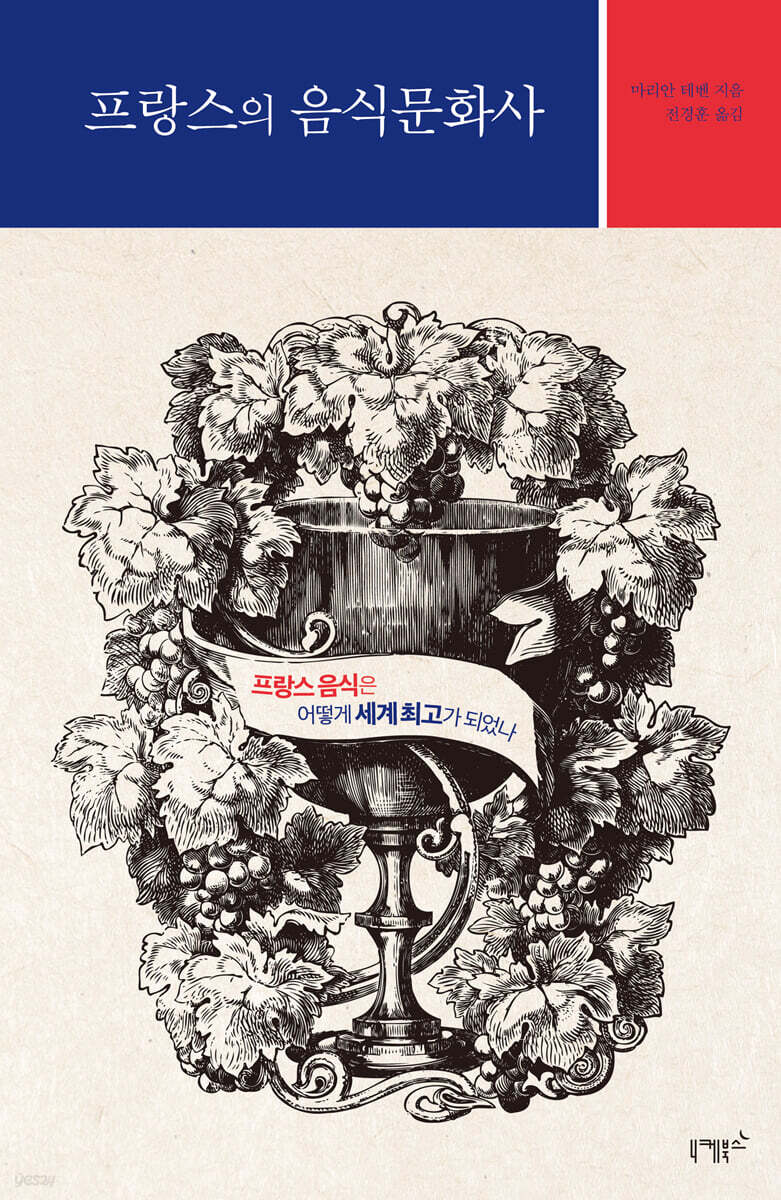
French food culture history
 |
Description
Book Introduction
“French cuisine has come to dominate the world not just because of the quality of its food.
That's also because of the stories the French tell about French food.
Moreover, the French are excellent storytellers!”
How France Became a Culinary Nation
A history of eating food, talking about food, and mythologizing food.
French cuisine is known as the origin and essence of gastronomy.
However, there are differing opinions as to whether the taste actually lives up to its reputation.
How did French cuisine earn the title of world-class? This book delves back in time, meticulously examining the foods eaten, drunk, and discussed by people who have lived in France from ancient times to the present day, to answer that question.
The spectrum covered in this book is diverse, from the barbaric Franks who ate raw pork, to the impact of Christianity on diet, to the countless institutions and regulations surrounding bread, to the emergence of cookbooks and the model of court cuisine, to the popularity of bourgeois cuisine after the Revolution, to the question of terroir in the colonies, to the culinary culture of France and its overseas territories today.
Beyond historical records, it also illuminates the ways in which food is represented in fictional genres such as literature and film. The diverse depictions of contemporary dietary customs in novels like Madame Bovary and In Search of Lost Time, and the film The Cook of the Elysée, allow us to explore layers that have been overlooked in previous research.
Author Marianne Teven, professor of French literature and director of the Institute for the History of Food and Culture at Bard College in Massachusetts, has published numerous works on food, exploring the relationship between French food and national identity and the symbolism of French cuisine.
After exploring extensive historical data, the author chose 'savoir-faire' as a keyword representing French food culture.
The original title of this book, savoir-faire, is a French word meaning skill or talent, but in relation to food culture, it refers to the know-how to grow, cook, and appreciate excellent food, and to promote it as French.
This single word embodies the belief that one can enjoy the best gastronomy by cooking high-quality food from the terroir created by nature with exceptional skill, and the confidence that one has made food uniquely French by relying on myths and symbols that elevate food beyond reality and into the realm of the imagination.
That's also because of the stories the French tell about French food.
Moreover, the French are excellent storytellers!”
How France Became a Culinary Nation
A history of eating food, talking about food, and mythologizing food.
French cuisine is known as the origin and essence of gastronomy.
However, there are differing opinions as to whether the taste actually lives up to its reputation.
How did French cuisine earn the title of world-class? This book delves back in time, meticulously examining the foods eaten, drunk, and discussed by people who have lived in France from ancient times to the present day, to answer that question.
The spectrum covered in this book is diverse, from the barbaric Franks who ate raw pork, to the impact of Christianity on diet, to the countless institutions and regulations surrounding bread, to the emergence of cookbooks and the model of court cuisine, to the popularity of bourgeois cuisine after the Revolution, to the question of terroir in the colonies, to the culinary culture of France and its overseas territories today.
Beyond historical records, it also illuminates the ways in which food is represented in fictional genres such as literature and film. The diverse depictions of contemporary dietary customs in novels like Madame Bovary and In Search of Lost Time, and the film The Cook of the Elysée, allow us to explore layers that have been overlooked in previous research.
Author Marianne Teven, professor of French literature and director of the Institute for the History of Food and Culture at Bard College in Massachusetts, has published numerous works on food, exploring the relationship between French food and national identity and the symbolism of French cuisine.
After exploring extensive historical data, the author chose 'savoir-faire' as a keyword representing French food culture.
The original title of this book, savoir-faire, is a French word meaning skill or talent, but in relation to food culture, it refers to the know-how to grow, cook, and appreciate excellent food, and to promote it as French.
This single word embodies the belief that one can enjoy the best gastronomy by cooking high-quality food from the terroir created by nature with exceptional skill, and the confidence that one has made food uniquely French by relying on myths and symbols that elevate food beyond reality and into the realm of the imagination.
- You can preview some of the book's contents.
Preview
index
Chapter 1: The Origins of French Food Culture, Gaul
Food in Literature | Decimus Magnus Ausonius, Mosella
Chapter 2: The Middle Ages and the Renaissance: The Age of Bread
Food in Literature | François Rabelais, Gargantua
Chapter 3 French Innovations: Cookbooks, Champagne, Canning, and Cheese
Food in Literature | Molière, The Nobles
Chapter 4 The French Revolution and Its Consequences: Wine, Bakery, and Meat
Food in Literature | Louis-Sébastien Mercier, The Year 2440
Chapter 5: The 19th Century and Carême: French Cuisine Conquers the World
Food in Literature | Delphine de Girardin, The Postman of Paris / George Sand, The Magic Swamp
Chapter 6: Literary Touchstones
Chapter 7: Outside the Hexagon: Terroir Across the Sea
Food in Literature | Mariese Condé, Cooking and Wonder
Chapter 8 Modernity: The Peasant Forever
Food in Literature | Muriel Barbery, Taste
Conclusion
Appendix | Recipes from History
Note / References / Acknowledgements / Photo Source
Food in Literature | Decimus Magnus Ausonius, Mosella
Chapter 2: The Middle Ages and the Renaissance: The Age of Bread
Food in Literature | François Rabelais, Gargantua
Chapter 3 French Innovations: Cookbooks, Champagne, Canning, and Cheese
Food in Literature | Molière, The Nobles
Chapter 4 The French Revolution and Its Consequences: Wine, Bakery, and Meat
Food in Literature | Louis-Sébastien Mercier, The Year 2440
Chapter 5: The 19th Century and Carême: French Cuisine Conquers the World
Food in Literature | Delphine de Girardin, The Postman of Paris / George Sand, The Magic Swamp
Chapter 6: Literary Touchstones
Chapter 7: Outside the Hexagon: Terroir Across the Sea
Food in Literature | Mariese Condé, Cooking and Wonder
Chapter 8 Modernity: The Peasant Forever
Food in Literature | Muriel Barbery, Taste
Conclusion
Appendix | Recipes from History
Note / References / Acknowledgements / Photo Source
Into the book
The tradition of eating well seems to have been inherent in the French lifestyle.
France, a blessed land of bountiful crops, once a magnificent empire extending beyond its borders, and celebrated in the writings of countless writers and chefs, seemed poised from the beginning to become the birthplace of gastronomy.
But French cuisine's dominance in the world isn't just due to the quality of its food.
That's also because of the stories the French tell about French food.
Moreover, the French are excellent storytellers.
Cookbooks, recipe books, and illustrations, not to mention myths, deliberately constructed stories, even those that are virtually fictional, and even the very terminology we use to talk about food and cooking, all play a part in understanding and spreading French cuisine around the world.
This book argues that French cuisine has become one of the most recognized cuisines on earth because we all know and remember its stories.
---From the "Opening Remarks"
As meat consumption was restricted by the influence of the Church, bread became central to the French diet, and in a sense the Middle Ages became the age of bread.
Unlike neighboring regions that relied on other grains, wheat cultivation dominated France from this period on.
The fact that wheat cultivation was dominant in France from an early period may explain the 'bread culture' that exists there today and that distinguishes France from its European neighbors.
(…) Since wheat had to be ground into flour to make bread, the mill became another site where the power of monasteries and feudal lords was at work.
---From "Chapter 2: The Middle Ages and the Renaissance: The Age of Bread"
Royal decrees on “just bread” (Charles V) in “sufficient, reasonable and just” quantities (Philip the Handsome), or on the “just price” of fish traded in the 14th-century Real (Palace of Paris) speak to the special relationship the French people had with food that began to take shape in the Middle Ages.
In legal documents and official decrees, prices and quantities were treated with consideration for fairness and accessibility.
It may seem odd to use terms like 'rational' in reference to bread and fish.
This is especially true when we consider that none of the human attributes that influence food choices, such as personal tastes, regional customs, and dietary preferences, can be quantified.
But in the history of French cuisine, the words 'appropriate' and 'just' are applied to food as readily as 'tasty' and 'healthy'.
The standard systems evoked by medieval and Renaissance codes show that objective measures (precise weights, regulations, fines) played a role.
However, imprecise and subjective characteristics, philosophies and beliefs also invade our thinking about food and food supply.
Pork was considered barbaric by the Franks, but later became acceptable.
The Grand Paradis was readily accepted until its origins were properly known.
The French believed that the climate in France was ideal for agriculture.
Early modern France experienced a turning point, turning away from the Rule of St. Benedict, which linked a thoughtful diet to spiritual salvation, and from strict medicinal rules that addressed physical temperament.
Now the French, drawn to the pleasures of taste and spices, began to tout their innate qualities as a nation of "bon mangeure"—a nation of good eaters in every sense of the word.
Now, 'Bon Mangeure' was a category that distinguished civilized people (restraint and refinement) from savages (gluttony and crudeness).
Just as the classical Roman aristocracy classified peoples outside the Roman Empire, including the Franks, as barbarians.
---From "Chapter 2: The Middle Ages and the Renaissance: The Age of Bread"
Surprisingly, the period when printed cookbooks were a triumph of haute cuisine for the upper classes coincided with one of the most severe famines in French history.
Bad weather led to catastrophic crop yields, which in turn led to rising grain prices, leading to severe famines that devastated the country in 1630, 1649, and 1652, culminating in the 'Medieval Famine' in 1661.
The Fronde, a series of revolts against the monarchy in the mid-17th century, exacerbated grain shortages by disrupting harvests and distribution to Paris.
In 1693 and 1694, unusually cold and wet spring and summer weather brought another severe famine, and France subsequently experienced a severe population decline due to widespread disease and a plummeting birth rate caused by hunger.
Ultimately, the grain shortages of the 17th century resulted in higher mortality rates than those that fueled the 18th-century revolutions.
The coincidence that the rise of haute cuisine in the upper class occurred against the backdrop of great famine further illuminates the highly decorative aspects of cookbooks and court cuisine.
Those who dined at court would spend lavishly on their appearance, even to the point of bankruptcy, wearing clothes that revealed their status, and like them, these cookbooks also flaunted their wealth.
French cuisine, as created and presented in 17th-century cookbooks, highlights the gap between the Parisian upper class and the rest of France.
Paris and the rest of the country had a master/slave relationship with regard to food supply, a relationship that became increasingly severe as transportation networks developed and government became more centralized.
The peasants of the countryside were practically being expropriated for the fruits of their hard labor to satisfy the bottomless desires of the Parisians.
This made Paris the true capital, and created a permanent divide between Paris and the provinces.
---From "Chapter 3 French Innovations: Cookbooks, Champagne, Canned Goods, and Cheese"
If French cuisine today is understood as haute cuisine, the credit goes to the events of the 19th century.
“Because gastronomy, as a modern social phenomenon, began in France in the early 19th century.”
Those who most loudly and proudly proclaimed the superiority of French cuisine belonged to the highest class and formed the familiar trio.
They are Marie-Antoine Carême, Jean-Anthelme Brillat-Savarin, and Alexandre-Balthazar-Laurent Grimaud de la Rénière.
In this formula, gastronomy belongs to France.
And haute cuisine led France into modern times.
Common knowledge about French cuisine is often limited to the foods and techniques of the 19th century.
Because these three men spread the gospel of gastronomy far and wide, reaching both the powerful elite and the reading public, creating an indelible portrait of French cuisine.
The 19th century was the whole and the core of French cuisine.
This perspective makes sense when we consider that this period was also the culmination of a process in which rules were created and systematically codified by the chef and cookbook author Marie-Antoine Carême.
Carême so thoroughly defined French cuisine, and his followers so widely disseminated its techniques, that French cuisine became the sole model of haute cuisine for the courts of Europe and state banquets around the world.
The 'classic' French cuisine in today's Michelin-starred restaurants largely remains true to these fundamentals.
But that wasn't how it should be.
The era that welcomed Carême and his gastronomy brothers came in the wake of the turbulent Revolution of 1789, saw the revolutions of 1830 and 1848, witnessed three republics, two empires under two different emperors named Napoleon, and saw two short-lived revolts (the Hundred Days of Napoleon and the Paris Commune of 1871).
---From "Chapter 5 The 19th Century and Carême: French Cuisine Conquers the World"
Brillat-Savarin's "Tell me what you eat.
You will hear the saying, “Then I will tell you who you are.”
If you were to ask what movie about French food is best, you'd probably get "Babette's Feast."
French cuisine not only dominates restaurant culture and haute cuisine, but also occupies our culinary consciousness in literature and film, an imaginary embodiment of food that can be eaten at any time and place, preserving the moment.
Food images in literature and film may be realistic, but they are not reality.
These representations convey a selective image of how, where, and with whom we eat.
And through the power of repetition, enduring images tell us something about the collective acceptance of that particular moment in time when it comes to food.
French food narratives rely on associating French cuisine with sophistication and elite aspirations.
---From "Chapter 6: Literary Touchstones"
The history of French cuisine is not about gastronomy, not about terroir, not about peasants, but about all of these things.
It is never a single entity, but rather a series of layers.
A true mille-feuille of culinary exceptionalism, a blend of haute cuisine and bourgeois cuisine, Paris and the countryside, city and country.
The holistic view of French cuisine includes produce and dishes from outside France's borders, but transforms them, either nominally or in fact, to make them French.
Science and art come together to produce the finest bread and ensure the highest standards of AOC wine and cheese.
Above all, the history of French cuisine relies on myths and symbols that elevate eating beyond the realm of the physical into the realm of the imaginary.
The legends of cheese, the inventors of wine, and the stories of the names of sauces have become 'lieux de memoirs' (places of memory) for the French people.
A shared culinary history (whether created or not) creates a sense of solidarity among members of a national group, and the French have been exceptionally adept at creating and promoting a shared culinary identity that has become so thoroughly defined that it resonates around the world.
France, a blessed land of bountiful crops, once a magnificent empire extending beyond its borders, and celebrated in the writings of countless writers and chefs, seemed poised from the beginning to become the birthplace of gastronomy.
But French cuisine's dominance in the world isn't just due to the quality of its food.
That's also because of the stories the French tell about French food.
Moreover, the French are excellent storytellers.
Cookbooks, recipe books, and illustrations, not to mention myths, deliberately constructed stories, even those that are virtually fictional, and even the very terminology we use to talk about food and cooking, all play a part in understanding and spreading French cuisine around the world.
This book argues that French cuisine has become one of the most recognized cuisines on earth because we all know and remember its stories.
---From the "Opening Remarks"
As meat consumption was restricted by the influence of the Church, bread became central to the French diet, and in a sense the Middle Ages became the age of bread.
Unlike neighboring regions that relied on other grains, wheat cultivation dominated France from this period on.
The fact that wheat cultivation was dominant in France from an early period may explain the 'bread culture' that exists there today and that distinguishes France from its European neighbors.
(…) Since wheat had to be ground into flour to make bread, the mill became another site where the power of monasteries and feudal lords was at work.
---From "Chapter 2: The Middle Ages and the Renaissance: The Age of Bread"
Royal decrees on “just bread” (Charles V) in “sufficient, reasonable and just” quantities (Philip the Handsome), or on the “just price” of fish traded in the 14th-century Real (Palace of Paris) speak to the special relationship the French people had with food that began to take shape in the Middle Ages.
In legal documents and official decrees, prices and quantities were treated with consideration for fairness and accessibility.
It may seem odd to use terms like 'rational' in reference to bread and fish.
This is especially true when we consider that none of the human attributes that influence food choices, such as personal tastes, regional customs, and dietary preferences, can be quantified.
But in the history of French cuisine, the words 'appropriate' and 'just' are applied to food as readily as 'tasty' and 'healthy'.
The standard systems evoked by medieval and Renaissance codes show that objective measures (precise weights, regulations, fines) played a role.
However, imprecise and subjective characteristics, philosophies and beliefs also invade our thinking about food and food supply.
Pork was considered barbaric by the Franks, but later became acceptable.
The Grand Paradis was readily accepted until its origins were properly known.
The French believed that the climate in France was ideal for agriculture.
Early modern France experienced a turning point, turning away from the Rule of St. Benedict, which linked a thoughtful diet to spiritual salvation, and from strict medicinal rules that addressed physical temperament.
Now the French, drawn to the pleasures of taste and spices, began to tout their innate qualities as a nation of "bon mangeure"—a nation of good eaters in every sense of the word.
Now, 'Bon Mangeure' was a category that distinguished civilized people (restraint and refinement) from savages (gluttony and crudeness).
Just as the classical Roman aristocracy classified peoples outside the Roman Empire, including the Franks, as barbarians.
---From "Chapter 2: The Middle Ages and the Renaissance: The Age of Bread"
Surprisingly, the period when printed cookbooks were a triumph of haute cuisine for the upper classes coincided with one of the most severe famines in French history.
Bad weather led to catastrophic crop yields, which in turn led to rising grain prices, leading to severe famines that devastated the country in 1630, 1649, and 1652, culminating in the 'Medieval Famine' in 1661.
The Fronde, a series of revolts against the monarchy in the mid-17th century, exacerbated grain shortages by disrupting harvests and distribution to Paris.
In 1693 and 1694, unusually cold and wet spring and summer weather brought another severe famine, and France subsequently experienced a severe population decline due to widespread disease and a plummeting birth rate caused by hunger.
Ultimately, the grain shortages of the 17th century resulted in higher mortality rates than those that fueled the 18th-century revolutions.
The coincidence that the rise of haute cuisine in the upper class occurred against the backdrop of great famine further illuminates the highly decorative aspects of cookbooks and court cuisine.
Those who dined at court would spend lavishly on their appearance, even to the point of bankruptcy, wearing clothes that revealed their status, and like them, these cookbooks also flaunted their wealth.
French cuisine, as created and presented in 17th-century cookbooks, highlights the gap between the Parisian upper class and the rest of France.
Paris and the rest of the country had a master/slave relationship with regard to food supply, a relationship that became increasingly severe as transportation networks developed and government became more centralized.
The peasants of the countryside were practically being expropriated for the fruits of their hard labor to satisfy the bottomless desires of the Parisians.
This made Paris the true capital, and created a permanent divide between Paris and the provinces.
---From "Chapter 3 French Innovations: Cookbooks, Champagne, Canned Goods, and Cheese"
If French cuisine today is understood as haute cuisine, the credit goes to the events of the 19th century.
“Because gastronomy, as a modern social phenomenon, began in France in the early 19th century.”
Those who most loudly and proudly proclaimed the superiority of French cuisine belonged to the highest class and formed the familiar trio.
They are Marie-Antoine Carême, Jean-Anthelme Brillat-Savarin, and Alexandre-Balthazar-Laurent Grimaud de la Rénière.
In this formula, gastronomy belongs to France.
And haute cuisine led France into modern times.
Common knowledge about French cuisine is often limited to the foods and techniques of the 19th century.
Because these three men spread the gospel of gastronomy far and wide, reaching both the powerful elite and the reading public, creating an indelible portrait of French cuisine.
The 19th century was the whole and the core of French cuisine.
This perspective makes sense when we consider that this period was also the culmination of a process in which rules were created and systematically codified by the chef and cookbook author Marie-Antoine Carême.
Carême so thoroughly defined French cuisine, and his followers so widely disseminated its techniques, that French cuisine became the sole model of haute cuisine for the courts of Europe and state banquets around the world.
The 'classic' French cuisine in today's Michelin-starred restaurants largely remains true to these fundamentals.
But that wasn't how it should be.
The era that welcomed Carême and his gastronomy brothers came in the wake of the turbulent Revolution of 1789, saw the revolutions of 1830 and 1848, witnessed three republics, two empires under two different emperors named Napoleon, and saw two short-lived revolts (the Hundred Days of Napoleon and the Paris Commune of 1871).
---From "Chapter 5 The 19th Century and Carême: French Cuisine Conquers the World"
Brillat-Savarin's "Tell me what you eat.
You will hear the saying, “Then I will tell you who you are.”
If you were to ask what movie about French food is best, you'd probably get "Babette's Feast."
French cuisine not only dominates restaurant culture and haute cuisine, but also occupies our culinary consciousness in literature and film, an imaginary embodiment of food that can be eaten at any time and place, preserving the moment.
Food images in literature and film may be realistic, but they are not reality.
These representations convey a selective image of how, where, and with whom we eat.
And through the power of repetition, enduring images tell us something about the collective acceptance of that particular moment in time when it comes to food.
French food narratives rely on associating French cuisine with sophistication and elite aspirations.
---From "Chapter 6: Literary Touchstones"
The history of French cuisine is not about gastronomy, not about terroir, not about peasants, but about all of these things.
It is never a single entity, but rather a series of layers.
A true mille-feuille of culinary exceptionalism, a blend of haute cuisine and bourgeois cuisine, Paris and the countryside, city and country.
The holistic view of French cuisine includes produce and dishes from outside France's borders, but transforms them, either nominally or in fact, to make them French.
Science and art come together to produce the finest bread and ensure the highest standards of AOC wine and cheese.
Above all, the history of French cuisine relies on myths and symbols that elevate eating beyond the realm of the physical into the realm of the imaginary.
The legends of cheese, the inventors of wine, and the stories of the names of sauces have become 'lieux de memoirs' (places of memory) for the French people.
A shared culinary history (whether created or not) creates a sense of solidarity among members of a national group, and the French have been exceptionally adept at creating and promoting a shared culinary identity that has become so thoroughly defined that it resonates around the world.
---From the "Concluding Remarks"
Publisher's Review
The invention of gastronomy
─The joy of eating well and the beginning of fine cuisine
The French invented the concepts and attitudes associated with gastronomy long before the term gastronomy, which implies gastronomy or gourmet culture, was included in dictionaries.
Ancient literature reveals that the Gauls and Franks, the ancestors of the French, were known to have been well-fed as early as the Roman Empire, and this later served as the basis for the claim that the French had a natural taste for culinary innovation and good food.
They enjoyed a variety of fish caught in the rivers, along with pork, cheese, and warm bread, especially fish, which enabled them to cleverly avoid the Lenten abstinence after the Frankish kingdom was established by Clovis I and Christianity was introduced.
In medieval Europe, as the influence of Christianity spread monastic dietary customs throughout the population, the monastic system gained power and influence in food production and culinary creation.
As meat consumption was restricted by the Church, bread became central to the French diet, and home-grown vegetables were included in the diet.
In the history of food culture, the Renaissance and the Middle Ages are significant in that they marked the beginning of a movement toward sophistication and gastronomy for the upper class.
While previous food choices followed medical principles, from this period onwards, people began to prioritize eating habits based on pleasure and personal taste.
The French court, in particular, enjoyed lavish feasts featuring sumptuous spices, fresh fruits and vegetables from the fields near Paris, the finest wines from the booming wine industry, and enormous quantities of meat.
France was able to develop its national cuisine earlier than other European countries thanks to its early centralization and its emphasis on Paris as a center of consumption and fashion.
Moreover, the early cookbooks that appeared during this period were microcosms of the sophisticated French cuisine that would emerge for the upper classes in the future.
The Rise of Haute Cuisine Following the Age of Bread
─Everyone's right to eat bread and the yearning for court cuisine
In France, wheat cultivation for bread flour became dominant from an early age compared to neighboring countries, and as it became more common to buy bread at the market rather than bake it at home, a baker training system governed by the structure and discipline of professional occupations was established, and related occupations also developed and specialized.
The medieval French, in particular, demanded bread at reasonable prices.
In general, the bread eaten in the city and the bread eaten in the countryside, the bread eaten by the bourgeoisie and the bread eaten by the working class were different, but each bread had a specific name and weight.
Royal decrees and regulations on bread enforced reasonable and appropriate quantities and prices, taking into account fairness and accessibility, and this trend also affected fish and meat.
Meanwhile, amidst innovations such as the invention of champagne and cheese, numerous cookbooks began to be printed in the 17th century, documenting and establishing the rules and techniques that defined the delicacies and techniques of French cuisine, supporting the model of courtly, elegant cooking, and leading to the dominance of French cuisine in haute cuisine.
This period was one of the most severe famines in French history, with the countryside suffering from chronic grain shortages, giving us an idea of how severe the gap was between the Parisian upper classes and the rest of France.
As the economy expanded and the foundations of aristocratic power changed, a wealthy bourgeoisie emerged and began to pretend to be nobles. Hiring chefs to imitate the culinary culture of the upper class became a key element, and bourgeois cuisine began to be featured in cookbooks.
In response, the court aristocracy sought to differentiate their dining customs through vanity, affection, and lengthy discussions about the quality of food.
In the 19th century, after a period of political upheaval that saw revolutions and two emperors, and the establishment of the Republic, French cuisine gave birth to the term gastronomy, with the contributions of legendary chef Marie-Antoine Carême, Jean-Anthelme Brillat-Savarin, famous for his book Les Gastronomies, and Grimaud de la Rénière, author of the Almanac of the Gourmet.
Ironically, after the Revolution, the elegant cuisine of the courtly style regained its appeal, and in Paris, chefs who had lost their jobs due to the decline of the aristocracy took to the streets and opened the first restaurants.
The creation of the restaurant distracted Parisians from politics and captured the attention of visitors who could only participate in the glamorous lifestyle of the wealthy by ordering food.
Trust in terroir and
The symbol of the farmer
Since the Middle Ages and the Renaissance, in the realm of fiction, including literature and mythology, praise for the riches of the French land has dominated the narrative.
France's pride in being a land of unrivaled terroir was also used to maintain the distinction between French and colonial cuisines during and after the 19th century, when the country was expanding its colonies.
In agriculture, the French attempted to transplant French terroir by having French botanists cultivate colonial produce in experimental gardens established in the colonies, and to introduce French crops to the colonial soil.
However, after countless failures, he shifted to growing specific indigenous crops for the colonies that France needed, and when the World War II broke out and severe food shortages occurred in France, he held expositions to promote colonial food.
However, the idea that there was a difference between the food of the French terroir and that of the colonies stubbornly persisted in the French mindset, and it continued to influence the perception of who was French and who was the other.
Colonial foods and peoples were never integrated into the idea of French cuisine.
After two world wars and German occupation, France suffered from food problems and rationing, and from the 1940s onwards, the rural system was reorganized as the agricultural population moved to the cities and small farmers were integrated into large farms.
France, perceiving this as a threat to its identity as the leader in gastronomy, sought to formalize the Frenchness of French cuisine and, with its belief in peasantism, to protect French agriculture from the encroachments of modern capitalism.
In the early 20th century, the Appellation d'Origine Control (AOC) system was established to legally protect high-quality foods such as wine and cheese from various regions of France based on the distinction of terroir.
As the invention of the automobile made regional travel possible, Parisians discovered, celebrated, and elevated regional cuisine.
From 1945 to 1975, remarkable economic growth was achieved, and as food and distribution became industrialized, the eating habits of the entire nation became homogenized. In the 1970s, there were attempts to innovate classic cuisine with simplicity and lightness, but eventually, in the 1980s, under the leadership of the Mitterrand government, there was a return to cuisine de terroir, and regional local cuisines came into the spotlight.
French cuisine has returned to the peasants and the soil.
Food is not only a national identity that defines France,
This is the phenomenon that best describes the life of the French community!
In 2010, French gastronomy was added to UNESCO's list of Intangible Cultural Heritage of Humanity, and modern French cuisine remains considered among the best in the world.
At the same time, the French diet includes not only fast food and frozen meals, but also foreign foods such as bagels, donuts, and kebabs, and the globalized food industry and culinary traditions brought by immigrants seem to threaten to destroy the image of French cuisine that has been built over centuries.
Even the pros and cons of halal food have sparked political conflict within France.
But as this book reveals, French cuisine is not a monolith, but rather a complex web of layers.
Haute cuisine and bourgeois cuisine, the food of professional chefs and grandmothers' home cooking, the tables of the capital city of Paris where all kinds of goods come together and the rural tables where regional characteristics are revealed are innumerable layers.
Even if we focus on food production rather than consumption, we see that both the modern food industry and traditional agriculture coexist.
Throughout its long history, French cuisine has embraced produce and dishes from outside France's borders, making them French, and shaping French culinary identity through various narratives.
And the story is still being told today.
Contemporary France, faced with change, will continue to rewrite its story, embracing novelty and fusion while simultaneously seeking ways to preserve and uphold the values of its history and regional terroir.
─The joy of eating well and the beginning of fine cuisine
The French invented the concepts and attitudes associated with gastronomy long before the term gastronomy, which implies gastronomy or gourmet culture, was included in dictionaries.
Ancient literature reveals that the Gauls and Franks, the ancestors of the French, were known to have been well-fed as early as the Roman Empire, and this later served as the basis for the claim that the French had a natural taste for culinary innovation and good food.
They enjoyed a variety of fish caught in the rivers, along with pork, cheese, and warm bread, especially fish, which enabled them to cleverly avoid the Lenten abstinence after the Frankish kingdom was established by Clovis I and Christianity was introduced.
In medieval Europe, as the influence of Christianity spread monastic dietary customs throughout the population, the monastic system gained power and influence in food production and culinary creation.
As meat consumption was restricted by the Church, bread became central to the French diet, and home-grown vegetables were included in the diet.
In the history of food culture, the Renaissance and the Middle Ages are significant in that they marked the beginning of a movement toward sophistication and gastronomy for the upper class.
While previous food choices followed medical principles, from this period onwards, people began to prioritize eating habits based on pleasure and personal taste.
The French court, in particular, enjoyed lavish feasts featuring sumptuous spices, fresh fruits and vegetables from the fields near Paris, the finest wines from the booming wine industry, and enormous quantities of meat.
France was able to develop its national cuisine earlier than other European countries thanks to its early centralization and its emphasis on Paris as a center of consumption and fashion.
Moreover, the early cookbooks that appeared during this period were microcosms of the sophisticated French cuisine that would emerge for the upper classes in the future.
The Rise of Haute Cuisine Following the Age of Bread
─Everyone's right to eat bread and the yearning for court cuisine
In France, wheat cultivation for bread flour became dominant from an early age compared to neighboring countries, and as it became more common to buy bread at the market rather than bake it at home, a baker training system governed by the structure and discipline of professional occupations was established, and related occupations also developed and specialized.
The medieval French, in particular, demanded bread at reasonable prices.
In general, the bread eaten in the city and the bread eaten in the countryside, the bread eaten by the bourgeoisie and the bread eaten by the working class were different, but each bread had a specific name and weight.
Royal decrees and regulations on bread enforced reasonable and appropriate quantities and prices, taking into account fairness and accessibility, and this trend also affected fish and meat.
Meanwhile, amidst innovations such as the invention of champagne and cheese, numerous cookbooks began to be printed in the 17th century, documenting and establishing the rules and techniques that defined the delicacies and techniques of French cuisine, supporting the model of courtly, elegant cooking, and leading to the dominance of French cuisine in haute cuisine.
This period was one of the most severe famines in French history, with the countryside suffering from chronic grain shortages, giving us an idea of how severe the gap was between the Parisian upper classes and the rest of France.
As the economy expanded and the foundations of aristocratic power changed, a wealthy bourgeoisie emerged and began to pretend to be nobles. Hiring chefs to imitate the culinary culture of the upper class became a key element, and bourgeois cuisine began to be featured in cookbooks.
In response, the court aristocracy sought to differentiate their dining customs through vanity, affection, and lengthy discussions about the quality of food.
In the 19th century, after a period of political upheaval that saw revolutions and two emperors, and the establishment of the Republic, French cuisine gave birth to the term gastronomy, with the contributions of legendary chef Marie-Antoine Carême, Jean-Anthelme Brillat-Savarin, famous for his book Les Gastronomies, and Grimaud de la Rénière, author of the Almanac of the Gourmet.
Ironically, after the Revolution, the elegant cuisine of the courtly style regained its appeal, and in Paris, chefs who had lost their jobs due to the decline of the aristocracy took to the streets and opened the first restaurants.
The creation of the restaurant distracted Parisians from politics and captured the attention of visitors who could only participate in the glamorous lifestyle of the wealthy by ordering food.
Trust in terroir and
The symbol of the farmer
Since the Middle Ages and the Renaissance, in the realm of fiction, including literature and mythology, praise for the riches of the French land has dominated the narrative.
France's pride in being a land of unrivaled terroir was also used to maintain the distinction between French and colonial cuisines during and after the 19th century, when the country was expanding its colonies.
In agriculture, the French attempted to transplant French terroir by having French botanists cultivate colonial produce in experimental gardens established in the colonies, and to introduce French crops to the colonial soil.
However, after countless failures, he shifted to growing specific indigenous crops for the colonies that France needed, and when the World War II broke out and severe food shortages occurred in France, he held expositions to promote colonial food.
However, the idea that there was a difference between the food of the French terroir and that of the colonies stubbornly persisted in the French mindset, and it continued to influence the perception of who was French and who was the other.
Colonial foods and peoples were never integrated into the idea of French cuisine.
After two world wars and German occupation, France suffered from food problems and rationing, and from the 1940s onwards, the rural system was reorganized as the agricultural population moved to the cities and small farmers were integrated into large farms.
France, perceiving this as a threat to its identity as the leader in gastronomy, sought to formalize the Frenchness of French cuisine and, with its belief in peasantism, to protect French agriculture from the encroachments of modern capitalism.
In the early 20th century, the Appellation d'Origine Control (AOC) system was established to legally protect high-quality foods such as wine and cheese from various regions of France based on the distinction of terroir.
As the invention of the automobile made regional travel possible, Parisians discovered, celebrated, and elevated regional cuisine.
From 1945 to 1975, remarkable economic growth was achieved, and as food and distribution became industrialized, the eating habits of the entire nation became homogenized. In the 1970s, there were attempts to innovate classic cuisine with simplicity and lightness, but eventually, in the 1980s, under the leadership of the Mitterrand government, there was a return to cuisine de terroir, and regional local cuisines came into the spotlight.
French cuisine has returned to the peasants and the soil.
Food is not only a national identity that defines France,
This is the phenomenon that best describes the life of the French community!
In 2010, French gastronomy was added to UNESCO's list of Intangible Cultural Heritage of Humanity, and modern French cuisine remains considered among the best in the world.
At the same time, the French diet includes not only fast food and frozen meals, but also foreign foods such as bagels, donuts, and kebabs, and the globalized food industry and culinary traditions brought by immigrants seem to threaten to destroy the image of French cuisine that has been built over centuries.
Even the pros and cons of halal food have sparked political conflict within France.
But as this book reveals, French cuisine is not a monolith, but rather a complex web of layers.
Haute cuisine and bourgeois cuisine, the food of professional chefs and grandmothers' home cooking, the tables of the capital city of Paris where all kinds of goods come together and the rural tables where regional characteristics are revealed are innumerable layers.
Even if we focus on food production rather than consumption, we see that both the modern food industry and traditional agriculture coexist.
Throughout its long history, French cuisine has embraced produce and dishes from outside France's borders, making them French, and shaping French culinary identity through various narratives.
And the story is still being told today.
Contemporary France, faced with change, will continue to rewrite its story, embracing novelty and fusion while simultaneously seeking ways to preserve and uphold the values of its history and regional terroir.
GOODS SPECIFICS
- Publication date: November 25, 2023
- Page count, weight, size: 580 pages | 768g | 140*215*35mm
- ISBN13: 9791189722883
- ISBN10: 1189722887
You may also like
카테고리
korean


korean

![GQ KOREA Mark (Monthly): December [2025]](http://librairie.coreenne.fr/cdn/shop/files/8ef265dbbfbf186523ed75ba7319009d.jpg?v=1765340328&width=3840)


