

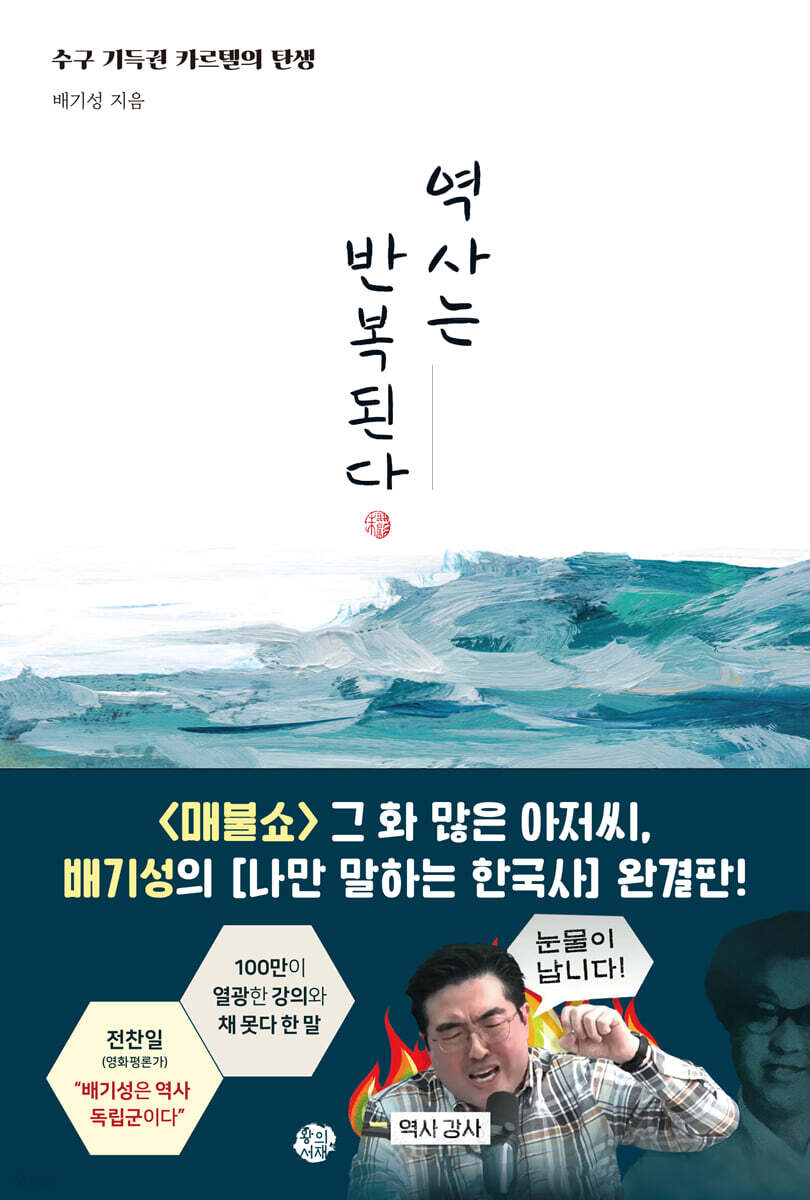
History repeats itself
 |
Description
Book Introduction
The Complete Edition of Bae Ki-seong's Korean History Lectures
The final installment of Bae Ki-seong's Korean history lecture series, which drew 300,000 to 1 million viewers!
(As of September 2023) The first Korean history book by Bae Ki-seong, the angry uncle of the popular YouTube current affairs and culture channel [Maebul Show] with 1.28 million subscribers.
The show host expressed his surprise at the truth of history by repeatedly asking, "Is this true? Is there any data or basis for the lecture content?"
As he introduced such new and unlearned Korean history, readers and listeners also heated up the comment section, exclaiming, "Did something like that happen? Is it real?", "History instructor Bae Ki-seong is amazing," and "Thank you for teaching me something I didn't know."
This is how [Korean History Only I Talk About] began.
The book contains the lectures that were discussed in this corner and the remaining content.
It is full of content that makes you read Korean history from the beginning again.
The content dealing with the incident at the center of the 'history war' is eye-catching.
It delves into the claims of a then-ruling party lawmaker that “the Jeju April 3 Incident occurred under Kim Il-sung’s orders,” the controversy over Syngman Rhee and the National Cemetery, the endless sophistry surrounding National Foundation Day, the disparagement of independence fighters and hidden facts, the Minister of Patriots and Veterans Affairs’ remarks protecting General Baek Seon-yeop, and the evil deeds of Park Maria, Lee Ki-bung’s wife, who was directly involved in the April 19 Revolution.
Bae Ki-seong's lectures, which appeared like a comet, have surpassed 300,000 to 1 million views and are still being talked about.
(As of September 2023) The first Korean history book by Bae Ki-seong, the angry uncle of the popular YouTube current affairs and culture channel [Maebul Show] with 1.28 million subscribers.
The show host expressed his surprise at the truth of history by repeatedly asking, "Is this true? Is there any data or basis for the lecture content?"
As he introduced such new and unlearned Korean history, readers and listeners also heated up the comment section, exclaiming, "Did something like that happen? Is it real?", "History instructor Bae Ki-seong is amazing," and "Thank you for teaching me something I didn't know."
This is how [Korean History Only I Talk About] began.
The book contains the lectures that were discussed in this corner and the remaining content.
It is full of content that makes you read Korean history from the beginning again.
The content dealing with the incident at the center of the 'history war' is eye-catching.
It delves into the claims of a then-ruling party lawmaker that “the Jeju April 3 Incident occurred under Kim Il-sung’s orders,” the controversy over Syngman Rhee and the National Cemetery, the endless sophistry surrounding National Foundation Day, the disparagement of independence fighters and hidden facts, the Minister of Patriots and Veterans Affairs’ remarks protecting General Baek Seon-yeop, and the evil deeds of Park Maria, Lee Ki-bung’s wife, who was directly involved in the April 19 Revolution.
Bae Ki-seong's lectures, which appeared like a comet, have surpassed 300,000 to 1 million views and are still being talked about.
- You can preview some of the book's contents.
Preview
index
Preface History Repeats Itself 4
Part 1: Japan's Ambition and Joseon's Apathy
1.
The Beginning of the A-B Relationship Between Korea and Japan: The Crown Prince's Wedding 17
2.
Yuan Shikai, the Qing Dynasty's governor of Joseon, and Emperor Gaozong, the fool, 22
3.
The Fate of Kim Ok-gyun, the First Pro-Japanese Collaborator 28
4.
At 4 a.m. on July 23, 1894, Gyeongbokgung Palace collapsed. 33
5.
Meiji Japan's Solution: War 39
Part 2: Meiji Japan's desperate survival
1.
Theory of Conquering the Korean Peninsula 47
2.
Defeat of the Qing Dynasty 52
3.
The Nikolai and Otsu Incident
Russia vs. Meiji Japan, Round 1, 57
4.
The British Empire's Asian Agents 62
5.
The Birth of the US-Japan Blood Alliance
USA vs. Meiji Japan, Round 1, 67
Part 3: The People in Distress, the Ruling Class Blinded by Greed
1.
The Battle of Jeongdong: Traitor Yi Wan-yong and Loyal Servant Seo Jae-pil, Part 1, Episode 75
2.
The Battle of Jeongdong between Traitor Yi Wan-yong and Loyal Servant Seo Jae-pil, Part 2, Episode 80
3.
Katsura-Taft Agreement
USA vs. Meiji Japan, Round 2, 86
4.
The Hague Secret Envoy Incident
Russia vs. Meiji Japan, Round 2, 91
5.
Mandongmyo and Jangdong Kim, Pungyang Jo, and Yeoheung Min clans
What Did the People of Joseon Truly Want in the Late 19th Century? 97
6.
The Root Cause of National Destruction: The Slaughter of People's Activists 102
7.
The Gatling gun was aimed not at Gyeongbokgung Palace, but at Ugeumchi 107.
8.
Judge No. 1 Jo Byeong-gap, Prosecutor No. 1 Lee Wan-yong, and Death Row Inmate No. 1 Choi Si-hyeong
The Tragic End of the Donghak Movement 113
9.
The Lushun Massacre during the First Sino-Japanese War, Part 119
10.
Russo-Japanese War Battle of Hill 203, 124
Part 4.
The Independence Movement and the Beginning of the Jeju Tragedy
1.
The Soron Faction and the Independence Movement 131
2.
Generals Choi Un-san and Hong Beom-do
There is no war in history 1 136
3.
Baek Seon-yeop and the Manchurian Independence Movement
There is no war in history 2 141
3.
The Prelude to the 19th-Century Jeju Island Crisis 146
4.
Jeju Island, a seething island, witnessed the Bang Seong-chil Rebellion of 1898 and the Lee Jae-su Rebellion of 1901.
5.
1931-1932 Haenyeo Uprising 156
6.
Japanese Operation "Kyeol 7" (Jeju Island and Gadeok Island), 1938-1945
Part 5: The Korean Peninsula Immediately After Liberation from American Control
1.
Marshall Plan vs. Molotov Plan 169
2.
When is National Foundation Day? 174
3.
Mao Zedong and Chiang Kai-shek's Manchurian Confrontation (Changchun Massacre) 179
4.
South Korea's secret power broker, US Captain James Houseman, 184
Part 6: The Sad Land of Jeju and Yeosun
1.
Syngman Rhee, Hausmann, and Manipulation
International Politics of the Jeju April 3 Incident 193
2.
Was the Jeju April 3 Incident ordered by Kim Il-sung?
The extreme right-wing anti-communism of the Jeju April 3 Incident 198
3.
Jeju April 3 Incident and the Zainichi Korean Community
Have you heard of the "Kkangkang Ajumma" from Yeongdo, Busan? 204
4.
Yeosun Incident Part 1
Aspirations for a Unified Government 209
5.
Yeosun Incident Part 2
The Origin of the Jeolla-do Reds 214
Part 7: The First Republic under Syngman Rhee
1.
Failed Diplomacy, Geneva International Conference 221
2.
Shin Ik-hee, 224, passed away on the Honam Line train in the rain.
3.
Special Forces Commander Kim Chang-ryong and Memorial Day, June 6, 229
4.
Cho Bong-am's Promise of Peaceful Unification vs. Syngman Rhee's Policy of Forced Northward Unification 234
Part 8: The Revolution of the Awakened Citizens: April 19th
1.
The April 19th Democratic Revolution started in Daegu
Daegu was originally a mecca for progress! 241
2.
International Politics of April 19th
Sputnik Shock, Suez Crisis, and the relocation of the UN Far East Command to Yongsan 246
3.
The Detonator of the April 19 Revolution: The Maria Park Family (U.S. Economic Aid Monopoly) 251
4.
Three-Vote Historical Regression, Vice President Jang Myeon 257
5.
Lee Byung-chul, who saved Hong Jin-gi, who killed Jo Bong-am, 263
Part 9: Unhappy or Cruel Military Presidents
1.
The unfortunate soldier Park Chung-hee and the United States (1961.
5. 16) 269
2.
The brutal military leader Chun Doo-hwan and the United States (1980.
5. 18) 274
Conclusion: A Historian's Cry 280
Part 1: Japan's Ambition and Joseon's Apathy
1.
The Beginning of the A-B Relationship Between Korea and Japan: The Crown Prince's Wedding 17
2.
Yuan Shikai, the Qing Dynasty's governor of Joseon, and Emperor Gaozong, the fool, 22
3.
The Fate of Kim Ok-gyun, the First Pro-Japanese Collaborator 28
4.
At 4 a.m. on July 23, 1894, Gyeongbokgung Palace collapsed. 33
5.
Meiji Japan's Solution: War 39
Part 2: Meiji Japan's desperate survival
1.
Theory of Conquering the Korean Peninsula 47
2.
Defeat of the Qing Dynasty 52
3.
The Nikolai and Otsu Incident
Russia vs. Meiji Japan, Round 1, 57
4.
The British Empire's Asian Agents 62
5.
The Birth of the US-Japan Blood Alliance
USA vs. Meiji Japan, Round 1, 67
Part 3: The People in Distress, the Ruling Class Blinded by Greed
1.
The Battle of Jeongdong: Traitor Yi Wan-yong and Loyal Servant Seo Jae-pil, Part 1, Episode 75
2.
The Battle of Jeongdong between Traitor Yi Wan-yong and Loyal Servant Seo Jae-pil, Part 2, Episode 80
3.
Katsura-Taft Agreement
USA vs. Meiji Japan, Round 2, 86
4.
The Hague Secret Envoy Incident
Russia vs. Meiji Japan, Round 2, 91
5.
Mandongmyo and Jangdong Kim, Pungyang Jo, and Yeoheung Min clans
What Did the People of Joseon Truly Want in the Late 19th Century? 97
6.
The Root Cause of National Destruction: The Slaughter of People's Activists 102
7.
The Gatling gun was aimed not at Gyeongbokgung Palace, but at Ugeumchi 107.
8.
Judge No. 1 Jo Byeong-gap, Prosecutor No. 1 Lee Wan-yong, and Death Row Inmate No. 1 Choi Si-hyeong
The Tragic End of the Donghak Movement 113
9.
The Lushun Massacre during the First Sino-Japanese War, Part 119
10.
Russo-Japanese War Battle of Hill 203, 124
Part 4.
The Independence Movement and the Beginning of the Jeju Tragedy
1.
The Soron Faction and the Independence Movement 131
2.
Generals Choi Un-san and Hong Beom-do
There is no war in history 1 136
3.
Baek Seon-yeop and the Manchurian Independence Movement
There is no war in history 2 141
3.
The Prelude to the 19th-Century Jeju Island Crisis 146
4.
Jeju Island, a seething island, witnessed the Bang Seong-chil Rebellion of 1898 and the Lee Jae-su Rebellion of 1901.
5.
1931-1932 Haenyeo Uprising 156
6.
Japanese Operation "Kyeol 7" (Jeju Island and Gadeok Island), 1938-1945
Part 5: The Korean Peninsula Immediately After Liberation from American Control
1.
Marshall Plan vs. Molotov Plan 169
2.
When is National Foundation Day? 174
3.
Mao Zedong and Chiang Kai-shek's Manchurian Confrontation (Changchun Massacre) 179
4.
South Korea's secret power broker, US Captain James Houseman, 184
Part 6: The Sad Land of Jeju and Yeosun
1.
Syngman Rhee, Hausmann, and Manipulation
International Politics of the Jeju April 3 Incident 193
2.
Was the Jeju April 3 Incident ordered by Kim Il-sung?
The extreme right-wing anti-communism of the Jeju April 3 Incident 198
3.
Jeju April 3 Incident and the Zainichi Korean Community
Have you heard of the "Kkangkang Ajumma" from Yeongdo, Busan? 204
4.
Yeosun Incident Part 1
Aspirations for a Unified Government 209
5.
Yeosun Incident Part 2
The Origin of the Jeolla-do Reds 214
Part 7: The First Republic under Syngman Rhee
1.
Failed Diplomacy, Geneva International Conference 221
2.
Shin Ik-hee, 224, passed away on the Honam Line train in the rain.
3.
Special Forces Commander Kim Chang-ryong and Memorial Day, June 6, 229
4.
Cho Bong-am's Promise of Peaceful Unification vs. Syngman Rhee's Policy of Forced Northward Unification 234
Part 8: The Revolution of the Awakened Citizens: April 19th
1.
The April 19th Democratic Revolution started in Daegu
Daegu was originally a mecca for progress! 241
2.
International Politics of April 19th
Sputnik Shock, Suez Crisis, and the relocation of the UN Far East Command to Yongsan 246
3.
The Detonator of the April 19 Revolution: The Maria Park Family (U.S. Economic Aid Monopoly) 251
4.
Three-Vote Historical Regression, Vice President Jang Myeon 257
5.
Lee Byung-chul, who saved Hong Jin-gi, who killed Jo Bong-am, 263
Part 9: Unhappy or Cruel Military Presidents
1.
The unfortunate soldier Park Chung-hee and the United States (1961.
5. 16) 269
2.
The brutal military leader Chun Doo-hwan and the United States (1980.
5. 18) 274
Conclusion: A Historian's Cry 280
Detailed image

Into the book
In the late Joseon Dynasty, King Yeongjo carried out a policy of exclusion and massacre against the Soron, Namin, and Geungi Namin (actually the Bukin), and killed Crown Prince Sado.
After that, the Noron faction, which had effectively solidified its one-party dictatorship, formed a vested interest cartel to protect its vested interests.
--- p.9
On February 22, 1882, the Japanese minister, Hanabusa, was smiling with satisfaction as he watched the young couple set up their new home in the Andong Byeolgung Palace in front of Pungmun Girls' High School.
The creditor nation, Japan, and the debtor nation, North Korea, are the origins of the A-B relationship between Korea and Japan that has continued until 2023.
--- p.21
Kim Ok-gyun fell for the bait and temptation of Inoue Kaoru's (1836-1915) policy of nurturing pro-Japanese collaborators.
Inoue Kaoru, who is known as one of the three great figures of the Meiji Restoration along with Yamagata Aritomo and Ito Hirobumi, was known as a very cunning man and a master of 'elegant rhetoric'.
--- p.30
In the world of international politics and Western history, the Sino-Japanese War, the Russo-Japanese War, the Eulsa Treaty of 19th and 20th centuries, and even the Gyeongsul National Humiliation, are all treated as events that occurred as an extension of this Great Game.
--- p.57
The Gatling gun and Kruse field gun that Gojong possessed were used in truly surprising places.
In late November 1894, guns and fireballs were aimed at the Donghak Peasant Army, which was trying to overthrow Joseon, at Ugeumchi in Gongju.
--- p.111
It is chilling to think how history would have unfolded if the Soron faction, which played the greatest role in overthrowing the Joseon Dynasty and establishing the democratic Republic of Korea, had not existed.
--- p.134
These torpedoes, called 'Shinyo' and 'Kaiden', were produced and Jeju residents and young people were made to operate them.
--- p.164
It is astonishing that he continued to act as an American agent in all sectors of Korean politics and business for a full 35 years, from early 1946 until his departure from Korea in 1981.
--- p.185
Despite this situation, the US military government and the subsequent South Korean government issued a rice collection order, auctioning the rice off at one-tenth of the market price, or if the market price was 100 won, they took it for a mere 10 won.
--- p.213
On Sunday afternoon, all students from eight schools gathered on Dongseong-ro in Jung-gu, Daegu, chanted in unison, “Syngman Rhee’s regime, step down,” “Syngman Rhee and Lee Ki-bung, step down,” and “The Liberal Party regime, step down.”
--- p.241
The claim that the United States held the Fraser Hearings to try to tame Park Chung-hee, who kept on not listening to its orders, but when he still did not listen, they mobilized Kim Jae-gyu to shoot and kill Park Chung-hee is somewhat far-fetched, but it does not seem entirely wrong.
After that, the Noron faction, which had effectively solidified its one-party dictatorship, formed a vested interest cartel to protect its vested interests.
--- p.9
On February 22, 1882, the Japanese minister, Hanabusa, was smiling with satisfaction as he watched the young couple set up their new home in the Andong Byeolgung Palace in front of Pungmun Girls' High School.
The creditor nation, Japan, and the debtor nation, North Korea, are the origins of the A-B relationship between Korea and Japan that has continued until 2023.
--- p.21
Kim Ok-gyun fell for the bait and temptation of Inoue Kaoru's (1836-1915) policy of nurturing pro-Japanese collaborators.
Inoue Kaoru, who is known as one of the three great figures of the Meiji Restoration along with Yamagata Aritomo and Ito Hirobumi, was known as a very cunning man and a master of 'elegant rhetoric'.
--- p.30
In the world of international politics and Western history, the Sino-Japanese War, the Russo-Japanese War, the Eulsa Treaty of 19th and 20th centuries, and even the Gyeongsul National Humiliation, are all treated as events that occurred as an extension of this Great Game.
--- p.57
The Gatling gun and Kruse field gun that Gojong possessed were used in truly surprising places.
In late November 1894, guns and fireballs were aimed at the Donghak Peasant Army, which was trying to overthrow Joseon, at Ugeumchi in Gongju.
--- p.111
It is chilling to think how history would have unfolded if the Soron faction, which played the greatest role in overthrowing the Joseon Dynasty and establishing the democratic Republic of Korea, had not existed.
--- p.134
These torpedoes, called 'Shinyo' and 'Kaiden', were produced and Jeju residents and young people were made to operate them.
--- p.164
It is astonishing that he continued to act as an American agent in all sectors of Korean politics and business for a full 35 years, from early 1946 until his departure from Korea in 1981.
--- p.185
Despite this situation, the US military government and the subsequent South Korean government issued a rice collection order, auctioning the rice off at one-tenth of the market price, or if the market price was 100 won, they took it for a mere 10 won.
--- p.213
On Sunday afternoon, all students from eight schools gathered on Dongseong-ro in Jung-gu, Daegu, chanted in unison, “Syngman Rhee’s regime, step down,” “Syngman Rhee and Lee Ki-bung, step down,” and “The Liberal Party regime, step down.”
--- p.241
The claim that the United States held the Fraser Hearings to try to tame Park Chung-hee, who kept on not listening to its orders, but when he still did not listen, they mobilized Kim Jae-gyu to shoot and kill Park Chung-hee is somewhat far-fetched, but it does not seem entirely wrong.
--- p.272
Publisher's Review
What Bae Ki-seong's Korean history indicates: "History repeats itself!"
If we follow each of the shocking and twisting events that became turning points in Korean history, we will see the truth that runs through 140 years of history.
'History repeats itself!' This book is proof and record of this.
Bae Ki-seong's Korean history lectures clearly tell us about 'that time,' but they also leave us with a subtle sense of foreboding, as if we were looking at the present.
As the subtitle of the book, “The Birth of the Vested Interest Cartel,” suggests, there is countless evidence that vested interests are being passed down through generations and continue to this day.
They took the queen at the end of the Joseon Dynasty and formed a powerful family as relatives of the queen. They have been building an iron fortress in Korean society through official positions, power, investigative and prosecutorial power, and most importantly, media power and academic cartel throughout the late Joseon Dynasty, the Korean Empire, the Japanese colonial period, the liberation period, the First Republic, the Korean War, and beyond.
The process of the people rising up and overcoming the corruption and incompetence of the vested interest cartel ruling class is repeated throughout the history of the Korean Peninsula.
The revolutionary nature of the newly written Gapsin Coup, Seo Jae-pil, the thoughts and spirit of Hong Gyeong-rae, Choi Si-hyeong, Jeon Bong-jun, and Son Byeong-hui who fell helplessly in the late Joseon Dynasty, the independence movement of Jeju haenyeo, Hong Beom-do, and Choi Un-san, and Shin Ik-hee and Jang Myeon who opposed Syngman Rhee are highlighted, adding to the regret of modern and contemporary history that has no 'what ifs'.
I think I can understand the angry old man when I close the book.
"Understanding history properly prevents us from repeating past mistakes."
The tragedy of the Korean Peninsula, which has been left in the dust by international politics
The three keywords of Korean history are ‘vested interests,’ ‘the people,’ and ‘international politics.’
These three forces, which can be said to be the driving force behind Korean history, are perspectives that allow us to fully understand a single event.
In particular, the background of how international politics, international situations, and the interests of major powers influenced Korea is revealed in detail.
The Great Game, the Cold War.
And that is the Meiji Restoration.
The Great Game was a 94-year-long competition for hegemony between the maritime power, Britain, and the continental power, Russia. From the 19th century to the 20th century, our country was caught up in the Sino-Japanese War, the Russo-Japanese War, the Eulsa Treaty, and even the Gyeongsul National Humiliation.
The Meiji Restoration was a major event that swallowed up Korea and enabled Japan to rise to imperialism.
The highlight of this book is that it introduces the process of Japan's Meiji Restoration and points out its core, saying that Kim Ok-gyun, a key figure in the Gapsin Coup, was assassinated and that "Meiji Japan had only one choice: war."
In such a situation, was it really possible that Joseon, ruled by a political force that was only interested in exploiting the people and engaging in the practice of selling off government officials and six positions, was destined to fall?
After liberation, the Cold War between the United States and the Soviet Union determined the fate of the Korean Peninsula.
The representative figure who appears at this time is the real power behind the throne, James Houseman.
As a mere captain, he covers the major currents of modern history, from the Jeju April 3 Incident to the Yeosu-Suncheon Rebellion, the Korean War, the April 19 Revolution, and the May 16 Uprising, as well as the nearly 20-year rule of Park Chung-hee and the early years of Choi Kyu-hah and Chun Doo-hwan, and ultimately, he digs up every atrocity, like a regent at the end of the Qing Dynasty, up to the May 18 Gwangju Democratization Movement.
The bitter history of Korea, written by a historian who inherited the "Soron" faction
The author has historical content on his YouTube channel that has garnered over 4 million views.
It is 'Crown Prince Sado and King Yeongjo'.
The story is about a power struggle between Crown Prince Sado, representing the Soron faction, and King Yeongjo, representing the Noron faction, and the Noron faction ultimately winning, driving Crown Prince Sado to death.
He points out that this is where the history of dividing conservatives and progressives, winners and losers, begins.
The author is a historian who inherited the so-called 'Soron'.
The reason for the ostracism and cold treatment the author suffered at the Department of History at Seoul National University was because he followed this theory.
This was inevitable because the grandmother who raised the author was the secretary of Mongyang Yeo Un-hyeong and taught the author the history of the Soron faction from a young age.
The author's lectures and books clearly show the various aspects of history that have inherited the Soron.
You will encounter history from a new perspective, including the Crown Prince's wedding and the Imo Incident, the revolutionary nature of the Gapsin Coup and Seo Jae-pil, the Donghak Peasant Revolution and Emperor Gojong's machine gun, Prosecutor No. 1 Lee Wan-yong, the Meiji Restoration and the conquest of the Korean Peninsula, the International Peace Exposition and the Manse Movement during the Japanese colonial period, General Choi Un-san and Manchurian independence activists, Jeju Operation Gyeol No. 7, the Jeju April 3 Incident and Kim Il-sung, the significance of the Yeosu-Suncheon Incident, Syngman Rhee and Kim Chang-ryong, Syngman Rhee and Park Maria, the relationship between Park Chung-hee, Chun Doo-hwan and the United States, and Shin Ik-hee and Chang Myon.
The world finally responded to his cry that the history war that continues to rage even in broad daylight in the 21st century is due to the history of the Noron faction, and that national history education has been distorted because the academic world has entirely inherited the Noron faction.
If we follow each of the shocking and twisting events that became turning points in Korean history, we will see the truth that runs through 140 years of history.
'History repeats itself!' This book is proof and record of this.
Bae Ki-seong's Korean history lectures clearly tell us about 'that time,' but they also leave us with a subtle sense of foreboding, as if we were looking at the present.
As the subtitle of the book, “The Birth of the Vested Interest Cartel,” suggests, there is countless evidence that vested interests are being passed down through generations and continue to this day.
They took the queen at the end of the Joseon Dynasty and formed a powerful family as relatives of the queen. They have been building an iron fortress in Korean society through official positions, power, investigative and prosecutorial power, and most importantly, media power and academic cartel throughout the late Joseon Dynasty, the Korean Empire, the Japanese colonial period, the liberation period, the First Republic, the Korean War, and beyond.
The process of the people rising up and overcoming the corruption and incompetence of the vested interest cartel ruling class is repeated throughout the history of the Korean Peninsula.
The revolutionary nature of the newly written Gapsin Coup, Seo Jae-pil, the thoughts and spirit of Hong Gyeong-rae, Choi Si-hyeong, Jeon Bong-jun, and Son Byeong-hui who fell helplessly in the late Joseon Dynasty, the independence movement of Jeju haenyeo, Hong Beom-do, and Choi Un-san, and Shin Ik-hee and Jang Myeon who opposed Syngman Rhee are highlighted, adding to the regret of modern and contemporary history that has no 'what ifs'.
I think I can understand the angry old man when I close the book.
"Understanding history properly prevents us from repeating past mistakes."
The tragedy of the Korean Peninsula, which has been left in the dust by international politics
The three keywords of Korean history are ‘vested interests,’ ‘the people,’ and ‘international politics.’
These three forces, which can be said to be the driving force behind Korean history, are perspectives that allow us to fully understand a single event.
In particular, the background of how international politics, international situations, and the interests of major powers influenced Korea is revealed in detail.
The Great Game, the Cold War.
And that is the Meiji Restoration.
The Great Game was a 94-year-long competition for hegemony between the maritime power, Britain, and the continental power, Russia. From the 19th century to the 20th century, our country was caught up in the Sino-Japanese War, the Russo-Japanese War, the Eulsa Treaty, and even the Gyeongsul National Humiliation.
The Meiji Restoration was a major event that swallowed up Korea and enabled Japan to rise to imperialism.
The highlight of this book is that it introduces the process of Japan's Meiji Restoration and points out its core, saying that Kim Ok-gyun, a key figure in the Gapsin Coup, was assassinated and that "Meiji Japan had only one choice: war."
In such a situation, was it really possible that Joseon, ruled by a political force that was only interested in exploiting the people and engaging in the practice of selling off government officials and six positions, was destined to fall?
After liberation, the Cold War between the United States and the Soviet Union determined the fate of the Korean Peninsula.
The representative figure who appears at this time is the real power behind the throne, James Houseman.
As a mere captain, he covers the major currents of modern history, from the Jeju April 3 Incident to the Yeosu-Suncheon Rebellion, the Korean War, the April 19 Revolution, and the May 16 Uprising, as well as the nearly 20-year rule of Park Chung-hee and the early years of Choi Kyu-hah and Chun Doo-hwan, and ultimately, he digs up every atrocity, like a regent at the end of the Qing Dynasty, up to the May 18 Gwangju Democratization Movement.
The bitter history of Korea, written by a historian who inherited the "Soron" faction
The author has historical content on his YouTube channel that has garnered over 4 million views.
It is 'Crown Prince Sado and King Yeongjo'.
The story is about a power struggle between Crown Prince Sado, representing the Soron faction, and King Yeongjo, representing the Noron faction, and the Noron faction ultimately winning, driving Crown Prince Sado to death.
He points out that this is where the history of dividing conservatives and progressives, winners and losers, begins.
The author is a historian who inherited the so-called 'Soron'.
The reason for the ostracism and cold treatment the author suffered at the Department of History at Seoul National University was because he followed this theory.
This was inevitable because the grandmother who raised the author was the secretary of Mongyang Yeo Un-hyeong and taught the author the history of the Soron faction from a young age.
The author's lectures and books clearly show the various aspects of history that have inherited the Soron.
You will encounter history from a new perspective, including the Crown Prince's wedding and the Imo Incident, the revolutionary nature of the Gapsin Coup and Seo Jae-pil, the Donghak Peasant Revolution and Emperor Gojong's machine gun, Prosecutor No. 1 Lee Wan-yong, the Meiji Restoration and the conquest of the Korean Peninsula, the International Peace Exposition and the Manse Movement during the Japanese colonial period, General Choi Un-san and Manchurian independence activists, Jeju Operation Gyeol No. 7, the Jeju April 3 Incident and Kim Il-sung, the significance of the Yeosu-Suncheon Incident, Syngman Rhee and Kim Chang-ryong, Syngman Rhee and Park Maria, the relationship between Park Chung-hee, Chun Doo-hwan and the United States, and Shin Ik-hee and Chang Myon.
The world finally responded to his cry that the history war that continues to rage even in broad daylight in the 21st century is due to the history of the Noron faction, and that national history education has been distorted because the academic world has entirely inherited the Noron faction.
GOODS SPECIFICS
- Date of issue: November 6, 2023
- Page count, weight, size: 284 pages | 442g | 152*225*17mm
- ISBN13: 9791186615645
- ISBN10: 1186615648
You may also like
카테고리
korean


korean

![GQ KOREA Mark (Monthly): December [2025]](http://librairie.coreenne.fr/cdn/shop/files/8ef265dbbfbf186523ed75ba7319009d.jpg?v=1765340328&width=3840)


