

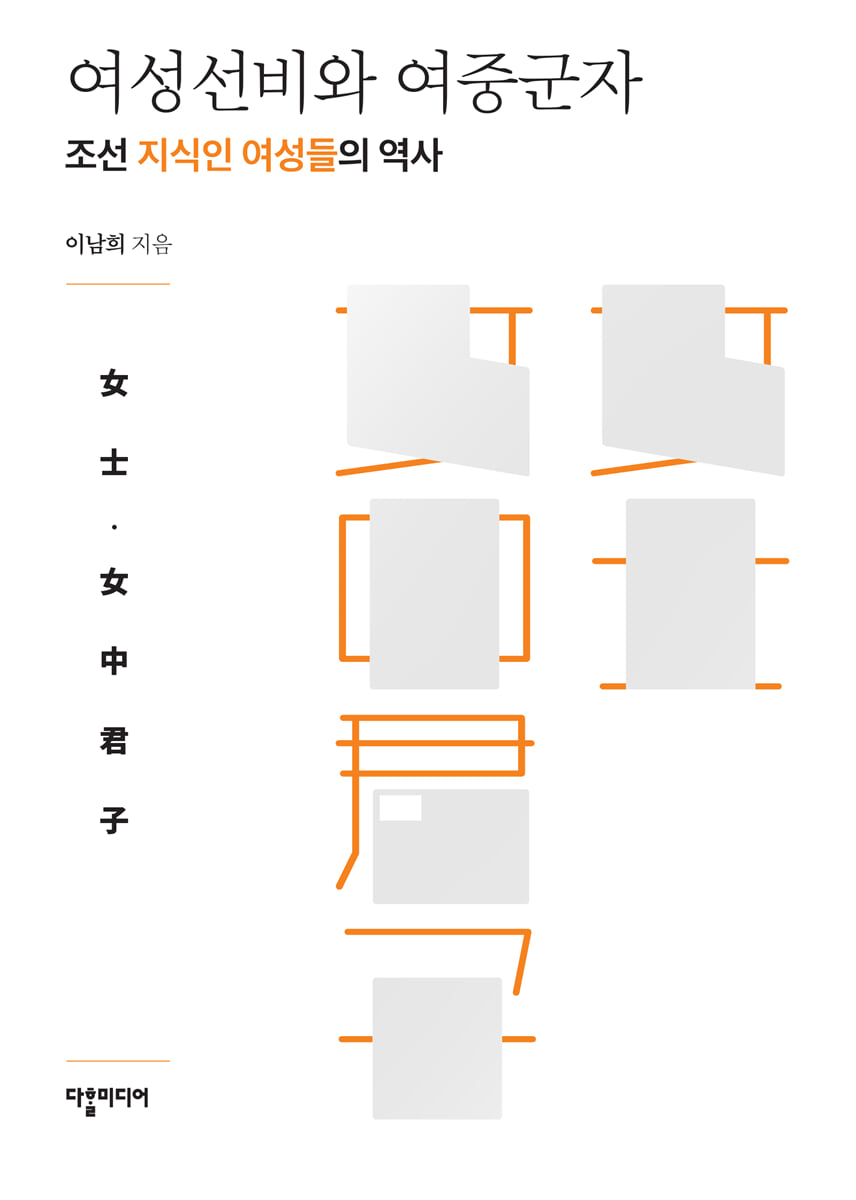
Female scholars and female gentlemen
 |
Description
Book Introduction
The Image of Women in the Transitional Period from Goryeo to Joseon as Seen Through an Analysis of Genealogical Records Published in the Early Joseon Dynasty
If we look at the Joseon Dynasty with a focus on the relationship between men and women, their respective roles, and married life, we can see that the early and late Joseon periods are very different.
With the founding of the Joseon Dynasty, as Neo-Confucianism came to function as the spirit of the times, 『Sohak』, which was paired with 『Daehak』 in the history of thought, assumed an important social function. If we follow this context, we can understand why the spread of 『Sohak』 was so encouraged during the reign of King Sejong [Chapter 1].
The author points out that when we limit the scope of our images of the Joseon Dynasty to the status and relationship between men and women, most of the images related to things like "Men and Women Should Not Sit Together at the Seven Ages of Age," "Chiljigogicak," and "Samjongjido" were solidified after the turbulent times of the Imjin and Byeongja Wars. In this book, through an analysis of genealogies published in the early Joseon Dynasty, the author focuses on the era of transition from Goryeo to Joseon society and examines in detail propositions related to the relationships and roles of men and women, and gender knowledge (gender).
Specifically, we examine the changes in the genealogy format, marriage and ancestral rites issues such as male-female marriage and kinship, equal inheritance, and reincarnation service [Chapter 2].
We also examine the records and distribution patterns of remarriage of women recorded in the oldest existing genealogy, the Andong Kwon Clan Genealogy, as well as marriage and whether or not a woman is married, remarriage and subsequent husband, distribution of remarriage and its social significance.
Through this, we can gauge the transitional aspects of the era and the influence that Joseon's Neo-Confucianism gradually had on women's lives, status, and social standing [Chapter 3].
If we look at the Joseon Dynasty with a focus on the relationship between men and women, their respective roles, and married life, we can see that the early and late Joseon periods are very different.
With the founding of the Joseon Dynasty, as Neo-Confucianism came to function as the spirit of the times, 『Sohak』, which was paired with 『Daehak』 in the history of thought, assumed an important social function. If we follow this context, we can understand why the spread of 『Sohak』 was so encouraged during the reign of King Sejong [Chapter 1].
The author points out that when we limit the scope of our images of the Joseon Dynasty to the status and relationship between men and women, most of the images related to things like "Men and Women Should Not Sit Together at the Seven Ages of Age," "Chiljigogicak," and "Samjongjido" were solidified after the turbulent times of the Imjin and Byeongja Wars. In this book, through an analysis of genealogies published in the early Joseon Dynasty, the author focuses on the era of transition from Goryeo to Joseon society and examines in detail propositions related to the relationships and roles of men and women, and gender knowledge (gender).
Specifically, we examine the changes in the genealogy format, marriage and ancestral rites issues such as male-female marriage and kinship, equal inheritance, and reincarnation service [Chapter 2].
We also examine the records and distribution patterns of remarriage of women recorded in the oldest existing genealogy, the Andong Kwon Clan Genealogy, as well as marriage and whether or not a woman is married, remarriage and subsequent husband, distribution of remarriage and its social significance.
Through this, we can gauge the transitional aspects of the era and the influence that Joseon's Neo-Confucianism gradually had on women's lives, status, and social standing [Chapter 3].
- You can preview some of the book's contents.
Preview
index
Preface: In Search of the Reality of Joseon Society and Women's Lives
Chapter 1: Reading the Elementary Learning after the Founding of Joseon
1. Learning Neo-Confucianism through the 『Elementary Learning』
1-1.
Confucianism, Joseon, and Elementary Learning
2.
Sejong promotes the Elementary Learning
2-1.
『Elementary Learning』 as a text, its system and author∥2-2.
King Sejong, the Humanistic Monarch, and the Spread of the Sohak (Elementary Learning)∥2-3. Sohak Education and the Civil Service Examination
3.
To establish order in a Confucian society
3-1.
The foundation of studying abroad in daily life∥3-2.
When a girl turns seven∥3-3.
Teaching the Three Kinds of Morality and the Seven Deadly Sins
Summary and Organization
Chapter 2 Marriage, Genealogy, and Ancestral Rites
1. How did women live in Joseon?
1-1.
Joseon society and the status of women
2.
If you look at the genealogy, you see a woman
2-1.
Family records and official documents∥2-2.
15th-16th century genealogies
3.
How were women recorded in genealogies?
3-1.
The style and method of writing about women: Write down sons first, then daughters | Ethics and records of family | Changes in the concept of kinship between grandchildren and adopted children | 3-2.
Customs and Changes in Marriage and Ancestral Rites: A Man Marries into a Woman's House | Inheritance and Ancestral Rites Are Shared Equally Between Sons and Daughters
Summary and Organization
Chapter 3 Did Joseon women remarry?
1.
Andong Kwon Clan Genealogy and Women's Lay
1-1.
The oldest genealogy
2.
Joseon society as seen in family records
2-1.
Marriage and whether or not a woman is married∥2-2.
Jaega and Hubu
3.
What the Household Records and Distribution Tell Us
3-1.
Distinction? Distribution patterns by generation: Privy Council and Bokya Council | Households concentrated in the late Goryeo and early Joseon periods∥3-2.
Changes in the perception of home care records and social meaning
Summary and Organization
Chapter 4.
Joseon's intellectual women, female scholars, and female noblewomen
1.
Women who could read and write Chinese characters
1-1.
Late Joseon Dynasty and intellectual women
2.
Female scholars and female gentlemen
2-1.
Women can also become scholars∥2-2.
A female gentleman with Confucian character∥2-3.
Equipped with Confucian qualities, female scholars and female gentlemen
3.
Women intellectuals who read, write, and are aware of themselves
3-1.
Social Change and Women's Awareness in the Late Joseon Dynasty∥3-2. Where Did the Female Scholars Come From?
4.
Im Yun-ji, seeking the will of the saints
4-1. As the taste of meat pleases the mouth, learning is also enjoyable∥4-2. A writing that cannot exist in the world, 『Yunjidang Yugo』∥4-3.
The life of a noblewoman and a female nobleman
5.
The board of directors, who only take the runners as their teachers
5-1.
Widely known noble character∥5-2.
Rather than poetry, read Confucian classics and history books∥5-3.
Read by the weaving fire at night to become lit
6.
Kang Jeong-il, a female scholar who sublimated suffering through scholarship
6-1.
Continuing the tradition of sadism∥6-2.
A husband compiles his wife's anthology, "Jeongildang Yugo" (6-3). Cultivating one's character based on the "Doctrine of the Mean" (Zhongyong). Women must also study to understand the principles. A revolutionary shift in perception and the female gentleman. The study of the mind as a path to becoming a saint.
Summary and Organization
Chapter 5.
Female court ladies in the royal family
1.
Queen Sohye, the greatest intellectual woman of her time
1-1.
Queen Sohye of the Han clan and 『Naehoon』∥1-2.
What kind of book is 『Naehoon』? The period and intention of writing|The writing method and characteristics∥1-3.
Gender-related propositions in 『Naehoon』 Men and women are different, Men and women do not sit together at the age of seven | The husband is heaven, Bunaebucheon | Women are prohibited from remarrying, Bulgyeongibu | The three kinds of guidance and the seven evils∥1-4.
The Social and Historical Significance of 『Naehoon』: Joseon's Transformation of 『Sohak』, Joseonization of 『Sohak』
Summary and Organization
2.
Lady Hyegyeong Hong, a noble woman who released her sorrow through writing.
2-1.
Crown Prince Sado's wife, King Jeongjo's mother∥2-2.
Remember what you see and hear for the rest of your life∥2-3.
Conveying meaning through words∥2-4.
Edict, a royal edict issued in Korean∥2-5.
A masterpiece of court literature, 『Hanjungnok』
Summary and Organization
3.
Queen Jeongsun, a brilliant female protagonist who ruled as regent
3-1.
Yeongjo's second wife, the 15-year-old queen∥3-2.
The family that gained power∥3-3.
Language and participation in state affairs∥3-4.
Recipient of the Convergence and Operational Methods|Intervening in Personnel and Petitions
Summary and Organization
4. Queen Sunwon, a key figure in the politics of the powerful
4-1.
A female warrior who has undergone two rounds of purification∥4-2.
Precious written materials left behind by Queen Sunwon: The words of the ‘best calligrapher’|The regency and family∥4-3.
Contents of Queen Sunwon's Korean letters: Letters to her nephews Kim Byeong-deok and Kim Byeong-ju | Kim Heung-geun, Jaejong's younger brother who discussed state affairs | Thoughts and caution about the family | The issue of King Cheoljong's choice of a concubine
Summary and Organization
Conclusion: Joseon society, Neo-Confucianism, and female intellectuals
Author's Note
Notes∥References∥Source of illustrations
Chapter 1: Reading the Elementary Learning after the Founding of Joseon
1. Learning Neo-Confucianism through the 『Elementary Learning』
1-1.
Confucianism, Joseon, and Elementary Learning
2.
Sejong promotes the Elementary Learning
2-1.
『Elementary Learning』 as a text, its system and author∥2-2.
King Sejong, the Humanistic Monarch, and the Spread of the Sohak (Elementary Learning)∥2-3. Sohak Education and the Civil Service Examination
3.
To establish order in a Confucian society
3-1.
The foundation of studying abroad in daily life∥3-2.
When a girl turns seven∥3-3.
Teaching the Three Kinds of Morality and the Seven Deadly Sins
Summary and Organization
Chapter 2 Marriage, Genealogy, and Ancestral Rites
1. How did women live in Joseon?
1-1.
Joseon society and the status of women
2.
If you look at the genealogy, you see a woman
2-1.
Family records and official documents∥2-2.
15th-16th century genealogies
3.
How were women recorded in genealogies?
3-1.
The style and method of writing about women: Write down sons first, then daughters | Ethics and records of family | Changes in the concept of kinship between grandchildren and adopted children | 3-2.
Customs and Changes in Marriage and Ancestral Rites: A Man Marries into a Woman's House | Inheritance and Ancestral Rites Are Shared Equally Between Sons and Daughters
Summary and Organization
Chapter 3 Did Joseon women remarry?
1.
Andong Kwon Clan Genealogy and Women's Lay
1-1.
The oldest genealogy
2.
Joseon society as seen in family records
2-1.
Marriage and whether or not a woman is married∥2-2.
Jaega and Hubu
3.
What the Household Records and Distribution Tell Us
3-1.
Distinction? Distribution patterns by generation: Privy Council and Bokya Council | Households concentrated in the late Goryeo and early Joseon periods∥3-2.
Changes in the perception of home care records and social meaning
Summary and Organization
Chapter 4.
Joseon's intellectual women, female scholars, and female noblewomen
1.
Women who could read and write Chinese characters
1-1.
Late Joseon Dynasty and intellectual women
2.
Female scholars and female gentlemen
2-1.
Women can also become scholars∥2-2.
A female gentleman with Confucian character∥2-3.
Equipped with Confucian qualities, female scholars and female gentlemen
3.
Women intellectuals who read, write, and are aware of themselves
3-1.
Social Change and Women's Awareness in the Late Joseon Dynasty∥3-2. Where Did the Female Scholars Come From?
4.
Im Yun-ji, seeking the will of the saints
4-1. As the taste of meat pleases the mouth, learning is also enjoyable∥4-2. A writing that cannot exist in the world, 『Yunjidang Yugo』∥4-3.
The life of a noblewoman and a female nobleman
5.
The board of directors, who only take the runners as their teachers
5-1.
Widely known noble character∥5-2.
Rather than poetry, read Confucian classics and history books∥5-3.
Read by the weaving fire at night to become lit
6.
Kang Jeong-il, a female scholar who sublimated suffering through scholarship
6-1.
Continuing the tradition of sadism∥6-2.
A husband compiles his wife's anthology, "Jeongildang Yugo" (6-3). Cultivating one's character based on the "Doctrine of the Mean" (Zhongyong). Women must also study to understand the principles. A revolutionary shift in perception and the female gentleman. The study of the mind as a path to becoming a saint.
Summary and Organization
Chapter 5.
Female court ladies in the royal family
1.
Queen Sohye, the greatest intellectual woman of her time
1-1.
Queen Sohye of the Han clan and 『Naehoon』∥1-2.
What kind of book is 『Naehoon』? The period and intention of writing|The writing method and characteristics∥1-3.
Gender-related propositions in 『Naehoon』 Men and women are different, Men and women do not sit together at the age of seven | The husband is heaven, Bunaebucheon | Women are prohibited from remarrying, Bulgyeongibu | The three kinds of guidance and the seven evils∥1-4.
The Social and Historical Significance of 『Naehoon』: Joseon's Transformation of 『Sohak』, Joseonization of 『Sohak』
Summary and Organization
2.
Lady Hyegyeong Hong, a noble woman who released her sorrow through writing.
2-1.
Crown Prince Sado's wife, King Jeongjo's mother∥2-2.
Remember what you see and hear for the rest of your life∥2-3.
Conveying meaning through words∥2-4.
Edict, a royal edict issued in Korean∥2-5.
A masterpiece of court literature, 『Hanjungnok』
Summary and Organization
3.
Queen Jeongsun, a brilliant female protagonist who ruled as regent
3-1.
Yeongjo's second wife, the 15-year-old queen∥3-2.
The family that gained power∥3-3.
Language and participation in state affairs∥3-4.
Recipient of the Convergence and Operational Methods|Intervening in Personnel and Petitions
Summary and Organization
4. Queen Sunwon, a key figure in the politics of the powerful
4-1.
A female warrior who has undergone two rounds of purification∥4-2.
Precious written materials left behind by Queen Sunwon: The words of the ‘best calligrapher’|The regency and family∥4-3.
Contents of Queen Sunwon's Korean letters: Letters to her nephews Kim Byeong-deok and Kim Byeong-ju | Kim Heung-geun, Jaejong's younger brother who discussed state affairs | Thoughts and caution about the family | The issue of King Cheoljong's choice of a concubine
Summary and Organization
Conclusion: Joseon society, Neo-Confucianism, and female intellectuals
Author's Note
Notes∥References∥Source of illustrations
Into the book
Chapter 1: Reading the Elementary Learning after the Founding of Joseon
『Sohak』 is a kind of companion to 『Daehak』, and is an indispensable book in Neo-Confucianism, Zhu Xi's teachings.
As Juhee had his disciple Yu Cheong-ji edit a book that could educate and educate boys, Juhee's interest was also special.
So, Joohee and Yujajing are sometimes viewed as co-authors, that is, as a joint work of two people.
Juhee also wrote “Sohakseoje” and “Sohakjesa” in “Sohak.”
Therefore, it is crucial to understand the 『Elementary Learning』 in the context of Neo-Confucianism and Zhu Xi's learning.
With the introduction of Neo-Confucianism at the end of the Goryeo Dynasty, 『Sohak』 began to be transmitted and accepted.
The founding of Joseon, which can be said to be a revolution for Confucianism in particular, opened a new chapter.
… This book examines King Sejong’s active promotion of the Elementary Learning from the perspective of the history of thought and the relationship between men and women and gender theory.
The active dissemination and propagation of 『Sohak』 during the Sejong era contained various historical implications.
At the level of the political system, there was a desire to create a new civilization and world based on Zhu Xi's teachings.
It aimed to build a Confucian (Zhu Xi) society based on the 『Elementary Learning』 and 『Great Learning』.
… The popularity of 『Elementary Learning』 showed signs of male dominance, and even male superiority and female inferiority.
However, even though propositions such as men and women not sitting together at the age of seven, the three kinds of guidance, and the seven evils of the sevenfold path are included in the 『Elementary Learning』, long-standing customs and culture could not change overnight.
It took time for such a proposition to gain much power.
--- p.47~49
Chapter 2 Marriage, Genealogy, and Ancestral Rites
Such relative equality was also generally tolerant of women's remarriage.
Even among the queens of Goryeo, there were women who were laywomen.
It's not that she was socially disadvantaged or discriminated against because she was a housewife.
Also, the status of sons and daughters in matters such as inheritance and ancestral rites was not significantly different.
However, with the founding of Joseon, which advocated Neo-Confucianism, its orientation toward a Confucian society became clearly evident.
However, it was not possible to transform into a Confucian society overnight.
In this context, it can be understood that in the genealogy published in the early Joseon Dynasty, records were made in order of birth age without distinction between sons and daughters, rather than according to the principle of first son and second daughter.
The customs of the Goryeo Dynasty remained intact.
In addition, the fact that a noblewoman was remarried is recorded ('posterior part'), and cases of remarriage can be confirmed in 『Seonghwabo』(1476) and 『Gayajeongbo』(1565).
…This same pattern is also confirmed in marriage forms.
In the Goryeo Dynasty, it was common for a man to marry and live with his wife's family.
This custom persisted for a considerable period of time despite the state's insistence on pro-British relations after the founding of Joseon, and it was not until the late Joseon period that anti-British relations were established.
…Until the early Joseon Dynasty, not only was inheritance of property distributed equally, but property rights for the inherited portion were also guaranteed.
Just because a daughter got married, her right to inherit property did not disappear.
The fact that the inheritance was divided equally between sons and daughters indicates that the obligations that came with the inheritance were also equal.
… In short, as Confucianism began to take hold in Joseon society, women’s chastity began to be emphasized.
In particular, the discriminatory provisions against sons of married women included in the Gyeongguk Daejeon became an important turning point.
The following provisions were made in the civil service examination section of the Gyeongguk Daejeon published during the reign of King Seongjong.
“The sons and grandsons of women who have remarried or lost their wives cannot take the civil service examinations, military service examinations, civil servant examinations, or civil service examinations.” The influence of this ban on the civil service examinations was enormous.
Moreover, after the Imjin War, the process of deepening Confucianism throughout society, in other words, the establishment of the ethics of Confucianism and the study of rites and etiquette, and the process of forming clans and family groups centered on patrilineal kinship under the patriarchal system, led to the transformation of Joseon society into a patrilineal male-centered society.
In genealogy, the practice of listing sons first and not grandsons became established.
Afterwards, this trend accelerated further, and the ethics of prohibiting remarriage spread not only to the yangban nobility but also to the common people, and chastity gradually became considered a given.
--- p.84~87
Chapter 3 Did Joseon women remarry?
I wanted to focus on the records of women's households that appear in the Andong Kwon Clan Genealogy (1476), the oldest existing genealogy.
In the 『Seonghwabo』, the son-in-law's name is written instead of the daughter's name.
In the daughter's seat, the daughter's husband was written as '여부女夫'.
But the main building was not small.
The format for indicating a son-in-law changed from various forms such as yeoboo, yeo, seo, yeoboo, to yeoboo and then to yeo before settling down, and 『Seonghwabo』 shows an intermediate form.
In addition, 『Seonghwabo』 clarifies the marriage type of the daughter who got married by specifying the first room, middle room, second room, and third room.
… First, from a macroscopic perspective, the process of Confucianization of Joseon society was taking place.
Compared to Goryeo society, where Buddhism was the dominant ideology, Joseon society adopted Neo-Confucianism as its dominant ideology, thus taking a different fundamental direction.
…Second, as can be confirmed from the data, the phenomenon of the Jaega and Samga clearly existed even in the early Joseon Dynasty.
The discussion held in the court in 1478 (the 8th year of King Seongjong's reign) regarding the regulation of female servants and female servants in the royal household speaks volumes about this.
…Third, there is a conflict between the aforementioned macro-level Confucianization process in Joseon and the second phenomenon of Jaega and Samga.
…Fourth, 『Seonghwabo』 can be said to be a genealogy that tells of the transitional period of the late Goryeo and early Joseon periods, in other words, the period when Confucian social order was solidifying.
So, there are aspects where seemingly contradictory aspects coexist.
--- p.120~123
Chapter 4: Women Intellectuals, Women Scholars, and Female Gentlemen of Joseon
The focus was on the thoughts and social awareness of intellectual women in the late Joseon Dynasty who could read and write and possessed Confucian knowledge in their daily lives.
They got married and lived as so-called good wives and wise mothers, but they did not stop there. They actively pursued Confucian knowledge and cultivation, and even went so far as to delve into the essence of Zhu Xi's teachings and leave behind collections of writings, showing an active learning and life style.
From a social historical perspective, after the Second Nan War, Joseon society showed a conservative tendency, including strengthening the patriarchal order and promoting chastity and filial piety policies.
Education and policies that emphasized traditional female image still persisted, and there were even aspects of them being strengthened.
But at the same time, women's awareness was also growing.
With the increase in women's economic status and the boom in reading and writing among women at the time, they were able to acquire a variety of knowledge and information.
Women with knowledge and insight emerged from the nobility.
Such intellectual women can be categorized as ‘female scholars’ and ‘female gentlemen.’
This book examines the lives and scholarship of the Im Yun-ji Party, the Isaju Party, and the Kang Jeong-il Party as specific examples that fall into that category.
… If we look at it this way, we can say that in the late Joseon Dynasty, a change in perception of women, especially intellectual women, was taking place, albeit within the larger framework of the Zhu Xi worldview.
Women also began to be recognized as scholars and female scholars who received and practiced knowledge through learning, and furthermore, they were considered to be capable of becoming gentlemen, the ideal human beings of Confucianism.
In fact, the path taken by the intellectual women, Isaju Party and Kang Jeong-il Party, was the life of a scholar who learned and practiced through scholarship.
… In short, the intellectual women who lived in the late Joseon Dynasty never denied their roles and status as women.
But I wasn't caught up in it.
Rather, he went on to his own interpretation that the fractions are different, but the essence is not different.
She accepted the traditional image of women at the time and devoted herself to academics and practice based on it.
However, they remained within a thoroughly Confucian worldview.
He did not rely on teachings such as Western learning or Catholicism that were popular among the people at the time.
--- p.192~198
Chapter 5: The Female Gentlemen of the Royal Family
Queen Sohye's 『Naehoon』 is the first document that actively accepted and reconstructed the gender knowledge of the center of Confucian civilization during the reign of King Seongjong and put it into writing.
Therefore, it needs to be understood from the perspective of a transitional period from Goryeo to Joseon society, and from Mahayana Buddhism to Confucianism.
It should be read in the context of the neo-Confucian or Zhu Xi transformation of Joseon society.
… As the greatest intellectual of her time in the 15th century, Queen Sohye proposed that the Zhu Xi philosophy of male-female relationships and gender-related propositions were desirable and should be accepted as norms for women to follow, but she kept a certain distance from the ideology of the ‘virtuous woman’ found in the ‘Sohak’.
It did not reach the point of excessive strictness, valuing chastity over starvation.
--- p.242~243
We examined the life and lifestyle of Lady Hyegyeonggung Hong by using her private records and official records as the main analysis materials.
Based on the words and speeches she left behind, I tried to reconstruct it from a historical perspective.
This could be considered as a supplement to the understanding of Lady Hyegyeong Hong's life, which has been mainly based on the Hanjungnok.
First of all, there are two pieces of writing left by Lady Hyegyeong Hong.
The letter sent to Princess Hwasun, the eldest sister-in-law, is of an everyday nature, but it was sent during a time when Crown Prince Sado was in conflict with King Yeongjo while acting as regent.
… Meanwhile, Lady Hyegyeong Hong issued seven proclamations.
Although she lived in the palace for 70 years across three dynasties, her speech only appeared during the reign of King Jeongjo.
This is because she was King Jeongjo's biological mother, and her political authority came from King Jeongjo.
However, there is no sign of any political nature in the speech.
He is only responding to the requests of the ministers in writing.
--- p.271
Queen Jeongsun Kim became King Yeongjo's second wife at the age of 15 and lived in the midst of palace politics until her death at the age of 61.
During the reign of King Jeongjo, she was the Queen Dowager, and during the reign of King Sunjo, she was the Grand Queen Dowager, and as an adult member of the royal family, she exercised political influence.
After Sunjo ascended to the throne, he seems to have exercised real political power by serving as regent for four years.
I lived through the era of political upheaval and the change of the throne from Yeongjo to Jeongjo and Sunjo.
During the reign of King Surim, she also called herself a female ruler or a female lord.
She had already issued a royal edict in Hangul during the reign of King Yeongjo, and she also issued a royal edict and a royal letter during the reigns of King Jeongjo and King Sunjo.
A total of 42 statements and writings can be confirmed, which is the most among all queens in history.
He was well aware of his political standing and sought to exert real political influence.
He also wrote some poems around the time of the Su-reum-cheong-jeong period, and some of them remain.
--- p.305
First of all, the evaluation of Queen Sunwon's regency, which took place twice during the reigns of King Heonjong and King Cheoljong, can vary considerably depending on one's perspective.
Even if you look at existing studies, the evaluation details are slightly different.
The evaluations range from Queen Sunwon's 'dictatorship' to her maintaining a balance among the royal relatives.
… However, following the precedent of the Sunjo era, the government was mainly run through official processes in the next generation based on the 『Suyeomcheongjeongjeolmok』.
He also promoted Jo In-yeong, who was entrusted with the maintenance of King Sunjo's government and was in charge of King Heonjong's affairs, and attempted to maintain a balance between the two maternal relatives' families, the Pungyang Jo clan and the Andong Kim clan.
There is also a need to discuss the next two rounds of convergence cleaning separately.
In that respect, Queen Sunwon's words are quite meaningful material.
『Sohak』 is a kind of companion to 『Daehak』, and is an indispensable book in Neo-Confucianism, Zhu Xi's teachings.
As Juhee had his disciple Yu Cheong-ji edit a book that could educate and educate boys, Juhee's interest was also special.
So, Joohee and Yujajing are sometimes viewed as co-authors, that is, as a joint work of two people.
Juhee also wrote “Sohakseoje” and “Sohakjesa” in “Sohak.”
Therefore, it is crucial to understand the 『Elementary Learning』 in the context of Neo-Confucianism and Zhu Xi's learning.
With the introduction of Neo-Confucianism at the end of the Goryeo Dynasty, 『Sohak』 began to be transmitted and accepted.
The founding of Joseon, which can be said to be a revolution for Confucianism in particular, opened a new chapter.
… This book examines King Sejong’s active promotion of the Elementary Learning from the perspective of the history of thought and the relationship between men and women and gender theory.
The active dissemination and propagation of 『Sohak』 during the Sejong era contained various historical implications.
At the level of the political system, there was a desire to create a new civilization and world based on Zhu Xi's teachings.
It aimed to build a Confucian (Zhu Xi) society based on the 『Elementary Learning』 and 『Great Learning』.
… The popularity of 『Elementary Learning』 showed signs of male dominance, and even male superiority and female inferiority.
However, even though propositions such as men and women not sitting together at the age of seven, the three kinds of guidance, and the seven evils of the sevenfold path are included in the 『Elementary Learning』, long-standing customs and culture could not change overnight.
It took time for such a proposition to gain much power.
--- p.47~49
Chapter 2 Marriage, Genealogy, and Ancestral Rites
Such relative equality was also generally tolerant of women's remarriage.
Even among the queens of Goryeo, there were women who were laywomen.
It's not that she was socially disadvantaged or discriminated against because she was a housewife.
Also, the status of sons and daughters in matters such as inheritance and ancestral rites was not significantly different.
However, with the founding of Joseon, which advocated Neo-Confucianism, its orientation toward a Confucian society became clearly evident.
However, it was not possible to transform into a Confucian society overnight.
In this context, it can be understood that in the genealogy published in the early Joseon Dynasty, records were made in order of birth age without distinction between sons and daughters, rather than according to the principle of first son and second daughter.
The customs of the Goryeo Dynasty remained intact.
In addition, the fact that a noblewoman was remarried is recorded ('posterior part'), and cases of remarriage can be confirmed in 『Seonghwabo』(1476) and 『Gayajeongbo』(1565).
…This same pattern is also confirmed in marriage forms.
In the Goryeo Dynasty, it was common for a man to marry and live with his wife's family.
This custom persisted for a considerable period of time despite the state's insistence on pro-British relations after the founding of Joseon, and it was not until the late Joseon period that anti-British relations were established.
…Until the early Joseon Dynasty, not only was inheritance of property distributed equally, but property rights for the inherited portion were also guaranteed.
Just because a daughter got married, her right to inherit property did not disappear.
The fact that the inheritance was divided equally between sons and daughters indicates that the obligations that came with the inheritance were also equal.
… In short, as Confucianism began to take hold in Joseon society, women’s chastity began to be emphasized.
In particular, the discriminatory provisions against sons of married women included in the Gyeongguk Daejeon became an important turning point.
The following provisions were made in the civil service examination section of the Gyeongguk Daejeon published during the reign of King Seongjong.
“The sons and grandsons of women who have remarried or lost their wives cannot take the civil service examinations, military service examinations, civil servant examinations, or civil service examinations.” The influence of this ban on the civil service examinations was enormous.
Moreover, after the Imjin War, the process of deepening Confucianism throughout society, in other words, the establishment of the ethics of Confucianism and the study of rites and etiquette, and the process of forming clans and family groups centered on patrilineal kinship under the patriarchal system, led to the transformation of Joseon society into a patrilineal male-centered society.
In genealogy, the practice of listing sons first and not grandsons became established.
Afterwards, this trend accelerated further, and the ethics of prohibiting remarriage spread not only to the yangban nobility but also to the common people, and chastity gradually became considered a given.
--- p.84~87
Chapter 3 Did Joseon women remarry?
I wanted to focus on the records of women's households that appear in the Andong Kwon Clan Genealogy (1476), the oldest existing genealogy.
In the 『Seonghwabo』, the son-in-law's name is written instead of the daughter's name.
In the daughter's seat, the daughter's husband was written as '여부女夫'.
But the main building was not small.
The format for indicating a son-in-law changed from various forms such as yeoboo, yeo, seo, yeoboo, to yeoboo and then to yeo before settling down, and 『Seonghwabo』 shows an intermediate form.
In addition, 『Seonghwabo』 clarifies the marriage type of the daughter who got married by specifying the first room, middle room, second room, and third room.
… First, from a macroscopic perspective, the process of Confucianization of Joseon society was taking place.
Compared to Goryeo society, where Buddhism was the dominant ideology, Joseon society adopted Neo-Confucianism as its dominant ideology, thus taking a different fundamental direction.
…Second, as can be confirmed from the data, the phenomenon of the Jaega and Samga clearly existed even in the early Joseon Dynasty.
The discussion held in the court in 1478 (the 8th year of King Seongjong's reign) regarding the regulation of female servants and female servants in the royal household speaks volumes about this.
…Third, there is a conflict between the aforementioned macro-level Confucianization process in Joseon and the second phenomenon of Jaega and Samga.
…Fourth, 『Seonghwabo』 can be said to be a genealogy that tells of the transitional period of the late Goryeo and early Joseon periods, in other words, the period when Confucian social order was solidifying.
So, there are aspects where seemingly contradictory aspects coexist.
--- p.120~123
Chapter 4: Women Intellectuals, Women Scholars, and Female Gentlemen of Joseon
The focus was on the thoughts and social awareness of intellectual women in the late Joseon Dynasty who could read and write and possessed Confucian knowledge in their daily lives.
They got married and lived as so-called good wives and wise mothers, but they did not stop there. They actively pursued Confucian knowledge and cultivation, and even went so far as to delve into the essence of Zhu Xi's teachings and leave behind collections of writings, showing an active learning and life style.
From a social historical perspective, after the Second Nan War, Joseon society showed a conservative tendency, including strengthening the patriarchal order and promoting chastity and filial piety policies.
Education and policies that emphasized traditional female image still persisted, and there were even aspects of them being strengthened.
But at the same time, women's awareness was also growing.
With the increase in women's economic status and the boom in reading and writing among women at the time, they were able to acquire a variety of knowledge and information.
Women with knowledge and insight emerged from the nobility.
Such intellectual women can be categorized as ‘female scholars’ and ‘female gentlemen.’
This book examines the lives and scholarship of the Im Yun-ji Party, the Isaju Party, and the Kang Jeong-il Party as specific examples that fall into that category.
… If we look at it this way, we can say that in the late Joseon Dynasty, a change in perception of women, especially intellectual women, was taking place, albeit within the larger framework of the Zhu Xi worldview.
Women also began to be recognized as scholars and female scholars who received and practiced knowledge through learning, and furthermore, they were considered to be capable of becoming gentlemen, the ideal human beings of Confucianism.
In fact, the path taken by the intellectual women, Isaju Party and Kang Jeong-il Party, was the life of a scholar who learned and practiced through scholarship.
… In short, the intellectual women who lived in the late Joseon Dynasty never denied their roles and status as women.
But I wasn't caught up in it.
Rather, he went on to his own interpretation that the fractions are different, but the essence is not different.
She accepted the traditional image of women at the time and devoted herself to academics and practice based on it.
However, they remained within a thoroughly Confucian worldview.
He did not rely on teachings such as Western learning or Catholicism that were popular among the people at the time.
--- p.192~198
Chapter 5: The Female Gentlemen of the Royal Family
Queen Sohye's 『Naehoon』 is the first document that actively accepted and reconstructed the gender knowledge of the center of Confucian civilization during the reign of King Seongjong and put it into writing.
Therefore, it needs to be understood from the perspective of a transitional period from Goryeo to Joseon society, and from Mahayana Buddhism to Confucianism.
It should be read in the context of the neo-Confucian or Zhu Xi transformation of Joseon society.
… As the greatest intellectual of her time in the 15th century, Queen Sohye proposed that the Zhu Xi philosophy of male-female relationships and gender-related propositions were desirable and should be accepted as norms for women to follow, but she kept a certain distance from the ideology of the ‘virtuous woman’ found in the ‘Sohak’.
It did not reach the point of excessive strictness, valuing chastity over starvation.
--- p.242~243
We examined the life and lifestyle of Lady Hyegyeonggung Hong by using her private records and official records as the main analysis materials.
Based on the words and speeches she left behind, I tried to reconstruct it from a historical perspective.
This could be considered as a supplement to the understanding of Lady Hyegyeong Hong's life, which has been mainly based on the Hanjungnok.
First of all, there are two pieces of writing left by Lady Hyegyeong Hong.
The letter sent to Princess Hwasun, the eldest sister-in-law, is of an everyday nature, but it was sent during a time when Crown Prince Sado was in conflict with King Yeongjo while acting as regent.
… Meanwhile, Lady Hyegyeong Hong issued seven proclamations.
Although she lived in the palace for 70 years across three dynasties, her speech only appeared during the reign of King Jeongjo.
This is because she was King Jeongjo's biological mother, and her political authority came from King Jeongjo.
However, there is no sign of any political nature in the speech.
He is only responding to the requests of the ministers in writing.
--- p.271
Queen Jeongsun Kim became King Yeongjo's second wife at the age of 15 and lived in the midst of palace politics until her death at the age of 61.
During the reign of King Jeongjo, she was the Queen Dowager, and during the reign of King Sunjo, she was the Grand Queen Dowager, and as an adult member of the royal family, she exercised political influence.
After Sunjo ascended to the throne, he seems to have exercised real political power by serving as regent for four years.
I lived through the era of political upheaval and the change of the throne from Yeongjo to Jeongjo and Sunjo.
During the reign of King Surim, she also called herself a female ruler or a female lord.
She had already issued a royal edict in Hangul during the reign of King Yeongjo, and she also issued a royal edict and a royal letter during the reigns of King Jeongjo and King Sunjo.
A total of 42 statements and writings can be confirmed, which is the most among all queens in history.
He was well aware of his political standing and sought to exert real political influence.
He also wrote some poems around the time of the Su-reum-cheong-jeong period, and some of them remain.
--- p.305
First of all, the evaluation of Queen Sunwon's regency, which took place twice during the reigns of King Heonjong and King Cheoljong, can vary considerably depending on one's perspective.
Even if you look at existing studies, the evaluation details are slightly different.
The evaluations range from Queen Sunwon's 'dictatorship' to her maintaining a balance among the royal relatives.
… However, following the precedent of the Sunjo era, the government was mainly run through official processes in the next generation based on the 『Suyeomcheongjeongjeolmok』.
He also promoted Jo In-yeong, who was entrusted with the maintenance of King Sunjo's government and was in charge of King Heonjong's affairs, and attempted to maintain a balance between the two maternal relatives' families, the Pungyang Jo clan and the Andong Kim clan.
There is also a need to discuss the next two rounds of convergence cleaning separately.
In that respect, Queen Sunwon's words are quite meaningful material.
--- p.347~348
Publisher's Review
The emergence of intellectual women who could be called "female scholars" and their lives and world of thought
As Neo-Confucianism deepened during the Joseon Dynasty, the ideology of the chaste woman also gained traction. How did women think about and respond to this reality? Were they forced to accept the given image of womanhood, or did some women think differently? More specifically, were there no women who were intellectuals capable of reading and writing? Fortunately, the author reveals the actual use of the terms "female scholar" (女士) and "female gentleman" (女中君子) in various documents, including the Annals of the Joseon Dynasty and anthologies of Korean literature.
Through this conceptual framework, we establish the female intellectuals who emerged in the late Joseon Dynasty as an independent category, and introduce in detail the lives and world of thought of the female intellectuals who belonged to this category: Im Yun-ji, Lee Sa-ju, and Kang Jeong-il.
During the reign of King Sejong, Hangul was created, allowing women to write, but we will also examine the thoughts and visions of women who could read and write Chinese characters and the places they reached [Chapter 4].
The activities and political activities of royal women who can be called 'female gentlemen'
Considering that Joseon was fundamentally a class society, even among women, there were various levels of influence and scope of action depending on their status and position.
If we approach it only as a single category called 'women', we may actually deviate from actual history.
Here, we will look at the intellectual women of the royal family, Queen Sohye, the greatest intellectual woman of her time, and her 『Naehun』; Lady Hyegyeong Hong, the wife of Crown Prince Sado and mother of King Jeongjo, who vented her sorrows through 『Hanjungnok』; Queen Jeongsun, a brilliant woman who became the second wife of King Yeongjo at the age of 15 and held the position of regent; and Queen Sunwon, a leading figure in the politics of the powerful who led the country as a female warrior who held the position of regent twice.
Their works and speeches? Their activities and vivid voices are revived through their written words.
As royal women, they could advance beyond self-cultivation to the level of a great woman who governed others, and they were also responsible for high-level political activities such as regency and the operation of the government.
The term "female gentlemen" is the highest praise for women who lived within the framework of moral practice and the completion of a moral personality, which is considered the ultimate goal in the Confucian worldview. Princess Hwasun and Lady Hyegyeong Hong were praised as female gentlemen [Chapter 5].
As Neo-Confucianism deepened during the Joseon Dynasty, the ideology of the chaste woman also gained traction. How did women think about and respond to this reality? Were they forced to accept the given image of womanhood, or did some women think differently? More specifically, were there no women who were intellectuals capable of reading and writing? Fortunately, the author reveals the actual use of the terms "female scholar" (女士) and "female gentleman" (女中君子) in various documents, including the Annals of the Joseon Dynasty and anthologies of Korean literature.
Through this conceptual framework, we establish the female intellectuals who emerged in the late Joseon Dynasty as an independent category, and introduce in detail the lives and world of thought of the female intellectuals who belonged to this category: Im Yun-ji, Lee Sa-ju, and Kang Jeong-il.
During the reign of King Sejong, Hangul was created, allowing women to write, but we will also examine the thoughts and visions of women who could read and write Chinese characters and the places they reached [Chapter 4].
The activities and political activities of royal women who can be called 'female gentlemen'
Considering that Joseon was fundamentally a class society, even among women, there were various levels of influence and scope of action depending on their status and position.
If we approach it only as a single category called 'women', we may actually deviate from actual history.
Here, we will look at the intellectual women of the royal family, Queen Sohye, the greatest intellectual woman of her time, and her 『Naehun』; Lady Hyegyeong Hong, the wife of Crown Prince Sado and mother of King Jeongjo, who vented her sorrows through 『Hanjungnok』; Queen Jeongsun, a brilliant woman who became the second wife of King Yeongjo at the age of 15 and held the position of regent; and Queen Sunwon, a leading figure in the politics of the powerful who led the country as a female warrior who held the position of regent twice.
Their works and speeches? Their activities and vivid voices are revived through their written words.
As royal women, they could advance beyond self-cultivation to the level of a great woman who governed others, and they were also responsible for high-level political activities such as regency and the operation of the government.
The term "female gentlemen" is the highest praise for women who lived within the framework of moral practice and the completion of a moral personality, which is considered the ultimate goal in the Confucian worldview. Princess Hwasun and Lady Hyegyeong Hong were praised as female gentlemen [Chapter 5].
GOODS SPECIFICS
- Date of issue: October 10, 2023
- Page count, weight, size: 440 pages | 670g | 153*214*24mm
- ISBN13: 9791191656275
- ISBN10: 1191656276
You may also like
카테고리
korean


korean

![GQ KOREA Mark (Monthly): December [2025]](http://librairie.coreenne.fr/cdn/shop/files/8ef265dbbfbf186523ed75ba7319009d.jpg?v=1765340328&width=3840)


