

The Annals of Joseon Real Estate
 |
Description
Book Introduction
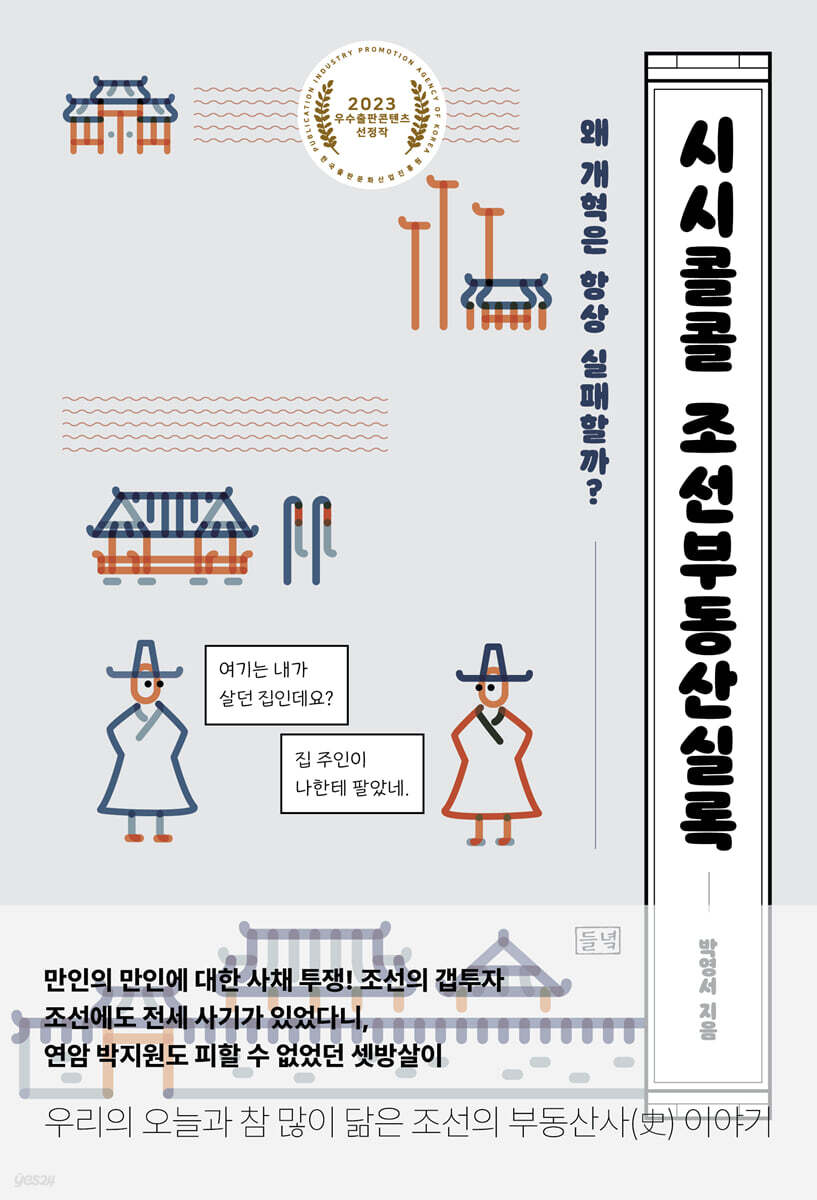
Books selected for the 2023 Excellent Publishing Content Support Project A history book for citizens who believe in the progress of history and move forward into the future. 『The Detailed Records of Joseon Real Estate』 This is the fourth book by author Park Young-seo, a witty storyteller who vividly unfolds Joseon history as if it were happening today. This was written to look back on the history of real estate in Joseon and to create an opportunity to create a common understanding for true 'real estate reform' in 21st century Korea. If you look at the origins of the fall of every nation, real estate issues are always at play. Goryeo was the same way. The land annexation by those in power resulted in countless evils and ultimately led Goryeo to ruin. The founding forces of Joseon, led by Taejo Yi Seong-gye, opened the door to a new dynasty and also implemented land reform. They wanted to correct the evils of Goryeo and create a country where all people could eat well, live in peace, and have a strong and prosperous nation. However, the reform failed, and Joseon's history was stained with the tyranny of corrupt officials and the tears of suffering people. We already know these facts well. However, we do not know much about the trials and errors Joseon experienced during the land reform process, the efforts it made to correct them, and the reasons why it failed despite all of this. This book traces the history of Joseon and traces the reasons why Joseon's real estate reforms were frustrated. And we find that the problems that occurred in the Joseon Dynasty and the things that are happening in 21st century South Korean society are very similar. South Korea has also attempted real estate reform several times, but the side effects have generally outweighed the improvements. In particular, the recent surge in cases of rental fraud is further heightening the sense of crisis. Against this background of history and reality, the book asks questions. Why do reforms always fail? And we explore the path forward, learning from Joseon's past failures. It conveys a message of hope that it is not too late. You can look into Joseon's economic history, especially its real estate history, in one volume. It is written in a friendly and interesting style, so even those unfamiliar with economic history or young people can read it with ease and comfort. I believe that history is the nutrient that shapes our thoughts and perceptions, and I recommend this book to those who wish to gain wisdom and insight for living today from it. |
- You can preview some of the book's contents.
Preview
index
introduction
Opening remarks
〈Part 1.
The Story of Joseon's Land
Chapter 1.
A turning point in Joseon: the law of over-extension
Unearned income, objection!
Utopia starts right here on this land
Chapter 2.
The dream of utopia begins to creak
The privileged class begins privatizing land.
Tax policy that favors the wealthy: Public law, what's the big deal?
The desire to increase wealth fills the sea
Chapter 3.
Joseon Becomes a Land of "Gotmulju"
A warm goodbye to nationalization
The Eldest Son Takes It All: Changes in Inheritance
Who ate all that land?
The 19th century: The myth of Seoul's invincibility begins.
Chapter 4.
The resurgent flag of land reform
The Real Face of Real Estate: A Life of Struggle
Reform = Finding the Original Intention of 'Land Nationalization'
The history of Joseon at a glance
〈Part 2.
The Story of Joseon's House
Chapter 1.
Joseon Jeonki: Hey, you too can 'buy your own home'! With Joseon
Joseon's Promise: "Home Sites for Residents"
You can still 'own your own home', as long as you overcome regulations and housing prices.
The promise of "owning a home" turns out to be a bad check.
Chapter 2.
Late Joseon Dynasty: In this vast land of Seoul, there is no place for me to lie down.
The escalating ownership dispute: "Oh, well, this has been my home for generations."
The Joseon Dynasty's Bokdeokbang landscape, shaped by housing shortages
A Peek into Late Joseon Dynasty House Prices Through Transaction Documents
Chapter 3.
Living in Seoul in the 18th and 19th centuries
It's so hard to buy a house
The illusion of owning a home through a loan
Do you know the sorrow of a civil servant who is homeless?
Neither the aristocracy nor the bureaucrats can escape! Joseon's land-rent fraud
A look at the history of Joseon houses
Reopening article
Americas
References
Opening remarks
〈Part 1.
The Story of Joseon's Land
Chapter 1.
A turning point in Joseon: the law of over-extension
Unearned income, objection!
Utopia starts right here on this land
Chapter 2.
The dream of utopia begins to creak
The privileged class begins privatizing land.
Tax policy that favors the wealthy: Public law, what's the big deal?
The desire to increase wealth fills the sea
Chapter 3.
Joseon Becomes a Land of "Gotmulju"
A warm goodbye to nationalization
The Eldest Son Takes It All: Changes in Inheritance
Who ate all that land?
The 19th century: The myth of Seoul's invincibility begins.
Chapter 4.
The resurgent flag of land reform
The Real Face of Real Estate: A Life of Struggle
Reform = Finding the Original Intention of 'Land Nationalization'
The history of Joseon at a glance
〈Part 2.
The Story of Joseon's House
Chapter 1.
Joseon Jeonki: Hey, you too can 'buy your own home'! With Joseon
Joseon's Promise: "Home Sites for Residents"
You can still 'own your own home', as long as you overcome regulations and housing prices.
The promise of "owning a home" turns out to be a bad check.
Chapter 2.
Late Joseon Dynasty: In this vast land of Seoul, there is no place for me to lie down.
The escalating ownership dispute: "Oh, well, this has been my home for generations."
The Joseon Dynasty's Bokdeokbang landscape, shaped by housing shortages
A Peek into Late Joseon Dynasty House Prices Through Transaction Documents
Chapter 3.
Living in Seoul in the 18th and 19th centuries
It's so hard to buy a house
The illusion of owning a home through a loan
Do you know the sorrow of a civil servant who is homeless?
Neither the aristocracy nor the bureaucrats can escape! Joseon's land-rent fraud
A look at the history of Joseon houses
Reopening article
Americas
References
Into the book
Successful real estate reform begins with citizens' absolute belief and awareness that "real estate inequality must be reformed."
As long as we remain mired in the illusion that "my home price should rise, but I hope it falls for the nation as a whole," real estate inequality will not be resolved for the next generation, and in fact, it will deepen.
In the end, it will become an escalator leading to national ruin.
Carrying the suffering of countless citizens.
--- From the "Preface"
Actually, the phrase 'there is no land' is quite strange.
It's always been there, it's immovable property, yet there's no earthquake or volcanic eruption, so how can there be no land? For hundreds of years, Joseon officials complained about land shortages and cried out in unison, "There's no land." Yet, land has always existed.
It's just that the land already had an owner.
Even though the lands they acquired as meritorious subjects, as members of the nobility, as the wives of officials, and as their descendants completely nullified the financial system of the nation that had been initially designed, no one mentioned the fundamental principles established by the architects of Joseon.
To say that it was 'complete redistribution through complete dismantling' is a painful statement.
--- From "The Privileged Class Begins Land Privatization"
It's the same reason that big players are following the National Pension Service's investments these days.
Since it was a project invested by the Jinheulcheong, big players in Seoul also took interest.
They obtain development rights for large areas of land after obtaining early access to development information and registration guidelines.
Then, they sold the land to others under the pretext of development rights.
They don't even bother to cultivate the land, but wait for someone to cultivate it and then 'rob' half of the crop.
When the Four Major Rivers Project or the Administrative Capital Relocation Project was in progress, the image of the "Seoul land tycoon" who bought land in promising areas in advance, or the "Tteodabang" (a type of real estate investment company) who put their eggs in every real estate in hot development areas, or the act of acquiring farmland under false pretenses and then splitting it up and selling it, comes to mind, right?
--- From "Who ate all that land?"
Land prices are a real headache.
From a distance, it seems that the gains and losses when land prices rise and fall are applied equally to everyone.
But if you look closely, when it goes up, the gains go mainly to the rich, and when it goes down, the losses go mainly to the common people.
So, Joseon operated a large-scale social security system called Hwan-gok to provide broad coverage to those who suffered great losses whenever prices and land prices fluctuated.
However, as the grain tax system began to lose its character as a welfare system, the fence that could protect the people when land prices fluctuated also gradually disappeared.
--- From "Who ate all that land?"
Of course, regulation isn't always a bad thing.
There is always a socio-cultural context behind the emergence of regulations that made them inevitable.
In other words, a regulation is an inevitable outcome of dialectical history.
The media's crossfire tends to focus on the regulation itself, neglecting or ignoring the social issues behind the regulation and its solutions.
Therefore, criticism that simply demonizes regulation is never justified.
However, real estate regulations alone are not enough to solve the major problem of housing shortage.
Regulations inevitably have unintended consequences.
Policymakers excuse this by calling it the "balloon effect."
However, any rational policymaker would also consider the inevitable side effects that will arise as the policy is implemented.
If we regulate without doing so, it is highly likely that it will end up being a case of ‘good intentions disguised as a cover-up.’
--- From "The Landscape of Bokdeokbang in Joseon Created by Housing Shortages"
The situation at the time was like this.
Numerous problems were emerging, including rising prices and a declining currency value due to unprecedented crop failures, a political situation with no answers due to the emergence of the Lee Yang-seon and the Se-do regime, public unrest, and a depleted national treasury.
In this moment of crisis, people are investing en masse in real estate.
The value of land and housing has been highlighted.
Did they also have the belief that "house prices would eventually rise"? We don't know, but it's clear that they had sufficient expectations of housing as a "safe asset."
--- From "Housing Prices in the Late Joseon Dynasty: A Peek Through Transaction Documents"
What went wrong? Perhaps the very idea of land nationalization was flawed? If so, it would be fatal to us living in the modern world.
Because many of the solutions devised to address the real estate problems of our time are based on the concept of public land ownership.
The concept of public land is the theoretical basis for limiting ownership rights or imposing obligations on land to ensure the public nature and rational use of land.
Although the concept is somewhat different from the nationalization of land based on the royal land ideology of the Joseon Dynasty, the goal of pursuing public interest through public sanctions on private property is the same.
However, it seems difficult to say that Joseon's ideal itself was wrong.
Because, despite great efforts, Joseon has never succeeded in nationalizing land.
Every time the government tried to restrain the market based on the ideology of land nationalization, it was met with surprisingly natural and sophisticated opposition from interested parties.
The government has consistently been complacent in its approach to housing issues.
We have pressured people with various regulatory policies, but we have not been able to closely examine the flow of market formation and growth.
In particular, despite the urgent need for a large-scale supply policy, the capital city of Hanyang maintained its position that it could not expand even an inch, and only occasionally implemented policies such as reorganizing administrative districts or leasing vacant lots to the public.
There was a single attempt to reverse that trend by building a new city in Mars and relocating the administrative capital, but that opportunity vanished like a spring dream.
Why would that be? Perhaps the court wasn't particularly concerned about Hanyang's housing shortage.
For example, the problem of illegal construction that persisted throughout the early Joseon Dynasty was triggered by concerns about royal authority and public safety.
The public rental policy for soldiers was part of a policy to strengthen national defense capabilities.
The ban on multiple homes for high-ranking officials was an ethical issue related to corruption.
In other words, the ultimate goal of all policies that can be called housing policies was not to ‘resolve the housing shortage.’
The technological innovations we are witnessing now may create a 'post-work society' that seemed like a dream.
It may already be too late to return to the universal value of 'owning as much as you work, paying taxes as much as you own', a world where people can determine their lives through their work.
But those who are left behind in the rush of technological innovation are also citizens and members of our community.
We must keep in mind that without them, our achievements would be empty.
The landowners of Joseon did not know.
That in the future, you too could become a vulnerable person and be exploited by someone.
We too often forget.
The moment we become intoxicated with our achievements and turn a blind eye to the inequalities in our community, we may fall into the abyss of despair that it creates.
Perhaps the real estate reform we so desperately desire will begin not with a yearning for equality, but with an acceptance that fairness can be detrimental to us.
As long as we remain mired in the illusion that "my home price should rise, but I hope it falls for the nation as a whole," real estate inequality will not be resolved for the next generation, and in fact, it will deepen.
In the end, it will become an escalator leading to national ruin.
Carrying the suffering of countless citizens.
--- From the "Preface"
Actually, the phrase 'there is no land' is quite strange.
It's always been there, it's immovable property, yet there's no earthquake or volcanic eruption, so how can there be no land? For hundreds of years, Joseon officials complained about land shortages and cried out in unison, "There's no land." Yet, land has always existed.
It's just that the land already had an owner.
Even though the lands they acquired as meritorious subjects, as members of the nobility, as the wives of officials, and as their descendants completely nullified the financial system of the nation that had been initially designed, no one mentioned the fundamental principles established by the architects of Joseon.
To say that it was 'complete redistribution through complete dismantling' is a painful statement.
--- From "The Privileged Class Begins Land Privatization"
It's the same reason that big players are following the National Pension Service's investments these days.
Since it was a project invested by the Jinheulcheong, big players in Seoul also took interest.
They obtain development rights for large areas of land after obtaining early access to development information and registration guidelines.
Then, they sold the land to others under the pretext of development rights.
They don't even bother to cultivate the land, but wait for someone to cultivate it and then 'rob' half of the crop.
When the Four Major Rivers Project or the Administrative Capital Relocation Project was in progress, the image of the "Seoul land tycoon" who bought land in promising areas in advance, or the "Tteodabang" (a type of real estate investment company) who put their eggs in every real estate in hot development areas, or the act of acquiring farmland under false pretenses and then splitting it up and selling it, comes to mind, right?
--- From "Who ate all that land?"
Land prices are a real headache.
From a distance, it seems that the gains and losses when land prices rise and fall are applied equally to everyone.
But if you look closely, when it goes up, the gains go mainly to the rich, and when it goes down, the losses go mainly to the common people.
So, Joseon operated a large-scale social security system called Hwan-gok to provide broad coverage to those who suffered great losses whenever prices and land prices fluctuated.
However, as the grain tax system began to lose its character as a welfare system, the fence that could protect the people when land prices fluctuated also gradually disappeared.
--- From "Who ate all that land?"
Of course, regulation isn't always a bad thing.
There is always a socio-cultural context behind the emergence of regulations that made them inevitable.
In other words, a regulation is an inevitable outcome of dialectical history.
The media's crossfire tends to focus on the regulation itself, neglecting or ignoring the social issues behind the regulation and its solutions.
Therefore, criticism that simply demonizes regulation is never justified.
However, real estate regulations alone are not enough to solve the major problem of housing shortage.
Regulations inevitably have unintended consequences.
Policymakers excuse this by calling it the "balloon effect."
However, any rational policymaker would also consider the inevitable side effects that will arise as the policy is implemented.
If we regulate without doing so, it is highly likely that it will end up being a case of ‘good intentions disguised as a cover-up.’
--- From "The Landscape of Bokdeokbang in Joseon Created by Housing Shortages"
The situation at the time was like this.
Numerous problems were emerging, including rising prices and a declining currency value due to unprecedented crop failures, a political situation with no answers due to the emergence of the Lee Yang-seon and the Se-do regime, public unrest, and a depleted national treasury.
In this moment of crisis, people are investing en masse in real estate.
The value of land and housing has been highlighted.
Did they also have the belief that "house prices would eventually rise"? We don't know, but it's clear that they had sufficient expectations of housing as a "safe asset."
--- From "Housing Prices in the Late Joseon Dynasty: A Peek Through Transaction Documents"
What went wrong? Perhaps the very idea of land nationalization was flawed? If so, it would be fatal to us living in the modern world.
Because many of the solutions devised to address the real estate problems of our time are based on the concept of public land ownership.
The concept of public land is the theoretical basis for limiting ownership rights or imposing obligations on land to ensure the public nature and rational use of land.
Although the concept is somewhat different from the nationalization of land based on the royal land ideology of the Joseon Dynasty, the goal of pursuing public interest through public sanctions on private property is the same.
However, it seems difficult to say that Joseon's ideal itself was wrong.
Because, despite great efforts, Joseon has never succeeded in nationalizing land.
Every time the government tried to restrain the market based on the ideology of land nationalization, it was met with surprisingly natural and sophisticated opposition from interested parties.
The government has consistently been complacent in its approach to housing issues.
We have pressured people with various regulatory policies, but we have not been able to closely examine the flow of market formation and growth.
In particular, despite the urgent need for a large-scale supply policy, the capital city of Hanyang maintained its position that it could not expand even an inch, and only occasionally implemented policies such as reorganizing administrative districts or leasing vacant lots to the public.
There was a single attempt to reverse that trend by building a new city in Mars and relocating the administrative capital, but that opportunity vanished like a spring dream.
Why would that be? Perhaps the court wasn't particularly concerned about Hanyang's housing shortage.
For example, the problem of illegal construction that persisted throughout the early Joseon Dynasty was triggered by concerns about royal authority and public safety.
The public rental policy for soldiers was part of a policy to strengthen national defense capabilities.
The ban on multiple homes for high-ranking officials was an ethical issue related to corruption.
In other words, the ultimate goal of all policies that can be called housing policies was not to ‘resolve the housing shortage.’
The technological innovations we are witnessing now may create a 'post-work society' that seemed like a dream.
It may already be too late to return to the universal value of 'owning as much as you work, paying taxes as much as you own', a world where people can determine their lives through their work.
But those who are left behind in the rush of technological innovation are also citizens and members of our community.
We must keep in mind that without them, our achievements would be empty.
The landowners of Joseon did not know.
That in the future, you too could become a vulnerable person and be exploited by someone.
We too often forget.
The moment we become intoxicated with our achievements and turn a blind eye to the inequalities in our community, we may fall into the abyss of despair that it creates.
Perhaps the real estate reform we so desperately desire will begin not with a yearning for equality, but with an acceptance that fairness can be detrimental to us.
--- From "Reopening the Writing"
Publisher's Review
A History of Joseon Real Estate in One Volume
How small privileges create huge inequalities
What are the prerequisites for successful real estate reform?
This book is divided into two parts.
Part 1 examines the land system of Joseon.
The new aristocracy of Joseon sought to nationalize all land in order to guarantee a certain livelihood to all the people and to prevent the powerful from monopolizing land and making unearned income.
But in the end, they too had no choice but to compromise with reality.
Private land was provided as a rewarding privilege for the founding fathers.
Part 1 traces how small "exceptional allowances" widened the gap over time, creating inequality and plunging Joseon into the abyss of national ruin.
Part 2 examines the history of housing transactions in Joseon, focusing on Hanyang.
During the Joseon Dynasty, the concept of land and houses was different from today, and houses were generally considered to be mere accessories that came with land transactions.
However, it was different in the capital city of Hanyang, the administrative, cultural, and economic center where the population was dense.
In Hanyang, a fierce and intense war of nerves broke out over a single small house on a narrow piece of land.
This point is reminiscent of today's Republic of Korea, which is called the 'Republic of Seoul'.
During this period, people in Hanyang suffered from a housing shortage regardless of their social status or position.
It is said that even Park Ji-won of Yeonam was unable to buy his own home until he was 60 years old and had to live in a rented room.
Just like us today, Koreans had to contend with landlords who refused to return their deposits.
While some people lament their inability to find a home, others own multiple homes within the small land area of Hanyang and use them as collateral to create new real estate investment opportunities.
In Part 2, we will examine how the Joseon Dynasty government viewed and responded to the housing shortage and conflicts surrounding housing in Hanyang.
The final "Reopening" section concludes the book and, by synthesizing the discussions in Parts 1 and 2, opens a new chapter of discussion, exploring what lessons we can learn from history today.
Throughout the book, the voices of various people, from the Joseon king and high and low officials to ordinary citizens, are vividly captured, unfolding the history of Joseon's real estate in a vivid and interesting way in one book.
How small privileges create huge inequalities
What are the prerequisites for successful real estate reform?
This book is divided into two parts.
Part 1 examines the land system of Joseon.
The new aristocracy of Joseon sought to nationalize all land in order to guarantee a certain livelihood to all the people and to prevent the powerful from monopolizing land and making unearned income.
But in the end, they too had no choice but to compromise with reality.
Private land was provided as a rewarding privilege for the founding fathers.
Part 1 traces how small "exceptional allowances" widened the gap over time, creating inequality and plunging Joseon into the abyss of national ruin.
Part 2 examines the history of housing transactions in Joseon, focusing on Hanyang.
During the Joseon Dynasty, the concept of land and houses was different from today, and houses were generally considered to be mere accessories that came with land transactions.
However, it was different in the capital city of Hanyang, the administrative, cultural, and economic center where the population was dense.
In Hanyang, a fierce and intense war of nerves broke out over a single small house on a narrow piece of land.
This point is reminiscent of today's Republic of Korea, which is called the 'Republic of Seoul'.
During this period, people in Hanyang suffered from a housing shortage regardless of their social status or position.
It is said that even Park Ji-won of Yeonam was unable to buy his own home until he was 60 years old and had to live in a rented room.
Just like us today, Koreans had to contend with landlords who refused to return their deposits.
While some people lament their inability to find a home, others own multiple homes within the small land area of Hanyang and use them as collateral to create new real estate investment opportunities.
In Part 2, we will examine how the Joseon Dynasty government viewed and responded to the housing shortage and conflicts surrounding housing in Hanyang.
The final "Reopening" section concludes the book and, by synthesizing the discussions in Parts 1 and 2, opens a new chapter of discussion, exploring what lessons we can learn from history today.
Throughout the book, the voices of various people, from the Joseon king and high and low officials to ordinary citizens, are vividly captured, unfolding the history of Joseon's real estate in a vivid and interesting way in one book.
GOODS SPECIFICS
- Date of issue: October 16, 2023
- Page count, weight, size: 360 pages | 538g | 153*225*21mm
- ISBN13: 9791159258121
- ISBN10: 1159258120
You may also like
카테고리
korean


korean

![GQ KOREA Mark (Monthly): December [2025]](http://librairie.coreenne.fr/cdn/shop/files/8ef265dbbfbf186523ed75ba7319009d.jpg?v=1765340328&width=3840)


