

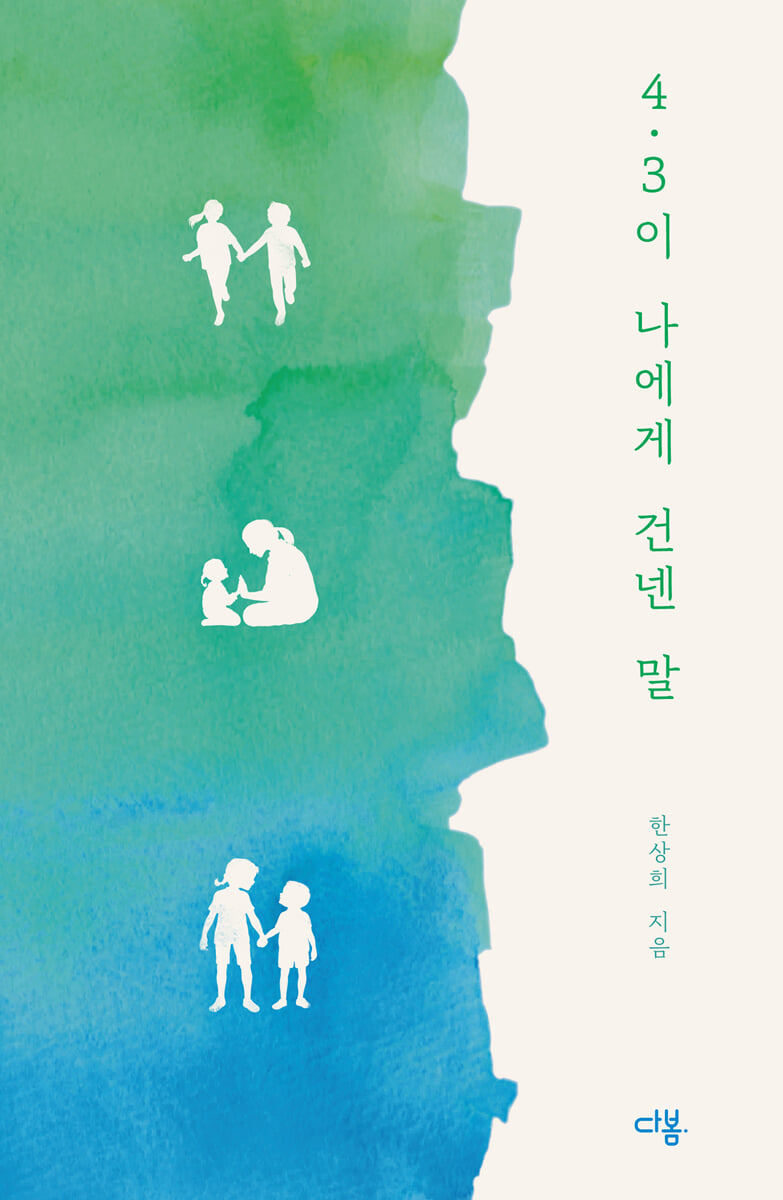
What April 3rd said to me
 |
Description
Book Introduction
A warm and cheerful companion of April 3rd
Dr. Han Sang-hee shares stories about the April 3 Incident and its people.
This book confronts the 4.3 incident historically,
Insight into the values of peace, human rights, justice, and unification,
It advances citizenship and restorative justice.
Education, children's and youth publishing company 'Dabom' published 'What April 3rd Said to Me' so that citizens, including youth and adults, can read and remember April 3rd together and commemorate the victims.
The author is Han Sang-hee, who was born and raised in Jeju.
After accidentally encountering the April 3rd Incident at the age of 16, he became a history teacher and a doctorate in global citizenship education. He currently lives as a practitioner of 'good citizenship' and 'restorative justice.'
For the author, April 3rd was a window through which he viewed the world and a milestone that guided his life's direction. "What April 3rd Said to Me" is a book written from his life of long efforts to understand, remember, and share April 3rd.
The meaning of ‘know, remember, and share’ here is a little special.
To "know" means to face the site of the April 3rd Incident 75 years ago and the suffering of those who experienced it. To "remember" means to contemplate the strength that allowed those who survived that time and those left behind to recover from their wounds. To "share" means to bring the lessons of the April 3rd Incident to today and use them as a proper balance to move forward into tomorrow.
'Knowing, remembering, and sharing' is the author's inner growth process along with the April 3rd Incident, and the structure of this book captures that process in its entirety.
The book contains artworks by three people who were involved in the April 3rd Incident.
Paintings by artist Kang Yo-bae, who recorded the April 3rd Incident by interviewing people who experienced it, photographs by artist Kim Ki-sam, who captured the historical site to uncover the truth about the April 3rd Incident, and installation photos by the late artist Koh Hyun-joo, who carefully placed bundles of bright light on the dark site of sacrifice.
All of these works elevate the meaning of this book by sublimating the idea of ‘knowing, remembering, and sharing’ April 3rd into art.
Herein lies the special meaning of “What April 3rd Said to Me.”
This book does not stop at 75 years ago when the April 3 Incident occurred.
It reminds us of how that one part of history that we must know has continued to lead to what we have today.
It also allows us to share our thoughts and opinions on how we should live and get along based on that knowledge and memory.
This is the result of starting from the idea that 4·3 is not just 4·3.
April 3rd is a tangled web of murderers and victims, survivors and those left behind, pain and endurance, rejection and acceptance, collapse and reconstruction, wounds and recovery, past and present, there and here.
The author calmly guides us on what we must do to ensure that April 3rd can become a strong net that holds the future.
It naturally leads to the investigation of the truth, the restoration of the victims' honor, and a moment of silence for the righteous.
Know, remember, share.
Let's follow Han Sang-hee, a companion of April 3rd, while reflecting on these three things.
Dr. Han Sang-hee shares stories about the April 3 Incident and its people.
This book confronts the 4.3 incident historically,
Insight into the values of peace, human rights, justice, and unification,
It advances citizenship and restorative justice.
Education, children's and youth publishing company 'Dabom' published 'What April 3rd Said to Me' so that citizens, including youth and adults, can read and remember April 3rd together and commemorate the victims.
The author is Han Sang-hee, who was born and raised in Jeju.
After accidentally encountering the April 3rd Incident at the age of 16, he became a history teacher and a doctorate in global citizenship education. He currently lives as a practitioner of 'good citizenship' and 'restorative justice.'
For the author, April 3rd was a window through which he viewed the world and a milestone that guided his life's direction. "What April 3rd Said to Me" is a book written from his life of long efforts to understand, remember, and share April 3rd.
The meaning of ‘know, remember, and share’ here is a little special.
To "know" means to face the site of the April 3rd Incident 75 years ago and the suffering of those who experienced it. To "remember" means to contemplate the strength that allowed those who survived that time and those left behind to recover from their wounds. To "share" means to bring the lessons of the April 3rd Incident to today and use them as a proper balance to move forward into tomorrow.
'Knowing, remembering, and sharing' is the author's inner growth process along with the April 3rd Incident, and the structure of this book captures that process in its entirety.
The book contains artworks by three people who were involved in the April 3rd Incident.
Paintings by artist Kang Yo-bae, who recorded the April 3rd Incident by interviewing people who experienced it, photographs by artist Kim Ki-sam, who captured the historical site to uncover the truth about the April 3rd Incident, and installation photos by the late artist Koh Hyun-joo, who carefully placed bundles of bright light on the dark site of sacrifice.
All of these works elevate the meaning of this book by sublimating the idea of ‘knowing, remembering, and sharing’ April 3rd into art.
Herein lies the special meaning of “What April 3rd Said to Me.”
This book does not stop at 75 years ago when the April 3 Incident occurred.
It reminds us of how that one part of history that we must know has continued to lead to what we have today.
It also allows us to share our thoughts and opinions on how we should live and get along based on that knowledge and memory.
This is the result of starting from the idea that 4·3 is not just 4·3.
April 3rd is a tangled web of murderers and victims, survivors and those left behind, pain and endurance, rejection and acceptance, collapse and reconstruction, wounds and recovery, past and present, there and here.
The author calmly guides us on what we must do to ensure that April 3rd can become a strong net that holds the future.
It naturally leads to the investigation of the truth, the restoration of the victims' honor, and a moment of silence for the righteous.
Know, remember, share.
Let's follow Han Sang-hee, a companion of April 3rd, while reflecting on these three things.
- You can preview some of the book's contents.
Preview
index
preface
Recommendation | A Requiem for 30,000 Lives
Prologue | April 3rd, a Coincidental Visit
Chapter 1 4·3 Speaks to Me
1) The oppression that came to Jeju Island with liberation
2) The March 1st shooting incident and the shouts of the general strike
3) Armed uprising and scorched-earth operation on April 3
4) Lasted 7 years and 7 months until after the Korean War
Chapter 2: Names Falling Like Camellia Flowers
1) People Who Shared Potatoes: In the Movie "Jiseul"
2) Babies of Bukchon-ri: Based on the novel ‘Uncle Sooni’
3) A flower blooming on a stone wall: The novel "Whispering on the Stone Wall"
Chapter 3: The Second Question: April 3rd and the People
1) Children who survived April 3rd
2) Meet your separated family
Chapter 4: The Banality of Evil vs. the Citizenship of Good
1) Distorted 'patriotism' without reflection
2) People who pursued justice and goodness to the end
Chapter 5: What the April 3 Incident Left Us
1) April 3: Our Modern History
2) Positive Peace: Seeing from the Other Person's Perspective
3) Global Citizen: Moving toward Peace and Human Rights
4) Restorative Justice: A Way to Revive Broken Communities
Epilogue | If I Hadn't Knew About April 3rd
Recommendation | A Requiem for 30,000 Lives
Prologue | April 3rd, a Coincidental Visit
Chapter 1 4·3 Speaks to Me
1) The oppression that came to Jeju Island with liberation
2) The March 1st shooting incident and the shouts of the general strike
3) Armed uprising and scorched-earth operation on April 3
4) Lasted 7 years and 7 months until after the Korean War
Chapter 2: Names Falling Like Camellia Flowers
1) People Who Shared Potatoes: In the Movie "Jiseul"
2) Babies of Bukchon-ri: Based on the novel ‘Uncle Sooni’
3) A flower blooming on a stone wall: The novel "Whispering on the Stone Wall"
Chapter 3: The Second Question: April 3rd and the People
1) Children who survived April 3rd
2) Meet your separated family
Chapter 4: The Banality of Evil vs. the Citizenship of Good
1) Distorted 'patriotism' without reflection
2) People who pursued justice and goodness to the end
Chapter 5: What the April 3 Incident Left Us
1) April 3: Our Modern History
2) Positive Peace: Seeing from the Other Person's Perspective
3) Global Citizen: Moving toward Peace and Human Rights
4) Restorative Justice: A Way to Revive Broken Communities
Epilogue | If I Hadn't Knew About April 3rd
Detailed image
.jpg)
Publisher's Review
'What on earth is April 3rd?'
A question posed by a 16-year-old teenager, and the long journey that follows to find the answer.
The author says that before he encountered the April 3rd Incident, he was a mischievous child when he was 16 years old.
Because I was a teenager who would fall asleep every night thinking about what I would do with my friends the next day.
That day, I fell asleep as usual, but I had a strange dream.
It was a scary dream where I dipped my hand into the sea water and felt bones, and then placed those bones on a tombstone next to a grave in a cemetery.
When I woke up and told my mother about my dream, she replied, “You dreamed of your grandfather!”
The author first heard about 'April 3rd' from his mother that day.
November 7, 1948, Hannam-ri, Namwon-eup, Jeju-do.
Soldiers and police stormed the village, burning houses and shooting indiscriminately.
My mother (then 8 years old) and my maternal uncle (then 5 years old) hid in a bamboo grove and watched in silence as the house burned.
The siblings waited all night for their parents, trembling with fear, and they never saw their father again.
The father of the siblings, who had fled in a hurry and was captured, was sentenced to life imprisonment and imprisoned in Mapo Prison in Seoul, where he was sacrificed during the Korean War.
(The author's mother later found out that her maternal grandfather had been falsely accused of treason and espionage.)
The author said that on this day, he couldn't contain his overwhelming curiosity.
Why did his maternal grandfather become a criminal? How did the young siblings survive, their house burned down and their father gone? Could other families have similar stories? What happened back then? The many questions posed by the 4/3 Incident, a chance visit, prompted the author to abandon his mischievous ways and embark on a journey to understand the events of the 4/3 Incident.
A history that was buried for a long time because no one spoke about it.
It was after the June Struggle that the victims, who had never been able to express their sorrow about their painful family history, began to speak about April 3rd.
The year the 16-year-old author first heard of April 3rd was 1988, a full 40 years after the April 3rd armed uprising.
“What on earth is April 3?” The author spent a long time searching for an answer to this question, which arose after hearing the stories of his mother, maternal uncle, and maternal grandfather.
The record of this uneasy journey is “What April 3rd Said to Me.”
A Study on the Strength That Endured the Wounds of the April 3rd Incident: April 3rd and the People
The first question was about the historical facts of April 3rd, and the answer to that is summarized in Chapter 1.
Why did the April 3rd Incident occur, what was the situation in Jeju, in Korea, and outside of Korea at the time, and what sacrificed whom?
The stories of the people who endured the 7 years and 7 months from the March 1st shooting incident in 1947 until the lifting of the Hallasan Mountain curfew on September 21, 1954 are vividly told in Chapter 2 through the film “Jiseul” (directed by Oh Myeol) and the novels “Uncle Sooni” (written by Hyun Ki-young) and “Whispering on the Stone Wall” (written by Lim Cheol-woo) that deal with the time.
The second question was, then, how did the survivors continue their lives and how was Jeju restored?
The reason why April 3rd is called 30,000 incidents when it is one incident; the victims and the survivors, the murderers and those who saved others, those who took the lead in uncovering the truth and remembering…
In other words, the author's interest in 'April 3rd and People' broadened and deepened.
Chapter 3 depicts the hardships and overcoming of children who were thrown into the harsh environment of the April 3 Incident through the author's family history.
The story is told warmly of two young siblings, aged 8 and 5, who vowed to have as many children as possible when they got married to rebuild their broken family and build a strong community. The children born that way grew up strong and united, overcoming the devastation of the April 3rd Incident and facing the harsh world, following the teachings of "sibling responsibility."
The author says that while the April 3rd Incident is an event that shows how mercilessly people can commit evil, it is also a historical event that proves how righteous and courageous people can make decisions.
He conceptualized the righteous courage that neutralized the well-known 'banality of evil' in the April 3rd Incident and named it 'good citizenship.'
The precious stories of each and every righteous person who risked their lives to save innocent people shine like jewels in Chapter 4.
What the April 3 Incident Belonged to Us: The Values of Peace, Human Rights, Justice, and Unification, Expanding Citizenship, and Restorative Justice
As the author gradually began to find answers to the question, “What is April 3?” and his understanding of “April 3 and the People” broadened, his thoughts took on a new form: “What has April 3 left us?”
It was not only the author's will to spend his life with April 3rd, but also a pledge to make April 3rd known to the world as a universal lesson for humanity.
The author emphasizes that the April 3 Incident itself is a teaching material that provides a great lesson not only for modern Korean history but also for world history.
First, April 3rd is a lesson in peace that proves that state violence cannot be tolerated for any purpose.
Second, it is a textbook on human rights that shows that human life is a precious thing that cannot be exchanged for anything in this world and that life should never be damaged under any circumstances.
Third, it is a textbook on justice that shows how a society is ruined and life is trampled when justice is forgotten.
The author emphasizes that, although the April 3rd Incident was a tragedy in modern Korean history that claimed the lives of countless Jeju Island residents amidst the historical vortex of division and the Cold War, it has now become a symbol that reminds us of the universal human values of peace and human rights, as well as the challenge of our time, unification, by learning from the wounds of history.
The author further states that the lessons of April 3rd are a driving force that expands citizenship and moves toward restorative justice.
Citizenship refers to global citizenship, including the previously mentioned ‘good citizenship.’
A 'global citizen' is someone who respects and coexists with people of different cultures and backgrounds, and global citizenship education is an education that conveys universal human values that transcend race and national borders.
According to the 2013 UN Recommendations on History Education, history education should promote fundamental values such as respect for diversity, tolerance, mutual understanding, human rights, and democracy.
As recommended by the UN, the current global trend in history education is to guard against becoming mired in nationalism that divides us from others, and to pursue universal human values such as peace and human rights.
This also explains why the April 3rd Incident, which healed the tragedy caused by extreme dichotomous thinking through reconciliation and forgiveness, is connected to global citizenship education.
'Restorative justice' is a method to restore broken communities and justice through the restoration of damage and relationships.
This complements the 'retributive justice' that ends in punishment and judgment, leading to reconciliation and communication.
The April 3rd Bereaved Families Association and the Gyeongwoohoe (a group of former police officers), which had been in conflict for a long time, joined hands and reconciled in 2013.
Since then, we have been visiting the April 3 Peace Park and the Chunghon Cemetery together every year to hold an event to commemorate the victims.
On March 29, 2022, the Jeju District Court ruled on the retrial of the April 3rd prisoners.
The prosecutor requested, “Please find all defendants not guilty,” and the judge said, “The burden of proof for the charges lies with the prosecutor.
The prosecution demanded a not guilty verdict, saying there was no evidence to prove the charges.
The reconciliation between the two groups that had long been at odds, and the retrial in which the prosecutor sought not guilty and the judge declared not guilty, demonstrate that the April 3 Incident is moving beyond "retributive justice" to "restorative justice."
The author focuses on this very point and explores the lessons of April 3rd in Chapter 5.
A Living Textbook of the April 3rd Incident: "What April 3rd Said to Me"
The Jeju April 3 Incident is approaching its 76th anniversary.
The truth-finding work that began in 1988 by the media and research institutes continued for over 10 years, and as a result, the Special Act on the Investigation of the Truth of the Jeju 4.3 Incident and Restoration of Honor of the Victims (hereinafter referred to as the “4.3 Special Act”) was enacted in 2000, and the “Jeju 4.3 Incident Truth-Finding Report” was officially adopted in 2003.
The investigation revealed that most of the victims were caused by state power, and that the majority of the victims were unarmed civilians.
Accordingly, President Roh Moo-hyun visited Jeju Island and officially apologized on behalf of the government for the past mistakes of state power.
Many bereaved families said they were greatly comforted by President Roh's apology and that their grievances were beginning to ease little by little.
As the president's apology created an atmosphere of reconciliation and forgiveness, movements for communication and reconciliation continued both on and off Jeju Island, and efforts were active to place the April 3 Incident in its proper place in modern Korean history.
In addition, efforts continued to find ways to heal the wounds of victims and their families through restorative justice.
As a result, the 'April 3rd Special Act' was revised in 2022, and compensation for the victims of the April 3rd Incident and retrials of illegal military trials are underway.
Additionally, a foundation for healing psychological wounds is being created, including the establishment of trauma centers.
The dark history that was trapped in a large cave is slowly coming out and encountering the world.
It is up to us, who have faced April 3rd, to decide what kind of future we will create through that history.
The author, who has been with 4·3 up until now, says:
4·3 The history was tragic, but the stories of those who survived that time were heartwarming.
He said that he was able to overcome his difficulties by recalling the earnest wishes of those who fell during the April 3rd Incident, and that he was able to recharge his courage by recalling the heroes of the April 3rd Incident who risked their lives to save their neighbors.
I have been forced to constantly reflect.
This book, which spans 75 years of history, focuses on the power of recovery that overcomes wounds and revives a collapsed community.
It helps us reflect on yesterday, contemplate today, and move forward toward tomorrow.
If 4·3 is a textbook for global citizenship education, then 『What 4·3 Said to Me』 is a living textbook on 4·3.
I encourage any citizen of the world to open this vibrant book.
A question posed by a 16-year-old teenager, and the long journey that follows to find the answer.
The author says that before he encountered the April 3rd Incident, he was a mischievous child when he was 16 years old.
Because I was a teenager who would fall asleep every night thinking about what I would do with my friends the next day.
That day, I fell asleep as usual, but I had a strange dream.
It was a scary dream where I dipped my hand into the sea water and felt bones, and then placed those bones on a tombstone next to a grave in a cemetery.
When I woke up and told my mother about my dream, she replied, “You dreamed of your grandfather!”
The author first heard about 'April 3rd' from his mother that day.
November 7, 1948, Hannam-ri, Namwon-eup, Jeju-do.
Soldiers and police stormed the village, burning houses and shooting indiscriminately.
My mother (then 8 years old) and my maternal uncle (then 5 years old) hid in a bamboo grove and watched in silence as the house burned.
The siblings waited all night for their parents, trembling with fear, and they never saw their father again.
The father of the siblings, who had fled in a hurry and was captured, was sentenced to life imprisonment and imprisoned in Mapo Prison in Seoul, where he was sacrificed during the Korean War.
(The author's mother later found out that her maternal grandfather had been falsely accused of treason and espionage.)
The author said that on this day, he couldn't contain his overwhelming curiosity.
Why did his maternal grandfather become a criminal? How did the young siblings survive, their house burned down and their father gone? Could other families have similar stories? What happened back then? The many questions posed by the 4/3 Incident, a chance visit, prompted the author to abandon his mischievous ways and embark on a journey to understand the events of the 4/3 Incident.
A history that was buried for a long time because no one spoke about it.
It was after the June Struggle that the victims, who had never been able to express their sorrow about their painful family history, began to speak about April 3rd.
The year the 16-year-old author first heard of April 3rd was 1988, a full 40 years after the April 3rd armed uprising.
“What on earth is April 3?” The author spent a long time searching for an answer to this question, which arose after hearing the stories of his mother, maternal uncle, and maternal grandfather.
The record of this uneasy journey is “What April 3rd Said to Me.”
A Study on the Strength That Endured the Wounds of the April 3rd Incident: April 3rd and the People
The first question was about the historical facts of April 3rd, and the answer to that is summarized in Chapter 1.
Why did the April 3rd Incident occur, what was the situation in Jeju, in Korea, and outside of Korea at the time, and what sacrificed whom?
The stories of the people who endured the 7 years and 7 months from the March 1st shooting incident in 1947 until the lifting of the Hallasan Mountain curfew on September 21, 1954 are vividly told in Chapter 2 through the film “Jiseul” (directed by Oh Myeol) and the novels “Uncle Sooni” (written by Hyun Ki-young) and “Whispering on the Stone Wall” (written by Lim Cheol-woo) that deal with the time.
The second question was, then, how did the survivors continue their lives and how was Jeju restored?
The reason why April 3rd is called 30,000 incidents when it is one incident; the victims and the survivors, the murderers and those who saved others, those who took the lead in uncovering the truth and remembering…
In other words, the author's interest in 'April 3rd and People' broadened and deepened.
Chapter 3 depicts the hardships and overcoming of children who were thrown into the harsh environment of the April 3 Incident through the author's family history.
The story is told warmly of two young siblings, aged 8 and 5, who vowed to have as many children as possible when they got married to rebuild their broken family and build a strong community. The children born that way grew up strong and united, overcoming the devastation of the April 3rd Incident and facing the harsh world, following the teachings of "sibling responsibility."
The author says that while the April 3rd Incident is an event that shows how mercilessly people can commit evil, it is also a historical event that proves how righteous and courageous people can make decisions.
He conceptualized the righteous courage that neutralized the well-known 'banality of evil' in the April 3rd Incident and named it 'good citizenship.'
The precious stories of each and every righteous person who risked their lives to save innocent people shine like jewels in Chapter 4.
What the April 3 Incident Belonged to Us: The Values of Peace, Human Rights, Justice, and Unification, Expanding Citizenship, and Restorative Justice
As the author gradually began to find answers to the question, “What is April 3?” and his understanding of “April 3 and the People” broadened, his thoughts took on a new form: “What has April 3 left us?”
It was not only the author's will to spend his life with April 3rd, but also a pledge to make April 3rd known to the world as a universal lesson for humanity.
The author emphasizes that the April 3 Incident itself is a teaching material that provides a great lesson not only for modern Korean history but also for world history.
First, April 3rd is a lesson in peace that proves that state violence cannot be tolerated for any purpose.
Second, it is a textbook on human rights that shows that human life is a precious thing that cannot be exchanged for anything in this world and that life should never be damaged under any circumstances.
Third, it is a textbook on justice that shows how a society is ruined and life is trampled when justice is forgotten.
The author emphasizes that, although the April 3rd Incident was a tragedy in modern Korean history that claimed the lives of countless Jeju Island residents amidst the historical vortex of division and the Cold War, it has now become a symbol that reminds us of the universal human values of peace and human rights, as well as the challenge of our time, unification, by learning from the wounds of history.
The author further states that the lessons of April 3rd are a driving force that expands citizenship and moves toward restorative justice.
Citizenship refers to global citizenship, including the previously mentioned ‘good citizenship.’
A 'global citizen' is someone who respects and coexists with people of different cultures and backgrounds, and global citizenship education is an education that conveys universal human values that transcend race and national borders.
According to the 2013 UN Recommendations on History Education, history education should promote fundamental values such as respect for diversity, tolerance, mutual understanding, human rights, and democracy.
As recommended by the UN, the current global trend in history education is to guard against becoming mired in nationalism that divides us from others, and to pursue universal human values such as peace and human rights.
This also explains why the April 3rd Incident, which healed the tragedy caused by extreme dichotomous thinking through reconciliation and forgiveness, is connected to global citizenship education.
'Restorative justice' is a method to restore broken communities and justice through the restoration of damage and relationships.
This complements the 'retributive justice' that ends in punishment and judgment, leading to reconciliation and communication.
The April 3rd Bereaved Families Association and the Gyeongwoohoe (a group of former police officers), which had been in conflict for a long time, joined hands and reconciled in 2013.
Since then, we have been visiting the April 3 Peace Park and the Chunghon Cemetery together every year to hold an event to commemorate the victims.
On March 29, 2022, the Jeju District Court ruled on the retrial of the April 3rd prisoners.
The prosecutor requested, “Please find all defendants not guilty,” and the judge said, “The burden of proof for the charges lies with the prosecutor.
The prosecution demanded a not guilty verdict, saying there was no evidence to prove the charges.
The reconciliation between the two groups that had long been at odds, and the retrial in which the prosecutor sought not guilty and the judge declared not guilty, demonstrate that the April 3 Incident is moving beyond "retributive justice" to "restorative justice."
The author focuses on this very point and explores the lessons of April 3rd in Chapter 5.
A Living Textbook of the April 3rd Incident: "What April 3rd Said to Me"
The Jeju April 3 Incident is approaching its 76th anniversary.
The truth-finding work that began in 1988 by the media and research institutes continued for over 10 years, and as a result, the Special Act on the Investigation of the Truth of the Jeju 4.3 Incident and Restoration of Honor of the Victims (hereinafter referred to as the “4.3 Special Act”) was enacted in 2000, and the “Jeju 4.3 Incident Truth-Finding Report” was officially adopted in 2003.
The investigation revealed that most of the victims were caused by state power, and that the majority of the victims were unarmed civilians.
Accordingly, President Roh Moo-hyun visited Jeju Island and officially apologized on behalf of the government for the past mistakes of state power.
Many bereaved families said they were greatly comforted by President Roh's apology and that their grievances were beginning to ease little by little.
As the president's apology created an atmosphere of reconciliation and forgiveness, movements for communication and reconciliation continued both on and off Jeju Island, and efforts were active to place the April 3 Incident in its proper place in modern Korean history.
In addition, efforts continued to find ways to heal the wounds of victims and their families through restorative justice.
As a result, the 'April 3rd Special Act' was revised in 2022, and compensation for the victims of the April 3rd Incident and retrials of illegal military trials are underway.
Additionally, a foundation for healing psychological wounds is being created, including the establishment of trauma centers.
The dark history that was trapped in a large cave is slowly coming out and encountering the world.
It is up to us, who have faced April 3rd, to decide what kind of future we will create through that history.
The author, who has been with 4·3 up until now, says:
4·3 The history was tragic, but the stories of those who survived that time were heartwarming.
He said that he was able to overcome his difficulties by recalling the earnest wishes of those who fell during the April 3rd Incident, and that he was able to recharge his courage by recalling the heroes of the April 3rd Incident who risked their lives to save their neighbors.
I have been forced to constantly reflect.
This book, which spans 75 years of history, focuses on the power of recovery that overcomes wounds and revives a collapsed community.
It helps us reflect on yesterday, contemplate today, and move forward toward tomorrow.
If 4·3 is a textbook for global citizenship education, then 『What 4·3 Said to Me』 is a living textbook on 4·3.
I encourage any citizen of the world to open this vibrant book.
GOODS SPECIFICS
- Date of issue: October 20, 2023
- Page count, weight, size: 216 pages | 312g | 134*205*14mm
- ISBN13: 9791192148779
- ISBN10: 1192148770
You may also like
카테고리
korean


korean

![GQ KOREA Mark (Monthly): December [2025]](http://librairie.coreenne.fr/cdn/shop/files/8ef265dbbfbf186523ed75ba7319009d.jpg?v=1765340328&width=3840)


