

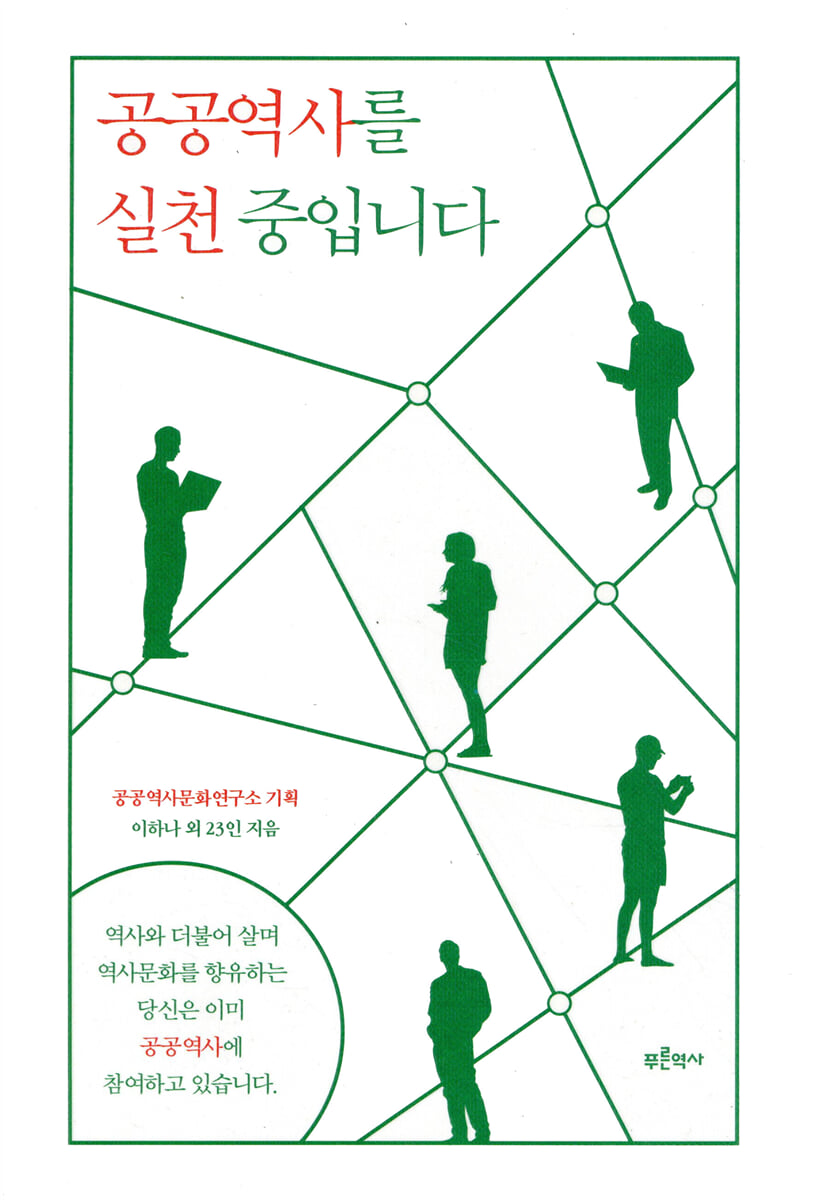
We are practicing public history.
 |
Description
Book Introduction
From concept explanations to use cases…from the lab to the field
Almost everything about 'public history' that has become ingrained in our lives.
History is too important to be left to historians alone.
History exists around us today, reproduced, displayed, and practiced in various cultural forms.
Meanwhile, South Korea is currently facing a major conflict over its perception of history.
Historians are cornered by various historical offensives, including the controversy surrounding General Hong Beom-do that arose from the relocation of his bust within the Korea Military Academy, the historical war with Japan over the Dokdo and Japanese military "comfort women" issues, and the offensives of the New Right and so-called independent historians.
Moreover, as historical ‘fake news’ becomes a hot topic, the academic authority of historians is being pushed aside by anti-intellectualism.
There is a saying that “history is too important to be left to historians alone,” but it is extremely important to properly understand and practice public history for “our collective history.”
Almost everything about 'public history' that has become ingrained in our lives.
History is too important to be left to historians alone.
History exists around us today, reproduced, displayed, and practiced in various cultural forms.
Meanwhile, South Korea is currently facing a major conflict over its perception of history.
Historians are cornered by various historical offensives, including the controversy surrounding General Hong Beom-do that arose from the relocation of his bust within the Korea Military Academy, the historical war with Japan over the Dokdo and Japanese military "comfort women" issues, and the offensives of the New Right and so-called independent historians.
Moreover, as historical ‘fake news’ becomes a hot topic, the academic authority of historians is being pushed aside by anti-intellectualism.
There is a saying that “history is too important to be left to historians alone,” but it is extremely important to properly understand and practice public history for “our collective history.”
- You can preview some of the book's contents.
Preview
index
Introduction: Abundant Reality, Poverty of Theory · Lee Ha-na
Part 1: The Korean Acceptance and Context of the Concept of Public History
1.
The Korean Context of Public History Discussions · Lee Ha-na
2.
Issues and Challenges of Public History · Moving
Part 2: The Field of Public History
Chapter 1: Museums and Historical Exhibits
1.
Women's History Museums and Public History: Issues and Alternatives · Yoon Taek-rim
2.
The value of pre-modern history museums as public history · Ok Jae-won
3.
Dark Tourism: An Audiovisual Experience of State Violence and Collective Trauma · Han Seong-min
Chapter 2 Media and Popular Culture
1.
The Use of History in Popular Culture and Historical Films as Public History · Lee Ha-na
2.
Public History Meets Games · Kim Tae-hyun
3.
The Metaverse and the Reality of History · Jin-ho Park
Chapter 3: Inside and Outside of History Education
1.
The Current State of Public History Education in Schools · Jong-Gwan Lee
2.
How should we view the intersection of school history education and public history? · Jiwon Bang
3.
From Popular History to Citizen History: Public History as a Bridge · Kim Jeong-in
Chapter 4 Oral History and Regional Culture
1.
Local History, Oral History, and Public History · Heo Yeong-ran
2.
Creating Local Cultural Content as Public History · Kang Seong-bong
3.
Methods and Tasks of Regional Surveys and Research · Baek Oe-jun
Part 3 For Public Historians
1.
Historian as a Public Historian · Jin-Oh Joo
2.
Curator: Curators of Small Museums · Shim Cheol-gi
3.
Archivist: Archives and Public Historian · Kim Young-kyung
4. How TV History Documentaries Were Made · Nam Seong-woo
5.
History Writer: History as a Profession, History as a Hobby · Heo Jin-mo
6.
Storyteller: Questions for a Historical Drama Writer · Jeong Hyun-min
7.
History Communicator: A Bridge Between the Inside and Outside of History · Daehoon Jeong
8.
History Creator: A New Demire Public History Captivating the Visual and Aural World · Choi Seul-gi
9.
Culture Planner: Locally Based Cultural Planner · Sim Jun-yong
10.
Cultural Interpreter: The Path to Becoming a Creative Public Historian · Park Tae-woong
11.
University lecturers are also public historians. Park Mi-seon
main
References
Search
Part 1: The Korean Acceptance and Context of the Concept of Public History
1.
The Korean Context of Public History Discussions · Lee Ha-na
2.
Issues and Challenges of Public History · Moving
Part 2: The Field of Public History
Chapter 1: Museums and Historical Exhibits
1.
Women's History Museums and Public History: Issues and Alternatives · Yoon Taek-rim
2.
The value of pre-modern history museums as public history · Ok Jae-won
3.
Dark Tourism: An Audiovisual Experience of State Violence and Collective Trauma · Han Seong-min
Chapter 2 Media and Popular Culture
1.
The Use of History in Popular Culture and Historical Films as Public History · Lee Ha-na
2.
Public History Meets Games · Kim Tae-hyun
3.
The Metaverse and the Reality of History · Jin-ho Park
Chapter 3: Inside and Outside of History Education
1.
The Current State of Public History Education in Schools · Jong-Gwan Lee
2.
How should we view the intersection of school history education and public history? · Jiwon Bang
3.
From Popular History to Citizen History: Public History as a Bridge · Kim Jeong-in
Chapter 4 Oral History and Regional Culture
1.
Local History, Oral History, and Public History · Heo Yeong-ran
2.
Creating Local Cultural Content as Public History · Kang Seong-bong
3.
Methods and Tasks of Regional Surveys and Research · Baek Oe-jun
Part 3 For Public Historians
1.
Historian as a Public Historian · Jin-Oh Joo
2.
Curator: Curators of Small Museums · Shim Cheol-gi
3.
Archivist: Archives and Public Historian · Kim Young-kyung
4. How TV History Documentaries Were Made · Nam Seong-woo
5.
History Writer: History as a Profession, History as a Hobby · Heo Jin-mo
6.
Storyteller: Questions for a Historical Drama Writer · Jeong Hyun-min
7.
History Communicator: A Bridge Between the Inside and Outside of History · Daehoon Jeong
8.
History Creator: A New Demire Public History Captivating the Visual and Aural World · Choi Seul-gi
9.
Culture Planner: Locally Based Cultural Planner · Sim Jun-yong
10.
Cultural Interpreter: The Path to Becoming a Creative Public Historian · Park Tae-woong
11.
University lecturers are also public historians. Park Mi-seon
main
References
Search
Into the book
Public history is a concept that encompasses not only the historical practice of professional historians outside of academia, but also the public utilization and representation of history, as well as critical activities related to it, which exist everywhere as a popular phenomenon.
--- p.11
For the sake of critique of power and the development of a pluralistic culture in a democratic society, such bottom-up historical narratives and representations should be further encouraged and strengthened.
In public history it constitutes a fairly important part.
Even so, it would be problematic to directly interpret the expansion of ownership over historical representation and narrative as an expansion of "history from below."
--- p.43
The Ashmolean Museum in England, founded in 1683, was the first example of a special sanctuary and special collection space in the Middle Ages, a 'place of memory', changing its name to 'museum' and transforming its functions into a specialized 'place of acquisition' by classifying them into exhibition, learning, and experimentation.
--- p.94
Dark tourism is a travel or visit to sites of tragic history such as war and massacre, places where great disasters and calamities occurred, memorials, museums, and tombs that allow us to look back on the dark wounds of history or the past.
And through this, it is a journey to understand historical reality, mourn those who have fallen victim to disasters and incidents, empathize with death by comparing it to oneself, and learn lessons by reflecting on the essence of tragic events.
… … Representative dark tourism destinations in Korea include … … the historic sites of the Jeju April 3rd Uprising … … Geoje POW Camp … … the May 18th Democratization Movement Archives … … and the Seodaemun Prison History Museum in Seoul.
--- p.110
Considering that it was Japan that strongly criticized the film "The Battleship Island" as a "fictional creation" intended to obstruct the registration of the island as a World Heritage Site, the accusations that "The Battleship Island" is pro-Japanese or intentionally distorts history for commercial purposes are unfair.
--- p.135
Historical films, which require relatively large production costs, are usually produced within the framework of commercial films, so the pursuit of entertainment for box office success is inevitable.
However, entertainment value varies according to the theme and sentiment of the film, and there is no specific fixed entertainment element.
The very act of imagining what might have been a historical blank space can be a source of entertainment for audiences.
--- p.139
‘Kkeut-eum’ is… …the first attempt to create a storyboard game dealing with the independence movement in the Primorsky Krai.
The title of this game, which is based on Choi Jae-hyung, is “Pechka.”
〈Pechka〉 attempted to portray the independence activists of the Russian Maritime Province in the early 20th century not as ‘heroes’, but as people who resembled ‘us’, living with daily worries and conflicts.
The intention behind the project, Pechka, is to change the narrative of the popular independence movement, which tends to flow toward "domination and resistance," "anti-Japanese sentiment," and "nationalism," within the game.
--- p.158
Among the classifications of AI digital humans, the one that particularly catches my attention is the ‘historical figure type.’
A representative example is Ahn Jung-geun, who appeared on JTBC's flagship educational program "China K-Class" in 2022 and conversed with the panelists.
Such historical figures can only be reproduced if accurate personal knowledge and corresponding big data are established.
To create an AI digital human like Dasan Jeong Yak-yong, a leading scholar of the late Joseon Dynasty, we need to build big data on his approximately 500 books, including "Mokminsimseo."
--- p.178
Teachers of the 'History Class Practice Group Using Media' are researching and practicing how to utilize historical films, TV dramas, and entertainment programs in history education.
… … Teachers working in the EdTech History Education Division of the Teacher Growth School are practicing history education using AI such as metaverse, Google-powered escape room games, and Chat GPT.
--- p.198
Launched in April 2018, the History Design Research Institute aims to be a platform where citizens and historians can connect, with professional researchers working as designers.
It involves writing and designing the history of individuals and communities together, such as personal life histories through oral accounts, writing corporate histories, and stories of public institutions and villages, and 'lecturing, discussing, and conducting field trips using history as a medium whenever and wherever necessary.'
--- p.255
Those who lead such activities in the region are mostly 'locals' with strong local ties, such as local historians or journalists from diverse backgrounds.
… … The results produced in this way were circulated back to the local community through local networks such as hyanggyo (Confucian schools), cultural centers, and local media.
However, local history research is often based on luxurious tastes and moral concepts that absolutize one's own region, and is therefore often ignored or criticized by historians.
--- p.282
Cheongju, which has been designated as a 'legal culture city' under the banner of 'creative city of record culture' and is carrying out various programs, is carrying out 'training public historians' who participate in record culture as its main project.
For example, “archivists who record for the next generation based on publicness and popularity, and all people who record worth passing on to the next generation” are defined as “next-generation archivists,” and their education and activities are being activated.
--- p.298
Recently, localized elementary school textbooks are being produced primarily by local governments and education offices.
Currently, in Seoul, the subject of 'Knowing My Hometown' is offered to third graders in elementary school, and each local education office is taking the lead in producing localized textbooks.
If a virtuous cycle of local archives and localized teaching materials is established, it will not only enhance learning effectiveness but also provide the advantage of field experience learning close to home and school.
--- p.310
In 2016, Seongbuk Cultural Center participated in the research project “Survey and Research on the Independence Movement and Independence Activists in Seongbuk-gu” (Professor Cho Gyu-tae, Research Director), which was conducted under the supervision of the Industry-Academic Cooperation Foundation of Hansung University and commissioned by Seongbuk-gu Office.
As a result, a total of 113 independence activists in Seongbuk-gu were identified, and 96 new people, including Choi Yong-deok, Na Jung-so, and Oh Se-deok, were discovered.
--- p.324
The curriculum of the Department of History focuses on training historians through graduate school.
… … The analysis of reality at the time was that if the department did not have a promising future despite studying hard, the very existence of the department would be at risk.
Based on this research, the author proposed the concept of historical content.
--- p.341
Curator qualifications can be broadly divided into associate curator qualifications and regular curator qualifications.
To obtain an associate curator license, you must pass the associate curator written exam, but there are no qualification restrictions, so anyone can take the exam.
… … The Associate Curator Exam is given out of 100 points for each subject, and those who score 40 points or more in each subject and an average of 60 points or more across all subjects are considered successful.
--- p.351
The discipline of archival studies was introduced to Korea in early 1999.
Since the Public Records Act stipulates that records management specialists are responsible for records management work, there are currently two main training courses to obtain the qualifications of records management specialists.
… … If you study archival studies, records management, or records information studies at graduate school and obtain a master’s degree, you will be qualified as a records management specialist as specified in the law.
Another route is to complete a separate specialist course (training center) and then pass the specialist qualification exam administered by the state.
--- p.368
'Raising questions' was the most important core of the program.
In the process of solving this, 'expanding imagination' was achieved, and virtual studios and other facilities made it possible to concretize this.
The expansion of historical imagination also broadened the range of subjects that historical documentaries can cover.
--- p.386
There is no set way to become a historical drama writer.
… … You don’t need a degree or certification in history, but you definitely need some training to write a good script.
The most common method is to complete a drama training course at an institution such as the Korea Broadcasting Writers Association Training Center and then apply for a script contest.
--- p.406
Although there is no nationally run cultural commentator system, there is a system in place to select and operate cultural commentators at the city and provincial level.
For example, in Seoul, there are interpreters under the Cultural Heritage Administration for each palace and Jongmyo Shrine.
Among the private cultural interpretation training institutions operated under a registration system, the well-known organizations are the Palace Culture Center, the Palace Guardians and Palace Guides operated by the Cultural Heritage Citizens' Solidarity, etc.
Applicants to the private sector must complete a certain period of classes and then take written and commentary demonstrations to obtain a standard score in order to become a cultural commentator.
--- p.11
For the sake of critique of power and the development of a pluralistic culture in a democratic society, such bottom-up historical narratives and representations should be further encouraged and strengthened.
In public history it constitutes a fairly important part.
Even so, it would be problematic to directly interpret the expansion of ownership over historical representation and narrative as an expansion of "history from below."
--- p.43
The Ashmolean Museum in England, founded in 1683, was the first example of a special sanctuary and special collection space in the Middle Ages, a 'place of memory', changing its name to 'museum' and transforming its functions into a specialized 'place of acquisition' by classifying them into exhibition, learning, and experimentation.
--- p.94
Dark tourism is a travel or visit to sites of tragic history such as war and massacre, places where great disasters and calamities occurred, memorials, museums, and tombs that allow us to look back on the dark wounds of history or the past.
And through this, it is a journey to understand historical reality, mourn those who have fallen victim to disasters and incidents, empathize with death by comparing it to oneself, and learn lessons by reflecting on the essence of tragic events.
… … Representative dark tourism destinations in Korea include … … the historic sites of the Jeju April 3rd Uprising … … Geoje POW Camp … … the May 18th Democratization Movement Archives … … and the Seodaemun Prison History Museum in Seoul.
--- p.110
Considering that it was Japan that strongly criticized the film "The Battleship Island" as a "fictional creation" intended to obstruct the registration of the island as a World Heritage Site, the accusations that "The Battleship Island" is pro-Japanese or intentionally distorts history for commercial purposes are unfair.
--- p.135
Historical films, which require relatively large production costs, are usually produced within the framework of commercial films, so the pursuit of entertainment for box office success is inevitable.
However, entertainment value varies according to the theme and sentiment of the film, and there is no specific fixed entertainment element.
The very act of imagining what might have been a historical blank space can be a source of entertainment for audiences.
--- p.139
‘Kkeut-eum’ is… …the first attempt to create a storyboard game dealing with the independence movement in the Primorsky Krai.
The title of this game, which is based on Choi Jae-hyung, is “Pechka.”
〈Pechka〉 attempted to portray the independence activists of the Russian Maritime Province in the early 20th century not as ‘heroes’, but as people who resembled ‘us’, living with daily worries and conflicts.
The intention behind the project, Pechka, is to change the narrative of the popular independence movement, which tends to flow toward "domination and resistance," "anti-Japanese sentiment," and "nationalism," within the game.
--- p.158
Among the classifications of AI digital humans, the one that particularly catches my attention is the ‘historical figure type.’
A representative example is Ahn Jung-geun, who appeared on JTBC's flagship educational program "China K-Class" in 2022 and conversed with the panelists.
Such historical figures can only be reproduced if accurate personal knowledge and corresponding big data are established.
To create an AI digital human like Dasan Jeong Yak-yong, a leading scholar of the late Joseon Dynasty, we need to build big data on his approximately 500 books, including "Mokminsimseo."
--- p.178
Teachers of the 'History Class Practice Group Using Media' are researching and practicing how to utilize historical films, TV dramas, and entertainment programs in history education.
… … Teachers working in the EdTech History Education Division of the Teacher Growth School are practicing history education using AI such as metaverse, Google-powered escape room games, and Chat GPT.
--- p.198
Launched in April 2018, the History Design Research Institute aims to be a platform where citizens and historians can connect, with professional researchers working as designers.
It involves writing and designing the history of individuals and communities together, such as personal life histories through oral accounts, writing corporate histories, and stories of public institutions and villages, and 'lecturing, discussing, and conducting field trips using history as a medium whenever and wherever necessary.'
--- p.255
Those who lead such activities in the region are mostly 'locals' with strong local ties, such as local historians or journalists from diverse backgrounds.
… … The results produced in this way were circulated back to the local community through local networks such as hyanggyo (Confucian schools), cultural centers, and local media.
However, local history research is often based on luxurious tastes and moral concepts that absolutize one's own region, and is therefore often ignored or criticized by historians.
--- p.282
Cheongju, which has been designated as a 'legal culture city' under the banner of 'creative city of record culture' and is carrying out various programs, is carrying out 'training public historians' who participate in record culture as its main project.
For example, “archivists who record for the next generation based on publicness and popularity, and all people who record worth passing on to the next generation” are defined as “next-generation archivists,” and their education and activities are being activated.
--- p.298
Recently, localized elementary school textbooks are being produced primarily by local governments and education offices.
Currently, in Seoul, the subject of 'Knowing My Hometown' is offered to third graders in elementary school, and each local education office is taking the lead in producing localized textbooks.
If a virtuous cycle of local archives and localized teaching materials is established, it will not only enhance learning effectiveness but also provide the advantage of field experience learning close to home and school.
--- p.310
In 2016, Seongbuk Cultural Center participated in the research project “Survey and Research on the Independence Movement and Independence Activists in Seongbuk-gu” (Professor Cho Gyu-tae, Research Director), which was conducted under the supervision of the Industry-Academic Cooperation Foundation of Hansung University and commissioned by Seongbuk-gu Office.
As a result, a total of 113 independence activists in Seongbuk-gu were identified, and 96 new people, including Choi Yong-deok, Na Jung-so, and Oh Se-deok, were discovered.
--- p.324
The curriculum of the Department of History focuses on training historians through graduate school.
… … The analysis of reality at the time was that if the department did not have a promising future despite studying hard, the very existence of the department would be at risk.
Based on this research, the author proposed the concept of historical content.
--- p.341
Curator qualifications can be broadly divided into associate curator qualifications and regular curator qualifications.
To obtain an associate curator license, you must pass the associate curator written exam, but there are no qualification restrictions, so anyone can take the exam.
… … The Associate Curator Exam is given out of 100 points for each subject, and those who score 40 points or more in each subject and an average of 60 points or more across all subjects are considered successful.
--- p.351
The discipline of archival studies was introduced to Korea in early 1999.
Since the Public Records Act stipulates that records management specialists are responsible for records management work, there are currently two main training courses to obtain the qualifications of records management specialists.
… … If you study archival studies, records management, or records information studies at graduate school and obtain a master’s degree, you will be qualified as a records management specialist as specified in the law.
Another route is to complete a separate specialist course (training center) and then pass the specialist qualification exam administered by the state.
--- p.368
'Raising questions' was the most important core of the program.
In the process of solving this, 'expanding imagination' was achieved, and virtual studios and other facilities made it possible to concretize this.
The expansion of historical imagination also broadened the range of subjects that historical documentaries can cover.
--- p.386
There is no set way to become a historical drama writer.
… … You don’t need a degree or certification in history, but you definitely need some training to write a good script.
The most common method is to complete a drama training course at an institution such as the Korea Broadcasting Writers Association Training Center and then apply for a script contest.
--- p.406
Although there is no nationally run cultural commentator system, there is a system in place to select and operate cultural commentators at the city and provincial level.
For example, in Seoul, there are interpreters under the Cultural Heritage Administration for each palace and Jongmyo Shrine.
Among the private cultural interpretation training institutions operated under a registration system, the well-known organizations are the Palace Culture Center, the Palace Guardians and Palace Guides operated by the Cultural Heritage Citizens' Solidarity, etc.
Applicants to the private sector must complete a certain period of classes and then take written and commentary demonstrations to obtain a standard score in order to become a cultural commentator.
--- p.459
Publisher's Review
A three-year project for a research network for public history practice
According to Thomas Corbin, former president of the International Union of Public History, the core concepts of public history include non-academic audiences, the use of the past, and shared authority.
Public history is not just for historians, but for everyone who learns, enjoys, and is interested in history “outside the classroom.”
However, although many history departments changed their department names to Department of History and Culture, Department of History Contents, or Department of History and Culture Contents and made innovative changes to their curricula, it was not easy to connect the history department and its contents, and problems such as inadequate history education were revealed.
The Public History and Culture Research Institute, which opened in 2021 as an affiliated research institute of the History Factory, a research network launched in 2018, has collected articles containing solid theories and vivid experiences of 24 history majors, curators, cultural commentators, and producers over the years.
An introductory and practical guide for history majors and enthusiasts.
Today, in addition to professional historians, many public historians with professional expertise and historical methodology are active in various fields, including museums, media, history education, and regional culture.
However, it is still unclear what public history is, what kind of people public historians are, what they become, and what activities they should carry out for public history.
This book is intended as an introductory and general guide for both history majors and enthusiasts, as well as a practical guide covering employment and career paths.
Part 1 covers the background of the public history debate in Korea, the flow of the debate, and the issues at stake.
Part 2 is divided into four categories, and historians and public historians closely related to the field discuss the issues and concerns of the field.
In Part 3, public historians working in various fields directly introduced their activities.
As the first monograph on Korea's public history, this book is of particular value.
This is especially true because it vividly shows the level and concerns of Korean public history by encompassing various fields.
This is also a meaningful first step toward establishing the term "history communicator," which connects history and the public, in Korea.
According to Thomas Corbin, former president of the International Union of Public History, the core concepts of public history include non-academic audiences, the use of the past, and shared authority.
Public history is not just for historians, but for everyone who learns, enjoys, and is interested in history “outside the classroom.”
However, although many history departments changed their department names to Department of History and Culture, Department of History Contents, or Department of History and Culture Contents and made innovative changes to their curricula, it was not easy to connect the history department and its contents, and problems such as inadequate history education were revealed.
The Public History and Culture Research Institute, which opened in 2021 as an affiliated research institute of the History Factory, a research network launched in 2018, has collected articles containing solid theories and vivid experiences of 24 history majors, curators, cultural commentators, and producers over the years.
An introductory and practical guide for history majors and enthusiasts.
Today, in addition to professional historians, many public historians with professional expertise and historical methodology are active in various fields, including museums, media, history education, and regional culture.
However, it is still unclear what public history is, what kind of people public historians are, what they become, and what activities they should carry out for public history.
This book is intended as an introductory and general guide for both history majors and enthusiasts, as well as a practical guide covering employment and career paths.
Part 1 covers the background of the public history debate in Korea, the flow of the debate, and the issues at stake.
Part 2 is divided into four categories, and historians and public historians closely related to the field discuss the issues and concerns of the field.
In Part 3, public historians working in various fields directly introduced their activities.
As the first monograph on Korea's public history, this book is of particular value.
This is especially true because it vividly shows the level and concerns of Korean public history by encompassing various fields.
This is also a meaningful first step toward establishing the term "history communicator," which connects history and the public, in Korea.
GOODS SPECIFICS
- Date of issue: September 26, 2023
- Page count, weight, size: 532 pages | 776g | 153*224*25mm
- ISBN13: 9791156122623
- ISBN10: 1156122627
You may also like
카테고리
korean


korean

![GQ KOREA Mark (Monthly): December [2025]](http://librairie.coreenne.fr/cdn/shop/files/8ef265dbbfbf186523ed75ba7319009d.jpg?v=1765340328&width=3840)


