

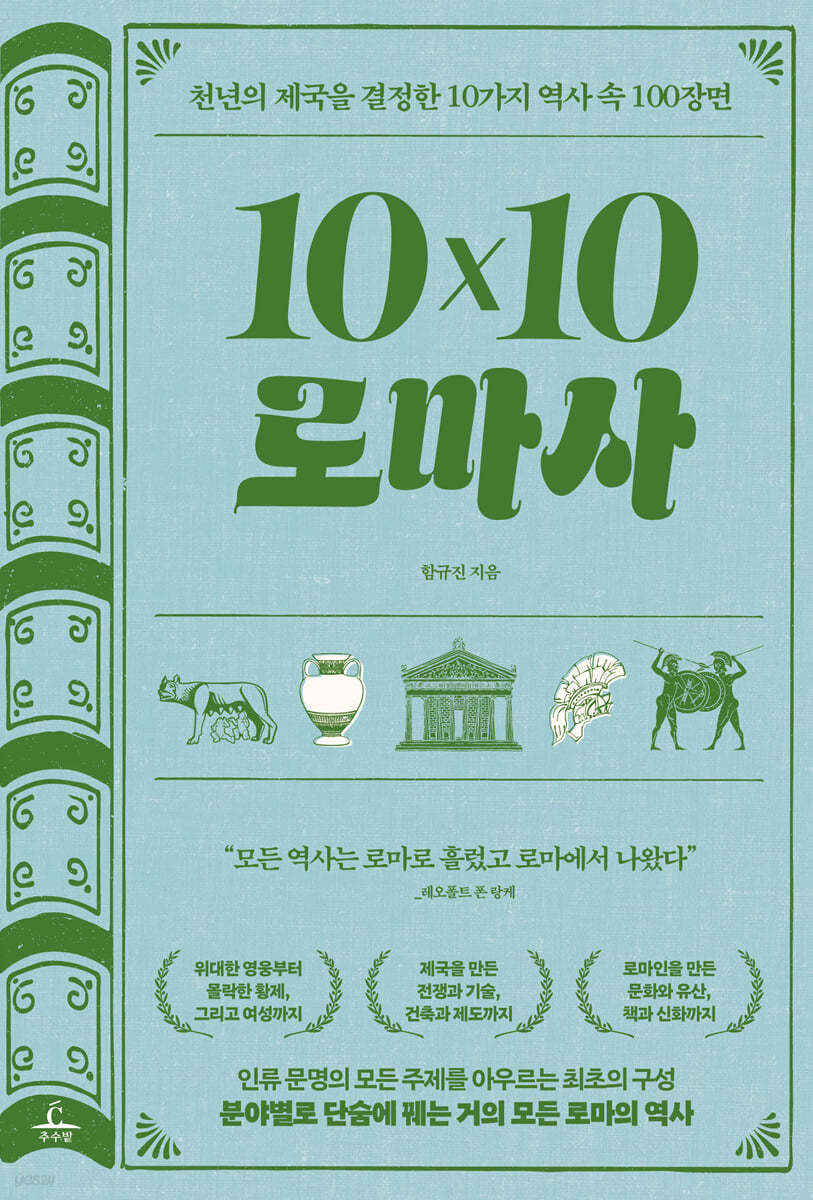
10×10 Roman History
 |
Description
Book Introduction
This book divides the history of Rome, known as the "lake of all civilizations," into ten themes, including heroes, women, and architecture. Within each theme, it presents ten key scenes for easy viewing.
From great emperors to lowly slaves, from moments of brilliant glory to moments of miserable ruin, it encapsulates the rise and fall of civilizations, while also describing the meaning, entertainment, and reflection their stories offer us today.
If you want to know the secrets that made Rome a legendary empire, this book is all you need.
From great emperors to lowly slaves, from moments of brilliant glory to moments of miserable ruin, it encapsulates the rise and fall of civilizations, while also describing the meaning, entertainment, and reflection their stories offer us today.
If you want to know the secrets that made Rome a legendary empire, this book is all you need.
- You can preview some of the book's contents.
Preview
index
As we enter, we read Roman history as '10×10'?
A timeline of 100 scenes from Roman history
Map of the Roman Empire at its peak
Part 1: The Heroes of Rome
1-1.
Romulus: Founded on Seven Hills
1-2.
Brutus: Founding a Republic
1-3.
Cincinnatus: Relinquishing Power and Becoming a Legend
1-4.
Scipio: Defeating Hannibal
1-5.
Kato: Setting an example of conservatism
1-6.
The Gracchus Brothers: Sacrificed for Reform
1-7.
Marius: Ushering in the Age of Warlords
1-8.
Caesar: Becoming Rome's Number One
1-9.
Aetius: Decorating the Twilight of the Empire
1-10.
Belisarius: Winning in War, Losing in Politics
Part 2: The Emperor of Rome
2-1.
Augustus: Building Rome of Marble
2-2.
Caligula: The Man Called a Reptile, Who Tried to Become a God
2-3.
Nero: Dreaming of becoming the empire's greatest clown
2-4.
Vespasian: An Ordinary Emperor Who Became an Extraordinary Emperor
2-5.
Trajan: to reach the highest, maximum, and best
2-6.
Hadrian: Dedicated to the stability of the empire
2-7.
Aurelius: Becoming a Real-Life Philosopher King
2-8.
Constantine: Reviving the Empire
2-9.
Justinian: Reigning as a Wise General and Tyrant
2-10.
Basil II: Living for War
Part 3: Women of Rome
3-1.
Hersilia: A Victim of Male Power, Leading the Way to Peace
3-2.
Lucretia: A Victim of Male Power, Transforming a Nation
3-3.
Cornelia: Becoming the Symbol of the Great Mother
3-4.
Libya: A Quiet Mother and a Powerful Behind-the-Scenes
3-5.
Agrippina: At the Center of Coup and Scandal
3-6.
Messalina: Becoming a Myth of Desire
3-7.
Helena: Growing the Christian Empire
3-8.
Thais: A legend as a prostitute and saint
3-9.
Theodora: From Actress to Empress, to Co-Empress
3-10.
Theophano: Remains the greatest villainess of Eastern Rome
Part 4: Roman Architecture
4-1.
Appian Way: All roads lead to Rome
4-2.
Pont du Gard: A Symbol of Imperial Unity
4-3.
Colosseum: Entertain the Roman people!
4-4.
Alcantara Bridge: The Bridge That Never Collapses
4-5.
Hadrian's Wall: Rome Stops Here
4-6.
Pantheon: Bringing the Gods of the Empire Under One Roof
4-7.
Baths of Caracalla: A Roman Holiday at the Baths
4-8.
The Arch of Constantine: Celebrating Both Glory and Decline
4-9.
The Theodosian Walls: Writing the Myth of Invincibility for a Thousand Years
4-10.
Hagia Sophia: Surpassing Solomon's Temple
Part 5: The Roman Wars
5-1.
The Samnite Wars: Italy's Rise as a Conqueror
5-2.
The Punic Wars: Rising to the Top of the Mediterranean
5-3.
The Roman Civil War: The Clash of Heroes, the Fall of the Republic
5-4.
The Mithridatic Wars: Conquering Half the Middle East
5-5.
Spartacus's Rebellion: A Cry for Humanity at the Center of the World
5-6.
The Gallic Wars: Caesar's Glory and Western European Expansion
5-7.
Jewish War: The Destruction of Jerusalem and the Beginning of Hebraism
5-8.
The Roman-Iranian Wars: West and East, the Clash of Civilizations
5-9.
The Byzantine-Roman Wars: Warriors Attacking "In the Name of God"
5-10.
Byzantine-Turkish Wars: Rome Finally Falls
Part 6: Roman Technology
6-1.
Arches: Something that neither the Pyramids, the Parthenon, nor Angkor Wat have
6-2.
Cement: Even ancient Rome had apartment complexes.
6-3.
Hydraulic Engineering: Civilization is about having access to water.
6-4.
Metallurgy: From Brass Coins to Cast Iron
6-5.
Glassworking: The Alchemy of Creating Jewels
6-6.
Harvesting machines: Agricultural technology used before the Industrial Revolution
6-7.
Clinical Medicine: Doctors Who Worked From the Battlefield to the Home
6-8.
Dental Technology: From Prosthetics to Implants
6-9.
Mosaic: Pragmatic Visual Art
6-10.
Greek Fire: The Advanced Weapon That Protected Eastern Rome
Book of Rome, Part 7
7-1.
Architecture: The Structure of Roman Scientific and Technological Civilization
7-2.
Deontology: We don't live just to be happy.
7-3.
Aeneid: The Latin Iliad-Odyssey
7-4.
Roman History: The Eternal City's Journey
7-5.
The Art of Loving: Timeless Advice on Love and Sex
7-6.
The New Testament: The Letters That Gave Birth to World Religions
7-7.
Museum: All the knowledge of the world
7-8.
Germania: Beyond Rome, Mirror of Rome
7-9.
Heroic Lives: About the Men Who Led Greco-Roman Empire
7-10.
Meditations: The Solitary Meditations of the World's Most Powerful Man
Part 8: The Roman Gods
8-1.
Jupiter: Ruler of the Sky
8-2.
Mars: Defender of Rome
8-3.
Venus: Master of the World
8-4.
Bacchus: Enjoy the day
8-5.
Vesta: Eternal Purity
8-6.
Janus: The Beginning and the End
8-7.
Fortuna: The Wheel of Fortune
8-8.
Flora: Our Happy Youth
8-9.
Isis: Our Lady of the Veil
8-10.
Genius: My Little Guardian
Part 9: The Roman System
9-1.
Consul: I am only human.
9-2.
Senatus and Comitia: We are the real Rome
9-3.
Tribunus and Kensor: Eyes Wide Open for Justice
9-4.
Pontifex Maximus: From High Priest to Pope
9-5.
Imperator: From Supreme Commander to Emperor
9-6.
Proconsul: On the Outskirts of the Empire
9-7.
Nomen: From Individual Names to Family Politics
9-8.
Legion: The Roman Legion, from dawn to dusk
9-9.
Serbus: The Human Condition
9-10.
Lupa: Wolves of the Night
Part 10: The Legacy of Rome
10-1.
Romanization: Establishment of the Alphabet
10-2.
Latin: Homo sapiens
10-3.
Roman Law: All roads lead to law
10-4.
Christian Church: Looking up to the heavenly Rome
10-5.
Republic: A Structure of People and Law
10-6.
The Solar Calendar: From Janus to Augustus
10-7.
Popular Entertainment: Meet at the Colosseum
10-8.
Hospitals: Christian Philanthropy and Imperial Welfare
10-9.
Auction: Anyone else interested?
10-10.
Bread, wine, forks and knives: from everyday staples to special banquets.
A timeline of 100 scenes from Roman history
Map of the Roman Empire at its peak
Part 1: The Heroes of Rome
1-1.
Romulus: Founded on Seven Hills
1-2.
Brutus: Founding a Republic
1-3.
Cincinnatus: Relinquishing Power and Becoming a Legend
1-4.
Scipio: Defeating Hannibal
1-5.
Kato: Setting an example of conservatism
1-6.
The Gracchus Brothers: Sacrificed for Reform
1-7.
Marius: Ushering in the Age of Warlords
1-8.
Caesar: Becoming Rome's Number One
1-9.
Aetius: Decorating the Twilight of the Empire
1-10.
Belisarius: Winning in War, Losing in Politics
Part 2: The Emperor of Rome
2-1.
Augustus: Building Rome of Marble
2-2.
Caligula: The Man Called a Reptile, Who Tried to Become a God
2-3.
Nero: Dreaming of becoming the empire's greatest clown
2-4.
Vespasian: An Ordinary Emperor Who Became an Extraordinary Emperor
2-5.
Trajan: to reach the highest, maximum, and best
2-6.
Hadrian: Dedicated to the stability of the empire
2-7.
Aurelius: Becoming a Real-Life Philosopher King
2-8.
Constantine: Reviving the Empire
2-9.
Justinian: Reigning as a Wise General and Tyrant
2-10.
Basil II: Living for War
Part 3: Women of Rome
3-1.
Hersilia: A Victim of Male Power, Leading the Way to Peace
3-2.
Lucretia: A Victim of Male Power, Transforming a Nation
3-3.
Cornelia: Becoming the Symbol of the Great Mother
3-4.
Libya: A Quiet Mother and a Powerful Behind-the-Scenes
3-5.
Agrippina: At the Center of Coup and Scandal
3-6.
Messalina: Becoming a Myth of Desire
3-7.
Helena: Growing the Christian Empire
3-8.
Thais: A legend as a prostitute and saint
3-9.
Theodora: From Actress to Empress, to Co-Empress
3-10.
Theophano: Remains the greatest villainess of Eastern Rome
Part 4: Roman Architecture
4-1.
Appian Way: All roads lead to Rome
4-2.
Pont du Gard: A Symbol of Imperial Unity
4-3.
Colosseum: Entertain the Roman people!
4-4.
Alcantara Bridge: The Bridge That Never Collapses
4-5.
Hadrian's Wall: Rome Stops Here
4-6.
Pantheon: Bringing the Gods of the Empire Under One Roof
4-7.
Baths of Caracalla: A Roman Holiday at the Baths
4-8.
The Arch of Constantine: Celebrating Both Glory and Decline
4-9.
The Theodosian Walls: Writing the Myth of Invincibility for a Thousand Years
4-10.
Hagia Sophia: Surpassing Solomon's Temple
Part 5: The Roman Wars
5-1.
The Samnite Wars: Italy's Rise as a Conqueror
5-2.
The Punic Wars: Rising to the Top of the Mediterranean
5-3.
The Roman Civil War: The Clash of Heroes, the Fall of the Republic
5-4.
The Mithridatic Wars: Conquering Half the Middle East
5-5.
Spartacus's Rebellion: A Cry for Humanity at the Center of the World
5-6.
The Gallic Wars: Caesar's Glory and Western European Expansion
5-7.
Jewish War: The Destruction of Jerusalem and the Beginning of Hebraism
5-8.
The Roman-Iranian Wars: West and East, the Clash of Civilizations
5-9.
The Byzantine-Roman Wars: Warriors Attacking "In the Name of God"
5-10.
Byzantine-Turkish Wars: Rome Finally Falls
Part 6: Roman Technology
6-1.
Arches: Something that neither the Pyramids, the Parthenon, nor Angkor Wat have
6-2.
Cement: Even ancient Rome had apartment complexes.
6-3.
Hydraulic Engineering: Civilization is about having access to water.
6-4.
Metallurgy: From Brass Coins to Cast Iron
6-5.
Glassworking: The Alchemy of Creating Jewels
6-6.
Harvesting machines: Agricultural technology used before the Industrial Revolution
6-7.
Clinical Medicine: Doctors Who Worked From the Battlefield to the Home
6-8.
Dental Technology: From Prosthetics to Implants
6-9.
Mosaic: Pragmatic Visual Art
6-10.
Greek Fire: The Advanced Weapon That Protected Eastern Rome
Book of Rome, Part 7
7-1.
Architecture: The Structure of Roman Scientific and Technological Civilization
7-2.
Deontology: We don't live just to be happy.
7-3.
Aeneid: The Latin Iliad-Odyssey
7-4.
Roman History: The Eternal City's Journey
7-5.
The Art of Loving: Timeless Advice on Love and Sex
7-6.
The New Testament: The Letters That Gave Birth to World Religions
7-7.
Museum: All the knowledge of the world
7-8.
Germania: Beyond Rome, Mirror of Rome
7-9.
Heroic Lives: About the Men Who Led Greco-Roman Empire
7-10.
Meditations: The Solitary Meditations of the World's Most Powerful Man
Part 8: The Roman Gods
8-1.
Jupiter: Ruler of the Sky
8-2.
Mars: Defender of Rome
8-3.
Venus: Master of the World
8-4.
Bacchus: Enjoy the day
8-5.
Vesta: Eternal Purity
8-6.
Janus: The Beginning and the End
8-7.
Fortuna: The Wheel of Fortune
8-8.
Flora: Our Happy Youth
8-9.
Isis: Our Lady of the Veil
8-10.
Genius: My Little Guardian
Part 9: The Roman System
9-1.
Consul: I am only human.
9-2.
Senatus and Comitia: We are the real Rome
9-3.
Tribunus and Kensor: Eyes Wide Open for Justice
9-4.
Pontifex Maximus: From High Priest to Pope
9-5.
Imperator: From Supreme Commander to Emperor
9-6.
Proconsul: On the Outskirts of the Empire
9-7.
Nomen: From Individual Names to Family Politics
9-8.
Legion: The Roman Legion, from dawn to dusk
9-9.
Serbus: The Human Condition
9-10.
Lupa: Wolves of the Night
Part 10: The Legacy of Rome
10-1.
Romanization: Establishment of the Alphabet
10-2.
Latin: Homo sapiens
10-3.
Roman Law: All roads lead to law
10-4.
Christian Church: Looking up to the heavenly Rome
10-5.
Republic: A Structure of People and Law
10-6.
The Solar Calendar: From Janus to Augustus
10-7.
Popular Entertainment: Meet at the Colosseum
10-8.
Hospitals: Christian Philanthropy and Imperial Welfare
10-9.
Auction: Anyone else interested?
10-10.
Bread, wine, forks and knives: from everyday staples to special banquets.
Detailed image

Into the book
Part 1: The Heroes of Rome
1-1.
Romulus: Founded on Seven Hills
In a way, it's ironic.
He was born of adultery, raised by a prostitute, killed his own brother, and orchestrated a gang rape.
Could such a man truly reign as king and be worshipped as a god? On the one hand, he was not only a fighter, but also a remarkable leader, transforming the hapless into warriors and citizens.
It also created institutions that enabled people to understand each other's positions and look to their common interests rather than relying solely on their own charisma.
The openness he displayed, the spirit of sophisticated and practical law, and the attitude that force was the answer were carried on throughout ancient Rome, and Rome turned the Mediterranean into a lake and became the lake of Western civilization.
Perhaps the Romans' attitude of deifying the founding monarch while not erasing or forgiving his human flaws from the records (compare Dangun, King Dongmyeongseong, and Park Hyeokgeose, who have no flaws in their records) may have allowed the nation founded by Romulus to last so long and prosper so well.
--- p.53~54
Part 2: The Emperor of Rome
2-3.
Nero: Dreaming of becoming the empire's greatest jester
When Nero ascended to the throne, Rome was pondering the question, 'What exactly does an emperor mean?'
Each emperor of the past answered with his own personality.
Augustus was the founder of various institutions, Tiberius was a ruthless administrator, and Caligula was a dictator.
And when the title of fifth emperor returned to Nero, after the incompetent Claudius, he presented himself as a Roman emperor in another sense: “the world’s greatest entertainer, the symbol that unites all Romans.”
He pursued politics that were popular with the majority of the people and maintained his authority through charm rather than force.
Wouldn't a kind-hearted clown be a better ruler than a vicious fighter? Had he not been particularly reviled by the aristocracy, intellectuals, and Christians, he might not have become the subject of such a bitter infamy.
--- p.133
Part 3: Women of Rome
3-3.
Cornelia: Becoming the Symbol of the Great Mother
Cornelia was the daughter of a hero and the mother of a hero.
But because of them, her real life was not well revealed.
She became her father's 'thank you gift' by marrying an uncle who was her uncle's age, and spent her youth supporting her husband, and after her husband's death, she lived only for her sons.
Was the "Three Pillars of Faith" she followed truly the path she desired? At the time, there were few ways for women to shine in the world, and being a good wife and wise mother seemed like the only way.
But she actually used another method.
Study and education are the key! Thus, today, many people evaluate her not as a "great mother," but as an "ancient female intellectual who demonstrated her talents in literature and education."
--- p.194
Part 4: Roman Architecture
4-10.
Hagia Sophia: Surpassing Solomon's Temple
In 537, Justinian, who attended the dedication ceremony with Procopius, was so moved by the magnificence of the completed cathedral that he raised his arms and cried out, "This is beyond my imagination!"
“Solomon, I have defeated you!”
Solomon's Temple in Jerusalem, described in the Bible as the most beautiful building in history.
Herod's temple, which was rebuilt with great magnificence and splendor after its destruction.
The Roman emperor who even destroyed the temple.
It was a cry of triumph and emotion, as he, the successor to the emperor, declared that he had built a temple more beautiful than Herod's temple or Solomon's temple.
Whether he was aware of it or not, it was also a triumph over Hadrian's pantheon.
Compared to the Pantheon, which adds mystery to the grandeur of its large, massive dome ceiling with a single oculus at the top, the ceiling of Hagia Sophia is larger, higher, and bathed in more and more colorful sunlight, taking the breath away of all who look up.
Among the cathedrals in the world, no other building displays the effects of light so impressively, except perhaps Spain's Sagrada Familia.
--- p.286~287
Part 5: The Roman Wars
5-5.
Spartacus's Rebellion: A Cry for Humanity at the Center of the World
How could an army of "subhuman" slaves repeatedly defeat the world's most powerful Roman army? The fact that the Roman army's elite and main force were located outside Italy played a significant role.
Pompey was in Spain suppressing Sertorius's rebellion, while in the east Lucullus was waging the Mithridatic War.
However, it would not be an exaggeration to say that the main causes were the accumulated resentment and anger from being treated less than human, the determination to die as warriors rather than live as slaves, the desperate courage displayed by this slave army burning with that spirit, and the tactics and leadership of Spartacus that helped them properly shake off that courage.
--- p.324
Part 6: Roman Technology
6-2.
Cement: Even ancient Rome had apartment complexes.
There were many problems.
There was a risk that the building would crack or collapse due to the use of poor quality materials, and in the event of a fire, residents of high-rise buildings had no way to escape (so it was common to avoid cooking at home and instead eat out).
There were no separate heating or cooling facilities.
The biggest problem was that the water pipes only reached the first floor! So, drinking water and laundry water had to be fetched from the first floor, and waste had to be collected and then brought down to the first floor to be disposed of.
If you can't stand the filth and hassle, you'll just pour it out the window! So, walking around the apartment at night was incredibly dangerous.
With Roman technology, it would have been possible to design a system that would bring water from the upper floors and then distribute it evenly to each floor.
But the poor had no obligation to go to such trouble.
--- p.375
Book of Rome, Part 7
7-5.
The Art of Loving: Timeless Advice on Love and Sex
'Why do we still read a book that is so hedonistic, so male-centric, and so blatantly recommends something that would be criminal by today's standards (even by those times?)?' This question might arise.
Firstly, if you look closely, you will see that this book is imbued with the Roman way of thinking.
The Romans were thorough pragmatists, worldlyists, and viewed everything through the lens of war.
In the case of love, you should find a place where you can meet a great partner (scrutinize the terrain), find out what the partner particularly likes and make them like you (find out the enemy's weakness and focus on attacking it), if the partner is old and it is difficult to satisfy him/her sexually, you should hold on to him/her with culture and affection (offset the disadvantage in military power with the strength of your own army), and you should know when to charge and when to retreat...
Ovid's love is war.
--- p.220
Part 8: The Roman Gods
8-6.
Janus: The Beginning and the End
In Greece, he was nothing more than chaos, but in Rome, he became Janus, the ruler of all beginnings and endings! This could be interpreted to mean that Western civilization, once confined to the narrow confines of city-states, was now broadly and extensively forged by the Roman sword. Along this path, civilization, including Roman law and Greek philosophy, spread throughout the world, ushering in a glorious era of peace and prosperity for humanity.
In that sense, Janus was the symbol of Pax Romana, and many people prayed for that peace to last forever.
--- p.499
Part 9: The Roman System
9-2.
Senatus and Comitia: We are the real Rome
The process by which the center of the Roman assembly shifted from the curia to the centuries and then to the tribes shows the development of ancient democracy, centering on the question, "Who are the people, and how should they be treated?"
At first, only the distinction of identity between tribes based on bloodline, such as the Kims and Lees, was important.
Then, as society developed and identity based on property ownership became more distinct than blood ties within a community, the idea that "it's unfair that our rich pay a lot of taxes and serve in the military, but they enjoy the same power as the poor!" led to a systematization of national differentiation based on property.
However, as society grew larger and the conflict between the wealthy few and the poor many became more pronounced, the voices asking, "What are we poor people? Are we citizens or slaves? Let's assert our rights!" led the Minhoe to soon mean the Commoners' Association.
--- p.528~529
Part 10: The Legacy of Rome
10-7.
Popular Entertainment: Meet at the Colosseum
It is quite remarkable that the state provided free means of stress relief to individuals who 'could not live on bread alone'.
In the kingdoms of East Asia and the Middle East, there were cases where the idea that the state should educate its people was put into practice.
There was also national relief for the poor, although it was not systematic.
However, Rome is the only pre-modern civilization that considered public entertainment a fundamental business for the state to run.
Although it is said that this lowers the political awareness of citizens, on the other hand, when many people gather together and talk, political awareness can actually increase and a public forum can be formed.
1-1.
Romulus: Founded on Seven Hills
In a way, it's ironic.
He was born of adultery, raised by a prostitute, killed his own brother, and orchestrated a gang rape.
Could such a man truly reign as king and be worshipped as a god? On the one hand, he was not only a fighter, but also a remarkable leader, transforming the hapless into warriors and citizens.
It also created institutions that enabled people to understand each other's positions and look to their common interests rather than relying solely on their own charisma.
The openness he displayed, the spirit of sophisticated and practical law, and the attitude that force was the answer were carried on throughout ancient Rome, and Rome turned the Mediterranean into a lake and became the lake of Western civilization.
Perhaps the Romans' attitude of deifying the founding monarch while not erasing or forgiving his human flaws from the records (compare Dangun, King Dongmyeongseong, and Park Hyeokgeose, who have no flaws in their records) may have allowed the nation founded by Romulus to last so long and prosper so well.
--- p.53~54
Part 2: The Emperor of Rome
2-3.
Nero: Dreaming of becoming the empire's greatest jester
When Nero ascended to the throne, Rome was pondering the question, 'What exactly does an emperor mean?'
Each emperor of the past answered with his own personality.
Augustus was the founder of various institutions, Tiberius was a ruthless administrator, and Caligula was a dictator.
And when the title of fifth emperor returned to Nero, after the incompetent Claudius, he presented himself as a Roman emperor in another sense: “the world’s greatest entertainer, the symbol that unites all Romans.”
He pursued politics that were popular with the majority of the people and maintained his authority through charm rather than force.
Wouldn't a kind-hearted clown be a better ruler than a vicious fighter? Had he not been particularly reviled by the aristocracy, intellectuals, and Christians, he might not have become the subject of such a bitter infamy.
--- p.133
Part 3: Women of Rome
3-3.
Cornelia: Becoming the Symbol of the Great Mother
Cornelia was the daughter of a hero and the mother of a hero.
But because of them, her real life was not well revealed.
She became her father's 'thank you gift' by marrying an uncle who was her uncle's age, and spent her youth supporting her husband, and after her husband's death, she lived only for her sons.
Was the "Three Pillars of Faith" she followed truly the path she desired? At the time, there were few ways for women to shine in the world, and being a good wife and wise mother seemed like the only way.
But she actually used another method.
Study and education are the key! Thus, today, many people evaluate her not as a "great mother," but as an "ancient female intellectual who demonstrated her talents in literature and education."
--- p.194
Part 4: Roman Architecture
4-10.
Hagia Sophia: Surpassing Solomon's Temple
In 537, Justinian, who attended the dedication ceremony with Procopius, was so moved by the magnificence of the completed cathedral that he raised his arms and cried out, "This is beyond my imagination!"
“Solomon, I have defeated you!”
Solomon's Temple in Jerusalem, described in the Bible as the most beautiful building in history.
Herod's temple, which was rebuilt with great magnificence and splendor after its destruction.
The Roman emperor who even destroyed the temple.
It was a cry of triumph and emotion, as he, the successor to the emperor, declared that he had built a temple more beautiful than Herod's temple or Solomon's temple.
Whether he was aware of it or not, it was also a triumph over Hadrian's pantheon.
Compared to the Pantheon, which adds mystery to the grandeur of its large, massive dome ceiling with a single oculus at the top, the ceiling of Hagia Sophia is larger, higher, and bathed in more and more colorful sunlight, taking the breath away of all who look up.
Among the cathedrals in the world, no other building displays the effects of light so impressively, except perhaps Spain's Sagrada Familia.
--- p.286~287
Part 5: The Roman Wars
5-5.
Spartacus's Rebellion: A Cry for Humanity at the Center of the World
How could an army of "subhuman" slaves repeatedly defeat the world's most powerful Roman army? The fact that the Roman army's elite and main force were located outside Italy played a significant role.
Pompey was in Spain suppressing Sertorius's rebellion, while in the east Lucullus was waging the Mithridatic War.
However, it would not be an exaggeration to say that the main causes were the accumulated resentment and anger from being treated less than human, the determination to die as warriors rather than live as slaves, the desperate courage displayed by this slave army burning with that spirit, and the tactics and leadership of Spartacus that helped them properly shake off that courage.
--- p.324
Part 6: Roman Technology
6-2.
Cement: Even ancient Rome had apartment complexes.
There were many problems.
There was a risk that the building would crack or collapse due to the use of poor quality materials, and in the event of a fire, residents of high-rise buildings had no way to escape (so it was common to avoid cooking at home and instead eat out).
There were no separate heating or cooling facilities.
The biggest problem was that the water pipes only reached the first floor! So, drinking water and laundry water had to be fetched from the first floor, and waste had to be collected and then brought down to the first floor to be disposed of.
If you can't stand the filth and hassle, you'll just pour it out the window! So, walking around the apartment at night was incredibly dangerous.
With Roman technology, it would have been possible to design a system that would bring water from the upper floors and then distribute it evenly to each floor.
But the poor had no obligation to go to such trouble.
--- p.375
Book of Rome, Part 7
7-5.
The Art of Loving: Timeless Advice on Love and Sex
'Why do we still read a book that is so hedonistic, so male-centric, and so blatantly recommends something that would be criminal by today's standards (even by those times?)?' This question might arise.
Firstly, if you look closely, you will see that this book is imbued with the Roman way of thinking.
The Romans were thorough pragmatists, worldlyists, and viewed everything through the lens of war.
In the case of love, you should find a place where you can meet a great partner (scrutinize the terrain), find out what the partner particularly likes and make them like you (find out the enemy's weakness and focus on attacking it), if the partner is old and it is difficult to satisfy him/her sexually, you should hold on to him/her with culture and affection (offset the disadvantage in military power with the strength of your own army), and you should know when to charge and when to retreat...
Ovid's love is war.
--- p.220
Part 8: The Roman Gods
8-6.
Janus: The Beginning and the End
In Greece, he was nothing more than chaos, but in Rome, he became Janus, the ruler of all beginnings and endings! This could be interpreted to mean that Western civilization, once confined to the narrow confines of city-states, was now broadly and extensively forged by the Roman sword. Along this path, civilization, including Roman law and Greek philosophy, spread throughout the world, ushering in a glorious era of peace and prosperity for humanity.
In that sense, Janus was the symbol of Pax Romana, and many people prayed for that peace to last forever.
--- p.499
Part 9: The Roman System
9-2.
Senatus and Comitia: We are the real Rome
The process by which the center of the Roman assembly shifted from the curia to the centuries and then to the tribes shows the development of ancient democracy, centering on the question, "Who are the people, and how should they be treated?"
At first, only the distinction of identity between tribes based on bloodline, such as the Kims and Lees, was important.
Then, as society developed and identity based on property ownership became more distinct than blood ties within a community, the idea that "it's unfair that our rich pay a lot of taxes and serve in the military, but they enjoy the same power as the poor!" led to a systematization of national differentiation based on property.
However, as society grew larger and the conflict between the wealthy few and the poor many became more pronounced, the voices asking, "What are we poor people? Are we citizens or slaves? Let's assert our rights!" led the Minhoe to soon mean the Commoners' Association.
--- p.528~529
Part 10: The Legacy of Rome
10-7.
Popular Entertainment: Meet at the Colosseum
It is quite remarkable that the state provided free means of stress relief to individuals who 'could not live on bread alone'.
In the kingdoms of East Asia and the Middle East, there were cases where the idea that the state should educate its people was put into practice.
There was also national relief for the poor, although it was not systematic.
However, Rome is the only pre-modern civilization that considered public entertainment a fundamental business for the state to run.
Although it is said that this lowers the political awareness of citizens, on the other hand, when many people gather together and talk, political awareness can actually increase and a public forum can be formed.
--- p.616
Publisher's Review
“How did Rome become an eternal empire?”
The first composition to encompass all the topics of human civilization
Almost all of Roman history, covered in one breath, by field.
“All history flows to Rome and comes from Rome.”
Roman thoughts and traces that still influence modern times
The lesson from history that “there is no eternal empire” is known as common sense.
Every hegemonic power in the world reaches its peak of power, but then suddenly declines or ultimately falls.
However, the legacy they left behind has been passed down in various forms and still boasts its grandeur to us today.
The pyramids of Egypt, the Mausoleum of the First Qin Emperor of the Qin Dynasty, and the Parthenon of Greece, representative relics of ancient empires, boast overwhelming technological prowess that even modern people consider them 'wonders.'
However, these ancient heritages are difficult for modern people who pursue practicality to understand, as they were built by the omnipotent rulers to show off their power for generations.
But the Roman Empire was different.
Like the ruins mentioned above, Rome also boasts overwhelming architectural masterpieces of outstanding technical prowess, such as the Pont du Gard, the Colosseum, and the Baths of Caracalla.
However, these differ in that they were cultural heritages not intended for a handful of powerful people, but were thoroughly intended for the convenience and benefit of their own citizens.
Despite the historical lesson that “no empire lasts forever,” historians call Rome the “immortal empire” because their pragmatic spirit and culture, which believed that “everyone should enjoy the benefits of civilization,” shaped our thoughts and lives today and still influence them today.
"Roman History: 10 Themes, 10 Scenes, and 70 Illustrations"
The first history book covering all topics of human civilization
The Roman Empire, considered the 'lake of all civilizations' and the origin of modern times.
Despite the numerous books that have been published covering its history, it is not easy to properly understand the vast flow that spans two thousand years.
『10×10 Roman History』 presents a new structure that previous history books, which arranged events in chronological order, could not.
By selecting 10 themes that form the core of human civilization and arranging 10 points within each theme, Roman history was composed of a total of 100 scenes.
In other words, rather than arranging the main history of Rome in two dimensions in chronological order from 1 to 100, it created a three-dimensional world by reconnecting 10 themes that are completed in 10 scenes.
Therefore, no matter which page you open, you can quickly and easily read the core of Roman history in that field and topic, and after reading it all, you can immediately draw a picture of the 2,000-year system of Roman history.
Each chapter is composed of approximately 5 to 6 pages, and each chapter includes one or two illustrations to help with a clearer understanding.
If there are concepts or people in the content of each corner that are connected to other corners, number the corner next to it so that you can open the corresponding chapter as if you were clicking on a link.
The front of the book contains a collection of vivid color illustrations that illustrate crucial moments in Roman history, along with a timeline and maps that organize 100 scenes for easy viewing, helping readers understand history through visual data.
▶Roman heroes, emperors, and women:
The Glory and Frustration of History's Most Dramatic Figures
Who were the people who created the immense system that was Rome? Indeed, it would be absurd to explain the entirety of history based solely on the remarkable achievements of a few individuals.
But would the Rome we know have existed without such great men? This includes not only their achievements, but also their fatal mistakes and the human side of their legacy.
This book examines the heroes, emperors, and women who laid the foundations of the Roman nation and took the lead in politics.
We introduce a number of emperors who demonstrated completely different ruling styles, including political heroes who attempted dramatic reversals in history, such as Brutus, who first established a republic, the Gracchi brothers who attempted to abolish vested interests, and Caesar, the figurehead who played a role in turning Rome into an empire, as well as Augustus, who paved the way for absolute power, Vespasian, who implemented politics for the common people, and Aurelius, who remains a great philosopher.
It also introduces women who rose to fame both at the periphery and center of power, such as Hersilia and Lucretia, who presented the nation's banner and direction even amidst the violence of the male power elite; Messalina, a symbol of free desire; and Theodora, who rose from actress to co-emperor.
By examining not only the achievements of these figures, but also their personalities, and the various stories and gossip they left behind, this book shows that it was not myths but people who created Rome.
▶Roman architecture, warfare, technology, and institutions:
The axis of civilization that made Rome the world's hegemon
In order to become an empire that will show its might to the world, in addition to the 'construction' explained above, 'war' is required.
To wage war against multiple countries, you need to stockpile up strength, and to do so, you need to have various materials and 'technology'.
In order to mobilize civilians, who are a resource for war, it is essential to have the support of an 'institution' to care for and manage their lives.
This book examines in detail these four axes, which are still essential as "conditions for empire" even in modern times, within the context of Roman history.
It introduces not only structures that preserve the history of growth and prosperity, such as the Appian Way and Hadrian's Wall, but also structures that survived times of crisis, such as the Theodosian Wall, and provides information on the arch structures, cement, and hydraulic engineering used in such construction, as well as the outstanding technologies that the Romans utilized in their daily lives, such as glasswork and clinical medicine.
It also vividly explains how the empire's map changed, from the Samnite Wars that protected Rome as a city-state, to the Gallic Wars and Jewish Wars that expanded the empire's territory, to the Roman-Iranian Wars that evoked a clash between the West and the East, and the Eastern Roman-Turkish War that led to the fall of Rome.
In addition, it examines the various Roman institutions that gave birth to various social groups, such as nobles, soldiers, commoners, and slaves, and encouraged dialogue and compromise among them, and provides a detailed explanation of how they are similar and different from our society, politics, and parliament today.
▶Roman books, gods, and cultural heritage:
The Roman spirit of practicality and rationality that continues to this day
Rome exerted a powerful influence on the world, not only materially but also spiritually and culturally.
In particular, the spirit of practicality, rationality, compromise, and playfulness that they pursued is still considered important values for modern people today.
This book examines the Roman spirit, which we should pay attention to, by examining the Roman books that have survived to this day, the gods they believed in, and their diverse cultural heritage.
In addition to 『Architecture』, 『Roman History』, and 『Natural History』, which have value as vast and systematic knowledge resources, it also introduces 『The Art of Loving』 and 『Lives of Heroes』, which are still read as self-help or practical books today, and deals with special Roman gods that are different from the Greek gods, such as Mars, the god of war, Janus with two faces, Vesta, a symbol of purity who later transformed into a Christian nun, and Genius, a small guardian deity of everyday life.
It also vividly shows how their lifestyles and cultural assets, such as the Roman alphabet, which established the world's most widely used alphabet; Roman law and the Republic, which prepared the foundation for modern law and politics; Roman Christianity, which became a global religion; and the Colosseum and circus, which foreshadowed the splendid performance culture of the modern era, have shaped modern people today.
“No matter which page you open, it’s a quick read.”
A new level of historical narrative with depth, breadth, and fun.
Author Ham Gyu-jin is known as a lecturer who explains history in an easy-to-understand way on various TV programs such as “Ssulzun” and “My Little Television.” However, he is also famous as a history writer who humorously explains how the problems of the past, regardless of ancient or modern history, are connected to the vivid issues of today.
The author's clear writing, which condenses not only the greatness of the Romans but also their darker sides, while also conveying the meaning, entertainment, and reflection their stories offer us today, demonstrates a new realm of historical narrative with a depth and breadth unseen elsewhere.
If you want to quickly understand the secrets of the empire that formed the foundation of all history and civilization, this book will suffice.
The first composition to encompass all the topics of human civilization
Almost all of Roman history, covered in one breath, by field.
“All history flows to Rome and comes from Rome.”
Roman thoughts and traces that still influence modern times
The lesson from history that “there is no eternal empire” is known as common sense.
Every hegemonic power in the world reaches its peak of power, but then suddenly declines or ultimately falls.
However, the legacy they left behind has been passed down in various forms and still boasts its grandeur to us today.
The pyramids of Egypt, the Mausoleum of the First Qin Emperor of the Qin Dynasty, and the Parthenon of Greece, representative relics of ancient empires, boast overwhelming technological prowess that even modern people consider them 'wonders.'
However, these ancient heritages are difficult for modern people who pursue practicality to understand, as they were built by the omnipotent rulers to show off their power for generations.
But the Roman Empire was different.
Like the ruins mentioned above, Rome also boasts overwhelming architectural masterpieces of outstanding technical prowess, such as the Pont du Gard, the Colosseum, and the Baths of Caracalla.
However, these differ in that they were cultural heritages not intended for a handful of powerful people, but were thoroughly intended for the convenience and benefit of their own citizens.
Despite the historical lesson that “no empire lasts forever,” historians call Rome the “immortal empire” because their pragmatic spirit and culture, which believed that “everyone should enjoy the benefits of civilization,” shaped our thoughts and lives today and still influence them today.
"Roman History: 10 Themes, 10 Scenes, and 70 Illustrations"
The first history book covering all topics of human civilization
The Roman Empire, considered the 'lake of all civilizations' and the origin of modern times.
Despite the numerous books that have been published covering its history, it is not easy to properly understand the vast flow that spans two thousand years.
『10×10 Roman History』 presents a new structure that previous history books, which arranged events in chronological order, could not.
By selecting 10 themes that form the core of human civilization and arranging 10 points within each theme, Roman history was composed of a total of 100 scenes.
In other words, rather than arranging the main history of Rome in two dimensions in chronological order from 1 to 100, it created a three-dimensional world by reconnecting 10 themes that are completed in 10 scenes.
Therefore, no matter which page you open, you can quickly and easily read the core of Roman history in that field and topic, and after reading it all, you can immediately draw a picture of the 2,000-year system of Roman history.
Each chapter is composed of approximately 5 to 6 pages, and each chapter includes one or two illustrations to help with a clearer understanding.
If there are concepts or people in the content of each corner that are connected to other corners, number the corner next to it so that you can open the corresponding chapter as if you were clicking on a link.
The front of the book contains a collection of vivid color illustrations that illustrate crucial moments in Roman history, along with a timeline and maps that organize 100 scenes for easy viewing, helping readers understand history through visual data.
▶Roman heroes, emperors, and women:
The Glory and Frustration of History's Most Dramatic Figures
Who were the people who created the immense system that was Rome? Indeed, it would be absurd to explain the entirety of history based solely on the remarkable achievements of a few individuals.
But would the Rome we know have existed without such great men? This includes not only their achievements, but also their fatal mistakes and the human side of their legacy.
This book examines the heroes, emperors, and women who laid the foundations of the Roman nation and took the lead in politics.
We introduce a number of emperors who demonstrated completely different ruling styles, including political heroes who attempted dramatic reversals in history, such as Brutus, who first established a republic, the Gracchi brothers who attempted to abolish vested interests, and Caesar, the figurehead who played a role in turning Rome into an empire, as well as Augustus, who paved the way for absolute power, Vespasian, who implemented politics for the common people, and Aurelius, who remains a great philosopher.
It also introduces women who rose to fame both at the periphery and center of power, such as Hersilia and Lucretia, who presented the nation's banner and direction even amidst the violence of the male power elite; Messalina, a symbol of free desire; and Theodora, who rose from actress to co-emperor.
By examining not only the achievements of these figures, but also their personalities, and the various stories and gossip they left behind, this book shows that it was not myths but people who created Rome.
▶Roman architecture, warfare, technology, and institutions:
The axis of civilization that made Rome the world's hegemon
In order to become an empire that will show its might to the world, in addition to the 'construction' explained above, 'war' is required.
To wage war against multiple countries, you need to stockpile up strength, and to do so, you need to have various materials and 'technology'.
In order to mobilize civilians, who are a resource for war, it is essential to have the support of an 'institution' to care for and manage their lives.
This book examines in detail these four axes, which are still essential as "conditions for empire" even in modern times, within the context of Roman history.
It introduces not only structures that preserve the history of growth and prosperity, such as the Appian Way and Hadrian's Wall, but also structures that survived times of crisis, such as the Theodosian Wall, and provides information on the arch structures, cement, and hydraulic engineering used in such construction, as well as the outstanding technologies that the Romans utilized in their daily lives, such as glasswork and clinical medicine.
It also vividly explains how the empire's map changed, from the Samnite Wars that protected Rome as a city-state, to the Gallic Wars and Jewish Wars that expanded the empire's territory, to the Roman-Iranian Wars that evoked a clash between the West and the East, and the Eastern Roman-Turkish War that led to the fall of Rome.
In addition, it examines the various Roman institutions that gave birth to various social groups, such as nobles, soldiers, commoners, and slaves, and encouraged dialogue and compromise among them, and provides a detailed explanation of how they are similar and different from our society, politics, and parliament today.
▶Roman books, gods, and cultural heritage:
The Roman spirit of practicality and rationality that continues to this day
Rome exerted a powerful influence on the world, not only materially but also spiritually and culturally.
In particular, the spirit of practicality, rationality, compromise, and playfulness that they pursued is still considered important values for modern people today.
This book examines the Roman spirit, which we should pay attention to, by examining the Roman books that have survived to this day, the gods they believed in, and their diverse cultural heritage.
In addition to 『Architecture』, 『Roman History』, and 『Natural History』, which have value as vast and systematic knowledge resources, it also introduces 『The Art of Loving』 and 『Lives of Heroes』, which are still read as self-help or practical books today, and deals with special Roman gods that are different from the Greek gods, such as Mars, the god of war, Janus with two faces, Vesta, a symbol of purity who later transformed into a Christian nun, and Genius, a small guardian deity of everyday life.
It also vividly shows how their lifestyles and cultural assets, such as the Roman alphabet, which established the world's most widely used alphabet; Roman law and the Republic, which prepared the foundation for modern law and politics; Roman Christianity, which became a global religion; and the Colosseum and circus, which foreshadowed the splendid performance culture of the modern era, have shaped modern people today.
“No matter which page you open, it’s a quick read.”
A new level of historical narrative with depth, breadth, and fun.
Author Ham Gyu-jin is known as a lecturer who explains history in an easy-to-understand way on various TV programs such as “Ssulzun” and “My Little Television.” However, he is also famous as a history writer who humorously explains how the problems of the past, regardless of ancient or modern history, are connected to the vivid issues of today.
The author's clear writing, which condenses not only the greatness of the Romans but also their darker sides, while also conveying the meaning, entertainment, and reflection their stories offer us today, demonstrates a new realm of historical narrative with a depth and breadth unseen elsewhere.
If you want to quickly understand the secrets of the empire that formed the foundation of all history and civilization, this book will suffice.
GOODS SPECIFICS
- Date of issue: September 29, 2023
- Page count, weight, size: 632 pages | 914g | 152*223*31mm
- ISBN13: 9791155402245
- ISBN10: 1155402243
You may also like
카테고리
korean


korean

![GQ KOREA Mark (Monthly): December [2025]](http://librairie.coreenne.fr/cdn/shop/files/8ef265dbbfbf186523ed75ba7319009d.jpg?v=1765340328&width=3840)


