

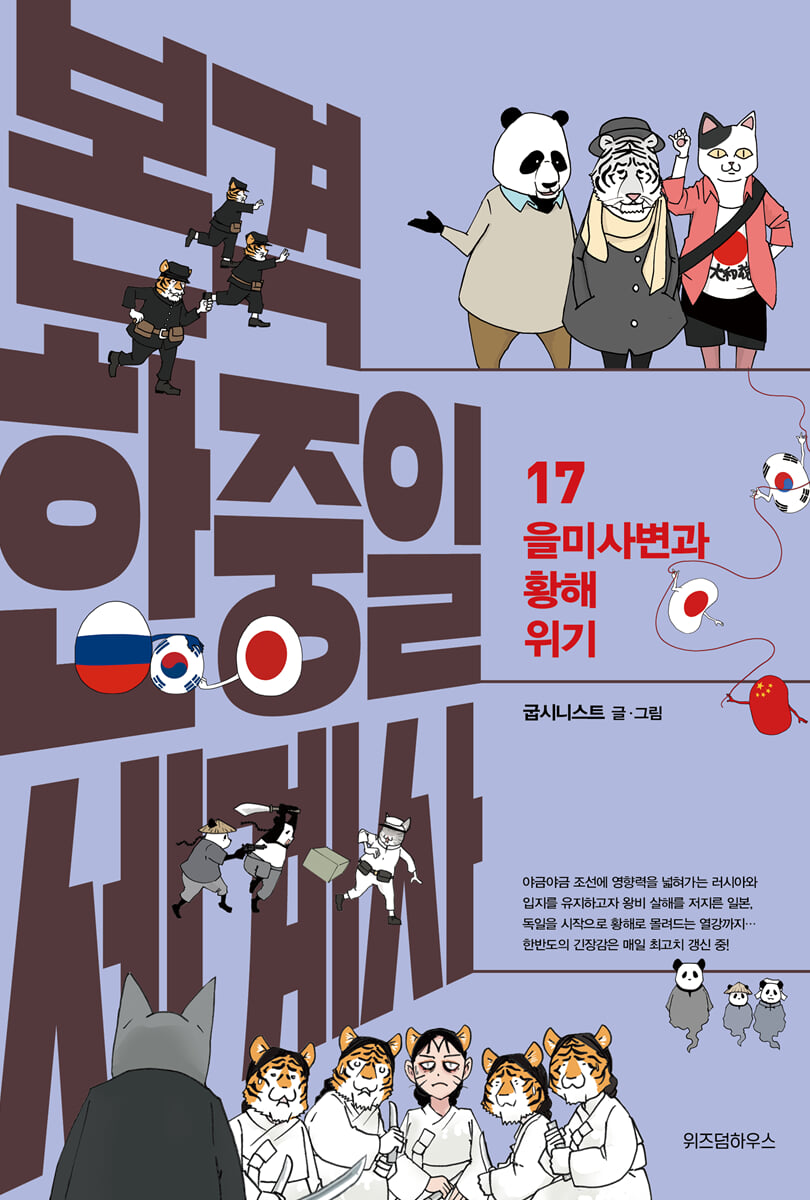
Authentic Korean-Chinese-Japanese World History 17
 |
Description
Book Introduction
An unforeseen and outrageous incident dyed the Joseon palace red with blood.
Taking advantage of the chaos, warships from the great powers gather in the Yellow Sea, and the situation worsens!
Volume 17 deals with Japan's plot to murder the queen and the fierce competition among the great powers in the Yellow Sea.
Japan carried out the 'physical expulsion' of the queen, who had repeatedly obstructed its control of Joseon.
However, with Emperor Gojong fleeing to the Russian Legation, Russia’s influence only grew… .
Meanwhile, Germany, which had become aware of its maritime power, Russia, which had Joseon in its grasp, and Britain and Japan, which were trying to check them, all clashed in the Yellow Sea, which also affected Joseon politics.
Taking advantage of the chaos, warships from the great powers gather in the Yellow Sea, and the situation worsens!
Volume 17 deals with Japan's plot to murder the queen and the fierce competition among the great powers in the Yellow Sea.
Japan carried out the 'physical expulsion' of the queen, who had repeatedly obstructed its control of Joseon.
However, with Emperor Gojong fleeing to the Russian Legation, Russia’s influence only grew… .
Meanwhile, Germany, which had become aware of its maritime power, Russia, which had Joseon in its grasp, and Britain and Japan, which were trying to check them, all clashed in the Yellow Sea, which also affected Joseon politics.
- You can preview some of the book's contents.
Preview
index
preface
Chapter 1 Blue Ocean
Chapter 2 Settings
Chapter 3: The Eulmi Incident
Chapter 4: The Abandoned
Chapter 5 Vacuum
Chapter 6: The Chunsaengmun Incident
Chapter 7: The Eulmi Reform and the Righteous Army
Chapter 8: Messenger of Love
Chapter 9: Agwan Pacheon
Chapter 10 Formosa No.
1
Chapter 11: End of Epilogue
Chapter 12: The Coronation
Chapter 13: The Moscow Meeting
Chapter 14: A Journey Through the World
Chapter 15: Son Rising
Chapter 16 The Independent
Chapter 17: Return to the Palace
Chapter 18: Empire of Dai Han
Chapter 19: Occupying the Leader
Chapter 20: The Game of the Yellow Sea
Chapter 21: 10k People
Chapter 22 Obituaries
Major events and people
Chapter 1 Blue Ocean
Chapter 2 Settings
Chapter 3: The Eulmi Incident
Chapter 4: The Abandoned
Chapter 5 Vacuum
Chapter 6: The Chunsaengmun Incident
Chapter 7: The Eulmi Reform and the Righteous Army
Chapter 8: Messenger of Love
Chapter 9: Agwan Pacheon
Chapter 10 Formosa No.
1
Chapter 11: End of Epilogue
Chapter 12: The Coronation
Chapter 13: The Moscow Meeting
Chapter 14: A Journey Through the World
Chapter 15: Son Rising
Chapter 16 The Independent
Chapter 17: Return to the Palace
Chapter 18: Empire of Dai Han
Chapter 19: Occupying the Leader
Chapter 20: The Game of the Yellow Sea
Chapter 21: 10k People
Chapter 22 Obituaries
Major events and people
Detailed image

Into the book
Now, let's finally look at the big picture of this event.
There were three coups in total aimed at overthrowing the powerful Min clan regime in Joseon.
In 1882, the old army and Daewongun drove out the queen and the Min family.
However, with the intervention of the Qing army, the queen and the Min regime were immediately restored.
Then, in 1884, the pro-Japanese reformists ousted the Min regime, but the Qing army's intervention soon restored the Min regime.
And in 1894, the previous year, the Min regime was overthrown by the Japanese army.
However, this year, the Min regime was restored again due to the aftermath of the Triple Intervention.
Ultimately, there is no fundamental solution without getting rid of the alien queen, the thorny root of the Min regime.
In other words, the goal should be the physical removal of the queen.
--- p.28~31, from “Chapter 2 Settings”
The Eulmi Incident in October 1895 led to the ousting of the Min clan and the Jeongdong faction, and the 4th Kim Hong-jip cabinet, a Gabo faction-only government, was launched.
(…) And the long-awaited look change reform- the short hair order!!! (…) “Eeeeeeeee~ You’re the one who destroys your body and hair! How can you so easily cut the hair your parents gave you!!!” “- That’s just a slogan-like joke, in reality, everyone has been cutting their hair well since long ago...” (…) So, the backlash against the short hair order wasn’t about the act of cutting hair itself, but the fact that it would be difficult to properly wear the nobleman’s attire since the topknot and hat-shaped scarf were banned.
--- p.89~91, from “Chapter 7, Eulmi Reform, Righteous Army”
It was common for the guards guarding the palace gates to open the palanquin windows and harass the palace maids under the pretext of inspection.
“Yoohoo~ Kim Na-in, I guess you changed your essence recently?” This was witnessed by the wife of the entertainment department (the king’s mother).
“Oh, really! When did the laws of this country become so absurd?! If I see one more thug opening the window of a palanquin carrying a palace maid, I’ll make it public on social media!!” And so, by February, there were no more thugs who would open the palanquin carrying a palace maid… On February 10, 100 sailors disembarked from a Russian warship in Incheon and entered the Russian embassy in Seoul.
The next day, February 11th, 5-6 AM.
Two palanquins leave the palace and head towards Jeongdong-gil.
--- p.110~111, from “Chapter 8 Messenger of Love”
Wars of conquest bring spoils not only of territory and indemnities, but also of lower castes to subjugate the people.
“A nation intoxicated by the sense of superiority it feels when looking down does not look up.
For first-class citizens to exist, second-class citizens must exist.
In this way, the first-class citizens who were given the opportunity to lead us as inferior second-class citizens - the ones who continue to expand that worldview - enthusiastically support the imperialist direction of the military.
“Civil rights, democracy, all that stuff is just an obstacle to this direction!”
--- p.154, from “Chapter 11 End of Epilogue”
On May 30, 1896, a stampede broke out on the Khodynka Field, a suburb of Moscow, as an excited crowd gathered.
The Tsar, who had been anointed four days earlier, was greatly shocked.
“Uh huh;; Cancel all remaining schedules; Visit the bereaved families and injured; Go to church to offer a prayer of condolences;;” “I don’t think I can cancel the celebratory ball hosted by the French Ambassador;; It’s a ball that the French Ambassador has been preparing with all his heart for the past six months, and the French Republic’s reputation is at stake;;” (…) On the night of the Hodinka disaster, the imperial couple attended the French Ambassador’s ball.
After looking at the chairman with a stern expression, he immediately leaves.
(…) However, the Tsar’s attendance at the ball immediately after the Khodynka disaster was already fabricated by anti-government speakers into a myth of a psychopathic bloody coronation, which made the world click its tongue.
--- p.170~174, from “Chapter 13: The Moscow Meeting”
In October 1895, the Eulmi Incident broke out.
“If Queen Min is dead! Now it’s possible to return to Joseon and do something!!” Seo Jae-pil entered the country on December 25, 1895.
(…) After returning home, he ignored all the relatives who came to visit him and even kicked beggars.
“It is my karma to feel a sense of duty to bring the barbarians living in this land of savage, violence, and subjugation closer to the light of Western civilization.” “Yeah, to enlighten this kingdom of ignorance…” “A newspaper! A newspaper!!” (…) And so, on April 7, 1896, [The Independent Newspaper] was launched with 100% Joseon government funding! “Filter out the uncivilized Chinese characters! A 100% pure Korean newspaper!!”
--- p.223~228, from “Chapter 16 The Independent”
“By the first half of 1897, the conditions for restoring and wielding strong royal authority were all in place, including the military, the palace, and even the loyal royalist faction.
Looking at external conditions, the Qing Dynasty was completely separated from Joseon, and Japan's political influence was also greatly reduced.
Now it feels like a truly independent nation!! Isn't this the perfect time to declare to the people a new national vision based on a strong royal authority! More than anything... the past 15 years have been filled with nothing but trauma... Ugh!!! I will compensate for those shames and humiliations with amazing achievements!! An achievement that no king has ever achieved in the 500 years of the dynasty!! Is Your Majesty watching!!! I will ascend to the throne!!!" Emperor's ascension
--- p.247~248, from “Chapter 18 Empire of Dai Han”
“You damn Putin’s ancestors are like those sons of bitches!! You made Liaodong vomit out with the Triple Intervention, and now you’re eating Lushun, the heart of Liaodong?!?!?!? We’ve put so much saliva on Joseon, and with one blow of the A-guan Pacheon attack, Joseon is all gone!?! Above all, installing a Russian base on Busan’s Jeolyeongdo Island is like completely blocking Japan’s access to the Korean Peninsula?! This kind of mutually degrading behavior is unprecedented in history!!” The Japanese government and opposition parties are in an uproar.
“Yeah!! The government won’t sit idly by any longer! First, increase the number of troops to the Weihai Command! Deploy a fleet to Tsushima Island!! Blockading the Korea Strait is also possible!!” At the end of December 1897, the Japanese fleet gathered off the coast of Busan.
--- p.276~277, from “Chapter 20: The Game of the Yellow Sea”
On March 10, 1898, a mass meeting to condemn Russian invasion was held in Jongno. It was a huge success, with 10,000 Seoul citizens in attendance.
“Russky!!!!!!” “Gasky!!!!” On March 19, 1898, both the Russian military advisory group and the financial advisor were dismissed.
Then, Han-Ru Bank was closed.
In April, the Russian advisory group, along with Sipayer, returned to Russia.
"We won!!! We repelled the clutches of the mighty Russian Empire with the power of the people!!!" The Independence Association, spearheaded by the Manmin Common Meeting, is powering up! "Is this the ultimate failure in trying to win over Russia?... But those who prioritize the Korean Peninsula will soon rise again in power in Russia..."
There were three coups in total aimed at overthrowing the powerful Min clan regime in Joseon.
In 1882, the old army and Daewongun drove out the queen and the Min family.
However, with the intervention of the Qing army, the queen and the Min regime were immediately restored.
Then, in 1884, the pro-Japanese reformists ousted the Min regime, but the Qing army's intervention soon restored the Min regime.
And in 1894, the previous year, the Min regime was overthrown by the Japanese army.
However, this year, the Min regime was restored again due to the aftermath of the Triple Intervention.
Ultimately, there is no fundamental solution without getting rid of the alien queen, the thorny root of the Min regime.
In other words, the goal should be the physical removal of the queen.
--- p.28~31, from “Chapter 2 Settings”
The Eulmi Incident in October 1895 led to the ousting of the Min clan and the Jeongdong faction, and the 4th Kim Hong-jip cabinet, a Gabo faction-only government, was launched.
(…) And the long-awaited look change reform- the short hair order!!! (…) “Eeeeeeeee~ You’re the one who destroys your body and hair! How can you so easily cut the hair your parents gave you!!!” “- That’s just a slogan-like joke, in reality, everyone has been cutting their hair well since long ago...” (…) So, the backlash against the short hair order wasn’t about the act of cutting hair itself, but the fact that it would be difficult to properly wear the nobleman’s attire since the topknot and hat-shaped scarf were banned.
--- p.89~91, from “Chapter 7, Eulmi Reform, Righteous Army”
It was common for the guards guarding the palace gates to open the palanquin windows and harass the palace maids under the pretext of inspection.
“Yoohoo~ Kim Na-in, I guess you changed your essence recently?” This was witnessed by the wife of the entertainment department (the king’s mother).
“Oh, really! When did the laws of this country become so absurd?! If I see one more thug opening the window of a palanquin carrying a palace maid, I’ll make it public on social media!!” And so, by February, there were no more thugs who would open the palanquin carrying a palace maid… On February 10, 100 sailors disembarked from a Russian warship in Incheon and entered the Russian embassy in Seoul.
The next day, February 11th, 5-6 AM.
Two palanquins leave the palace and head towards Jeongdong-gil.
--- p.110~111, from “Chapter 8 Messenger of Love”
Wars of conquest bring spoils not only of territory and indemnities, but also of lower castes to subjugate the people.
“A nation intoxicated by the sense of superiority it feels when looking down does not look up.
For first-class citizens to exist, second-class citizens must exist.
In this way, the first-class citizens who were given the opportunity to lead us as inferior second-class citizens - the ones who continue to expand that worldview - enthusiastically support the imperialist direction of the military.
“Civil rights, democracy, all that stuff is just an obstacle to this direction!”
--- p.154, from “Chapter 11 End of Epilogue”
On May 30, 1896, a stampede broke out on the Khodynka Field, a suburb of Moscow, as an excited crowd gathered.
The Tsar, who had been anointed four days earlier, was greatly shocked.
“Uh huh;; Cancel all remaining schedules; Visit the bereaved families and injured; Go to church to offer a prayer of condolences;;” “I don’t think I can cancel the celebratory ball hosted by the French Ambassador;; It’s a ball that the French Ambassador has been preparing with all his heart for the past six months, and the French Republic’s reputation is at stake;;” (…) On the night of the Hodinka disaster, the imperial couple attended the French Ambassador’s ball.
After looking at the chairman with a stern expression, he immediately leaves.
(…) However, the Tsar’s attendance at the ball immediately after the Khodynka disaster was already fabricated by anti-government speakers into a myth of a psychopathic bloody coronation, which made the world click its tongue.
--- p.170~174, from “Chapter 13: The Moscow Meeting”
In October 1895, the Eulmi Incident broke out.
“If Queen Min is dead! Now it’s possible to return to Joseon and do something!!” Seo Jae-pil entered the country on December 25, 1895.
(…) After returning home, he ignored all the relatives who came to visit him and even kicked beggars.
“It is my karma to feel a sense of duty to bring the barbarians living in this land of savage, violence, and subjugation closer to the light of Western civilization.” “Yeah, to enlighten this kingdom of ignorance…” “A newspaper! A newspaper!!” (…) And so, on April 7, 1896, [The Independent Newspaper] was launched with 100% Joseon government funding! “Filter out the uncivilized Chinese characters! A 100% pure Korean newspaper!!”
--- p.223~228, from “Chapter 16 The Independent”
“By the first half of 1897, the conditions for restoring and wielding strong royal authority were all in place, including the military, the palace, and even the loyal royalist faction.
Looking at external conditions, the Qing Dynasty was completely separated from Joseon, and Japan's political influence was also greatly reduced.
Now it feels like a truly independent nation!! Isn't this the perfect time to declare to the people a new national vision based on a strong royal authority! More than anything... the past 15 years have been filled with nothing but trauma... Ugh!!! I will compensate for those shames and humiliations with amazing achievements!! An achievement that no king has ever achieved in the 500 years of the dynasty!! Is Your Majesty watching!!! I will ascend to the throne!!!" Emperor's ascension
--- p.247~248, from “Chapter 18 Empire of Dai Han”
“You damn Putin’s ancestors are like those sons of bitches!! You made Liaodong vomit out with the Triple Intervention, and now you’re eating Lushun, the heart of Liaodong?!?!?!? We’ve put so much saliva on Joseon, and with one blow of the A-guan Pacheon attack, Joseon is all gone!?! Above all, installing a Russian base on Busan’s Jeolyeongdo Island is like completely blocking Japan’s access to the Korean Peninsula?! This kind of mutually degrading behavior is unprecedented in history!!” The Japanese government and opposition parties are in an uproar.
“Yeah!! The government won’t sit idly by any longer! First, increase the number of troops to the Weihai Command! Deploy a fleet to Tsushima Island!! Blockading the Korea Strait is also possible!!” At the end of December 1897, the Japanese fleet gathered off the coast of Busan.
--- p.276~277, from “Chapter 20: The Game of the Yellow Sea”
On March 10, 1898, a mass meeting to condemn Russian invasion was held in Jongno. It was a huge success, with 10,000 Seoul citizens in attendance.
“Russky!!!!!!” “Gasky!!!!” On March 19, 1898, both the Russian military advisory group and the financial advisor were dismissed.
Then, Han-Ru Bank was closed.
In April, the Russian advisory group, along with Sipayer, returned to Russia.
"We won!!! We repelled the clutches of the mighty Russian Empire with the power of the people!!!" The Independence Association, spearheaded by the Manmin Common Meeting, is powering up! "Is this the ultimate failure in trying to win over Russia?... But those who prioritize the Korean Peninsula will soon rise again in power in Russia..."
--- p.289~291, from “Chapter 21 10k People”
Publisher's Review
Japan, which broke into the palace in the middle of the night and murdered the queen of a country
It's getting more and more difficult and there are no solutions as you might think!
Japanese Minister Miura, who arrived in Seoul on September 1, 1895, prepared a "shock and awe" operation to take control of Joseon in one fell swoop.
The target is the queen! Japan's plans have repeatedly failed because the queen and her close associates cling to power without regard for the means or methods necessary.
Miura, who believed that Japan should not be picky about its means and methods, plotted to kill the queen.
Finally, at dawn on October 8, Japanese ronin, military, and Korean collaborators stormed Gyeongbokgung Palace, and the queen met her end around sunrise.
The Japanese government is also flustered by the series of events, but it's just water under the bridge.
He wants to quickly take over Joseon.
Accordingly, on October 10, the pro-Japanese Gabo faction took control of the Joseon government and initiated a reform drive, including the hair-cutting order.
The public anger, fueled by the murder of the queen and the disfigurement of the nobles, explodes into rebellion across the eight provinces. A group of Joseon soldiers attempts a grand rescue operation for Emperor Gojong, but fails miserably. The situation is chaotic! In short, it becomes chaos.
Meanwhile, Emperor Gojong, who had gathered his courage, asked for help from the Russian minister, Weber, with whom he was close, and on the morning of February 11, 1896, he successfully escaped the palace by hiding in a palanquin used by a court lady and took refuge in the Russian embassy.
Immediately after, King Gojong purged all pro-Japanese Gabo faction members and reorganized the political landscape with anti-Japanese faction members.
For Japan, it was as if they had fallen for their own tricks, and in the end, they only ended up increasing the influence of Emperor Gojong and Russia.
In such a situation, Emperor Gojong, who returned to the palace on February 20, 1897, ascended to the throne of the emperor through the declaration of the founding of the nation and presented a vision of strengthening national competitiveness… .
Will the newly born Korean Empire be able to overcome the snubs of the great powers and transform into a truly modern nation?
The tangled war between Germany, Russia, Britain, and Japan
The turbid Yellow Sea becomes even more turbid!
The Korean Empire, which had just begun to walk, was immediately faced with trials.
The root of the problem was the "theory of sea power," which captivated the minds of the great powers of the time. In short, the theory that the sea was the key to hegemony, even Germany, a land powerhouse, adopted this as its national doctrine.
So, in the mid-1890s, Germany, which had been building warships, was forced to submit to the Qing Dynasty.
In November and January 1897, German missionaries visiting a small town near Qingdao were murdered by locals. In response, the German Navy, as if waiting for this, occupied Qingdao, a strategic location on the Yellow Sea.
Meanwhile, Russia, which had gained momentum after the Akgwan Pacheon incident, established strongholds in Vladivostok in the East Sea, Port Arthur in the Yellow Sea, and Jeolyeongdo Island off the coast of Busan, in an attempt to further pressure Japan.
If these bases became the eastern exit for the Trans-Siberian Railway, Japan would be trapped in a trap! So, they turned to Britain for help, and starting in December 1897, Germany, Russia, Japan, and Britain converged on the Yellow Sea, competing for supremacy.
Even though the situation is so urgent, the Korean Empire is just watching, so the citizens are raising their voices instead.
The person standing before them is Seo Jae-pil.
After the failure of the Gapsin Coup, he went into exile in the United States and even acquired citizenship. He returned to Korea on December 25, 1895, and with the mission of enlightening the people, he founded the [Independence Newspaper] in April 1896 and established the Independence Association in July.
Afterwards, during the Yellow Sea crisis, the People's Assembly was held on March 10, 1898, and Russia's demand for Jeolyeongdo Island was strongly criticized, and Russia actually backed down...
But in fact, Russia had already decided to take Lushun, and the Independence Association, aware of this, held the People's Assembly with the intention of showing off its power.
To King Gojong, who was trying to draw Russia in and use it as a backer, the Independence Association's sudden actions were like a thorn in his side, and the chaos inside and outside the country deepened even more!
▶ The series “Authentic Korean, Chinese, and Japanese World History”
This is foul play, how can you not lose the humor while still having depth in the content?
Easily overcoming the conventional wisdom that history must be memorized to be understood.
When we talk about 'history', we often have the common perception that it is 'boring' and that 'you have to memorize it to understand it'.
This may be because the memories of memorizing the years and processes of each event in middle and high school history classes are all that remain of our image of history.
In contrast, this series deviates significantly from the conventional wisdom that history must be memorized.
This series is a historical comic by cartoonist Gupsinist, who uses his major to cover the modern history of Korea, China, and Japan. It describes the modern history of 19th century East Asia, while naturally incorporating various subcultures such as games, military, animation, and dramas.
As you slowly follow the author's extensive knowledge of history, the various parodies and wordplay that are sprinkled throughout, the zeitgeist and world situation of the time will naturally come to mind.
Through this series, readers will experience a significant reduction in the barriers to entry into history, which was once perceived as difficult.
In the face of the tidal wave of Western imperialist powers entering the world,
How did Korea, China, and Japan resist or comply?
Why must we read world history through the lens of "Korea, China, and Japan"? To observe the tree of Korean history, our own history, we must first see the forest of East Asian history. Without understanding this, we cannot grasp the larger picture of world history.
To understand our country's past and present, and the global situation, we will compare the history of three East Asian countries.
World history up to now has not strayed far from the form of a brief description of the history of Western powers and the surrounding nations and peoples within the global historical flow they created.
However, not only the military and diplomacy of powerful nations, but also the resistance and identity of weak nations occupy a large portion of history.
This series is an attempt to break away from the conventional Western-centric historical narrative and look at history from an East Asian perspective.
Among these, we will take a closer look at the period from the mid-19th century to the mid-20th century, when Korea, China, and Japan were most closely connected.
01.
The beginning of the West Sea branch
02.
Taiping Heavenly Kingdom Rising
03.
Japan's opening
04.
Taiping Heavenly Kingdom Downfall
05.
Archipelago game
06.
Tsunami of Dawn
07.
Heungseon Daewongun and the Byeongin Yangyo
08.
The fall of the shogunate and the Boshin War
09.
Bloody Sunshine Shinmiyangyo
10.
Ganghwa Island Treaty Ominous
11.
Southwestern War and Uyghur Uprising
12.
The Im-o Incident and the Tonkin Crisis
13.
The Sino-French War and the Gapsin Coup
14.
Geomundo Crisis and Banggokryeong
15.
Donghak Peasant Revolution and the Sino-Japanese War
16.
The Triple Intervention and the Gabo Reforms
17.
The Eulmi Incident and the Yellow Sea Crisis
18.
Martial Arts Coup and the People's Common Assembly (Basis)
*Continued publication.
It's getting more and more difficult and there are no solutions as you might think!
Japanese Minister Miura, who arrived in Seoul on September 1, 1895, prepared a "shock and awe" operation to take control of Joseon in one fell swoop.
The target is the queen! Japan's plans have repeatedly failed because the queen and her close associates cling to power without regard for the means or methods necessary.
Miura, who believed that Japan should not be picky about its means and methods, plotted to kill the queen.
Finally, at dawn on October 8, Japanese ronin, military, and Korean collaborators stormed Gyeongbokgung Palace, and the queen met her end around sunrise.
The Japanese government is also flustered by the series of events, but it's just water under the bridge.
He wants to quickly take over Joseon.
Accordingly, on October 10, the pro-Japanese Gabo faction took control of the Joseon government and initiated a reform drive, including the hair-cutting order.
The public anger, fueled by the murder of the queen and the disfigurement of the nobles, explodes into rebellion across the eight provinces. A group of Joseon soldiers attempts a grand rescue operation for Emperor Gojong, but fails miserably. The situation is chaotic! In short, it becomes chaos.
Meanwhile, Emperor Gojong, who had gathered his courage, asked for help from the Russian minister, Weber, with whom he was close, and on the morning of February 11, 1896, he successfully escaped the palace by hiding in a palanquin used by a court lady and took refuge in the Russian embassy.
Immediately after, King Gojong purged all pro-Japanese Gabo faction members and reorganized the political landscape with anti-Japanese faction members.
For Japan, it was as if they had fallen for their own tricks, and in the end, they only ended up increasing the influence of Emperor Gojong and Russia.
In such a situation, Emperor Gojong, who returned to the palace on February 20, 1897, ascended to the throne of the emperor through the declaration of the founding of the nation and presented a vision of strengthening national competitiveness… .
Will the newly born Korean Empire be able to overcome the snubs of the great powers and transform into a truly modern nation?
The tangled war between Germany, Russia, Britain, and Japan
The turbid Yellow Sea becomes even more turbid!
The Korean Empire, which had just begun to walk, was immediately faced with trials.
The root of the problem was the "theory of sea power," which captivated the minds of the great powers of the time. In short, the theory that the sea was the key to hegemony, even Germany, a land powerhouse, adopted this as its national doctrine.
So, in the mid-1890s, Germany, which had been building warships, was forced to submit to the Qing Dynasty.
In November and January 1897, German missionaries visiting a small town near Qingdao were murdered by locals. In response, the German Navy, as if waiting for this, occupied Qingdao, a strategic location on the Yellow Sea.
Meanwhile, Russia, which had gained momentum after the Akgwan Pacheon incident, established strongholds in Vladivostok in the East Sea, Port Arthur in the Yellow Sea, and Jeolyeongdo Island off the coast of Busan, in an attempt to further pressure Japan.
If these bases became the eastern exit for the Trans-Siberian Railway, Japan would be trapped in a trap! So, they turned to Britain for help, and starting in December 1897, Germany, Russia, Japan, and Britain converged on the Yellow Sea, competing for supremacy.
Even though the situation is so urgent, the Korean Empire is just watching, so the citizens are raising their voices instead.
The person standing before them is Seo Jae-pil.
After the failure of the Gapsin Coup, he went into exile in the United States and even acquired citizenship. He returned to Korea on December 25, 1895, and with the mission of enlightening the people, he founded the [Independence Newspaper] in April 1896 and established the Independence Association in July.
Afterwards, during the Yellow Sea crisis, the People's Assembly was held on March 10, 1898, and Russia's demand for Jeolyeongdo Island was strongly criticized, and Russia actually backed down...
But in fact, Russia had already decided to take Lushun, and the Independence Association, aware of this, held the People's Assembly with the intention of showing off its power.
To King Gojong, who was trying to draw Russia in and use it as a backer, the Independence Association's sudden actions were like a thorn in his side, and the chaos inside and outside the country deepened even more!
▶ The series “Authentic Korean, Chinese, and Japanese World History”
This is foul play, how can you not lose the humor while still having depth in the content?
Easily overcoming the conventional wisdom that history must be memorized to be understood.
When we talk about 'history', we often have the common perception that it is 'boring' and that 'you have to memorize it to understand it'.
This may be because the memories of memorizing the years and processes of each event in middle and high school history classes are all that remain of our image of history.
In contrast, this series deviates significantly from the conventional wisdom that history must be memorized.
This series is a historical comic by cartoonist Gupsinist, who uses his major to cover the modern history of Korea, China, and Japan. It describes the modern history of 19th century East Asia, while naturally incorporating various subcultures such as games, military, animation, and dramas.
As you slowly follow the author's extensive knowledge of history, the various parodies and wordplay that are sprinkled throughout, the zeitgeist and world situation of the time will naturally come to mind.
Through this series, readers will experience a significant reduction in the barriers to entry into history, which was once perceived as difficult.
In the face of the tidal wave of Western imperialist powers entering the world,
How did Korea, China, and Japan resist or comply?
Why must we read world history through the lens of "Korea, China, and Japan"? To observe the tree of Korean history, our own history, we must first see the forest of East Asian history. Without understanding this, we cannot grasp the larger picture of world history.
To understand our country's past and present, and the global situation, we will compare the history of three East Asian countries.
World history up to now has not strayed far from the form of a brief description of the history of Western powers and the surrounding nations and peoples within the global historical flow they created.
However, not only the military and diplomacy of powerful nations, but also the resistance and identity of weak nations occupy a large portion of history.
This series is an attempt to break away from the conventional Western-centric historical narrative and look at history from an East Asian perspective.
Among these, we will take a closer look at the period from the mid-19th century to the mid-20th century, when Korea, China, and Japan were most closely connected.
01.
The beginning of the West Sea branch
02.
Taiping Heavenly Kingdom Rising
03.
Japan's opening
04.
Taiping Heavenly Kingdom Downfall
05.
Archipelago game
06.
Tsunami of Dawn
07.
Heungseon Daewongun and the Byeongin Yangyo
08.
The fall of the shogunate and the Boshin War
09.
Bloody Sunshine Shinmiyangyo
10.
Ganghwa Island Treaty Ominous
11.
Southwestern War and Uyghur Uprising
12.
The Im-o Incident and the Tonkin Crisis
13.
The Sino-French War and the Gapsin Coup
14.
Geomundo Crisis and Banggokryeong
15.
Donghak Peasant Revolution and the Sino-Japanese War
16.
The Triple Intervention and the Gabo Reforms
17.
The Eulmi Incident and the Yellow Sea Crisis
18.
Martial Arts Coup and the People's Common Assembly (Basis)
*Continued publication.
GOODS SPECIFICS
- Date of issue: August 2, 2023
- Page count, weight, size: 308 pages | 152*225*19mm
- ISBN13: 9791168126466
- ISBN10: 1168126460
You may also like
카테고리
korean


korean

![GQ KOREA Mark (Monthly): December [2025]](http://librairie.coreenne.fr/cdn/shop/files/8ef265dbbfbf186523ed75ba7319009d.jpg?v=1765340328&width=3840)


