

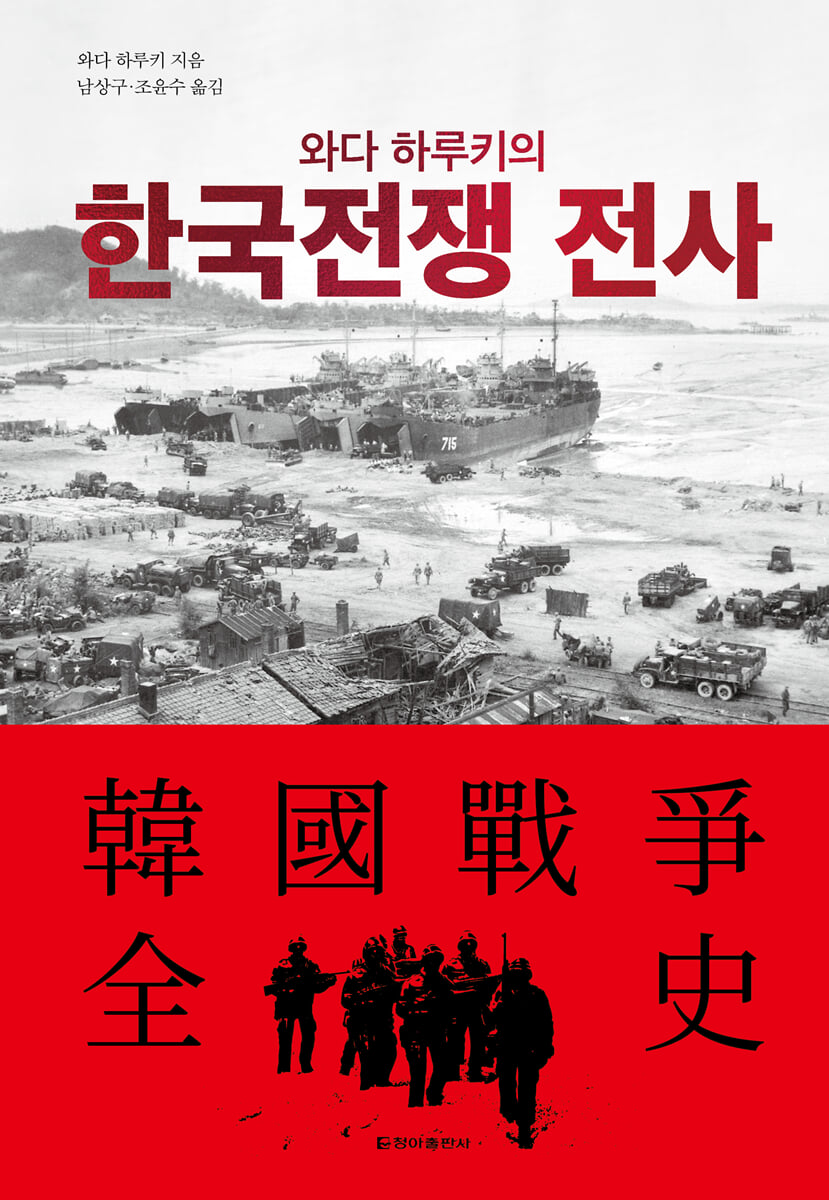
Haruki Wada's Korean War Chronicles
 |
Description
Book Introduction
He has received awards such as the Kim Dae-jung Academic Award, the DMZ Peace Award, and the Manhae Award.
Haruki Wada, a leading Japanese scholar of the Korean Wave
His definitive study of the Korean War, "Complete History of Joseon"
Published in Korean to commemorate the 70th anniversary of the Korean War armistice!
Why and how did the war start?
What did each country go to war for?
How did the war change the international order?
Beyond left-right logic, reveal the full story of the Korean War from a third-person perspective!
70 years have already passed since the Korean War ended with the armistice agreement.
Although there have been several instances of reconciliation, including reunions of separated families between the South and the North and the inter-Korean summits, inter-Korean relations remain mired in conflict and confrontation, and progress has been slow.
In a reality where the tide is turning more toward war than peace, reexamining the Korean War and reflecting on its consequences and meaning is necessary to establish peace on the Korean Peninsula and move forward into a new century.
Why did Kim Il-sung, Stalin, and Mao Zedong plan to invade the South? Was the United States unaware of North Korea's invasion plan? Did the United States seek unification of the Korean Peninsula or the preservation of the status quo? What did North and South Korea, the United States, the Soviet Union, China, Japan, and Taiwan hope to gain from the Korean War? Why did China call it the War to Resist US Aggression and Aid Korea? Through this book, we can gain a fairly close understanding of the full story of the Korean War.
Confidential information related to the Korean War began to be disclosed in the 1990s after the collapse of the Soviet Union.
Since then, numerous studies have been published on the Korean War both domestically and internationally, but there have been few that can be called a comprehensive history of the Korean War.
This is because it is not easy to decipher and understand historical materials written in the languages of the various countries involved in the Korean War.
The author of this book, Haruki Wada, was able to decipher materials from not only the parties involved, North and South Korea, but also China, the Soviet Union, the United States, and Japan, allowing him to fully reflect his balanced interests in his research.
He dramatically portrayed the entire course of the Korean War by comprehensively compiling a vast amount of previously disclosed material, including classified documents from the U.S. State Department and intelligence agencies, coded telegrams, war-related materials from Russia (the former Soviet Union) and China, and North Korean materials captured by the U.S.
This book can be said to be the definitive edition of his research on the Korean War, containing the culmination of his painstaking efforts, to the extent that the author himself stated, “This will be the last book I publish on the subject of the Korean War.”
Kathryn Weathersby, a professor at the Johns Hopkins University School of Advanced International Studies and research director at the Woodrow Wilson International Center for Scholars, praised the book as “the most comprehensive and balanced history of the Korean War ever published.”
This is because the entire Korean War was described in a concrete and objective manner based solely on primary sources, rather than on the logic of progressive and conservative.
Although this book is a massive 712-page study, it provides a three-dimensional view of the Korean War, making it as immersive as reading an engaging novel.
This will be a book that will help you fully understand the Korean War.
Haruki Wada, a leading Japanese scholar of the Korean Wave
His definitive study of the Korean War, "Complete History of Joseon"
Published in Korean to commemorate the 70th anniversary of the Korean War armistice!
Why and how did the war start?
What did each country go to war for?
How did the war change the international order?
Beyond left-right logic, reveal the full story of the Korean War from a third-person perspective!
70 years have already passed since the Korean War ended with the armistice agreement.
Although there have been several instances of reconciliation, including reunions of separated families between the South and the North and the inter-Korean summits, inter-Korean relations remain mired in conflict and confrontation, and progress has been slow.
In a reality where the tide is turning more toward war than peace, reexamining the Korean War and reflecting on its consequences and meaning is necessary to establish peace on the Korean Peninsula and move forward into a new century.
Why did Kim Il-sung, Stalin, and Mao Zedong plan to invade the South? Was the United States unaware of North Korea's invasion plan? Did the United States seek unification of the Korean Peninsula or the preservation of the status quo? What did North and South Korea, the United States, the Soviet Union, China, Japan, and Taiwan hope to gain from the Korean War? Why did China call it the War to Resist US Aggression and Aid Korea? Through this book, we can gain a fairly close understanding of the full story of the Korean War.
Confidential information related to the Korean War began to be disclosed in the 1990s after the collapse of the Soviet Union.
Since then, numerous studies have been published on the Korean War both domestically and internationally, but there have been few that can be called a comprehensive history of the Korean War.
This is because it is not easy to decipher and understand historical materials written in the languages of the various countries involved in the Korean War.
The author of this book, Haruki Wada, was able to decipher materials from not only the parties involved, North and South Korea, but also China, the Soviet Union, the United States, and Japan, allowing him to fully reflect his balanced interests in his research.
He dramatically portrayed the entire course of the Korean War by comprehensively compiling a vast amount of previously disclosed material, including classified documents from the U.S. State Department and intelligence agencies, coded telegrams, war-related materials from Russia (the former Soviet Union) and China, and North Korean materials captured by the U.S.
This book can be said to be the definitive edition of his research on the Korean War, containing the culmination of his painstaking efforts, to the extent that the author himself stated, “This will be the last book I publish on the subject of the Korean War.”
Kathryn Weathersby, a professor at the Johns Hopkins University School of Advanced International Studies and research director at the Woodrow Wilson International Center for Scholars, praised the book as “the most comprehensive and balanced history of the Korean War ever published.”
This is because the entire Korean War was described in a concrete and objective manner based solely on primary sources, rather than on the logic of progressive and conservative.
Although this book is a massive 712-page study, it provides a three-dimensional view of the Korean War, making it as immersive as reading an engaging novel.
This will be a book that will help you fully understand the Korean War.
- You can preview some of the book's contents.
Preview
index
Preface to the Korean edition
Letter of recommendation
preface
Chapter 1.
The crisis of 1949
- The birth of two countries and the theory of unification by force
- Cross-border attacks by South Korea
- North Korean delegation's visit to the Soviet Union
- Information on the South Korean military's invasion of the North
- Chinese troops cross the Yangtze River
- Negotiations for the delivery of the Korean troops
Border conflict escalates
- Formation of the Democratic Front for the Reunification of the Fatherland
- The superiority of the Korean military
- Fatherland Front Formation Conference
- US troops complete withdrawal
- Battle of Ongjin
- North Korea's declaration of intent
- Moscow's continued refusal
- Guerrilla activities in South Korea
- Changes in Soviet policy toward Japan
- North Korea's operation to recapture Eunpasan
- Korea's persuasion and appeasement
Chapter 2.
North Korea heading toward war
- Small and Medium-sized Summit
- The repercussions of Acheson's speech
- Kim Il-sung's desperate appeal
- Stalin's approval
- Full-scale preparations for war begin
- Kim Il-sung and Pak Hon-yong's visit to Moscow
- Kim Il-sung and Pak Hon-yong's visit to Beijing
- Accelerate preparations
- Deployment of each division of the People's Army
- America on the Eve
- Korea on the eve
Chapter 3.
North Korean military attack
- Initiate the attack
- The South Korean military's response and the government's abandonment of Seoul
- The People's Army occupies Seoul
- America's response
- Soviet moves
- America enters the war
- The outbreak of war and Japan
- The opening of the war and Taiwan
- Soviet and Chinese reactions to the US entry into the war
- The advance of the Korean People's Army and the response of the US Army
- North Koreanization of occupied territories
- The People's Army couldn't break the wall
- Japan's Ministry of Foreign Affairs and Peace Issues Dialogue
- US troops land in Incheon
- Withdrawal from Seoul and request for reinforcements
- The People's Army is in full retreat
Chapter 4.
The advance of US and ROK forces northward and the entry of Chinese forces into the war
- The advance of South Korean and US forces northward
- China discusses entering the war
- Zhou Enlai's visit to the Soviet Union and China's dispatch of troops
- Japanese participation in the war
- Fall of Pyongyang
- Chinese troops cross the Yalu River
- Retreat of ROK and US forces
- Liberation of Pyongyang by North Korean forces
- Shock from America
- Should we move forward or rest?
- Plenary meeting of the Central Committee of the Workers' Party of Korea
- Recapture of Seoul
- American nursery rhymes and Japanese atmosphere
- Hardline Mao Zedong
- Before and after the North-South Military Senior Officers' Joint Meeting
Chapter 5.
War while holding armistice talks
- The attitudes of the United States and the Soviet Union
- The 5th Chinese military campaign
- Preparation for strengthening ties with Japan
- Crisis in Korea's domestic politics
- Soviet Union's move to broker a ceasefire
- Kim Il-sung and Gao Gang's visit to the Soviet Union
- Preparation for armistice talks
- Commencement of armistice talks
- The feelings of the leaders of the North and South
- The San Francisco Peace Treaty and the Japanese Communist Party
- Special Issues on the Korean Peninsula and Japan
- Korea-Japan preliminary talks
- The war situation on the Korean Peninsula and the resumption of armistice talks
- Kim Il-sung's control of the party
Armistice talks reach a dead end
Chapter 6.
The third year of war
- 'Oppose Germ Warfare' Campaign
- Conclusion of the Ilhwa Peace Treaty
Kim Il-sung hopes for an immediate ceasefire
- Busan political turmoil
- Zhou Enlai's visit to the Soviet Union
- Comparing Stalin, Kim Il-sung, and Pak Hon-yong
- Two defeats
- Demanding accountability
- The final negotiations between Stalin and Mao Zedong
Chapter 7.
blackout
- Stalin's death
- Resumption of negotiations
- Progress in negotiations and Korean resistance
- By agreement
- American persuasion
- North Korea and the Soviet Union on the night before the armistice
- Signing of the Armistice Agreement
- Reactions of each country after the signing of the armistice agreement
- Human casualties and the fate of prisoners
- The emergence of the armistice agreement system
Chapter 8.
Northeast Asia after the Korean War
- South and North of the Korean Peninsula
- USA
- Soviet Union
- china
- Taiwan
- japan
Americas
Japanese version review
Translator's Note
map
pictorial
index
Letter of recommendation
preface
Chapter 1.
The crisis of 1949
- The birth of two countries and the theory of unification by force
- Cross-border attacks by South Korea
- North Korean delegation's visit to the Soviet Union
- Information on the South Korean military's invasion of the North
- Chinese troops cross the Yangtze River
- Negotiations for the delivery of the Korean troops
Border conflict escalates
- Formation of the Democratic Front for the Reunification of the Fatherland
- The superiority of the Korean military
- Fatherland Front Formation Conference
- US troops complete withdrawal
- Battle of Ongjin
- North Korea's declaration of intent
- Moscow's continued refusal
- Guerrilla activities in South Korea
- Changes in Soviet policy toward Japan
- North Korea's operation to recapture Eunpasan
- Korea's persuasion and appeasement
Chapter 2.
North Korea heading toward war
- Small and Medium-sized Summit
- The repercussions of Acheson's speech
- Kim Il-sung's desperate appeal
- Stalin's approval
- Full-scale preparations for war begin
- Kim Il-sung and Pak Hon-yong's visit to Moscow
- Kim Il-sung and Pak Hon-yong's visit to Beijing
- Accelerate preparations
- Deployment of each division of the People's Army
- America on the Eve
- Korea on the eve
Chapter 3.
North Korean military attack
- Initiate the attack
- The South Korean military's response and the government's abandonment of Seoul
- The People's Army occupies Seoul
- America's response
- Soviet moves
- America enters the war
- The outbreak of war and Japan
- The opening of the war and Taiwan
- Soviet and Chinese reactions to the US entry into the war
- The advance of the Korean People's Army and the response of the US Army
- North Koreanization of occupied territories
- The People's Army couldn't break the wall
- Japan's Ministry of Foreign Affairs and Peace Issues Dialogue
- US troops land in Incheon
- Withdrawal from Seoul and request for reinforcements
- The People's Army is in full retreat
Chapter 4.
The advance of US and ROK forces northward and the entry of Chinese forces into the war
- The advance of South Korean and US forces northward
- China discusses entering the war
- Zhou Enlai's visit to the Soviet Union and China's dispatch of troops
- Japanese participation in the war
- Fall of Pyongyang
- Chinese troops cross the Yalu River
- Retreat of ROK and US forces
- Liberation of Pyongyang by North Korean forces
- Shock from America
- Should we move forward or rest?
- Plenary meeting of the Central Committee of the Workers' Party of Korea
- Recapture of Seoul
- American nursery rhymes and Japanese atmosphere
- Hardline Mao Zedong
- Before and after the North-South Military Senior Officers' Joint Meeting
Chapter 5.
War while holding armistice talks
- The attitudes of the United States and the Soviet Union
- The 5th Chinese military campaign
- Preparation for strengthening ties with Japan
- Crisis in Korea's domestic politics
- Soviet Union's move to broker a ceasefire
- Kim Il-sung and Gao Gang's visit to the Soviet Union
- Preparation for armistice talks
- Commencement of armistice talks
- The feelings of the leaders of the North and South
- The San Francisco Peace Treaty and the Japanese Communist Party
- Special Issues on the Korean Peninsula and Japan
- Korea-Japan preliminary talks
- The war situation on the Korean Peninsula and the resumption of armistice talks
- Kim Il-sung's control of the party
Armistice talks reach a dead end
Chapter 6.
The third year of war
- 'Oppose Germ Warfare' Campaign
- Conclusion of the Ilhwa Peace Treaty
Kim Il-sung hopes for an immediate ceasefire
- Busan political turmoil
- Zhou Enlai's visit to the Soviet Union
- Comparing Stalin, Kim Il-sung, and Pak Hon-yong
- Two defeats
- Demanding accountability
- The final negotiations between Stalin and Mao Zedong
Chapter 7.
blackout
- Stalin's death
- Resumption of negotiations
- Progress in negotiations and Korean resistance
- By agreement
- American persuasion
- North Korea and the Soviet Union on the night before the armistice
- Signing of the Armistice Agreement
- Reactions of each country after the signing of the armistice agreement
- Human casualties and the fate of prisoners
- The emergence of the armistice agreement system
Chapter 8.
Northeast Asia after the Korean War
- South and North of the Korean Peninsula
- USA
- Soviet Union
- china
- Taiwan
- japan
Americas
Japanese version review
Translator's Note
map
pictorial
index
Detailed image

Into the book
On June 21, Citicorp sent a more decisive telegram.
Kim Il-sung said that based on South Korean broadcasts and intelligence reports, the South seemed to have specifically detected an imminent attack by the Korean People's Army.
Accordingly, the South is devising measures to increase the combat power of its military.
We are strengthening our defense line and deploying additional troops toward the Ongjin Peninsula.
In this regard, Kim Il-sung proposed to change the original operational plan and attack simultaneously along the entire dividing line.” In response, Stalin said that the Soviet Navy should not be used to transport the landing force as it would give the United States a pretext to intervene, but he ultimately supported Kim Il-sung’s plan to attack along all fronts.
---From "Chapter 2 North Korea Heading for War - 'Deployment of Each Division of the People's Army'"
In the afternoon, Chief of Staff Chae Byeong-deok devised a plan to hastily call in three divisions from the south and prepare for a counterattack.
At the State Council meeting held at 2 p.m., the government declared a state of emergency by presidential decree after confirming the North Korean military's full-scale attack through a report by Director Chae.
The South Korean army was fighting desperately north of Seoul, but that night the North Korean army advanced right up to Uijeongbu.
President Syngman Rhee shocked his ministers and Ambassador Muccio by making the unilateral decision that same night to move the government to Daejeon.
Ambassador Muccio tried to persuade him to remain in Seoul, but President Lee refused to change his mind, repeating only that his personal safety was not a concern and that the government should not risk being taken prisoner.
When Uijeongbu fell at 1:00 PM on the 26th, Seoul was left in a precarious situation.
The president escaped from Seoul at dawn on the 27th.
The remaining Shinsungmo acted as prime minister and decided to hold an emergency cabinet meeting and move the government to Suwon.
The destination of this president who escaped from Seoul was not Daejeon, but Jinhae, a naval base in the southernmost part of the country.
However, when he arrived in Daegu, the president reflected that he had run too far and turned back to Daejeon.
---From "Chapter 3 North Korean Army's Attack - 'South Korean Army's Response and Information Abandonment of Seoul'"
However, the Socialist Party's position gained solid support among some citizens, and the Peace Dialogue's opinion enjoyed widespread support among intellectuals.
Even the Yoshida government only talked about “spiritual cooperation” regarding the Korean War, and actual cooperation was forced secretly and without seeking public support.
The Japanese people's aversion to war and the military, derived from their war experience, was equally strong.
The realistic and rebellious national sentiment that there was nothing that could be done in the Korean War but that they did not want to cooperate in any war was what supported the utopian pacifist discourse and supported the Yoshida line from the bottom.
These sentiments also fueled the Japanese people's immersion in an economic boom during the Korean War.
The Korean War was an invisible war for the Japanese living in war bases.
The Japanese, while throwing their country and their bodies into the maelstrom of war, were deluded into thinking that they were not swept away.
---From "Chapter 3 North Korean Army Attacks - 'Japan's Ministry of Foreign Affairs and Peace Issues Dialogue'"
At this very moment, the US military launched another air raid on Pyongyang.
On August 29, an operation called "All United Nations Air Forces Effort" was launched.
Starting at 9:30 a.m., carrier-based aircraft and 5th Air Force aircraft took off in three sorties at four-hour intervals, at 1:30 p.m. and 5:30 p.m., for a total of 1,403 sorties.
This was even more devastating than the aerial bombardment of July 11th.
At night, 11 B-29 bombers from Kadena took off and bombed.
Pyongyang was completely destroyed.
No capital city in world history has been bombed so repeatedly.
The Soviet Air Force and anti-aircraft artillery units were completely helpless.
The power relationship between the attacking and defending sides was more dire than that of Tokyo, which was bombed by the US military at the end of the Pacific War.
---From "Chapter 6, The Third Year of War _ 'Comparing Stalin, Kim Il-sung, and Pak Hon-yong'"
It is not known whether Syngman Rhee was aware of this atmosphere, but he was once again attempting a bold counterattack.
Syngman Rhee sent a letter to Robertson on July 1, and wrote the following at the end:
“If the United States makes a clear commitment to resume fighting alongside us until the unification of the Korean Peninsula is achieved if political talks fail, we will be very close to an agreement not to interfere with the armistice.
If you don't accept this, I'm not sure how I can address your needs regarding the power outage.
“There is no way to persuade the Korean people who are clearly opposed to the current armistice conditions.” This was going too far.
Upon receiving this letter, Robertson had no choice but to report to Washington that if Syngman Rhee's attitude did not change, his mission was over.
---From "Chapter 7 Armistice _ 'American Persuasion'"
On July 29, a celebration ceremony for the signing of the Korean Armistice Agreement was held in Beijing at the Zhongshan Park Music Hall, with 4,500 people from all walks of life participating.
Guo Moruo, Chairman of the Chinese People's Association for Resistance against American Aggression and Aid to Korea, gave a speech.
After hearing Peng Dehuai's report at the Central People's Committee on September 12, Mao Zedong declared in a speech that "the victory in the War to Resist US Aggression and Aid Korea is great and of great significance."
Specifically, he emphasized that first, by pushing the enemy back to the 38th parallel and defending it, the front line was moved farther away from the Yalu and Tumen Rivers (Tumen Rivers), thus relieving instability in the northeastern region; second, by gaining military experience, after fighting the US military for 33 months, they had fully learned the inside story and no longer feared it; third, by raising the political resolve of the people across the country; and fourth, as a result, “the new imperialist war of aggression against China was delayed and the Third World War was postponed.”
The war between the United States and China ended in a draw.
However, it was a great success that revolutionary China survived and secured citizenship in the international community.
Kim Il-sung said that based on South Korean broadcasts and intelligence reports, the South seemed to have specifically detected an imminent attack by the Korean People's Army.
Accordingly, the South is devising measures to increase the combat power of its military.
We are strengthening our defense line and deploying additional troops toward the Ongjin Peninsula.
In this regard, Kim Il-sung proposed to change the original operational plan and attack simultaneously along the entire dividing line.” In response, Stalin said that the Soviet Navy should not be used to transport the landing force as it would give the United States a pretext to intervene, but he ultimately supported Kim Il-sung’s plan to attack along all fronts.
---From "Chapter 2 North Korea Heading for War - 'Deployment of Each Division of the People's Army'"
In the afternoon, Chief of Staff Chae Byeong-deok devised a plan to hastily call in three divisions from the south and prepare for a counterattack.
At the State Council meeting held at 2 p.m., the government declared a state of emergency by presidential decree after confirming the North Korean military's full-scale attack through a report by Director Chae.
The South Korean army was fighting desperately north of Seoul, but that night the North Korean army advanced right up to Uijeongbu.
President Syngman Rhee shocked his ministers and Ambassador Muccio by making the unilateral decision that same night to move the government to Daejeon.
Ambassador Muccio tried to persuade him to remain in Seoul, but President Lee refused to change his mind, repeating only that his personal safety was not a concern and that the government should not risk being taken prisoner.
When Uijeongbu fell at 1:00 PM on the 26th, Seoul was left in a precarious situation.
The president escaped from Seoul at dawn on the 27th.
The remaining Shinsungmo acted as prime minister and decided to hold an emergency cabinet meeting and move the government to Suwon.
The destination of this president who escaped from Seoul was not Daejeon, but Jinhae, a naval base in the southernmost part of the country.
However, when he arrived in Daegu, the president reflected that he had run too far and turned back to Daejeon.
---From "Chapter 3 North Korean Army's Attack - 'South Korean Army's Response and Information Abandonment of Seoul'"
However, the Socialist Party's position gained solid support among some citizens, and the Peace Dialogue's opinion enjoyed widespread support among intellectuals.
Even the Yoshida government only talked about “spiritual cooperation” regarding the Korean War, and actual cooperation was forced secretly and without seeking public support.
The Japanese people's aversion to war and the military, derived from their war experience, was equally strong.
The realistic and rebellious national sentiment that there was nothing that could be done in the Korean War but that they did not want to cooperate in any war was what supported the utopian pacifist discourse and supported the Yoshida line from the bottom.
These sentiments also fueled the Japanese people's immersion in an economic boom during the Korean War.
The Korean War was an invisible war for the Japanese living in war bases.
The Japanese, while throwing their country and their bodies into the maelstrom of war, were deluded into thinking that they were not swept away.
---From "Chapter 3 North Korean Army Attacks - 'Japan's Ministry of Foreign Affairs and Peace Issues Dialogue'"
At this very moment, the US military launched another air raid on Pyongyang.
On August 29, an operation called "All United Nations Air Forces Effort" was launched.
Starting at 9:30 a.m., carrier-based aircraft and 5th Air Force aircraft took off in three sorties at four-hour intervals, at 1:30 p.m. and 5:30 p.m., for a total of 1,403 sorties.
This was even more devastating than the aerial bombardment of July 11th.
At night, 11 B-29 bombers from Kadena took off and bombed.
Pyongyang was completely destroyed.
No capital city in world history has been bombed so repeatedly.
The Soviet Air Force and anti-aircraft artillery units were completely helpless.
The power relationship between the attacking and defending sides was more dire than that of Tokyo, which was bombed by the US military at the end of the Pacific War.
---From "Chapter 6, The Third Year of War _ 'Comparing Stalin, Kim Il-sung, and Pak Hon-yong'"
It is not known whether Syngman Rhee was aware of this atmosphere, but he was once again attempting a bold counterattack.
Syngman Rhee sent a letter to Robertson on July 1, and wrote the following at the end:
“If the United States makes a clear commitment to resume fighting alongside us until the unification of the Korean Peninsula is achieved if political talks fail, we will be very close to an agreement not to interfere with the armistice.
If you don't accept this, I'm not sure how I can address your needs regarding the power outage.
“There is no way to persuade the Korean people who are clearly opposed to the current armistice conditions.” This was going too far.
Upon receiving this letter, Robertson had no choice but to report to Washington that if Syngman Rhee's attitude did not change, his mission was over.
---From "Chapter 7 Armistice _ 'American Persuasion'"
On July 29, a celebration ceremony for the signing of the Korean Armistice Agreement was held in Beijing at the Zhongshan Park Music Hall, with 4,500 people from all walks of life participating.
Guo Moruo, Chairman of the Chinese People's Association for Resistance against American Aggression and Aid to Korea, gave a speech.
After hearing Peng Dehuai's report at the Central People's Committee on September 12, Mao Zedong declared in a speech that "the victory in the War to Resist US Aggression and Aid Korea is great and of great significance."
Specifically, he emphasized that first, by pushing the enemy back to the 38th parallel and defending it, the front line was moved farther away from the Yalu and Tumen Rivers (Tumen Rivers), thus relieving instability in the northeastern region; second, by gaining military experience, after fighting the US military for 33 months, they had fully learned the inside story and no longer feared it; third, by raising the political resolve of the people across the country; and fourth, as a result, “the new imperialist war of aggression against China was delayed and the Third World War was postponed.”
The war between the United States and China ended in a draw.
However, it was a great success that revolutionary China survived and secured citizenship in the international community.
---From "Chapter 7 Armistice _ 'Reactions of each country after the conclusion of the armistice agreement'"
Publisher's Review
From the outbreak of war to the armistice, a three-dimensional depiction of the Korean War based on historical materials!
On August 15, 1945, the Korean Peninsula was liberated from Japan's illegal occupation.
That joy was short-lived, as during the Cold War, the Korean Peninsula was divided into North and South, occupied by the United States and the Soviet Union, and eventually separate governments were established in the North and South.
The division was formalized with the creation of two states, the Republic of Korea and the Democratic People's Republic of Korea, each claiming to be the sole legitimate state of the Korean Peninsula.
North Korea, which had acquired military power with aid from China and the Soviet Union, was encouraged by changes in domestic and international situations and attempted unification by force, and launched a surprise attack on the South on June 25, 1950.
The Korean War, which began as a special civil war on the Korean Peninsula, transformed into an international war with the participation of the United Nations and Chinese forces.
Stalin of the Soviet Union secretly commanded the war from the Kremlin, and Japan took full advantage of the Korean War and served as a logistics base for the United States.
Taiwan benefited from the Korean War without paying any price, including receiving sufficient security guarantees from the United States.
In this way, the Korean War was a war between South and North Korea, but it was also a war between the free world and the communist world, a war in which the interests of various countries were intricately intertwined.
Haruki Wada defined the Korean War as the ‘Northeast Asian War.’
This book examines the Korean War from a global perspective, meticulously presenting the events from its outbreak to the armistice agreement in July 1953, based on extensive data.
It describes in detail the process by which Kim Il-sung persistently persuaded Stalin to approve the invasion, the background to Stalin's sudden change of attitude after rejecting Kim Il-sung's proposal for invasion until the end of 1949, and the specific process by which North Korea, with Soviet support, prepared for the invasion and began military operations on June 25, 1950.
It also specifically revealed the process by which the Chinese military intervened in the war, the reason why the Soviet Air Force disguised itself as the Chinese military and participated in the war, the reason why the Chinese military stopped advancing after occupying Seoul, the conflict between North Korea, China, and the Soviet Union surrounding the armistice agreement, and the process by which the Soviet Union and North Korea created internal enemies and shifted responsibility in order to end the failed Korean War.
However, based on Syngman Rhee's remarks and American documents, he also noted that there was no significant difference from North Korea in that Syngman Rhee also had the goal of unification by force, and specifically revealed this fact.
It also describes the clashes between Syngman Rhee and the United States, including his independent release of anti-communist prisoners of war, the fact that the United States once planned to oust Syngman Rhee through a coup, and the process by which Syngman Rhee concluded a mutual defense treaty with the United States.
It also provides a glimpse into the policy decision-making processes of the leaders of each country involved in the Korean War, as well as their personal psychological states and styles.
It sharply analyzes why North and South Korea went to war, why each country intervened in the war, what the Korean War meant to North and South Korea, the United States, the Soviet Union, China, Japan, and Taiwan, and how the war changed the world structure thereafter.
On August 15, 1945, the Korean Peninsula was liberated from Japan's illegal occupation.
That joy was short-lived, as during the Cold War, the Korean Peninsula was divided into North and South, occupied by the United States and the Soviet Union, and eventually separate governments were established in the North and South.
The division was formalized with the creation of two states, the Republic of Korea and the Democratic People's Republic of Korea, each claiming to be the sole legitimate state of the Korean Peninsula.
North Korea, which had acquired military power with aid from China and the Soviet Union, was encouraged by changes in domestic and international situations and attempted unification by force, and launched a surprise attack on the South on June 25, 1950.
The Korean War, which began as a special civil war on the Korean Peninsula, transformed into an international war with the participation of the United Nations and Chinese forces.
Stalin of the Soviet Union secretly commanded the war from the Kremlin, and Japan took full advantage of the Korean War and served as a logistics base for the United States.
Taiwan benefited from the Korean War without paying any price, including receiving sufficient security guarantees from the United States.
In this way, the Korean War was a war between South and North Korea, but it was also a war between the free world and the communist world, a war in which the interests of various countries were intricately intertwined.
Haruki Wada defined the Korean War as the ‘Northeast Asian War.’
This book examines the Korean War from a global perspective, meticulously presenting the events from its outbreak to the armistice agreement in July 1953, based on extensive data.
It describes in detail the process by which Kim Il-sung persistently persuaded Stalin to approve the invasion, the background to Stalin's sudden change of attitude after rejecting Kim Il-sung's proposal for invasion until the end of 1949, and the specific process by which North Korea, with Soviet support, prepared for the invasion and began military operations on June 25, 1950.
It also specifically revealed the process by which the Chinese military intervened in the war, the reason why the Soviet Air Force disguised itself as the Chinese military and participated in the war, the reason why the Chinese military stopped advancing after occupying Seoul, the conflict between North Korea, China, and the Soviet Union surrounding the armistice agreement, and the process by which the Soviet Union and North Korea created internal enemies and shifted responsibility in order to end the failed Korean War.
However, based on Syngman Rhee's remarks and American documents, he also noted that there was no significant difference from North Korea in that Syngman Rhee also had the goal of unification by force, and specifically revealed this fact.
It also describes the clashes between Syngman Rhee and the United States, including his independent release of anti-communist prisoners of war, the fact that the United States once planned to oust Syngman Rhee through a coup, and the process by which Syngman Rhee concluded a mutual defense treaty with the United States.
It also provides a glimpse into the policy decision-making processes of the leaders of each country involved in the Korean War, as well as their personal psychological states and styles.
It sharply analyzes why North and South Korea went to war, why each country intervened in the war, what the Korean War meant to North and South Korea, the United States, the Soviet Union, China, Japan, and Taiwan, and how the war changed the world structure thereafter.
GOODS SPECIFICS
- Date of issue: July 27, 2023
- Format: Hardcover book binding method guide
- Page count, weight, size: 712 pages | 150*220*40mm
- ISBN13: 9788936812294
- ISBN10: 8936812297
You may also like
카테고리
korean


korean

![GQ KOREA Mark (Monthly): December [2025]](http://librairie.coreenne.fr/cdn/shop/files/8ef265dbbfbf186523ed75ba7319009d.jpg?v=1765340328&width=3840)


